REVIEW 4 major objections 4 minor 1 cited by
un$^2$CLIP: Improving CLIP's Visual Detail Capturing Ability via Inverting unCLIP
T0 review · 4 major / 4 minor · reviewed 2026-08-07 · deepseek-v4-flash
Pith's one-line read This paper claims CLIP's weak fine-detail vision can be repaired by finetuning its image encoder against the frozen unCLIP generator that inverts it, transferring detail-capturing knowledge while keeping language alignment.
desk verdict A genuinely new image-only CLIP fine-tuning method with real gains on detail benchmarks, but the 'alignment preserved' claim is undercut by a large zero-shot classification drop and needs more evidence. read the letter →
The pith
A machine-rendered reading of the paper's core claim, the machinery that carries it, and where it could break.
The reading
What carries the argument
The load-bearing object is the frozen unCLIP generator $G$: a diffusion-based image generator conditioned on the output-layer image embeddings of the pretrained CLIP encoder, i.e., a learned inverse of $E$. It does two jobs at once. As a training signal it defines the objective $\min_E \mathbb{E}_{\mathbf{x},\boldsymbol{\epsilon},t}[\|\boldsymbol{\epsilon} - \boldsymbol{\epsilon}_G(\mathbf{x}_t, t, E(\mathbf{x}))\|_2^2]$, so every gradient step asks the encoder to produce embeddings from which the generator can denoise the original image more accurately, transferring the generator's visual knowledge into the encoder. As a constraint, freezing the generator keeps the encoder's outputs close to unCLIP's input domain, which coincides with CLIP's image-text embedding space; this is what makes the design projector-free and what preserves the original text encoder's ability to read the new embeddings. The same diffusion loss also serves as a label-free diagnostic metric whose value correlates with MMVP-VLM performance across training epochs.
What would settle it
Pick a CLIP-blind pair from MMVP-VLM whose distinguishing detail the original encoder maps to nearly the same embedding, and measure three things: (1) whether samples from the frozen generator, conditioned on the original embedding, actually show that detail; (2) whether the un2CLIP-finetuned embeddings separate the pair in cosine distance while staying close to the image's caption under the frozen text encoder; and (3) whether the accuracy gain for that pattern tracks the drop in diffusion loss. If the generator's samples cannot show the detail in (1) yet MMVP accuracy still rises, the proposed detail-transfer mechanism is not what drives the improvement.
Extended reading notes
Core claim
The central claim is that inverting an unCLIP generator improves the very CLIP encoder that the generator was built from. The paper formalizes detail capture as maximizing the mutual information $I(\mathbf{x}; E(\mathbf{x}))$ between an image and its embedding, subject to keeping the embedding aligned with the image's text embedding; since $I(\mathbf{x}; E(\mathbf{x})) = H(\mathbf{x}) - H(\mathbf{x}|E(\mathbf{x}))$, this reduces to maximizing $\mathbb{E}_{\mathbf{x}}[\log p(\mathbf{x}|E(\mathbf{x}))]$. A pretrained unCLIP diffusion model was trained to maximize exactly this quantity, giving a probability model $p_G(\mathbf{x}|E(\mathbf{x}))$ that lives in the CLIP image-text embedding space, so the paper finetunes the encoder with the same diffusion loss $\min_E \mathbb{E}_{\mathbf{x},\boldsymbol{\epsilon},t}[\|\boldsymbol{\epsilon} - \boldsymbol{\epsilon}_G(\mathbf{x}_t, t, E(\mathbf{x}))\|_2^2]$ while freezing $G$, using only images. The frozen generator doubles as the constraint that keeps the new embeddings inside the original embedding space. The paper reports that this image-only finetuning raises MMVP-VLM accuracy, improves open-vocabulary segmentation under multiple inference-time protocols, and helps LLaVA-1.5-based MLLMs on vision-centric benchmarks; it also shows that the diffusion loss itself tracks recognition performance across training epochs, but only when the generator is frozen.
Load-bearing premise
The method assumes the frozen generator is an accurate decoder of what the original CLIP embeddings contain: if a fine detail was discarded by the original encoder, the reconstruction gradient contains no trace of that detail, so any observed benchmark gain would come from an uncontrolled change in the embedding distribution rather than from the claimed transfer of detail-capturing ability.
Editorial extensions
If this is right
- Substituting any of the tested CLIP image encoders (CLIP ViT-L-14 at 224 and 336, OpenCLIP ViT-H-14, SigLIP ViT-SO-14) with the un2CLIP-finetuned version improves MMVP-VLM accuracy over the original model and over DIVA on the same backbone.
- On open-vocabulary semantic segmentation, the finetuned encoder lifts mIoU under the training-free MaskCLIP, SCLIP, and ClearCLIP protocols, adding 3.5 mIoU on average to ClearCLIP, while DIVA gains little and the contemporaneous GenHancer loses ground on this task.
- The finetuned encoder transfers its gains to LLaVA-1.5-based MLLMs on vision-centric benchmarks (MMVP, NaturalBench, CV-Bench 2D and 3D, POPE) without changing LLaVA's default training configuration.
- The diffusion loss works as a label-free predictor of recognition performance when the generator stays frozen: across training epochs lower loss tracks higher MMVP-VLM accuracy, and the link breaks if the generator is updated or a learnable projection layer is inserted.
- The method needs only image data (one epoch of CC3M) and no region-text annotations, so it applies upstream to any CLIP backbone for which a CLIP-embedding-conditioned generator exists or is trained.
Reading between the lines
- A testable extension of the paper's mechanism is that benchmark gains should scale with the capacity and coverage of the backend generator, because the objective is an estimate of $p(\mathbf{x}|E(\mathbf{x}))$; a stronger unCLIP model or a larger image corpus should push detail capture further, and a weak generator should cap it.
- The paper's appendix shows an explicit trade-off that the main text does not emphasize: the detail-improved encoder loses coarse zero-shot classification accuracy (ImageNet-1K drops from 75.5 to 62.4 for CLIP ViT-L-14@224). A practical consequence the authors leave implicit is that deployments may want both encoders, the original for coarse tasks and the finetuned one for dense or vision-centric t
- Because the diagnostic diffusion loss needs no labels, it could serve as a drift monitor for any future finetuning of CLIP-like encoders: practitioners could early-stop or detect alignment loss on unlabeled data without running full benchmark suites.
- The framework suggests a general recipe beyond CLIP: any discriminative encoder that has a conditional generative decoder trained in its own latent space could be sharpened by inverting that decoder. Whether the same trick helps other contrastive or self-supervised vision encoders is an open question this paper does not address.
Editorial analysis
A structured set of objections, weighed in public.
Referee Report
Summary. The paper proposes un2CLIP, a method to improve a pretrained CLIP image encoder by finetuning it to invert a frozen unCLIP generator. Since unCLIP is trained to generate images from CLIP image embeddings, the authors use the diffusion loss of the generator as a training objective for the encoder, aiming to transfer the generator's visual-detail knowledge while keeping the embeddings aligned with the original CLIP text embedding space. The method is evaluated on the MMVP-VLM benchmark, open-vocabulary segmentation with MaskCLIP/SCLIP/ClearCLIP, and MLLM benchmarks, with additional ablations and zero-shot classification/retrieval results in an appendix.
Significance. If the central claim holds, un2CLIP is a practical and elegant way to improve CLIP's fine-grained visual understanding using only image data and an existing generative model, without requiring region-text annotations. The paper is transparent about its design choices and includes useful ablations (frozen generator, projection layer, updating generator), providing evidence about which components matter. The method outperforms prior work DIVA and is competitive with the contemporaneous GenHancer on several benchmarks. However, the claim that alignment with the original embedding space is preserved 'simultaneously' is not established by the reported experiments, and some benchmark comparisons lack statistical support or complete baselines.
major comments (4)
- [Sec. 3.2, Eqs. (3)-(5), and Appendix C, Table 8] The derivation equates the ideal objective in Eq. (4) with the fixed generator's likelihood in Eq. (5), but the generator was trained to invert the original encoder E0, not the evolving encoder E. As E is finetuned, the embeddings can leave the region where G is a faithful model, so minimizing Eq. (5) can reduce loss by exploiting G's off-manifold behavior rather than by encoding more image detail. Freezing G is described only as 'encouraging' closeness, with no explicit constraint or drift measurement. The reported zero-shot ImageNet drop from 75.5 to 62.4 in Table 8 is a direct indication of substantial embedding drift and contradicts the abstract's claim of 'preserving the alignment to its original embedding space simultaneously.' The authors should either add an explicit alignment regularizer or provide alignment metrics (e.g., zero-shot classification, retrieval, text-image similarity) and reframe the claim as a trade-off rather than simultaneous preservation.
- [Sec. 4.2, Table 1] The MMVP-VLM benchmark contains only 135 image pairs total (15 per pattern), and many reported differences between methods are small (e.g., 32.6 vs. 31.9 for OpenAI ViT-L-14@224). No error bars, standard deviations, or significance tests are reported, so the claim that un2CLIP 'significantly improves' over baselines is not supported on this benchmark. Please report variance across repeated runs or paired statistical tests, especially since the diffusion-loss evaluation itself samples random noises and timesteps.
- [Sec. 4.4, Table 3] The MLLM evaluation is incomplete for comparing against prior methods: the NaturalBench results for DIVA and GenHancer are missing (shown as '-'), so the claim of improved performance over prior methods on vision-centric MLLM tasks cannot be assessed for this benchmark. Additionally, several other benchmarks in Table 3 show nearly identical or mixed results (e.g., Hallusion Avg. 28.4 for both Original and un2CLIP). Please provide the missing baselines or restrict the claim to benchmarks where complete comparisons are available.
- [Sec. 4.5, Figure 3, and Appendix A] The 'diffusion loss as a diagnostic tool' is the same objective used for finetuning, so the observed correlation between lower diffusion loss and higher MMVP-VLM performance is partly self-referential: optimizing the training loss naturally decreases it. The ablation with updating the generator partially addresses this, but the paper should validate the diagnostic with an independent reconstruction or likelihood metric, or explicitly discuss the circularity and why the training-loss correlation is still informative.
minor comments (4)
- [Table 1] The column headers for the nine MMVP-VLM patterns contain garbled symbols and are very difficult to parse; please use readable names or a legend.
- [Throughout] There are several typos and spacing errors, e.g., 'objet detection' in Sec. 2, 'hasbeenapplied' and 'wefind' in the abstract/introduction; a careful proofread is needed.
- [Appendix B.1, Table 6] The toy experiment for validating embedding-space alignment between ViT-L-14@224 and ViT-L-14@336 uses only zero-shot classification accuracy; reporting a direct distributional similarity (e.g., mean cosine similarity between corresponding embeddings) would strengthen the justification for sharing the same unCLIP model.
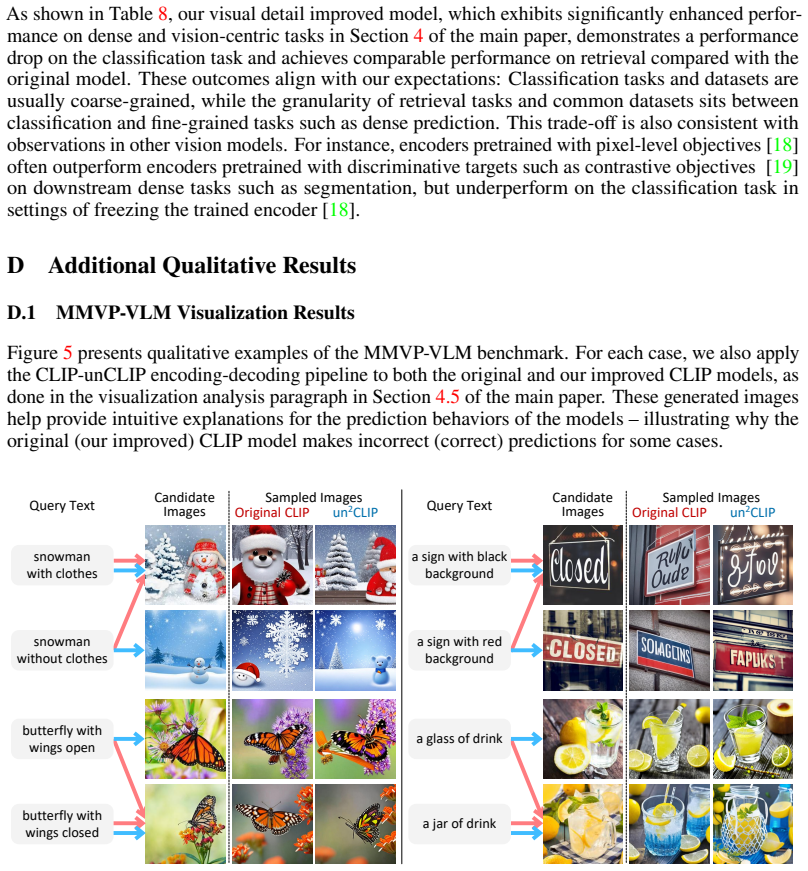
- [Table 8] The text in Appendix C attributes the zero-shot classification drop to a coarse-versus-fine granularity trade-off, but the drop is quite large (75.5 to 62.4 on ImageNet). Please quantify how much of this drop is due to the absence of an alignment constraint versus a genuine detail-versus-semantics trade-off.
Circularity Check
No significant circularity: the central finetuning objective is a plug-in conditional-likelihood estimate and all headline results are external benchmarks; only the diffusion-loss diagnostic is mildly self-referential, so the alignment-preservation weakness in Table 8 is a correctness concern, not a circular one.
full rationale
The derivation chain is not circular. The method's objective in Eq. (5) is obtained by substituting the pretrained unCLIP generator G as an estimate of p(x|E(x)) in the conditional-entropy expansion of I(x;E(x)); it is a plug-in likelihood objective, not a definition of the evaluation target. The paper's headline claims are validated on held-out external benchmarks (MMVP-VLM, open-vocabulary segmentation, MLLM tasks), none of which are used to fit E or select hyperparameters: training is on CC3M with the Stable unCLIP configuration. G and all baselines are taken from prior work rather than fitted by the authors, so no result is its own input renamed. The diffusion-loss diagnostic is the only mildly self-referential element, since the same loss is both the training objective and the 'detail capture' metric; however, the paper does not rest the central claim on this diagnostic, it explicitly anchors the diagnostic to the independent MMVP results, and it warns in footnote 2 that the diagnostic conclusion is design-dependent. The observed ImageNet zero-shot drop (75.5 to 62.4 in Table 8) undercuts the claim that alignment is preserved simultaneously, but an unverified assumption or a failed prediction is a correctness risk, not a circularity, because the claim is not made true by construction. No self-citation chain is load-bearing. Score 1 reflects the minor non-load-bearing self-reference in the diagnostic rather than any reduction of the central prediction to its inputs.
Assumptions & free parameters
free parameters (2)
- Fine-tuning epochs =
1 epoch (default; 0 to 2 in ablations)
- Learning rate =
3e-7
assumptions (4)
- standard math Diffusion training loss is a variational bound on the conditional log-likelihood.
- domain assumption The frozen unCLIP generator G approximates the true conditional distribution p(x|E(x)), so maximizing log p_G(x|E(x)) approximates maximizing mutual information I(x; E(x)).
- domain assumption Freezing G keeps the fine-tuned embeddings within the original CLIP embedding space, preserving language alignment.
- domain assumption OpenAI CLIP ViT-L-14@224 and @336 have interchangeable embedding spaces, allowing one unCLIP model to serve both.
Cite this review
Pith. "Pith review of un$^2$CLIP: Improving CLIP's Visual Detail Capturing Ability via Inverting unCLIP." pith.science (2026). https://pith.science/paper/XBGMKSBZ
@misc{pith2026250524517,
  author       = {Pith},
  title        = {Pith review of: un$^2$CLIP: Improving CLIP's Visual Detail Capturing Ability via Inverting unCLIP},
  year         = {2026},
  howpublished = {\url{https://pith.science/paper/XBGMKSBZ}},
  note         = {Machine review of arXiv:2505.24517}
}
abstract
Contrastive Language-Image Pre-training (CLIP) has become a foundation model and has been applied to various vision and multimodal tasks. However, recent works indicate that CLIP falls short in distinguishing detailed differences in images and shows suboptimal performance on dense-prediction and vision-centric multimodal tasks. Therefore, this work focuses on improving existing CLIP models, aiming to capture as many visual details in images as possible. We find that a specific type of generative models, unCLIP, provides a suitable framework for achieving our goal. Specifically, unCLIP trains an image generator conditioned on the CLIP image embedding. In other words, it inverts the CLIP image encoder. Compared to discriminative models like CLIP, generative models are better at capturing image details because they are trained to learn the data distribution of images. Additionally, the conditional input space of unCLIP aligns with CLIP's original image-text embedding space. Therefore, we propose to invert unCLIP (dubbed un$^2$CLIP) to improve the CLIP model. In this way, the improved image encoder can gain unCLIP's visual detail capturing ability while preserving its alignment with the original text encoder simultaneously. We evaluate our improved CLIP across various tasks to which CLIP has been applied, including the challenging MMVP-VLM benchmark, the dense-prediction open-vocabulary segmentation task, and multimodal large language model tasks. Experiments show that un$^2$CLIP significantly improves the original CLIP and previous CLIP improvement methods. Code and models will be available at https://github.com/LiYinqi/un2CLIP.
Figures



Figures from the paper (3 more)


Forward citations
Cited by 1 Pith paper
-
Contextualized Multimodal Lifelong Person Re-Identification in Hybrid Clothing States
CMLReID uses dynamic text prompts and dual-path prototypes to improve lifelong person re-identification in hybrid clothing states, reporting gains of about 5 mAP over four baselines.
Reference graph
Works this paper leans on
-
[1]
Diffusion feedback helps CLIP see better
Wenxuan Wang, Quan Sun, Fan Zhang, Yepeng Tang, Jing Liu, and Xinlong Wang. Diffusion feedback helps CLIP see better. InInternational Conference on Learning Representations, 2025
work page 2025
-
[2]
Shijie Ma, Yuying Ge, Teng Wang, Yuxin Guo, Yixiao Ge, and Ying Shan. GenHancer: Imperfect generative models are secretly strong vision-centric enhancers.arXiv preprint arXiv:2503.19480, 2025
arXiv 2025
-
[3]
High-resolution image synthesis with latent diffusion models
Robin Rombach, Andreas Blattmann, Dominik Lorenz, Patrick Esser, and Björn Ommer. High-resolution image synthesis with latent diffusion models. InProceedings of the IEEE/CVF Conference on Computer Vision and Pattern Recognition, pages 10684–10695, 2022
2022
-
[4]
Conceptual captions: A cleaned, hypernymed, image alt-text dataset for automatic image captioning
Piyush Sharma, Nan Ding, Sebastian Goodman, and Radu Soricut. Conceptual captions: A cleaned, hypernymed, image alt-text dataset for automatic image captioning. InAnnual Meeting of the Association for Computational Linguistics, 2018
work page 2018
-
[5]
CLIPScore: A reference-free evaluation metric for image captioning
Jack Hessel, Ari Holtzman, Maxwell Forbes, Ronan Le Bras, and Yejin Choi. CLIPScore: A reference-free evaluation metric for image captioning. InProceedings of the 2021 Conference on Empirical Methods in Natural Language Processing, pages 7514–7528, 2021
work page 2021
-
[6]
ImageNet: Alarge-scalehierarchical imagedatabase
JiaDeng,WeiDong,RichardSocher,Li-JiaLi,KaiLi,andLiFei-Fei. ImageNet: Alarge-scalehierarchical imagedatabase. In Proceedings of the IEEE/CVF Conference on Computer Vision and Pattern Recognition, 2009
work page 2009
-
[7]
Learning multiple layers of features from tiny images
Alex Krizhevsky. Learning multiple layers of features from tiny images. 2009
2009
-
[8]
Li Fei-Fei, Rob Fergus, and Pietro Perona. Learning generative visual models from few training examples: An incremental bayesian approach tested on 101 object categories. InComputer Vision and Pattern Recognition Workshop, pages 178–178, 2004
work page 2004
Show all 19 references
-
[9]
SUN database: Large-scale scene recognition from abbey to zoo
Jianxiong Xiao, James Hays, Krista A Ehinger, Aude Oliva, and Antonio Torralba. SUN database: Large-scale scene recognition from abbey to zoo. InIEEE Conference on Computer Vision and Pattern Recognition, pages 3485–3492, 2010
2010
-
[10]
Fine-grained visual classification of aircraft.arXiv preprint arXiv:1306.5151, 2013
Subhransu Maji, Esa Rahtu, Juho Kannala, Matthew Blaschko, and Andrea Vedaldi. Fine-grained visual classification of aircraft.arXiv preprint arXiv:1306.5151, 2013
2013 arXiv
-
[11]
3D object representations for fine-grained categorization
Jonathan Krause, Michael Stark, Jia Deng, and Li Fei-Fei. 3D object representations for fine-grained categorization. In IEEE International Conference on Computer Vision Workshops, pages 554–561, 2013
2013
-
[12]
Learning transferable visual models from natural language supervision
Alec Radford, Jong Wook Kim, Chris Hallacy, Aditya Ramesh, Gabriel Goh, Sandhini Agarwal, Girish Sastry, Amanda Askell, Pamela Mishkin, Jack Clark, Gretchen Krueger, and Ilya Sutskever. Learning transferable visual models from natural language supervision. InInternational Conf...
2021
-
[13]
Reproducible scaling laws for contrastive language-image learning
Mehdi Cherti, Romain Beaumont, Ross Wightman, Mitchell Wortsman, Gabriel Ilharco, Cade Gordon, Christoph Schuhmann, Ludwig Schmidt, and Jenia Jitsev. Reproducible scaling laws for contrastive language-image learning. InProceedings of the IEEE/CVF Conference on Computer Vision ...
2023
-
[14]
Kingma and Max Welling
Diederik P. Kingma and Max Welling. Auto-encoding variational bayes. InInternational Conference on Learning Representations, 2014
2014
-
[15]
Sigmoid loss for language image pre-training
Xiaohua Zhai, Basil Mustafa, Alexander Kolesnikov, and Lucas Beyer. Sigmoid loss for language image pre-training. In Proceedings of the IEEE/CVF International Conference on Computer Vision , pages 11975–11986, 2023
2023
-
[16]
Peter Young, Alice Lai, Micah Hodosh, and Julia Hockenmaier. From image descriptions to visual denotations: New similarity metrics for semantic inference over event descriptions.Transactions of the Association for Computational Linguistics, 2:67–78, 2014
2014
-
[17]
Microsoft COCO: Common objects in context
Tsung-Yi Lin, Michael Maire, Serge Belongie, James Hays, Pietro Perona, Deva Ramanan, Piotr Dollár, and C Lawrence Zitnick. Microsoft COCO: Common objects in context. InEuropean Conference on Computer Vision, pages 740–755, 2014
2014
-
[18]
Maskedautoencoders are scalable vision learners
KaimingHe, XinleiChen, SainingXie, YanghaoLi, PiotrDollár, andRossGirshick. Maskedautoencoders are scalable vision learners. InProceedings of the IEEE/CVF Conference on Computer Vision and Pattern Recognition, pages 16000–16009, 2022
2022
-
[19]
An empirical study of training self-supervised vision trans- formers
Xinlei Chen, Saining Xie, and Kaiming He. An empirical study of training self-supervised vision trans- formers. InProceedings of the IEEE/CVF International Conference on Computer Vision,pages9640–9649, 2021. 19
2021
Reviewed August 7, 2026 · model on record in the stance chip above.
Discussion (0). Sign in to comment.