REVIEW 3 major objections 5 minor 78 references
Hydrogen defects as probes of band alignment in metal-organic frameworks
T0 review · 3 major / 5 minor · reviewed 2026-08-07 · deepseek-v4-flash
Pith's one-line read Hydrogen defects can serve as probes of band alignment in metal-organic frameworks: the average of their (+/−) transition levels at the metal-oxide cluster and organic linker defines a charge neutrality level that places predicted band…
desk verdict A genuinely new extension of hydrogen-level alignment to MOFs, with a load-bearing but openly admitted universality assumption; worth refereeing, but the absolute scale is not yet established. read the letter →
The pith
A machine-rendered reading of the paper's core claim, the machinery that carries it, and where it could break.
The reading
What carries the argument
The central object is the effective (+/−) hydrogen defect level, defined as the average of the local charge-state transition levels of interstitial hydrogen at the secondary building unit (SBU) and at the linker. A charge-state transition level is the Fermi-level position at which two charge states of a defect have equal formation energies; here it probes the anion- and cation-like dangling-bond states created when hydrogen bonds strongly to the host. Averaging the SBU and linker values fuses information about the inorganic and organic components into a single reference energy, which is then pinned to the hydrogen electrode level to convert relative density-functional-theory band positions into absolute band edges. The argument also depends on the hydrogen levels being universal, meaning this pinning requires no material-dependent offset.
What would settle it
Take a MOF outside the eleven studied, compute its effective (+/−) level and resulting band edges, and compare with flatband potentials measured at the point of zero charge; a discrepancy beyond the paper's stated error bar of about 0.1 eV would falsify the alignment. A sharper test targets the lone-pair caveat: if a MOF binds H+ to a three-coordinated oxygen lone pair without disturbing the lattice (as in β-Ga2O3), and the associated (+/−) level sits at a systematic offset from the hydrogen electrode reference, the universality premise is broken for MOFs.
Extended reading notes
Core claim
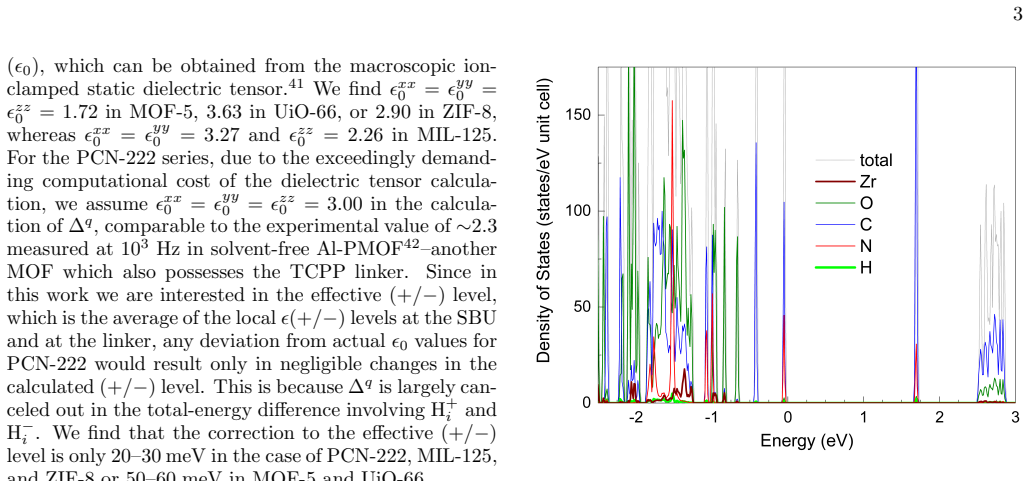
The central claim is that the universal alignment of hydrogen defect levels, previously established for conventional semiconductors, carries over to metal-organic frameworks. In each MOF, the author calculates the local (+/−) transition levels of interstitial hydrogen placed at the secondary building unit and at the linker; the average of these two levels defines an effective (+/−) level that functions as a charge neutrality level. Setting this effective level to the H+(aq)/H2(g) electrode at 0 V vs NHE (about 4.44 eV below vacuum) aligns the calculated valence- and conduction-band edges on an absolute scale. For PCN-222(2H) and its metal-substituted analogs, and for MOF-5, MIL-125, UiO-66, and ZIF-8, the predicted band edges agree with reported flatband-potential measurements and reproduce the chemical trends better than the global (+/−) level, the pore-center electrostatic potential, or slab-based approaches. The effective level is not itself a thermodynamic transition level; it is a constructed probe that captures chemical bonding at both building blocks, and the paper notes that the underlying universal alignment may need quantification for materials with lone-pair-like bonding.
Load-bearing premise
The load-bearing premise, flagged in the paper's lone-pair discussion, is that the universal alignment of hydrogen levels holds for MOFs without a material-dependent offset, so the effective (+/−) level can be pinned directly to the H+(aq)/H2(g) electrode at 0 V vs NHE; if that universality fails, every predicted band edge shifts by a common offset and the agreement with experiment is lost.
Editorial extensions
If this is right
- Band-edge positions for MOFs can be obtained from bulk defect calculations alone, without surface slabs, and compared directly with flatband-potential measurements.
- Changing the metal in the PCN-222 linker shifts the predicted band edges in line with experiment, so the effective level tracks chemical substitution at the organic building block.
- The pore-center electrostatic potential approach fails for ZIF-8 and UiO-66 by roughly 0.8–1.6 eV, while the hydrogen-level approach stays consistent across all eleven MOFs.
- The method gives a screening tool for photocatalytic and electrochemical applications: one can predict whether a MOF's conduction band is reducing enough for a target reaction, such as water splitting or CO2 reduction.
- The same effective-level construction can be applied to other hybrid or multicomponent materials with two distinct chemical building blocks.
Reading between the lines
- As an editorial extension: if the effective (+/−) level is a genuine charge neutrality level, it should also predict band offsets at MOF/MOF and MOF/oxide interfaces; this could be tested by comparing computed offsets with charge-separation behavior in composite photocatalysts.
- A testable refinement would replace the simple arithmetic mean by a density-of-states-weighted average over SBU and linker; MOFs with very different electronic weights at the two blocks may need such a modification.
- The lone-pair caveat noted in the paper implies a discriminating experiment: measure flatband potentials of a MOF whose oxygen coordination resembles three-coordinated lone-pair oxides and check whether the effective (+/−) level sits at a systematic offset from the hydrogen electrode reference.
Editorial analysis
A structured set of objections, weighed in public.
Referee Report
Summary. The paper proposes a method to align the band edges of metal-organic frameworks (MOFs) on an absolute energy scale using hydrogen interstitial defects as probes. For each MOF, the author calculates charge-state transition levels of hydrogen at the inorganic secondary building unit (SBU) and at the organic linker, and defines an 'effective (+/−) level' as the arithmetic average of the two local levels. This effective level is identified as a charge neutrality level (CNL) and is pinned to the H+(aq)/H2(g) electrode (0 V vs NHE) by assuming the universal alignment of hydrogen levels established by Van de Walle and Neugebauer. The approach is applied to two series of MOFs: PCN-222(2H) and its metal-substituted analogs, and MOF-5, MIL-125, UiO-66, and ZIF-8. The predicted band edges are compared with experimentally measured band-edge positions and with results from two other alignment approaches (slab calculations and average pore-center electrostatic potentials). The paper reports excellent agreement with experiment for the effective (+/−) level across all 11 MOFs.
Significance. If the method is valid, it provides a computationally efficient way to predict absolute band-edge positions of MOFs, which is important for photocatalysis and photoelectrochemistry. The paper is strong in its systematic application: it covers chemically distinct MOFs, includes detailed defect calculations with finite-size corrections, and explicitly compares with alternative alignment schemes, showing that the hydrogen-level approach outperforms the pore-potential and slab approaches in matching experimental band edges. The author is transparent about the non-thermodynamic character of the effective level and about the lone-pair caveat in the universal alignment assumption. However, the central validation is weakened by two issues: the absolute energy scale rests on an unverified universality assumption for MOFs, and the DFT functionals are tuned to the experimental band gaps of the same materials whose band edges are later compared. These issues are load-bearing because they affect whether the reported agreement with experiment is a genuine test of the method or a consequence of the tuning and the chosen energy reference.
major comments (3)
- [§II and Tables S1/S2] The absolute energy scale is obtained by setting the effective (+/−) level to the H+(aq)/H2(g) electrode (0 V vs NHE), i.e., by assuming Van de Walle–Neugebauer universality holds for MOFs. The paper itself states in the final paragraph of §III.C that for β-Ga2O3 and SnO2, lone-pair-bound H+ configurations may not probe dangling-bond states and can introduce an offset, and that 'further studies might still be needed to quantify any offset.' MOFs contain many lone-pair-bearing O and N atoms, so this caveat applies directly. Because all predicted band edges shift by a common offset if the universality assumption fails, the agreement in Figs. 4 and 6 cannot discriminate such a constant offset. Moreover, the Δdipole term in Eq. (3) is not independently fixed; it is estimated as 0.1–0.2 eV only after aligning one compound (PCN-222(2H)), so the remaining comparison is consistent with any uniform shift along the energy axis. This is a load-bearing assumption that requires independent calibration (e.g., comparison with a different absolute reference such as ultraviolet photoemission spectroscopy work functions) or at least a quantitative sensitivity analysis of the predicted band edges to an assumed offset.
- [§III.B and §III.C] The functional parameters (HSE mixing parameter α and Hubbard U) are explicitly chosen to 'match the experimental band gap reported in the literature' for the same materials whose band edges are later compared with experiment. This introduces circularity into the validation: the band gap is a fitting target, and the defect levels—and hence the absolute band-edge positions—are computed with the fitted functional. Since the position of the VBM/CBM relative to the defect level depends on the functional, the reported agreement between predicted and measured band edges is not a fully independent test of the method. The paper should demonstrate robustness of the absolute band-edge positions to reasonable variations of α and U, or present at least one MOF computed with a standard, untuned functional (e.g., HSE with α = 0.25, even with a gap overestimate) to show that the alignment procedure itself, rather than the gap-fitting, produces the agreement.
- [§III.B and §III.C] The effective (+/−) level is defined as the arithmetic average of the local ǫ(+/−) levels at the SBU and the linker, and the paper explicitly states that it 'is thus not a thermodynamic transition level.' The choice of this arithmetic average is not derived from any physical argument; it is introduced to account for the multi-component nature of MOFs and is shown to reproduce experimental trends better than the global (+/−) level. Because the central quantity of the method is an ad hoc construct, the agreement with experiment may reflect the flexibility in this definition rather than a validated physical principle. The paper should justify the weighting, for example by showing insensitivity to the weighting factor or by deriving the average from an established CNL construction (e.g., balance of valence- and conduction-band-derived states), so that the method is predictive rather than descriptive.
minor comments (5)
- [Title and abstract] The title contains a stray space in 'metal-organ ic frameworks'; the abstract and body should use consistent spacing.
- [§II] In the description of the HSE functional, 'we use the the Heyd-Scuseria-Ernzerhof (HSE) hybrid functional' contains a duplicated 'the'.
- [§III.C] The text refers to the 'Nerst equation'; the correct spelling is the Nernst equation.
- [Fig. 6 caption] The caption says 'The data for PCN-222(2H) is repeated for comparison'; 'data' is plural and should be 'are repeated'.
- [Figs. S8 and S9] The figures use different hydrogen chemical potentials (µH = −0.23 eV in some cases, −1.60 eV in others), even though the transition levels are independent of µH. A brief note explaining that the different values only shift the formation-energy curves vertically and do not affect the reported levels would improve clarity.
Circularity Check
No load-bearing circularity: the absolute scale is imported from an external universality result and the effective H(+/−) level is computed rather than fitted; one minor gap-fitting step reduces the independence of the VBM/CBM comparison.
-
fitted input called prediction
[Section II (Methodology), first paragraph]
"The density functional and associated parameters are chosen to reasonably reproduce the electronic structure and to match the experimental band gap reported in the literature."
The hybrid-functional mixing parameter α (and Hubbard U where used) is tuned so that the calculated band gap equals the experimentally reported gap for each MOF. Since the predicted CBM and VBM are separated by exactly this fitted gap, the two predicted edges are not independent outputs: once the H(+/−) reference sets one edge, the other edge is forced by the fitted experimental gap. Thus the reported 'excellent agreement' with both experimental VBM and CBM in Figs. 4–6 is partly a consequence of the gap fit, not solely of the hydrogen-level alignment scheme. The absolute position of the H(+/−) reference itself, however, is not fitted to the experimental band-edge positions, so the central alignment claim retains independent content.
full rationale
The paper's core derivation defines an effective hydrogen defect level as the average of computed local (+/−) transition levels at the SBU and linker, then pins that level to the H+(aq)/H2(g) electrode by explicitly assuming the universal alignment of hydrogen levels established by Van de Walle and Neugebauer. That universality is an external, independently published result for conventional semiconductors; the extension to MOFs is stated as an assumption, not smuggled in through self-citation. There is no load-bearing self-citation: the author's own prior work appears only as a background reference for CeO2 defects. The paper also openly concedes in Section III.C that lone-pair systems such as β-Ga2O3 and SnO2 may exhibit an offset from the universal line and that 'further studies might still be needed to quantify any offset,' which is an honest limitation rather than a circularity. The main residual concern is that the DFT functional parameters are adjusted per material to match experimental band gaps, so the predicted VBM–CBM separation is not a fully independent prediction; nevertheless, the absolute band-edge positions are still determined from the computed H(+/−) level and are not fitted to the experimental band edges. Given that the central alignment result is therefore not equivalent to its inputs by construction, a low score is appropriate.
Assumptions & free parameters
free parameters (3)
- Hubbard U for PCN-222(M) =
6 eV (Fe, Ni, Pt), 7 eV (Cu), 10 eV (Mn), 0 for 2H/Zn
- HSE mixing parameter alpha (second series) =
0.05 (MOF-5), 0.22 (MIL-125), 0.18 (UiO-66), 0.20 (ZIF-8)
- Assumed dielectric constant for PCN-222 =
3.00
assumptions (4)
- domain assumption Universal alignment of hydrogen defect levels holds in MOFs, so the effective (+/-) level can be pinned to the H+(aq)/H2(g) electrode level (0 V vs NHE).
- domain assumption The DFT+U and HSE functionals with the chosen parameters accurately describe the bulk electronic structure and defect transition levels of the MOFs.
- standard math The charge-state transition level formalism (Eq. 2) and Freysoldt finite-size corrections (Eq. 1) are valid for these large supercells.
- ad hoc to paper The effective (+/-) level, defined as the arithmetic mean of the local (+/-) levels at SBU and linker, is a valid charge neutrality level for the hybrid material.
invented entities (1)
-
Effective hydrogen defect level (effective (+/-) level)
independent evidence
Cite this review
Pith. "Pith review of Hydrogen defects as probes of band alignment in metal-organic frameworks." pith.science (2026). https://pith.science/paper/6YICZ6RZ
@misc{pith2026250524570,
  author       = {Pith},
  title        = {Pith review of: Hydrogen defects as probes of band alignment in metal-organic frameworks},
  year         = {2026},
  howpublished = {\url{https://pith.science/paper/6YICZ6RZ}},
  note         = {Machine review of arXiv:2505.24570}
}
read the original abstract
Band alignment, namely the prediction of band-edge positions of semiconductors and insulators in aqueous solutions, is an important problem in physics and chemistry. Such a prediction is especially challenging for structurally and chemically complex, multi-component materials. Here we present an approach to align band structure of metal-organic frameworks (MOFs) on an absolute energy scale which can be used for direct comparison with experiments. Hydrogen defects are used as probes into the chemical bonding of the hybrid inorganic-organic materials. An effective hydrogen defect level, defined as the average of the charge-state transition levels of the defects at the secondary building unit and at the linker, is identified as a charge neutrality level to align band structures. This level captures subtle chemical details at both the building blocks and provides results that are in agreement with experiments in a wide range of different MOFs. We also compare with results obtained from using other approaches involving surface calculations and average pore-center electrostatic potentials.
Figures


Figures from the paper (2 more)


Reference graph
Works this paper leans on
-
[1]
H. Furukawa, K. E. Cordova, M. O’Keeffe, and O. M. Yaghi, The Chemistry and Applications of Metal-Organic Frameworks, Science 341, 1230444 (2013)
work page 2013
-
[2]
R. Li, W. Zhang, and K. Zhou, Metal–Organic- Framework-Based Catalysts for Photoreduction of CO 2, Adv. Mater. 30, 1705512 (2018)
work page 2018
-
[3]
C.-C. Chueh, C.-I. Chen, Y.-A. Su, H. Konnerth, Y.-J. Gu, C.-W. Kung, and K. C.-W. Wu, Harnessing MOF materials in photovoltaic devices: recent advances, chal- lenges, and perspectives, J. Mater. Chem. A 7, 17079 (2019)
work page 2019
-
[4]
S. Naval´ on, A. Dhakshinamoorthy, M. ´Alvaro, B. Ferrer, and H. Garc ´ ıa, Metal–Organic Frameworks as Photocat- alysts for Solar-Driven Overall Water Splitting, Chem. Rev. 123, 445 (2023)
work page 2023
-
[5]
Y. Chen, H. Xu, J. Shi, Y. Su, X. Chen, and H. Pang, Application of Metal-Organic Framework Composites, ChemistryEurope 3, e202500078 (2025)
work page 2025
-
[6]
J. L. Mancuso, A. M. Mroz, K. N. Le, and C. H. Hendon, Electronic Structure Modeling of Metal–Organic Frame- works, Chem. Rev. 120, 8641 (2020)
work page 2020
-
[7]
N. Kolobov, M. G. Goesten, and J. Gascon, Metal–Organic Frameworks: Molecules or Semicon- ductors in Photocatalysis?, Angew. Chem. Int. Ed. 60, 26038 (2021)
work page 2021
-
[8]
A. Franciosi and C. G. Van de Walle, Heterojunction band offset engineering, Surf. Sci. Rep. 25, 1 (1996)
work page 1996
Show all 78 references
-
[9]
P. G. Moses and C. G. Van de Walle, Band bowing and band alignment in InGaN alloys, Appl. Phys. Lett. 96, 021908 (2010)
2010
-
[10]
K. T. Butler, C. H. Hendon, and A. Walsh, Electronic Chemical Potentials of Porous Metal–Organic Frame- works, J. Am. Chem. Soc. 136, 2703 (2014)
2014
-
[11]
Van de Walle and J
C. Van de Walle and J. Neugebauer, Universal alignment of hydrogen levels in semiconductors, insulators and so- lutions, Nature 423, 626 (2003)
2003
-
[12]
Tejedor, F
C. Tejedor, F. Flores, and E. Louis, The metal- semiconductor interface: Si (111) and zincblende (110) junctions, J. Phys. C: Solid Stat. Phys. 10, 2163 (1977)
1977
-
[13]
Flores and C
F. Flores and C. Tejedor, Energy barriers and interface states at heterojunctions, J. Phys. C: Solid Stat. Phys. 12, 731 (1979)
1979
-
[14]
Tersoff, Schottky Barrier Heights and the Continuum of Gap States, Phys
J. Tersoff, Schottky Barrier Heights and the Continuum of Gap States, Phys. Rev. Lett. 52, 465 (1984)
1984
-
[15]
Cardona and N
M. Cardona and N. E. Christensen, Acoustic deforma- tion potentials and heterostructure band offsets in semi- conductors, Phys. Rev. B 35, 6182 (1987)
1987
-
[16]
Walukiewicz, Mechanism of Fermi-level stabilizati on in semiconductors, Phys
W. Walukiewicz, Mechanism of Fermi-level stabilizati on in semiconductors, Phys. Rev. B 37, 4760 (1988)
1988
-
[17]
P. D. C. King, T. D. Veal, P. H. Jefferson, J. Z´ u˜ niga P´ erez, V. Mu˜ noz Sanjos´ e, and C. F. McConville, Unifica- tion of the electrical behavior of defects, impurities, and surface states in semiconductors: Virtual gap states in CdO, Phys. Rev. B 79, 035203 (2009)
2009
-
[18]
J. B. Varley, J. R. Weber, A. Janotti, and C. G. Van de Walle, Dangling bonds, the charge neutrality level, and band alignment in semiconductors, J. Appl. Phys. 135, 075703 (2024)
2024
-
[19]
P. W. Peacock and J. Robertson, Behavior of hydrogen in high dielectric constant oxide gate insulators, Appl. Phys. Lett. 83, 2025 (2003)
2003
-
[20]
J. B. Varley, A. Samanta, and V. Lordi, Descriptor-Base d Approach for the Prediction of Cation Vacancy Forma- tion Energies and Transition Levels, J. Phys. Chem. Lett. 8, 5059 (2017)
2017
-
[21]
J. E. N. Swallow, J. B. Varley, L. A. H. Jones, J. T. Gibbon, L. F. J. Piper, V. R. Dhanak, and T. D. Veal, Transition from electron accumulation to depletion at β- Ga2O3 surfaces: The role of hydrogen and the charge neutrality level, APL Mater. 7, 022528 (2019)
2019
-
[22]
Lefebvre, M
I. Lefebvre, M. Lannoo, C. Priester, G. Allan, and C. Delerue, Role of dangling bonds at Schottky barri- ers and semiconductor heterojunctions, Phys. Rev. B 36, 1336 (1987)
1987
-
[23]
Morris, B
W. Morris, B. Volosskiy, S. Demir, F. G´ andara, P. L. Mc- Grier, H. Furukawa, D. Cascio, J. F. Stoddart, and O. M. Yaghi, Synthesis, Structure, and Metalation of Two New Highly Porous Zirconium Metal–Organic Frameworks, Inorg. Chem. 51, 6443 (2012)
2012
-
[24]
Feng, Z.-Y
D. Feng, Z.-Y. Gu, J.-R. Li, H.-L. Jiang, Z. Wei, and H.- C. Zhou, Zirconium-Metalloporphyrin PCN-222: Meso- porous Metal–Organic Frameworks with Ultrahigh Sta- bility as Biomimetic Catalysts, Angew. Chem. Int. Ed. 51, 10307 (2012)
2012
-
[25]
Y. Chen, T. Hoang, and S. Ma, Biomimetic Catalysis of a Porous Iron-Based Metal–Metalloporphyrin Framework, Inorg. Chem. 51, 12600 (2012)
2012
-
[26]
H. Li, M. Eddaoudi, M. O’Keeffe, and O. M. Yaghi, Design and synthesis of an exceptionally stable and highly porous metal-organic framework, Nature 402, 276 (1999)
1999
-
[27]
Dan-Hardi, C
M. Dan-Hardi, C. Serre, T. Frot, L. Rozes, G. Maurin, C. Sanchez, and G. F´ erey, A New Photoactive Crys- talline Highly Porous Titanium(IV) Dicarboxylate, J. Am. Chem. Soc. 131, 10857 (2009)
2009
-
[28]
J. H. Cavka, S. Jakobsen, U. Olsbye, N. Guillou, C. Lam- berti, S. Bordiga, and K. P. Lillerud, A New Zirconium Inorganic Building Brick Forming Metal Organic Frame- works with Exceptional Stability, J. Am. Chem. Soc. 130, 9 TABLE S1. Structural and electronic properties of PC...
2008
-
[29]
K. S. Park, Z. Ni, A. P. Cˆ ot´ e, J. Y. Choi, R. Huang, F. J. Uribe-Romo, H. K. Chae, M. O’Keeffe, and O. M. Yaghi, Exceptional chemical and thermal stability of zeolitic im- idazolate frameworks, Proc. Natl. Acad. Sci. 103, 10186 (2006)
2006
-
[30]
P. E. Bl¨ ochl, Projector augmented-wave method, Phys. Rev. B 50, 17953 (1994)
1994
-
[31]
Kresse and D
G. Kresse and D. Joubert, From ultrasoft pseudopoten- tials to the projector augmented-wave method, Phys. Rev. B 59, 1758 (1999)
1999
-
[32]
Kresse and J
G. Kresse and J. Furthm¨ uller, Efficient iterative schem es for ab initio total-energy calculations using a plane-wave basis set, Phys. Rev. B 54, 11169 (1996)
1996
-
[33]
J. P. Perdew, K. Burke, and M. Ernzerhof, Generalized Gradient Approximation Made Simple, Phys. Rev. Lett. 77, 3865 (1996)
1996
-
[34]
V. I. Anisimov, J. Zaanen, and O. K. Andersen, Hubbard- corrected density-functional theory, Phys. Rev. B 44, 943 (1991)
1991
-
[35]
J. Heyd, G. E. Scuseria, and M. Ernzerhof, Hybrid func- tionals based on a screened Coulomb potential, J. Chem. Phys. 118, 8207 (2003)
2003
-
[36]
C. G. Van de Walle and J. Neugebauer, First-principles calculations for defects and impurities: Applications to III-nitrides, J. Appl. Phys. 95, 3851 (2004)
2004
-
[37]
Freysoldt, B
C. Freysoldt, B. Grabowski, T. Hickel, J. Neugebauer, G. Kresse, A. Janotti, and C. G. Van de Walle, First- principles calculations for point defects in solids, Rev. Mod. Phys. 86, 253 (2014)
2014
-
[38]
Hemmes, A
H. Hemmes, A. Driessen, and R. Griessen, Thermody- namic properties of hydrogen at pressures up to 1 Mbar and temperatures between 100 and 1000K, J. Phys. C: Solid State Phys. 19, 3571 (1986)
1986
-
[39]
Freysoldt, J
C. Freysoldt, J. Neugebauer, and C. G. Van de Walle, Fully Ab Initio Finite-Size Corrections for Charged- Defect Supercell Calculations, Phys. Rev. Lett. 102, 016402 (2009)
2009
-
[40]
Freysoldt, sxdefectalign
C. Freysoldt, sxdefectalign
-
[41]
Gajdoˇ s, K
M. Gajdoˇ s, K. Hummer, G. Kresse, J. Furthm¨ uller, and F. Bechstedt, Linear optical properties in the projector- augmented wave methodology, Phys. Rev. B 73, 045112 (2006)
2006
-
[42]
Zhang, Q.-K
D.-L. Zhang, Q.-K. Feng, S.-L. Zhong, D.-F. Liu, Y. Zhao, and Z.-M. Dang, Tunable dielectric performance of porphyrin based metal-organic frameworks with po- lar molecule confinement, Compos. Commun. 25, 100734 (2021)
2021
-
[43]
C. G. Van de Walle and R. M. Martin, Theoretical cal- culations of heterojunction discontinuities in the Si/Ge system, Phys. Rev. B 34, 5621 (1986)
1986
-
[44]
C. G. Van de Walle, Band lineups and deformation po- tentials in the model-solid theory, Phys. Rev. B 39, 1871 (1989)
1989
-
[45]
C. G. Van de Walle, Electronic materials theory: In- terfaces and defects, J. Vac. Sci. Technol. A. 21, S182 (2003)
2003
-
[46]
Harnett-Caulfield and A
L. Harnett-Caulfield and A. Walsh, Assessment of inter- stitial potentials for rapid prediction of absolute band energies in crystals, J. Chem. Phys. 155, 024113 (2021)
2021
-
[47]
T. G. Semerci, A. Melillo, Y. C ¸ imen Mutlu, and H. Gar- cia, Band alignment of PCN-222 via selection of the metal porphyrin linker for sunlight driven photocatalytic over- all water splitting, Catal. Today 423, 113931 (2023)
2023
-
[48]
Hariri and S
R. Hariri and S. Dehghanpour, Effective visible- light CO 2 photoreduction over (metallo)porphyrin-based metal–organic frameworks to achieve useful hydrocar- bons, Appl. Organomet. Chem. 35, e6422 (2021)
2021
-
[49]
H.-Q. Xu, J. Hu, D. Wang, Z. Li, Q. Zhang, Y. Luo, S.-H. Yu, and H.-L. Jiang, Visible-Light Photoreduction 10 FIG. S1. Slab models for the (001) surface of PCN-222(2H) and PCN-222(Cu). Color code: red = O, brown = C, pink = H, light blue = N, green = Zr, and blue = Cu. of CO 2...
2015
-
[50]
Jin, Porphyrin-based metal–organic framework cata - lysts for photoreduction of CO 2: understanding the effect of node connectivity and linker metalation on activity, New J
J. Jin, Porphyrin-based metal–organic framework cata - lysts for photoreduction of CO 2: understanding the effect of node connectivity and linker metalation on activity, New J. Chem. 44, 15362 (2020)
2020
-
[51]
Q. Li, K. Wang, H. Wang, M. Zhou, B. Zhou, Y. Li, Q. Li, Q. Wang, H.-M. Shen, and Y. She, Metalloporphyrin- Based Metal–Organic Frameworks for Photocatalytic Carbon Dioxide Reduction: The Influence of Metal Cen- ters, Processes 11, 1042 (2023)
2023
-
[52]
M. Yuan, J. Xue, J. Li, S. Ma, and M. Wang, PCN- 222/Ag2O-Ag p-n heterojunction modified fabric as recy- clable photocatalytic platform for boosting bacteria inac - tivation and organic pollutant degradation, Colloids Surf . A: Physicochem. Eng. Asp. 656, 130474 (2023)
2023
-
[53]
Zhang, Q
H. Zhang, Q. Li, B. Li, B. Weng, Z. Tian, J. Yang, J. Hofkens, F. Lai, and T. Liu, Atomically dispersed Pt sites on porous metal–organic frameworks to enable dual reaction mechanisms for enhanced photocatalytic hydro- gen conversion, J. Catal. 407, 1 (2022)
2022
-
[54]
S. Duan, S. Wu, L. Wang, H. She, J. Huang, and Q. Wang, Rod-Shaped Metal Organic Framework Struc- tured PCN-222(Cu)/TiO 2 Composites for Efficient Pho- tocatalytic CO 2 Reduction, Acta Phys. -Chim. Sin. 36, 1905086. (2020)
2020
-
[55]
Huang, L
H. Huang, L. Li, R. Wang, A. R. M. Shaheer, T. Liu, H. Liu, and R. Cao, Assembling phase-junctions based on metal-organic framework polymophism for enhanced overall CO 2 photoreduction activities, Sci. China Mater. 67, 1839 (2024). 11 FIG. S2. Structures of (a) PCN-222(2H) and...
2024
-
[56]
Aleksandrzak, K
M. Aleksandrzak, K. Sielicki, and E. Mijowska, Enhance - ment of photocatalytic hydrogen evolution with catalysts based on carbonized MOF-5 and g-C 3N4, RSC Adv. 10, 4032 (2020)
2020
-
[57]
A. Chen, J. Zhang, Y. Zhou, and H. Tang, Preparation of a zinc-based metal–organic framework (MOF-5)/BiOBr heterojunction for photodegradation of Rhodamine B, Reac. Kinet. Mech. Cat. 134, 1003 (2021)
2021
-
[58]
T. Yao, Y. Tan, Y. Zhou, Y. Chen, and M. Xiang, Prepa- ration of core-shell MOF-5/Bi 2WO6 composite for the enhanced photocatalytic degradation of pollutants, J. Solid Stat. Chem. 308, 122882 (2022)
2022
-
[59]
M. Chen, X. Wei, L. Zhao, Y. Huang, S.-C. Lee, W. Ho, and K. Chen, Novel N/Carbon Quantum Dot Modified MIL-125(Ti) Composite for Enhanced Visible-Light Pho- tocatalytic Removal of NO, Ind. Eng. Chem. Res. 59, 6470 (2020)
2020
-
[60]
C. Jin, J. Liu, Y. Yin, and Z. Li, WO 3/MIL-125 (Ti) composite material for enhancing the reduction of Cr(VI) under visible light, RSC Adv. 14, 5142 (2024)
2024
-
[61]
Q. Dai, G. Gao, J. Tang, R. Jiang, S. Sun, Y. Ye, S. Li, R. Xie, and J. Zhang, The MIL-125(Ti)/Co 3O4 towards efficiently removing tetracycline by synergistic adsorption-photocatalysis roles, Mater. Des. 250, 113608 (2025)
2025
-
[62]
W. Hou, C. Chen, Y. Wang, and Y. Xu, Cerium ver- sus zirconium UiO-66 metal–organic frameworks coupled with CdS for H 2 evolution under visible light, Catal. Sci. Technol. 12, 4012 (2022)
2022
-
[63]
Y. Sun, T. Huang, W. Feng, G. Zhang, H. Ji, Y. Zhu, H. Zhou, F. Dou, Y. Su, Z. Liu, M. Yang, and H. Pang, Enhanced Photocatalytic Nitrogen Fixation over Nano- UiO-66(Zr) via Natural Chlorophyll Sensitization, Inorg. Chem. 63, 24876 (2024)
2024
-
[64]
X. Mu, J. Jiang, F. Chao, Y. Lou, and J. Chen, Ligand modification of UiO-66 with an unusual visible light pho- tocatalytic behavior for RhB degradation, Dalton Trans. 47, 1895 (2018)
2018
-
[65]
Gayathri, K
K. Gayathri, K. Vinothkumar, Y. Teja, B. M. Al-Shehri, M. Selvaraj, M. Sakar, and R. G. Balakrishna, Ligand- mediated band structure engineering and physiochemi- cal properties of UiO-66 (Zr) metal-organic frameworks (MOFs) for solar-driven degradation of dye molecules, Colloi...
2022
-
[66]
H.-Q. Xu, S. Yang, X. Ma, J. Huang, and H.- L. Jiang, Unveiling Charge-Separation Dynamics in CdS/Metal–Organic Framework Composites for En- hanced Photocatalysis, ACS Catal. 8, 11615 (2018)
2018
-
[67]
J.-J. Li, Q. Zhang, L.-Y. Zhang, J.-Y. Zhang, Y. Liu, N. Zhang, and Y.-Z. Fang, Interfacial band bending induced charge-transfer regulation over Ag@ZIF-8@g- C3N4 to boost photocatalytic CO 2 reduction into syngas, Catal. Sci. Technol. 12, 3343 (2022)
2022
-
[68]
L. Feng, Y. Wang, S. Yuan, K.-Y. Wang, J.-L. Li, G. S. Day, D. Qiu, L. Cheng, W.-M. Chen, S. T. Madrahimov, and H.-C. Zhou, Porphyrinic Metal–Organic Frameworks Installed with Brønsted Acid Sites for Efficient Tandem Semisynthesis of Artemisinin, ACS Catal. 9, 5111 (2019)
2019
-
[69]
Planas, J
N. Planas, J. E. Mondloch, S. Tussupbayev, J. Bo- rycz, L. Gagliardi, J. T. Hupp, O. K. Farha, and C. J. Cramer, Defining the Proton Topology of the Zr 6-Based Metal–Organic Framework NU-1000, J. Phys. Chem. Lett. 5, 3716 (2014)
2014
-
[70]
R. D. Shannon, Revised effective ionic radii and sys- tematic studies of interatomic distances in halides and chalcogenides, Acta Crystallogr., Sect. A: Found. Crys- tallogr. 32, 751 (1976)
1976
-
[71]
Momma and F
K. Momma and F. Izumi, VESTA 3 for three-dimensional visualization of crystal, volumetric and morphology data, J. Appl. Cryst. 44, 1272 (2011). 12 FIG. S3. Total and atom-decomposed electronic densities of states near the band-gap region in PCN-222( M ), M = Pt, Mn, Fe, Ni, Cu...
2011
-
[72]
Jing, C.-C
H.-P. Jing, C.-C. Wang, Y.-W. Zhang, P. Wang, and R. Li, Photocatalytic degradation of methylene blue in ZIF-8, RSC Adv. 4, 54454 (2014)
2014
-
[73]
P. W. Anderson, Model for the Electronic Structure of Amorphous Semiconductors, Phys. Rev. Lett. 34, 953 (1975)
1975
-
[74]
Uncovering the Complex Behavior of Hydrogen in Cu 2O
K. Biswas, M.-H. Du, J. T-Thienprasert, S. Limpijum- nong, and D. J. Singh, Comment on “Uncovering the Complex Behavior of Hydrogen in Cu 2O”, Phys. Rev. Lett. 108, 219703 (2012)
2012
-
[75]
Hoang and M
K. Hoang and M. D. Johannes, Native defects, hydro- gen impurities, and metal dopants in CeO 2, Phys. Rev. Mater. 9, 095801 (2025)
2025
-
[76]
M. A. Butler and D. S. Ginley, Prediction of Flatband Potentials at Semiconductor-Electrolyte Interfaces from Atomic Electronegativities, J. Electrochem. Soc. 125, 228 (1978)
1978
-
[77]
Stevanovi´ c, S
V. Stevanovi´ c, S. Lany, D. S. Ginley, W. Tumas, and A. Zunger, Assessing capability of semiconductors to split water using ionization potentials and electron affinities only, Phys. Chem. Chem. Phys. 16, 3706 (2014)
2014
-
[78]
J. B. Varley, J. R. Weber, A. Janotti, and C. G. Van de Walle, Oxygen vacancies and donor impurities in β- Ga2O3, Appl. Phys. Lett. 97, 142106 (2010). 13 FIG. S4. Total and atom-decomposed electronic densities of states near the band-gap region in MOF-5, MIL-125, UiO-66, a nd ...
2010
Reviewed August 7, 2026 · model on record in the stance chip above.
Discussion (0). Sign in to comment.