REVIEW 5 major objections 5 minor 1 cited by
GATE: General Arabic Text Embedding for Enhanced Semantic Textual Similarity with Matryoshka Representation Learning and Hybrid Loss Training
T0 review · 5 major / 5 minor · reviewed 2026-08-07 · deepseek-v4-flash
Pith's one-line read The paper claims that a 135M-parameter Arabic embedding model trained with Matryoshka representation learning and a hybrid loss beats much larger multilingual and OpenAI models on Arabic semantic textual similarity, achieving 69.99 on the…
desk verdict The trained models are real and the MRL results are plausibly useful for Arabic STS, but the 20-25% claim over OpenAI and the 'essential' hybrid loss are contradicted by the paper's own tables. read the letter →
The pith
A machine-rendered reading of the paper's core claim, the machinery that carries it, and where it could break.
The reading
What carries the argument
The central machinery is Matryoshka Representation Learning, defined as training so that every prefix of the embedding vector at dimensions 768, 512, 256, 128, and 64 is independently optimized, combined with a hybrid loss: SoftmaxLoss for entailment, neutral, and contradiction classification, and a cosine-similarity ranking loss (CoSENT) for STS pairs. This combination carries the argument because MRL supplies compressed but accurate embeddings, while the hybrid loss is what separates fine-grained similarity scoring from plain contrastive learning. The paper also uses Efficient MRL weight-tying across linear classifiers to control memory use.
What would settle it
Have Arabic-speaking annotators check the correctness of the entailment and contradiction labels on a random sample of the translated triplets; if a substantial share of labels are wrong, the training signal is corrupted and the claimed performance depends on translation artifacts.
Extended reading notes
Core claim
The central discovery is that Matryoshka Representation Learning applied to Arabic NLI triplets produces large jumps in Arabic STS performance, and that adding a hybrid loss of softmax classification and cosine-similarity ranking sharpens the model's ability to tell unrelated sentences apart. The best model, Arabic-Triplet-Matryoshka-V2, reaches 85.31 on STS17 and an average of 69.99 across three Arabic STS benchmarks, compared with 50.45 for its untrained base model. The hybrid-loss model GATE-AraBERT-V1 scores slightly lower overall at 68.54, but its error analysis shows the most accurate low-similarity prediction, suggesting a trade-off between overall similarity ranking and false-positive control.
Load-bearing premise
The Arabic training data is created by machine-translating English NLI datasets, and the paper reports no numerical check of translation quality, so distorted labels could be responsible for the apparent gains.
Editorial extensions
If this is right
- A 135M-parameter Arabic model can beat 7B-parameter and OpenAI embedding models on Arabic STS, suggesting scale is not the dominant factor for fine-grained Arabic similarity.
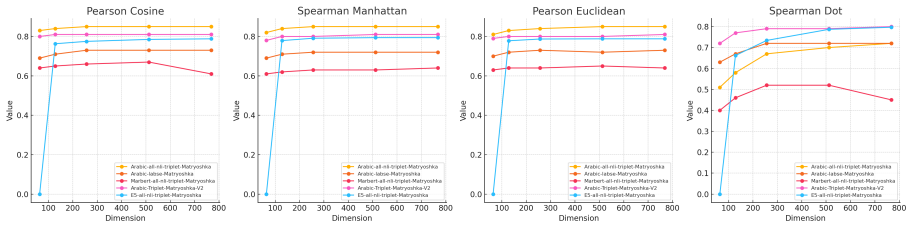
- Matryoshka training keeps nearly full STS accuracy down to 64-dimensional embeddings, so compact and cheap Arabic retrieval systems are feasible.
- The hybrid-loss model is more conservative on unrelated pairs, which reduces false-positive similarity scores in applications.
- The paper positions GATE as a general Arabic text embedding model, so the same recipe could support retrieval, clustering, and classification tasks beyond STS.
Reading between the lines
- If the reported gains hold, Arabic NLP practitioners could replace expensive multilingual API embeddings with a small open model for similarity and retrieval, cutting cost and latency.
- The absence of translation-quality metrics leaves a testable gap: a small human-annotation study of the translated triplets could confirm or undercut the causal role of NLI supervision.
- The same Matryoshka-plus-hybrid-loss recipe may transfer to other low-resource languages, but the paper does not test that transfer, so that remains an open question rather than a result.
- The false-positive bias on unrelated pairs suggests that lexical overlap tricks the models; adding hard negatives that share vocabulary but differ in meaning could close the remaining error gap.
Editorial analysis
A structured set of objections, weighed in public.
Referee Report
Summary. The manuscript introduces GATE, a family of Arabic text embedding models built by fine-tuning AraBERT and other base models with Matryoshka representation learning (Eq. 1) and a per-task hybrid loss that switches between a softmax classification loss (Eq. 2) and a cosine STS loss (Eq. 3) on Arabic NLI and STS datasets derived by machine translation from SNLI and MultiNLI. The models are evaluated on three Arabic STS tasks from MTEB (STS17, STS22, STS22-v2), where they are reported to outperform their base counterparts and several larger multilingual and proprietary models. The paper claims state-of-the-art Arabic STS performance and a 20-25% improvement over OpenAI embeddings, with the hybrid loss described as essential to the approach.
Significance. Should the headline claims hold, the result would be practically significant: a 135M-parameter Arabic-specific model outperforming billion-parameter and proprietary multilingual embeddings on Arabic STS would be a useful contribution, and the MRL dimension ablation in Table 5, plus the public release of models and data, are positive features. However, the two central quantitative claims are contradicted by the paper's own tables. The reported margins over OpenAI models are about 6.8% and 9.9% relative, not 20-25%, and Table 4 shows that MRL alone outperforms the hybrid-loss model. The machine-translated training corpus also lacks any reported quality metrics. As a result, the paper's main assertions of state-of-the-art performance and of the necessity of hybrid loss are not established.
major comments (5)
- [Abstract, §4.3, Figure 2] The headline '20-25% performance improvement' over OpenAI is not supported by the reported numbers. Arabic-Triplet-Matryoshka-V2 scores 69.99 versus 65.54 for text-embedding-3-large and 63.67 for text-embedding-ada-002, which are relative gains of approximately 6.8% and 9.9%, respectively; no baseline in Figure 2 is within 20-25% of GATE. Because this claim is the central selling point of the paper, it must be corrected or replaced with the exact relative margins.
- [§3.2.2 and Table 4] The abstract and §3.2.2 describe the hybrid loss (L_sts + L_cls) as 'essential' for fine-grained semantic understanding, but Table 4 reports that the MRL-only model (L_MRL) achieves 69.99 while the hybrid-loss model (L_sts + L_cls) achieves 68.54. The proposed hybrid loss therefore does not produce the best reported result, and the claimed necessity of the hybrid mechanism is contradicted by the paper's own ablation.
- [§3.1] The Arabic training data are machine translations of SNLI and MultiNLI produced with CTranslate2, and the only quality check is the statement that 'Manual reviews ensured high translation accuracy.' No translation-quality scores, number of reviewed examples, or inter-annotator agreement are reported. Since all subsequent gains are attributed to training on this corpus, the reliability of the translated labels is load-bearing and needs quantitative evidence.
- [§4.2 and §4.3] The 'state-of-the-art' conclusion rests on only three Arabic STS tasks (STS17, STS22, STS22-v2), and the comparison set excludes other Arabic-specific embedding systems as well as published Arabic STS results beyond the listed base models. This limited evaluation is insufficient to support the general claim of state-of-the-art performance on Arabic STS within MTEB.
- [Table 4] The LCE baseline in Table 4 has exactly the same scores as bert-base-arabertv02 in Table 3 (54.53, 46.86, 49.95, 50.45), suggesting that it is not a model trained with cross-entropy loss under the same pipeline but rather the untrained base model. If that is the case, the ablation conflates the choice of base model with the effect of the loss function and should be redescribed or re-run.
minor comments (5)
- [§3.2] There is a typo in 'isGATE-AraBERT-V1' (missing space), and model names are inconsistent across the paper, for example 'GATE-AraBERT-V1' versus 'GATE-AraBert-v1' in Table 3.
- [§3.1] The MultiNLI dataset is cited as (Kim et al., 2019), but the quoted reference is a different paper on semantic sentence matching; the correct MultiNLI citation should be Williams et al., 2018.
- [§4.1] Figure 1 is not described with axis labels, units, or the exact evaluation protocol, which makes it difficult to verify the reported Pearson and Spearman correlations.
- [§4.4] The error analysis is anecdotal, based on a small number of selected examples; a systematic error distribution over the test sets would be more informative.
- [§3.2.2, Eq. (4)] Eq. (4) defines the 'hybrid' loss as a per-task switch rather than a sum of losses; the term 'hybrid' should be clarified to avoid implying a joint objective.
Circularity Check
No significant circularity: the headline benchmark numbers are external MTEB scores, not outputs of the paper's loss equations or of the authors' prior work.
full rationale
The paper's derivation chain is empirical rather than analytic: Equations (1)-(4) define the MRL, classification, and STS losses that are optimized during training, while Tables 3-5 and Figure 2 report scores on the external MTEB Arabic STS17, STS22, and STS22-v2 benchmarks. Those evaluation sets are not the training data (translated SNLI/MultiNLI triplets, STS pairs, and NLI pairs), so the reported improvements are not fitted predictions of the loss objectives. The only self-citation, (Nacar and Koubaa, 2024), appears in Section 3.2 as motivational support for Matryoshka/triplet training and supplies no benchmark number; it is not load-bearing. The abstract's 20-25% improvement over OpenAI is inconsistent with the roughly 7-10% relative margins implied by Section 4.3's numbers, and Table 4 shows the hybrid loss (L_sts + L_cls, 68.54) underperforming MRL alone (69.99); these are internal-consistency or correctness defects, not reductions of the claimed result to its inputs. No equation is defined in terms of the target STS scores, and no fitted parameter is relabeled as a prediction, so the central empirical claim is not circular by construction.
Assumptions & free parameters
free parameters (2)
- Temperature tau in losses (Eq. 2, Eq. 3) =
not reported
- Matryoshka dimension weights cm (Eq. 1) =
not reported
assumptions (3)
- domain assumption Machine-translated Arabic NLI labels preserve the original semantic relations (entailment, contradiction, neutral)
- domain assumption The three MTEB tasks STS17, STS22, and STS22-v2 are a sufficient operationalization of 'state-of-the-art Arabic STS'
- standard math The implementation of Matryoshka loss via MultipleNegativesRankingLoss and MatryoshkaLoss faithfully realizes Kusupati et al. 2022
Cite this review
Pith. "Pith review of GATE: General Arabic Text Embedding for Enhanced Semantic Textual Similarity with Matryoshka Representation Learning and Hybrid Loss Training." pith.science (2026). https://pith.science/paper/XUA3DGC5
@misc{pith2026250524581,
  author       = {Pith},
  title        = {Pith review of: GATE: General Arabic Text Embedding for Enhanced Semantic Textual Similarity with Matryoshka Representation Learning and Hybrid Loss Training},
  year         = {2026},
  howpublished = {\url{https://pith.science/paper/XUA3DGC5}},
  note         = {Machine review of arXiv:2505.24581}
}
read the original abstract
Semantic textual similarity (STS) is a critical task in natural language processing (NLP), enabling applications in retrieval, clustering, and understanding semantic relationships between texts. However, research in this area for the Arabic language remains limited due to the lack of high-quality datasets and pre-trained models. This scarcity of resources has restricted the accurate evaluation and advance of semantic similarity in Arabic text. This paper introduces General Arabic Text Embedding (GATE) models that achieve state-of-the-art performance on the Semantic Textual Similarity task within the MTEB benchmark. GATE leverages Matryoshka Representation Learning and a hybrid loss training approach with Arabic triplet datasets for Natural Language Inference, which are essential for enhancing model performance in tasks that demand fine-grained semantic understanding. GATE outperforms larger models, including OpenAI, with a 20-25% performance improvement on STS benchmarks, effectively capturing the unique semantic nuances of Arabic.
Figures

Forward citations
Cited by 1 Pith paper
-
Position: Text Embeddings Should Capture Implicit Semantics, Not Just Surface Meaning
State-of-the-art text embeddings lag far behind on tasks requiring pragmatic inference, stance detection, and social meaning, relative to their strong performance on surface semantic benchmarks.
Reference graph
Works this paper leans on
-
[1]
online" 'onlinestring :=
ENTRY address archivePrefix author booktitle chapter edition editor eid eprint eprinttype howpublished institution journal key month note number organization pages publisher school series title type volume year doi pubmed url lastchecked label extra.label sort.label short.list INTEGERS output.state before.all mid.sentence after.sentence after.block STRING...
-
[2]
write newline
" write newline "" before.all 'output.state := FUNCTION n.dashify 't := "" t empty not t #1 #1 substring "-" = t #1 #2 substring "--" = not "--" * t #2 global.max substring 't := t #1 #1 substring "-" = "-" * t #2 global.max substring 't := while if t #1 #1 substring * t #2 global.max substring 't := if while FUNCTION word.in bbl.in capitalize " " * FUNCT...
-
[3]
Muhammad Abdul-Mageed, AbdelRahim Elmadany, and El Moatez Billah Nagoudi. 2020. Arbert & marbert: Deep bidirectional transformers for arabic. arXiv preprint arXiv:2101.01785
arXiv 2020
-
[4]
Wissam Antoun, Fady Baly, and Hazem Hajj. 2020. Arabert: Transformer-based model for arabic language understanding. arXiv preprint arXiv:2003.00104
arXiv 2020
-
[5]
Akari Asai, Sewon Min, Zexuan Zhong, and Danqi Chen. 2023. Retrieval-based language models and applications. In Proceedings of the 61st Annual Meeting of the Association for Computational Linguistics (Volume 6: Tutorial Abstracts), pages 41--46
2023
-
[6]
Ghizlane Bourahouat, Manar Abourezq, and Najima Daoudi. 2024. Word embedding as a semantic feature extraction technique in arabic natural language processing: an overview. Int. Arab J. Inf. Technol., 21(2):313--325
work page 2024
-
[7]
Samuel R Bowman, Gabor Angeli, Christopher Potts, and Christopher D Manning. 2015. A large annotated corpus for learning natural language inference. arXiv preprint arXiv:1508.05326
arXiv 2015
-
[8]
Daniel Cer, Mona Diab, Eneko Agirre, Inigo Lopez-Gazpio, and Lucia Specia. 2017. Semeval-2017 task 1: Semantic textual similarity-multilingual and cross-lingual focused evaluation. arXiv preprint arXiv:1708.00055
arXiv 2017
Show all 38 references
-
[9]
Fangxiaoyu Feng, Yinfei Yang, Daniel Cer, Naveen Arivazhagan, and Wei Wang. 2020. Language-agnostic bert sentence embedding. arXiv preprint arXiv:2007.01852
2020 arXiv
-
[10]
Tianyu Gao, Xingcheng Yao, and Danqi Chen. 2021. Simcse: Simple contrastive learning of sentence embeddings. arXiv preprint arXiv:2104.08821
2021 arXiv
-
[11]
Yunfan Gao, Yun Xiong, Xinyu Gao, Kangxiang Jia, Jinliu Pan, Yuxi Bi, Yi Dai, Jiawei Sun, and Haofen Wang. 2023. Retrieval-augmented generation for large language models: A survey. arXiv preprint arXiv:2312.10997
2023 arXiv
-
[12]
Michael Gutmann and Aapo Hyv \"a rinen. 2010. Noise-contrastive estimation: A new estimation principle for unnormalized statistical models. In Proceedings of the thirteenth international conference on artificial intelligence and statistics, pages 297--304. JMLR Workshop and Co...
2010
-
[13]
Kaiming He, Haoqi Fan, Yuxin Wu, Saining Xie, and Ross Girshick. 2020. Momentum contrast for unsupervised visual representation learning. In Proceedings of the IEEE/CVF conference on computer vision and pattern recognition, pages 9729--9738
2020
-
[14]
Junqin Huang, Zhongjie Hu, Zihao Jing, Mengya Gao, and Yichao Wu. 2024. Piccolo2: General text embedding with multi-task hybrid loss training. arXiv preprint arXiv:2405.06932
2024 arXiv
-
[15]
Infgrad . 2024. https://huggingface.co/infgrad/stella-mrl-large-zh-v3.5-1792d Stella-mrl-large-zh-v3.5-1792d . Accessed: 2024-08-28
2024
-
[16]
Seonhoon Kim, Inho Kang, and Nojun Kwak. 2019. Semantic sentence matching with densely-connected recurrent and co-attentive information. In Proceedings of the AAAI conference on artificial intelligence, volume 33, pages 6586--6593
2019
-
[17]
Guillaume Klein, Yoon Kim, Yuntian Deng, Jean Senellart, and Alexander M Rush. 2017. Opennmt: Open-source toolkit for neural machine translation. arXiv preprint arXiv:1701.02810
2017 arXiv
-
[18]
Darius Koenig, Sean Lee, and Aamir Shakir. 2024. https://www.mixedbread.ai/blog/mxbai-embed-large-v1 Open source strikes bread - new fluffy embeddings model . Accessed: 2024-08-28
2024
-
[19]
Aditya Kusupati, Gantavya Bhatt, Aniket Rege, Matthew Wallingford, Aditya Sinha, Vivek Ramanujan, William Howard-Snyder, Kaifeng Chen, Sham Kakade, Prateek Jain, et al. 2022. Matryoshka representation learning. Advances in Neural Information Processing Systems, 35:30233--30249
2022
-
[20]
Jinhyuk Lee, Zhuyun Dai, Xiaoqi Ren, Blair Chen, Daniel Cer, Jeremy R Cole, Kai Hui, Michael Boratko, Rajvi Kapadia, Wen Ding, et al. 2024. Gecko: Versatile text embeddings distilled from large language models. arXiv preprint arXiv:2403.20327
2024 arXiv
-
[21]
Yang Li and Tao Yang. 2018. Word embedding for understanding natural language: a survey. Guide to big data applications, pages 83--104
2018
-
[22]
Zehan Li, Xin Zhang, Yanzhao Zhang, Dingkun Long, Pengjun Xie, and Meishan Zhang. 2023. Towards general text embeddings with multi-stage contrastive learning. arXiv preprint arXiv:2308.03281
2023 arXiv
-
[23]
Shuaiqi Liu, Jiannong Cao, Ruosong Yang, and Zhiyuan Wen. 2022. Key phrase aware transformer for abstractive summarization. Information Processing & Management, 59(3):102913
2022
-
[24]
Bill MacCartney and Christopher D Manning. 2008. Modeling semantic containment and exclusion in natural language inference. In Proceedings of the 22nd International Conference on Computational Linguistics (Coling 2008), pages 521--528
2008
-
[25]
Niklas Muennighoff, Nouamane Tazi, Lo \" c Magne, and Nils Reimers. 2022. Mteb: Massive text embedding benchmark. arXiv preprint arXiv:2210.07316
2022 arXiv
-
[26]
Omer Nacar and Anis Koubaa. 2024. Enhancing semantic similarity understanding in arabic nlp with nested embedding learning. arXiv preprint arXiv:2407.21139
2024 arXiv
-
[27]
OpenAI . 2023. Openai embeddings documentation. https://platform.openai.com/docs/guides/embeddings
2023
-
[28]
OpenAI . 2024. https://openai.com/blog/new-embedding-models-and-api-updates New embedding models and api updates . Accessed: 2024-08-28
2024
-
[29]
Amarnath Pathak, Partha Pakray, and Jereemi Bentham. 2019. English--mizo machine translation using neural and statistical approaches. Neural Computing and Applications, 31(11):7615--7631
2019
-
[30]
Alec Radford, Jong Wook Kim, Chris Hallacy, Aditya Ramesh, Gabriel Goh, Sandhini Agarwal, Girish Sastry, Amanda Askell, Pamela Mishkin, Jack Clark, et al. 2021. Learning transferable visual models from natural language supervision. In International conference on machine learni...
2021
-
[32]
Nils Reimers and Iryna Gurevych. 2019. https://arxiv.org/abs/1908.10084 Sentence-bert: Sentence embeddings using siamese bert-networks . In Proceedings of the 2019 Conference on Empirical Methods in Natural Language Processing. Association for Computational Linguistics
2019 arXiv
-
[33]
Liang Wang, Nan Yang, Xiaolong Huang, Binxing Jiao, Linjun Yang, Daxin Jiang, Rangan Majumder, and Furu Wei. 2022. Text embeddings by weakly-supervised contrastive pre-training. arXiv preprint arXiv:2212.03533
2022 arXiv
-
[34]
Liang Wang, Nan Yang, Xiaolong Huang, Linjun Yang, Rangan Majumder, and Furu Wei. 2023. Improving text embeddings with large language models. arXiv preprint arXiv:2401.00368
2023 arXiv
-
[35]
Liang Wang, Nan Yang, Xiaolong Huang, Linjun Yang, Rangan Majumder, and Furu Wei. 2024. Multilingual e5 text embeddings: A technical report. arXiv preprint arXiv:2402.05672
2024 arXiv
-
[36]
Yongliang Wu, Shuliang Zhao, and Ruiqiang Guo. 2021. A novel community answer matching approach based on phrase fusion heterogeneous information network. Information Processing & Management, 58(1):102408
2021
-
[37]
Shitao Xiao, Zheng Liu, Peitian Zhang, and Niklas Muennighof. 2023. C-pack: Packaged resources to advance general chinese embedding. arXiv preprint arXiv:2309.07597
2023 arXiv
-
[38]
Xin Zhang, Zehan Li, Yanzhao Zhang, Dingkun Long, Pengjun Xie, Meishan Zhang, and Min Zhang. 2023. Language models are universal embedders. arXiv preprint arXiv:2310.08232
2023 arXiv
-
[39]
Ying Zhao, Tingyu Xia, Yunqi Jiang, and Yuan Tian. 2024. Enhancing inter-sentence attention for semantic textual similarity. Information Processing & Management, 61(1):103535
2024
Reviewed August 7, 2026 · model on record in the stance chip above.
Discussion (0). Sign in to comment.