REVIEW 3 major objections 4 minor 1 cited by
Resonance density range governs two-plasmon decay saturation and enables hot-electron prediction in inertial confinement fusion
T0 review · 3 major / 4 minor · reviewed 2026-08-07 · deepseek-v4-flash
Pith's one-line read The resonance density range of two-plasmon decay sets the saturation amplitude of ion density fluctuations and Langmuir waves, enabling an intensity-only scaling for the hot-electron fraction that needs only two calibration points.
desk verdict A genuinely useful saturation parameter for TPD, wrapped in a scaling law that is really a two-coefficient calibration fit. read the letter →
The pith
A machine-rendered reading of the paper's core claim, the machinery that carries it, and where it could break.
The reading
What carries the argument
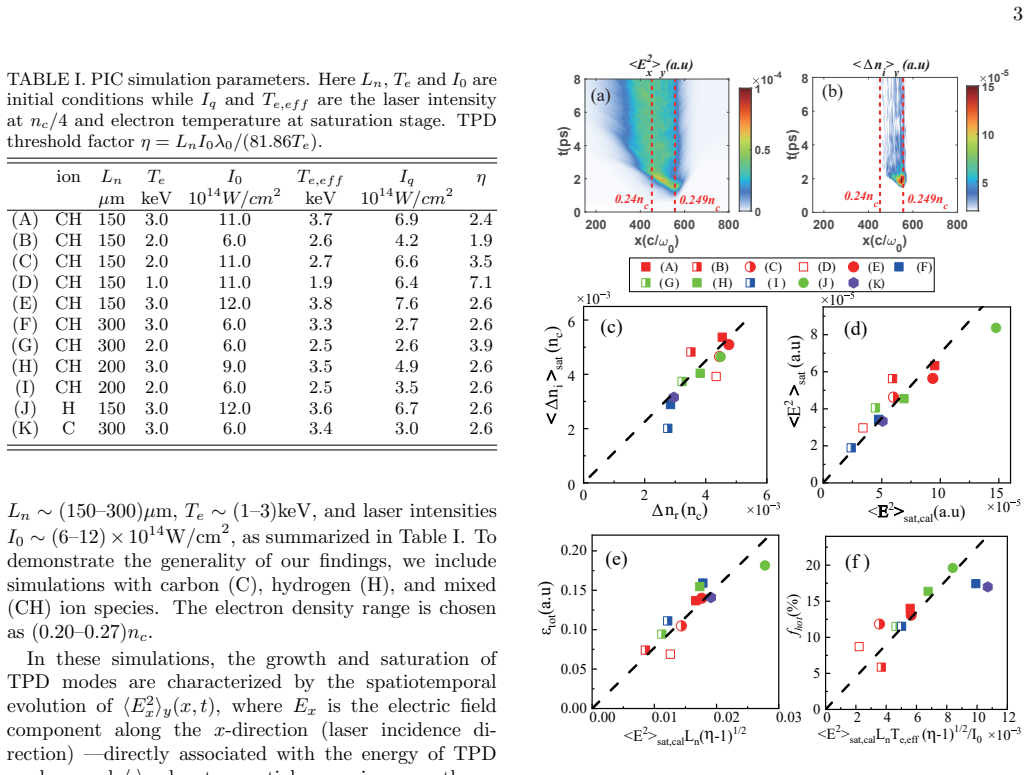
The machinery is the resonance density range Δn_r: the interval of electron densities in which a given electrostatic TPD daughter mode is linearly unstable (growth rate γ above electron-ion collisional damping ν_ei), computed from the homogeneous TPD dispersion relation. Although derived for a homogeneous plasma, it matches the spatial growth region of the absolute TPD mode in inhomogeneous fluid simulations. The rule ⟨Δn_i⟩_sat ≈ 1.1Δn_r converts linear theory directly into a saturation amplitude, and the ponderomotive pressure balance ⟨E²⟩_sat ∼ 16π(ZT_e + 3T_i)⟨Δn_i⟩_sat converts that into a saturated Langmuir-wave energy. The final intensity-only scaling follows by combining Δn_r ∼ $I^{{1/2}}$ with the ablation scalings for density scale length and electron temperature.
What would settle it
Scan the laser intensity at fixed plasma temperature and density scale length in a long-scale-length plasma, and measure the ion density fluctuation level at saturation: the criterion predicts ⟨Δn_i⟩_sat ≈ 1.1Δn_r with Δn_r growing like $I^{{1/2}}$, so a steeper or non-monotonic dependence would rule out the saturation mechanism. A second check is the threshold behavior: the model requires the hot-electron fraction to drop sharply as β $I^{{2/3}}$ approaches 1 from above, so an observed smooth onset with no threshold would falsify the (η−1)^{1/2} factor.
Extended reading notes
Core claim
The central claim is that the nonlinear saturation of two-plasmon decay is set by the resonance density range Δn_r, not by the details of the turbulent spectrum. In an inhomogeneous plasma, a TPD mode grows only where its linear growth rate exceeds collisional damping, defining a band of electron densities; saturation occurs when ion density fluctuations become large enough to push the local density out of that band. The paper supports this by showing that electrostatic fluid simulations place the growth region inside the predicted band and that fully kinetic particle-in-cell simulations obey ⟨Δn_i⟩_sat ≈ 1.1Δn_r. Balancing the ponderomotive force against pressure perturbations then gives the saturated Langmuir energy as approximately 16π(ZT_e + 3T_i)⟨Δn_i⟩_sat. Feeding these amplitudes into two empirical relations for total wave energy and hot-electron fraction, and using ablation scalings L_n ∝ $I^{{1/3}}$, T_{e,eff} ∝ $I^{{2/3}}$, yields f_hot ≈ α $I^{{7/6}}$(β $I^{{2/3}}$ − 1)^{1/2}, where α and β encode configuration-specific physics and can be fixed with two (I, f_hot) data points.
Load-bearing premise
The load-bearing premise is that the empirical relations connecting the saturated wave energy to the total Langmuir energy and to the hot-electron fraction, fitted to a limited set of particle-in-cell simulations, carry over to real experimental conditions, because calibrating the two coefficients in the final formula cannot repair a wrong exponent inherited from those relations.
Editorial extensions
If this is right
- Hot-electron preheat in direct-drive designs can be estimated from laser intensity alone, once two measured (I, f_hot) pairs fix α and β for the beam geometry.
- The scaling implies a sharp intensity threshold, since the (β I^{2/3} − 1)^{1/2} factor vanishes when I falls below the TPD threshold; below it, hot-electron production should drop rapidly.
- Because the same saturation mechanism ties ion fluctuations to the resonance width, the Δn_r rule could be transferred to other parametric instabilities limited by density-fluctuation-induced detuning.
- The model gives target designers a physical interpretation of the calibration coefficients: α encodes how intensity maps to saturated field energy, and β encodes the TPD threshold and geometry.
Reading between the lines
- The empirical scalings in Eqs. (3)–(4) are fitted to a limited set of PIC simulations; a dedicated experiment varying density scale length at fixed intensity would test whether the L_n(η−1)^{1/2} dependence survives outside the fitted range.
- If the saturation rule holds in three-dimensional multi-beam geometries, the coefficients α and β might be computable from first principles instead of calibrated, since they encode beam-overlap and mode-spectrum details.
- Evaluating all quantities at the effective steady-state intensity and temperature near quarter-critical density leaves open how to apply the formula to a time-dependent implosion; a pulse-averaging prescription would be a natural next step.
Editorial analysis
A structured set of objections, weighed in public.
Referee Report
Summary. The paper argues that the resonance density range Δn_r of absolute two-plasmon-decay (TPD) modes, computed from linear homogeneous-plasma theory, controls the nonlinear saturation level of ion density fluctuations and Langmuir wave energy in inhomogeneous plasmas. Using fluid (LTS) and fully kinetic particle-in-cell (OSIRIS) simulations, the authors report ⟨Δn_i⟩_sat ≈ 1.1 Δn_r across a matrix of densities, temperatures, intensities, and ion species. They then propose a chain of approximations leading to Eq. (5), f_hot ≈ α I^{7/6}(β I^{2/3} − 1)^{1/2}, with coefficients calibrated by two experimental points per configuration, and they show curves that match OMEGA and OMEGA-EP data in Fig. 3.
Significance. The identification of Δn_r as a saturation amplitude is a physically appealing and potentially useful result, and the comparison across 11 PIC runs with multiple ion species is a strength. If Eq. (5) were truly predictive beyond calibration, it would be practically valuable for ICF hot-electron estimation. However, the paper's own text acknowledges that Eq. (1) omits an integration constant, that Eq. (2) matches simulation only to a factor of about 0.7, and that Eqs. (3)–(4) are 'fair empirical relations' with no reported residuals. The experimental validation in Fig. 3 is in-sample: the same dataset supplies both the calibration points and the validation points, with uncertainties not stated. The central saturation result is well supported, but the predictive scaling claim needs stronger out-of-sample evidence and error quantification.
major comments (3)
- [Eq. (1) and Fig. 2(d)] The text explicitly states that Eq. (1) omits a possible integration constant, and the comparison in Fig. 2(d) shows only approximate proportionality with a factor of about 0.7. Because Eq. (2) is the bridge through which ⟨E²⟩_sat,cal ∼ T_e,eff Δn_r enters Eqs. (3)–(5), the manuscript should quantify how the missing constant and the 0.7 factor vary across the parameter matrix. Without this, the exponent I^{7/6} in Eq. (5), which inherits this proportionality, is less secure than the text implies.
- [Eqs. (3)–(4) and Fig. 2(e)–(f)] The relations ε_tot ∼ ⟨E²⟩_sat,cal L_n (η−1)^{1/2} and f_hot ∼ ⟨E²⟩_sat,cal L_n (η−1)^{1/2} T_e,eff/I are introduced as 'fair empirical relations' from 11 PIC runs, but no residuals, error bars, or sensitivity to individual simulations are reported. These relations fix the functional form of Eq. (5), since α and β only set the overall level and the threshold. The authors should provide a leave-one-out or bootstrap analysis over the PIC runs and state how the relation degrades when individual simulations are removed.
- [Fig. 3 and §4] The experimental validation uses two calibration points 'roughly extracted' from the same dataset (Ref. [26]) that also supplies the points used to judge agreement, and no uncertainty is given for those extracted values. With only two free parameters (α and β) per beam configuration, agreement at the calibration points is by construction, and the remaining points do not constitute an out-of-sample test of the I^{7/6}(βI^{2/3}−1)^{1/2} functional form. A holdout test, a leave-one-configuration-out test, or comparison with an independent experiment is needed before the method can be described as predictive.
minor comments (4)
- [Throughout] There are several typographical errors: 'calcualted' in Section 3, 'flucatuations' in Section 3, 'minumum' in the Fig. 1 caption, and 'influnces' in Section 3.
- [Fig. 2 caption] The caption refers to 'table (I)'; this should be 'Table I'.
- [Fig. 3] The shaded areas highlighting 'regions of concentrated experimental data points' are not defined quantitatively; please describe how these regions are constructed.
- [§4] The derivation of Eq. (5) uses L_n ∝ I^{1/3} and T_e,eff ∝ I^{2/3} from a 1-D ablation model; the manuscript should state the parameter range over which these scalings are expected to remain valid for the multi-beam, 3D experimental configurations considered here.
Circularity Check
No significant circularity: the model is a transparently calibrated scaling law with independent out-of-sample checks and no load-bearing self-citation.
full rationale
The derivation chain is not circular. The resonance density range Δn_r is computed from the standard homogeneous TPD dispersion relation and validated against LTS fluid simulations, and the saturation relation ⟨Δn_i⟩_sat ≈ 1.1 Δn_r is an independent comparison with PIC results rather than an input of the final scaling. Equations (3) and (4) are explicitly labeled as empirical, with the paper calling Eq. (3) a 'fair empirical relation' and Eq. (4) something that 'suggests the validity'; they are not disguised as first-principles derivations. Equation (5) inherits the empirical exponents from those relations, but the coefficients α and β are openly calibrated with two experimental (I, f_hot) points per configuration, and the agreement with the remaining data from Ref. [26] is an out-of-sample check rather than a forced reproduction. The abstract's phrase 'successfully reproduces results' also covers the two calibration points, which are matched by construction, but this is standard and disclosed calibration practice, not a hidden equivalence. The paper itself flags its limitations, noting that Eq. (1) 'omits a possible constant of integration' and that Eq. (3) is only a 'fair empirical relation.' No load-bearing self-citation chain, imported uniqueness claim, or definitional identification of input and output is present.
Assumptions & free parameters
free parameters (5)
- alpha (α) per beam configuration =
8.2e-3 (1-/2-beam), 3.4e-3 (4-beam), 2.7e-4 (18-beam)
- beta (β) per beam configuration =
0.8 (1-/2-beam), 0.6 (4-beam), 0.4 (18-beam)
- Proportionality factor between ⟨Δn_i⟩_sat and Δn_r =
≈1.1
- Discrepancy factor between simulated and calculated ⟨E^2⟩_sat =
≈0.7
- Exponent 1/2 on (η−1) in Eq. (3) =
1/2
assumptions (5)
- standard math Standard homogeneous-plasma TPD dispersion relation defines γ(k,n) and hence n_r.
- domain assumption The linear fluid code LTS is a valid benchmark for the spatial growth region of absolute TPD modes.
- domain assumption Ablation theory scalings L_n ∝ I^{1/3} and T_e,eff ∝ I^{2/3}.
- ad hoc to paper Langmuir wave spectral characteristics remain similar across conditions, so total wave energy ε_tot is a proxy for hot-electron energy.
- ad hoc to paper f_hot scales as ε_tot T_e,eff / I (Eq. 4).
Cite this review
Pith. "Pith review of Resonance density range governs two-plasmon decay saturation and enables hot-electron prediction in inertial confinement fusion." pith.science (2026). https://pith.science/paper/4TDPCBAG
@misc{pith2026250524607,
  author       = {Pith},
  title        = {Pith review of: Resonance density range governs two-plasmon decay saturation and enables hot-electron prediction in inertial confinement fusion},
  year         = {2026},
  howpublished = {\url{https://pith.science/paper/4TDPCBAG}},
  note         = {Machine review of arXiv:2505.24607}
}
read the original abstract
The saturation level of parametric instabilities critically determines their impact on fusion plasmas. We identify the resonance density range of two-plasmon decay as the critical parameter governing nonlinear saturation of ion density fluctuations and Langmuir waves, which drive hot-electron generation. Using this insight, we develop a predictive scaling model for the hot-electron energy fraction f_{hot} that depends only on the laser intensity I, with plasma conditions encoded via plasma ablation theory. The model can work for various experimental configurations-requiring only two (I, f_{hot}) data points to calibrate coefficients-and successfully reproduces results from prior OMEGA and OMEGA-EP experiments.
Figures


Forward citations
Cited by 1 Pith paper
-
Resonance density range of absolute two-plasmon decay instability
The spatial growth region of absolute two-plasmon decay matches the density interval where the mode is linearly unstable, and this interval sets the modulation-frequency threshold for absolute growth under two-color p...
Reference graph
Works this paper leans on
-
[26]
D. T. Michel, A. V. Maximov, R. W. Short, J. A. Delet- trez, D. Edgell, S. X. Hu, I. V. Igumenshchev, J. F. My- att, A. A. Solodov, C. Stoeckl, B. Yaakobi, and D. H. Froula, Measured hot-electron intensity thresholds quan- tified by a two-plasmon-decay resonant common-wave gain in various experimental configurations, Physics of Plasmas20, 55703 (2013)
work page 2013
-
[1]
W.L.Kruer,The Physics of Laser Plasma Interactions (Westview Press, Boulder CO, 2003)
work page 2003
-
[2]
J. Li, S. X. Hu, and C. Ren, Effects of laser-plasma insta- bilities on hydro evolution in an OMEGA-EP long-scale- length experiment, Physics of Plasmas24, 22706 (2017)
work page 2017
-
[3]
D. Turnbull, A. V. Maximov, D. H. Edgell, W. Seka, R. K. Follett, J. P. Palastro, D. Cao, V. N. Goncharov, C. Stoeckl, and D. H. Froula, Anomalous Absorption by the Two-Plasmon Decay Instability, Physical Review Letters124, 185001 (2020)
work page 2020
-
[4]
M. Hohenberger, P. B. Radha, J. F. Myatt, S. Lepape, J. A. Marozas, F. J. Marshall, D. T. Michel, S. P. Re- gan, W. Seka, A. Shvydky, T. C. Sangster, J. W. Bates, R. Betti, T. R. Boehly, M. J. Bonino, D. T. Casey, T. J. Collins, R. S. Craxton, J. A. Delettrez, D. H. Edgell, R. Epstein, G. Fiksel, P. Fitzsimmons, J. A. Frenje, D. H. Froula, V. N. Goncharov...
work page 2015
-
[5]
D. T. Michel, A. V. Maximov, R. W. Short, S. X. Hu, J. F. Myatt, W. Seka, A. A. Solodov, B. Yaakobi, and D. H. Froula, Experimental validation of the two- plasmon-decay common-wave process, Physical Review Letters109, 155007 (2012)
work page 2012
-
[6]
A. R. Christopherson, R. Betti, C. J. Forrest, J. Howard, W. Theobald, J. A. Delettrez, M. J. Rosenberg, A. A. Solodov, C. Stoeckl, D. Patel, V. Gopalaswamy, D. Cao, J. L. Peebles, D. H. Edgell, W. Seka, R. Epstein, M. S. Wei, M. Gatu Johnson, R. Simpson, S. P. Regan, and E. M. Campbell, Direct Measurements of DT Fuel Pre- heat from Hot Electrons in Direc...
work page 2021
-
[7]
A. A. Solodov, M. J. Rosenberg, M. Stoeckl, A. R. Christopherson, R. Betti, P. B. Radha, C. Stoeckl, M. Hohenberger, B. Bachmann, R. Epstein, R. K. Follett, W. Seka, J. F. Myatt, P. Michel, S. P. Regan, J. P. Palas- tro, D. H. Froula, E. M. Campbell, and V. N. Goncharov, Hot-electron preheat and mitigation in polar-direct-drive experiments at the National...
work page 2022
Show all 27 references
-
[8]
W. Seka, D. H. Edgell, J. F. Myatt, A. V. Maximov, R. W. Short, V. N. Goncharov, and H. A. Baldis, Two- plasmon-decay instability in direct-drive inertial confine- ment fusion experiments, Physics of Plasmas16, 052701 (2009)
2009
-
[9]
S. P. Regan, N. B. Meezan, L. J. Suter, D. J. Strozzi, W. L. Kruer, D. Meeker, S. H. Glenzer, W. Seka, C. Stoeckl, V. Y. Glebov, T. C. Sangster, D. D. Mey- erhofer, R. L. McCrory, E. A. Williams, O. S. Jones, D. A. Callahan, M. D. Rosen, O. L. Landen, C. Sorce, and B. J. MacGo...
2010
-
[10]
A. Clod, M. G. Senstius, A. H. Nielsen, R. Ragona, A. S. Thrysøe, U. Kumar, S. Coda, and S. K. Nielsen, Cascades of Parametric Instabilities in the Tokamak Plasma Edge during Electron Cyclotron Resonance Heating, Physical Review Letters132, 135101 (2024)
2024
-
[11]
Tancetti, S
A. Tancetti, S. K. Nielsen, J. Rasmussen, E. Z. Gusakov, A. Y. Popov, D. Moseev, T. Stange, M. G. Senstius, C. Killer, M. Vecs´ ei, T. Jensen, M. Zanini, I. Abramovic, M. Stejner, G. Anda, D. Dunai, S. Zoletnik, and H. P. Laqua, Nonlinear decay of high-power microwaves into tr...
2022
-
[12]
Yu Popov and E
A. Yu Popov and E. Z. Gusakov, Low-threshold abso- lute two-plasmon decay instability in the second har- monic electron cyclotron resonance heating experiments in toroidal devices, Plasma Physics and Controlled Fu- sion57, 025022 (2015)
2015
-
[13]
R. Yan, C. Ren, J. Li, A. V. Maximov, W. B. Mori, Z. M. Sheng, and F. S. Tsung, Generating energetic electrons through staged acceleration in the two-plasmon-decay in- stability in inertial confinement fusion, Physical Review Letters108, 175002 (2012)
2012
-
[14]
R. Yan, A. V. Maximov, C. Ren, and F. S. Tsung, Growth and Saturation of Convective Modes of the Two-Plasmon Decay Instability in Inertial Confinement Fusion, Physi- cal Review Letters103, 175002 (2009)
2009
-
[15]
D. F. DuBois, D. A. Russell, and H. A. Rose, Saturation spectra of the two-plasmon decay instability, Physical Re- view Letters74, 3983 (1995)
1995
-
[16]
H. Wen, A. V. Maximov, R. Yan, J. Li, C. Ren, and F. S. Tsung, Three-dimensional particle-in-cell modeling of parametric instabilities near the quarter-critical den- sity in plasmas, Physical Review E100, 041201 (2019)
2019
-
[17]
A. B. Langdon, B. F. Lasinski, and W. L. Kruer, Nonlin- ear saturation and recurrence of the two-plasmon decay instability, Physical Review Letters43, 133 (1979)
1979
-
[18]
J. Li, R. Yan, and C. Ren, Density modulation-induced absolute laser-plasma-instabilities: Simulations and the- ory, Physics of Plasmas24, 52705 (2017)
2017
-
[19]
S. H. Cao, R. Yan, H. Wen, J. Li, and C. Ren, Cogenera- tion of hot electrons from multiple laser-plasma instabil- ities, Physical Review E101, 53205 (2020)
2020
-
[20]
S. H. Cao, D. Patel, A. Lees, C. Stoeckl, M. J. Rosen- berg, V. Gopalaswamy, H. Wen, H. Huang, A. Shvy- 6 dky, R. Betti, and C. Ren, Predicting hot electron gen- eration in inertial confinement fusion with particle-in- cell simulations, Physical Review E106, 10.1103/Phys- RevE...
2022 doi
-
[21]
Zhang, J
J. Zhang, J. F. Myatt, R. W. Short, A. V. Maximov, H. X. Vu, D. F. Dubois, and D. A. Russell, Multiple beam two-plasmon decay: Linear threshold to nonlinear saturation in three dimensions, Physical Review Letters 113, 105001 (2014)
2014
-
[22]
Simon, R
A. Simon, R. W. Short, E. A. Williams, and T. De- wandre, On the inhomogeneous two-plasmon instability, Physics of Fluids26, 3107 (1983)
1983
-
[23]
R. Yan, a. V. Maximov, and C. Ren, The linear regime of the two-plasmon decay instability in inhomogeneous plasmas, Physics of Plasmas17, 052701 (2010)
2010
-
[24]
R. A. Fonseca, L. O. Silva, F. S. Tsung, V. K. De- cyk, W. Lu, C. Ren, W. B. Mori, S. Deng, S. Lee, T. Katsouleas, and J. C. Adam, Computational sci- ence — iccs 2002: International conference amsterdam, the netherlands, april 21–24, 2002 proceedings, part iii (Springer Berlin...
2002
-
[25]
Atzeni and J
S. Atzeni and J. Meyer-ter Vehn,The Physics of Inertial Fusion: BeamPlasma Interaction, Hydrodynamics, Hot Dense Matter(Oxford University Press, 2004)
2004
-
[27]
R. K. Follett, J. F. Myatt, J. G. Shaw, D. T. Michel, A. A. Solodov, D. H. Edgell, B. Yaakobi, and D. H. Froula, Simulations and measurements of hot-electron generation driven by the multibeam two-plasmon-decay instability, Physics of Plasmas24, 102134 (2017)
2017
Reviewed August 7, 2026 · model on record in the stance chip above.
Discussion (0). Sign in to comment.