REVIEW 4 major objections 7 minor 55 references
Harnessing Large Language Models for Scientific Novelty Detection
T0 review · 4 major / 7 minor · reviewed 2026-08-07 · deepseek-v4-flash
Pith's one-line read The paper trains a lightweight retriever on LLM-generated rephrased, partial, and incremental variants of real ideas so that novelty detection matches conceptual similarity rather than surface wording.
desk verdict A plausible retriever-distillation framework with two new benchmarks, but the benchmark labels are LLM-generated from the same family as the scorers, so the headline gains likely measure how well the retriever learns to reverse-engineer LLM paraphrase distribution rather than real scientific non-novelty. read the letter →
The pith
A machine-rendered reading of the paper's core claim, the machinery that carries it, and where it could break.
The reading
What carries the argument
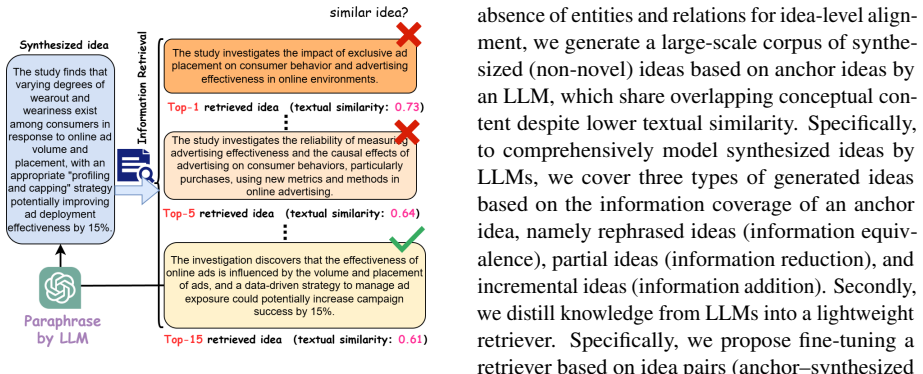
The load-bearing object is the anchor–synthesized idea pair set built from LLM-generated rephrased, partial, and incremental variants of each seed idea, together with a contrastive learning loss that pulls the retriever's embedding of each synthesized variant toward its anchor and away from unrelated seed ideas. The three-way taxonomy — information equivalence (rephrase), information reduction (partial), and information addition (incremental) — is what makes the synthetic non-novel corpus cover distinct failure modes: rephrasings test vocabulary invariance, partials test subset detection, and incrementals test the hardest case of small textual overlap with large conceptual overlap. A decision tree trained on the LLM's five-level novelty scores for the retrieved candidates supplies the final novel/non-novel decision without a hand-set threshold.
What would settle it
Take a held-out set of real papers widely recognized as incremental extensions of prior work (for example, follow-up papers in the same line of research) and run the trained RAG-KD system; if it labels most of them novel even though human experts judge them non-novel, then the synthetic ground truth has not transferred to real non-novelty.
Extended reading notes
Core claim
The central discovery is that the gap between textual similarity and idea conception can be bridged by a knowledge-distillation procedure: an LLM generates anchored non-novel variants of each seed idea — information-equivalent rephrasings, information-reducing partial statements, and information-adding incremental fusions — and the retriever is fine-tuned with a contrastive objective so that each variant's embedding is pulled toward its anchor and pushed away from other seed ideas. The resulting retriever captures conceptual overlap that standard encoders such as GTE, E5, SimCSE, Sentence-BERT, NLI, and BGE miss, especially for incremental ideas that have the lowest textual similarity to their anchors. Feeding the retriever's top candidates to an LLM with a five-level novelty rubric, then learning a decision tree on the resulting score vector, yields about 0.745 accuracy on the marketing test set and 0.747 on the NLP test set, outperforming all compared baselines including reference-alignment variants on both retrieval and classification.
Load-bearing premise
The evaluation assumes that LLM-generated rephrased, partial, and incremental variants are a faithful stand-in for real non-novel scientific ideas; if real incremental papers do not resemble these synthetic variants, the benchmark may overstate real-world performance.
Editorial extensions
If this is right
- Automated novelty screening for submissions or grant proposals could flag rephrased or incremental contributions against a closed corpus of the field's prior work.
- The three-way synthesis taxonomy gives a precise vocabulary for why an idea is not new: it restates an existing conception, covers only part of one, or makes a small extension of known ideas.
- Because the retriever is lightweight and the LLM only scores a handful of retrieved candidates, the pipeline is cheap enough to run over whole corpora rather than single queries.
- The decision-tree layer on LLM novelty scores keeps the final verdict interpretable: a low novelty label can be traced back to which retrieved idea most influenced it.
Reading between the lines
- The same distillation recipe should transfer to other closed-corpus sciences, such as biomedicine or computer vision, wherever seed papers and their references can be assembled into a closure set.
- Because the benchmark's non-novel ground truth is generated entirely by LLMs, reported gains could shrink on real incremental papers, which typically mix paraphrase, narrowing, and extension less cleanly than synthetic variants; a human-annotated holdout of genuine incremental papers would test transfer.
- The contrastive objective assumes seed ideas are mutually novel, which may be too strong in dense research areas; relaxing it with soft negatives could yield better-calibrated novelty scores.
- Since the LLM only sees the top-K retrieved candidates, the system's ceiling is set by retrieval recall; retrieving diverse candidates rather than only the most similar ones could further improve novelty detection.
Editorial analysis
A structured set of objections, weighed in public.
Referee Report
Summary. The paper introduces two novelty-detection benchmark datasets (Marketing and NLP) constructed by selecting seed papers, crawling their reference closure sets, and compressing each paper into an LLM-generated 'idea' summary. It then proposes an LLM-based knowledge distillation framework that fine-tunes a retriever on contrastive pairs of anchor ideas and LLM-synthesized non-novel variants (rephrased, partial, and incremental), followed by a RAG-based novelty-detection stage that scores retrieved candidates with a five-level LLM rubric and learns a decision tree on the resulting score vectors. Experiments report consistent improvements over baselines for both idea retrieval and novelty detection, with the largest gains on incremental synthetic ideas.
Significance. If the benchmark and the methodology are sound, the paper would provide a useful resource and a practical recipe for bridging textual and conceptual similarity in novelty detection. The strengths are the release of two closed corpora with compact idea summaries, the contrastive distillation idea, the systematic comparison across six retriever backbones, and the group analysis separating rephrased, partial, and incremental ideas. The core reservation is that the benchmark's ground truth is defined entirely by LLM-generated variants of the same seed ideas that the retriever is trained on, so the reported gains may partly measure the retriever's ability to reverse-engineer the generation distribution rather than to identify real-world non-novelty. The paper's own Limitation section concedes that the pseudo-labels are not guaranteed accurate, but does not quantify how this affects the headline results.
major comments (4)
- [3, 4.2 (Prompt 2(c), Prompt 3)] The benchmark's non-novel ground truth is asserted, not verified, and appears inconsistent with the paper's own novelty rubric. Section 3 assumes every synthesized idea in G_S is non-novel because it was generated from an anchor in G_N, but Prompt 2(c) intentionally fuses fragments of two anchor ideas and targets low BERT similarity, and Prompt 3 assigns 0.5 to a 'different combination of claims' and 0.7 to 'applies known ideas in a new context.' By that rubric, many incremental ideas (and some partial ideas) would be scored moderately or highly novel, yet every one is labeled non-novel. The paper reports expert voting only for idea-extraction alignment on 50 papers, not for the novelty labels of the synthesized variants. This makes the F1 and retrieval gains in Tables 1 and 3 hard to interpret as measuring scientific non-novelty.
- [4.2, 5.2] The evaluation loop is self-referential: the retriever is contrastively trained on anchor–synthesized pairs produced by Prompt 2, and the same type of LLM-generated variants constitutes the test queries. The consistent improvement of LLM-KD over Vanilla may therefore reflect learning the paraphrase/recombination distribution of GPT-4o-mini rather than a generalizable idea-level similarity. The paper does not test on human-authored non-novel ideas, such as close incremental papers from the reference closure, or provide any evidence that the synthetic variants are representative of real non-novelty. The Limitation section acknowledges noise in pseudo-labels but does not quantify the effect on the benchmark or on the reported improvements.
- [3, 4.1] The assumption that all seed ideas in G_N are novel and mutually distinct is stated without verification. Because seed papers are drawn from a small set of venues and the corpus is closed by references, the paper does not rule out the possibility that two seed ideas are themselves highly similar or that a seed idea closely matches an older reference paper in the closure set. If such cases exist, the training and evaluation labels in Section 4.2's contrastive objective and in the ND task are inconsistent. An expert audit of seed summaries, or a report of nearest-neighbor idea overlap among seed ideas, is needed to support the benchmark's validity.
- [5.3, Table 3] The ND evaluation uses only 100 training and 100 test samples per domain with a 1:1 novel/non-novel split, and no confidence intervals or multiple runs are reported. Given this sample size, the Marketing margin between RAG-KD and RAG-Vanilla (F1 0.7344 vs 0.7180) is small and may fall within sampling noise. The claim that RAG-KD 'consistently outperforms' baselines should be supported by repeated runs, standard deviations, or a statistical test.
minor comments (7)
- [5.3] The heading 'Experiments on idea retrieval tasks (RQ2)' appears to be a typo; RQ2 is the novelty-detection question, and the section describes the ND task.
- [5.1] The datasets are described in Section 4.1, not Section 3.1 as stated in the experimental setup.
- [1] The phrase 'topologicalclosurein topological andcompactnessfor ND' is garbled and should be rewritten.
- [Prompt 2(c)] There is a typo in 'LAGRELY different from these two papers'; it should be 'LARGELY.'
- [5.4] DeepSeek-reasoner is used as an LLM backbone but is not cited in the references; please add a proper citation.
- [Table 2] The group analysis is reported only for the NLP dataset; please clarify why Marketing is omitted or add the corresponding table.
- [5.2] The reported 'average improvements' of 5.40% and 15.19% are not defined in Table 1; state explicitly over which metrics and baselines the averages are computed.
Circularity Check
Evaluation loop is self-referential: non-novel labels are defined as LLM-generated variants of seed ideas, the retriever is trained on those generated pairs, and the ND scorer evaluates the same generated distribution, while Prompt 2(c) fusions would be rated novel by the paper's own Prompt 3 rubric.
-
self definitional
[Section 3 (Problem Formulation); Appendix Prompt 2(c); Appendix Prompt 3]
"For the synthesized corpus, we assume that its ideas are non-novel as they are generated based on GN, i.e.,P dj ∈GN I(d i, dj)≥1for eachd i ∈ GS. Prompt 2(c) instructs: 'you can generate the idea by selecting subset of ideas from both these two papers (e.g., ideas idea_A1 + idea_B2 -> new abstract)'. Prompt 3 gives 0.5 for 'a different combination of claims'."
Non-novelty is stipulated, not measured: any idea generated from GN is automatically labeled non-novel, regardless of content. Prompt 2(c) deliberately fuses two distinct seed ideas into one abstract, and the paper's own Prompt 3 rubric scores a 'different combination of claims' as 0.5 (moderate novelty) and applying known ideas in a new context as 0.7 (high novelty). Thus the ground-truth label 'non-novel' contradicts the paper's own scoring criterion for a substantial subset of the generated negatives. The benchmark label is defined by the generation mechanism, so the dataset cannot independently establish that these instances are truly non-novel.
-
fitted input called prediction
[Section 4.2 (contrastive loss L); Section 3 retrieval-task definition; Section 5.2 and Table 2]
"We propose to fine-tune a retriever based on idea pairs (si, gi) to bridge between textual similarity and idea conception, where si ∈ GN is the anchor (novel) idea and gi ∈ GS is the synthesized non-novel idea (i.e., rephrased, partial, or incremental). The core objective is to align the representation space of the retriever with the idea-level similarity determined by the LLM."
The retriever is trained with a contrastive loss whose positive pairs are exactly (anchor si, LLM-generated gi) from Prompt 2, and the retrieval test task is defined in Section 3 as: given a synthesized idea d in GS, retrieve its anchor paper. The test split is drawn from the same LLM-generated distribution used for training. Consequently, Acc@k and MAP gains, including the 19.82% Acc@5 improvement on incremental ideas in Table 2, measure how well the model reproduces Prompt 2's paraphrase/recombination statistics rather than any externally established idea-level relation. The reported 'effectiveness of the proposed method' is therefore a fitted-input result: the supervision and the evaluation target are outputs of the same generative process.
1 more flagged steps
-
fitted input called prediction
[Section 4.3 (label definition); Section 5.1 (negative generation); Section 5.3 and Table 3; Section 7 (Limitation)]
"Given a training dataset D={(s q, yq)}, where yq ∈ {Novel,Non-Novel} is the ground truth label ( yq =Novel if q∈ G N and yq =Non-Novel if q∈ GS), we train a decision tree classifier DT ree(·)"
The ND labels are assigned by set membership: Novel if q is in GN and Non-Novel if q is in GS, while Section 5.1 states that all negative examples were generated from seed papers using GPT-4o-mini with rephrased, partial, and incremental prompts. The features used by the decision tree are the LLM's novelty scores from Prompt 3, produced by the same class of LLM generator. Thus RAG-KD is trained and evaluated on labels that are generated by the LLM pipeline it is supposed to assess. The F1 improvements in Table 3 (e.g., 0.7344 vs 0.7180 in Marketing) therefore demonstrate consistency between deepseek-reasoner's scores and GPT-4o-mini's generation prior, not detection of independently validated scientific non-novelty.
full rationale
The paper's derivation chain is closed by construction rather than by external evidence. Section 3 stipulates that G_S is non-novel because it is generated from G_N; Section 4.2 trains the retriever on anchor-synthesized pairs from Prompt 2; Section 4.3 defines ND labels as membership in G_S versus G_N; and Section 5.1 reveals that all negatives were produced by GPT-4o-mini. The retrieval and ND experiments therefore measure agreement with the LLM generator's paraphrase/recombination distribution, not an independent notion of scientific novelty. The internal inconsistency between Prompt 2(c)'s deliberate cross-paper fusion and Prompt 3's rubric (0.5 for 'a different combination of claims'; 0.7 for applying ideas in a new context) further shows that many generated negatives would be rated novel by the paper's own scoring scale. No load-bearing self-citation chain is present; the circularity lies in the benchmark construction and label definition. The Limitation section's admission of pseudo-label noise is honest but does not break the loop, because the central claims are not re-evaluated against expert or otherwise external labels.
Assumptions & free parameters
free parameters (3)
- Novelty scoring rubric anchors =
0.0, 0.3, 0.5, 0.7, 1.0
- Number of synthesized variants per anchor =
up to 10
- Retrieval size K =
10 (Marketing), 5 (NLP)
assumptions (3)
- domain assumption Seed papers plus their reference lists form a closure set for novelty assessment
- domain assumption LLM-generated rephrased, partial, and incremental ideas are valid non-novel examples
- domain assumption LLM novelty scores are reliable enough to supervise a decision tree
Cite this review
Pith. "Pith review of Harnessing Large Language Models for Scientific Novelty Detection." pith.science (2026). https://pith.science/paper/TENPPA3V
@misc{pith2026250524615,
  author       = {Pith},
  title        = {Pith review of: Harnessing Large Language Models for Scientific Novelty Detection},
  year         = {2026},
  howpublished = {\url{https://pith.science/paper/TENPPA3V}},
  note         = {Machine review of arXiv:2505.24615}
}
read the original abstract
In an era of exponential scientific growth, identifying novel research ideas is crucial and challenging in academia. Despite potential, the lack of an appropriate benchmark dataset hinders the research of novelty detection. More importantly, simply adopting existing NLP technologies, e.g., retrieving and then cross-checking, is not a one-size-fits-all solution due to the gap between textual similarity and idea conception. In this paper, we propose to harness large language models (LLMs) for scientific novelty detection (ND), associated with two new datasets in marketing and NLP domains. To construct the considerate datasets for ND, we propose to extract closure sets of papers based on their relationship, and then summarize their main ideas based on LLMs. To capture idea conception, we propose to train a lightweight retriever by distilling the idea-level knowledge from LLMs to align ideas with similar conception, enabling efficient and accurate idea retrieval for LLM novelty detection. Experiments show our method consistently outperforms others on the proposed benchmark datasets for idea retrieval and ND tasks. Codes and data are available at https://anonymous.4open.science/r/NoveltyDetection-10FB/.
Figures


Reference graph
Works this paper leans on
-
[1]
**Change Words to Synonyms** - Replace key terms with scientifically appropriate synonyms while maintaining clarity and rigor
-
[2]
- If extending, add **clarifying details** or **restructure for better readability**
**Modify Sentence Length** - Either **extend or shorten** the sentence while preserving the original meaning. - If extending, add **clarifying details** or **restructure for better readability**. - If shortening, remove redundant words while retaining key scientific information
-
[3]
- Improve fluency by modifying transitions or simplifying phrasing
**Add or Delete Non-Essential Words** - Introduce or remove words **that do not alter** the fundamental meaning. - Improve fluency by modifying transitions or simplifying phrasing
-
[4]
- Convert passive to active voice (or vice versa) where appropriate
**Alter Sentence Structure** - Rearrange the sentence while maintaining logical flow. - Convert passive to active voice (or vice versa) where appropriate. - Split complex sentences into simpler ones or combine shorter ones for a smoother read
-
[5]
**Ensure Significant Differences from the Original** - The paraphrased versions **must be structurally different** while still preserving the core message
-
[6]
**Output Format:** - Return **only** the elaborated subset sentences, numbered **1 to 5**, with no additional text or explanations. ### **Example Input & Output** #### **Example 1: Scientific Context** **Input Sentence:** *"Long-term exposure to polluted air has been linked to an increased risk of developing respiratory illnesses such as asthma and chroni...
-
[7]
Do not introduce entirely new or unrelated information
-
[8]
**Output only the elaborated subset sentences, numbered from 1 to 10, with no additional text or explanations.** — ### **Example Input & Output** #### **Example 1:** **Input:** "The increasing reliance on artificial intelligence in the healthcare industry is transforming patient diagnostics and treatment planning." **Output:**
Show all 55 references
-
[9]
— ### **Example Input & Output** #### **Example 1:** **idea_A1:** Personalization improves email engagement
**Output Format:** - Return **only** the elaborated subset sentences, numbered **1 to 5**, with no additional text or explanations. — ### **Example Input & Output** #### **Example 1:** **idea_A1:** Personalization improves email engagement. **idea_B2:** Scarcity messaging can ...
-
[16]
Machine learning algorithms are increasingly being used to detect patterns in large datasets, improving decision- making processes in fields such as healthcare and finance
The presence of hazardous particles in the atmosphere can gradually impair lung function and lead to chronic respiratory distress. — #### **Example 2: AI & Technology Context** **Input Sentence:** *"Machine learning algorithms are increasingly being used to detect patterns in ...
-
[17]
AI-driven models are enhancing decision-making by identifying trends in vast amounts of data
-
[18]
The application of machine learning techniques is revolutionizing data analysis across multiple industries
-
[19]
Advanced computational models help uncover hidden insights within extensive datasets
-
[20]
The use of artificial intelligence in fields like healthcare and banking is optimizing predictive analytics
-
[21]
Modern machine learning tools enable more efficient data-driven decisions through pattern recognition. — Now, generate up to k paraphrased sentences for the following input: **Input:** {idea} 12 Prompt 2 (b):Detailed prompt for partial idea generation by LLMs System: You are a...
-
[22]
Extract a meaningful portion of the input sentence
-
[23]
Modify the extracted portion by **adding, deleting, or replacing** words while ensuring clarity and coherence
-
[24]
Elaborate on the extracted information by adding context, explanation, or detail while retaining the core meaning
-
[25]
Each subset sentence should retain **only part of the original information**, not the full meaning
-
[26]
Ensure grammatical correctness and natural phrasing
-
[27]
Avoid directly copying the exact words from the input sentence
-
[30]
AI is revolutionizing healthcare by enhancing how doctors diagnose illnesses and design personalized treatments
-
[31]
The healthcare sector is increasingly adopting AI-driven tools to streamline diagnostic processes and improve patient outcomes
-
[32]
Advanced algorithms are now assisting healthcare providers in identifying conditions more accurately and efficiently
-
[33]
Artificial intelligence is not only transforming diagnostics but also reshaping how treatment plans are tailored to individual patients
-
[34]
Long-term exposure to polluted air has been linked to an increased risk of developing respiratory illnesses such as asthma and chronic bronchitis
Medical professionals are leveraging AI systems to analyze patient data and detect abnormalities earlier. — ### **Example 2:** *"Long-term exposure to polluted air has been linked to an increased risk of developing respiratory illnesses such as asthma and chronic bronchitis."*...
-
[35]
Extended periods of contact with contaminated air are associated with a greater likelihood of respiratory conditions, including asthma and bronchitis
-
[36]
Prolonged inhalation of polluted air may elevate the probability of experiencing chronic lung diseases
-
[37]
Airborne pollutants have been found to contribute to the onset of various respiratory disorders over time
-
[38]
Studies suggest that individuals consistently exposed to poor air quality are at a heightened risk of breathing-related health issues
-
[39]
Due to climate change, extreme weather events such as hurricanes and heatwaves have become more frequent and intense
The presence of hazardous particles in the atmosphere can gradually impair lung function and lead to chronic respiratory distress. — #### **Example 2: AI & Technology Context** **Input:** "Due to climate change, extreme weather events such as hurricanes and heatwaves have beco...
-
[40]
Rising global temperatures are causing hurricanes to become more powerful and destructive
-
[41]
Climate change is intensifying heatwaves, making them last longer and reach higher temperatures
-
[42]
Severe weather patterns are now more common due to the warming atmosphere and changing climate conditions
-
[43]
The increased occurrence of hurricanes and heatwaves is a direct result of shifts in global weather systems
-
[44]
Scientists link the rise in extreme weather events to the ongoing effects of climate change. — Now, generate up to k elaborated subset sentences for the following input: **Input:** {idea} 13 Prompt 2 (c):Detailed prompt for incremental idea generation by LLMs System: You are a...
-
[45]
**Rephrase & Restructure**: The new sentence must **significantly alter** the structure and wording of the selected subsets while **retaining only their core ideas**
-
[46]
**Break Down & Blend**: Instead of copying large portions, **extract fragments** from the subsets and recombine them in a different way
-
[47]
**Introduce Metaphors or Analogies**: Use figurative language to convey the original meaning in a more indirect manner
-
[48]
**Use Different Sentence Structures**: Experiment with **questions, lists, cause-effect statements, conditionals, or passive voice**
-
[49]
**Limit Direct Keywords**: Avoid using the **exact phrasing** from the original subsets-paraphrase where possible
-
[50]
**Focus on Implicit Links**: The new sentence **should not clearly resemble either source sentence**, making it harder to trace back to any one subset
-
[51]
**Enforce Conceptual Fusion**: The new sentence must not focus too heavily on just one of the selected subsets but should **merge ideas from both** in a way that feels natural and balanced
-
[52]
**Ensure Consistency**: Does not create a new perspective or connection between the ideas, presents the ideas together in one sentence, but without forcing a relationship
-
[54]
#### **Example 2: NLP Domain** **idea_A2:** Instruction tuning aligns model outputs with user prompts
Tailored content boosts email responses, while limited-time offers may compromise brand credibility. #### **Example 2: NLP Domain** **idea_A2:** Instruction tuning aligns model outputs with user prompts. **idea_B1:** Retrieval enhances factual accuracy in text generation. **Ge...
-
[55]
new research idea
While instruction tuning improves adherence to task instructions, adding retrieval helps ground outputs in reliable information. — Now, generate up to k fused sentences for the following inputs: Sentence A: Idea 1 Sentence B: Idea 2 14 Prompt 3:Trigger LLMs for novelty detecti...
-
[56]
Examine the conceptual and structural overlap between the new idea and the existing idea
Assess Overlap. Examine the conceptual and structural overlap between the new idea and the existing idea
-
[57]
Use the Novelty Scoring Rubric to assign a score between 0.0 and 1.0, based on the degree of similarity or difference
Assign a Novelty Score. Use the Novelty Scoring Rubric to assign a score between 0.0 and 1.0, based on the degree of similarity or difference
-
[58]
Perform this scoring for each existing idea in the set
Repeat for All Comparisons. Perform this scoring for each existing idea in the set. ###Output Format:[List of scores like: [0.3, 0.5, 0.3, 0.7, 1.0]] Now, compare the given research idea with each of the existing ideas. For each comparison, assign a novelty score using the rub...
-
[59]
profiling and capping
The study finds that varying degrees of wearout and weariness exist among consumers in response to online ad volume and placement, with an appropriate "profiling and capping" strategy potentially improving ad deployment effectiveness by 15%. ... K. The study finds that display...
-
[2017]
Liang Wang, Nan Yang, Xiaolong Huang, Binxing Jiao, Linjun Yang, Daxin Jiang, Rangan Majumder, and Furu Wei
Bias against novelty in science: A cautionary tale for users of bibliometric indicators.Research Policy, 46(8):1416–1436. Liang Wang, Nan Yang, Xiaolong Huang, Binxing Jiao, Linjun Yang, Daxin Jiang, Rangan Majumder, and Furu Wei. 2022. Text embeddings by weakly- supervised co...
2022 arXiv
-
[2018]
Pierre Azoulay, Joshua S Graff Zivin, and Gustavo Manso
Network-based approach to detect novelty of scholarly literature.Information sciences, 422:542– 557. Pierre Azoulay, Joshua S Graff Zivin, and Gustavo Manso. 2011. Incentives and creativity: evidence from the academic life sciences.The RAND Journal of Economics, 42(3):527–554....
2011 arXiv
-
[2021]
Denis Trapido
Measuring novelty in science with word em- bedding.PloS one, 16(7):e0254034. Denis Trapido. 2015. How novelty in knowledge earns recognition: The role of consistent identities.Re- search Policy, 44(8):1488–1500. Brian Uzzi, Satyam Mukherjee, Michael Stringer, and Ben Jones. 20...
2015
-
[2022]
Bodhisattwa Prasad Majumder, Harshit Surana, Dhruv Agarwal, Bhavana Dalvi Mishra, Abhijeetsingh Meena, Aryan Prakhar, Tirth V ora, Tushar Khot, Ashish Sabharwal, and Peter Clark
Combination of research questions and meth- ods: A new measurement of scientific novelty.Jour- nal of Informetrics, 16(2):101282. Bodhisattwa Prasad Majumder, Harshit Surana, Dhruv Agarwal, Bhavana Dalvi Mishra, Abhijeetsingh Meena, Aryan Prakhar, Tirth V ora, Tushar Khot, Ash...
2024 arXiv
-
[2024]
Optimistic posterior sampling algorithm for reinforcement learning (OPSRL)
Scimon: Scientific inspiration machines opti- mized for novelty. InProceedings of the 62nd Annual Meeting of the Association for Computational Lin- guistics (Volume 1: Long Papers), pages 279–299. Zhongyi Wang, Haoxuan Zhang, Jiangping Chen, and Haihua Chen. 2023. Measuring th...
2023 arXiv
Reviewed August 7, 2026 · model on record in the stance chip above.
Discussion (0). Sign in to comment.