REVIEW 3 major objections 7 minor 57 references
PRISM: A Framework for Producing Interpretable Political Bias Embeddings with Political-Aware Cross-Encoder
T0 review · 3 major / 7 minor · reviewed 2026-08-07 · deepseek-v4-flash
Pith's one-line read The paper claims that PRISM is the first framework to produce interpretable political bias embeddings, where each dimension is a named controversial topic and each value is the net right-minus-left alignment of an article with…
desk verdict A useful interpretable-bias embedding pipeline with a plausible but under-validated weak-label premise; the headline classification claim is stronger than the evidence. read the letter →
The pith
A machine-rendered reading of the paper's core claim, the machinery that carries it, and where it could break.
The reading
What carries the argument
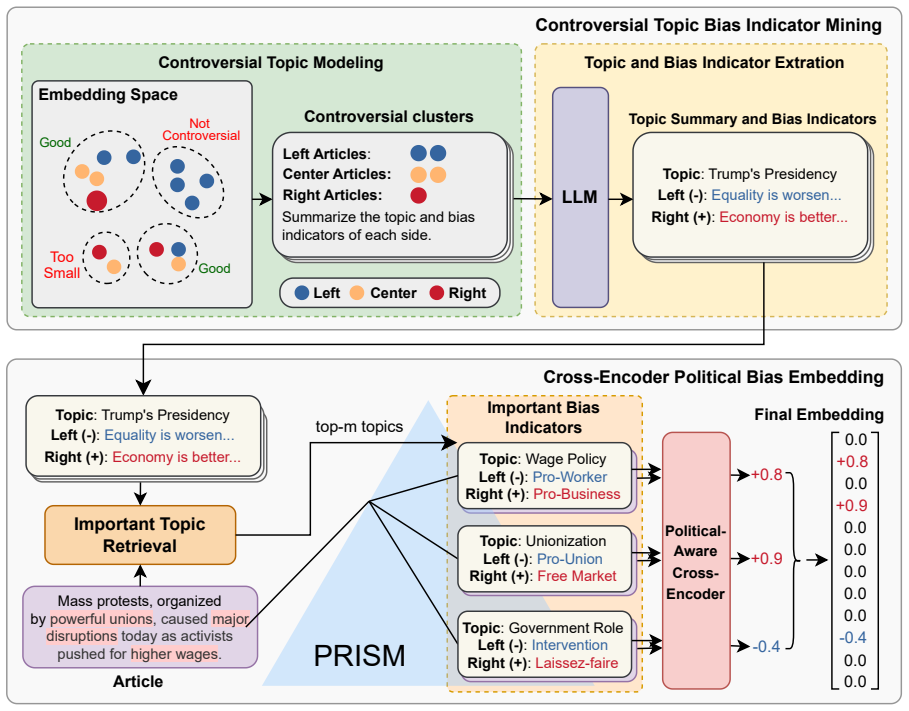
The load-bearing object is the political-aware cross-encoder, a neural scorer that takes an article and a bias indicator and returns a score between zero and one. The embedding coordinate for a topic is the difference between the right-indicator score and the left-indicator score, and only the top-m topics selected by an importance score that balances topical relevance with left-right divergence receive nonzero values. The topic dimensions themselves come from k-means clustering of semantically embedded articles, keeping only clusters with high bias dispersion, then having an LLM summarize each cluster into a neutral topic and paired left/right indicators.
What would settle it
Take a set of articles from outlets whose media rating conflicts with expert human ratings of the article's own stance, and check whether PRISM's embedding scores for the relevant topic follow the outlet label rather than the expert label; if they follow the outlet label, the weak-label training signal, not true article ideology, is carrying the result.
Extended reading notes
Core claim
PRISM discovers controversial topics from weakly labeled news corpora by embedding articles, clustering them, and keeping clusters with high ideological dispersion. An LLM then summarizes each cluster into a neutral topic plus paired left and right bias indicators. A political-aware cross-encoder is trained with weak labels so that an article paired with its own cluster's indicator is scored high only when the article's outlet leans that way; at inference, each embedding coordinate is the difference between the article's alignment with the right indicator and its alignment with the left indicator. The paper reports that these embeddings beat generic and political text embedding baselines on political bias classification, provide a reliable distance metric for diversified retrieval, and yield interpretable per-topic scores.
Load-bearing premise
The load-bearing premise is that a news outlet's bias rating accurately describes the political slant of every individual article from that outlet; if outlet ratings reflect brand or editorial style rather than article-level stance, PRISM's scores encode the label source instead of genuine bias.
Editorial extensions
If this is right
- Political bias classification can be done with a simple linear classifier on PRISM embeddings and still beat generic and political text embedding models, including on the held-out human-annotated BASIL dataset.
- Politically diversified retrieval can use PRISM embeddings as a distance metric, improving the diversity-relevance trade-off over retrieval based on semantic embeddings alone.
- Because topics are mined automatically, re-running PRISM on a new or updated corpus yields new topical dimensions without manual annotation, allowing adaptation to emerging political discourse.
- The embedding space can be inspected directly: a nonzero value on a topic dimension tells the reader which side of a named controversy the article aligns with, while zero indicates irrelevance or neutrality.
Reading between the lines
- A natural extension the paper does not pursue is using PRISM's per-topic scores as a stance profile: instead of one overall bias number, each article gets a vector over issues, which could power issue-specific ideological search or tracking.
- The paper's limitations note that topics are treated as independent axes; in the editor's reading, allowing overlapping or hierarchical topic dimensions could improve performance on corpora with correlated issues.
- Because the bias indicators are written by an LLM, the wording of those indicators is a hidden sensitivity: reformulating a left or right indicator could shift embedding values, suggesting a prompt-robustness test as a next step.
- If the weak-label assumption survives article-level human validation, the same pipeline should transfer to non-U.S. contexts by re-mining with local outlet ratings, a direction the paper notes but does not evaluate.
Editorial analysis
A structured set of objections, weighed in public.
Referee Report
Summary. The paper introduces PRISM, a two-stage framework for generating interpretable political bias embeddings for news articles. In the first stage, PRISM mines controversial topics and their left/right bias indicators from weakly labeled news corpora by clustering articles, measuring bias dispersion of clusters, and using an LLM to summarize each controversial cluster and generate side-specific indicators. In the second stage, a cross-encoder is trained on weak labels derived from the same media bias ratings to score article-indicator alignment, and each article's embedding is a sparse vector over the top-m mined topics with values given by the difference between right- and left-alignment scores, so positive values indicate right-leaning bias and negative values left-leaning bias. The authors evaluate PRISM on NewsSpectrum and BigNews for political bias classification and politically diversified retrieval, report a within-dataset accuracy of 86.1% on NewsSpectrum, and include a case study and an out-of-distribution experiment on the human-annotated BASIL dataset.
Significance. If the results hold, PRISM would be a practically useful contribution: it produces sparse, interpretable embeddings whose dimensions are named controversial topics, it is fully automatic and does not require fine-grained manual annotations, and the code is released. The paper also includes useful elements: a parameter study for k and m, an external BASIL evaluation, and an unusually candid Limitations section that concedes the framework may conflate topic and stance. However, the headline claim that PRISM 'outperforms state-of-the-art text embedding models in political bias classification' is not yet established, because the weak-label premise, the held-out protocol, and the baseline comparisons all need additional validation before the central claim is secure.
major comments (3)
- [Section 3.3 / Section 4.3 / Limitations] The load-bearing weak-label assumption is not validated at article level. The cross-encoder is trained so that (a, b_left) receives label 1 only when the article's outlet is rated left, and likewise for right, using AllSides outlet ratings that also define the classification target; the within-dataset accuracy therefore partly measures how well the model recovers its own training signal. The paper's own Limitations section concedes that 'the current framework may conflate topic and stance,' and the only article-level human-labeled check, BASIL in Table 4, shows PRISM at 40.0% accuracy and 37.3 F1-macro, far below the 86.1% within-dataset result and only about 5 points above the best generic embedding. Please add a direct article-level validation of the weak labels, or otherwise temper the claims about article-level bias classification.
- [Section 4.3 / Appendix B] The held-out protocol is not clearly disjoint from PRISM's training data. The main text states that SVM training is performed on a held-out dataset distinct from PRISM's training data, but Appendix B describes randomly sampling 10,000 articles from NewsSpectrum and 100,000 from BigNews without stating whether those articles were excluded from the topic-mining stage and the cross-encoder training stage. Because PRISM's cross-encoder is trained on the same NewsSpectrum and BigNews corpora, any overlap would inflate the reported classification numbers. In addition, Appendix B states that 'All results are reported from a single experimental run,' with no error bars, multiple seeds, or significance tests. Please specify the exact split, verify that no evaluation article contributes to PRISM training, and report variance across several runs.
- [Section 4.3 / Table 1] The baseline comparison is not apples-to-apples. PRISM is trained on large in-domain weakly labeled data, while the generic embedding baselines (AnglE, Instructor, InBedder, CQG-MBQA) are evaluated as off-the-shelf feature extractors, and POLITICS is pre-trained on BigNews, the same dataset on which it is tested. The claim that PRISM 'outperforms state-of-the-art text embedding models' therefore conflates the method's architecture with the advantage of training on the evaluation corpus and its labels. A control in which a generic encoder is fine-tuned on the same weak labels, or an otherwise matched training protocol, would be needed to attribute the gains to PRISM's design.
minor comments (7)
- [Table 1] The column header 'NewsSepctrum' is a typo for 'NewsSpectrum'.
- [Figure 5 caption] The caption reads 'F1-marco' and should read 'F1-macro'.
- [Section 3.3 / Equation (3)] The symbol x is used for the article embedding in Equation (1) and then re-used for the final embedding in Equation (3); please use distinct notation for the article text, the article's semantic embedding, and the final bias embedding.
- [Section 3.3 / Weak Label Generation] The description of negative sampling says 'some random out-of-cluster topics' are used, but the number of negatives per article and the sampling procedure are not specified; please provide these details.
- [Section 4.5 / Figure 4] The case study does not state which outlets the three articles come from, so the reader cannot judge whether the displayed scores are representative or cherry-picked; please provide source information.
- [Appendix D / Table 4] The BASIL experiment lacks essential details: the number of BASIL articles, the train/test split, whether the results are averaged over multiple seeds, and how the logistic regression was trained; without these, the out-of-distribution conclusion is hard to assess.
- [Appendix D / Table 6] The zero-shot LLM baselines in Table 6 are reported without any prompting details or decoding settings; please document the prompts and inference configuration for reproducibility.
Circularity Check
No significant circularity: PRISM's classification results are supervised evaluations on held-out data and an external human-annotated benchmark, not derivations from the target labels.
full rationale
The potential circularity concern is that PRISM's cross-encoder is trained with weak labels derived from AllSides media-outlet ratings, which are also the target of the downstream political-bias classification. However, the paper does not claim to derive bias from first principles; it trains a supervised model and evaluates generalization. Section 4.3 states that the SVM classifier is trained on a held-out dataset distinct from PRISM's training data and evaluated on a separate test set, so the reported 86.1% NewsSpectrum accuracy and the BigNews results measure held-out prediction rather than recovery of the training labels by construction. The final embedding value in Eq. (3) is e_i = s^r_i - s^l_i, computed from a learned function f_theta; nothing in the equations forces e_i to equal the weak label for a held-out article. Appendix D provides an external check on BASIL, a human-annotated dataset disjoint from PRISM's training data, where PRISM outperforms the baselines, further supporting that the framework has independent predictive content. The Limitations section concedes that the framework 'may conflate topic and stance' and that evaluation relies on AllSides ratings; this is a validity and generalizability caveat about weak-label quality, not a circularity in the derivation. Self-citations to DiversiNews (Sun et al., 2024) and DkMIPS (Huang et al., 2024) are used as evaluation protocols and retrieval algorithms, not as unverified premises of the embedding construction. No equation in the paper reduces to its own input, and no fitted parameter is renamed as a prediction. No significant circularity found.
Assumptions & free parameters
free parameters (5)
- number of clusters k =
3000
- bias dispersion threshold tau =
1.0 for NewsSpectrum, 0.5 for BigNews
- minimum cluster size p =
50
- topic retrieval weight lambda =
0.8
- top-m topic dimensions =
not stated for final experiments
assumptions (5)
- domain assumption AllSides media outlet ratings are valid article-level political bias labels
- domain assumption K-means clusters correspond to coherent political topics
- ad hoc to paper GPT-4o-mini generated bias indicators accurately represent left and right framing
- domain assumption Inner product similarity in the semantic embedding space measures topic relevance for Equation 1
- domain assumption MSE-trained cross-encoder scores generalize from weak labels to unseen articles
Cite this review
Pith. "Pith review of PRISM: A Framework for Producing Interpretable Political Bias Embeddings with Political-Aware Cross-Encoder." pith.science (2026). https://pith.science/paper/23OXFWJV
@misc{pith2026250524646,
  author       = {Pith},
  title        = {Pith review of: PRISM: A Framework for Producing Interpretable Political Bias Embeddings with Political-Aware Cross-Encoder},
  year         = {2026},
  howpublished = {\url{https://pith.science/paper/23OXFWJV}},
  note         = {Machine review of arXiv:2505.24646}
}
read the original abstract
Semantic Text Embedding is a fundamental NLP task that encodes textual content into vector representations, where proximity in the embedding space reflects semantic similarity. While existing embedding models excel at capturing general meaning, they often overlook ideological nuances, limiting their effectiveness in tasks that require an understanding of political bias. To address this gap, we introduce PRISM, the first framework designed to Produce inteRpretable polItical biaS eMbeddings. PRISM operates in two key stages: (1) Controversial Topic Bias Indicator Mining, which systematically extracts fine-grained political topics and their corresponding bias indicators from weakly labeled news data, and (2) Cross-Encoder Political Bias Embedding, which assigns structured bias scores to news articles based on their alignment with these indicators. This approach ensures that embeddings are explicitly tied to bias-revealing dimensions, enhancing both interpretability and predictive power. Through extensive experiments on two large-scale datasets, we demonstrate that PRISM outperforms state-of-the-art text embedding models in political bias classification while offering highly interpretable representations that facilitate diversified retrieval and ideological analysis. The source code is available at https://github.com/dukesun99/ACL-PRISM.
Figures


Figures from the paper (2 more)


Reference graph
Works this paper leans on
-
[1]
Charu C Aggarwal and ChengXiang Zhai. 2012. https://link.springer.com/chapter/10.1007/978-1-4614-3223-4_4 A survey of text clustering algorithms . Mining Text Data, pages 77--128
-
[2]
Eneko Agirre, Daniel Cer, Mona Diab, and Aitor Gonzalez-Agirre. 2012. https://aclanthology.org/S12-1051.pdf SemEval-2012 task 6: A pilot on semantic textual similarity . In *SEM 2012: The First Joint Conference on Lexical and Computational Semantics--Volume 1: Proceedings of the main conference and the shared task, and Volume 2: Proceedings of the Sixth I...
work page 2012
-
[3]
Eneko Agirre, Daniel Cer, Mona Diab, Aitor Gonzalez-Agirre, and Weiwei Guo. 2013. https://aclanthology.org/S13-1004.pdf *SEM 2013 shared task: Semantic Textual Similarity . In Second Joint Conference on Lexical and Computational Semantics (* SEM ), Volume 1: Proceedings of the Main Conference and the Shared Task: Semantic Textual Similarity , pages 32--43
work page 2013
-
[4]
Peter Anderson, Mano Vikash Janardhanan, Jason He, Wei Cheng, and Charlie Flanagan. 2024. https://aclanthology.org/2024.emnlp-industry.26/ Greenback bears and fiscal hawks: Finance is a jungle and text embeddings must adapt . In Proceedings of the 2024 Conference on Empirical Methods in Natural Language Processing (EMNLP), pages 362--370
work page 2024
-
[5]
Ramy Baly, Giovanni Da San Martino, James Glass, and Preslav Nakov. 2020 a . https://aclanthology.org/2020.emnlp-main.404/ We can detect your bias: Predicting the political ideology of news articles . In Proceedings of the 2020 Conference on Empirical Methods in Natural Language Processing (EMNLP), pages 4982--4991
work page 2020
-
[6]
Ramy Baly, Georgi Karadzhov, Jisun An, Haewoon Kwak, Yoan Dinkov, Ahmed Ali, James Glass, and Preslav Nakov. 2020 b . https://aclanthology.org/2020.acl-main.308/ What was written vs. who read it: News media profiling using text analysis and social media context . In Proceedings of the 58th Annual Meeting of the Association for Computational Linguistics (A...
work page 2020
-
[7]
Iz Beltagy, Kyle Lo, and Arman Cohan. 2019. https://aclanthology.org/D19-1371/ SciBERT: A Pretrained Language Model for Scientific Text . In Proceedings of the 2019 Conference on Empirical Methods in Natural Language Processing and the 9th International Joint Conference on Natural Language Processing (EMNLP-IJCNLP), pages 3615--3620
work page 2019
-
[8]
Vinamra Benara, Chandan Singh, John X Morris, Richard J Antonello, Ion Stoica, Alexander G Huth, and Jianfeng Gao. 2024. https://nips.cc/virtual/2024/poster/93720 Crafting interpretable embeddings for language neuroscience by asking llms questions . In Proceedings of the 38th International Conference on Neural Information Processing Systems (NeurIPS), pag...
work page 2024
Show all 57 references
-
[9]
Qingyu Chen, Yifan Peng, and Zhiyong Lu. 2019. https://www.computer.org/csdl/proceedings-article/ichi/2019/08904728/1f8N795Otnq BioSentVec: creating sentence embeddings for biomedical texts . In 2019 IEEE International Conference on Healthcare Informatics (ICHI), pages 1--5
2019
-
[10]
Wei Chen, Xiao Zhang, Tengjiao Wang, Bishan Yang, and Yi Li. 2017. https://www.ijcai.org/proceedings/2017/510 Opinion-aware knowledge graph for political ideology detection . In Proceedings of the 26th International Joint Conference on Artificial Intelligence (IJCAI), pages 3647--3653
2017
-
[11]
Jacob Devlin, Ming-Wei Chang, Kenton Lee, and Kristina Toutanova. 2019. https://aclanthology.org/N19-1423.pdf BERT : Pre-training of deep bidirectional transformers for language understanding . In Proceedings of the 2019 Conference of the North A merican Chapter of the Associa...
2019
-
[12]
Tim Draws, Nava Tintarev, and Ujwal Gadiraju. 2021. https://www.kdd.org/exploration_files/7_specialsectionBIAS_7.pdf Assessing viewpoint diversity in search results using ranking fairness metrics . ACM SIGKDD Explorations Newsletter, 23(1):50--58
2021
-
[13]
Lisa Fan, Marshall White, Eva Sharma, Ruisi Su, Prafulla Kumar Choubey, Ruihong Huang, and Lu Wang. 2019. https://aclanthology.org/D19-1664/ In plain sight: Media bias through the lens of factual reporting . In Proceedings of the 2019 Conference on Empirical Methods in Natural...
2019
-
[14]
Tianyu Gao, Xingcheng Yao, and Danqi Chen. 2021. https://aclanthology.org/2021.emnlp-main.552/ SimCSE : Simple contrastive learning of sentence embeddings . In Proceedings of the 2021 Conference on Empirical Methods in Natural Language Processing (EMNLP), pages 6894--6910
2021
-
[15]
Pengcheng He, Jianfeng Gao, and Weizhu Chen. 2023. https://openreview.net/forum?id=sE7-XhLxHA DeBERTaV3 : Improving DeBERTa using ELECTRA-Style pre-training with gradient-disentangled embedding sharing . In The Eleventh International Conference on Learning Representations (ICLR)
2023
-
[16]
Valentin Hofmann, Xiaowen Dong, Janet Pierrehumbert, and Hinrich Sch \"u tze. 2022. https://aclanthology.org/2022.findings-naacl.41/ Modeling ideological salience and framing in polarized online groups with graph neural networks and structured sparsity . In Findings of the Ass...
2022
-
[17]
Jiwoo Hong, Yejin Cho, Jiyoung Han, Jaemin Jung, and James Thorne. 2023. https://aclanthology.org/2023.findings-emnlp.377.pdf Disentangling structure and style: Political bias detection in news by inducing document hierarchy . In Findings of the Association for Computational L...
2023
-
[18]
Qiang Huang, Yanhao Wang, Yiqun Sun, and Anthony KH Tung. 2024. https://arxiv.org/abs/2402.13858 Diversity-aware k -maximum inner product search revisited . arXiv preprint arXiv:2402.13858
2024 arXiv
-
[19]
Mohit Iyyer, Peter Enns, Jordan Boyd-Graber, and Philip Resnik. 2014. https://aclanthology.org/P14-1105.pdf Political ideology detection using recursive neural networks . In Proceedings of the 52nd Annual Meeting of the Association for Computational Linguistics (ACL), pages 1113--1122
2014
-
[20]
Vladimir Karpukhin, Barlas Oguz, Sewon Min, Patrick Lewis, Ledell Wu, Sergey Edunov, Danqi Chen, and Wen-tau Yih. 2020. https://aclanthology.org/2020.emnlp-main.550/ Dense passage retrieval for open-domain question answering . In Proceedings of the 2020 Conference on Empirical...
2020
-
[21]
Michelle YoungJin Kim and Kristen Johnson. 2022. https://aclanthology.org/2022.coling-1.245/ CLoSE : Contrastive learning of subframe embeddings for political bias classification of news media . In Proceedings of the 29th International Conference on Computational Linguistics (...
2022
-
[22]
Vivek Kulkarni, Junting Ye, Steven Skiena, and William Yang Wang. 2018. https://aclanthology.org/D18-1388/ Multi-view models for political ideology detection of news articles . In Proceedings of the 2018 Conference on Empirical Methods in Natural Language Processing (EMNLP), p...
2018
-
[23]
Jinhyuk Lee, Wonjin Yoon, Sungdong Kim, Donghyeon Kim, Sunkyu Kim, Chan Ho So, and Jaewoo Kang. 2020. https://academic.oup.com/bioinformatics/article/36/4/1234/5566506?login=false BioBERT : a pre-trained biomedical language representation model for biomedical text mining . Bio...
2020
-
[24]
Seonghyeon Lee, Dongha Lee, Seongbo Jang, and Hwanjo Yu. 2022. https://aclanthology.org/2022.acl-long.412/ Toward interpretable semantic textual similarity via optimal transport-based contrastive sentence learning . In Proceedings of the 60th Annual Meeting of the Association ...
2022
-
[25]
Xianming Li and Jing Li. 2024. https://aclanthology.org/2024.acl-long.101/ AoE : Angle-optimized embeddings for semantic textual similarity . In Proceedings of the 62nd Annual Meeting of the Association for Computational Linguistics (ACL), pages 1825--1839
2024
-
[26]
Luyang Lin, Lingzhi Wang, Xiaoyan Zhao, Jing Li, and Kam-Fai Wong. 2024. https://aclanthology.org/2024.findings-eacl.70/ IndiVec: An Exploration of Leveraging Large Language Models for Media Bias Detection with Fine-Grained Bias Indicators . In Findings of the Association for ...
2024
-
[27]
Songtao Liu, Ziling Luo, Minghua Xu, Lixiao Wei, Ziyao Wei, Han Yu, Wei Xiang, and Bang Wang. 2023. https://aclanthology.org/2023.emnlp-main.256/ Ideology takes multiple looks: A high-quality dataset for multifaceted ideology detection . In Proceedings of the 2023 Conference o...
2023
-
[28]
Songtao Liu, Bang Wang, Wei Xiang, Han Xu, and Minghua Xu. 2024. https://aclanthology.org/2024.findings-acl.172/ Encoding hierarchical schema via concept flow for multifaceted ideology detection . In Findings of the Association for Computational Linguistics: ACL 2024, pages 2930--2942
2024
-
[29]
Yinhan Liu, Myle Ott, Naman Goyal, Jingfei Du, Mandar Joshi, Danqi Chen, Omer Levy, Mike Lewis, Luke Zettlemoyer, and Veselin Stoyanov. 2019. https://arxiv.org/abs/1907.11692 RoBERTa: A Robustly Optimized BERT Pretraining Approach . arXiv preprint arXiv:1907.11692
2019 arXiv
-
[30]
Yujian Liu, Xinliang Frederick Zhang, David Wegsman, Nicholas Beauchamp, and Lu Wang. 2022. https://aclanthology.org/2022.findings-naacl.101/ POLITICS: Pretraining with Same-story Article Comparison for Ideology Prediction and Stance Detection . In Findings of the Association ...
2022
-
[31]
Manuel Martinez, Sonja Schmer-Galunder, Zoey Liu, Sangpil Youm, Chathuri Jayaweera, and Bonnie Dorr. 2024. https://aclanthology.org/2024.sicon-1.7/ Balancing transparency and accuracy: A comparative analysis of rule-based and deep learning models in political bias classificati...
2024
-
[32]
Denis McInerney, Geoffrey Young, Jan-Willem van de Meent, and Byron C Wallace. 2023. https://aclanthology.org/2023.findings-emnlp.568/ Chill: Zero-shot custom interpretable feature extraction from clinical notes with large language models . In Findings of the Association for C...
2023
-
[33]
Tomas Mikolov, Ilya Sutskever, Kai Chen, Greg Corrado, and Jeffrey Dean. 2013. https://dl.acm.org/doi/abs/10.5555/2999792.2999959 Distributed representations of words and phrases and their compositionality . In Proceedings of the 27th International Conference on Neural Informa...
2013
-
[34]
Niklas Muennighoff, Nouamane Tazi, Loic Magne, and Nils Reimers. 2023. https://aclanthology.org/2023.eacl-main.148/ MTEB: Massive Text Embedding Benchmark . In Proceedings of the 17th Conference of the European Chapter of the Association for Computational Linguistics (EACL), p...
2023
-
[35]
Preslav Nakov, Jisun An, Haewoon Kwak, Muhammad Arslan Manzoor, Zain Mujahid, and Husrev Sencar. 2024. https://aclanthology.org/2024.findings-acl.944/ A survey on predicting the factuality and the bias of news media . In Findings of the Association for Computational Linguistic...
2024
-
[36]
Rodrigo Nogueira and Kyunghyun Cho. 2019. https://arxiv.org/abs/1901.04085 Passage Re-ranking with BERT . arXiv preprint arXiv:1901.04085
2019 arXiv
-
[37]
Juri Opitz and Anette Frank. 2022. https://aclanthology.org/2022.aacl-main.48/ SBERT studies Meaning Representations: Decomposing Sentence Embeddings into Explainable Semantic Features . In Proceedings of the 2nd Conference of the Asia-Pacific Chapter of the Association for Co...
2022
-
[38]
Julia Otmakhova, Shima Khanehzar, and Lea Frermann. 2024. https://aclanthology.org/2024.acl-long.822/ Media Framing: A Typology and Survey of Computational Approaches Across Disciplines . In Proceedings of the 62nd Annual Meeting of the Association for Computational Linguistic...
2024
-
[39]
Ajay Patel, Delip Rao, Ansh Kothary, Kathleen Mckeown, and Chris Callison-Burch. 2023. https://aclanthology.org/2023.findings-emnlp.1020/ Learning interpretable style embeddings via prompting llms . In Findings of the Association for Computational Linguistics: EMNLP 2023, page...
2023
-
[40]
Letian Peng, Yuwei Zhang, Zilong Wang, Jayanth Srinivasa, Gaowen Liu, Zihan Wang, and Jingbo Shang. 2024. https://aclanthology.org/2024.acl-long.27/ Answer is all you need: Instruction-following text embedding via answering the question . In Proceedings of the 62nd Annual Meet...
2024
-
[41]
Jeffrey Pennington, Richard Socher, and Christopher D Manning. 2014. https://aclanthology.org/D14-1162.pdf GloVe: Global Vectors for Word Representation . In Proceedings of the 2014 conference on empirical methods in natural language processing (EMNLP), pages 1532--1543
2014
-
[42]
Nils Reimers and Iryna Gurevych. 2019. https://aclanthology.org/D19-1410/ Sentence-BERT: Sentence Embeddings using Siamese BERT-Networks . In Proceedings of the 2019 Conference on Empirical Methods in Natural Language Processing and the 9th International Joint Conference on Na...
2019
-
[43]
Francisco-Javier Rodrigo-Gin \'e s, Jorge Carrillo-de Albornoz, and Laura Plaza. 2024. https://www.sciencedirect.com/science/article/pii/S0957417423021437 A systematic review on media bias detection: What is media bias, how it is expressed, and how to detect it . Expert System...
2024
-
[44]
Adi Simhi and Shaul Markovitch. 2023. https://aclanthology.org/2023.emnlp-main.106/ Interpreting embedding spaces by conceptualization . In Proceedings of the 2023 Conference on Empirical Methods in Natural Language Processing (EMNLP), pages 1704--1719
2023
-
[45]
Barea Sinno, Bernardo Oviedo, Katherine Atwell, Malihe Alikhani, and Junyi Jessy Li. 2022. https://aclanthology.org/2022.naacl-main.17/ Political ideology and polarization: A multi-dimensional approach . In Proceedings of the 2022 Conference of the North American Chapter of th...
2022
-
[46]
Timo Spinde, Manuel Plank, Jan-David Krieger, Terry Ruas, Bela Gipp, and Akiko Aizawa. 2021. https://aclanthology.org/2021.findings-emnlp.101/ Neural media bias detection using distant supervision with babe-bias annotations by experts . In Findings of the Association for Compu...
2021
-
[47]
Hongjin Su, Weijia Shi, Jungo Kasai, Yizhong Wang, Yushi Hu, Mari Ostendorf, Wen-tau Yih, Noah A Smith, Luke Zettlemoyer, and Tao Yu. 2023. https://aclanthology.org/2023.findings-acl.71/ One embedder, any task: Instruction-finetuned text embeddings . In Findings of the Associa...
2023
-
[48]
Yiqun Sun, Qiang Huang, Yixuan Tang, Anthony K. H. Tung, and Jun Yu. 2025. https://openreview.net/forum?id=23uY3FpQxc¬eId=rpzPsaCpdb A general framework for producing interpretable semantic text embeddings . In The Thirteenth International Conference on Learning Representat...
2025
-
[49]
Yiqun Sun, Qiang Huang, Yanhao Wang, and Anthony K. H. Tung. 2024. https://www.vldb.org/pvldb/vol17/p4277-huang.pdf DiversiNews: Enriching News Consumption with Relevant Yet Diverse News Articles Retrieval . Proceedings of the VLDB Endowment, 17(12):4277--4280
2024
-
[50]
Maia Sutter, Antoine Gourru, Amine Trabelsi, and Christine Largeron. 2024. https://aclanthology.org/2024.eacl-long.107/ Unsupervised stance detection for social media discussions: A generic baseline . In Proceedings of the 18th Conference of the European Chapter of the Associa...
2024
-
[51]
Yixuan Tang and Yi Yang. 2024. https://arxiv.org/abs/2409.18511 Do we need domain-specific embedding models? an empirical investigation . arXiv preprint arXiv:2409.18511
2024 arXiv
-
[52]
Nandan Thakur, Nils Reimers, Andreas R \"u ckl \'e , Abhishek Srivastava, and Iryna Gurevych. 2021. https://datasets-benchmarks-proceedings.neurips.cc/paper_files/paper/2021/file/65b9eea6e1cc6bb9f0cd2a47751a186f-Paper-round2.pdf BEIR: A Heterogeneous Benchmark for Zero-shot Ev...
2021
-
[53]
Sanne Vrijenhoek, Mesut Kaya, Nadia Metoui, Judith M \"o ller, Daan Odijk, and Natali Helberger. 2021. https://dl.acm.org/doi/abs/10.1145/3406522.3446019 Recommenders with a mission: assessing diversity in news recommendations . In Proceedings of the 2021 Conference on Human I...
2021
-
[54]
Chuhan Wu, Fangzhao Wu, Tao Qi, and Yongfeng Huang. 2020. https://aclanthology.org/2020.aacl-main.6/ SentiRec: Sentiment Diversity-aware Neural News Recommendation . In Proceedings of the 1st conference of the Asia-Pacific chapter of the association for computational linguisti...
2020
-
[55]
Wenjie Zhuo, Yifan Sun, Xiaohan Wang, Linchao Zhu, and Yi Yang. 2023. https://aclanthology.org/2023.acl-long.677/ Whitenedcse: Whitening-based contrastive learning of sentence embeddings . In Proceedings of the 61st Annual Meeting of the Association for Computational Linguisti...
2023
-
[56]
online" 'onlinestring :=
ENTRY address archivePrefix author booktitle chapter edition editor eid eprint eprinttype howpublished institution journal key month note number organization pages publisher school series title type volume year doi pubmed url lastchecked label extra.label sort.label short.list...
-
[57]
write newline
" write newline "" before.all 'output.state := FUNCTION n.dashify 't := "" t empty not t #1 #1 substring "-" = t #1 #2 substring "--" = not "--" * t #2 global.max substring 't := t #1 #1 substring "-" = "-" * t #2 global.max substring 't := while if t #1 #1 substring * t #2 gl...
Reviewed August 7, 2026 · model on record in the stance chip above.
Discussion (0). Sign in to comment.