REVIEW 4 major objections 4 minor 19 references
BPE Stays on SCRIPT: Structured Encoding for Robust Multilingual Pretokenization
T0 review · 4 major / 4 minor · reviewed 2026-08-07 · deepseek-v4-flash
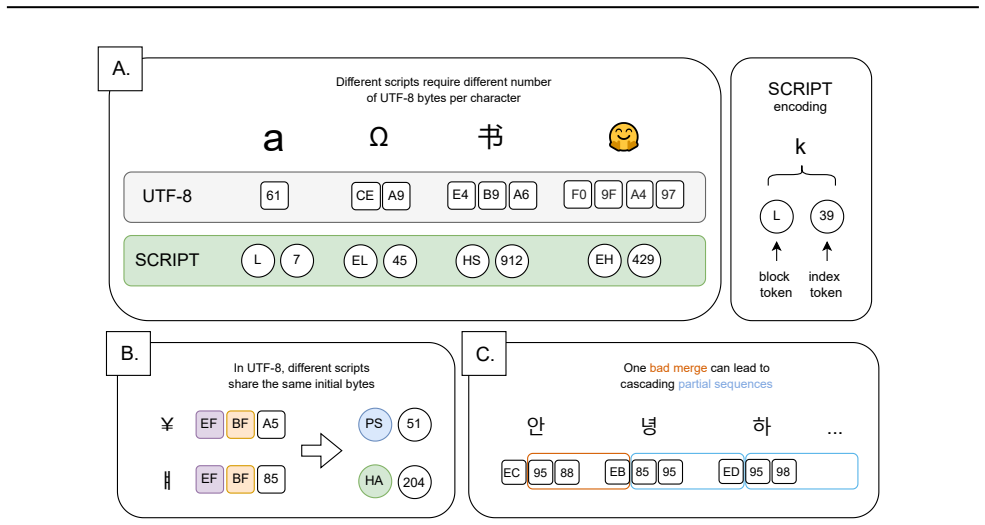
Pith's one-line read SCRIPT-BPE replaces UTF-8 bytes with script-based block and index token pairs, giving every character a uniform two-token cost, removing the byte premium and eliminating partial-character tokens.
desk verdict SCRIPT's two-token-per-character encoding plus constrained merges is a solid, useful tokenization result; just fix the overclaimed partial-UTF-8 elimination in §4.1 before it's citable. read the letter →
The pith
A machine-rendered reading of the paper's core claim, the machinery that carries it, and where it could break.
The reading
What carries the argument
The central object is the SCRIPT encoding: a bijective map from Unicode characters to ordered pairs of a block token and an index token, where the block is determined by Unicode Script plus one of five supercategories (Letters & Marks, Punctuation & Symbols, Numbers, Separators, Other) and large blocks are split into sub-blocks. This mapping gives every character a uniform two-token starting representation. The second piece is the constrained BPE merge: merges are allowed only between tokens that already represent one or more full characters, or between a block token and an index token that together form a complete character; the same rule applied to byte-level BPE only allows merges within a character's byte sequence or between complete characters. Together, the encoding and the merge constraint prevent the cascade of cross-character merges that creates partial UTF-8 tokens.
What would settle it
Train two otherwise identical multilingual language models, one with SCRIPT-BPE and one with byte-level BPE, and evaluate them on a battery of downstream tasks across scripts; if the SCRIPT model does not match or beat the byte-level model on at least some tasks despite equal or better compression, the central value claim fails, and a simpler check would be to count mixed full and partial UTF-8 tokens in the SCRIPT tokenizer's output, which the paper predicts to be zero.
Extended reading notes
Core claim
On its own terms, the central discovery is that UTF-8 byte conversion is not a necessary substrate for BPE. By assigning each Unicode character a block token from 468 script-supercategory sub-block combinations and an index token from 1448 possible indices, SCRIPT-BPE makes the initial cost of every character exactly two tokens, independent of script. A rule-based pretokenizer that groups consecutive characters sharing script and supercategory then performs as well as regex-based pretokenizers, and a constrained merge rule that forbids cross-character merges removes all tokens containing partial character sequences. Across monolingual and multilingual tokenizers, constrained SCRIPT-BPE reaches tokens-per-character values competitive with byte-level BPE using the o200k regex, while improving compression for scripts like Thai, Hindi, and Punjabi that the cl100k regex penalized. The paper explicitly stops short of claiming downstream model gains; it claims the encoding and merge constraints remove a known source of bias and fragility without sacrificing compression.
Load-bearing premise
The paper's value claim rests on the assumption that compression and the absence of partial-character tokens are good proxies for tokenizer quality and downstream model fairness; no language model is trained, so better token counts are not shown to produce better or fairer models.
Editorial extensions
If this is right
- Non-Latin scripts no longer carry an inherent token-count penalty: every character starts at two tokens, and final compression for Thai, Hindi, and Punjabi improves relative to the cl100k regex baseline.
- Constrained merges eliminate tokens with mixed full and partial UTF-8 sequences, removing a class of semantically empty tokens that risk invalid encodings and under-training.
- Rule-based SCRIPT pretokenization matches regex-based pretokenization on compression, so multilingual tokenizers do not have to depend on fragile regular expressions.
- The merge constraint also helps byte-level BPE, meaning existing byte-based pipelines can adopt it without switching encodings.
- Training time stays practical, about one hour with 16 CPUs for 256,000 merges, so the approach scales to large multilingual tokenizer training.
Reading between the lines
- Beyond the paper, uniform two-token character costs could change how multilingual models are priced and how context windows are consumed: if adopted, languages like Chinese and Thai would stop being charged a byte premium in token-based billing.
- Beyond the paper, the constrained merge rule is directly testable on existing byte-level tokenizers: retraining merges with the boundary constraint on a fixed corpus should reproduce the near-complete elimination of partial-character tokens reported here.
- Beyond the paper, because SCRIPT pretokenization is rule-based and script-aware, it may make tokenizer construction for low-resource languages easier and more predictable, though the paper does not evaluate low-resource downstream tasks.
- Beyond the paper, the paper's acknowledged gap suggests a direct next experiment: train identical models with SCRIPT-BPE and byte-level BPE and compare downstream multilingual performance and fairness, since the compression results alone do not establish either.
Editorial analysis
A structured set of objections, weighed in public.
Referee Report
Summary. The paper proposes SCRIPT (Script Category Representation in PreTokenization), a Unicode-script-and-category-based encoding that maps every character to exactly two initial tokens (a block token and an index token). It combines this encoding with a rule-based pretokenizer that groups characters by script and supercategory, and with a constrained BPE merge strategy that only merges complete characters (or, for byte-level BPE, completes a character's byte sequence before merging it with other complete characters). The authors evaluate compression as tokens per Unicode character and count tokens containing partial UTF-8 sequences, comparing SCRIPT-BPE against byte-level BPE with tiktoken's cl100k and o200k regex pretokenizers, in monolingual and multilingual settings. They report that SCRIPT-BPE achieves compression competitive with byte-level BPE while eliminating tokens with partial UTF-8 sequences and avoiding the byte-premium penalty.
Significance. If the results hold, the paper offers a clean, regex-free pretokenization framework that addresses a real problem: byte-level BPE's uneven initial token costs across scripts and its tendency to create tokens that mix full and partial UTF-8 sequences. The manuscript's strengths are its simple and reproducible design, the public implementation, and the benchmarking against widely used tiktoken-based baselines. The compression gains for Thai, Hindi, and Punjabi are substantial and practically relevant. However, the paper evaluates only tokenizer-level metrics; Section 5 explicitly concedes that compression does not guarantee better downstream model performance, and no language model is trained. Consequently, the contribution is a tokenizer-design demonstration rather than an end-to-end validation of improved multilingual modeling. The uniform two-token initial cost is a property of the encoding by construction, so the central empirical content is that final compression remains competitive after BPE merging and that partial-character tokens can be avoided; that content is plausible but needs the clarifications below.
major comments (4)
- [Section 4.1, Table 2] The text states that constraining BPE merges "eliminate[s] tokens with partial UTF-8 sequences" and the Discussion repeats that constrained merging "universally eliminated tokens representing a mix of full and partial characters." Table 2, however, reports 209 #Partial UTF-8 tokens for Bytes + cl100k regex with constrained merges and 183 for Bytes + o200k regex with constrained merges. If the #Partial UTF-8 column counts mixed full/partial-character tokens, these numbers directly contradict the claimed elimination; if it counts something else (e.g., tokens containing only partial byte sequences), the table header and text are misleading. Since the constrained-merge mechanism is a headline contribution, the authors should correct the claim, the metric definition, or the implementation so that the text and table are consistent.
- [Section 4.3, Table 4] All numerical comparisons are reported for a single training run without seeds, standard deviations, or significance tests. Many differences are minute: Japanese final tokens/character is 0.5249 (Bytes cl100k) versus 0.5267 (SCRIPT), German is 0.2128 versus 0.2138, and English is 0.2152 versus 0.2150. Given the manual design choices in the method (the block-split threshold, the supercategory reassignments in Appendix A, and the whitespace-separating script list in Appendix B), the reader cannot tell whether these differences are real or noise. Please report results over several seeds or otherwise provide variance estimates, and ideally a sensitivity analysis for the main design choices.
- [Section 4.1] The statement that constraining merges "is beneficial for all encodings and datasets" is not supported by the evidence shown. Table 2 reports only aggregated means over the monolingual corpora (mean tokens/char and mean #partial counts), not per-language or per-dataset values, and the compression improvements are described as "almost universal" without a per-language constrained-versus-unconstrained comparison. Please provide the per-language breakdown or soften the claim to match the presented evidence.
- [Abstract, Section 4.3, Table 4] The abstract's claim that SCRIPT-BPE "eliminates encoding-based penalties for non-Latin-script languages" conflates a design property with a measured outcome. The uniform initial cost of two tokens per character is true by construction of the block+index encoding, not an empirical finding. The final compression results are more mixed: SCRIPT rule-based is worse than the best byte-based baseline for Chinese (0.6537 vs. 0.6259) and Japanese (0.5393 vs. 0.5267), and roughly tied elsewhere. The paper should distinguish clearly between the definitional two-token initial cost and the empirical final-compression comparison, and the abstract should be toned down accordingly.
minor comments (4)
- [Section 5] The sentence "combining refining the handling of digits and leading spaces" is ungrammatical and should be revised.
- [Table 4] The grouped header is difficult to parse: the two "Init. Tokens/Char" columns (Bytes, SCRIPT) and the four "Final Tokens/Character" columns should be explicitly labeled so that the reader can tell which baseline each o200k column refers to.
- [Section 4] The text refers to "cl100k (GPT-4) and o200k (GPT-4o) variants" as if these were vocabularies; the paper elsewhere clarifies that only tiktoken's regex pretokenizers are used, but the shorthand is misleading and should be made explicit.
- [Appendix B] The space-merging rule relies on a manually specified list of whitespace-separating scripts; please state whether this list is intended to be exhaustive and how it was selected, since it is a free design choice that could affect the reported compression.
Circularity Check
One definitional property, the fixed two-initial-token cost of SCRIPT, is presented as an experimentally eliminated byte premium; the central compression comparisons remain empirical and non-circular.
-
self definitional
[Abstract and Section 1 (encoding overview); Section 3 (SCRIPT Encoding definition)]
"Our encoding uses two initial tokens to represent each character, eliminating crosslinguistic bias due to byte premium effects."
The elimination of the byte premium is not a derived prediction: SCRIPT is defined in Section 3 as mapping each Unicode character to exactly one block token and one index token, so every character costs exactly two initial tokens by construction. Table 4's Initial Tokens/Character column shows 2.00 for every SCRIPT row because the encoding is defined that way, not because an experiment established it. The abstract's stronger claim that experiments 'demonstrate ... eliminating encoding-based penalties for non-Latin-script languages' therefore reduces, for the initial encoding cost, to the encoding's own definition. The separate post-BPE compression results are genuinely empirical and do not reduce to this definition.
full rationale
The paper's central empirical content is the compression comparison in Tables 2 through 5, where SCRIPT-BPE and constrained byte-based BPE are measured against tiktoken-based baselines on monolingual and multilingual corpora. Those numbers are not fitted to any target result and do not reduce to the method's definitions, so the main compression claim is self-contained. The only step that reduces to its own input is the byte-premium elimination claim: because SCRIPT is defined as exactly two initial tokens per character, the absence of a variable per-character byte cost is a design guarantee rather than an experimentally discovered effect. The constrained-merge claim that partial UTF-8 tokens are eliminated is also a definitional consequence for SCRIPT, and it is partially contradicted for byte-based BPE by Table 2's residual counts of 209 and 183 mixed tokens; however, that is an internal consistency or correctness issue, not a circularity. The self-citations (Land & Bartolo 2024; Arnett et al. 2024; Land 2024) motivate the problem of partial tokens and byte premiums but do not carry the derivation of the compression results. Overall, the central contribution has independent empirical content, so the circularity score is low.
Assumptions & free parameters
free parameters (3)
- Block split threshold =
1,448 (size of Latin LM block)
- Supercategory grouping =
five supercategories: LM, PS, N, Z, C
- Whitespace-separating script list =
19 scripts listed in Appendix B
assumptions (4)
- domain assumption Unicode Script and Supercategory properties are meaningful units for pretokenization.
- domain assumption Compression in tokens per character is the relevant evaluation metric for tokenizer quality.
- domain assumption Excluding Unassigned, Private Use, and Surrogate code points is fair across baselines.
- domain assumption A complete-character merge constraint does not prevent BPE from finding competitive vocabularies.
Cite this review
Pith. "Pith review of BPE Stays on SCRIPT: Structured Encoding for Robust Multilingual Pretokenization." pith.science (2026). https://pith.science/paper/RS4K2CIL
@misc{pith2026250524689,
  author       = {Pith},
  title        = {Pith review of: BPE Stays on SCRIPT: Structured Encoding for Robust Multilingual Pretokenization},
  year         = {2026},
  howpublished = {\url{https://pith.science/paper/RS4K2CIL}},
  note         = {Machine review of arXiv:2505.24689}
}
read the original abstract
Byte Pair Encoding (BPE) tokenizers, widely used in Large Language Models, face challenges in multilingual settings, including penalization of non-Western scripts and the creation of tokens with partial UTF-8 sequences. Pretokenization, often reliant on complex regular expressions, can also introduce fragility and unexpected edge cases. We propose SCRIPT (Script Category Representation in PreTokenization), a novel encoding scheme that bypasses UTF-8 byte conversion by using initial tokens based on Unicode script and category properties. This approach enables a simple, rule-based pretokenization strategy that respects script boundaries, offering a robust alternative to pretokenization strategies based on regular expressions. We also introduce and validate a constrained BPE merging strategy that enforces character integrity, applicable to both SCRIPT-BPE and byte-based BPE. Our experiments demonstrate that SCRIPT-BPE achieves competitive compression while eliminating encoding-based penalties for non-Latin-script languages.
Figures

Reference graph
Works this paper leans on
-
[1]
wHy DoNt YoU jUsT uSe ThE lLaMa ToKeNiZeR?? Blog Post, 2024
Arnett, C. wHy DoNt YoU jUsT uSe ThE lLaMa ToKeNiZeR?? Blog Post, 2024. URL https://huggingface.co/blog/catherinearnett/dangers-of-tokenizer-recycling
work page 2024
-
[2]
Arnett, C., Chang, T. A., and Bergen, B. A Bit of a Problem: Measurement Disparities in Dataset Sizes across Languages . In Melero, M., Sakti, S., and Soria, C. (eds.), Proceedings of the 3rd Annual Meeting of the Special Interest Group on Under-resourced Languages @ LREC-COLING 2024, pp.\ 1--9, Torino, Italia, May 2024. ELRA and ICCL. URL https://aclanth...
work page 2024
-
[3]
A., Arnett, C., Tu, Z., and Bergen, B
Chang, T. A., Arnett, C., Tu, Z., and Bergen, B. K. Goldfish: Monolingual language models for 350 languages. arXiv preprint arXiv:2408.10441, 2024. URL https://arxiv.org/abs/2408.10441
arXiv 2024
-
[4]
Getting the most out of your tokenizer for pre-training and domain adaptation
Dagan, G., Synnaeve, G., and Roziere, B. Getting the most out of your tokenizer for pre-training and domain adaptation. In Forty-first International Conference on Machine Learning, 2024. URL https://openreview.net/forum?id=ZFYBnLljtT
work page 2024
-
[5]
Kudo, T. and Richardson, J. SentencePiece : A simple and language independent subword tokenizer and detokenizer for neural text processing. In Blanco, E. and Lu, W. (eds.), Proceedings of the 2018 Conference on Empirical Methods in Natural Language Processing: System Demonstrations, pp.\ 66--71, Brussels, Belgium, November 2018. Association for Computatio...
-
[6]
Pre-tokenization on punctuation in GPT-4
Land, S. Pre-tokenization on punctuation in GPT-4 . Blog Post, 2024. URL https://tokencontributions.substack.com/p/pre-tokenization-on-punctuation-in
work page 2024
-
[7]
Land, S. and Bartolo, M. Fishing for M agikarp: Automatically detecting under-trained tokens in large language models. In Al-Onaizan, Y., Bansal, M., and Chen, Y.-N. (eds.), Proceedings of the 2024 Conference on Empirical Methods in Natural Language Processing, pp.\ 11631--11646, Miami, Florida, USA, November 2024. Association for Computational Linguistic...
-
[8]
Jamo-level subword tokenization in low-resource K orean machine translation
Lee, J., Cognetta, M., Moon, S., and Okazaki, N. Jamo-level subword tokenization in low-resource K orean machine translation. In Ojha, A. K., Liu, C.-h., Vylomova, E., Pirinen, F., Washington, J., Oco, N., and Zhao, X. (eds.), Proceedings of the Eighth Workshop on Technologies for Machine Translation of Low-Resource Languages (LoResMT 2025), pp.\ 66--80, ...
work page 2025
Show all 19 references
-
[9]
MYTE : Morphology-driven byte encoding for better and fairer multilingual language modeling
Limisiewicz, T., Blevins, T., Gonen, H., Ahia, O., and Zettlemoyer, L. MYTE : Morphology-driven byte encoding for better and fairer multilingual language modeling. In Ku, L.-W., Martins, A., and Srikumar, V. (eds.), Proceedings of the 62nd Annual Meeting of the Association for...
2024 doi
-
[10]
A., and Choi, Y
Liu, A., Hayase, J., Hofmann, V., Oh, S., Smith, N. A., and Choi, Y. SuperBPE : Space travel for language models. arXiv preprint arXiv:2503.13423, 2025. URL https://arxiv.org/abs/2503.13423
2025 arXiv
-
[11]
and Low, B
Liu, T. and Low, B. K. H. Goat: Fine-tuned LLaMA outperforms GPT-4 on arithmetic tasks. arXiv preprint arXiv:2305.14201, 2023. URL https://arxiv.org/abs/2305.14201
2023 arXiv
-
[12]
V., Lai, V
Nguyen, T., Nguyen, C. V., Lai, V. D., Man, H., Ngo, N. T., Dernoncourt, F., Rossi, R. A., and Nguyen, T. H. CulturaX : A cleaned, enormous, and multilingual dataset for large language models in 167 languages, 2023. URL https://arxiv.org/abs/2309.09400
2023 arXiv
-
[13]
tiktoken: a fast BPE tokeniser for use with OpenAI 's models., 2024
OpenAI. tiktoken: a fast BPE tokeniser for use with OpenAI 's models., 2024. URL https://github.com/openai/tiktoken
2024
-
[14]
W., Reddy, V., Zhang, H., Alameddine, A., Uzan, O., Pinter, Y., and Tanner, C
Schmidt, C. W., Reddy, V., Zhang, H., Alameddine, A., Uzan, O., Pinter, Y., and Tanner, C. Tokenization is more than compression. In Al-Onaizan, Y., Bansal, M., and Chen, Y.-N. (eds.), Proceedings of the 2024 Conference on Empirical Methods in Natural Language Processing, pp.\...
2024 doi
-
[15]
W., Reddy, V., Tanner, C., and Pinter, Y
Schmidt, C. W., Reddy, V., Tanner, C., and Pinter, Y. Boundless Byte Pair Encoding: Breaking the Pre-tokenization Barrier . arXiv preprint arXiv:2504.00178, 2025. URL https://arxiv.org/abs/2504.00178
2025
-
[16]
Neural Machine Translation of Rare Words with Subword Units
Sennrich, R., Haddow, B., and Birch, A. Neural Machine Translation of Rare Words with Subword Units . In Erk, K. and Smith, N. A. (eds.), Proceedings of the 54th Annual Meeting of the Association for Computational Linguistics (Volume 1: Long Papers), pp.\ 1715--1725, Berlin, G...
2016 doi
-
[17]
Singh, A. K. and Strouse, D. Tokenization counts: the impact of tokenization on arithmetic in frontier llms. arXiv preprint arXiv:2402.14903, 2024. URL https://arxiv.org/abs/2402.14903
2024 arXiv
-
[18]
and Sarveswaran, K
Velayuthan, M. and Sarveswaran, K. Egalitarian Language Representation in Language Models: It All Begins with Tokenizers . In Rambow, O., Wanner, L., Apidianaki, M., Al-Khalifa, H., Eugenio, B. D., and Schockaert, S. (eds.), Proceedings of the 31st International Conference on ...
2025
-
[19]
Tokenization is Sensitive to Language Variation
Wegmann, A., Nguyen, D., and Jurgens, D. Tokenization is Sensitive to Language Variation . arXiv preprint arXiv:2502.15343, 2025. URL https://arxiv.org/abs/2502.15343
2025 arXiv
Reviewed August 7, 2026 · model on record in the stance chip above.
Discussion (0). Sign in to comment.