REVIEW 3 major objections 6 minor 51 references
Heavy Ion Double Charge Exchange Reactions as Probes for Two-Body Transition Densities
T0 review · 3 major / 6 minor · reviewed 2026-08-07 · deepseek-v4-flash
Pith's one-line read Collisions can expose the two-body nuclear densities behind double-beta decay.
desk verdict A genuinely new s-channel recoupling of the DCE amplitude, but the 'probe-independent' 2BTD claim needs a cutoff-stability check and an explanation of the 35% t-channel discrepancy before it is established. read the letter →
The pith
A machine-rendered reading of the paper's core claim, the machinery that carries it, and where it could break.
The reading
What carries the argument
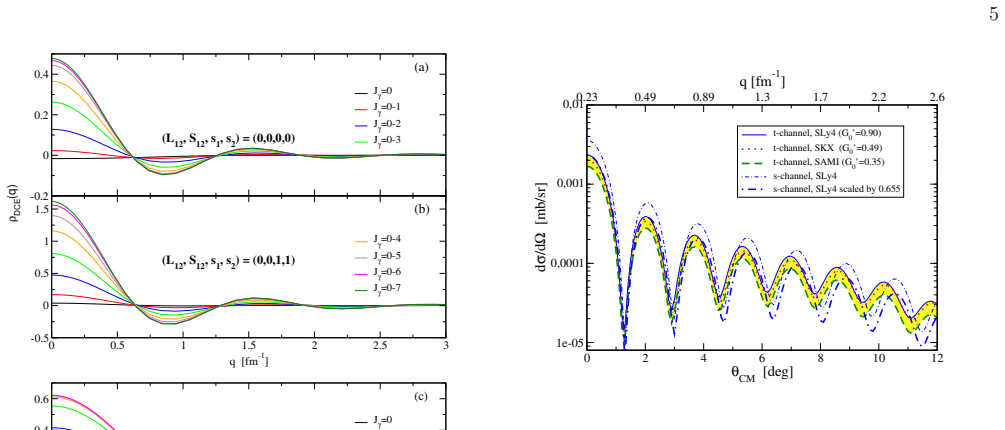
The engine is the s-channel recoupling of the second-order distorted-wave amplitude. A rotation in spin–angular-momentum space converts the t-channel polarization tensor — products of one-body single-charge-exchange form factors of the projectile and target at each interaction step — into products of two-body DCE form factors of each nucleus; then the 'average approximation' replaces the intermediate propagator by its pole-dominated logarithmic value $L^{(+)}_{\gamma}(\omega_\alpha)$ and performs the integral over the momentum-difference variable $v=p_1-p_2$ with a cutoff $\bar{v}\approx 2.1$–$2.2$ fm$^{-1}$, calibrated so the $q=0$ form factor saturates about 95% of the transition strength. What emerges is the two-body transition density $\rho^{J_AJ_BI_A}_{LS}(q)$, defined through $F^{\mathrm{(BCA)}}_{SM}(q)=(2\pi)^3 V_v^{-1}\int d^3r\, e^{iq\cdot r}\,[F^{\mathrm{(BC)}}_{S_2}(r)\otimes F^{\mathrm{(CA)}}_{S_1}(r)]_{SM}$, and this object carries the spectroscopic content of the whole amplitude. The recast matrix element then looks like a one-step SCE amplitude, with the 2BTD as the factor that connects the measured cross section to the nuclear structure of double-$\beta$-decay candidates.
What would settle it
Measure the $^{18}\mathrm{O}+{}^{76}\mathrm{Se}\to{}^{18}\mathrm{Ne}+{}^{76}\mathrm{Ge}$ DCE angular distribution at $T_{\mathrm{lab}}=270$ MeV beyond $\theta_{\mathrm{CM}}\approx 5^\circ$, where the s- and t-channel predictions run out of phase, and recompute the two-body transition densities with the cutoff $\bar{v}$ varied over roughly 1.5–3 fm$^{-1}$; the central claim fails if no single normalization reconciles the two schemes across the full angular range and if the extracted densities shift appreciably with $\bar{v}$.
Extended reading notes
Core claim
The central claim is that the entire double sequential charge exchange (DSCE) transition matrix element can be rewritten, in the s-channel interaction form, as an expression structurally identical to a single-step charge-exchange amplitude: $M^{(2)}_{\beta\alpha} \simeq L^{(+)}_{\gamma}(\omega_\alpha)\sum_{S_1,S_2}\sum_{S,M}(-1)^{S_1+S_2+S-M}\sum_{c,C}\int d^3q\, F^{\mathrm{(BCA)}}_{SM}(q)\,F^{\mathrm{(bca)}}_{S-M}(q)\,\tilde{V}^{\mathrm{DSCE}}_{S_1S_2}(q)\,D_{\alpha\beta}(q)$, with an effective four-body form factor built from the product of a target and a projectile two-body DCE form factor. Because the distortion amplitude $D_{\alpha\beta}(q)$ and the effective rank-2 isotensor vertex $\tilde{V}^{\mathrm{DSCE}}_{S_1S_2}(q)$ multiply the two-body form factors from outside, the two-body transition densities $\rho^{J_AJ_BI_A}_{LS}(q)$ appear as probe-independent spectroscopic quantities, cleanly separated from the reaction mechanism. Applied to $^{18}\mathrm{O}+{}^{76}\mathrm{Se}\to{}^{18}\mathrm{Ne}+{}^{76}\mathrm{Ge}$ at $T_{\mathrm{lab}}=270$ MeV with three effective interactions of increasing spin–isospin coupling, the s-channel 'average approximation' cross section follows the t-channel result up to about $5^\circ$ after a single rescaling by 0.655, and the extracted densities are dominated by Fermi-like and Gamow-Teller-like components while rank-2 tensor contributions average to negligible size.
Load-bearing premise
The load-bearing premise is that the extracted two-body densities are insensitive to the 'average approximation' cutoff $\bar{v}$, fixed at 2.1 fm$^{-1}$ (projectile) and 2.2 fm$^{-1}$ (target) by requiring the $q=0$ form factor to saturate about 95% of the transition strength, and that the single 0.655 rescaling that aligns the s-channel cross section with the t-channel at zero angle reflects calibration rather than a missing physical effect.
Editorial extensions
If this is right
- Collisional DCE reactions become a spectroscopic tool for the two-body transition densities that enter double-beta-decay matrix elements, so a measured cross section can be mapped onto the structure of candidates such as $^{76}\mathrm{Ge}$.
- The same two-body transition densities govern both the sequential (DSCE) and the Majorana (MDCE) mechanisms, so a single measured density constrains two physically distinct reaction paths.
- Because the 2BTD are separated from the distortion and vertex factors, densities extracted from DCE data are transferable and can be compared directly with double-beta-decay theory and with other reactions.
- Rank-2 spin-tensor contributions to the 2BTD vanish after the momentum-difference average, so Fermi ($L=S=0$) and Gamow-Teller ($L=S=1$) components dominate the DCE response.
- The factorization is expected to be more accurate for mass-asymmetric systems, which favours extracting 2BTD from DCE reactions with a light projectile on a heavy target such as $^{76}\mathrm{Ge}$.
Reading between the lines
- If the factorization survives against data, DCE cross sections could in principle be inverted to obtain an empirical two-body transition density for double-beta-decay candidates — a quantity no existing measurement provides directly; the paper stops short of claiming an inversion procedure.
- The cross section's sensitivity to the spin–isospin coupling of the effective interaction suggests that precise DCE data could pin down the isovector part of the interaction in a regime where single charge exchange leaves it underdetermined — a testable consequence of the paper's framework.
- The single 0.655 rescaling needed at zero angle may itself encode the off-shell behaviour of intermediate states; comparing systems of different projectile–target mass asymmetry could tell whether the residual s–t discrepancy is calibration noise or a physical signal.
- A natural cross-check would be to use the extracted 2BTD to predict other DCE transitions between different states of the same nuclei, or to compare their momentum-transfer dependence with two-neutrino double-beta-decay form factors.
Editorial analysis
A structured set of objections, weighed in public.
Referee Report
Summary. The manuscript develops a theoretical formalism for heavy-ion double charge exchange (DCE) reactions mediated by second-order nucleon-nucleon interactions. Starting from the second-order distorted-wave amplitude, the authors recouple the polarization tensor from the standard t-channel representation into an s-channel form, obtaining Eq. (8), in which the DSCE transition matrix element factorizes into an effective four-body transition form factor built from two-body DCE form factors, an effective isotensor interaction, and a distortion amplitude. Two-body transition densities (2BTD) are introduced through an 'average approximation' with a finite momentum cutoff. The formalism is applied to 18O + 76Se -> 18Ne + 76Ge at 270 MeV, with QRPA input from three Skyrme forces, and s-channel cross sections are compared with t-channel results. The central claim is that DCE reactions give direct access to probe-independent two-body transition densities relevant for double-beta-decay matrix elements.
Significance. If the central claim is established, the paper would open a genuinely new spectroscopic window: heavy-ion DCE reactions would provide experimental access to two-body spin-isospin transition densities that are difficult to probe by other means and are directly connected to double-beta-decay physics. The formal recoupling leading to Eq. (8) is a nontrivial and elegant step, and the numerical implementation is careful in several respects: three Skyrme interactions are compared, multipole sums are shown to saturate, and Ikeda-type sum rules are checked to better than 1%. The derivation is not circular: the 2BTD are computed microscopically from QRPA rather than extracted from the reaction. However, the probe-independent status of the extracted densities is not yet demonstrated. The 2BTD depend on the calibrated cutoff \bar v used in the 'average approximation', and the s-channel cross section must be rescaled by an empirical factor 0.655 to match the t-channel at forward angles, with the two calculations running out of phase at larger momentum transfer. These issues affect the central claim, so the paper requires substantial additional analysis before it can be accepted.
major comments (3)
- [Eq. (7) and the definition of the 'average approximation'] The two-body transition density rho_DCE(q) defined in Eq. (7) depends on the finite integration volume Vv through the prefactor (2*pi)^3/Vv and through the restriction of the d^3v integral to a sphere of radius \bar v. The cutoff is fixed only by requiring that the q=0 form factor saturates the transition strength at about 95%, giving \bar v = 2.1 fm^-1 for the projectile and 2.2 fm^-1 for the target. The paper does not show that the q-dependence of rho_DCE(q) is stable under changes of \bar v, despite the fact that Eq. (8) claims to separate a probe-independent spectroscopic quantity from reaction dynamics. Because the very definition of the 2BTD is tied to this calibrated cutoff, this is a load-bearing gap. Please provide a \bar v-stability analysis, for example by varying \bar v by +/-10-20% and displaying the resulting changes in rho_DCE(q) and in the s-channel cross section.
- [Fig. 4 and the comparison of s- and t-channel results] The s-channel cross section overestimates the t-channel result by about 35% at forward angles, and the two calculations run out of phase beyond approximately theta=5 degrees, corresponding to momentum transfers above about 1 fm^-1. The scaling of the s-channel curve by 0.655 is an empirical renormalization, not a prediction of the formalism, and the phase disagreement is largest in the momentum region where the 2BTD carry most of their structural information. The statement that cutoff uncertainties can be controlled by referencing t-channel results at q approximately 0 calibrates the s-channel at a single point; it does not explain the 35% normalization or the phase mismatch. Moreover, the authors note that similar discrepancies are observed for other Skyrme forces, indicating a systematic effect. Please either derive the normalization and phase behavior from the approximations made in the s-channel reduction, or demonstrate quantitatively that these discrepancies do not propagate into the extracted 2BTD.
- [Normalization of L(+)gamma before Fig. 4] The channel-independent normalization |L(+)_gamma(omega_alpha)| approximately 1/300 MeV^-1 is introduced in order to reproduce, within the t-channel scheme, the full distorted-wave results. Since L(+)_gamma appears as an overall multiplicative factor in the s-channel amplitude, Eq. (8), this is a calibration of the mapping from reaction observables to 2BTD rather than a quantity computed from the mean-energy approximation. The paper should show that L(+)_gamma can be determined without fitting to the t-channel results, or at least demonstrate that the extracted 2BTD are insensitive to its value over a reasonable range. Without this, the predictive content of the s-channel factorization is weakened.
minor comments (6)
- [Eqs. (6)-(7)] The notation is confusing because v is first defined as the integration variable (p1 - p2), while the same symbol v is used for the cutoff radius in Vv = 4*pi*v^3/3. Please use distinct symbols, for example u for the integration variable and \bar v for the cutoff radius.
- [Text after Eq. (10)] There is a typo in 'stregths', which should be 'strengths'.
- [Illustrative results section] The text says 'ISI and IFI' where IFI is presumably a typo for FSI (final-state interaction).
- [Fig. 4] The upper axis of Fig. 4 is labeled 'q [fm^-1]' while the text refers to the momentum transfer k_alpha_beta; please make the notation consistent.
- [Fig. 3 caption] The caption uses '18Negs' without defining the notation; please write '18Ne ground state'.
- [Fig. 2] The color-scale panels in Fig. 2 appear to use a diverging color map, but no color bar or numerical scale is provided, so the reader cannot read quantitative values; please add one. The panels should also be labeled with the corresponding (L, S, S1, S2) values.
Circularity Check
No significant circularity: the 2BTD are computed microscopically rather than fitted to the reaction, and the acknowledged calibrations do not reduce the central claim to its inputs.
full rationale
The central derivation, Eq. (8), is a reformulation of the second-order distorted-wave amplitude after angular-momentum recoupling and a finite-volume momentum average; it is an identity given the definitions in Eqs. (4)–(7), not a fit. The 2BTD are computed from QRPA with Skyrme forces, not extracted from DCE data. The cutoff v̄ is calibrated by requiring F(q=0) saturates at ~95%, but the paper explicitly labels this as an 'average approximation' and states that cutoff uncertainties can be checked against t-channel results; this is a model calibration, not a prediction. Similarly, the |L| ≈ 1/300 MeV^-1 normalization and the 0.655 scaling used in Fig. 4 are acknowledged adjustments to compare s- and t-channel schemes, and the paper does not present the s-channel cross section as an independent prediction. The mean-energy approximation is cited to the authors' prior work [27,28,31], but the paper also points to a supplemental derivation; while self-citations are numerous, the load-bearing formalism is displayed in the paper's own equations. No specific step reduces by construction to its inputs.
Assumptions & free parameters
free parameters (3)
- cutoff radius v̄ in average approximation =
2.1 fm^-1 (projectile), 2.2 fm^-1 (target)
- overall normalization |L(+)γ(ωα)| =
≈ 1/300 MeV^-1
- s-channel rescaling factor =
0.655
assumptions (5)
- domain assumption The intermediate-state propagator can be averaged over an energy interval around the pole and replaced by a kγ-independent logarithmic function L(+)γ (mean-energy approximation).
- domain assumption The DCE reaction is dominated by the sequential single charge exchange (DSCE) mechanism driven by second-order NN T-matrix with π/ρ exchange; competing Majorana DCE is neglected.
- domain assumption QRPA SCE-TMEs from the final nuclei to intermediate states approximate the second-step transitions, neglecting non-orthogonality problems.
- domain assumption Intermediate states up to 50 MeV excitation and multipolarities up to Jπ=7± exhaust the SCE response; Ikeda sum rules satisfied within 1%.
- domain assumption Skyrme-QRPA with SAMI, SKX, SLy4 forces provides reliable ground and excited states and covers model spread via G0' parameter.
Cite this review
Pith. "Pith review of Heavy Ion Double Charge Exchange Reactions as Probes for Two-Body Transition Densities." pith.science (2026). https://pith.science/paper/OL2LSC5G
@misc{pith2026250524753,
  author       = {Pith},
  title        = {Pith review of: Heavy Ion Double Charge Exchange Reactions as Probes for Two-Body Transition Densities},
  year         = {2026},
  howpublished = {\url{https://pith.science/paper/OL2LSC5G}},
  note         = {Machine review of arXiv:2505.24753}
}
abstract
Collisional heavy ion double charge exchange (DCE) reactions, induced by second order nucleon-nucleon interactions, are shown to provide access to the two-body transition densities of the complementary DCE transitions in the interacting nuclei. Corresponding two-body operators are introduced, treating the second order distorted wave reaction amplitude in the s-channel interaction form. The theoretical results are applied to the reaction $^{18}O+{}^{76}Se\to {} ^{18}Ne+{}^{76}Ge$ at $T_{lab}=270$~MeV, being $^{76}Ge$ a candidate for neutrino--less double beta decay.
Figures


Figures from the paper (1 more)

Reference graph
Works this paper leans on
- [1]
-
[2]
C. Walz, H. Scheit, N. Pietralla, et al. , Nature 526, 406409 (2015)
work page 2015
-
[3]
P.A. S¨ oderstr¨ om, L. Capponi,E. A¸ ciks¨ ozet al. , Nat. Commun. 11, 3242 (2020)
work page 2020
- [4]
-
[5]
F. T. Avignone, S. R. Elliott, and J. Engel, Rev. Mod. Phys. 80, 481 (2008)
2008
-
[6]
Ejiri, J
H. Ejiri, J. Suhonen, and K. Zuber, Phys. Rep. 797, 1 (2019)
2019
- [7]
-
[8]
T. R. Rodr ´ ıguez, G. Mart ´ ınez-Pinedo, Phys. Lett. B719, 174-178 (2013)
work page 2013
Show all 51 references
-
[9]
Kotila and F
J. Kotila and F. Iachello, Phys. Rev. C 103, no.4, 044302 (2021)
2021
-
[10]
Nit ¸escu, S
O. Nit ¸escu, S. Ghinescu, S. Stoica and F. ˇSimkovic, Uni- verse 10, no.2, 98 (2024)
2024
-
[11]
Siciliano, M.D
E.R. Siciliano, M.D. Cooper, M.B. Johnson, M.J. Leitch , Phys. Rev. C 34, 267 (1986)
1986
-
[12]
Siciliano, M.B
E.R. Siciliano, M.B. Johnson, H. Sarafian, Annals Phys. 203, 1-75 (1990)
1990
-
[13]
M. B. Johnson and C. L. Morris, Ann. Rev. Nucl. Part. Sci. 43, 165-208 (1993)
1993
-
[14]
Gilman, H.T
R.A. Gilman, H.T. Fortune, M.B. Johnson, E.R. Sicil- iano, H. Toki, A. Wirzba, B.A. Brown, Phys. Rev. C 34, 1895-1899 (1986)
1986
-
[15]
Auerbach, W.R
N. Auerbach, W.R. Gibbs, E. Piasetzky, Phys. Rev. Lett. 59, 1076-1079 (1987)
1987
-
[16]
Auerbach, W.R
N. Auerbach, W.R. Gibbs, J.N. Ginocchio, W.B. Kauf- mann, Phys. Rev. C 38, 1277-1296 (1988)
1988
-
[17]
Auerbach, Annals Phys
N. Auerbach, Annals Phys. 197, 376-395 (1990)
1990
-
[18]
Auerbach, Symposium on Twenty Years of Meson Factory Physics, 47-58 (1996)
N. Auerbach, Symposium on Twenty Years of Meson Factory Physics, 47-58 (1996)
1996
-
[19]
Haxton, Symposium on Twenty Years of Meson Factory Physics, 289-297 (1997)
W.C. Haxton, Symposium on Twenty Years of Meson Factory Physics, 289-297 (1997)
1997
-
[20]
Blomgren et al
J. Blomgren et al. , Phys. Lett. B 362, 34-38 (1995)
1995
-
[21]
Naulin, C
F. Naulin, C. D´ etraz, M. Roy-St´ ephan, M. Bernas, J. de Boer, D. Guillemaud, M. Langevin, F. Pougheon, and P. Roussel, Phys. Rev. C 25, 1074-1075 (1982)
1982
-
[22]
D. M. Drake, J. D. Moses, J. C. Peng, N. Stein, and J. W. Sunier. Phys. Rev. Lett. 45, 1765-1769 (1980)
1980
-
[23]
D.R. Bes, O. Drag´ un, and E.E. Maqueda. Nuclear Physics A 405(2), 313-347 (1983)
1983
-
[24]
C. H. Dasso and A. Vitturi. Phys. Rev. C 34, 743-745 (1986)
1986
-
[25]
Ejiri, Universe 8(9), 457 (2022)
H. Ejiri, Universe 8(9), 457 (2022)
2022
-
[26]
Cappuzzello et al
F. Cappuzzello et al. , Prog. Part. Nucl. Phys., 128, 103999 (2023)
2023
-
[27]
Lenske, J
H. Lenske, J. Bellone, M. Colonna, and D. Gambacurta. Universe, 7(4), 98 (2021)
2021
-
[28]
Lenske, J
H. Lenske, J. Bellone, M. Colonna, D. Gambacurta, and J.-A. Lay. Universe, 10, 93 (2024)
2024
-
[29]
Lenske, F
H. Lenske, F. Cappuzzello, M. Cavallaro, and M. Colonna. Prog. Part. Nucl. Phys., 109, 103716 (2019)
2019
-
[30]
See Supplemental material at [url] for more details
-
[31]
Lenske, J
H. Lenske, J. Bellone, M. Colonna, and J.A. Lay. Phys. Rev., C 98, 044620 (2018)
2018
-
[32]
Bellone, S
J. Bellone, S. Burrello, M. Colonna, J.A. Lay, and H. Lenske, Phys. Lett. B, 807, 135528 (2020)
2020
-
[33]
Barea, J
J. Barea, J. Kotila, F. Iachello, Phys. Rev. C 91, 034304 (2015)
2015
-
[34]
Roca-Maza, H
X. Roca-Maza, H. Sagawa, and G. Col´ o, Phys. Rev. C 101, 014320 (2020)
2020
-
[35]
V. dos S. Ferreira, A. R. Samana, F. Krmpoti´ c, and M. Chiapparini, Phys. Rev. C 101, 044314 (2020)
2020
-
[36]
Kauppinen and J
E. Kauppinen and J. Suhonen, Phys. Rev. C 106, 064315 (2022)
2022
-
[37]
Shimizu, J
N. Shimizu, J. Men´ endez, and K. Yako, Phys. Rev. Lett. 120, 142502 (2018)
2018
-
[38]
Santopinto, H
E. Santopinto, H. Garc ´ ıa-Tecocoatzi, R. I. Maga˜ na Vsevolodovna, and J. Ferretti (NUMEN Collaboration) Phys. Rev. C 98, 061601(R) (2018)
2018
-
[39]
Ejiri, L
H. Ejiri, L. Jokiniemi and J. Suhonen, Phys. Rev. C 105, L022501 (2022)
2022
-
[40]
Wang, P.W
Y.K. Wang, P.W. Zhao, J. Meng, Phys. Lett. B 855, 138796 (2024)
2024
-
[41]
Cappuzzello et al
F. Cappuzzello et al. , Int. J. Mod. Phys. A 36(30), 2130018 (2021)
2021
-
[42]
Cavallaro et al
M. Cavallaro et al. ,. Front. Astron. Space Sci. 8, 659815 (2021)
2021
- [43]
-
[44]
Roca-Maza, G
X. Roca-Maza, G. Col` o, and H. Sagawa. Phys. Rev. C 86, 031306(R) (2012)
2012
-
[45]
Brown, Phys
B.A. Brown, Phys. Rev. C 58, 220 (1998)
1998
-
[46]
Chabanat, J
E. Chabanat, J. Meyer, P. Bonche, R. Schaeffer, and P. Haensel. Nucl. Phys. A 627, 710-746 (1997)
1997
-
[47]
I. S. Towner Phys. Rep. 155, 263 (1987)
1987
-
[48]
Bender, J
M. Bender, J. Dobaczewski, J. Engel and W. Nazarewicz Phys. Rev. C 65, 054322 (2002)
2002
-
[49]
M. N. Harakeh and A. van der Woude, Giant Resonances: Fundamental High-Frequency Modes of Nuclear Excita- tion, (Oxford University Press, Oxford, 2001)
2001
-
[50]
Pacearescu, V
L. Pacearescu, V. Rodin, F. Simkovic and A. Faessler, Phys. Rev. C 68, 064310 (2003) [erratum: Phys. Rev. C 75, 059902 (2007)]
2003
-
[51]
Lenske, J
H. Lenske, J. Bellone, M. Colonna, and D. Gambacurta. Universe 10(5), 202 (2024)
2024
Reviewed August 7, 2026 · model on record in the stance chip above.
Discussion (0). Sign in to comment.