REVIEW 4 major objections 7 minor 59 references
From Macro to Micro: Probing Dataset Diversity in Language Model Fine-Tuning
T0 review · 4 major / 7 minor · reviewed 2026-08-07 · deepseek-v4-flash
Pith's one-line read The paper claims that controlling the variety of mid-frequency tokens in model responses is a more effective lever for fine-tuned LLM quality than instruction-level diversity controls, with maximum token diversity producing the best models.
desk verdict A useful taxonomy and a plausible response-diversity effect, but the effect is entangled with sequence length and the single-run design leaves the headline claim under-supported. read the letter →
The pith
A machine-rendered reading of the paper's core claim, the machinery that carries it, and where it could break.
The reading
What carries the argument
The central object is the 'mid band' of the token frequency spectrum: tokens whose corpus counts lie between 10 and 500, which a manual inspection identifies as the carriers of semantic content, between high-frequency function words and low-frequency names, loanwords, and typos. Two algorithms make diversity controllable at this grain: inverse greedy pruning removes samples that contribute the fewest unique mid-band tokens until a target token-type count is reached, and token-aware sampling then selects samples to reach the fixed dataset size while keeping all target token types covered. The connecting mechanism is token-level exposure during autoregressive training: because every output token is a supervised training signal, a flatter and broader token distribution in responses is proposed to reduce overfitting and improve generalization.
What would settle it
A decisive test is to build two fixed-size response datasets matched on instruction set, response length distribution, topic mixture, and per-sample quality, differing only in mid-band token coverage, and check whether the higher-coverage set still wins; if the performance gap vanishes once those covariates are matched, the mid-band diversity claim is not causal. A second check is threshold invariance: shifting the band boundaries (for example to 5–1000) should preserve the effect if the band is the true carrier of semantic diversity.
Extended reading notes
Core claim
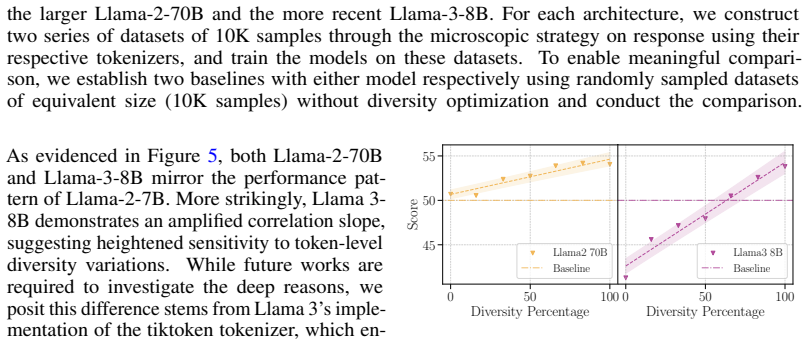
The paper's central claim is that the microscopic strategy—controlling how many distinct mid-band tokens appear in the responses of an SFT dataset—is the strongest diversity lever available, stronger than macroscopic topic-semantics diversity and stronger than mesoscopic tag diversity, on both the instruction and response components. Evidence comes from fixed-size datasets with diversity scaled from minimal to maximal under each strategy; the response-token strategy has the steepest positive slope between diversity percentage and benchmark score across three dataset sizes and across three model families in ablations, and at 100% diversity it reaches the highest scores in the comparison. The authors' explanation is direct: language models are supervised on response tokens and decode token by token, so broadening the token distribution in responses mitigates overfitting and makes the trained model generalize across varied tokens. They also show that the effect is not explained by response length, that it requires the model's own tokenizer rather than word segmentation, and that response information entropy—the flattest token distribution—correlates most with performance.
Load-bearing premise
The load-bearing assumption is that the 'mid band' of tokens—those appearing between 10 and 500 times in the corpus—carries most of the semantic meaning, so that increasing their variety is a clean intervention on diversity; if that threshold is arbitrary, or if the pruning and sampling also change response length, topic mix, or response quality, then the observed performance gains could come from a confound rather than from token diversity itself.
Editorial extensions
If this is right
- Fixed-size SFT datasets can be sorted by marginal mid-band token coverage, and curators who select for that coverage should expect higher downstream performance than curators who select for topic or tag variety alone.
- A smaller but token-diverse dataset can outperform a larger but less diverse one, so response token diversity is a concrete way to train stronger models under limited data or compute budgets.
- Instruction-side diversity remains useful, but its achievable score range is narrower; topic and tag diversity should be treated as complements rather than substitutes for response-token diversity.
- Tokenizer choice is part of the method: diversity measured with word segmentation does not produce the same gain, so the target model's own tokenizer should be used when constructing the training set.
- Maximizing mid-band token coverage is a safe default: across the tested sizes and model families, the highest diversity level consistently gives the best or near-best performance.
Reading between the lines
- Editorial inference: the paper's own correlation data point to response information entropy as an even more direct objective than mid-band coverage; optimizing full-vocabulary entropy rather than mid-band token types might further improve performance and deserves a head-to-head test.
- Editorial inference: the 10-to-500 threshold is likely corpus- and tokenizer-dependent; if the mechanism is causal, the correct band should scale with corpus size and vocabulary, and a principled rule for setting it would make the method portable to other data regimes.
- Editorial inference: because response-token diversity and instruction diversity appear to act independently, a combined strategy that controls both axes at once may produce compounding gains, which the paper leaves as future work.
- Editorial inference: the strongest practical test is whether token-diverse response selection also improves performance when responses come from the original, lower-quality data sources rather than regenerated ones; the paper reports an ablation with original responses, but a systematic comparison across quality levels would settle the scope.
Editorial analysis
A structured set of objections, weighed in public.
Referee Report
Summary. The paper investigates dataset diversity in supervised fine-tuning (SFT) of large language models, organizing diversity-control strategies into three granularities—macroscopic (semantic clustering), mesoscopic (tagging), and microscopic (token-level)—and applying them to both the instruction and response components of SFT data. It proposes a new microscopic response-diversity method based on the variety of mid-frequency tokens, constructs fixed-size datasets (10K, 20K, 30K) at diversity scales from minimal to maximal, fine-tunes Llama-2-7B (plus Llama-3-8B and Llama-2-70B in ablations), and evaluates with an LLM judge. The central empirical claim is that the microscopic response strategy shows a stronger correlation between diversity and model performance and achieves the best performance at maximum diversity compared with all other strategies. The paper also analyzes posterior diversity metrics and reports ablations on model family, tokenizer, length control, and additional benchmarks.
Significance. If the central finding is upheld, the paper provides a practical, token-level criterion for SFT data curation that goes beyond instruction-level diversity and aligns with the supervised-signal nature of SFT. The strengths of the paper are its systematic taxonomy, the breadth of the comparison (three strategies, two components, three dataset sizes), the inclusion of multiple diversity metrics, and the additional robustness checks via alternative judges, model families, tokenizers, and non-LLM benchmarks (MMLU, LiveBench). The algorithmic descriptions in Algorithms 1-2 are sufficiently detailed to be reimplemented, though no code is provided. The main risks are that the headline result may be confounded with response length, that the experiments lack repeated-seed uncertainty quantification, and that the token-frequency-band definition rests on a manual and unvalidated choice.
major comments (4)
- [§3.2, §4.2, Figure 4, Figure 6(a)]
- [§3.1, Table 2]
- [§2.2, Figure 2]
- [§2.3, Appendix B, Table 4]
minor comments (7)
- [§3.1.2]
- [Table 2]
- [Appendix A]
- [§4.2]
- [§3.2, Appendix E]
- [Figure 4]
- [§2.3, Appendix H]
Circularity Check
One mild self-referential validation step (IE as confirmation of the entropy-like micro objective); the central empirical claim is not circular.
-
self definitional
[Section 3.2 (Tests of Diversity Metrics), paragraph on information entropy; related to Section 2.2 and Appendix E.]
"The information entropy metric relates to the core mechanism of our microscopic strategy, with the slight difference that the strategy optimizes the entropy over the set of mid-band tokens and the metric computes over the whole vocabulary set. Moreover, the strong correlation with information entropy implies the effectiveness of the microscopic strategy."
The micro strategy's diversity scale is defined as the proportion of unique important (mid-band) token types, and Algorithms 1-2 are designed to maximize coverage of those token types. Information entropy over the token distribution is the same variety measure at whole-vocabulary granularity. The paper uses the IE-performance correlation as evidence that the micro strategy is effective ('implies the effectiveness of the microscopic strategy'), but since the strategy is constructed to increase this very entropy, a positive IE correlation is expected by construction and cannot serve as independent confirmation. The performance scores are externally measured, so the main diversity-performance claim is empirical; only this confirmatory metric is partially self-referential.
full rationale
The central claim (response-micro diversity has stronger correlation and best max-diversity performance) rests on measured fine-tuning scores across constructed datasets, not on a derivation from the strategy's definition. The x-axis diversity scale is indeed the controlled token-type coverage, but the y-axis scores come from external pairwise evaluations; slopes in Table 2 are empirical fits, not predictions forced by construction. No load-bearing self-citation: the in-house Nemotron judge ([43], co-authored by Y. Dong) is used for evaluation and response generation, but its agreement with GPT-4 Turbo is checked (8% reversal) and alternative judges reproduce the trend, so it does not by itself determine the conclusion. The only circular element is Section 3.2's use of information entropy as evidence of effectiveness: IE is essentially the whole-vocabulary version of the entropy over mid-band tokens that the micro strategy optimizes, so that correlation is partly self-referential. This does not affect the independent empirical comparison across strategies. The sequence-length confounding concern is a validity/confound issue, not a circularity one. Hence score 2.
Assumptions & free parameters
free parameters (5)
- Mid-band token frequency thresholds =
high: >500, mid: 10-500, low: <10
- UMAP neighbors and components =
neighbors=15, components=5
- HDBSCAN parameters for macro and meso strategies =
min_cluster_size=20; eps=0.15, min_samples=2
- Trade-off alpha and batch size B in Algorithm 2 =
not specified
- Length control threshold =
approximately 500 tokens
assumptions (5)
- domain assumption SFT training signal is in the response tokens
- ad hoc to paper Mid-band tokens carry most of the semantic meaning
- ad hoc to paper Nemotron-generated responses are of sufficiently high and uniform quality
- domain assumption The pairwise scoring with a reference model gives meaningful performance differences
- domain assumption Uniform sampling across clusters, tags, or token types preserves usefulness
Cite this review
Pith. "Pith review of From Macro to Micro: Probing Dataset Diversity in Language Model Fine-Tuning." pith.science (2026). https://pith.science/paper/RLNMVC3E
@misc{pith2026250524768,
  author       = {Pith},
  title        = {Pith review of: From Macro to Micro: Probing Dataset Diversity in Language Model Fine-Tuning},
  year         = {2026},
  howpublished = {\url{https://pith.science/paper/RLNMVC3E}},
  note         = {Machine review of arXiv:2505.24768}
}
read the original abstract
Dataset diversity plays a pivotal role for the successful training of many machine learning models, particularly in the supervised fine-tuning (SFT) stage of large language model (LLM) development. Despite increasing recognition of its importance, systematic analyses of dataset diversity still remain underexplored. To address this gap, this work presents a systematic taxonomy of existing diversity-control strategies, which primarily focus on the instruction component, operating at either macroscopic (entire instruction semantics) or mesoscopic levels (instruction units), and furthermore introduces a novel analysis of microscopic diversity within the response component, specifically analyzing the statistical distribution of tokens in SFT training samples. In the experimental evaluation, we construct fixed-size datasets (e.g., 10,000 samples each) from a corpus of 117,000 open-source SFT samples, incorporating six distinct diversity-control strategies spanning macro-, meso-, and microscopic levels applied to both instructions and responses. We then fine-tune LLMs on these datasets to assess the six diversity-control strategies. Results reveal that while macroscopic and mesoscopic strategies lead to higher performance with increasing diversity, the microscopic strategy in responses exhibits both a stronger correlation between model performance and the degree of diversity and superior performance with maximum diversity across all strategies. These findings offer actionable insights for constructing high-performance SFT datasets.
Figures


Figures from the paper (6 more)



Reference graph
Works this paper leans on
- [1]
- [2]
- [3]
-
[4]
A. L. Berger, S. A. Della Pietra, and V . J. Della Pietra. A maximum entropy approach to natural language processing.Computational Linguistics, 22(1):39–71, 1996
work page 1996
-
[5]
Brown, B
T. Brown, B. Mann, N. Ryder, M. Subbiah, J. D. Kaplan, P. Dhariwal, A. Neelakantan, P. Shyam, G. Sastry, A. Askell, et al. Language models are few-shot learners.Advances in Neural Information Processing Systems, 33:1877–1901, 2020
1901
- [6]
-
[7]
A. Bukharin, S. Li, Z. Wang, J. Yang, B. Yin, X. Li, C. Zhang, T. Zhao, and H. Jiang. Data diversity matters for robust instruction tuning. InFindings of the 2024 Conference on Empirical Methods in Natural Language Processing, pages 3411–3425, 2024
work page 2024
-
[8]
H. Chen, A. Waheed, X. Li, Y . Wang, J. Wang, B. Raj, and M. I. Abdin. On the diversity of synthetic data and its impact on training large language models.arXiv preprint arXiv:2410.15226, 2024
arXiv 2024
Show all 59 references
-
[9]
Conover, M
M. Conover, M. Hayes, A. Mathur, J. Xie, J. Wan, S. Shah, A. Ghodsi, P. Wendell, M. Zaharia, and R. Xin. Free dolly: Introducing the world’s first truly open instruction-tuned llm, 2023
2023
-
[10]
Dettmers, A
T. Dettmers, A. Pagnoni, A. Holtzman, and L. Zettlemoyer. Qlora: Efficient finetuning of quantized llms. Advances in Neural Information Processing Systems, 36, 2023
2023
-
[11]
Devlin, M.-W
J. Devlin, M.-W. Chang, K. Lee, and K. Toutanova. Bert: Pre-training of deep bidirectional transformers for language understanding. InProceedings of the 2019 Conference of the North American Chapter of the Association for Computational Linguistics: Human Language Technologies,...
2019
-
[12]
Q. Du, C. Zong, and J. Zhang. Mods: Model-oriented data selection for instruction tuning.arXiv preprint arXiv:2311.15653, 2023
2023 arXiv
-
[13]
Dubey, A
A. Dubey, A. Jauhri, A. Pandey, A. Kadian, A. Al-Dahle, A. Letman, A. Mathur, A. Schelten, A. Yang, A. Fan, et al. The llama 3 herd of models.arXiv preprint arXiv:2407.21783, 2024
2024 arXiv
-
[14]
Ester, H.-P
M. Ester, H.-P. Kriegel, J. Sander, X. Xu, et al. A density-based algorithm for discovering clusters in large spatial databases with noise. InProceedings of the 2nd International Conference on Knowledge Discovery and Data Mining, volume 96, pages 226–231, 1996
1996
-
[15]
T. Ge, X. Chan, X. Wang, D. Yu, H. Mi, and D. Yu. Scaling synthetic data creation with 1,000,000,000 personas.arXiv preprint arXiv:2406.20094, 2024
2024 arXiv
-
[16]
Y . Ge, Y . Liu, C. Hu, W. Meng, S. Tao, X. Zhao, M. Xia, Z. Li, B. Chen, H. Yang, B. Li, T. Xiao, and J. Zhu. Clustering and ranking: Diversity-preserved instruction selection through expert-aligned quality estimation. InProceedings of the 2024 Conference on Empirical Methods...
2024
-
[17]
Grootendorst
M. Grootendorst. Bertopic: Neural topic modeling with a class-based tf-idf procedure.arXiv preprint arXiv:2203.05794, 2022. 10
2022 arXiv
-
[18]
Hendrycks, C
D. Hendrycks, C. Burns, S. Basart, A. Zou, M. Mazeika, D. Song, and J. Steinhardt. Measuring mas- sive multitask language understanding. InProceedings of the International Conference on Learning Representations, 2021
2021
-
[19]
E. J. Hu, yelong shen, P. Wallis, Z. Allen-Zhu, Y . Li, S. Wang, L. Wang, and W. Chen. LoRA: Low- rank adaptation of large language models. InProceedings of the International Conference on Learning Representations, 2022
2022
-
[20]
Kaplan, S
J. Kaplan, S. McCandlish, T. Henighan, T. B. Brown, B. Chess, R. Child, S. Gray, A. Radford, J. Wu, and D. Amodei. Scaling laws for neural language models.arXiv preprint arXiv:2001.08361, 2020
2001 arXiv
-
[21]
Land and M
S. Land and M. Bartolo. Fishing for magikarp: Automatically detecting under-trained tokens in large language models. InProceedings of the 2024 Conference on Empirical Methods in Natural Language Processing, pages 11631–11646, 2024
2024
-
[22]
J. Li, M. Galley, C. Brockett, J. Gao, and B. Dolan. A diversity-promoting objective function for neural conversation models. InProceedings of the 2016 Conference of the North American Chapter of the Association for Computational Linguistics: Human Language Technologies, pages...
2016
-
[23]
Li, W.-L
T. Li, W.-L. Chiang, E. Frick, L. Dunlap, T. Wu, B. Zhu, J. E. Gonzalez, and I. Stoica. From crowdsourced data to high-quality benchmarks: Arena-hard and benchbuilder pipeline.arXiv preprint arXiv:2406.11939, 2024
2024 arXiv
-
[24]
X. Li, T. Zhang, Y . Dubois, R. Taori, I. Gulrajani, C. Guestrin, P. Liang, and T. B. Hashimoto. Alpacaeval: An automatic evaluator of instruction-following models. https://github.com/tatsu-lab/alpaca_ eval, 2023
2023
-
[25]
Z. Li, C. Chen, T. Xu, Z. Qin, J. Xiao, R. Sun, and Z.-Q. Luo. Entropic distribution matching for supervised fine-tuning of LLMs: Less overfitting and better diversity. InProceedings of the 38th Annual Conference on Neural Information Processing Systems Workshop on Fine-Tuning...
2024
-
[26]
C.-Y . Lin. ROUGE: A package for automatic evaluation of summaries. InProceedings of Text Summariza- tion Branches Out, pages 74–81, July 2004
2004
-
[27]
Z. Lin, Z. Gou, Y . Gong, X. Liu, yelong shen, R. Xu, C. Lin, Y . Yang, J. Jiao, N. Duan, and W. Chen. Not all tokens are what you need for pretraining. InProceedings of the thirty-eighth Annual Conference on Neural Information Processing Systems, 2024
2024
-
[28]
W. Liu, W. Zeng, K. He, Y . Jiang, and J. He. What makes good data for alignment? a comprehensive study of automatic data selection in instruction tuning. InProceedings of the International Conference on Learning Representations, 2024
2024
-
[29]
Z. Liu, A. Karbasi, and T. Rekatsinas. TSDS: Data selection for task-specific model finetuning. In Proceedings of the Annual Conference on Neural Information Processing Systems, 2024
2024
-
[30]
K. Lu, H. Yuan, Z. Yuan, R. Lin, J. Lin, C. Tan, C. Zhou, and J. Zhou. # instag: Instruction tagging for analyzing supervised fine-tuning of large language models. InProceedings of the International Conference on Learning Representations, 2023
2023
-
[31]
Madsen, N
A. Madsen, N. Meade, V . Adlakha, and S. Reddy. Evaluating the faithfulness of importance measures in nlp by recursively masking allegedly important tokens and retraining. InFindings of the 2022 Conference on Empirical Methods in Natural Language Processing, pages 1731–1751, 2022
2022
-
[32]
McInnes, J
L. McInnes, J. Healy, and S. Astels. hdbscan: Hierarchical density based clustering.Journal of Open Source Software, 2(11):205, 2017
2017
-
[33]
McInnes, J
L. McInnes, J. Healy, N. Saul, and L. Großberger. Umap: Uniform manifold approximation and projection. Journal of Open Source Software, 3(29):861, 2018
2018
-
[34]
Mikolov, I
T. Mikolov, I. Sutskever, K. Chen, G. S. Corrado, and J. Dean. Distributed representations of words and phrases and their compositionality.Advances in Neural Information Processing Systems, 26, 2013
2013
-
[35]
Ouyang, J
L. Ouyang, J. Wu, X. Jiang, D. Almeida, C. Wainwright, P. Mishkin, C. Zhang, S. Agarwal, K. Slama, A. Ray, et al. Training language models to follow instructions with human feedback.Advances in Neural Information Processing Systems, 35, 2022
2022
-
[36]
Padmakumar and H
V . Padmakumar and H. He. Does writing with language models reduce content diversity? InProceedings of the International Conference on Learning Representations, 2024. 11
2024
-
[37]
Shaib, J
C. Shaib, J. Barrow, J. Sun, A. F. Siu, B. C. Wallace, and A. Nenkova. Standardizing the measurement of text diversity: A tool and a comparative analysis of scores.arXiv preprint arXiv:2403.00553, 2024
2024
-
[38]
F. Song, B. Yu, H. Lang, H. Yu, F. Huang, H. Wang, and Y . Li. Scaling data diversity for fine-tuning language models in human alignment. InProceedings of the 2024 Joint International Conference on Computational Linguistics, Language Resources and Evaluation, pages 14358–14369, 2024
2024
-
[39]
Touvron, L
H. Touvron, L. Martin, K. Stone, P. Albert, A. Almahairi, Y . Babaei, N. Bashlykov, S. Batra, P. Bhargava, S. Bhosale, et al. Llama 2: Open foundation and fine-tuned chat models.arXiv preprint arXiv:2307.09288, 2023
2023 arXiv
-
[40]
Vaswani, N
A. Vaswani, N. Shazeer, N. Parmar, J. Uszkoreit, L. Jones, A. N. Gomez, L. u. Kaiser, and I. Polosukhin. Attention is all you need.Advances in Neural Information Processing Systems, 30, 2017
2017
-
[41]
P. Wang, Y . Shen, Z. Guo, M. Stallone, Y . Kim, P. Golland, and R. Panda. Diversity measurement and subset selection for instruction tuning datasets.arXiv preprint arXiv:2402.02318, 2024
2024 arXiv
-
[42]
Y . Wang, Y . Kordi, S. Mishra, A. Liu, N. A. Smith, D. Khashabi, and H. Hajishirzi. Self-instruct: Aligning language models with self-generated instructions. InProceedings of the 61st Annual Meeting of the Association for Computational Linguistics, pages 13484–13508, 2023
2023
-
[43]
Z. Wang, A. Bukharin, O. Delalleau, D. Egert, G. Shen, J. Zeng, O. Kuchaiev, and Y . Dong. Helpsteer2- preference: Complementing ratings with preferences.arXiv preprint arXiv:2410.01257, 2024
2024 arXiv
-
[44]
J. Wei, Y . Tay, R. Bommasani, C. Raffel, B. Zoph, S. Borgeaud, D. Yogatama, M. Bosma, D. Zhou, D. Metzler, et al. Emergent abilities of large language models.Transactions on Machine Learning Research, 2022
2022
-
[45]
White, S
C. White, S. Dooley, M. Roberts, A. Pal, B. Feuer, S. Jain, R. Shwartz-Ziv, N. Jain, K. Saifullah, S. Dey, Shubh-Agrawal, S. S. Sandha, S. V . Naidu, C. Hegde, Y . LeCun, T. Goldstein, W. Neiswanger, and M. Goldblum. Livebench: A challenging, contamination-free LLM benchmark. ...
2025
-
[46]
W. F. Wiggins and A. S. Tejani. On the opportunities and risks of foundation models for natural language processing in radiology.Radiology: Artificial Intelligence, 4(4):e220119, 2022
2022
-
[47]
A. Yang, B. Yang, B. Zhang, B. Hui, B. Zheng, B. Yu, C. Li, D. Liu, F. Huang, H. Wei, et al. Qwen2. 5 technical report.arXiv preprint arXiv:2412.15115, 2024
2024 arXiv
-
[48]
Zhang, S
Y . Zhang, S. Sun, M. Galley, Y .-C. Chen, C. Brockett, X. Gao, J. Gao, J. Liu, and B. Dolan. DIALOGPT : Large-scale generative pre-training for conversational response generation. InProceedings of the 58th Annual Meeting of the Association for Computational Linguistics: Syste...
2020
-
[49]
D. Zhao, J. Andrews, O. Papakyriakopoulos, and A. Xiang. Position: Measure dataset diversity, don’t just claim it. InProceedings of the 41st International Conference on Machine Learning, pages 60644–60673, 2024
2024
-
[50]
H. Zhao, M. Andriushchenko, F. Croce, and N. Flammarion. Long is more for alignment: A simple but tough-to-beat baseline for instruction fine-tuning. InProceedings of the 41st International Conference on Machine Learning, 2024
2024
-
[51]
Zheng, R
Y . Zheng, R. Zhang, J. Zhang, Y . Ye, Z. Luo, Z. Feng, and Y . Ma. Llamafactory: Unified efficient fine-tuning of 100+ language models. InProceedings of the 62nd Annual Meeting of the Association for Computational Linguistics: System Demonstrations, 2024
2024
-
[52]
Zhong, L
Q. Zhong, L. Ding, J. Liu, X. Liu, M. Zhang, B. Du, and D. Tao. Revisiting token dropping strategy in efficient bert pretraining. InProceedings of the 61st Annual Meeting of the Association for Computational Linguistics, pages 10391–10405, 2023
2023
-
[53]
C. Zhou, P. Liu, P. Xu, S. Iyer, J. Sun, Y . Mao, X. Ma, A. Efrat, P. Yu, L. Yu, et al. Lima: Less is more for alignment.Advances in Neural Information Processing Systems, 36, 2023
2023
-
[54]
important tokens
Y . Zhu, S. Lu, L. Zheng, J. Guo, W. Zhang, J. Wang, and Y . Yu. Texygen: A benchmarking platform for text generation models. InProceedings of the 41st International ACM SIGIR Conference on Research & Development in Information Retrieval, pages 1097–1100, 2018. 12 A Collection...
2018
-
[55]
Assistant A is significantly better: [[A»B]]
-
[56]
Assistant A is slightly better: [[A>B]]
-
[57]
Tie, relatively the same: [[A=B]]
-
[58]
Assistant B is slightly better: [[B>A]]
-
[59]
Spelling and Grammar Check
Assistant B is significantly better: [[B»A]] Example output: {My final verdict is tie: [[A=B]]} prompt_template: ["<|User Prompt|> {question_1} <|The Start of Assistant A’s Answer|> {answer_1} <|The End of Assistant A’s Answer|> <|The Start of Assistant B’s Answer|> {answer_2}...
Reviewed August 7, 2026 · model on record in the stance chip above.
Discussion (0). Sign in to comment.