REVIEW 3 major objections 6 minor 9 references
Mixed state concurrence for symmetric systems
T0 review · 3 major / 6 minor · reviewed 2026-08-07 · deepseek-v4-flash
Pith's one-line read The paper argues that for thermal states of symmetric spin systems, the true concurrence is obtained by a linear program that optimally mixes explicitly constructed separable densities into the state.
desk verdict A genuinely new symmetry-based construction, but Cs is only an upper bound on the convex roof until the degenerate-multiplet issue is resolved. read the letter →
The pith
A machine-rendered reading of the paper's core claim, the machinery that carries it, and where it could break.
The reading
What carries the argument
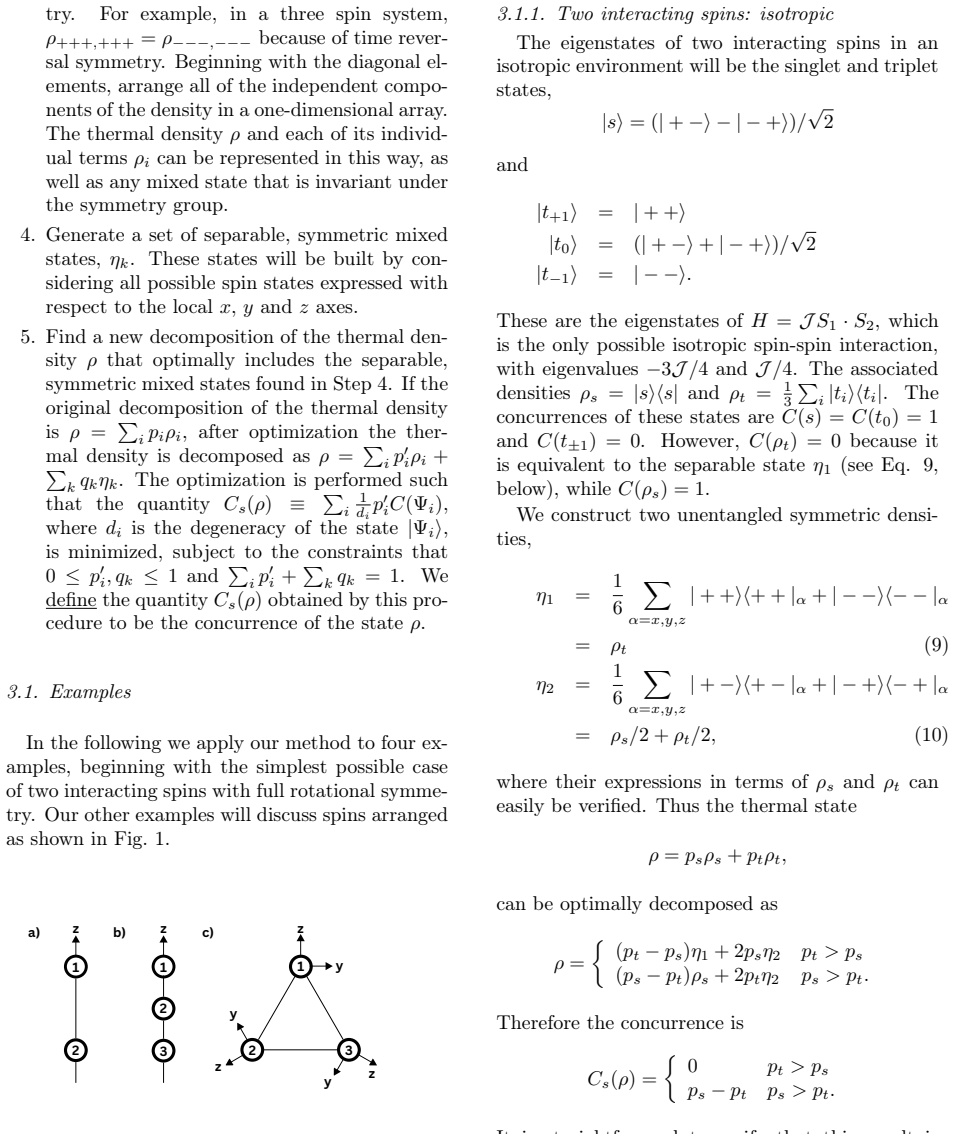
The load-bearing object is the finite set of separable symmetric densities $\eta_k$: for each geometry, the paper enumerates all product states of the form $|\pm\rangle_\alpha \otimes |\pm\rangle_\beta \otimes \cdots$ with each spin quantized along its local $x$, $y$, or $z$ axis, averages them over the symmetry group, and keeps only the resulting densities that are not positive sums of others, nine for three spins on a line and eight for three spins on a triangle. These $\eta_k$ are then used as free variables in a linear program: starting from the thermal density $\rho=\sum_i p_i \rho_i$, one maximizes the weight $q_k$ of each separable density that can be subtracted, reducing the coefficients $p'_i$ of the entangled eigenstate densities. The minimized value of $\sum_i (1/d_i) p'_i C(\Psi_i)$ is the proposed concurrence $C_s(\rho)$.
What would settle it
Run a numerical search over decompositions, such as a semidefinite relaxation of the convex roof, for the three-spin triangle at parameters where $C_s>0$; if any valid decomposition gives a strictly lower concurrence than $C_s$, the separable list is incomplete. A direct enumeration of the extreme points of the symmetric separable polytope would settle the same question.
Extended reading notes
Core claim
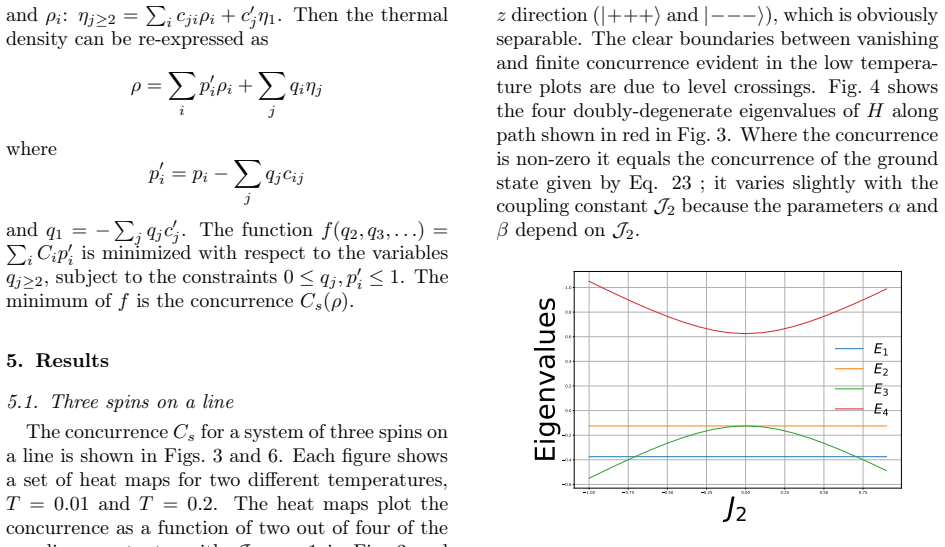
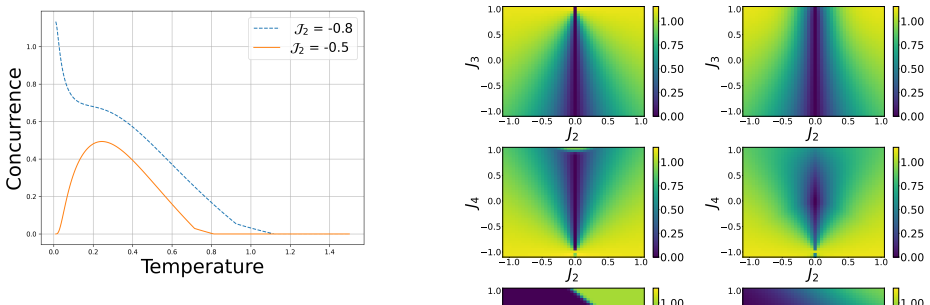
The central claim is that the concurrence of a thermal density $\rho$ of a symmetric spin system is the minimum of $C_s(\rho)=\sum_i (1/d_i)\, p'_i\, C(\Psi_i)$ over decompositions $\rho=\sum_i p'_i \rho_i + \sum_k q_k \eta_k$, where the $\rho_i$ are the symmetry-grouped eigenstate densities, the $\eta_k$ are explicitly constructed separable densities that are invariant under the same symmetry group, and $C(\Psi)$ is the multipartite concurrence of Eq. (4). By construction $C_s$ equals the convex-roof infimum restricted to this family of decompositions, so the paper identifies $C_s$ with the concurrence of $\rho$. The method is demonstrated on two-spin systems, three spins on a line, and three spins on a triangle; in the two-spin cases it matches the exact two-qubit concurrence, and in the three-spin cases it produces heat maps of $C_s$ versus coupling constants at low temperature, with sharp boundaries from level crossings and smooth onset from degeneracy lifting.
Load-bearing premise
The method assumes that the finite list of separable symmetric densities it constructs, after dropping those that are positive sums of others, contains every extreme point of the convex hull of symmetric separable states; if any separable symmetric density is missing, the optimized value overestimates the true concurrence.
Editorial extensions
If this is right
- For two spins with full or axial rotational symmetry, $C_s$ reproduces the exact two-qubit concurrence, including the kink where a coefficient crosses $1/2$.
- In the zero-temperature limit $C_s$ equals the concurrence of the ground-state multiplet; at high temperature it vanishes, matching the known separable high-temperature limit.
- For three spins on a line and on a triangle, $C_s$ produces phase-like maps in the coupling-constant plane: sharp boundaries where level crossings change the ground state, and smooth onset of entanglement where degeneracies are lifted.
- The method extends to any symmetric arrangement of qubits or spins and is proposed as a quantitative measure for states with large ground-state degeneracy, such as frustrated spin systems.
Reading between the lines
- If the enumerated $\eta_k$ list is incomplete, $C_s$ overestimates the true convex roof; a certificate of completeness, such as an extreme-point enumeration of the symmetric separable polytope, would turn $C_s$ from an upper bound into the exact concurrence.
- The same optimization could be applied to other convex-roof entanglement measures by replacing $C(\Psi)$ with a different pure-state monotone, since the separable $\eta_k$ construction only uses symmetry, not the specific concurrence formula.
- The authors' scalability remark suggests replacing Eq. (4) with the $I$-concurrence to cut the $2^N$ term count; a concrete test would be whether the heat-map structure survives on a 16-site pyrochlore cluster.
- A direct experimental signature: for the triangle at $J_1>0$, the central point with all $J_2=J_3=J_4=0$ is predicted to have zero thermal concurrence at any temperature, while any small perturbation produces a finite value, a sharp and testable crossover.
Editorial analysis
A structured set of objections, weighed in public.
Referee Report
Summary. The paper proposes a symmetry-based method to estimate the concurrence of thermal mixed states of symmetric spin systems. The authors group degenerate eigenstates into multiplet densities ρ_i, construct a set of symmetric separable densities η_k from product states along local axes, and then solve a linear program that re-expresses the thermal density as ρ = Σ_i p'_i ρ_i + Σ_k q_k η_k. The resulting quantity Cs(ρ) = Σ_i (1/d_i) p'_i C(Ψ_i) is put forward as the concurrence of the state. The method is illustrated on two-spin and three-spin (line and triangle) systems, with two-spin results checked against Wootters' formula and three-spin results presented as heat maps over coupling parameters.
Significance. If the central claim were established, the method would provide a rare tractable route to a quantitative entanglement measure for highly symmetric mixed states, with potential applications to frustrated spin systems such as spin ice. The explicit construction of symmetric separable densities and the reduction to a linear program are genuinely useful ideas, and the two-spin examples are verified exactly against Wootters' formula. However, the paper's main assertion that Cs equals the convex-roof concurrence is not proved for the three-spin systems: the optimization is restricted to a fixed set of pure states within each degenerate multiplet and to a heuristic list of separable densities, so Cs is at best an upper bound on the true concurrence. The three-spin results therefore need either additional proof or a careful reframing as a variational upper bound.
major comments (3)
- [Section 3, Step 5; Eq. (6)] The quantity Cs is defined by minimizing over the restricted family of decompositions ρ = Σ_i p'_i ρ_i + Σ_k q_k η_k, where each ρ_i = (1/d_i)Σ_j |Ψ_ij⟩⟨Ψ_ij| is kept intact. Since the convex roof in Eq. (6) minimizes over all decompositions, Cs is an upper bound on the true concurrence unless one proves either that an optimal convex-roof ensemble can always be chosen in this restricted form, or that the convex roof of each ρ_i equals the average (1/d_i)Σ_j C(Ψ_ij). Neither proof is given. This is load-bearing: for the three-spin line (Section 3.1.3), ρ_3 and ρ_4 are rank-2 mixtures of time-reversed eigenstates, and for rank-2 states the convex roof can be strictly smaller than the average pure-state concurrence (e.g., the equal mixture of |Φ+⟩ and |Φ−⟩ has concurrence 0 although each Bell state has C=1). The manuscript contains no argument excluding this effect for ρ_3 or ρ_4, so the plotted Cs in Section 5 may overestimate the entanglement.
- [Sections 3.1.3 and 3.2] The lists of separable symmetric densities η_j (nine for the line, eight for the triangle) are obtained by enumerating separable product states on local axes and deleting those states expressible as positive sums of others. The paper does not prove that the remaining set is complete, i.e., that it contains all extreme points of the convex hull of symmetric separable density matrices for the relevant symmetry-invariant subspace. Without such a proof or a dual linear-programming certificate, the optimization in Section 4 may subtract less separable weight than is actually possible, again pushing Cs upward. This issue is independent of the restricted-multiplet concern in the previous comment: even a complete η set would not fix the unproven treatment of the degenerate multiplets.
- [Section 5] The three-spin results are not benchmarked against any independent estimate of the true convex-roof concurrence. The two-spin checks in Sections 3.1.1 and 3.1.2 are valuable, but they do not exercise the problematic case: every entangled multiplet there is non-degenerate or has a density that coincides with one of the η_k, so no rank-2 entangled multiplet is ever evaluated. For the three-spin line and triangle, no comparison is made with exact values at special parameter points or with numerical lower bounds from another method (e.g., a semidefinite relaxation or a direct search over rotations of the doublet states). This leaves the magnitude of the possible over-estimation identified above unquantified and makes the physical interpretation of the heat maps in Figs. 3, 6, 7, and 8 unclear.
minor comments (6)
- [Throughout] The name Wootters is misspelled as 'Wootter' in Sections 3.1.1 and 3.1.2; it should be 'Wootters'.
- [Introduction] The word 'temperatute' in the last paragraph of the Introduction is a typo for 'temperature'.
- [Section 5.1, Fig. 3 caption and text] The caption of Fig. 3 states that the right column is T=0.01 and the left column is T=0.2, but the text in Section 5.1 refers to 'the higher temperature results (right column of Fig. 3)'. These statements are inconsistent; the text should refer to the left column if the caption is correct, or the caption should be corrected.
- [Section 3.1.3, Eq. (24)-(27)] The notation for the example separable states in the η_j list (e.g., '|+ ++⟩ zxx') is not explained in the text; a brief definition of the axis subscripts in this context would improve readability.
- [Section 4] The linear program is described in terms of expressing each η_j as a linear combination of η_1 and the ρ_i, but it is not stated whether the coefficients c_ji and c'_j are unique or how degeneracies in the representation are handled; a short clarification would help reproducibility.
- [Section 5.1] In the sentence 'The lower curve the ground state has zero concurrence', the word 'in' is missing after 'curve'; it should read 'The lower curve, the ground state has zero concurrence'.
Circularity Check
No significant circularity: Cs is defined by a restricted linear program over independently constructed separable states; the two-qubit checks are genuine external validation, and the main gap (eta_k completeness, convex-roof equality) is an unproven correctness claim, not a circular reduction.
full rationale
The derivation chain is not circular. In Section 3 Step 5, Cs(ρ) is defined as the minimum of Σ (1/d_i) p'_i C(Ψ_i) over decompositions of the form ρ = Σ p'_i ρ_i + Σ q_k η_k, where the ρ_i are fixed multiplet densities from the Hamiltonian and the η_k are constructed from product states along symmetry axes. No parameter is fitted to the quantity being predicted: the q_k and p'_i are optimization variables, not data-derived constants, and the pure-state concurrences C(Ψ_i) are computed from Eq. 4 independently of the linear program. The two-spin results are checked against Wootters' formula (Eq. 8), an external benchmark, so those checks are not circular. The three-spin results are presented as consequences of the same construction. The main weakness is that the finite η_k lists are asserted without a proof of completeness, and the optimization is restricted to a subset of all decompositions, so Cs is at best an upper bound on the convex roof; the paper also does not prove that each degenerate multiplet density ρ_i has convex roof equal to (1/d_i)Σ C(Ψ_ij). These are correctness gaps, not instances of assuming the target result. The only self-citation (ref. [8] by Wei and Curnoe) appears in the Discussion as motivation for spin-ice physics and as a pointer for the I-concurrence; it is not load-bearing for the derivation. The definitional statement "we define the quantity Cs(ρ) obtained by this procedure to be the concurrence of the state ρ" is a naming choice, not a reduction of the target to the input: the convex-roof value is not inserted into the linear program. Accordingly no circular step can be exhibited.
Assumptions & free parameters
assumptions (4)
- standard math The convex roof definition of mixed-state concurrence (Eq. 6) is the correct definition of entanglement for mixed states.
- standard math The N-partite pure-state concurrence formula (Eq. 4) is a valid entanglement measure.
- ad hoc to paper The set of separable symmetric densities generated from local-axis product states contains all extreme points of the symmetric separable convex hull for the systems studied.
- ad hoc to paper A degenerate block ρ_i can be represented by its average pure-state concurrence (1/d_i)Σ C(Ψ_i) without loss for the convex roof optimization.
Cite this review
Pith. "Pith review of Mixed state concurrence for symmetric systems." pith.science (2026). https://pith.science/paper/BFXSFWXO
@misc{pith2026250524772,
  author       = {Pith},
  title        = {Pith review of: Mixed state concurrence for symmetric systems},
  year         = {2026},
  howpublished = {\url{https://pith.science/paper/BFXSFWXO}},
  note         = {Machine review of arXiv:2505.24772}
}
read the original abstract
We present a method to quantify entanglement in mixed states of highly symmetric systems. Symmetry constrains interactions between parts and predicts the degeneracies of the states. While symmetry alone produces entangled eigenstates, the thermal mixed state (density) which contains all of the eigenstate densities weighted by their Boltzmann factors is not necessarily as entangled as the eigenstates themselves because generally the mixed state can be re-expressed as a sum over densities which are less entangled. The entanglement of the mixed state is the minimum obtained by considering all such re-expressions, but there is no well-defined approach to solving this problem generally. Our method uses symmetry to explicitly construct unentangled densities, which are then optimally included in the thermal mixed state, resulting in a quantitative measure of entanglement that accounts for the reduction of entanglement arising from degenerate states. We present results for several small spin systems.
Figures

Figures from the paper (3 more)


Reference graph
Works this paper leans on
-
[1]
Carvalho, Marek Kuś, and Andreas Buchleitner
Florian Mintert, André R.R. Carvalho, Marek Kuś, and Andreas Buchleitner. Measures and dynamics of entangled states.Physics Reports, 415(4):207–259, 2005
work page 2005
-
[2]
Fidelity and concurrence of conjugated states.Phys
Armin Uhlmann. Fidelity and concurrence of conjugated states.Phys. Rev. A, 62:032307, Aug 2000
work page 2000
-
[3]
André R. R. Carvalho, Florian Mintert, and An- dreas Buchleitner. Decoherence and multipar- tite entanglement.Phys. Rev. Lett., 93:230501, Dec 2004
work page 2004
-
[4]
Hughston, Richard Jozsa, and William K
Lane P. Hughston, Richard Jozsa, and William K. Wootters. A complete classification of quantum ensembles having a given density matrix.Physics Letters A, 183(1):14–18, 1993
work page 1993
-
[5]
Sam A. Hill and William K. Wootters. Entan- glement of a pair of quantum bits.Phys. Rev. Lett., 78:5022–5025, Jun 1997
work page 1997
- [6]
-
[7]
Kate A. Ross, Lucile Savary, Bruce D. Gaulin, and Leon Balents. Quantum excitations in quantum spin ice.Phys. Rev. X, 1:021002, Oct 2011
work page 2011
- [8]
Show all 9 references
-
[9]
Pranaw Rungta and Carlton M. Caves. Concurrence-based entanglement measures for isotropic states.Phys. Rev. A, 67:012307, Jan 2003. 12
2003
Reviewed August 7, 2026 · model on record in the stance chip above.
Discussion (0). Sign in to comment.