REVIEW 2 major objections 5 minor 54 references
Chameleon: A Multiplier-Free Temporal Convolutional Network Accelerator for End-to-End Few-Shot and Continual Learning from Sequential Data
T0 review · 2 major / 5 minor · reviewed 2026-08-07 · deepseek-v4-flash
Pith's one-line read Chameleon is a 40-nm SoC that performs end-to-end few-shot and continual learning on-chip at 0.5% area overhead while keeping 3.1-uW keyword-spotting inference.
desk verdict Chameleon is a real chip with clean math and open code, but the 'sequential data' claim for FSL/CL rests on flattened images, and the 3.1 uW KWS number excludes MFCC extraction. read the letter →
The pith
A machine-rendered reading of the paper's core claim, the machinery that carries it, and where it could break.
The reading
What carries the argument
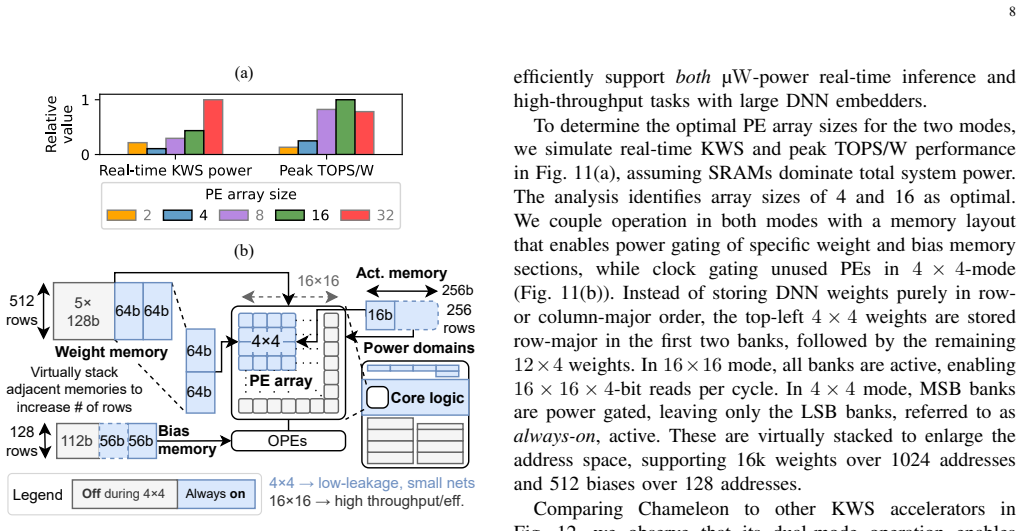
Three mechanisms carry the argument. (1) The prototypical-network-to-FC identity (Equations 3–6) maps class-mean embeddings to an equivalent fully-connected layer, so the inference datapath performs learning; the 'prototypical parameter extractor' and 'learning controller' implement this in hardware. (2) A greedy dilation-aware execution scheme for TCNs, driven by a network address generator, skips zero-valued activations introduced by dilation and uses FIFO-style activation storage, cutting activation memory by up to 90× and expanding the receptive field to 16k timesteps, which is what makes raw-audio KWS and long context possible. (3) A dual-mode 16×16/4×4 MatMul-free PE array uses 4-bit signed log2 weights in place of multipliers, and power-gates memory banks in 4×4 mode to reach 3.1 µW real-time KWS or 76.8 GOPS peak in 16×16 mode.
What would settle it
Measure the same on-chip FSL/CL flow on a genuinely temporal benchmark, for example learning new spoken-word classes from a few audio examples on Google Speech Commands, and compare accuracy and power with the Omniglot results; if accuracy collapses, the sequential-data claim is unsupported. A cheaper check is to meta-train a 2D convolutional embedder on Omniglot and compare with the TCN: if the flattened order carries no usable temporal structure, the two should match, undercutting the claim that TCN processing matters.
Extended reading notes
Core claim
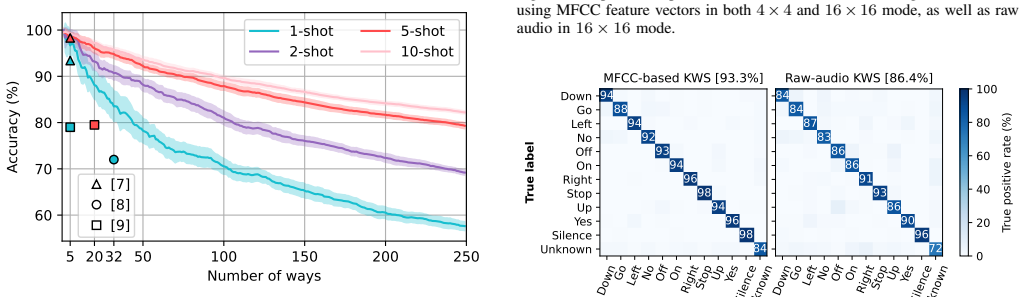
Chameleon's central discovery is that prototypical networks—a gradient-free few-shot method that classifies a query by its L2 distance to class-mean embeddings—can be rewritten as a single fully-connected layer. Concretely, with prototypes $P_j = s_j/k$ where $s_j = \sum_l e_{l,j}$ is the sum of the $k$ support embeddings for way $j$, the squared distance to a query embedding $x$ satisfies $D_j^2 \propto b_j + W_j \cdot x$ with $b_j = \frac{1}{2k}\sum_i (s_j^i)^2$ and $W_j = s_j$. Because bias and weights are simple functions of the prototype sums, the existing inference datapath can load them directly; learning a new class reduces to embedding a few support samples, averaging them per class, and copying the resulting FC parameters into the weight and bias memories. This makes end-to-end on-chip FSL and CL essentially free, and, because learning is forward-only, the design can use 4-bit signed log2 weights so that all multiplications become bit shifts. The paper claims this is the first silicon-proven demonstration of scalable end-to-end FSL and CL on sequential data, reporting new Omniglot accuracy records.
Load-bearing premise
The paper's headline claim of first end-to-end on-chip few-shot and continual learning on sequential data rests on treating pixelwise-flattened Omniglot images as sequential input, and no FSL or CL experiment is run on an actual temporal signal such as audio or sensor time series.
Editorial extensions
If this is right
- On-chip learning becomes a forward pass: any inference accelerator with an FC layer can be retrofitted for FSL/CL at about 0.5% area overhead using the same prototype-to-FC conversion, subject to embedding quality.
- Edge devices could continually add new classes (new user-specific keywords, gestures, or sensor signatures) without cloud round-trips, gradient computation, or sample-hungry retraining.
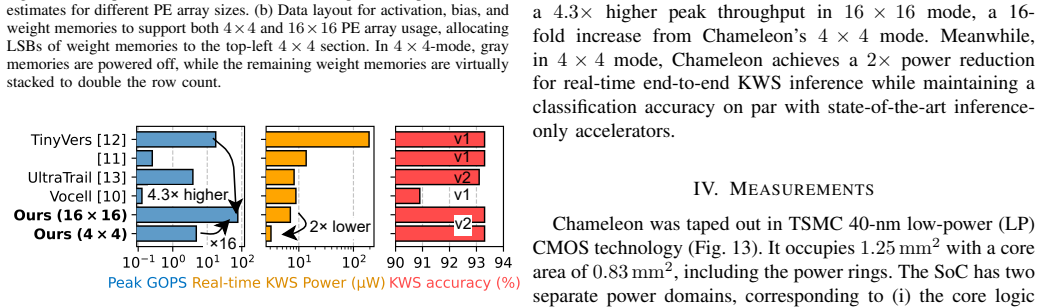
- Raw-audio keyword spotting without MFCC preprocessing becomes feasible at 59.4 µW, while MFCC-based KWS matches state-of-the-art accuracy at 3.1 µW.
- Learning a new class adds less than 0.04% latency and effectively the same energy as inference, so lifetime learning costs are negligible per class.
- A 250-way continual-learning baseline is established for end-to-end on-chip CL, scaling at 26 bytes per new class on Omniglot.
Reading between the lines
- The prototype-to-FC conversion is a general trick: it should port to any accelerator that already executes a fully-connected layer, including RNN or transformer accelerators, provided the off-chip meta-trained embedder produces separable embeddings.
- The sequential-data claim is broader than what is measured; flattening a 28x28 image into a 784-step sequence is not the same as learning from a genuine temporal signal, and a true test would be few-shot learning of new spoken words or gestures on the chip.
- The 3.1 µW power figure is for the MFCC path with a 16.5k-parameter network; raw-audio inference with the larger 118k-parameter network consumes 59.4 µW, so 'extreme-edge power' and 'long-context raw audio' are demonstrated in different operating points.
- Because learning is gradient-free and forward-only, the accuracy ceiling is set entirely by the off-chip meta-trained TCN embeddings; harder or more variable real-world tasks may require finer-than-4-bit weight granularity for the prototypes.
Editorial analysis
A structured set of objections, weighed in public.
Referee Report
Summary. The paper presents Chameleon, a 40-nm SoC that unifies inference with gradient-free few-shot and continual learning by reformulating prototypical networks as an equivalent fully connected layer on a temporal convolutional network (TCN) accelerator. The three headline contributions are: (i) a unified learning/inference architecture with claimed 0.5% area overhead; (ii) the first end-to-end on-chip FSL/CL demonstration on sequential data using TCNs, together with inference on 16-kHz raw audio; and (iii) a dual-mode, matrix-multiplication-free PE array that achieves 3.1 µW MFCC-based keyword spotting or a peak throughput of 76.8 GOPS. The FSL/CL experiments use Omniglot images flattened into 1D pixel sequences, while the KWS experiments use GSCv2 audio. The claims are supported by fabricated-chip measurements and the paper states that all code is open-source.
Significance. If the claims hold, this is a strong systems contribution: it shows that prototypical-network learning can be folded into an inference-only accelerator with negligible overhead, and it provides the first silicon measurements of end-to-end on-chip FSL/CL with a TCN embedder plus raw-audio long-context inference at microwatt power. The algebraic reformulation in Eqs. (4)-(6) is clean and self-contained, and the measured accuracy/power numbers appear internally consistent. The significance, however, hinges on whether the learning demonstrations count as sequential-data learning and on whether the 3.1 µW power figure is scoped end-to-end; both points need clarification or additional evidence before the central novelty claim is fully supported.
major comments (2)
- [Section IV-B] The central claim of 'first demonstration of end-to-end on-chip FSL and CL on sequential data' is not directly supported by the measurements. The only FSL/CL experiments use Omniglot images that are 'flatten[ed] ... pixelwise' into 1D vectors (Section IV-B). A flattened static image is not a temporal signal: the pixel ordering is arbitrary, and causal convolution over that ordering does not demonstrate learning of temporal dependencies. The raw-audio KWS experiment in Section IV-C demonstrates long-context inference, not learning. Please add a genuine time-series FSL/CL benchmark (for example, few-shot adaptation on audio or sensor data) or a permutation control showing that temporal ordering affects FSL/CL accuracy; if neither is possible, the sequential-data claim should be scaled back to '1D-sequence processing' rather than 'sequential data'.
- [Section IV-C and Table II] The 3.1 µW real-time KWS figure is presented as 'real-time end-to-end KWS' and as the 'lowest reported real-time end-to-end power,' but the text says that 'the audio is transformed into a 28D MFCC feature map ... before it is fed to the DNN,' and the power breakdown in Fig. 16 contains no feature-extraction component. If MFCC extraction is performed off-chip, the 3.1 µW number excludes a component that is part of an end-to-end system, and the comparison with other KWS accelerators in Table II is not apples-to-apples. Please state explicitly whether feature extraction is on-chip or off-chip, report its power if on-chip, and if it is off-chip, either include it in the end-to-end figure or add a footnote such as the one already used for Vocell in Table II.
minor comments (5)
- [Abstract] The phrase 'sets new accuracy records on Omniglot' should be qualified as 'among silicon FSL accelerators' to avoid implying that Chameleon outperforms software state-of-the-art meta-learning methods.
- [Section IV-B] The statement that flattening images 'effectively creat[es] a sequential Omniglot representation' overstates the case; the resulting input is a 1D vector, not a time series, and the paper should not equate the two.
- [Section III-A, Eq. (8)] The description of the division by 2k is ambiguous: a right shift by '2⌈log2(k)⌉ bits' does not equal division by 2k except for power-of-two k. Please clarify whether this is a deliberate power-of-two approximation (for example, shifting by ⌈log2(2k)⌉ bits) and discuss its effect on the claimed equivalence in Eq. (6).
- [Table II] The KWS accuracy comparison mixes GSC versions (V ocell and TinyVers on v1, Chameleon on v2); while the versions are listed, the text should note that v2 is generally considered more challenging so that the 'on par' claim is not overstated.
- [Table I] Confidence intervals are reported for the proposed work but not for the prior silicon results [7]–[9]; please state whether the prior numbers are means, best runs, or reported values, to make the comparison reproducible.
Circularity Check
No circularity: Eq. (3)-(8) are self-contained algebraic reformulations and all headline results are measured on silicon against external benchmarks.
full rationale
Chameleon's derivation chain is self-contained. The central learning formulation in Section III-A starts from the prototypical-network L2 distance and derives, in Eqs. (4)-(6), an equivalent fully connected layer by expanding the squared distance, dropping the query-only constant, and rescaling; Eq. (8) repeats the same identity under log2 quantization. No fitted parameter or measured accuracy is fed back into these equations. The FSL, CL, and KWS results in Section IV are measurements from a fabricated 40-nm SoC on external datasets (Omniglot and Google Speech Commands V2) with standard splits, and comparisons to prior silicon works are external and reproduced from their papers. The greedy dilation-aware TCN execution is compared against a clearly labeled weight-stationary baseline, so the quoted 90x/7x reductions are explicit relative statements rather than disguised predictions. The only caveat, that FSL/CL is demonstrated on pixelwise-flattened Omniglot images rather than on a natural temporal signal, is a benchmark-validity question about the 'sequential data' claim and not a circularity of the derivation; it does not change the fact that the reported equations and measurements stand on their own. There is no load-bearing self-citation chain and no uniqueness result imported from the authors' own prior work.
Assumptions & free parameters
free parameters (3)
- 4-bit signed log2 weight quantization =
4-bit log2
- 4-bit unsigned activation quantization =
4-bit unsigned
- PE array sizes for dual-mode operation =
4 and 16
assumptions (5)
- domain assumption The pre-trained embedding DNN produces high-quality embeddings for unseen classes from the same meta-training distribution.
- domain assumption Squared L2 distance in the embedding space is a suitable similarity measure for few-shot and continual classification.
- domain assumption Quantization-aware training in Brevitas, with the custom log2 quantizer and requantizer, faithfully models the chip's arithmetic.
- standard math Batch normalization can be exactly folded into the preceding layer's weights and bias during deployment.
- domain assumption Measured metrics at room temperature are representative of the stated operating conditions.
Cite this review
Pith. "Pith review of Chameleon: A Multiplier-Free Temporal Convolutional Network Accelerator for End-to-End Few-Shot and Continual Learning from Sequential Data." pith.science (2026). https://pith.science/paper/FZAZPQ46
@misc{pith2026250524852,
  author       = {Pith},
  title        = {Pith review of: Chameleon: A Multiplier-Free Temporal Convolutional Network Accelerator for End-to-End Few-Shot and Continual Learning from Sequential Data},
  year         = {2026},
  howpublished = {\url{https://pith.science/paper/FZAZPQ46}},
  note         = {Machine review of arXiv:2505.24852}
}
abstract
On-device learning at the edge enables low-latency, private personalization with improved long-term robustness and reduced maintenance costs. Yet, achieving scalable, low-power end-to-end on-chip learning, especially from real-world sequential data with a limited number of examples, is an open challenge. Indeed, accelerators supporting error backpropagation optimize for learning performance at the expense of inference efficiency, while simplified learning algorithms often fail to reach acceptable accuracy targets. In this work, we present Chameleon, leveraging three key contributions to solve these challenges. (i) A unified learning and inference architecture supports few-shot learning (FSL), continual learning (CL) and inference at only 0.5% area overhead to the inference logic. (ii) Long temporal dependencies are efficiently captured with temporal convolutional networks (TCNs), enabling the first demonstration of end-to-end on-chip FSL and CL on sequential data and inference on 16-kHz raw audio. (iii) A dual-mode, multiplier-free compute array allows either matching the power consumption of state-of-the-art inference-only keyword spotting (KWS) accelerators or enabling $4.3\times$ higher peak GOPS. Fabricated in 40-nm CMOS, Chameleon sets new accuracy records on Omniglot for end-to-end on-chip FSL (96.8%, 5-way 1-shot, 98.8%, 5-way 5-shot) and CL (82.2% final accuracy for learning 250 classes with 10 shots), while maintaining an inference accuracy of 93.3% on the 12-class Google Speech Commands dataset at an extreme-edge power budget of 3.1 $\mu$W.
Figures


Figures from the paper (11 more)




Reference graph
Works this paper leans on
-
[1]
Learn to learn on chip: Hardware-aware meta-learning for quantized few-shot learning at the edge,
N. S. Murthy, P. Vrancx, N. Laubeuf, P. Debacker, F. Catthoor, and M. Verhelst, “Learn to learn on chip: Hardware-aware meta-learning for quantized few-shot learning at the edge,” in 2022 IEEE/ACM 7th Symp. on Edge Computing (SEC) , 2022, pp. 14–25
work page 2022
-
[2]
A tinyml platform for on-device continual learning with quantized latent replays,
L. Ravaglia, M. Rusci, D. Nadalini, A. Capotondi, F. Conti, and L. Benini, “A tinyml platform for on-device continual learning with quantized latent replays,” IEEE J. on Emerging and Selected Topics in Circuits and Systems , vol. 11, no. 4, pp. 789–802, 2021
work page 2021
-
[3]
Concrete problems in ai safety
D. Amodei, C. Olah, J. Steinhardt, P. Christiano, J. Schulman, and D. Man ´e, “Concrete problems in ai safety”, 2016. arXiv:1606.06565
arXiv 2016
-
[4]
Latent replay for real-time continual learning,
L. Pellegrini, G. Graffieti, V . Lomonaco, and D. Maltoni, “Latent replay for real-time continual learning,” in 2020 IEEE/RSJ Int. Conf. on Intelligent Robots and Systems (IROS) , 2020, pp. 10 203–10 209
work page 2020
-
[5]
A quantization framework for neural network adaption at the edge,
M. Li and X. S. Hu, “A quantization framework for neural network adaption at the edge,” in 2021 Des., Automat. & Test in Europe Conf. & Exhib. (DATE), 2021, pp. 402–407
work page 2021
-
[6]
Exploring quantization in few-shot learning,
M. Wang, R. Xue, J. Lin, and Z. Wang, “Exploring quantization in few-shot learning,” in 2020 18th IEEE Int. New Circuits and Systems Conf. (NEWCAS), 2020, pp. 279–282
work page 2020
-
[7]
An in-memory computing sram macro for memory-augmented neural network,
S. Kim, W. Lee, S. Kim, S. Park, and D. Jeon, “An in-memory computing sram macro for memory-augmented neural network,” TCAS- II, vol. 69, no. 3, 2022
work page 2022
-
[8]
H. Li, W.-C. Chen, A. Levy, C.-H. Wang, H. Wang, P.-H. Chen, W. Wan, H.-S. P. Wong, and P. Raina, “One-shot learning with memory- augmented neural networks using a 64-kbit, 118 gops/w rram-based non-volatile associative memory,” in 2021 Symp. on VLSI Technology , 2021, pp. 1–2
work page 2021
Show all 54 references
-
[9]
Fsl-hdnn: A 5.7 tops/w end-to- end few-shot learning classifier accelerator with feature extraction and hyperdimensional computing,
H. Yang, C. E. Song, W. Xu, B. Khaleghi, U. Mallappa, M. Shah, K. Fan, M. Kang, and T. Rosing, “Fsl-hdnn: A 5.7 tops/w end-to- end few-shot learning classifier accelerator with feature extraction and hyperdimensional computing,” in 2024 IEEE European Solid-State Electronics Re...
2024
-
[10]
V ocell: A 65-nm speech-triggered wake-up soc for 10- µ w keyword spotting and speaker verification,
J. S. P. Giraldo, S. Lauwereins, K. Badami, and M. Verhelst, “V ocell: A 65-nm speech-triggered wake-up soc for 10- µ w keyword spotting and speaker verification,” IEEE J. of Solid-State Circuits, vol. 55, no. 4, pp. 868–878, 2020
2020
-
[11]
Efficient execution of temporal convolutional networks for embedded keyword spotting,
J. S. P. Giraldo, V . Jain, and M. Verhelst, “Efficient execution of temporal convolutional networks for embedded keyword spotting,” IEEE Trans. on Very Large Scale Integration (VLSI) Systems , vol. 29, no. 12, pp. 2220–2228, 2021
2021
-
[12]
Tinyvers: A tiny versatile system-on-chip with state-retentive emram for ml inference at the extreme edge,
V . Jain, S. Giraldo, J. D. Roose, L. Mei, B. Boons, and M. Verhelst, “Tinyvers: A tiny versatile system-on-chip with state-retentive emram for ml inference at the extreme edge,” JSSC, vol. 58, no. 8, 2023
2023
-
[13]
Ultratrail: A configurable ultralow-power tc-resnet ai accelerator for efficient keyword spotting,
P. P. Bernardo, C. Gerum, A. Frischknecht, K. L ¨ubeck, and O. Bringmann, “Ultratrail: A configurable ultralow-power tc-resnet ai accelerator for efficient keyword spotting,” IEEE Trans. on Computer- Aided Design of Integrated Circuits and Systems , vol. 39, no. 11, pp. 4240–4...
2020
-
[14]
A 23-uw keyword spotting ic with ring-oscillator-based time-domain feature extraction,
K. Kim, C. Gao, R. Grac ¸a, I. Kiselev, H.-J. Yoo, T. Delbruck, and S.-C. Liu, “A 23-uw keyword spotting ic with ring-oscillator-based time-domain feature extraction,”IEEE J. of Solid-State Circuits, vol. 57, no. 11, pp. 3298–3311, 2022
2022
-
[15]
In-memory realization of in-situ few-shot continual learning with a dynamically evolving explicit memory,
G. Karunaratne, M. Hersche, J. Langeneager, G. Cherubini, M. L. Gallo, U. Egger, K. Brew, S. Choi, I. Ok, C. Silvestre, N. Li, N. Saulnier, V . Chan, I. Ahsan, V . Narayanan, L. Benini, A. Sebastian, and A. Rahimi, “In-memory realization of in-situ few-shot continual learning ...
2022
-
[16]
Prototypical networks for few- shot learning,
J. Snell, K. Swersky, and R. Zemel, “Prototypical networks for few- shot learning,” in Advances in Neural Information Processing Systems , vol. 30, 2017
2017
-
[17]
Human-level concept learning through probabilistic program induction,
B. M. Lake, R. Salakhutdinov, and J. B. Tenenbaum, “Human-level concept learning through probabilistic program induction,” Science, vol. 350, no. 6266, 2015
2015
-
[18]
An empirical evaluation of generic convolutional and recurrent networks for sequence modeling
S. Bai, J. Z. Kolter, and V . Koltun, “An empirical evaluation of generic convolutional and recurrent networks for sequence modeling”, 2018. arXiv:1803.01271
2018 arXiv
-
[19]
Tcn-cutie: A 1,036-top/s/w, 2.72-µj/inference, 12.2-mw all-digital ternary accelerator in 22-nm fdx technology,
M. Scherer, A. D. Mauro, T. Fischer, G. Rutishauser, and L. Benini, “Tcn-cutie: A 1,036-top/s/w, 2.72-µj/inference, 12.2-mw all-digital ternary accelerator in 22-nm fdx technology,” IEEE Micro , vol. 43, no. 1, pp. 42–48, 2023
2023
-
[20]
Model-agnostic meta-learning for fast adaptation of deep networks,
C. Finn, P. Abbeel, and S. Levine, “Model-agnostic meta-learning for fast adaptation of deep networks,” in Int. Conf. on machine learning , PMLR, 2017, pp. 1126–1135
2017
-
[21]
Meta- learning in neural networks: A survey,
T. Hospedales, A. Antoniou, P. Micaelli, and A. Storkey, “Meta- learning in neural networks: A survey,” IEEE Transactions on Pattern Analysis and Machine Intelligence, vol. 44, no. 9, pp. 5149–5169, 2022
2022
-
[22]
Adam: A method for stochastic optimization
D. P. Kingma and J. Ba, “Adam: A method for stochastic optimization”,
-
[23]
A Simple Neural Attentive Meta-Learner
N. Mishra, M. Rohaninejad, X. Chen, and P. Abbeel, “A Simple Neural Attentive Meta-Learner”, 2018. arXiv:1707.03141
2018 arXiv
-
[24]
Meta-learning with memory-augmented neural networks,
A. Santoro, S. Bartunov, M. Botvinick, D. Wierstra, and T. Lillicrap, “Meta-learning with memory-augmented neural networks,” in Proc. of The 33rd Int. Conf. on Machine Learning , ser. Proc. of Machine Learning Research, vol. 48, New York, New York, USA: PMLR, Jun. 2016, pp. 1842–1850
2016
-
[25]
Locality-based encoder and model quantization for efficient hyper- dimensional computing,
J. Morris, R. Fernando, Y . Hao, M. Imani, B. Aksanli, and T. Rosing, “Locality-based encoder and model quantization for efficient hyper- dimensional computing,” IEEE Trans. on Computer-Aided Design of Integrated Circuits and Systems , vol. 41, no. 4, pp. 897–907, 2022
2022
-
[26]
Anp-g: A 28-nm 1.04-pj/sop sub-mm2 asynchronous hybrid neural network olfactory processor enabling few-shot class-incremental on- chip learning,
D. Huo, J. Zhang, X. Dai, J. Zhang, C. Qian, K.-T. Tang, and H. Chen, “Anp-g: A 28-nm 1.04-pj/sop sub-mm2 asynchronous hybrid neural network olfactory processor enabling few-shot class-incremental on- chip learning,” IEEE J. of Solid-State Circuits , pp. 1–11, 2025
2025
-
[27]
Attention is all you need,
A. Vaswani, N. Shazeer, N. Parmar, J. Uszkoreit, L. Jones, A. N. Gomez, Ł. Kaiser, and I. Polosukhin, “Attention is all you need,” Advances in neural information processing systems , vol. 30, 2017
2017
-
[28]
Long short-term memory,
S. Hochreiter and J. Schmidhuber, “Long short-term memory,” Neural computation, vol. 9, no. 8, pp. 1735–1780, 1997
1997
-
[29]
R-transformer: Recurrent neural network enhanced transformer
Z. Wang, Y . Ma, Z. Liu, and J. Tang, “R-transformer: Recurrent neural network enhanced transformer”, 2016. arXiv:1907.05572
2016 arXiv
-
[30]
Deep residual learning for image recognition
K. He, X. Zhang, S. Ren, and J. Sun, “Deep residual learning for image recognition”, 2015. arXiv:1512.03385
2015 arXiv
-
[31]
Convolutional neural net- works using logarithmic data representation
D. Miyashita, E. H. Lee, and B. Murmann, “Convolutional neural net- works using logarithmic data representation”, 2016. arXiv:1603.01025
2016 arXiv
-
[32]
Power-of-two quantization for low bitwidth and hardware compliant neural networks
D. Przewlocka-Rus, S. S. Sarwar, H. E. Sumbul, Y . Li, and B. De Salvo, “Power-of-two quantization for low bitwidth and hardware compliant neural networks”, 2022. arXiv:2203.05025
2022 arXiv
-
[33]
Batch normalization: Accelerating deep network training by reducing internal covariate shift
S. Ioffe and C. Szegedy, “Batch normalization: Accelerating deep network training by reducing internal covariate shift”, 2015. arXiv:1502.03167
2015 arXiv
-
[34]
Accurate, large minibatch sgd: Training imagenet in 1 hour
P. Goyal, “Accurate, large minibatch sgd: Training imagenet in 1 hour”,
-
[35]
Delving deep into rectifiers: Sur- passing human-level performance on imagenet classification,
K. He, X. Zhang, S. Ren, and J. Sun, “Delving deep into rectifiers: Sur- passing human-level performance on imagenet classification,” in 2015 IEEE Int. Conf. on Computer Vision (ICCV) , 2015, pp. 1026–1034
2015
-
[36]
Pappalardo
A. Pappalardo. Xilinx/brevitas. (2023)
2023
-
[37]
Quantizing deep convolutional networks for effi- cient inference: A whitepaper
R. Krishnamoorthi, “Quantizing deep convolutional networks for effi- cient inference: A whitepaper”, 2018. arXiv:1806.08342
2018 arXiv
-
[38]
Quantization and training of neural networks for efficient integer-arithmetic-only inference,
B. Jacob, S. Kligys, B. Chen, M. Zhu, M. Tang, A. Howard, H. Adam, and D. Kalenichenko, “Quantization and training of neural networks for efficient integer-arithmetic-only inference,” in Proc. of the IEEE Conf. on Computer Vision and Pattern Recognition (CVPR) , Jun. 2018
2018
-
[39]
A white paper on neural network quan- tization
M. Nagel, M. Fournarakis, R. A. Amjad, Y . Bondarenko, M. van Baalen, and T. Blankevoort, “A white paper on neural network quan- tization”, 2021. arXiv:2106.08295
2021 arXiv
-
[40]
Matching networks for one shot learning,
O. Vinyals, C. Blundell, T. Lillicrap, k. kavukcuoglu koray, and D. Wierstra, “Matching networks for one shot learning,” in Advances in Neural Information Processing Systems , vol. 29, 2016
2016
-
[41]
Chimera: A 0.92-tops, 2.2-tops/w edge ai accelerator with 2-mbyte on-chip foundry resistive ram for efficient training and inference,
K. Prabhu, A. Gural, Z. F. Khan, R. M. Radway, M. Giordano, K. Koul, R. Doshi, J. W. Kustin, T. Liu, G. B. Lopes, V . Turbiner, W.-S. Khwa, Y .-D. Chih, M.-F. Chang, G. Lallement, B. Murmann, S. Mitra, and P. Raina, “Chimera: A 0.92-tops, 2.2-tops/w edge ai accelerator with 2-...
2022
-
[42]
9.3 a 40nm 4.81tflops/w 8b floating- point training processor for non-sparse neural networks using shared exponent bias and 24-way fused multiply-add tree,
J. Park, S. Lee, and D. Jeon, “9.3 a 40nm 4.81tflops/w 8b floating- point training processor for non-sparse neural networks using shared exponent bias and 24-way fused multiply-add tree,” in 2021 IEEE Int. Solid-State Circuits Conf. (ISSCC) , vol. 64, 2021, pp. 1–3
2021
-
[43]
Boosting keyword spot- ting through on-device learnable user speech characteristics
C. Cioflan, L. Cavigelli, and L. Benini, “Boosting keyword spot- ting through on-device learnable user speech characteristics”, 2024. arXiv:2403.07802
2024 arXiv
-
[44]
Few- shot class-incremental learning,
X. Tao, X. Hong, X. Chang, S. Dong, X. Wei, and Y . Gong, “Few- shot class-incremental learning,” in Proceedings of the IEEE/CVF Conference on Computer Vision and Pattern Recognition (CVPR) , Jun. 2020
2020
-
[45]
12 mj per class on-device online few-shot class-incremental learning,
Y . E. Wibowo, C. Cioflan, T. M. Ingolfsson, M. Hersche, L. Zhao, A. Rahimi, and L. Benini, “12 mj per class on-device online few-shot class-incremental learning,” in 2024 Des., Automat. & Test in Europe Conf. & Exhib. (DATE) , 2024, pp. 1–6. 14
2024
-
[46]
Speech commands: A dataset for limited-vocabulary speech recognition
P. Warden, “Speech commands: A dataset for limited-vocabulary speech recognition”, 2018. arXiv:1804.03209
2018 arXiv
-
[47]
Streaming keyword spotting on mobile devices
O. Rybakov, N. Kononenko, N. Subrahmanya, M. Visontai, and S. Laurenzo, “Streaming keyword spotting on mobile devices”, 2020. arXiv:2005.06720
2020 arXiv
-
[48]
Hello edge: Keyword spotting on microcontrollers
Y . Zhang, N. Suda, L. Lai, and V . Chandra, “Hello edge: Keyword spotting on microcontrollers”, 2017. arXiv:1711.07128
2017 arXiv
-
[49]
Comparison of parametric represen- tations for monosyllabic word recognition in continuously spoken sentences,
S. Davis and P. Mermelstein, “Comparison of parametric represen- tations for monosyllabic word recognition in continuously spoken sentences,” IEEE Trans. on acoustics, speech, and signal processing , vol. 28, no. 4, pp. 357–366, 1980
1980
-
[50]
A 510-nw wake-up keyword-spotting chip using serial-fft-based mfcc and binarized depthwise separable cnn in 28-nm cmos,
W. Shan, M. Yang, T. Wang, Y . Lu, H. Cai, L. Zhu, J. Xu, C. Wu, L. Shi, and J. Yang, “A 510-nw wake-up keyword-spotting chip using serial-fft-based mfcc and binarized depthwise separable cnn in 28-nm cmos,” IEEE J. of Solid-State Circuits , vol. 56, no. 1, pp. 151–164, 2021
2021
-
[51]
A 22nm, 10.8 uw/15.1 uw dual computing modes high power-performance-area efficiency domained background noise aware keyword- spotting processor,
B. Liu, H. Cai, Z. Wang, Y . Sun, Z. Shen, W. Zhu, Y . Li, Y . Gong, W. Ge, J. Yang, and L. Shi, “A 22nm, 10.8 uw/15.1 uw dual computing modes high power-performance-area efficiency domained background noise aware keyword- spotting processor,” IEEE Trans. on Circuits and Syste...
-
[52]
Tan, W.-H
F. Tan, W.-H. Yu, J. Lin, K.-F. Un, R. P. Martins, and P.-I. Mak, “A 1.8% far, 2 ms decision latency, 1.73 nj/decision keywords- spotting (kws) chip incorporating transfer-computing speaker verifica- tion, hybrid-if-domain computing and scalable 5t-sram,” IEEE J. of Solid-Stat...
2025
-
[54]
She serves or has served as a program co-chair of NICE 2023-2024 and of the tinyML Research Symposium 2024, as a co-lead of the NeuroBench initiative for benchmarks in neuromorphic computing since 2022, as a TPC member of IEEE ESSERC for 2022-2024, and as an associate editor f...
2023
-
[2021]
She presented several invited talks, including keynotes at the tinyML EMEA technical forum 2021 and at the Neuro-Inspired Computational Elements (NICE) neuromorphic conference
In 2023, she was awarded prestigious Veni and AiNed Fellowship grants from the Dutch Research Council (NWO). She presented several invited talks, including keynotes at the tinyML EMEA technical forum 2021 and at the Neuro-Inspired Computational Elements (NICE) neuromorphic conference
2023
Reviewed August 7, 2026 · model on record in the stance chip above.
Discussion (0). Sign in to comment.