REVIEW 6 major objections 5 minor 12 references
Graph Contrastive Learning for Optimizing Sparse Data in Recommender Systems with LightGCL
T0 review · 6 major / 5 minor · reviewed 2026-08-07 · deepseek-v4-flash
Pith's one-line read The paper claims that a reimplementation of LightGCL, which uses a truncated randomized SVD of the user-item graph as a contrastive view, beats LightGCN, HCCF, and SimGCL on Recall@20 and NDCG@20 across Yelp, Gowalla, ML-10M, Amazon-book…
desk verdict An honest reimplementation of LightGCL, but the printed evaluation is internally contradictory and cannot support the paper's main claim. read the letter →
The pith
A machine-rendered reading of the paper's core claim, the machinery that carries it, and where it could break.
The reading
What carries the argument
The load-bearing mechanism is the truncated randomized SVD factorization $\hat{A}_{\mathrm{SVD}} = \tilde{U}_r \tilde{S}_r \tilde{V}_r^\top$ of the user-item adjacency matrix, computed at rank $r$ (set to 5 for most datasets). A two-layer GCN with residual connections produces local embeddings from the original graph, while the SVD-reconstructed graph propagates global collaborative messages; a contrastive loss with cosine similarity and temperature $\tau$ aligns the local and global views for users and items. The low-rank view is the paper's substitute for stochastic node or edge dropout and clustering heuristics, and it is what carries the claimed gains in accuracy, sparsity robustness, and popularity-bias mitigation.
What would settle it
On Amazon-book, run the identical training pipeline with the SVD augmentation replaced by a random rank-5 matrix with the same Frobenius norm; if Recall@20 does not drop well below the reported 0.0585, the low-rank spectral content is not what carries the improvement.
Extended reading notes
Core claim
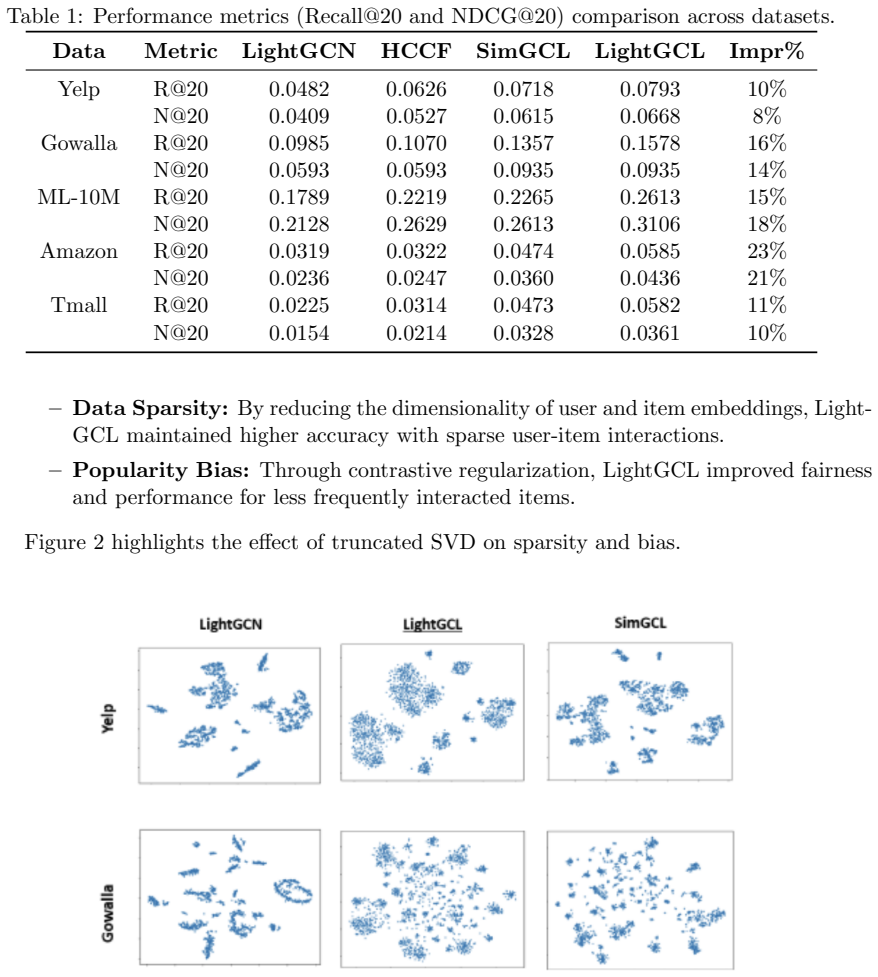
On the paper's own terms, the discovery is that contrasting local GCN embeddings against an SVD-reconstructed global view yields consistently better top-20 ranking than either plain light graph convolution or stochastic and heuristic contrastive baselines. The reimplementation reports higher Recall@20 and NDCG@20 than LightGCN, HCCF, and SimGCL on all five datasets, with the largest relative gains on Amazon-book at 23% Recall@20 and 21% NDCG@20. It also attributes to the SVD view improved representation of long-tail items and reduced over-smoothing, using the global structure as a regularizer.
Load-bearing premise
The paper's results depend on the assumption that a rank-5 randomized SVD reconstruction of the user-item adjacency matrix is a semantically faithful view of global collaborative structure, so that contrasting it with the original graph teaches useful signals rather than adding noise.
Editorial extensions
If this is right
- Recommender systems on sparse interaction graphs can use a rank-$r$ SVD view instead of random dropout or clustering to get better Recall@20 and NDCG@20.
- The contrastive alignment between local and global views should keep long-tail items better represented, improving fairness for less popular items.
- Because the SVD augmentation is a fixed low-rank matrix, it avoids per-epoch stochastic perturbation and should be cheaper than methods like SGL or SimGCL in training and inference.
- The consistent gains across five datasets suggest the approach transfers across domains such as location check-ins, movies, books, and e-commerce.
- The method's robustness to over-smoothing follows from the global view acting as a regularizer that pulls embeddings toward collaborative structure rather than allowing all nodes to converge.
Reading between the lines
- An ablation that replaces the SVD view with a random rank-5 matrix of the same norm, holding all hyperparameters fixed, would test whether the spectral content of the SVD, rather than just the lower-dimensional view, drives the reported gains.
- The rank-5 setting implies a testable diagnostic: datasets whose normalized singular values decay slowly may need a higher rank, so plotting the spectrum of the adjacency matrix could predict when LightGCL-style augmentation will help most.
- Because the contrastive objective is view-agnostic, the same local-global recipe could be ported to dynamic graphs by recomputing a low-rank SVD over sliding time windows, an extension the paper lists as future work.
Editorial analysis
A structured set of objections, weighed in public.
Referee Report
Summary. The manuscript presents a re-implementation of LightGCL, a graph contrastive learning method for recommender systems that uses truncated SVD to construct a global augmented view of the user-item graph. The authors describe the GCN backbone, the SVD-based view generation, and the local-global contrastive loss (Equations 1-5), then report Recall@20 and NDCG@20 comparisons against LightGCN, HCCF, SimGCL, and SGL on five datasets (Yelp, Gowalla, ML-10M, Amazon-book, Tmall). The paper also claims improved efficiency, robustness to data sparsity, and reduced popularity bias, and it points to a GitHub repository containing the implementation.
Significance. An independent implementation of a published method can be a useful community resource, and the availability of code with fixed random seeds is a strength. However, the manuscript makes no new methodological or theoretical contribution: it explicitly states in Section 1 that it is a re-implementation of the original LightGCL. More importantly, the central empirical claim, namely consistent superiority over all baselines on all five datasets, is not supported by the evidence as printed. Table 1 is internally inconsistent, the results text contains unfilled placeholders, and the evaluation lacks the statistical detail needed to assess the reported gains. As a result, the paper's significance is currently limited; if the experiments were corrected and fully documented, the work could serve as a reproducibility study, but that is not what the manuscript delivers.
major comments (6)
- [§4.4, Table 1] The printed results are internally inconsistent and cannot support the claim of consistent superiority. Several entries are duplicated across rows/columns: Gowalla N@20 is 0.0593 for both LightGCN and HCCF and 0.0935 for both SimGCL and LightGCL, and ML-10M SimGCL N@20 (0.2613) equals ML-10M LightGCL R@20 (0.2613). The Impr% column is also not consistent with the raw values: if SimGCL is the reference baseline, Tmall R@20 should be (0.0582-0.0473)/0.0473 ≈ 23%, not 11%, and Gowalla N@20 is 0%, not 14%; if LightGCN is the reference, nearly every row is far off. The definition of Impr% is never stated, so the reader cannot reconstruct the comparison.
- [§4.4] The results narrative contains unfilled placeholders, specifically 'margins of X% and Y% (specific numbers from experiments)' and 'X% higher NDCG compared to LightGCN.' These are not final manuscript text and indicate that the reported comparisons were not fully transcribed. This alone prevents the reader from verifying the headline results.
- [§4.3–§4.4] The baseline methods are incompletely and inconsistently reported. SGL is introduced in Section 4.3 and referenced in Section 4.4 ('outperformed SGL and SimGCL by margins of X% and Y%'), but it does not appear in Table 1. HCCF appears in Table 1 but is never introduced in Section 4.3. Consequently, the claimed comparison is not reproducible from the manuscript.
- [§4.2–§4.4] The evaluation lacks the statistical and procedural detail needed to interpret the numerical improvements. No standard deviations, confidence intervals, or numbers of independent runs are reported; the dataset split protocol is described only as 'following prior works'; and the hyperparameters (temperature τ, loss weights λ1 and λ2, edge dropout probability, embedding size k, number of layers T, and SVD rank r) are not specified for any dataset. Without this information, the gains in Table 1 cannot be distinguished from noise or from favorable hyperparameter selection.
- [§4.1, §4.5] Research questions RQ2–RQ5 are posed but not answered. Table 2 covers only two datasets and gives no units or measurement protocol for 'computational efficiency'; no ablation isolates the contribution of the local-global contrastive loss; and parameter sensitivity is asserted ('performance was stable across varied hyperparameter settings', 'a rank of 5 was sufficient') without any supporting figures, tables, or quantitative results. The claims of efficiency, fairness, and robustness are therefore unsupported.
- [§3.2, §4.5] The central assumption that a rank-r SVD reconstruction of the adjacency matrix yields a semantically faithful augmented view is not tested. The paper fixes r=5 with only the statement that 'a rank of 5 was sufficient for most datasets'; there is no sensitivity analysis over r, no comparison of different reconstruction ranks, and no inspection of whether the SVD view preserves global collaborative structure. As a result, any observed gains cannot be attributed to the SVD-based augmentation mechanism rather than to the GCN backbone or the contrastive objective.
minor comments (5)
- [§4.2, §4.4] Dataset names contain spacing errors ('Y elp' should be 'Yelp'), and Section 4.4 has the heading 'T runcated SVD Impact' with a stray space. Several places also lack spaces after periods ('users.By', 'items.The'), making the text hard to read.
- [§4.5] The text uses 'lambda1' where the objective in Section 3.3 defines λ1; notation should be consistent throughout the paper.
- [References] Several references are incomplete or inconsistently formatted; for example, [10] lacks page numbers, [12] has 'IEEE Xplore, ICIRCA 2022' embedded in the entry, and [3] is a preprint. The reference list should be cleaned up.
- [Figure 2] Figure 2 is cited as highlighting the effect of truncated SVD on sparsity and bias, but no description of its content, axes, or data source is given in the text, so the reader cannot interpret it.
- [Appendix] The appendix lists a GitHub repository, but the manuscript does not state the commit/version or confirm that the published tables were produced by that code, which weakens the reproducibility claim.
Circularity Check
No significant circularity: this is a reimplementation study whose empirical claims rest on external comparisons, not on fitted inputs or self-citations.
full rationale
This manuscript is an implementation/reimplementation of the original LightGCL framework, explicitly citing Cai et al. as reference [3] and describing the project as 'an implementation of the original LightGCL framework.' There is no first-principles derivation whose conclusion is wired into its premise: the SVD-based augmentation in Section 3.2 is adopted from that external prior work, and the contrastive loss in Section 3.3 is the standard InfoNCE formulation. The central quantitative claim, 'LightGCL demonstrated consistent superiority over the baseline methods across all five datasets' (Section 4.4), is empirical and is benchmarked against external baselines such as LightGCN, SimGCL, SGL, and HCCF; none of those baselines involve parameters fitted from LightGCL's own outputs, and no self-citation chain is used to justify the model choice. The table's internal inconsistencies (e.g., Tmall R@20 implies roughly 23% improvement over SimGCL while the Impr% column prints 11%, and Gowalla N@20 is identical for SimGCL and LightGCL yet the table prints +14%) are serious evidence-quality problems, but they are not a form of circularity: the claim does not reduce to its own inputs by definition, it is instead unsupported by the printed numbers. Consequently, the circularity score is 0.
Assumptions & free parameters
free parameters (7)
- temperature tau
- contrastive regularization weight lambda_1
- weight decay lambda_2
- SVD rank r =
5 (stated as sufficient for most datasets)
- embedding size k
- number of GCN layers T
- edge dropout probability P
assumptions (3)
- domain assumption The low-rank SVD reconstruction preserves the global collaborative signals that are relevant for recommendation.
- domain assumption The randomized SVD approximation is accurate enough that the augmented graph remains a valid contrastive view.
- domain assumption The dataset splits 'following prior works' are fair and comparable to the splits used by the baselines.
Cite this review
Pith. "Pith review of Graph Contrastive Learning for Optimizing Sparse Data in Recommender Systems with LightGCL." pith.science (2026). https://pith.science/paper/4ADECRJD
@misc{pith2026250600048,
  author       = {Pith},
  title        = {Pith review of: Graph Contrastive Learning for Optimizing Sparse Data in Recommender Systems with LightGCL},
  year         = {2026},
  howpublished = {\url{https://pith.science/paper/4ADECRJD}},
  note         = {Machine review of arXiv:2506.00048}
}
read the original abstract
Graph Neural Networks (GNNs) are powerful tools for recommendation systems, but they often struggle under data sparsity and noise. To address these issues, we implemented LightGCL, a graph contrastive learning model that uses Singular Value Decomposition (SVD) for robust graph augmentation, preserving semantic integrity without relying on stochastic or heuristic perturbations. LightGCL enables structural refinement and captures global collaborative signals, achieving significant gains over state-of-the-art models across benchmark datasets. Our experiments also demonstrate improved fairness and resilience to popularity bias, making it well-suited for real-world recommender systems.
Figures

Reference graph
Works this paper leans on
-
[3]
Cai, Xuheng, et al. ”LightGCL: Simple yet effective graph contrastive learning for recom- mendation.” arXiv preprint arXiv:2302.08191 (2023)
arXiv 2023
-
[1]
Deli Chen, Yankai Lin, Wei Li, Peng Li, Jie Zhou, and Xu Sun. Measuring and reliev- ing the over smoothing problem for graph neural networks from the topological view. In Proceedings of the AAAI Conference on Artificial Intelligence, volume 34, pp. 3438–3445, 2020a
-
[2]
Lei Chen, LeWu,RichangHong,KunZhang,andMengWang. Revisitinggraphbasedcollabora- tive f iltering: A linear residual graph convolutional network approach. In AAAI conference on artificial intelligence, volume 34, pp. 27–34, 2020b
-
[4]
Contrastive multi-view representation learn- ing on graphs
Kaveh Hassani and Amir Hosein Khasahmadi. Contrastive multi-view representation learn- ing on graphs. In International Conference on Machine Learning (ICML), pp. 4116–4126. PMLR, 2020
work page 2020
-
[5]
Factorization meets the neighborhood: a multifaceted collaborative filtering model
Yehuda Koren. Factorization meets the neighborhood: a multifaceted collaborative filtering model. In Proceedings of the 14th ACM SIGKDD international conference on Knowledge discovery and data mining, pp. 426–434, 2008
work page 2008
-
[6]
Matrix factorization techniques for rec- ommender systems
Yehuda Koren, Robert Bell, and Chris Volinsky. Matrix factorization techniques for rec- ommender systems. Computer, 42(8):30–37, 2009
work page 2009
-
[7]
Task-adaptive neural process for user cold-start recommendation
Xixun Lin, Jia Wu, Chuan Zhou, Shirui Pan, Yanan Cao, and Bin Wang. Task-adaptive neural process for user cold-start recommendation. In Proceedings of the Web Conference (WWW), pp. 1306–1316, 2021
work page 2021
-
[8]
Learning matrix space image representations
Anand Rangarajan. Learning matrix space image representations. In International Work- shop on En ergy Minimization Methods in Computer Vision and Pattern Recognition, pp. 153–168. Springer, 2001
work page 2001
Show all 12 references
-
[9]
”Self-supervised graph learning for recommendation.” Proceedings of the 44th international ACM SIGIR conference on research and development in information retrieval
Wu, Jiancan, et al. ”Self-supervised graph learning for recommendation.” Proceedings of the 44th international ACM SIGIR conference on research and development in information retrieval. 2021
2021
-
[10]
Yu, Junliang, et al. ”Are graph augmentations necessary? simple graph contrastive learning for recommendation.” Proceedings of the 45th international ACM SIGIR conference on research and development in information retrieval. 2022
2022
-
[11]
He, Xiangnan, et al. ”Lightgcn: Simplifying and powering graph convolution network for recommendation.” Proceedings of the 43rd International ACM SIGIR conference on re- search and development in Information Retrieval. 2020
2020
-
[12]
Enhancing sequential recommendation with graph contrastive learning
Yixin Zhang, Yong Liu, Yonghui Xu, Hao Xiong, Chenyi Lei, Wei He, Lizhen Cui, and Chunyan Miao. Enhancing sequential recommendation with graph contrastive learning. International Joint Conference on Artificial Intelligence (IJCAI), 2022. IEEE Xplore, ICIRCA 2022. 8 Appendix: C...
2022
Reviewed August 7, 2026 · model on record in the stance chip above.
Discussion (0). Sign in to comment.