REVIEW 4 major objections 6 minor 46 references
SPLASH: A Rapid Host-Based Supernova Classifier for Wide-Field Time-Domain Surveys
T0 review · 4 major / 6 minor · reviewed 2026-08-07 · deepseek-v4-flash
Pith's one-line read This paper shows that a supernova's class can be inferred from the photometry of its host galaxy alone, without any light-curve information from the supernova itself, at accuracy comparable to state-of-the-art methods.
desk verdict A solid host-only SN classifier with a real if modest gain over photometry-only baselines; abstract overstates F1 and SLSNe, and Pan-STARRS domain transfer needs validation. read the letter →
The pith
A machine-rendered reading of the paper's core claim, the machinery that carries it, and where it could break.
The reading
What carries the argument
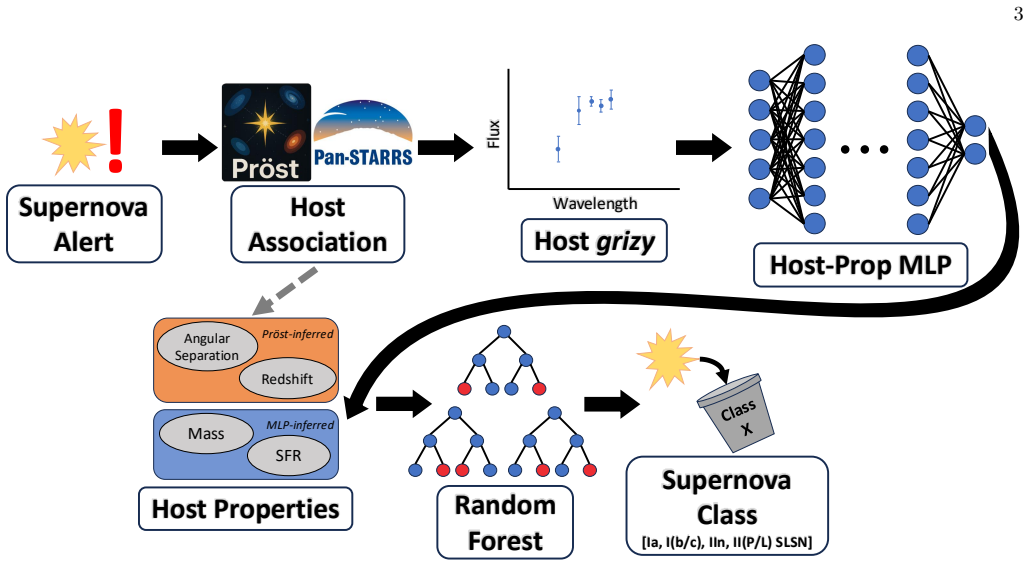
The central object is the SPLASH pipeline, a two-stage architecture. Stage one is a multilayer perceptron with six input nodes (host $g$, $r$, $i$, $z$, $y$ absolute magnitudes plus redshift), four ReLU hidden layers, and a two-node linear output predicting $\log M_*$ and $\log \mathrm{SFR}$, trained with a mean-squared-error loss on the SED-fit catalog. Stage two is a random forest of 1000 trees trained on the inferred $\log M_*$, $\log \mathrm{SFR}$, host-SN angular separation, and redshift, with classes Type Ia, I(b/c), IIn, II(P/L), and SLSNe. The load-bearing step is the intermediate inference: it converts raw photometry into physically meaningful properties, which the paper shows (by comparison to a photometry-only random forest) slightly improves F1 and makes the classifier interpretable. Host association supplies redshift and angular separation, so the entire classification can be done without any supernova photometry.
What would settle it
Take a sample of galaxies that have both Pan-STARRS grizy photometry and independent spectroscopic redshifts with SED-derived stellar masses and star formation rates, run SPLASH's property-inference MLP on the Pan-STARRS magnitudes, and compare inferred to fitted values. A systematic offset, or a median fractional error on $\log \mathrm{SFR}$ much larger than the 0.2 reported on the training-set test split, would show that the cross-survey band match does not transfer and would break the classifier's inputs.
Extended reading notes
Core claim
SPLASH's central claim is that the mapping from a supernova's class to its galactic environment is strong enough that a classifier trained on host stellar mass, star formation rate, redshift, and angular offset can match classifiers that use supernova light curves. The paper argues that the two-stage design—deep learning from host photometry to physical properties, then random-forest classification from those properties—captures the same discriminative information as using the true SED-derived properties: in cross-validation, purities differ by at most 0.04 between pipelines fed inferred and true host properties. It further claims that, because it only needs host photometry, the method classifies from the instant a transient is detected, and that requiring a high confidence threshold yields pure samples of all major supernova types while sacrificing completeness, a trade the paper argues is acceptable in the Rubin era.
Load-bearing premise
The pipeline assumes that Pan-STARRS DR2 grizy photometry is interchangeable with the multi-survey photometry on which the property-inference network was trained, so that inferred stellar masses and star formation rates stay unbiased when the network is applied to Pan-STARRS hosts; no validation demonstrates this.
Editorial extensions
If this is right
- An LSST alert can be classified immediately, before any supernova light curve has accumulated, so follow-up telescopes can be pointed at promising young events in real time.
- Confidence-thresholding converts the classifier into a follow-up filter: keeping only the most confident 10% of predictions yields roughly 97.5% Type Ia purity and 80% core-collapse purity in the BTS & YSE validation.
- At roughly 500 classifications per second, the full nightly alert stream of LSST can be processed cheaply, and the inferred host properties double as a demographic selection tool for population studies.
- Because several independent host-only classifiers plateau at similar accuracy, the paper argues that the remaining error is dominated by intrinsic overlap in host properties rather than by model architecture.
Reading between the lines
- Inference: if the cross-survey photometry transfer holds, SPLASH's inferred host properties could be combined with early light-curve features to push beyond the host-only plateau, since the two information sources are likely partly independent.
- Inference: the two-stage design—photometry to physical properties to class—could generalize to other transients whose rates depend on galactic environment, such as tidal disruption events or kilonovae.
- Inference: a direct test of the transfer assumption would be to recalibrate the MLP on a small Pan-STARRS sample with spectroscopic redshifts; if the bias is linear, a simple correction layer could recover accuracy without retraining on the full multi-survey catalog.
Editorial analysis
A structured set of objections, weighed in public.
Referee Report
Summary. This paper presents SPLASH, a three-stage pipeline for classifying supernovae from host-galaxy photometry alone: (i) host association via Prost or a chance-coincidence criterion, (ii) inference of host stellar mass and star formation rate from grizy photometry and redshift using an MLP trained on the Zou et al. (2022) deep-drilling-field catalog, and (iii) classification into Ia, I(b/c), IIn, II(P/L), and SLSN using a random forest with inputs of inferred M*, SFR, redshift, and host-SN angular separation. The authors report 76% binary accuracy and 69% F1 in the abstract, compare performance across Pan-STARRS, BTS/YSE, and Zou et al. validation sets, and demonstrate high-purity subsets when confidence thresholds are applied.
Significance. If the headline performance survives scrutiny, SPLASH would be a practical early-time triage tool for LSST, since it classifies transients immediately after detection without SN light-curve data. The paper's design has genuine strengths: the intermediate physical-property inference makes the model interpretable and reusable for demographic selection; the use of an external spectroscopic-label dataset and independent validation on BTS/YSE is the right general strategy; and the authors provide operational code and a public web service. The central unresolved risk is the domain transfer from the multi-survey DDF photometry used to train the MLP to the Pan-STARRS photometry used in deployment; until that transfer is calibrated, the headline numbers rest on an unquantified assumption.
major comments (4)
- [Sec. 2.1.1, 2.1.2, 3.2] The MLP is trained on the Zou et al. (2022) multi-survey photometry (DES, HSC, VOICE, VIDEO, GALEX, Spitzer) with bands merged by median effective wavelength, and is then applied to Pan-STARRS DR2 grizy photometry with no test that the inferred log M* and log SFR remain unbiased on Pan-STARRS data. Pan-STARRS differs from the deep drilling field catalogs in depth, deblending, photometric zero points, and bandpass shape, so a systematic color offset would propagate directly into the random-forest inputs and into all of the headline metrics (Pan-STARRS cross-validation and BTS/YSE validation in Table 2). The statement in Sec. 2.1.1 that bandpasses are 'similar enough' is not a calibration, and Figure 2(a) cannot expose a shared SPLASH bias because every Pan-STARRS and BTS/YSE value passes through the same MLP. Please add a cross-check, for example by applying the MLP to Pan-STARRS photometry of galaxies with CIGALE-derived properties in overlapping fields (e.g., XMM-LSS or CDF-S) and reporting the bias and scatter, or by retraining the property-inference step on Pan-STARRS-like photometry.
- [Sec. 2.1.3, 2.1.4, Table 2] The BTS/YSE validation is described as independent, but no de-duplication against the OACAPI training sample is documented. Since OACAPI is described as aggregating SNe from heterogeneous sources including wide-field synoptic surveys, it may already contain BTS or YSE events, in which case the reported BTS/YSE accuracy of 0.76 and F1 of 0.69 are not an out-of-sample test. Please quantify the overlap, repeat the validation after removing any overlapping events, and report the BTS/YSE metrics with sample counts and uncertainties.
- [Sec. 2.3, 3.2, Fig. 5] The MLP training split is drawn from the Zou et al. (2022) spec-z galaxy catalog, and the Figure 5 proof-of-concept and the Zou+2022 row of Table 2 use SNe whose hosts are in that same catalog. The paper does not state whether those host galaxies were excluded from the MLP training split. If they were not, the agreement between NN-inferred and true properties in Figure 5 is at least partly in-sample for the MLP and may overstate how well the inferred properties preserve class-discriminating information on unseen hosts. Please clarify whether any of the supernova host galaxies fall in the MLP training set and, if so, recompute the comparison on hosts that are strictly out-of-sample for the MLP.
- [Sec. 3.2, Table 2, Abstract] The headline accuracy of 76% is not benchmarked against the class prior. The supernova dataset is roughly 75% Type Ia (Sec. 2.1.3), so a trivial classifier that always predicts 'Ia' would already achieve ~75% accuracy on a similar sample; 76% accuracy alone therefore does not establish useful discrimination, and the abstract's phrasing ('comparable to other state-of-the-art methods') rests on this number. Please report a chance-normalized metric (balanced accuracy or Matthews correlation coefficient), and please state in the abstract and Section 5 which dataset and which F1 convention (unweighted vs. weighted) the 69% value refers to.
minor comments (6)
- [Sec. 4.1, Fig. 8, Abstract] The text claims SPLASH can obtain 'pure samples of all five SN classes,' but the next paragraph and Figure 8 show that at confidence thresholds 0.6-0.9 no SLSNe are recovered at all; please correct the abstract and Section 5 to state this limitation.
- [Sec. 2.1.3, Fig. 7] The description of the 'supernova dataset' is difficult to reconcile with the sample sizes in Figure 7; the text gives 586 classified SNe with hosts in DDFs, while the confusion matrices contain thousands of objects. Please clarify whether the Pan-STARRS dataset consists of all spectroscopically classified OACAPI SNe with Pan-STARRS hosts and define the per-dataset sample sizes.
- [Sec. 2.2.1] The text says OACAPI SNe are associated with host galaxies from 'Zou et al. (2021)'; the galaxy property catalog used elsewhere is Zou et al. (2022), so please verify this citation.
- [Eq. (3), Sec. 2.3] The loss in Eq. (3) divides by sigma_i, but the text then says the spectroscopic errors are set to 'an arbitrarily small value'; please clarify what sigma_i represents (target uncertainty, redshift uncertainty, or both) and how the weighting behaves for the spec-z training galaxies.
- [Table 2] The row labels 'Pan-STARRS', 'BTS & YSE', and 'Zou+2022' mix host catalogs and galaxy catalogs; please define in the caption what each row contains (e.g., which SN sample and which host catalog was used) and why uncertainties are reported for some rows but not others.
- [Sec. 4.2] The throughput claim of ~500 classifications per second appears to exclude the Prost host-association step, which the text says takes a few seconds per SN; please qualify the statement to avoid conflating per-alert end-to-end speed with per-host classification speed.
Circularity Check
No significant circularity: SPLASH's classification metrics are supervised against external spectroscopic labels and evaluated on held-out folds and independent validation catalogs; the self-citations are not load-bearing.
full rationale
The derivation chain is: an MLP maps multi-band host photometry to stellar mass and star formation rate (trained on CIGALE-labeled Zou et al. galaxies with an 80-20 split), and then a random forest maps inferred M*, SFR, redshift, and angular separation to supernova class (trained on spectroscopic class labels and evaluated by stratified k-fold cross-validation plus the independent BTS/YSE catalogs). The claimed binary accuracy and F1-score are measured on held-out folds and on an external validation set, so they are not forced by construction. The property-inference metrics (Table 1, Figure 4) are computed on a held-out test set and compared with the reported CIGALE uncertainties, not by reusing training targets as predictions. The comparison of NN-inferred versus derived-property classification (Figure 5) is an internal sanity check, not the headline result. The self-citation to Pröst (Gagliano et al., in prep.) is not load-bearing for the quantitative claims: the validation and cross-validation host associations use the Bloom et al. (2002) chance-coincidence method instead of Pröst. The main robustness risk, namely applying the MLP trained on DDF multi-survey photometry to Pan-STARRS grizy without an explicit calibration check, is an unvalidated domain-transfer assumption rather than a circular derivation. It does not raise the circularity score under the enumerated criteria.
Assumptions & free parameters
free parameters (7)
- MLP weights and biases =
trained on 84,672 spec-z galaxies from Zou et al. 2022
- MLP hyperparameters =
lr=0.01, batch size=2048, up to 10000 epochs, early stopping patience=100, 4 ReLU layers (6,5,4,3 nodes) plus linear…
- KNN imputation k =
5
- Random forest size and impurity =
1000 trees, Gini impurity
- Host association threshold P_cc =
0.1
- Redshift cut =
z <= 1
- Confidence thresholds for pure samples =
0.6, 0.7, 0.8, 0.9
assumptions (6)
- domain assumption Supernova class is correlated with host galaxy stellar mass, star formation rate, and environment.
- domain assumption CIGALE-derived log M* and log SFR from Zou et al. (2022) are accurate enough to serve as training labels.
- domain assumption Pan-STARRS grizy photometry is interchangeable with the DDF survey photometry used in training.
- domain assumption The spec-z selected subset (84,672 galaxies) is representative of all galaxies to which the MLP will be applied.
- domain assumption Spectroscopic classifications in OACAPI and in BTS/YSE are correct.
- domain assumption Host association with chance coincidence or Prost identifies the true host galaxy.
Cite this review
Pith. "Pith review of SPLASH: A Rapid Host-Based Supernova Classifier for Wide-Field Time-Domain Surveys." pith.science (2026). https://pith.science/paper/LOVN3Y7G
@misc{pith2026250600121,
  author       = {Pith},
  title        = {Pith review of: SPLASH: A Rapid Host-Based Supernova Classifier for Wide-Field Time-Domain Surveys},
  year         = {2026},
  howpublished = {\url{https://pith.science/paper/LOVN3Y7G}},
  note         = {Machine review of arXiv:2506.00121}
}
abstract
The upcoming Legacy Survey of Space and Time (LSST) conducted by the Vera C. Rubin Observatory will detect millions of supernovae (SNe) and generate millions of nightly alerts, far outpacing available spectroscopic resources. Rapid, scalable photometric classification methods are therefore essential for identifying young SNe for follow-up and enabling large-scale population studies. We present SPLASH, a host-based classification pipeline that infers supernova classes using only host galaxy photometry. SPLASH first associates SNe with their hosts (yielding a redshift estimate), then infers host galaxy stellar mass and star formation rate using deep learning, and finally classifies SNe using a random forest trained on these inferred properties, along with host-SN angular separation and redshift. SPLASH achieves a binary (Type Ia vs. core-collapse) classification accuracy of $76\%$ and an F1-score of $69\%$, comparable to other state-of-the-art methods. By selecting only the most confident predictions, SPLASH can return highly pure subsets of all major SN types, making it well-suited for targeted follow-up. Its efficient design allows classification of $\sim 500$ SNe per second, making it ideal for next-generation surveys. Moreover, its intermediate inference step enables selection of transients by host environment, providing a tool not only for classification but also for probing the demographics of stellar death.
Figures


Figures from the paper (4 more)


Reference graph
Works this paper leans on
-
[1]
Abbott, T. M. C., Adam´ ow, M., Aguena, M., et al. 2021, ApJS, 255, 20, doi: 10.3847/1538-4365/ac00b3
-
[2]
D., Malanchev, K., Sharief, S., et al
Aleo, P. D., Malanchev, K., Sharief, S., et al. 2023, ApJS, 266, 9, doi: 10.3847/1538-4365/acbfba Astropy Collaboration, Robitaille, T. P., Tollerud, E. J., et al. 2013, A&A, 558, A33, doi: 10.1051/0004-6361/201322068 Astropy Collaboration, Price-Whelan, A. M., Sip˝ ocz, B. M., et al. 2018, AJ, 156, 123, doi: 10.3847/1538-3881/aabc4f
-
[3]
Coppejans, D. L. 2020, ApJ, 902, 60, doi: 10.3847/1538-4357/abb1c0
-
[4]
Beckwith, S. V. W., Stiavelli, M., Koekemoer, A. M., et al. 2006, AJ, 132, 1729, doi: 10.1086/507302
doi:10.1086/507302 2006
-
[5]
Bellm, E. C., Kulkarni, S. R., Graham, M. J., et al. 2019, PASP, 131, 018002, doi: 10.1088/1538-3873/aaecbe
-
[6]
Bloom, J. S., Kulkarni, S. R., & Djorgovski, S. G. 2002, The Astronomical Journal, 123, 1111, doi: 10.1086/338893
doi:10.1086/338893 2002
-
[7]
2019, A&A, 622, A103, doi: 10.1051/0004-6361/201834156
Boquien, M., Burgarella, D., Roehlly, Y., et al. 2019, A&A, 622, A103, doi: 10.1051/0004-6361/201834156
-
[8]
A., Pearson, J., Shrestha, M., et al
Bostroem, K. A., Pearson, J., Shrestha, M., et al. 2023, Early Spectroscopy and Dense Circumstellar Medium Interaction in SN 2023ixf. https://arxiv.org/abs/2306.10119
arXiv 2023
Show all 46 references
-
[9]
B., van Dokkum, P
Brammer, G. B., van Dokkum, P. G., & Coppi, P. 2008, ApJ, 686, 1503, doi: 10.1086/591786
2008 doi
- [10]
-
[11]
2013, The Astrophysical Journal, 770, 107, doi: 10.1088/0004-637X/770/2/107 D´ alya, G., Galg´ oczi, G., Dobos, L., et al
Childress, M., Aldering, G., Antilogus, P., et al. 2013, The Astrophysical Journal, 770, 107, doi: 10.1088/0004-637X/770/2/107 D´ alya, G., Galg´ oczi, G., Dobos, L., et al. 2018, MNRAS, 479, 2374, doi: 10.1093/mnras/sty1703
2013 doi
-
[12]
J., Lang, D., et al
Dey, A., Schlegel, D. J., Lang, D., et al. 2019, AJ, 157, 168, doi: 10.3847/1538-3881/ab089d
2019 doi
-
[13]
Filippenko, A. V. 1997, ARA&A, 35, 309, doi: 10.1146/annurev.astro.35.1.309
1997 doi
-
[14]
A., Magnier, E
Flewelling, H. A., Magnier, E. A., Chambers, K. C., et al. 2020, ApJS, 251, 7, doi: 10.3847/1538-4365/abb82d
2020 doi
-
[15]
2025, arXiv preprint arXiv:2501.16311
Frohmaier, C., Vincenzi, M., Sullivan, M., et al. 2025, arXiv preprint arXiv:2501.16311
2025 arXiv
-
[16]
2023, in American Astronomical Society Meeting Abstracts, Vol
Gagliano, A., Contardo, G., Foreman-Mackey, D., Malz, A., & Aleo, P. 2023, in American Astronomical Society Meeting Abstracts, Vol. 241, American Astronomical Society Meeting Abstracts, 103.02
2023
-
[17]
2021, ApJ, 908, 170, doi: 10.3847/1538-4357/abd02b
Gagliano, A., Narayan, G., Engel, A., Carrasco Kind, M., & LSST Dark Energy Science Collaboration. 2021, ApJ, 908, 170, doi: 10.3847/1538-4357/abd02b
2021 doi
-
[18]
Guillochon, J., & Cowperthwaite, P. S. 2018, Research Notes of the American Astronomical Society, 2, 27, doi: 10.3847/2515-5172/aac2c8
2018 doi
-
[19]
R., Kuhlmann, S., Kovacs, E., et al
Gupta, R. R., Kuhlmann, S., Kovacs, E., et al. 2016, AJ, 152, 154, doi: 10.3847/0004-6256/152/6/154
2016 doi
-
[20]
A., Adibekyan, V
Hakobyan, A. A., Adibekyan, V. Z., Aramyan, L. S., et al. 2012, A&A, 544, A81, doi: 10.1051/0004-6361/201219541
2012 doi
-
[21]
R., Millman, K
Harris, C. R., Millman, K. J., van der Walt, S. J., et al. 2020, Nature, 585, 357–362, doi: 10.1038/s41586-020-2649-2 13
2020 doi
-
[22]
W., Pahre, M
Hogg, D. W., Pahre, M. A., McCarthy, J. K., et al. 1997, MNRAS, 288, 404, doi: 10.1093/mnras/288.2.404
1997 doi
-
[23]
Hunter, J. D. 2007, Computing in Science & Engineering, 9, 90, doi: 10.1109/MCSE.2007.55
2007 doi
-
[24]
J., Bonfield, D
Jarvis, M. J., Bonfield, D. G., Bruce, V. A., et al. 2013, MNRAS, 428, 1281, doi: 10.1093/mnras/sts118
2013 doi
-
[25]
L., & Kirshner, R
Kelly, P. L., & Kirshner, R. P. 2012, The Astrophysical Journal, 759, 107, doi: 10.1088/0004-637X/759/2/107
2012 doi
-
[26]
2023, The Astrophysical Journal, 942, 29, doi: 10.3847/1538-4357/aca532
Kisley, M., Qin, Y.-J., Zabludoff, A., Barnard, K., & Ko, C.-L. 2023, The Astrophysical Journal, 942, 29, doi: 10.3847/1538-4357/aca532
2023 doi
-
[27]
Kulkarni, S. R. 2020, Towards An Integrated Optical Transient Utility. https://arxiv.org/abs/2004.03511
2020 arXiv
-
[28]
A., Farrah, D., et al
Lacy, M., Surace, J. A., Farrah, D., et al. 2021, MNRAS, 501, 892, doi: 10.1093/mnras/staa3714
2021 doi
-
[30]
2011, MNRAS, 412, 1473, doi: 10.1111/j.1365-2966.2011.18162.x
Li, W., Chornock, R., Leaman, J., et al. 2011, MNRAS, 412, 1473, doi: 10.1111/j.1365-2966.2011.18162.x
2011
-
[31]
J., Smith, H
Lonsdale, C. J., Smith, H. E., Rowan-Robinson, M., et al. 2003, PASP, 115, 897, doi: 10.1086/376850
2003 doi
-
[32]
2019, Decoupled Weight Decay Regularization
Loshchilov, I., & Hutter, F. 2019, Decoupled Weight Decay Regularization. https://arxiv.org/abs/1711.05101 LSST Science Collaboration, Abell, P. A., Allison, J., et al. 2009, arXiv e-prints, arXiv:0912.0201, doi: 10.48550/arXiv.0912.0201
2019 arXiv
-
[33]
C., Fanson, J., Schiminovich, D., et al
Martin, D. C., Fanson, J., Schiminovich, D., et al. 2005, ApJL, 619, L1, doi: 10.1086/426387
2005 doi
-
[34]
N., & Yang, G
Ni, Q., Timlin, J., Brandt, W. N., & Yang, G. 2019, Research Notes of the American Astronomical Society, 3, 5, doi: 10.3847/2515-5172/aaf8af
2019 doi
-
[35]
N., Chen, C.-T., et al
Ni, Q., Brandt, W. N., Chen, C.-T., et al. 2021, ApJS, 256, 21, doi: 10.3847/1538-4365/ac0dc6
2021 doi
-
[36]
2024, MNRAS, 531, 4990, doi: 10.1093/mnras/stae1450
Parker, L., Lanusse, F., Golkar, S., et al. 2024, MNRAS, 531, 4990, doi: 10.1093/mnras/stae1450
2024 doi
-
[37]
2019, PyTorch: An Imperative Style, High-Performance Deep Learning Library
Paszke, A., Gross, S., Massa, F., et al. 2019, PyTorch: An Imperative Style, High-Performance Deep Learning Library. https://arxiv.org/abs/1912.01703
2019 arXiv
-
[38]
2011, Journal of Machine Learning Research, 12, 2825
Pedregosa, F., Varoquaux, G., Gramfort, A., et al. 2011, Journal of Machine Learning Research, 12, 2825
2011
-
[39]
A., Fremling, C., Sollerman, J., et al
Perley, D. A., Fremling, C., Sollerman, J., et al. 2020, ApJ, 904, 35, doi: 10.3847/1538-4357/abbd98 Python Core Team. 2019, Python: A dynamic, open source programming language, Python Software Foundation. https://www.python.org/
2020 doi
-
[40]
2024, MNRAS, 533, 3517, doi: 10.1093/mnras/stae1921
Qin, Y.-J., & Zabludoff, A. 2024, MNRAS, 533, 3517, doi: 10.1093/mnras/stae1921
2024 doi
-
[41]
2021, The Astrophysical Journal Supplement Series, 255, 29, doi: 10.3847/1538-4365/abff5e Surace, & et al
Schulze, S., Yaron, O., Sollerman, J., et al. 2021, The Astrophysical Journal Supplement Series, 255, 29, doi: 10.3847/1538-4365/abff5e Surace, & et al. 2012, VizieR Online Data Catalog: The SWIRE Data Release 2 (Surace+ 2005), VizieR On-line Data Catalog: II/302. Originally p...
2021 doi
-
[42]
2020, Journal of Open Source Software, 5, 1943, doi: 10.21105/joss.01943
Uieda, L., Soler, S., Rampin, R., et al. 2020, Journal of Open Source Software, 5, 1943, doi: 10.21105/joss.01943
2020 doi
-
[43]
2016, in The 4th Annual Conference on High Energy Astrophysics in Southern Africa (HEASA 2016), 26, doi: 10.22323/1.275.0026
Vaccari, M., Covone, G., Radovich, M., et al. 2016, in The 4th Annual Conference on High Energy Astrophysics in Southern Africa (HEASA 2016), 26, doi: 10.22323/1.275.0026
2016 doi
-
[44]
A., Gomez, S., Berger, E., & Gagliano, A
Villar, V. A., Gomez, S., Berger, E., & Gagliano, A. 2025, ApJS, 276, 3, doi: 10.3847/1538-4365/ad8a5b
2025 doi
-
[45]
2023, The Astrophysical Journal, 949, 23, doi: 10.3847/1538-4357/acc2c3
Zhu, J., Jiang, N., Dong, S., et al. 2023, The Astrophysical Journal, 949, 23, doi: 10.3847/1538-4357/acc2c3
2023 doi
-
[46]
N., et al
Zou, F., Yang, G., Brandt, W. N., et al. 2021, Research Notes of the American Astronomical Society, 5, 56, doi: 10.3847/2515-5172/abf050
2021 doi
-
[47]
N., Chen, C.-T., et al
Zou, F., Brandt, W. N., Chen, C.-T., et al. 2022, The Astrophysical Journal Supplement Series, 262, 15, doi: 10.3847/1538-4365/ac7bdf 14 Ia Ib/c SLSN IIn II (P/L) II (P/L) IIn SLSN Ib/c Ia True label 0.1 (564) 0.3 (3) 0.0 (0) 0.0 (0) 0.44 (47) 0.02 (132) 0.1 (1) 0.0 (0) 1.0 (2...
2022 doi
Reviewed August 7, 2026 · model on record in the stance chip above.
Discussion (0). Sign in to comment.