REVIEW 3 major objections 3 minor 80 references
Role of thermal fluctuations in nucleation of three-flavor quark matter
T0 review · 3 major / 3 minor · reviewed 2026-08-07 · deepseek-v4-flash
Pith's one-line read Flavor jitter lowers the quark-matter nucleation barrier
desk verdict A genuine three-flavor extension of their nucleation formalism with a new CFL threshold, transparently derived, but the quantitative barrier heights rest on treating ~45-baryon droplets as bulk phases and switching to CFL right at the critical radius. read the letter →
The pith
A machine-rendered reading of the paper's core claim, the machinery that carries it, and where it could break.
The reading
What carries the argument
The key object is the activation energy W, the height of the free-energy barrier between the metastable hadronic phase and the quark phase, computed as a sum of a bulk term and a surface term σ·$4πR^{2}$. The saddle-point condition fixes the critical radius R_* = 2σ/(P_Q - P_H), and the composition of the droplet is set by minimizing W with respect to the fluctuated strangeness and charge fractions, giving the strong-interaction chemical equilibrium conditions in Eqs. (68)-(72). Color superconductivity enters as a step function: the pressure is that of unpaired quark matter for R ≤ R_Δ and of CFL quark matter for R > R_Δ, with R_Δ = 1/Δ(T) taken as the diquark coherence length. This machine turns the vague idea of 'composition fluctuation' into a definite formula for the nucleation rate, and it turns the size threshold for pairing into a concrete modification of the critical radius.
What would settle it
A lattice or functional-QCD computation of the free energy of a 45-70 baryon droplet of deconfined quark matter with a sharp hadron-quark interface: if that free energy cannot be represented as a bulk term plus a constant surface tension, then the quantitative barrier heights and the R_* = R_Δ threshold derived here are not reliable.
Extended reading notes
Core claim
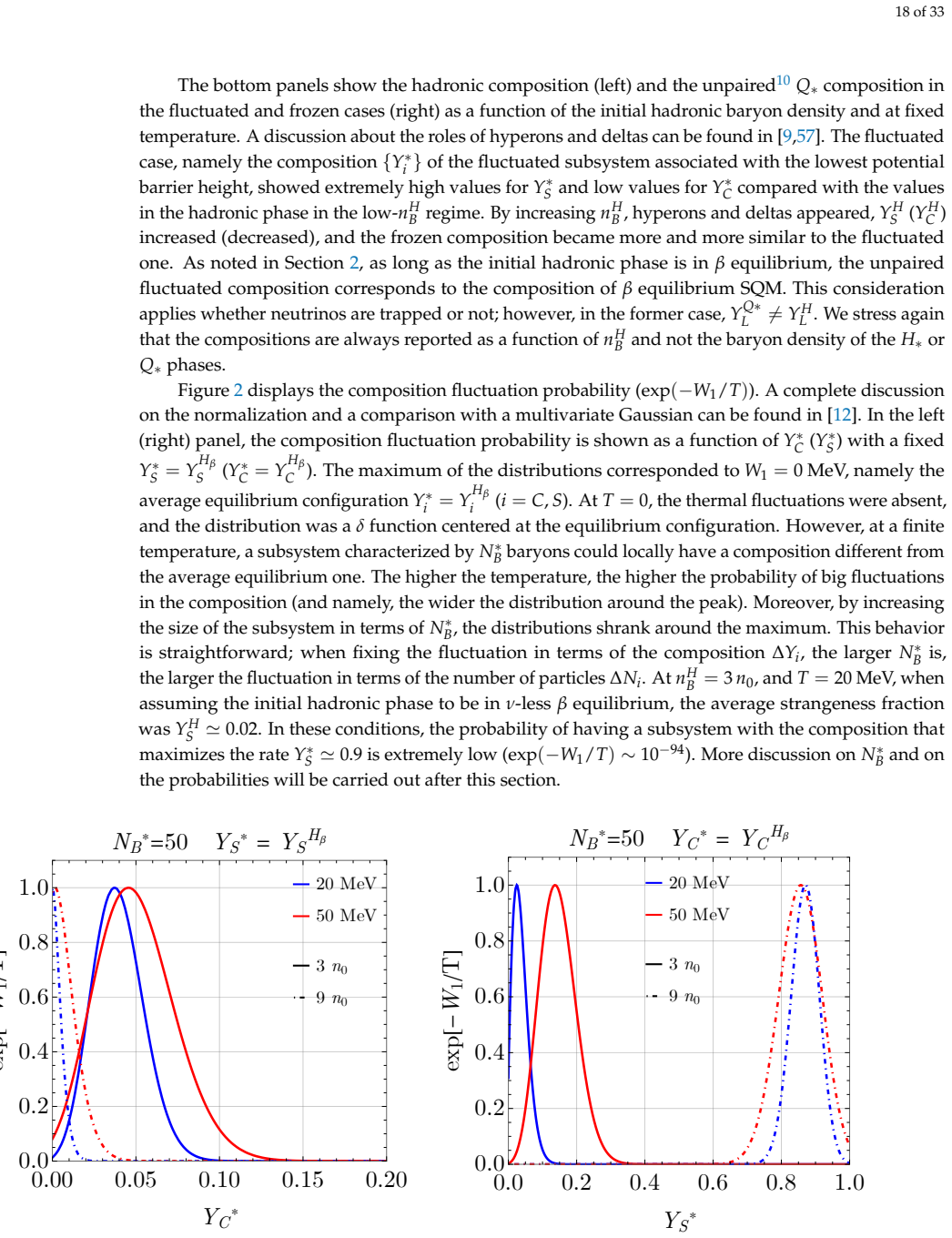
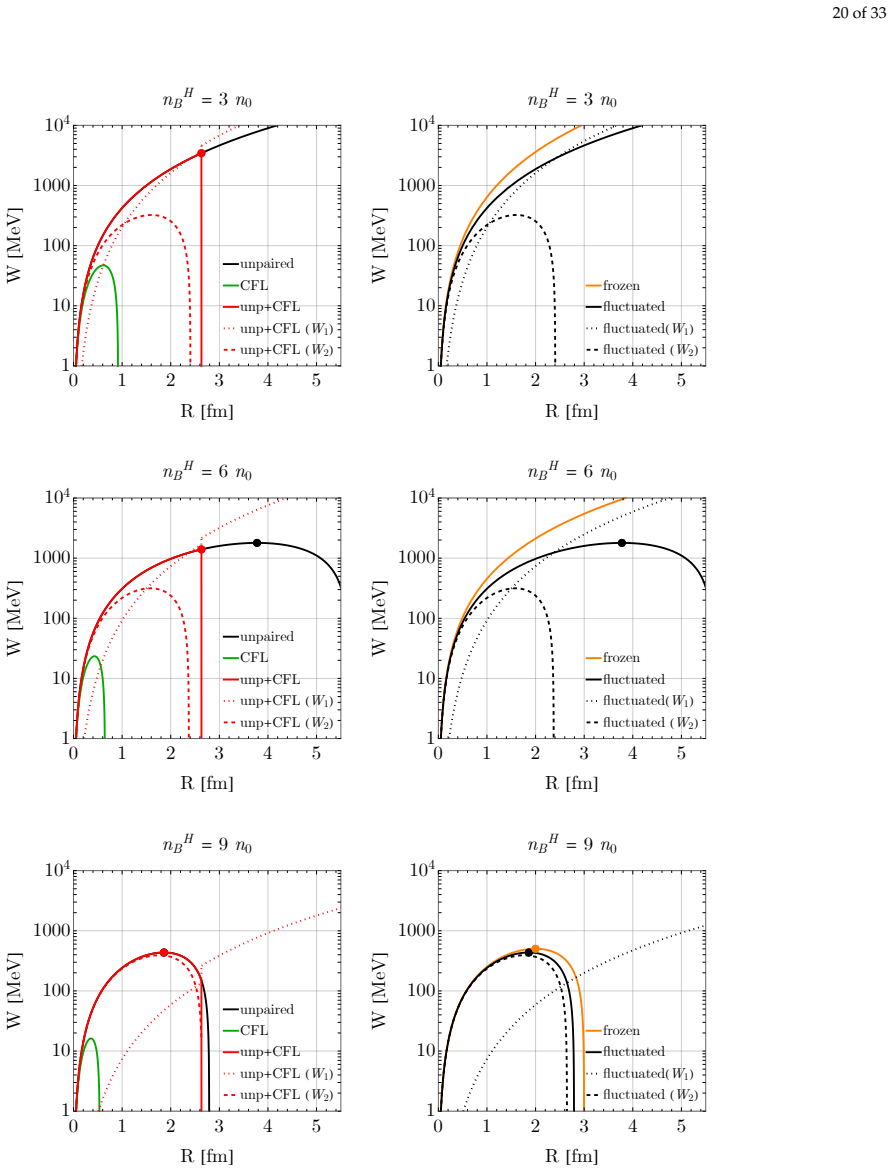
The central claim is that the activation energy for nucleating a three-flavor quark matter droplet is W = $16πσ^{3}$ / (3 [P_Q(n_Q*, Y_Q*, T) - P_H(n_H, Y_H, T)]^2), where the droplet's composition is no longer fixed to the hadronic composition but is instead determined by the chemical equilibrium conditions μ_Q^B = μ_H^B, μ_Q^C + μ_Q^e = μ_H^C + μ_H^e, μ_Q^S = μ_H^S, and charge neutrality. For an initial hadronic phase in β equilibrium, this makes the first quark droplet also β-equilibrated even though weak interactions play no role during nucleation. The paper further claims that color-flavor-locked (CFL) pairing can participate only once the droplet radius exceeds the diquark coherence length R_Δ = 1/Δ(T); when the unpaired critical radius exceeds that length, the true critical radius is R_* = R_Δ, and the barrier height is reduced accordingly. The overall effect is that composition fluctuations and, in the relevant regime, color superconductivity lower the nucleation barrier relative to the frozen-composition estimate.
Load-bearing premise
The calculation treats a droplet of only a few dozen baryons as a bulk thermodynamic phase with a sharp surface tension and a step-function switch to CFL pairing beyond a fixed radius.
Editorial extensions
If this is right
- Nucleation of strange quark matter in compact stars occurs at lower baryon density and temperature than the frozen-composition estimate predicted, because a locally fluctuated composition can substantially reduce the barrier.
- The first droplet of quark matter is in β equilibrium whenever the surrounding hadronic phase is in β equilibrium, even though weak interactions are too slow to change the composition during nucleation.
- Color-flavor-locked pairing matters only when the unpaired critical radius exceeds the diquark coherence length; otherwise the critical radius is set by R_Δ = 1/Δ(T), independent of the hadronic density.
- The activation energy scales as σ^3 when the critical radius is determined by mechanical equilibrium, but only linearly with σ when the critical radius is pinned at R_Δ, so the surface tension matters differently in the two regimes.
- A nucleation time of about one second corresponds to W/T ≈ 170, meaning that even a very low local nucleation rate is sufficient to trigger deconfinement inside a compact star core of about 100 m radius.
Reading between the lines
- Beyond the paper, this framework suggests that core-collapse supernova and binary neutron-star merger simulations that assume frozen flavor composition may systematically overestimate the density and temperature needed for quark deconfinement, so the observable signature (e.g., a delayed collapse or an ejected-strangeness signal) could appear earlier than those simulations predict.
- The same composition-fluctuation logic could be tested in heavy-ion collision models that enforce global strangeness conservation: allowing local fluctuations of strangeness should lower the effective onset density for quark droplet formation there as well.
- Because the CFL gap is temperature-dependent, the nucleation window at high temperature would be governed by the unpaired equation of state alone, so measurements of the nucleation threshold in that regime could constrain the unpaired bag constant more directly than the CFL parameters.
- The framework identifies a sharp crossover at R_* = R_Δ; if a microscopic calculation of the droplet free energy shows a smooth onset of pairing rather than a step function, the quantitative barrier heights derived here would change, but the qualitative lowering due to composition fluctuations would persist.
Editorial analysis
A structured set of objections, weighed in public.
Referee Report
Summary. The paper develops a thermodynamic framework for the nucleation of three-flavor quark matter in compact-star conditions, extending the authors' previous two-flavor formalism. The key ingredients are (i) thermal fluctuations of the local hadronic composition, so that the first quark droplet can be born in a fluctuated subsystem H* whose composition differs from the bulk average, and (ii) a radius-dependent equation of state in which color-flavor-locked (CFL) pairing is allowed only for droplets larger than the diquark coherence length R_Delta = 1/Delta(T). The main formal result is the activation energy W = 16 pi sigma^3 / [3 (P_Q - P_H)^2] (Eq. 67), with the droplet composition fixed by the chemical-equilibrium conditions in Eqs. (68)-(72), and the corresponding critical radius in the CFL case given by Eq. (80). The authors show that minimizing the total work over the fluctuated composition yields exactly the conditions of global chemical equilibrium for the strong-interaction conserved charges, and they present illustrative numerical results for representative values of sigma, the bag constants, and the diquark gap. They conclude that composition fluctuations lower the nucleation barrier relative to the frozen-composition approach and that CFL pairing further reduces the barrier at low baryon density and temperature.
Significance. If quantitatively reliable, the framework would change the estimated threshold for quark deconfinement in protoneutron stars and merger remnants, moving it to lower densities and temperatures than the standard frozen-composition calculation. The paper is valuable for making explicit the variational structure of multicomponent nucleation: the equivalence between minimizing the activation energy over the droplet composition and imposing global chemical equilibrium is a useful and non-obvious result, and the authors are commendably explicit about the main limitations (constant surface tension, local charge neutrality, two-phase approximation, missing order-parameter potential). The derivation is presented in enough detail that it can be checked and extended. However, the quantitative claims are not yet on a firm footing because the calculation applies bulk thermodynamics plus a constant surface term to droplets of only about 45-70 baryons, and the CFL step-function onset is assumed rather than derived; both points are central to the reported barrier reduction. The parameter dependence is also strong, and the authors defer a systematic scan to future work.
major comments (3)
- [Sec. 3, Eq. (79)] The step-function onset of CFL pairing at R_Delta = 1/Delta(T) is load-bearing for the central quantitative claim that color superconductivity lowers the nucleation barrier at low density and temperature. In the illustrative case nH_B = 3 n0, T = 20 MeV, the critical droplet has N*_B ~ 45 and R* ~ 2.6 fm, while R_Delta ~ 2.5 fm, so the saddle point in Eq. (80) sits essentially at the assumed pairing threshold. In such a few-baryon system, finite-size suppression of BCS pairing and discrete level spacings are expected to be non-negligible, and the true minimum radius for pairing may be appreciably larger than 1/Delta; if so, the R* = R_Delta saddle point would not exist at low nH_B and the claimed barrier reduction would not occur. The paper cites Ref. [54] on color superconductivity in finite systems but does not use its estimates. Please provide a quantitative estimate of finite-size pairing corrections, or explicitly reframe the R* = R_Delta result as an illustrative upper bound rather than a quantitative prediction.
- [Secs. 2.4-2.5 and Sec. 4] The calculation treats a critical droplet of about 45-70 baryons as a bulk thermodynamic phase with a sharp interface and a constant surface tension. At the reference parameters (sigma = 30 MeV fm^-2, nH_B = 3 n0, T = 20 MeV), the surface energy 4 pi sigma R*^2 ~ 2.5 GeV corresponds to roughly 57 MeV per baryon, the same order as the bulk driving terms, so there is no small parameter justifying the neglect of curvature and higher-order finite-size terms. The paper mentions that curvature can be absorbed into an enlarged surface tension, but no estimate of the resulting systematic error is given. Since Eq. (67) is presented as a quantitative activation energy, the authors should either estimate the curvature/finite-size corrections or consistently present the numerical results as order-of-magnitude illustrations rather than quantitative predictions.
- [Sec. 4 and Sec. 5] The numerical threshold statements, such as the claim that tau = 1 s is reached at T ~ 20 MeV in the unp+CFL approach versus T ~ 80 MeV in the frozen-composition approach, are obtained for a single hand-picked parameter set (sigma = 30 MeV fm^-2, B_unp^1/4 = 175 MeV, B_CFL^1/4 = 135 MeV, Delta0 = 80 MeV, alpha_s = pi/20). The central result is expected to depend sensitively on sigma and Delta0, and the paper explicitly defers a systematic parameter scan. This is acceptable for a framework paper, but the abstract and conclusions should make clear that the quantitative lowering of the nucleation threshold is provisional and parameter-dependent, not a robust prediction of the framework.
minor comments (3)
- [Appendix A.5] In the parameter list, the second value 'B^{1/4}_{unp} = 135 MeV' should read 'B^{1/4}_{CFL} = 135 MeV'; as written, the same symbol is used twice with different values.
- [Sec. 2.11] The finding that minimizing W over the fluctuated composition yields exactly the global chemical-equilibrium conditions (Eqs. 60-62) is an important result, but the wording 'thermal fluctuations lower the barrier' could be misread as claiming that typical equilibrium fluctuations drive the effect. In fact, the optimal composition is not a typical fluctuation but a large deviation whose cost W1 is included; a sentence distinguishing 'path optimization' from 'typical thermal fluctuation' would improve clarity.
- [Sec. 4, Fig. 3] The captions of the left panels are dense, and the relationship between the red curve (unp+CFL) and the dashed/dotted red curves (W2 and W1) is hard to follow at a glance. Adding a short pointer in the caption clarifying that the solid red curve is W = W1 + W2 would help the reader.
Circularity Check
No significant circularity; the composition optimization is a genuine saddle-point result, and the CFL threshold is an explicit ansatz. Only minor non-load-bearing self-citations to [12] appear.
full rationale
The central derivation is self-contained. The activation energy W in Eq. (67) is the standard classical-nucleation expression, and the droplet composition is obtained by minimizing the total work W over the fluctuated composition {Y*}. Section 2.11 (Eqs. (58)-(62)) shows that this minimization yields the chemical-equilibrium conditions mu_Q_C + mu_Q_e = mu_H_C + mu_H_e and mu_Q_S = mu_H_S, and the paper explicitly states that the approach is then analytically identical to assuming global conservation of strongly conserved charges. This is an acknowledged equivalence, not a circular import: the equilibrium composition is an output of the variational calculation, not an input. The lowering of the barrier relative to the frozen-composition case is the standard consequence of allowing a previously constrained composition variable to relax to its saddle-point value; the associated fluctuation cost W1 is included and cancels in the total W, so no statistical forcing is hidden. The CFL ingredient is introduced as an explicit step-function ansatz in Eq. (79), with R_Delta = 1/Delta(T) taken from the cited coherence-length estimate; Eq. (80) then follows by maximizing the piecewise W(R). The result that CFL lowers the barrier at low density is a direct consequence of the assumed higher pressure of the CFL phase, not a fitted parameter presented as a prediction. Self-citations to [12] concern the previous two-flavor formalism and the normalization of the fluctuation distribution; the present paper re-derives the core equations, so these citations are not load-bearing. The acknowledged limitations (constant surface tension, missing order-parameter potential, and application of bulk thermodynamics to approximately 45-baryon droplets) are correctness and model risks, not circularity.
Assumptions & free parameters
free parameters (6)
- surface tension sigma =
30 MeV fm^-2
- unpaired phase bag constant Bunp^1/4 =
175 MeV
- CFL phase bag constant BCFL^1/4 =
135 MeV
- zero-temperature diquark gap Delta0 =
80 MeV
- strong coupling alpha_s =
pi/2 * 0.1
- strange quark mass m_s =
100 MeV
assumptions (7)
- standard math Fluctuation probability P proportional to exp(-W/T) (Eq. 1) and Langer nucleation theory, Eqs. (2)-(5).
- domain assumption Local flavor conservation of C and S during droplet formation, Eqs. (28)-(29), and local electromagnetic charge neutrality, Eqs. (30)-(31).
- domain assumption The hadronic fluctuation H* reaches thermal and mechanical equilibrium with the surroundings instantaneously while the chemical composition remains frozen, Eqs. (32)-(33).
- domain assumption Small droplet approximation: V_Q* ~ 100-1000 fm^3 is much smaller than V ~ 10^51 fm^3, so the surroundings act as a bath, Eqs. (20)-(22).
- domain assumption Two-phase approximation with a sharp interface, constant surface tension, and curvature energy absorbed into the surface term.
- ad hoc to paper Step-function onset of CFL pairing at droplet radius R > R_Delta = 1/Delta(T), Eq. (79).
- domain assumption Bulk thermodynamic EOSs remain valid for droplets with N*_B ~ 45-70 baryons (R* ~ 2.6 fm).
Cite this review
Pith. "Pith review of Role of thermal fluctuations in nucleation of three-flavor quark matter." pith.science (2026). https://pith.science/paper/DEOLQUAT
@misc{pith2026250600139,
  author       = {Pith},
  title        = {Pith review of: Role of thermal fluctuations in nucleation of three-flavor quark matter},
  year         = {2026},
  howpublished = {\url{https://pith.science/paper/DEOLQUAT}},
  note         = {Machine review of arXiv:2506.00139}
}
read the original abstract
We present a framework that aims to investigate the role of thermal fluctuations of the matter composition and color-superconductivity in the nucleation of three-flavor deconfined quark matter in the typical conditions of high-energy astrophysical systems related to compact stars. It is usually assumed that the flavor composition is locally fixed during the formation of the first seed of deconfined quark matter since weak interaction acts too slowly to re-equilibrate flavors. However, the matter composition fluctuates around its average equilibrium values at the typical temperatures of high-energy astrophysical processes. Here, we extend our previous two-flavor nucleation formalism to a three-flavor case. We develop a thermodynamic framework incorporating finite-size effects and thermal fluctuations of local composition to compute the nucleation probability as the product of droplet formation and composition fluctuation rates. Moreover, we discuss the role of color-superconductivity in nucleation, arguing that it can play a role only in systems larger than the typical coherence length of diquark pairs. We found that thermal fluctuations of the matter composition lead to lowering the potential barrier between the metastable hadronic phase and the stable quark phase. Moreover, the formation of diquark pairs reduces the critical radius and thus the potential barrier in the low baryon density and temperature regime.
Figures

Reference graph
Works this paper leans on
-
[54]
Color superconductivity in finite systems.Phys
Amore, P .; Birse, M.C.; McGovern, J.A.; Walet, N.R. Color superconductivity in finite systems.Phys. Rev. D 2002,65, 074005. https://doi.org/10.1103/PhysRevD.65.074005
-
[1]
Nucleation of quark matter bubbles in neutron stars.Phys
Olesen, M.L.; Madsen, J. Nucleation of quark matter bubbles in neutron stars.Phys. Rev. D1994,49, 2698–
-
[2]
Quark Matter Droplet Formation in Neutron Stars
Heiselberg, H. Quark Matter Droplet Formation in Neutron Stars.arXiv1995, arXiv:hep-ph/9501374
-
[3]
Quark matter nucleation in neutron stars and astrophys- ical implications.Eur
Bombaci, I.; Logoteta, D.; Vidaña, I.; Providência, C. Quark matter nucleation in neutron stars and astrophys- ical implications.Eur. Phys. J. A2016,52, 58. https://doi.org/10.1140/epja/i2016-16058-5
-
[4]
Nucleation of quark matter in protoneutron star matter.Phys
Mintz, B.W.; Fraga, E.S.; Pagliara, G.; Schaffner-Bielich, J. Nucleation of quark matter in protoneutron star matter.Phys. Rev. D2010,81, 123012. https://doi.org/10.1103/PhysRevD.81.123012
-
[5]
Quantum nucleation of two flavor quark matter in neutron stars.Prog
Iida, K.; Sato, K. Quantum nucleation of two flavor quark matter in neutron stars.Prog. Theor. Phys.1997, 98, 277–282. https://doi.org/10.1143/PTP .98.277
doi:10.1143/ptp 1997
-
[6]
Effects of color superconductivity on the nucleation of quark matter in neutron stars.Astron
Bombaci, I.; Lugones, G.; Vidana, I. Effects of color superconductivity on the nucleation of quark matter in neutron stars.Astron. Astrophys.2007,462, 1017–1022. https://doi.org/10.1051/0004-6361:20065259
-
[7]
Quark deconfinement as a supernova explosion engine for massive blue supergiant stars.Nat
Fischer, T.; Bastian, N.U.F.; Wu, M.R.; Baklanov, P .; Sorokina, E.; Blinnikov, S.; Typel, S.; Klähn, T.; Blaschke, D.B. Quark deconfinement as a supernova explosion engine for massive blue supergiant stars.Nat. Astron. 2018,2, 980–986. https://doi.org/10.1038/s41550-018-0583-0
Show all 80 references
-
[8]
Constraining the onset density of the hadron-quark phase transition with gravitational-wave observations
Blacker, S.; Bastian, N.U.F.; Bauswein, A.; Blaschke, D.B.; Fischer, T.; Oertel, M.; Soultanis, T.; Typel, S. Constraining the onset density of the hadron-quark phase transition with gravitational-wave observations. Phys. Rev. D2020,102, 123023. https://doi.org/10.1103/PhysRev...
-
[9]
Can very compact and very massive neutron stars both exist?Phys
Drago, A.; Lavagno, A.; Pagliara, G. Can very compact and very massive neutron stars both exist?Phys. Rev. D2014,89, 043014. https://doi.org/10.1103/PhysRevD.89.043014
-
[10]
The scenario of two families of compact stars: 1
Drago, A.; Lavagno, A.; Pagliara, G.; Pigato, D. The scenario of two families of compact stars: 1. Equations of state, mass-radius relations and binary systems.Eur. Phys. J. A2016,52, 40. https://doi.org/10.1140/ epja/i2016-16040-3
-
[11]
The scenario of two families of compact stars: 2
Drago, A.; Pagliara, G. The scenario of two families of compact stars: 2. Transition from hadronic to quark matter and explosive phenomena.Eur. Phys. J. A2016,52, 41. https://doi.org/10.1140/epja/i2016-16041-2
-
[12]
Thermal Fluctuations of Matter Composition and Quark Nucleation in Compact Stars.Astrophys
Guerrini, M.; Pagliara, G.; Drago, A.; Lavagno, A. Thermal Fluctuations of Matter Composition and Quark Nucleation in Compact Stars.Astrophys. J.2024,974, 45. https://doi.org/10.3847/1538-4357/ad67cc
2024 doi
-
[13]
The Minimal CFL nuclear interface.Phys
Alford, M.G.; Rajagopal, K.; Reddy, S.; Wilczek, F. The Minimal CFL nuclear interface.Phys. Rev. D2001, 64, 074017. https://doi.org/10.1103/PhysRevD.64.074017
-
[14]
Hybrid Stars that Masquerade as Neutron Stars.Astrophys
Alford, M.; Braby, M.; Paris, M.; Reddy, S. Hybrid Stars that Masquerade as Neutron Stars.Astrophys. J. 2005,629, 969–978. https://doi.org/10.1086/430902
2005 doi
-
[15]
Color superconductivity in dense quark matter.Rev
Alford, M.G.; Schmitt, A.; Rajagopal, K.; Schäfer, T. Color superconductivity in dense quark matter.Rev. Mod. Phys.2008,80, 1455–1515. https://doi.org/10.1103/RevModPhys.80.1455
2008 doi
-
[16]
Hybrid star phenomenology from the properties of the special point.Phys
Gärtlein, C.; Ivanytskyi, O.; Sagun, V .; Blaschke, D. Hybrid star phenomenology from the properties of the special point.Phys. Rev. D2023,108, 114028. https://doi.org/10.1103/PhysRevD.108.114028
-
[17]
Effect of color superconductivity on the mass of hybrid neutron stars in an effective model with perturbative QCD asymptotics.Phys
Blaschke, D.; Shukla, U.; Ivanytskyi, O.; Liebing, S. Effect of color superconductivity on the mass of hybrid neutron stars in an effective model with perturbative QCD asymptotics.Phys. Rev. D2023,107, 063034. https://doi.org/10.1103/PhysRevD.107.063034
-
[18]
Early deconfinement of asymptotically conformal color-superconducting quark matter in neutron stars.EPJ Web Conf.2022,274, 07010
Ivanytskyi, O.; Blaschke, D.; Fischer, T.; Bauswein, A. Early deconfinement of asymptotically conformal color-superconducting quark matter in neutron stars.EPJ Web Conf.2022,274, 07010. https://doi.org/10.1 051/epjconf/202227407010
2022
-
[19]
Was GW190814 a Black Hole–Strange Quark Star System?Phys
Bombaci, I.; Drago, A.; Logoteta, D.; Pagliara, G.; Vidaña, I. Was GW190814 a Black Hole–Strange Quark Star System?Phys. Rev. Lett.2021,126, 162702. https://doi.org/10.1103/PhysRevLett.126.162702
2021 doi
-
[20]
Using gravitational-wave observations and quasi-universal relations to constrain the maximum mass of neutron stars.Astrophys
Rezzolla, L.; Most, E.R.; Weih, L.R. Using gravitational-wave observations and quasi-universal relations to constrain the maximum mass of neutron stars.Astrophys. J. Lett.2018,852, L25. https://doi.org/10.3847/20 41-8213/aaa401
2018 doi
-
[21]
GW190814: Gravitational Waves from the Coalescence of a 23 Solar Mass Black Hole 31 of 33 with a 2.6 Solar Mass Compact Object.Astrophys
Abbott, R.; Abbott, T.D.; Abraham, S.; Acernese, F.; Ackley, K.; Adams, C.; Adhikari, R.X.; Adya, V .B.; Affeldt, C.; Agathos, M.; et al. GW190814: Gravitational Waves from the Coalescence of a 23 Solar Mass Black Hole 31 of 33 with a 2.6 Solar Mass Compact Object.Astrophys. J...
2020 doi
-
[22]
GW170817 and GW190814: Tension on the maximum mass.Astrophys
Nathanail, A.; Most, E.R.; Rezzolla, L. GW170817 and GW190814: Tension on the maximum mass.Astrophys. J. Lett.2021,908, L28. https://doi.org/10.3847/2041-8213/abdfc6
2021 doi
-
[23]
Evolution of bare quark stars in full general relativity: Single star case.Phys
Zhou, E.; Kiuchi, K.; Shibata, M.; Tsokaros, A.; Uryu, K. Evolution of bare quark stars in full general relativity: Single star case.Phys. Rev. D2021,103, 123011. https://doi.org/10.1103/PhysRevD.103.123011
-
[24]
Landau, L.; Lifshitz, E.Statistical Physics, Volume 5; Editori Riuniti: Roma, Italy, 1978
1978
-
[25]
Statistical theory of the decay of metastable states.Ann
Langer, J.S. Statistical theory of the decay of metastable states.Ann. Phys.1969,54, 258–275. https: //doi.org/10.1016/0003-4916(69)90153-5
1969 doi
-
[26]
Hydrodynamic Model of the Condensation of a Vapor near Its Critical Point.Phys
Langer, J.S.; Turski, L.A. Hydrodynamic Model of the Condensation of a Vapor near Its Critical Point.Phys. Rev. A1973,8, 3230–3243. https://doi.org/10.1103/PhysRevA.8.3230
-
[27]
Nucleation of relativistic first-order phase transitions.Phys
Csernai, L.P .; Kapusta, J.I. Nucleation of relativistic first-order phase transitions.Phys. Rev. D1992, 46, 1379–1390. https://doi.org/10.1103/PhysRevD.46.1379
-
[28]
Dynamical growth rate of a diffuse interface in first-order phase transitions
Venugopalan, R.; Vischer, A.P . Dynamical growth rate of a diffuse interface in first-order phase transitions. Phys. Rev. E1994,49, 5849–5852. https://doi.org/10.1103/PhysRevE.49.5849
-
[29]
Transport Properties of Excited Nuclear Matter and the Shock Wave Profile.Phys
Danielewicz, P . Transport Properties of Excited Nuclear Matter and the Shock Wave Profile.Phys. Lett. B 1984,146, 168–175. https://doi.org/10.1016/0370-2693(84)91010-4
1984 doi
-
[30]
Quark matter nucleation in hot hadronic matter.Phys
Bombaci, I.; Logoteta, D.; Panda, P .K.; Providencia, C.; Vidana, I. Quark matter nucleation in hot hadronic matter.Phys. Lett. B2009,680, 448–452. https://doi.org/10.1016/j.physletb.2009.09.039
2009 doi
-
[31]
https://doi.org/10.1017/9781009401968
Kapusta, J.I.; Gale, C.Finite-Temperature Field Theory: Principles and Applications, 2nd ed.; Cambridge University Press: Cambridge, UK, 2007. https://doi.org/10.1017/9781009401968
2007 doi
-
[32]
From quark drops to quark stars: Some aspects of the role of quark matter in compact stars
Lugones, G. From quark drops to quark stars: Some aspects of the role of quark matter in compact stars. Eur. Phys. J. A2016,52, 53. https://doi.org/10.1140/epja/i2016-16053-x
-
[33]
Nucleation rate of color superconducting droplets in protoneu- tron stars.J
Carmo, T.A.S.d.; Lugones, G.; Grunfeld, A.G. Nucleation rate of color superconducting droplets in protoneu- tron stars.J. Phys. G2013,40, 035201. https://doi.org/10.1088/0954-3899/40/3/035201
-
[34]
Effects of hyperons on the dynamical deconfinement transition in cold neutron star matter
Iida, K.; Sato, K. Effects of hyperons on the dynamical deconfinement transition in cold neutron star matter. Phys. Rev. C1998,58, 2538–2559. https://doi.org/10.1103/PhysRevC.58.2538
-
[35]
First order phase transitions with more than one conserved charge: Consequences for neutron stars.Phys
Glendenning, N.K. First order phase transitions with more than one conserved charge: Consequences for neutron stars.Phys. Rev. D1992,46, 1274–1287. https://doi.org/10.1103/PhysRevD.46.1274
-
[36]
The Deconfinement phase transition in asymmetric matter.Nucl
Muller, H. The Deconfinement phase transition in asymmetric matter.Nucl. Phys. A1997,618, 349–370. https://doi.org/10.1016/S0375-9474(97)00018-3
-
[37]
Conditions for Phase Equilibrium in Supernovae, Proto- Neutron and Neutron Stars.Phys
Hempel, M.; Pagliara, G.; Schaffner-Bielich, J. Conditions for Phase Equilibrium in Supernovae, Proto- Neutron and Neutron Stars.Phys. Rev. D2009,80, 125014. https://doi.org/10.1103/PhysRevD.80.125014
-
[38]
Framework for phase transitions between the Maxwell and Gibbs constructions at finite temperature.arXiv2025,[arXiv:nucl-th/2506.20418]
Constantinou, C.; Guerrini, M.; Zhao, T.; Han, S.; Prakash, M. Framework for phase transitions between the Maxwell and Gibbs constructions at finite temperature.arXiv2025,[arXiv:nucl-th/2506.20418]
-
[39]
Separation of Strangeness from Antistrangeness in the Phase Transition from Quark to Hadron Matter: Possible Formation of Strange Quark Matter in Heavy Ion Collisions.Phys
Greiner, C.; Koch, P .; Stoecker, H. Separation of Strangeness from Antistrangeness in the Phase Transition from Quark to Hadron Matter: Possible Formation of Strange Quark Matter in Heavy Ion Collisions.Phys. Rev. Lett.1987,58, 1825–1828. https://doi.org/10.1103/PhysRevLett.58.1825
1987 doi
-
[40]
Distillation and survival of strange quark matter droplets in ultrarelativistic heavy ion collisions.Phys
Greiner, C.; Stoecker, H. Distillation and survival of strange quark matter droplets in ultrarelativistic heavy ion collisions.Phys. Rev. D1991,44, 3517–3529. https://doi.org/10.1103/PhysRevD.44.3517
-
[41]
Strangeness thermodynamic instabilities in hot and dense nuclear matter.Eur
Lavagno, A.; Pigato, D. Strangeness thermodynamic instabilities in hot and dense nuclear matter.Eur. Phys. J. A2022,58, 237. https://doi.org/10.1140/epja/s10050-022-00885-6
-
[42]
Testing deconfinement at high isospin density
Di Toro, M.; Drago, A.; Gaitanos, T.; Greco, V .; Lavagno, A. Testing deconfinement at high isospin density. Nucl. Phys. A2006,775, 102–126. https://doi.org/10.1016/j.nuclphysa.2006.04.007
2006 doi
-
[43]
Strangeness nucleation in neutron star matter.Phys
Norsen, T. Strangeness nucleation in neutron star matter.Phys. Rev. C2002,65, 045805. https://doi.org/10 .1103/PhysRevC.65.045805
-
[44]
Surface tension of dense matter at the chiral phase transition.Phys
Fraga, E.S.; Hippert, M.; Schmitt, A. Surface tension of dense matter at the chiral phase transition.Phys. Rev. D2019,99, 014046. https://doi.org/10.1103/PhysRevD.99.014046
-
[45]
Phase conversion in a weakly first-order quark-hadron transition.Phys
Bessa, A.; Fraga, E.S.; Mintz, B.W. Phase conversion in a weakly first-order quark-hadron transition.Phys. Rev. D2009,79, 034012. https://doi.org/10.1103/PhysRevD.79.034012
-
[46]
Surface and Curvature Tensions of Cold, Dense Quark Matter: A Term-by-Term Analysis Within the Nambu–Jona–Lasinio Model.Universe2025,11, 29
Grunfeld, A.G.; Izzo Villafañe, M.F.; Lugones, G. Surface and Curvature Tensions of Cold, Dense Quark Matter: A Term-by-Term Analysis Within the Nambu–Jona–Lasinio Model.Universe2025,11, 29. https: //doi.org/10.3390/universe11020029
-
[47]
Quark matter droplets in neutron stars.Phys
Heiselberg, H.; Pethick, C.J.; Staubo, E.F. Quark matter droplets in neutron stars.Phys. Rev. Lett.1993, 70, 1355–1359. https://doi.org/10.1103/PhysRevLett.70.1355. 32 of 33
1993 doi
-
[48]
Droplets in the cold and dense linear sigma model with quarks.Phys
Palhares, L.F.; Fraga, E.S. Droplets in the cold and dense linear sigma model with quarks.Phys. Rev. D2010, 82, 125018. https://doi.org/10.1103/PhysRevD.82.125018
-
[49]
Surface tension of hot and dense quark matter under strong magnetic fields
Lugones, G.; Grunfeld, A.G. Surface tension of hot and dense quark matter under strong magnetic fields. Phys. Rev. C2019,99, 035804. https://doi.org/10.1103/PhysRevC.99.035804
-
[50]
Chiral pasta: Mixed phases at the chiral phase transition.Phys
Schmitt, A. Chiral pasta: Mixed phases at the chiral phase transition.Phys. Rev. D2020,101, 074007. https://doi.org/10.1103/PhysRevD.101.074007
-
[51]
Hadron-quark mixed phase in the quark-meson coupling model.Phys
Ju, M.; Wu, X.; Ji, F.; Hu, J.; Shen, H. Hadron-quark mixed phase in the quark-meson coupling model.Phys. Rev. C2021,103, 025809. https://doi.org/10.1103/PhysRevC.103.025809
-
[52]
Charge screening at first order phase transitions and hadron–quark mixed phase.Nucl
Voskresensky, D.; Yasuhira, M.; Tatsumi, T. Charge screening at first order phase transitions and hadron–quark mixed phase.Nucl. Phys. A2003,723, 291–339. https://doi.org/10.1016/s0375-9474 (03)01313-7
-
[53]
Equations of state for supernovae and compact stars.Rev
Oertel, M.; Hempel, M.; Klähn, T.; Typel, S. Equations of state for supernovae and compact stars.Rev. Mod. Phys.2017,89. https://doi.org/10.1103/revmodphys.89.015007
2017 doi
-
[56]
Collapsed nuclei.Phys
Bodmer, A.R. Collapsed nuclei.Phys. Rev. D1971,4, 1601–1606. https://doi.org/10.1103/PhysRevD.4.1601
-
[57]
Early appearance of ∆ isobars in neutron stars.Phys
Drago, A.; Lavagno, A.; Pagliara, G.; Pigato, D. Early appearance of ∆ isobars in neutron stars.Phys. Rev. C 2014,90, 065809. https://doi.org/10.1103/PhysRevC.90.065809
2014 doi
-
[58]
Three-dimensional hydrodynamic simulations of the combustion of a neutron star into a quark star.Phys
Herzog, M.; Ropke, F.K. Three-dimensional hydrodynamic simulations of the combustion of a neutron star into a quark star.Phys. Rev. D2011,84, 083002. https://doi.org/10.1103/PhysRevD.84.083002
-
[59]
Combustion of a hadronic star into a quark star: The turbulent and the diffusive regimes.Phys
Drago, A.; Pagliara, G. Combustion of a hadronic star into a quark star: The turbulent and the diffusive regimes.Phys. Rev. C2015,92, 045801. https://doi.org/10.1103/PhysRevC.92.045801
-
[60]
Typel, S. et al. [CompOSE Core Team] CompOSE Reference Manual.Eur. Phys. J. A2022,58, 221. https://doi.org/10.1140/epja/s10050-022-00847-y
-
[61]
Relativistic Calculation of Nuclear Matter and the Nuclear Surface.Nucl
Boguta, J.; Bodmer, A.R. Relativistic Calculation of Nuclear Matter and the Nuclear Surface.Nucl. Phys. A 1977,292, 413–428. https://doi.org/10.1016/0375-9474(77)90626-1
1977 doi
-
[62]
Isospin asymmetry in nuclei and neutron stars.Phys
Steiner, A.W.; Prakash, M.; Lattimer, J.M.; Ellis, P .J. Isospin asymmetry in nuclei and neutron stars.Phys. Rept.2005,411, 325–375. https://doi.org/10.1016/j.physrep.2005.02.004
2005 doi
-
[63]
Core-collapse supernova equations of state based on neutron star observations.Astrophys
Steiner, A.W.; Hempel, M.; Fischer, T. Core-collapse supernova equations of state based on neutron star observations.Astrophys. J.2013,774, 17. https://doi.org/10.1088/0004-637X/774/1/17
2013 doi
-
[64]
Transition to Delta matter from hot, dense nuclear matter within a relativistic mean field formulation of the nonlinear sigma and omega model.Phys
Li, Z.X.; Mao, G.J.; Zhuo, Y.Z.; Greiner, W. Transition to Delta matter from hot, dense nuclear matter within a relativistic mean field formulation of the nonlinear sigma and omega model.Phys. Rev. C1997,56, 1570–1575. https://doi.org/10.1103/PhysRevC.56.1570
-
[65]
Hot and dense hadronic matter in an effective mean field approach.Phys
Lavagno, A. Hot and dense hadronic matter in an effective mean field approach.Phys. Rev. C2010, 81, 044909. https://doi.org/10.1103/PhysRevC.81.044909
-
[66]
Strange hadronic matter.Phys
Schaffner, J.; Dover, C.B.; Gal, A.; Greiner, C.; Stoecker, H. Strange hadronic matter.Phys. Rev. Lett.1993, 71, 1328–1331. https://doi.org/10.1103/PhysRevLett.71.1328
1993 doi
-
[67]
Hyperon rich matter in neutron stars.Phys
Schaffner, J.; Mishustin, I.N. Hyperon rich matter in neutron stars.Phys. Rev. C1996,53, 1416–1429. https://doi.org/10.1103/PhysRevC.53.1416
-
[68]
Hyperons in hot dense matter: What do the constraints tell us for equation of state?Publ
Fortin, M.; Oertel, M.; Providência, C. Hyperons in hot dense matter: What do the constraints tell us for equation of state?Publ. Astron. Soc. Aust.2018,35, e044. https://doi.org/10.1017/pasa.2018.32
2018 doi
-
[69]
∆ Selfenergy in Nuclear Matter.Nucl
Oset, E.; Salcedo, L.L. ∆ Selfenergy in Nuclear Matter.Nucl. Phys. A1987,468, 631–652. https://doi.org/10 .1016/0375-9474(87)90185-0
-
[70]
Phenomenological approach to baryon resonance damping in nuclei.Phys
Alberico, W.M.; Gervino, G.; Lavagno, A. Phenomenological approach to baryon resonance damping in nuclei.Phys. Lett. B1994,321, 177–182. https://doi.org/10.1016/0370-2693(94)90460-X
-
[71]
Determination of the equation of state of dense matter.Science2002, 298, 1592–1596
Danielewicz, P .; Lacey, R.; Lynch, W.G. Determination of the equation of state of dense matter.Science2002, 298, 1592–1596. https://doi.org/10.1126/science.1078070
-
[72]
Strange matter.Phys
Farhi, E.; Jaffe, R.L. Strange matter.Phys. Rev. D1984,30, 2379–2390. https://doi.org/10.1103/PhysRevD. 30.2379
-
[73]
Quark Matter In Massive Neutron Stars.Astrophys
Weissenborn, S.; Sagert, I.; Pagliara, G.; Hempel, M.; Schaffner-Bielich, J. Quark Matter In Massive Neutron Stars.Astrophys. J. Lett.2011,740, L14. https://doi.org/10.1088/2041-8205/740/1/L14
2011 doi
-
[74]
Core-Collapse Supernova Explosions Triggered by a Quark- 33 of 33 Hadron Phase Transition During the Early Post-Bounce Phase.Astrophys
Fischer, T.; Sagert, I.; Pagliara, G.; Hempel, M.; Schaffner-Bielich, J.; Rauscher, T.; Thielemann, F.K.; Käppeli, R.; Martínez-Pinedo, G.; Liebendörfer, M. Core-Collapse Supernova Explosions Triggered by a Quark- 33 of 33 Hadron Phase Transition During the Early Post-Bounce P...
2011 doi
-
[75]
Glendenning, N.K.Compact Stars; Astronomy and Astrophysics Library; Springer: New York, NY, USA, 2012
2012
-
[76]
Numerical Approximation to the Thermodynamic Integrals.Astrophys
Johns, S.M.; Ellis, P .J.; Lattimer, J.M. Numerical Approximation to the Thermodynamic Integrals.Astrophys. J.1996,473, 1020. https://doi.org/10.1086/178212
1996 doi
-
[77]
https://doi.org/10 .1007/978-3-642-12866-0
Schmitt, A.Dense Matter in Compact Stars; Springer: Berlin/Heidelberg, Germany, 2010. https://doi.org/10 .1007/978-3-642-12866-0
2010
-
[78]
Muons in the aftermath of neutron star mergers and their impact on trapped neutrinos.Astron
Loffredo, E.; Perego, A.; Logoteta, D.; Branchesi, M. Muons in the aftermath of neutron star mergers and their impact on trapped neutrinos.Astron. Astrophys.2023,672, A124. https://doi.org/10.1051/0004-6361/ 202244927
2023 doi
-
[79]
g modes of neutron stars with hadron-to-quark crossover transitions.Phys
Constantinou, C.; Han, S.; Jaikumar, P .; Prakash, M. g modes of neutron stars with hadron-to-quark crossover transitions.Phys. Rev. D2021,104, 123032. https://doi.org/10.1103/PhysRevD.104.123032
-
[80]
Framework for phase transitions between the Maxwell and Gibbs constructions.Phys
Constantinou, C.; Zhao, T.; Han, S.; Prakash, M. Framework for phase transitions between the Maxwell and Gibbs constructions.Phys. Rev. D2023,107, 074013. https://doi.org/10.1103/PhysRevD.107.074013. Disclaimer/Publisher’s Note:The statements, opinions and data contained in al...
-
[2702]
https://doi.org/10.1103/PhysRevD.49.2698
Reviewed August 7, 2026 · model on record in the stance chip above.
Discussion (0). Continue with ORCID to comment.