REVIEW 3 major objections 5 minor 37 references
Curate, Connect, Inquire: A System for Findable Accessible Interoperable and Reusable (FAIR) Human-Robot Centered Datasets
T0 review · 3 major / 5 minor · reviewed 2026-08-07 · deepseek-v4-flash
Pith's one-line read Curating human-robot datasets into one knowledge graph lets a retrieval-augmented chatbot answer cross-dataset questions, earning expert ratings of 4.65 to 4.9 out of 5.
desk verdict A real and useful FAIR curation pipeline for HRI data, but the evaluation does not support the 'significantly improved' claim — the raters are the metadata authors and the only fitted effect has a CI that includes zero. read the letter →
The pith
A machine-rendered reading of the paper's core claim, the machinery that carries it, and where it could break.
The reading
What carries the argument
The load-bearing mechanism is a hierarchical robotics data model implemented as a knowledge graph. The model fixes a shared vocabulary of metadata classes and properties—robot type and model, sensors, control method, research method, experimental conditions, participant measures, and data post-processing—so that every curated dataset is described in the same terms. Published repository metadata and data-report fields are parsed into graph nodes and typed relationships, for example a robot model node such as 'Boston Dynamics Spot' linked to its dataset through a 'usesModel' relation. A retrieval-augmented generation (RAG) chatbot, a language model that is fed retrieved graph content and documents before answering, grounds its responses in these structures rather than in the model's pre-trained knowledge alone.
What would settle it
Run the expert review's forty questions with five independent raters who have never seen the seven datasets, scoring the chatbot's answers against the published data reports; if their factual-accuracy and completeness averages fall well below 4.65–4.9, the claimed improvement in accessibility is not established.
Extended reading notes
Core claim
The central discovery is that structured curation is what makes natural-language access to robotics data reliable. By imposing one hierarchical data model across datasets—robot model, sensors, control method, research method, experimental sessions, participant measures, and post-processing—the system turns heterogeneous repository records into uniformly connected graph nodes, so the same query can be answered consistently whether it targets one dataset or several. The chatbot's answers are not generated from general language-model knowledge; they are retrieved and synthesized from the knowledge graph and the associated data reports, which is why the paper expects factual grounding rather than hallucination. The evaluation reports that this design achieved expert ratings of 4.65 to 4.9 across the four quality dimensions.
Load-bearing premise
The headline scores assume that the two expert raters, who also created and curated the metadata the chatbot answers from, can judge the chatbot's answers objectively; if that objectivity is missing, the 4.65–4.9 averages validate the system against its own inputs rather than its service to outside researchers.
Editorial extensions
If this is right
- A researcher can ask questions such as 'Which datasets use joystick-based teleoperation versus autonomous navigation?' and receive a synthesized answer drawn from the knowledge graph instead of a list of links to inspect one by one.
- New datasets become comparable to existing ones as soon as they are curated with the same template, because the data model provides a fixed vocabulary for robot, human, and experimental attributes.
- Large datasets can remain permanently accessible when small files live in the repository with persistent identifiers and large files live on scalable web-accessible storage, as done for the four-terabyte dataset in the system.
- Because the chatbot's answer quality is tied to curation quality, the system creates a direct incentive for researchers to document provenance, ethics decisions, and data dictionaries at publication time.
- The same pipeline is intended to extend beyond human-robot interaction to broader robotics datasets and to additional repositories, which the authors list as future work.
Reading between the lines
- A decisive test the paper does not run is a blind comparison between this chatbot and the same language model prompted with uncurated repository landing pages; that comparison would isolate how much of the 4.65–4.9 performance comes from the curation pipeline itself.
- If this pattern generalizes, the design of curating once and then querying through a knowledge graph plus a conversational interface could transfer to other fields whose data is self-published and heterogeneous, such as ecology or mixed-methods social science.
- The pattern-matching extraction step that populates the knowledge graph suggests a measurable engineering target: building a hand-labeled gold standard of data-report fields and measuring extraction precision, since every downstream answer inherits extraction errors.
- The authors' own finding that vague comparison prompts produce poor answers implies the next interface improvement may be query suggestion or disambiguation rather than more training data.
Editorial analysis
A structured set of objections, weighed in public.
Referee Report
Summary. The paper describes a prototype system for curating, publishing, and accessing human-robot interaction (HRI) datasets according to FAIR principles. The system has three tightly coupled components: a robotics-specific data model and data report template; publication in the Texas Robotics Dataverse with persistent DOIs; and a Neo4j knowledge graph populated from repository metadata and data reports, which feeds a ChatGPT-based retrieval-augmented chatbot. The authors report on seven registered datasets with DOIs and evaluate the chatbot via an expert review by two raters (the dataset creators/curators) on four dimensions, a pilot think-aloud session, and a FAIR checklist. The main claims are that the system supports standardized curation, persistent publication, and natural-language retrieval and comparison across HRI datasets, and that access and understandability are 'significantly improved.'
Significance. If the system and evaluation were fully supported, this would be a useful contribution to HRI data practices: it addresses a real gap in robotics data curation, demonstrates a concrete architecture with seven DOI-assigned datasets, and candidly acknowledges limitations such as vague comparison queries failing. The engineering design is credible and the infrastructure choices (institutional repository, TACC storage, knowledge graph, RAG) are sensible. However, the evidence for the headline claim that access and understandability are 'significantly improved' is not commensurate with the claim. The ratings come from the same people who created and curated the metadata being evaluated, there is no baseline or comparison condition, and the only fitted effect in the statistical model has a credible interval that includes zero. The paper is better positioned as a system description and a set of curation guidelines than as a demonstrated improvement over existing access methods.
major comments (3)
- [Section IV.A and Section V.A] The headline scores (4.65–4.9 out of 5) are produced by the two dataset creators/curators rating a chatbot whose answers are drawn from metadata those same raters wrote. Section IV.A states this explicitly: 'The experts were the creators or curators of the datasets.' With no independent raters and no baseline condition, the ratings support at most that the system behaves as its builders expect; they do not support the abstract's claim that access and understandability are 'significantly improved.' The Bayesian hierarchical model only reweights the same self-reported judgments and cannot remove this circularity.
- [Section V.A, model for y_{ij}] The only fitted effect reported in the evaluation, gamma_comp = +0.01 with a 95% credible interval of [-0.015, 0.035], contains zero. The text interprets this as 'confirming that structured metadata enhances the model's precision,' but a null interval does not confirm an effect; it is inconclusive at best. Because this is the only quantitative contrast in the entire evaluation, the paper's quantitative case for improvement rests entirely on absolute scores with no comparison condition, such as an uncurated-metadata condition, keyword search, or a general-purpose chatbot.
- [Section III.F] Knowledge-graph population relies on Python scripts that use pattern matching and keyword detection to parse structured JSON records and data-report fields, but the paper reports no validation of this extraction step (e.g., precision/recall against a manually labeled set, or error analysis per dataset). Since the RAG chatbot's factual grounding is inherited directly from these extracted nodes, any extraction errors propagate into all downstream answers. The paper should either provide extraction validation or soften the factual-accuracy claims in Section V.A.
minor comments (5)
- [Abstract] The phrase 'exploration, comparison robotics datasets' is missing a word or conjunction; it should be 'exploration and comparison of robotics datasets.'
- [Section I] There is a typo in 'While more discover,able, many datasets published in institutional repositories'—'discover,able' should be 'discoverable.'
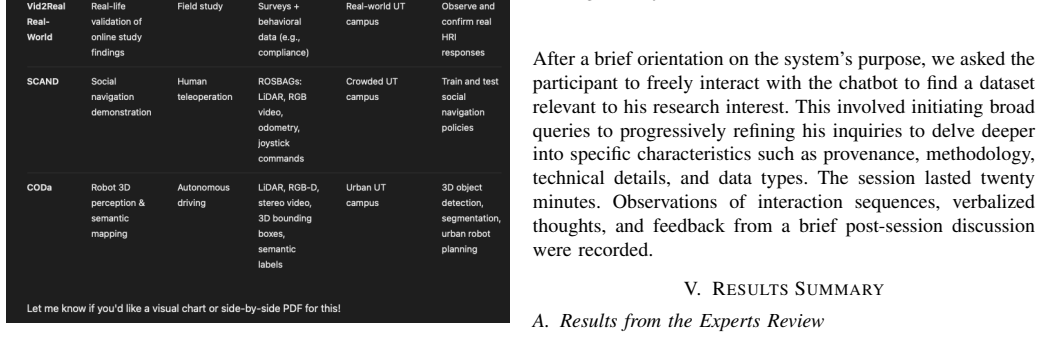
- [Section IV and Section V] Figures 4 and 5 are referenced in the text but not described in enough detail; the reader cannot see the actual comparison answer or the Bayesian correction without reproducing the figures. Please add a few sentences explaining what each figure shows.
- [Section VI] The conclusion states 'The evaluation of our system demonstrated its effectiveness,' which is stronger than the abstract's 'suggests' and is not supported by the self-referential, baseline-free evaluation; please align the conclusion with the evidence presented.
- [Section II] The statement 'GitHub will only hold up to 100 MB per project' is imprecise: GitHub's 100 MB limit applies to individual files, not repository-wide storage; please rephrase to avoid a factual error.
Circularity Check
The quantitative evaluation is self-referential: experts who authored the curated metadata rate whether the chatbot reproduces that same metadata, and the only fitted contrast (γcomp, CI includes zero) is read as confirmation.
-
self definitional
[Section IV.A, Expert Review of Chatbot Information Quality]
"The experts were the creators or curators of the datasets, which equips them with deep, first-hand knowledge necessary to judge the veracity and completeness of the chatbot’s responses."
The system's answers are generated by RAG from the curated metadata and knowledge graph (Section III.G: 'the chatbot retrieves structured metadata from the Neo4j knowledge graph'). The ground truth for 'factual accuracy' is 'the underlying metadata' — the same metadata the expert raters wrote as creators/curators. The evaluation therefore checks whether the chatbot echoes its own input, judged by the authors of that input, with no baseline or external benchmark. The claimed inference that access and understandability are 'significantly improved' is not supported by a comparison to any alternative; the ratings reduce to self-consistency between the system and its own training/retrieval corpus.
-
fitted input called prediction
[Section V.A, Results from the Experts Review]
"Fitting the model resulted in γcomp = +0.01 ( 95% Credible Interval [−0.015, 0.035]). This indicates that the chatbot’s answers were, on average, marginally more complete than the global baseline, confirming that structured metadata enhances the model’s precision by enabling it to include the key details researchers expect."
γcomp is a parameter fitted by the Bayesian hierarchical model to the very same expert ratings it is used to validate. The credible interval includes zero, so the data do not provide evidence of a positive effect; interpreting the point estimate as 'confirming that structured metadata enhances the model's precision' is reading a conclusion out of the fitted model's own posterior. No comparison is made between systems with and without structured metadata, so the fitted parameter cannot confirm the centrality's load-bearing claim. This is a fitted quantity renamed as an independent confirmation.
full rationale
The paper's engineering contributions — the curation template, repository publication, knowledge graph, and RAG chatbot — are externally checkable and not circular in themselves. The circularity lies in the evaluation that is claimed to demonstrate 'significantly improved' access and understandability. First, the expert raters are the dataset creators/curators, and the chatbot's answers are drawn from the metadata those same experts wrote; the rating dimensions (e.g., 'Factual Accuracy: Correctness and precision of the information provided based on the underlying metadata') therefore measure the system against its own input. Second, the only quantitative contrast reported, γcomp = +0.01 (95% CI [−0.015, 0.035]), is a parameter fitted to the same ratings and is overinterpreted as confirmation despite the interval including zero. These are not independent validations. However, this is partial circularity rather than complete: the system's behavior is demonstrated through concrete examples and a think-aloud session, and the metadata extraction pipeline is a real implementation whose outputs are not entirely predetermined by the evaluation design. Score 5 reflects that the central quantitative claim reduces to a self-referential fit, while the prototype's engineering content retains independent substance.
Assumptions & free parameters
free parameters (4)
- gamma_comp (completeness effect in the Bayesian hierarchical model) =
+0.01 (95% credible interval [-0.015, 0.035])
- alpha_i (per-expert bias terms) =
not reported in the paper
- theta_j (per-question difficulty terms) =
not reported in the paper
- mu (global intercept of the rating model) =
not reported in the paper
assumptions (4)
- domain assumption FAIR principles are the appropriate normative standard for judging the system's success.
- ad hoc to paper Dataset creators and curators can provide objective expert ratings of a system that answers questions about their own curated metadata.
- domain assumption Pattern matching and keyword detection in the Python scripts reliably extract data report fields into knowledge graph nodes.
- domain assumption There is currently no shared robotics dataset metadata standard, so creating one is a novel contribution.
invented entities (2)
-
HRI-specific robotics data model (classes such as RobotModel and ExperimentSession, relationships such as usesModel)
independent evidence
-
Data report template with a dedicated appendix for emerging metadata elements
independent evidence
Cite this review
Pith. "Pith review of Curate, Connect, Inquire: A System for Findable Accessible Interoperable and Reusable (FAIR) Human-Robot Centered Datasets." pith.science (2026). https://pith.science/paper/PJEKNYCX
@misc{pith2026250600220,
  author       = {Pith},
  title        = {Pith review of: Curate, Connect, Inquire: A System for Findable Accessible Interoperable and Reusable (FAIR) Human-Robot Centered Datasets},
  year         = {2026},
  howpublished = {\url{https://pith.science/paper/PJEKNYCX}},
  note         = {Machine review of arXiv:2506.00220}
}
read the original abstract
The rapid growth of AI in robotics has amplified the need for high-quality, reusable datasets, particularly in human-robot interaction (HRI) and AI-embedded robotics. While more robotics datasets are being created, the landscape of open data in the field is uneven. This is due to a lack of curation standards and consistent publication practices, which makes it difficult to discover, access, and reuse robotics data. To address these challenges, this paper presents a curation and access system with two main contributions: (1) a structured methodology to curate, publish, and integrate FAIR (Findable, Accessible, Interoperable, Reusable) human-centered robotics datasets; and (2) a ChatGPT-powered conversational interface trained with the curated datasets metadata and documentation to enable exploration, comparison robotics datasets and data retrieval using natural language. Developed based on practical experience curating datasets from robotics labs within Texas Robotics at the University of Texas at Austin, the system demonstrates the value of standardized curation and persistent publication of robotics data. The system's evaluation suggests that access and understandability of human-robotics data are significantly improved. This work directly aligns with the goals of the HCRL @ ICRA 2025 workshop and represents a step towards more human-centered access to data for embodied AI.
Figures


Figures from the paper (2 more)

Reference graph
Works this paper leans on
-
[1]
Texas Advanced Computing Cen- ter,
Texas Advanced Computing Center, “Texas Advanced Computing Cen- ter,” The University of Texas at Austin , 2024. [Online]. Available: https://tacc.utexas.edu
work page 2024
-
[2]
Texas Robotics Dataverse, “Texas Robotics Dataverse,” Texas Data Repository, 2024. [Online]. Available: https://dataverse .tdl.org/ dataverse/robotics
work page 2024
-
[3]
Texas Data Repository, “Texas Data Repository,” Texas Digital Library,
-
[4]
The FAIR Guiding Principles for scientific data management and stewardship,
M. D. Wilkinson etal., “The FAIR Guiding Principles for scientific data management and stewardship,” Scientific Data, vol. 3, p. 160018, Mar. 2016, doi: 10.1038/sdata.2016.18
-
[5]
Zenodo: A Dataset Sharing Platform for Scientific Research,
Zenodo, “Zenodo: A Dataset Sharing Platform for Scientific Research,” Accessed Apr. 4, 2025. [Online]. Available: https://zenodo .org
work page 2025
-
[6]
J. S. Heinisch, J. Kirchhoff, P. Busch, et al. , “Physiological data for affective computing in HRI with anthropomorphic service robots: the AFFECT-HRI data set,” Sci. Data , vol. 11, p. 333, 2024, doi: 10.1038/s41597-024-03128-z
-
[7]
Human-Robot Interaction Conversational User Enjoyment Scale (HRI CUES)
B. Irfan, J. Miniota, S. Thunberg, E. Lagerstedt, S. Kuoppam ¨aki, G. Skantze, and A. Pereira, “Human-Robot Interaction Conversational User Enjoyment Scale (HRI CUES),” arXiv preprint arXiv:2405.01354, 2024, doi: 10.48550/arXiv.2405.01354
work page Pith review arXiv doi:10.48550/arxiv.2405.01354 2024
-
[8]
P2PSTORY: Dataset of Children as Storytellers and Listeners in Peer-to-Peer Interactions,
MIT Media Lab, “P2PSTORY: Dataset of Children as Storytellers and Listeners in Peer-to-Peer Interactions,” Accessed Apr. 6, 2025. [Online]. Available: https://www.media.mit.edu/projects/p2pstory/overview/
work page 2025
Show all 37 references
-
[9]
UE-HRI: A Dataset for the Study of User Engagement in Spontaneous Human-Robot Interactions,
A. Ben-Youssef, C. Clavel, and S. Essid, “UE-HRI: A Dataset for the Study of User Engagement in Spontaneous Human-Robot Interactions,” Accessed Apr. 6, 2025. [Online]. Available: https://adasp .telecom- paris.fr/resources/2017-05-18-ue-hri/
2025
-
[10]
The PInSoRo Dataset,
S. Lemaignan, C. E. R. Edmunds, E. Senft, and T. Belpaeme, “The PInSoRo Dataset,” Accessed Apr. 6, 2025. [Online]. Available: https: //freeplay-sandbox.github.io
2025
-
[11]
Deep Fingerprinting: Undermining Website Fingerprinting Defenses with Deep Learning,
P. Sirinam, M. Juarez, J. Hayes, and G. Danezis, “Deep Fingerprinting: Undermining Website Fingerprinting Defenses with Deep Learning,” arXiv preprint arXiv:1805.03595 [cs.CR] , 2018. [Online]. Available: https://github.com/deep-fingerprinting/df
2018 arXiv
-
[12]
About large files on GitHub,
GitHub, “About large files on GitHub,” GitHub Docs , 2024. [On- line]. Available: https://docs .github.com/en/repositories/working-with- files/managing-large-files/about-large-files-on-github
2024
-
[14]
Community Embedded Robotics: A Dataset to Study Perceived Social Intelligence and Safety During Unexpected Encounters with Quadrupedal Robots,
R. Gupta, E. Norman, X. Zhou, M. Esteva, K. K. Stephens, and L. Sentis, “Community Embedded Robotics: A Dataset to Study Perceived Social Intelligence and Safety During Unexpected Encounters with Quadrupedal Robots,” Texas Data Repository, 2025, Version 1. [Online]. Available:...
2025 doi
-
[15]
Data Documentation Initiative (DDI) Metadata Specifi- cation,
DDI Alliance, “Data Documentation Initiative (DDI) Metadata Specifi- cation,” 2021. [Online]. Available: https://ddialliance .org
2021
-
[16]
KG-Hub: A Framework for Building and Sharing Biological Knowledge Graphs,
J. T. Reese, A. D. Himmelstein, J. K. Lovell, et al., “KG-Hub: A Framework for Building and Sharing Biological Knowledge Graphs,” arXiv preprint arXiv:2302.10800 [q-bio.QM], 2023. [Online]. Available: https://doi.org/10.48550/arXiv.2302.10800
-
[17]
Bio- Cypher: A Reproducible Knowledge Graph Construction Toolkit for Biomedical Data,
C. T. Hoyt, D. Domingo-Fernandez, M. Mendez-Carmona, et al., “Bio- Cypher: A Reproducible Knowledge Graph Construction Toolkit for Biomedical Data,” arXiv preprint arXiv:2212.13543 [q-bio.QM] , 2022. [Online]. Available: https://doi .org/10.48550/arXiv.2212.13543
-
[18]
KnowWhereGraph: A Knowledge Graph Infrastructure for Geospatial AI,
K. Janowicz, M. Regalia, P. Hitzler, et al., “KnowWhereGraph: A Knowledge Graph Infrastructure for Geospatial AI,” arXiv preprint arXiv:2410.13948 [cs.AI] , 2024. [Online]. Available: https://doi .org/ 10.48550/arXiv.2410.13948
-
[19]
About Digital Curation,
Digital Curation Centre, “About Digital Curation,” Accessed Apr. 6,
-
[20]
The Open X-Embodiment Dataset: Enabling Real-World Robot Learning at Scale,
M. Ahn et al., “The Open X-Embodiment Dataset: Enabling Real-World Robot Learning at Scale,” 2023. [Online]. Available: https://robotics- transformer-x.github.io/
2023
-
[21]
DROID: A Large-Scale In-the-Wild Robot Manipula- tion Dataset,
E. Zhang et al., “DROID: A Large-Scale In-the-Wild Robot Manipula- tion Dataset,” 2023. [Online]. Available: https://droid-dataset .github.io/
2023
-
[22]
Verti-Wheelers Dataset: Human Teleopera- tion for Vertical Terrain Navigation,
S. A. Thompson et al. , “Verti-Wheelers Dataset: Human Teleopera- tion for Vertical Terrain Navigation,” ORC Dataverse , George Mason University, 2020. [Online]. Available: https://doi .org/10.13021/orc2020/ QSN50Q
2020 doi
-
[23]
RH20T: Learning Diverse Robot Skills in One-Shot from Human Videos and Language,
A. Mandal et al., “RH20T: Learning Diverse Robot Skills in One-Shot from Human Videos and Language,” 2023. [Online]. Available: https: //arxiv.org/abs/2307.00595
2023 arXiv
-
[24]
DexYCB: A Benchmark for Capturing Hand Grasping of Objects,
X. Choi et al., “DexYCB: A Benchmark for Capturing Hand Grasping of Objects,” 2021. [Online]. Available: https://arxiv.org/abs/2104.04631
2021 arXiv
-
[25]
Vid2Real HRI: Align video-based HRI study designs with real-world settings,
E. Hauser, Y .-C. Chan, S. Modak, J. Biswas, and J. Hart, “Vid2Real HRI: Align video-based HRI study designs with real-world settings,” in Proc. 33rd IEEE Int. Conf. Robot. Hum. Interactive Commun. (RO- MAN), 2024
2024
-
[26]
Community Embedded Robotics: Vid2Real—An online video dataset about per- ceived social intelligence in human–robot encounters (Version 1) [Data set],
Y .-C. Chan, S. Modak, E. Hauser, J. Biswas, and J. Hart, “Community Embedded Robotics: Vid2Real—An online video dataset about per- ceived social intelligence in human–robot encounters (Version 1) [Data set],” Texas Data Repository, 2024, doi: 10.18738/T8/KAHJIB
2024 doi
-
[27]
Community Embedded Robotics: Vid2Real—A real-world dataset about perceived social intelligence in human–robot encounters (Draft version) [Data set],
Y .-C. Chan, S. Modak, E. Hauser, J. Biswas, and J. Hart, “Community Embedded Robotics: Vid2Real—A real-world dataset about perceived social intelligence in human–robot encounters (Draft version) [Data set],” Texas Data Repository, 2024, doi: 10.18738/T8/UOES4S
2024 doi
-
[28]
UT Campus Object Dataset (CODa) [Data set],
A. Zhang, C. Eranki, C. Zhang, R. Hong, P. Kalyani, L. Kalyanara- man, A. Gamare, A. Bagad, M. Esteva, and J. Biswas, “UT Campus Object Dataset (CODa) [Data set],” Texas Data Repository , 2023, doi: 10.18738/T8/BBOQMV
2023 doi
-
[29]
Community Embedded Robotics: A Multimodal Dataset on Perceived Safety during Indoor Mobile Robot Encounters [Data set],
R. Gupta, H. Shin, E. Norman, Z. Deng, M. Esteva, N. Lu, K.K. Stephens, and L. Sentis, “Community Embedded Robotics: A Multimodal Dataset on Perceived Safety during Indoor Mobile Robot Encounters [Data set],” Texas Data Repository , 2024, doi: 10.18738/T8/FT9VYS
2024 doi
-
[30]
Community Embedded Robotics: Non-Robot Pre-Deployment Interviews Analy- sis Dataset, PhaseI [Data set],
E.A.Norman, J.Liu, E.Hauser, Y .Xu, and K.Stephens, “Community Embedded Robotics: Non-Robot Pre-Deployment Interviews Analy- sis Dataset, PhaseI [Data set],” Texas Data Repository , 2024, doi: 10.18738/T8/SSHQHM
2024 doi
-
[31]
Hand and Glove Segmentation Dataset for Department of Energy Glovebox Environments [Data set],
S. Sharma, M.Huang, S. Nair, A. Wen, C.Petlowany, S.Wanna, and M. Pryor, “Hand and Glove Segmentation Dataset for Department of Energy Glovebox Environments [Data set],” Texas Data Repository, 2024, doi: 10.18738/T8/85R7KQ
2024 doi
-
[32]
Socially Compliant Navigation Dataset (SCAND) [Data set],
H. Karnan, A. Nair, X. Xiao, G. Warnell, S. Pirk, A. Toshev, J. Hart, J. Biswas, and P. Stone, “Socially Compliant Navigation Dataset (SCAND) [Data set],” Texas Data Repository, 2022, doi: 10.18738/T8/0PRYRH
2022 doi
-
[33]
Reproduction Data for: Models of Human Preference for Learning Reward Functions,
W. B. Knox, S. Hatgis-Kessell, S. Booth, S. Niekum, P. Stone, and A. Allievi, “Reproduction Data for: Models of Human Preference for Learning Reward Functions,” Texas Data Repository , 2023, Version 2. [Online]. Available: https://doi .org/10.18738/T8/S4WTWR
2023 doi
-
[34]
Effective Bug Detection in Graph Database Engines: An LLM-based Approach,
J. Wu, Z. Wu, R. Li, H. Qin, and G. Wang, “Effective Bug Detection in Graph Database Engines: An LLM-based Approach,” arXiv preprint arXiv:2402.00292 [cs.DB] , 2024. [Online]. Available: https://doi .org/ 10.48550/arXiv.2402.00292
-
[35]
Ask and You Shall Receive (a Graph Drawing): Testing ChatGPT’s Potential to Apply Graph Layout Algorithms,
S. Di Bartolomeo, G. Severi, V . Schetinger, and C. Dunne, “Ask and You Shall Receive (a Graph Drawing): Testing ChatGPT’s Potential to Apply Graph Layout Algorithms,” arXiv preprint arXiv:2303.08819 [cs.HC] ,
- [2023]
-
[2024]
Available: https://dataverse .tdl.org
[Online]. Available: https://dataverse .tdl.org
-
[2025]
Available: https://www .dcc.ac.uk/about/digital-curation
[Online]. Available: https://www .dcc.ac.uk/about/digital-curation
Reviewed August 7, 2026 · model on record in the stance chip above.
Discussion (0). Sign in to comment.