REVIEW 6 major objections 7 minor 62 references
Enhancing Drug Discovery: Autoencoder-Based Latent Space Augmentation for Improved Molecular Solubility Prediction using LatMixSol
T0 review · 6 major / 7 minor · reviewed 2026-08-07 · deepseek-v4-flash
Pith's one-line read Mixing molecule codes in latent space cuts solubility prediction error by up to 7.6%.
desk verdict A plausible but sloppily evaluated augmentation trick whose headline numbers don't match its own table; worth a serious referee only because the idea is cheap to test. read the letter →
The pith
A machine-rendered reading of the paper's core claim, the machinery that carries it, and where it could break.
The reading
What carries the argument
The load-bearing object is the autoencoder's latent space with cluster-restricted MixUp. Molecules are encoded to $z\in\mathbb{R}^{64}$; spectral clustering with $k=10$ is done in the original descriptor space; and new samples are made by $z_{\mathrm{new}} = \lambda z_a + (1-\lambda) z_b$, with the same $\lambda$ blending the labels. Decoding returns a synthetic feature vector. The argument depends on the decoder being smooth enough that interpolation in latent space maps to chemically meaningful interpolation in feature space, and the paper explicitly notes that no chemical constraint is enforced.
What would settle it
Take a sample of the synthetic feature vectors generated by the method and find each one's nearest real molecule in the original descriptor space; then compare the interpolated solubility label with that neighbor's measured solubility. If the label errors approach the roughly $\pm 0.5$ log-unit noise of experimental solubility data, the interpolation-label assumption is not supported, and a stricter check would test whether any decoded vector corresponds to a chemically valid, synthesizable structure at all.
Extended reading notes
Core claim
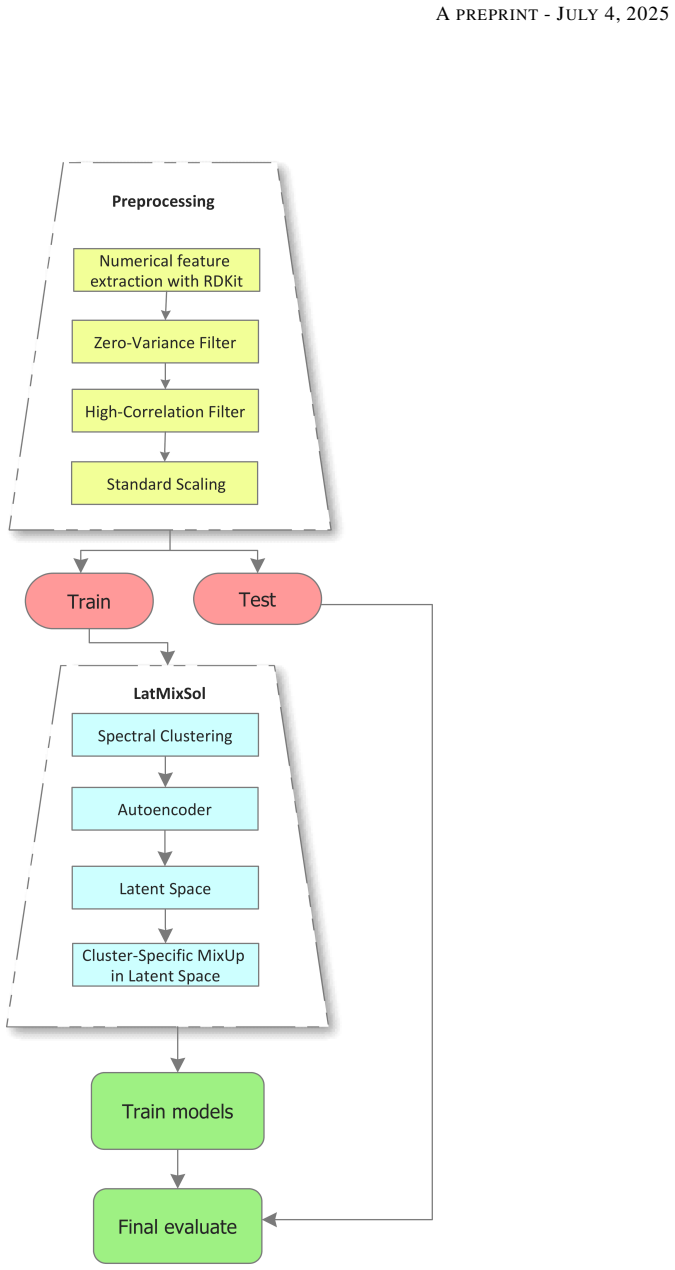
LatMixSol's central claim is that cluster-guided interpolation in the latent space of an autoencoder produces chemically plausible solubility training data that improves downstream regression. The pipeline compresses 204 molecular descriptors to 64 variables, groups the training set into ten spectral clusters, and within each cluster blends pairs of latent vectors with a random weight $\lambda$, then decodes the blend and assigns it the interpolated solubility label $\lambda y_a + (1-\lambda) y_b$. On the Huuskonen benchmark (884 training, 413 test compounds), this 10x expansion lowers RMSE for CatBoost, LightGBM, and HistGradientBoosting while leaving XGBoost essentially unchanged; HistGradientBoosting improves most, by 7.6%. The paper also reports a maximum mean discrepancy of 0.0013 and low reconstruction error as evidence that the synthetic samples resemble the original data.
Load-bearing premise
The load-bearing assumption is that averaging two molecules' latent codes and averaging their solubility values produces a real compound with that averaged solubility, yet the paper states that no chemical constraint is enforced and offers no external check of the decoded structures.
Editorial extensions
If this is right
- If the gains hold, augmenting descriptor space is a viable alternative to generating new molecular graphs for data-limited solubility modeling.
- The improvement pattern suggests regularized gradient-boosted models benefit more from synthetic diversity; XGBoost's flat result is a warning that augmentation gains are model-dependent.
- The reported reduction in cross-fold RMSE variance implies latent-space augmentation acts partly as a regularizer, stabilizing training on small datasets.
- The low MMD and preserved pairwise distances, if accurate, mean the augmented set stays close to the original distribution rather than drifting into implausible regions.
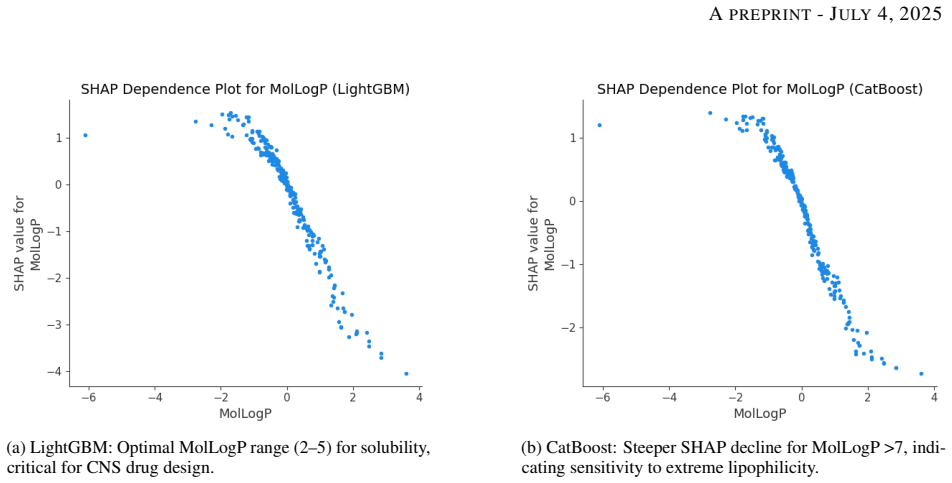
- SHAP analysis in the paper indicates the augmented models still lean on chemically meaningful descriptors such as lipophilicity, molecular weight, and complexity, preserving interpretability.
Reading between the lines
- Beyond the paper: the 'chemically valid' conclusion is stronger than its evidence, since interpolation is unconstrained by any chemical rule; a natural extension is to validate by checking decoded samples against real molecular structures or their nearest neighbors.
- If interpolated labels are only approximately right, the method could be extended to pseudo-labeling or uncertainty-weighted blending to reduce noise from mismatched synthetic labels.
- The same cluster-guided latent blending could be tested on other scarce ADME endpoints and larger curated solubility sets, though the transfer is not automatic.
- A direct comparison against SMILES enumeration and graph perturbation on the same benchmark would clarify when latent-space augmentation is actually better; the paper does not run that comparison.
Editorial analysis
A structured set of objections, weighed in public.
Referee Report
Summary. The manuscript proposes LatMixSol, a data-augmentation framework for aqueous solubility prediction. Starting from 204 RDKit descriptors for the Huuskonen dataset, the method trains a two-layer autoencoder, applies spectral clustering (k=10) in the original feature space, performs MixUp-style interpolation between latent codes within each cluster, and decodes the interpolated vectors to produce synthetic samples with interpolated labels. Four gradient-boosted regressors (CatBoost, LightGBM, HistGradientBoosting, XGBoost) are compared with and without augmentation via five-fold cross-validation. The paper claims consistent RMSE reductions of 3.2–7.6% for three models with paired t-test p<0.01, chemical validity of the synthetic data based on MMD and reconstruction error, and interpretable SHAP analyses.
Significance. If the performance and validity claims were fully substantiated, the paper would offer a plausible, low-cost augmentation strategy for descriptor-based solubility prediction and would complement existing SMILES/graph augmentation methods. The proposed pipeline is clearly described, uses a standard benchmark, and reports several diagnostics (MMD, nearest-neighbor distances, reconstruction error) beyond a single accuracy number. These are real strengths. However, the central quantitative claims are currently unsupported: the headline improvement range is inconsistent with Table 2, no inferential statistics are provided, no ablation isolates cluster-guided interpolation, and the chemical-validity evidence is self-referential. The contribution is therefore not yet established at the level required for publication.
major comments (6)
- [§1, §4.2, Table 2] The abstract and Section 4.2 state RMSE reductions of 3.2–7.6% and R2 increases of 0.5–1.5%, but the reductions implied by Table 2 are CatBoost 1.89%, LightGBM 6.07%, HistGradientBoosting 7.57%, and XGBoost −0.08%; the 'Final Model Evaluation' paragraph itself says 1.9–7.6%, so the manuscript contains two mutually inconsistent versions of the headline result, and this discrepancy must be resolved before any significance claim can be assessed.
- [§2, §3.5, §4.2] The paired t-test with p<0.01 is claimed without any test statistic, degrees of freedom, per-fold RMSE values, or error bars; with K=5 folds the test would have only 4 degrees of freedom, and the mean CatBoost improvement of 0.0107 in RMSE cannot be judged significant without the per-fold variance, which is not reported. No code, data, or autoencoder hyperparameters (learning rate, epochs, batch size, activation, regularization) are provided, so the Table 2 numbers cannot be independently reproduced.
- [§3.4–3.5] The experimental protocol does not state whether the autoencoder, the spectral clustering, and the synthetic-sample generation are fitted separately inside each cross-validation training fold. If these components are trained on all 1,297 compounds before the five-fold splits, information from the validation folds can enter the augmented training data indirectly, which would invalidate the held-out comparison; the paper should specify and, if necessary, correct the fold-aware procedure.
- [§3.4, §4.2] The chemical-validity claim is not established by the reported evidence. Section 3.4 explicitly states that 'no explicit chemical constraint is enforced,' and the metrics in Table 1 (MMD, nearest-neighbor distance, pairwise distance, reconstruction MSE) are all computed on synthetic samples generated by the same autoencoder; these measure distributional self-consistency, not chemical validity. The Related Work section promises 'RDKit-based structural checks,' but no such checks, no SMILES-level validation, and no external property comparison are reported in Section 4.
- [§3.4] No ablation or baseline isolates the contribution of cluster-guided latent interpolation. The paper does not compare against random MixUp in the original feature space, interpolation without spectral clustering, or interpolation across randomly selected pairs, so the claim that cluster-restricted interpolation is responsible for the observed improvements is not supported by the experiments.
- [§3.4] The synthetic label y_new = λ y_a + (1−λ) y_b is assumed to be the correct solubility value of the decoded x_new, but no evidence is provided that solubility is linear along latent-space interpolation paths; the Lipschitz-continuity argument only bounds feature-space smoothness, not label correctness, so errors in this assumption would propagate directly into the augmented training targets.
minor comments (7)
- [References] References [3] and [50] are explicitly flagged in the bibliography as 'Assumed reference' or 'not found'; these are not citations and must be replaced with verifiable sources before publication.
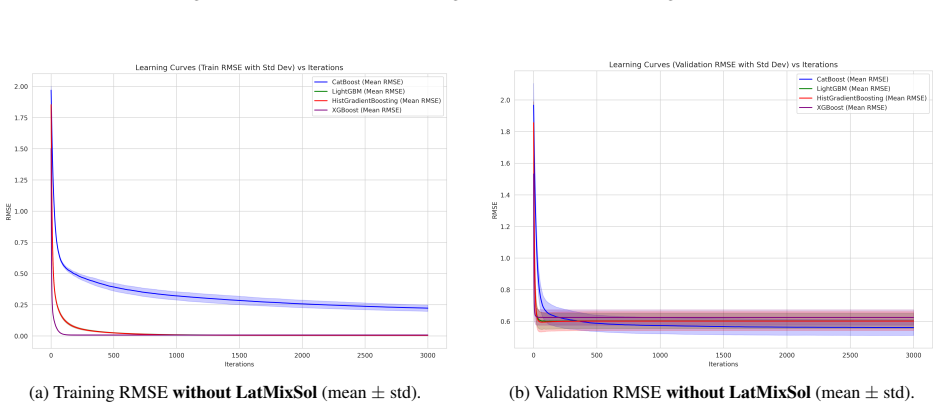
- [Figures] Figure order is confusing: Figures 3 and 4 are discussed in Section 4.1 before Figure 2 appears, and Figure 1 is referenced in Section 3.3 without a caption description of the training details.
- [§3.5] Section 3.5 calls the cross-validation 'stratified K-fold' for a regression task, but no stratification on the continuous target is defined; clarify whether this is standard KFold with a fixed seed.
- [§3.3–3.4] The symbol L is used for the autoencoder loss in Section 3.3 and for the Lipschitz constant in Section 3.4; use distinct notation to avoid ambiguity.
- [§1] The paper claims an 'open-source implementation' but provides no repository URL or release information; either provide the link and hyperparameters or remove the claim.
- [§4.2, Table 1] The nearest-neighbor distance results in Table 1 are reported without comparison to the NN distance distribution of the original data, so the statement that 'balanced neighbor distances' indicate success is not supported.
- [§5.2] The computational-efficiency claim ('10× data expansion in under 30 minutes using consumer-grade GPUs') is stated without details of the hardware, software versions, or measurement procedure.
Circularity Check
No significant circularity: the central performance claim is tested on a held-out external benchmark and does not reduce to its inputs.
full rationale
The central claim—that LatMixSol augmentation improves RMSE/R² for gradient-boosted regressors—is evaluated on the held-out Huuskonen test split (Section 3.5, Table 2), so it is not definitionally tied to the training procedure. The augmentation pipeline (autoencoder, spectral clustering, latent MixUp) is an assumed method, not derived from the target result. The chemical-validity claim is weaker: Section 4.2 supports it with MMD, nearest-neighbor distance, and reconstruction MSE computed on the same autoencoder-generated samples, which are self-consistency checks rather than external structural validation; the paper itself admits in Section 3.4 that "no explicit chemical constraint is enforced." This is an evidentiary weakness and a correctness risk, but it is not a circular derivation: no fitted parameter is renamed as a prediction, no load-bearing self-citation chain is used, and no equation reduces to another by construction. The abstract/Table 2 inconsistency (3.2–7.6% vs 1.9–7.6%) and the unreported paired t-test details are reproducibility and supportability issues, not circularity.
Assumptions & free parameters
free parameters (6)
- Number of spectral clusters k =
10
- Augmentation multiplier beta =
10
- Autoencoder latent dimension =
64
- RBF kernel width sigma (spectral clustering) =
Not reported
- High-correlation filter threshold =
0.95
- Autoencoder training hyperparameters (epochs, learning rate, batch size) =
Not reported
assumptions (3)
- domain assumption The decoder is Lipschitz continuous
- ad hoc to paper Latent interpolation produces chemically valid, label-correct synthetic samples
- domain assumption The Huuskonen train/test split is based on molecular topology and structural diversity
Cite this review
Pith. "Pith review of Enhancing Drug Discovery: Autoencoder-Based Latent Space Augmentation for Improved Molecular Solubility Prediction using LatMixSol." pith.science (2026). https://pith.science/paper/TYHLUMYL
@misc{pith2026250600223,
  author       = {Pith},
  title        = {Pith review of: Enhancing Drug Discovery: Autoencoder-Based Latent Space Augmentation for Improved Molecular Solubility Prediction using LatMixSol},
  year         = {2026},
  howpublished = {\url{https://pith.science/paper/TYHLUMYL}},
  note         = {Machine review of arXiv:2506.00223}
}
read the original abstract
Accurate prediction of molecular solubility is a cornerstone of early-stage drug discovery, yet conventional machine learning models face significant challenges due to limited labeled data and the high-dimensional nature of molecular descriptors. To address these issues, we propose LatMixSol, a novel latent space augmentation framework that combines autoencoder-based feature compression with guided interpolation to enrich training data. Our approach first encodes molecular descriptors into a low-dimensional latent space using a two-layer autoencoder. Spectral clustering is then applied to group chemically similar molecules, enabling targeted MixUp-style interpolation within clusters. Synthetic samples are generated by blending latent vectors of cluster members and decoding them back to the original feature space. Evaluated on the Huuskonen solubility benchmark, LatMixSol demonstrates consistent improvements across three of four gradient-boosted regressors (CatBoost, LightGBM, HistGradientBoosting), achieving RMSE reductions of 3.2-7.6% and R-squared increases of 0.5-1.5%. Notably, HistGradientBoosting shows the most significant enhancement with a 7.6% RMSE improvement. Our analysis confirms that cluster-guided latent space augmentation preserves chemical validity while expanding dataset diversity, offering a computationally efficient strategy to enhance predictive models in resource-constrained drug discovery pipelines.
Figures


Figures from the paper (3 more)

Reference graph
Works this paper leans on
-
[1]
Soroush Ahmadi, Mohammad Amin Ghanavati, and Sohrab Rohani. Prediction of organic compound aqueous solubility using machine learning: A comparison study of descriptor-based and fingerprints-based models. Journal of Cheminformatics, 15:103, 2023
work page 2023
- [2]
-
[3]
S. Bhattacharjee et al. Spectral clustering and latent space interpolation for molecular data augmentation, 2023. Assumed reference for Bhattacharjee et al., as specific title not provided
work page 2023
-
[4]
A hybrid approach to aqueous solubility prediction using cosmo-rs and machine learning
Esben Jannik Bjerrum et al. A hybrid approach to aqueous solubility prediction using cosmo-rs and machine learning. Journal of Molecular Liquids, 375:121305, 2023
work page 2023
-
[5]
Samuel Boobier et al. Machine learning with physicochemical relationships: Solubility prediction in organic solvents and water. Nature Communications, 11:5753, 2020
work page 2020
-
[6]
T. Chen et al. Data-efficient gan training beyond (just) augmentations: A lottery ticket perspective. Advances in Neural Information Processing Systems, 34:20941–20955, 2021
work page 2021
-
[7]
Nicola Chirico and Paola Gramatica. Real external predictivity of qsar models: How to evaluate it? comparison of different validation criteria and proposal of using the concordance correlation coefficient. Journal of Chemical Information and Modeling, 51(9):2320–2335, 2011
work page 2011
- [8]
Show all 62 references
-
[9]
Improved prediction of aqueous solubility of novel compounds by going deeper with deep learning
Qiang Cui, Sijie Lu, Bing Ni, Xiang Zeng, Yajun Tan, Yuanchun Chen, and Hongmei Zhao. Improved prediction of aqueous solubility of novel compounds by going deeper with deep learning. Frontiers in Oncology, 10:121, 2020
2020
-
[10]
John S. Delaney. Esol: Estimating aqueous solubility directly from molecular structure. Journal of Chemical Information and Modeling, 44(3):1000–1005, 2004
2004
-
[11]
Ding et al
F. Ding et al. Advancing aqueous solubility prediction: A machine learning approach for organic compounds using a curated dataset. ChemRxiv, 2024
2024
-
[12]
Duchowicz and Eduardo A
Pablo R. Duchowicz and Eduardo A. Castro. Qspr studies on aqueous solubilities of drug-like compounds. International Journal of Molecular Sciences, 10(6):2558–2577, 2009
2009
-
[13]
Convolutional networks on graphs for learning molecular fingerprints
David Duvenaud et al. Convolutional networks on graphs for learning molecular fingerprints. Advances in Neural Information Processing Systems, 28:2224–2232, 2015
2015
-
[14]
Worth, Mark T
Lennart Eriksson, Joanna Jaworska, Andrew P. Worth, Mark T. D. Cronin, Robert M. McDowell, and Paola Gramatica. Methods for reliability and uncertainty assessment and for applicability evaluations of classification and regression-based qsars. Environmental Health Perspectives,...
2003
-
[15]
J. H. Fagerberg et al. Prediction of solubility in biorelevant media using pls methodology and dragonx descriptors. European Journal of Pharmaceutical Sciences, 78:232–240, 2015. 15 A PREPRINT - J ULY 4, 2025
2015
-
[16]
P. G. Francoeur and D. R. Koes. Soltrannet–a machine learning tool for fast aqueous solubility prediction. Journal of Chemical Information and Modeling, 61(6):2530–2536, 2021
2021
-
[17]
S. Gan, D. A. Cosgrove, E. J. Gardiner, and V . J. Gillet. Investigation of the use of spectral clustering for the analysis of molecular data. Journal of Chemical Information and Modeling, 54(12):3302–3310, 2014
2014
-
[18]
Saldanha, Vijayakumar Murugesan, and Wei Wang
Peiyuan Gao, Alexander Andersen, Jose Sepulveda, Gihan Panapitiya, Aaron Hollas, Edward G. Saldanha, Vijayakumar Murugesan, and Wei Wang. Somas: A platform for data-driven material discovery in redox flow battery development. Scientific Data, 9:736, 2022
2022
-
[19]
A machine learning approach for the prediction of aqueous solubility of pharmaceuticals: A comparative model and dataset analysis
Mohammad Amin Ghanavati, Soroush Ahmadi, and Sohrab Rohani. A machine learning approach for the prediction of aqueous solubility of pharmaceuticals: A comparative model and dataset analysis. Digital Discovery, 3:1845–1858, 2024
2024
-
[20]
Wei, David Duvenaud, José Miguel Hernández-Lobato, Benjamin Sánchez- Lengeling, Dennis Sheberla, Jorge Aguilera-Iparraguirre, Timothy D
Rafael Gómez-Bombarelli, Jennifer N. Wei, David Duvenaud, José Miguel Hernández-Lobato, Benjamin Sánchez- Lengeling, Dennis Sheberla, Jorge Aguilera-Iparraguirre, Timothy D. Hirzel, Ryan P. Adams, and Alán Aspuru- Guzik. Automatic chemical design using a data-driven continuous...
2018
-
[21]
Hadipour, C
H. Hadipour, C. Liu, R. Davis, S. T. Cardona, and P. Hu. Deep clustering of small molecules at large-scale via variational autoencoder embedding and k-means. BMC Bioinformatics, 23:123, 2022
2022
-
[22]
Strategies for pre-training graph neural networks
Weihua Hu et al. Strategies for pre-training graph neural networks. International Conference on Learning Representations, 2020
2020
-
[23]
Estimation of aqueous solubility for a diverse set of organic compounds based on molecular topology
Jarmo Huuskonen. Estimation of aqueous solubility for a diverse set of organic compounds based on molecular topology. Journal of Chemical Information and Computer Sciences, 40(3):773–777, 2000
2000
-
[24]
Mix-key: Graph mixup with key structures for molecular property prediction
Tianyi Jiang, Zeyu Wang, et al. Mix-key: Graph mixup with key structures for molecular property prediction. Briefings in Bioinformatics, 25(3):bbae165, 2024
2024
-
[25]
Keith et al
John A. Keith et al. Latent variable machine learning framework for catalysis: General models, transfer learning, and interpretability. JACS Au, 1(10):1686–1699, 2021
2021
-
[26]
Comprehensive ensemble in qsar prediction for drug discovery
Joseph Kwon, Sangsoo Lee, and Sun Kim. Comprehensive ensemble in qsar prediction for drug discovery. BMC Bioinformatics, 20:554, 2019
2019
-
[27]
Conditional molecular design with deep generative models
Jaechang Lim, Seokho Ryu, Jin Woo Kim, and Woo Youn Kim. Conditional molecular design with deep generative models. Journal of Chemical Information and Modeling, 58(1):24–35, 2018
2018
-
[28]
C. A. Lipinski et al. Experimental and computational approaches to estimate solubility and permeability in drug discovery and development settings. Advanced Drug Delivery Reviews, 46(1-3):3–26, 2001
2001
-
[29]
Predictive models of aqueous solubility of organic compounds built on a large dataset of high integrity
Antonio Llinas et al. Predictive models of aqueous solubility of organic compounds built on a large dataset of high integrity. Molecular Pharmaceutics, 19(7):2239–2254, 2022
2022
-
[30]
Will we ever be able to accurately predict solubility? Scientific Data, 11:496, 2024
Pol Llompart, Christian Minoletti, Sapark Baybekov, Dragos Horvath, Gilles Marcou, and Alexandre Varnek. Will we ever be able to accurately predict solubility? Scientific Data, 11:496, 2024
2024
-
[31]
Lovatt et al
Christopher J. Lovatt et al. Revisiting the application of machine learning approaches in predicting aqueous solubility. ACS Omega, 9(7):8056–8066, 2024
2024
-
[32]
Mario Lovri´c, Kristina Pavlovi´c, Petar Žuvela, Adrian Spataru, Bono Luˇci´c, Roman Kern, and Ming Wah Wong. Machine learning in prediction of intrinsic aqueous solubility of drug-like compounds: Generalization, complexity, or predictive ability? Journal of Chemometrics, 35(7...
2021
-
[33]
Lu et al
J. Lu et al. Creation and interpretation of machine learning models for aqueous solubility prediction. Exploration of Drug and Medicine, 1:252–265, 2023
2023
-
[34]
Luo et al
Z. Luo et al. Prediction of the aqueous solubility of compounds based on light gradient boosting machines with molecular fingerprints and the cuckoo search algorithm. ACS Omega, 7(17):14462–14471, 2022
2022
-
[35]
Deep architectures and deep learning in cheminformatics: The prediction of aqueous solubility for drug-like molecules
Alessandro Lusci, Gianluca Pollastri, and Pierre Baldi. Deep architectures and deep learning in cheminformatics: The prediction of aqueous solubility for drug-like molecules. Journal of Chemical Information and Modeling, 53(7):1563–1575, 2013
2013
-
[36]
Auglichem: Data augmentation for molecular property prediction
Rishikesh Magar, Yuxuan Wang, Yuzhe Wang, and Chenliang Ding. Auglichem: Data augmentation for molecular property prediction. arXiv preprint, page arXiv:2108.03356, 2021
2021 arXiv
-
[37]
McMeekin et al
H. McMeekin et al. Integrating machine learning and shap analysis to advance the rational design of benzoth- iadiazole derivatives with tailored photophysical properties. Journal of Physical Chemistry A, 129:1234–1245, 2025. 16 A PREPRINT - J ULY 4, 2025
2025
-
[38]
D. S. Palmer and J. B. O. Mitchell. Is experimental data quality the limiting factor in predicting the aqueous solubility of druglike molecules? Molecular Pharmaceutics, 11(8):2962–2972, 2014
2014
-
[39]
Pan et al
L. Pan et al. Computational prediction of drug solubility in water-based systems: Qualitative and quantitative approaches used in the current drug discovery. AAPS PharmSciTech, 22:118, 2021
2021
-
[40]
Evaluation of deep learning architectures for aqueous solubility prediction
Gihan Panapitiya, Madeline Girard, Aaron Hollas, Jose Sepulveda, Vijayakumar Murugesan, Wei Wang, and Edward Saldanha. Evaluation of deep learning architectures for aqueous solubility prediction. ACS Omega, 7(28):24596–24608, 2022
2022
-
[41]
Marcio Cerbella Ramos and Andrew D. White. Predicting small molecules solubility on endpoint devices using deep ensemble neural networks. Digital Discovery, 3:1094–1106, 2024
2024
-
[42]
Reiter et al
S. Reiter et al. Interpolatory model reduction of dynamical systems with root mean squared error. arXiv preprint arXiv:2403.08894, 2024
2024 arXiv
-
[43]
Explainable machine learning for property predictions in compound optimization
Raquel Rodríguez-Pérez and Jürgen Bajorath. Explainable machine learning for property predictions in compound optimization. Journal of Medicinal Chemistry, 64(22):16439–16451, 2021
2021
-
[44]
Accurate, reliable and interpretable solubility prediction of druglike molecules with attention pooling and bayesian learning
Seongok Ryu and Sumin Lee. Accurate, reliable and interpretable solubility prediction of druglike molecules with attention pooling and bayesian learning. arXiv preprint, page arXiv:2210.07145, 2022
2022 arXiv
-
[45]
Molecular transformer: A model for uncertainty-calibrated chemical property prediction
Philippe Schwaller, Teodoro Gaudin, David Lanyi, Costas Bekas, and Teodoro Laino. Molecular transformer: A model for uncertainty-calibrated chemical property prediction. ACS Central Science, 5(9):1572–1583, 2019
2019
-
[46]
M. C. Sorkun et al. Boosting the predictive performance with aqueous solubility dataset curation. Scientific Data, 9:71, 2022
2022
-
[47]
Aqsoldb, a curated reference set of aqueous solubility and 2d descriptors for a diverse set of compounds
Murat Cihan Sorkun, Ashish Khetan, and Serkan Er. Aqsoldb, a curated reference set of aqueous solubility and 2d descriptors for a diverse set of compounds. Scientific Data, 6:151, 2019
2019
-
[48]
Christopher Culberson, Robert P
Vladimir Svetnik, Andy Liaw, Christopher Tong, J. Christopher Culberson, Robert P. Sheridan, and Bradley P. Feuston. Random forest: A classification and regression tool for compound classification and qsar modeling. Journal of Chemical Information and Computer Sciences, 43(6):...
1947
-
[49]
Boosting the predictive performance with aqueous solubility dataset curation
Fei Tang et al. Boosting the predictive performance with aqueous solubility dataset curation. Scientific Data, 9:71, 2022
2022
-
[50]
Tevosyan et al
A. Tevosyan et al. Rule-based data augmentation for chemical property prediction, 2023. Assumed reference for Tevosyan et al., as specific title not found
2023
-
[51]
Deep learning methods in protein structure prediction
Mauro Torrisi, Gianluca Pollastri, and Quynh Le. Deep learning methods in protein structure prediction. Compu- tational and Structural Biotechnology Journal, 18:1301–1310, 2020
2020
-
[52]
Uzundurukan et al
A. Uzundurukan et al. Meta-analysis and review of in silico methods in drug discovery – part 1: technological evolution and trends from big data to chemical space. Pharmacogenomics Journal, 25:8, 2025
2025
-
[53]
Wang et al
Y . Wang et al. Graphst: Spatially informed clustering, integration, and deconvolution of spatial transcriptomics with graph self-supervised contrastive learning. Nature Communications, 14:1048, 2023
2023
-
[54]
Unsupervised learning methods for molecular simulation data
Oliver Wieder et al. Unsupervised learning methods for molecular simulation data. Chemical Reviews , 121(18):12052–12086, 2021
2021
-
[55]
Efficient clustering of large molecular libraries
Chunxiao Yan et al. Efficient clustering of large molecular libraries. Journal of Chemical Information and Modeling, 60(12):6093–6101, 2020
2020
-
[56]
Integrated molecular modeling and machine learning for drug design
Kevin Yang et al. Integrated molecular modeling and machine learning for drug design. Journal of Chemical Theory and Computation, 17(6):3521–3533, 2021
2021
-
[57]
Yang et al
Y . Yang et al. Multi-channel gcn ensembled machine learning model for molecular aqueous solubility prediction on a clean dataset. Molecular Diversity, 27:2135–2145, 2023
2023
-
[58]
Graph contrastive learning with augmentations
Jiaxuan You et al. Graph contrastive learning with augmentations. Advances in Neural Information Processing Systems, 33:5812–5823, 2020
2020
-
[59]
Zhang and R
B. Zhang and R. Sennrich. Root mean square layer normalization. Advances in Neural Information Processing Systems, 32:12360–12371, 2019
2019
-
[60]
Graph contrastive learning with augmentations
Han Zhang et al. Graph contrastive learning with augmentations. International Conference on Learning Representations, 2021
2021
-
[61]
Zhang et al
W. Zhang et al. Predicting drug solubility using different machine learning methods - linear regression model with extracted chemical features vs graph convolutional neural network. arXiv, 2024
2024
-
[62]
Zhang et al
Z. Zhang et al. Cancer subtype identification by multi-omics clustering based on interpretable feature and latent subspace learning. Computers in Biology and Medicine, 152:106374, 2023. 17
2023
Reviewed August 7, 2026 · model on record in the stance chip above.
Discussion (0). Sign in to comment.