REVIEW 4 major objections 5 minor 33 references
SkillVerse : Assessing and Enhancing LLMs with Tree Evaluation
T0 review · 4 major / 5 minor · reviewed 2026-08-07 · deepseek-v4-flash
Pith's one-line read SkillVerse turns LLM critiques into a hierarchical skill tree that improves in-context learning by 25% and predicts model weaknesses with 55% success.
desk verdict A genuinely new hierarchical evaluation framework with solid clustering validation, but the unvalidated parser and a sign-flipped headline claim mean the downstream numbers should not be trusted yet. read the letter →
The pith
A machine-rendered reading of the paper's core claim, the machinery that carries it, and where it could break.
The reading
What carries the argument
The machinery is the atomic judgment and the dendrogram. An atomic judgment is a strict triple, subject (model), verb (succeed, partially succeed, or fail), object (a specific task such as 'identify cities in Eastern Europe'), that the framework parses from free-form critiques. Only the object is embedded, using Google's Text Embedding API, and agglomerative clustering builds a dendrogram from semantic distances; horizontal slices at chosen thresholds produce nested skill clusters, and each cluster's proficiency is the ratio of positive atomic judgments. The same tree powers two new algorithms: a tree-search that prunes branches where the target model already succeeds (success rate above a threshold) and re-ranks the remaining contrastive examples by relevance and benefit, and a weakness-extrapolation pipeline that feeds a proficiency report to a separate reasoner. The dendrogram's key work is to make the critiques searchable and generalizable, bringing together semantically similar tasks and providing a compact, granular capability report.
What would settle it
Manually inspect a random sample of 200 atomic judgments and compare them against a human-annotated gold parse of the corresponding critiques, measuring agreement; if parser accuracy is low, the dendrogram and all downstream claims collapse. Alternatively, run SkillVerse with human-written critiques on the same response pairs and check whether the cluster structure and the reported 25% in-context learning improvement persist.
Extended reading notes
Core claim
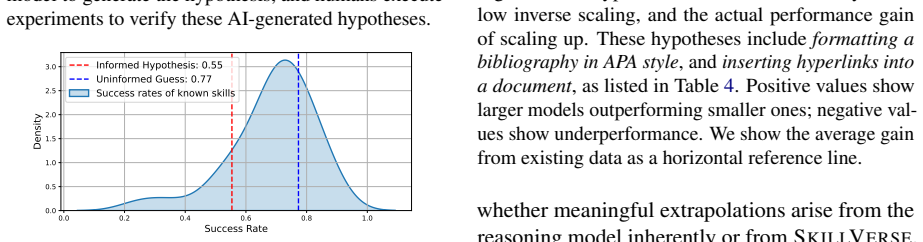
The central claim is that the dendrogram of atomic judgments faithfully represents model capabilities, and that this representation is not just descriptive but operative: it can be searched to pick few-shot demonstrations that are both relevant and challenging, and it can be digested by a strong reasoner to extrapolate to unseen failure modes. The paper validates the clustering against human similarity judgments (Pearson correlation 0.643, true positive rate 0.916, true negative rate 0.88) and the anchoring step against human gold merges (precision 0.926, recall 0.980). Downstream, the tree-search selection achieves a 25% relative improvement over the C-ICL baseline across GPT-4o, Gemini-1.5-pro, and Gemini-1.5-flash on IFEval and ChatbotArena, and the reasoner's informed weakness hypotheses hit only 55% success, 22% lower than the uninformed baseline, meaning the predicted tasks are indeed difficult for the target model. The paper also reports that SkillVerse identifies inverse-scaling capabilities, where larger models underperform smaller ones, and predicts such cases with an average scaling gain of 0.5% versus 10.6% for uninformed predictions.
Load-bearing premise
The whole framework assumes the LLM judge's free-form critiques, after parsing into atomic judgments, accurately reflect what the model actually did wrong or right; the paper never validates this parser.
Editorial extensions
If this is right
- SkillVerse's tree-search demonstration selection yields a 25% relative improvement over standard contrastive in-context learning on IFEval and ChatbotArena across three models.
- The reasoner with SkillVerse's proficiency report predicts weaknesses that are 22% more challenging than uninformed predictions, with success rates of 55% versus 77% on those tasks.
- The framework identifies inverse-scaling capabilities, where larger models underperform smaller ones, with an average scaling gain of only 0.5% on predicted tasks compared to 10.6% without performance data.
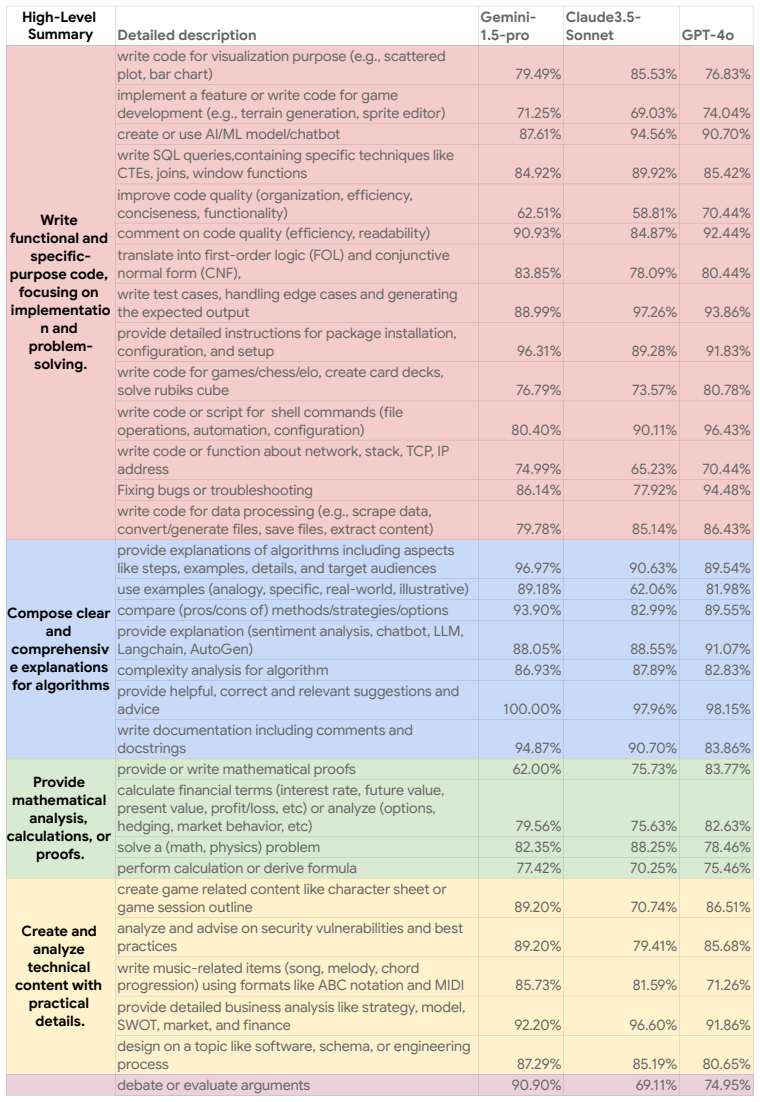
- SkillVerse reveals fine-grained strengths and weaknesses that leaderboards mask, for instance GPT-4-turbo outperforming GPT-4o on SQL queries, file processing, and music tasks despite being an older release.
- The dendrogram can be sliced at arbitrary granularity, so the same diagnosis serves both coarse-grained and fine-grained analyses, from broad categories like coding down to specific tasks like writing a riddle.
Reading between the lines
- A direct extension of the demonstration-selection logic is model routing: once a new prompt is located in the dendrogram, it could be sent to the model whose cluster proficiency is highest, turning the skill map into an inference-time dispatcher.
- The inverse-scaling findings suggest a testable hypothesis that strict-format and constraint-heavy tasks form a recurring failure family across model series trained on similar data, so the dendrogram could serve as an early-warning system for such tasks.
- The causal role of the hierarchy itself could be isolated by ablating the proficiency report to a flat, non-hierarchical skill list and measuring whether the weakness-prediction gain disappears; the paper does not run this ablation.
- A robustness check worth trying is to run the full pipeline with human-written critiques on a small response set and compare the resulting dendrogram and downstream gains, which would separate the framework's contribution from the judge model's reliability.
Editorial analysis
A structured set of objections, weighed in public.
Referee Report
Summary. SkillVerse constructs an unsupervised hierarchical skill tree from LLM critiques: free-form critiques are parsed into atomic judgments (Subject+Verb+Object), embedded, agglomeratively clustered, and sliced at multiple granularities to yield model proficiency estimates. The framework is evaluated via human similarity judgments of cluster structure and human-verified anchoring of independently built trees. Two downstream applications are reported: tree-guided selection of contrastive few-shot demonstrations, claimed to yield a 25% relative improvement over C-ICL, and LLM-generated weakness hypotheses for unseen tasks, where informed predictions achieve a 55% success rate versus 77% for uninformed guesses, with a complementary inverse-scaling prediction result.
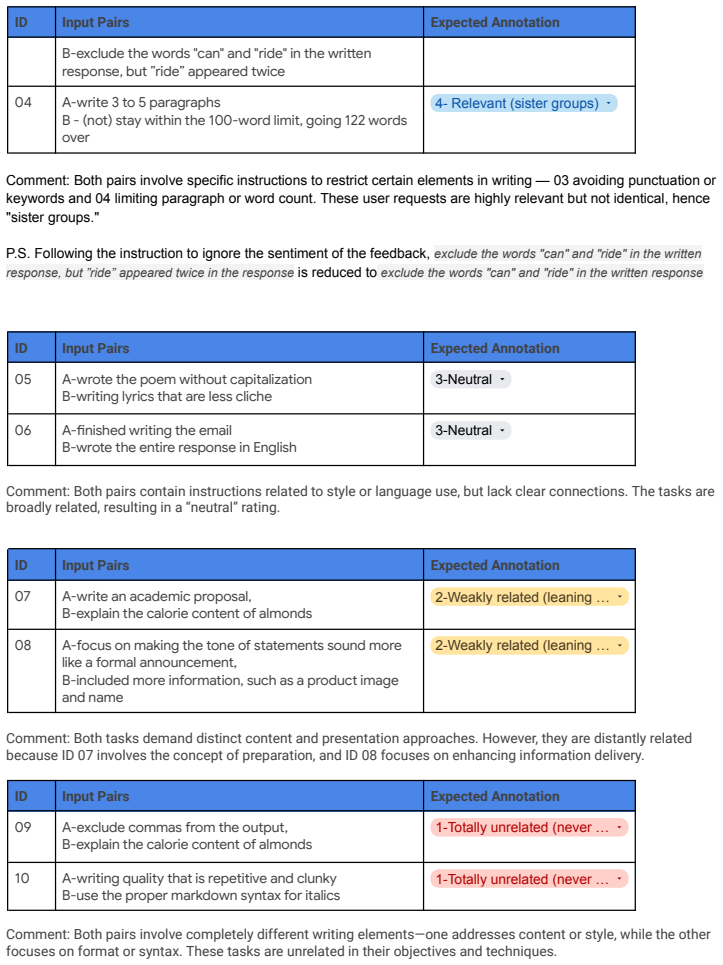
Significance. If the central pipeline is reliable, SkillVerse offers a useful alternative to benchmark scores: it provides granular, interpretable model diagnostics with user-controlled granularity. The paper's strongest evidence is the human validation of the clustering (Pearson r=0.643 on similarity ratings; TPR=0.916 and TNR=0.883) and of the anchoring procedure (precision 0.926, recall 0.980). The two applications—ICL demonstration selection and weakness prediction—are concrete and falsifiable, and the inverse-scaling findings are interesting. However, the framework's input is free-form LLM critiques, and the atomic-judgment parsing step is unvalidated, so the overall significance of the framework depends on adding that missing evidence.
major comments (4)
- [§2.3 and §3.2] Section 2.3 introduces atomic judgments (Subject+Verb+Object) extracted from free-form critiques, and Section 3.2 states that "the only potential source of error in our framework arises from the unsupervised clustering process." This is not accurate: the parsing step is itself a potential error source, and no precision, recall, or human agreement is reported for it. Since the dendrogram, proficiency ratios, ICL demonstration selection, and weakness hypotheses are all computed from these parsed judgments, an error in this step would propagate to every downstream claim. Please validate the parser against human-annotated atomic judgments, or otherwise bound its error rate.
- [Abstract and §5.3] The abstract states that SkillVerse predicts weaknesses with a 55% success rate, "22% higher than without SkillVerse." In Section 5.3 and Figure 8, however, the informed hypothesis success rate is 0.55, 22% lower than the uninformed guess of 0.77. Because a lower success rate on hypothesized weakness tasks is the intended demonstration of predictive ability, the abstract's direction is incorrect and must be fixed.
- [§5.2–§5.3] Section 5.3 draws strong conclusions from a small, filtered set: after the "practical relevance" re-ranking, only 10 tasks remain for the inverse-scaling analysis (Figure 9), and the KS test in Table 3 is based on 5 rows. The 0.5% versus 10.6% average performance-gap comparison in Tables 4–5 is reported without per-task variance or confidence intervals. Please report the full selected task lists, the exact filtering rule, and uncertainty measures so readers can assess whether the claimed effect is robust.
- [§4.2 and Figure 6] The 25% relative improvement over C-ICL is not defined in Section 4.2. Figure 6 plots improvement relative to direct generation, not relative to C-ICL, and the per-condition improvements vary widely, from about 6.7% (GPT-4o, Chatbot Arena) to 40% (Gemini-1.5-Flash, IFEval). State the aggregation rule (e.g., average over all conditions) and report per-condition values with error bars, since the headline number depends on how the comparison is aggregated.
minor comments (5)
- [References and §4.1] The citation for C-ICL is incorrect: the text cites Yan et al. (2021), but the reference list entry is a zero-shot object detection paper. The contrastive in-context learning method appears to correspond to Mo et al. (2024), which is already cited in the related work; please fix the citation.
- [§2.3] There is a typo in Section 2.3: "serve as act as the building blocks" should read "serve as the building blocks."
- [§4] Section 4's introduction contains "how the the uncovered model proficiency" with a duplicated article; please proofread the manuscript for similar issues.
- [§2.3 and Figure 2] "Easter Europe" appears in Figure 2 and Section 2.3 and should be "Eastern Europe"; also, "scaler score" in §4.1 should be "scalar score."
- [§3.2] Section 3.2 reports inter-annotator agreement as Pearson 0.88, but the main text says there were 1,590 annotations with 3 annotators; please specify whether this is a pairwise average or another statistic.
Circularity Check
No significant circularity found: the dendrogram is definitional, and the ICL and weakness-prediction claims are tested on held-out tasks.
full rationale
SkillVerse's core construction is definitional rather than derivational: an atomic judgment is defined as a Subject+Verb+Object claim extracted from critiques, and a skill cluster's proficiency is defined as the ratio of positive atomic judgments in that cluster. These definitions do not make a predicted quantity equal to an input by construction. The two downstream claims are evaluated out-of-sample. For in-context learning, demonstrations are selected by tree search using content relevance and the benefit C(r1)-C(r2) (Section 4.1), but the reported 25% relative improvement is measured on 150 held-out prompts per dataset (Section 4.2) and compared against C-ICL and similarity-only baselines under the same evaluation; the benefit score is not a parameter fitted to the held-out evaluation set. For weakness prediction, a reasoning LLM receives the proficiency report, hypothesizes new tasks, humans curate prompts for those tasks, and success rates are then measured on the newly collected prompts (Sections 5.1-5.2); the uninformed baseline isolates the contribution of the proficiency data. The predictions are therefore not the same objects as the training judgments. The paper's stated assumption that 'the critiques are reliable' (Section 3.2) and the Limitation paragraph acknowledging that LLM judges 'might introduce errors' are genuine missing-validation and correctness risks, especially because the atomic-judgment parser is never precision/recall-checked, but they are not circularity: nothing in the paper equates an output to an input by construction. There are no load-bearing self-citations or imported uniqueness theorems; the cited related work is external. Accordingly, the circularity score is 0.
Assumptions & free parameters
free parameters (4)
- tau (anchor centroid threshold) =
not specified
- epsilon (anchor overlap threshold) =
not specified
- T (pruning threshold for ICL skill selection) =
not specified
- dendrogram slicing level =
not specified
assumptions (3)
- domain assumption LLM critiques are reliable indicators of model errors
- domain assumption Atomic judgments can be accurately parsed from free-form critiques
- domain assumption Text embedding similarity corresponds to task-skill similarity
invented entities (1)
-
atomic judgment
Cite this review
Pith. "Pith review of SkillVerse : Assessing and Enhancing LLMs with Tree Evaluation." pith.science (2026). https://pith.science/paper/7OPC42PY
@misc{pith2026250600319,
  author       = {Pith},
  title        = {Pith review of: SkillVerse : Assessing and Enhancing LLMs with Tree Evaluation},
  year         = {2026},
  howpublished = {\url{https://pith.science/paper/7OPC42PY}},
  note         = {Machine review of arXiv:2506.00319}
}
read the original abstract
As language models evolve to tackle complex, multifaceted tasks, their evaluation must adapt to capture this intricacy. A granular, skill-specific understanding of model capabilities can empower researchers to make informed model development plans. In this paper, we introduce SkillVerse, an unsupervised tree-structured diagnosis framework for understanding model proficiency in specific abilities. With LLM as a judge, SkillVerse first critiques the model responses, and then organizes them into a hierarchical structure termed dendrogram. Given proficiency at arbitrary levels of granularity, SkillVerse is flexible to produce insights of behaviors of modern large models. We also demonstrate its efficacy in two downstream tasks: 1) improving model in-context learning by 25% using a tree-search algorithm to select more informative few-shot demonstrations, and 2) accurately predicting new model weaknesses with a 55% success rate, 22% higher than without SkillVerse.
Figures


Figures from the paper (9 more)




Reference graph
Works this paper leans on
-
[1]
online" 'onlinestring :=
ENTRY address archivePrefix author booktitle chapter edition editor eid eprint eprinttype howpublished institution journal key month note number organization pages publisher school series title type volume year doi pubmed url lastchecked label extra.label sort.label short.list INTEGERS output.state before.all mid.sentence after.sentence after.block STRING...
-
[2]
write newline
" write newline "" before.all 'output.state := FUNCTION n.dashify 't := "" t empty not t #1 #1 substring "-" = t #1 #2 substring "--" = not "--" * t #2 global.max substring 't := t #1 #1 substring "-" = "-" * t #2 global.max substring 't := while if t #1 #1 substring * t #2 global.max substring 't := if while FUNCTION word.in bbl.in capitalize " " * FUNCT...
-
[3]
Anthropic. 2024. https://www.anthropic.com/news/claude-3-5-sonnet Introducing claude 3.5 sonnet . Accessed: 2024-12-14
work page 2024
-
[4]
Yupeng Chang, Xu Wang, Jindong Wang, Yuan Wu, Linyi Yang, Kaijie Zhu, Hao Chen, Xiaoyuan Yi, Cunxiang Wang, Yidong Wang, et al. 2024. A survey on evaluation of large language models. ACM Transactions on Intelligent Systems and Technology, 15(3):1--45
2024
-
[5]
Liang Chao, Wei Xiang, and Bang Wang. 2024. In-context contrastive learning for event causality identification. In Proceedings of the 2024 Conference on Empirical Methods in Natural Language Processing, pages 868--881
work page 2024
-
[7]
Yew Ken Chia, Guizhen Chen, Luu Anh Tuan, Soujanya Poria, and Lidong Bing. 2023 b . https://arxiv.org/abs/2311.09277 Contrastive chain-of-thought prompting . Preprint, arXiv:2311.09277
arXiv 2023
-
[8]
Wei-Lin Chiang, Lianmin Zheng, Ying Sheng, Anastasios Nikolas Angelopoulos, Tianle Li, Dacheng Li, Banghua Zhu, Hao Zhang, Michael Jordan, Joseph E Gonzalez, et al. 2024. Chatbot arena: An open platform for evaluating llms by human preference. In International Conference on Machine Learning, pages 8359--8388. PMLR
work page 2024
-
[9]
Google. 2024 a . https://arxiv.org/abs/2403.05530 Gemini 1.5: Unlocking multimodal understanding across millions of tokens of context . arXiv preprint arXiv:2403.05530
arXiv 2024
Show all 33 references
-
[10]
Google. 2024 b . Text embeddings api. https://cloud.google.com/vertex-ai/generative-ai/docs/embeddings/get-text-embeddings. Accessed: 2024-12-14
2024
-
[11]
Dan Hendrycks, Collin Burns, Steven Basart, Andy Zou, Mantas Mazeika, Dawn Song, and Jacob Steinhardt. 2020. Measuring massive multitask language understanding. arXiv preprint arXiv:2009.03300
2020 arXiv
-
[12]
Xiaonan Jing, Srinivas Billa, and Danny Godbout. 2024. On a scale from 1 to 5: Quantifying hallucination in faithfulness evaluation. arXiv preprint arXiv:2410.12222
2024 arXiv
-
[13]
Akira Kawabata and Saku Sugawara. 2024. https://doi.org/10.18653/v1/2024.emnlp-main.905 Rationale-aware answer verification by pairwise self-evaluation . In Proceedings of the 2024 Conference on Empirical Methods in Natural Language Processing, pages 16178--16196, Miami, Flori...
2024 doi
-
[14]
Tianle Li, Wei-Lin Chiang, Evan Frick, Lisa Dunlap, Tianhao Wu, Banghua Zhu, Joseph E Gonzalez, and Ion Stoica. 2024. From crowdsourced data to high-quality benchmarks: Arena-hard and benchbuilder pipeline. arXiv preprint arXiv:2406.11939
2024 arXiv
-
[15]
Hashimoto
Xuechen Li, Tianyi Zhang, Yann Dubois, Rohan Taori, Ishaan Gulrajani, Carlos Guestrin, Percy Liang, and Tatsunori B. Hashimoto. 2023. Alpacaeval: An automatic evaluator of instruction-following models. https://github.com/tatsu-lab/alpaca_eval
2023
-
[16]
Adian Liusie, Potsawee Manakul, and Mark Gales. 2024 a . https://aclanthology.org/2024.eacl-long.8 LLM comparative assessment: Zero-shot NLG evaluation through pairwise comparisons using large language models . In Proceedings of the 18th Conference of the European Chapter of t...
2024
-
[17]
Adian Liusie, Vatsal Raina, Yassir Fathullah, and Mark Gales. 2024 b . https://doi.org/10.18653/v1/2024.emnlp-main.389 Efficient LLM comparative assessment: A product of experts framework for pairwise comparisons . In Proceedings of the 2024 Conference on Empirical Methods in ...
2024 doi
-
[18]
Aman Madaan, Niket Tandon, Prakhar Gupta, Skyler Hallinan, Luyu Gao, Sarah Wiegreffe, Uri Alon, Nouha Dziri, Shrimai Prabhumoye, Yiming Yang, Shashank Gupta, Bodhisattwa Prasad Majumder, Katherine Hermann, Sean Welleck, Amir Yazdanbakhsh, and Peter Clark. 2023. https://proceed...
2023
-
[19]
Inverse scaling: When bigger isn't better
Ian R McKenzie, Alexander Lyzhov, Michael Martin Pieler, Alicia Parrish, Aaron Mueller, Ameya Prabhu, Euan McLean, Xudong Shen, Joe Cavanagh, Andrew George Gritsevskiy, et al. Inverse scaling: When bigger isn't better. Transactions on Machine Learning Research
-
[20]
Ying Mo, Jiahao Liu, Jian Yang, Qifan Wang, Shun Zhang, Jingang Wang, and Zhoujun Li. 2024. C-icl: contrastive in-context learning for information extraction. arXiv preprint arXiv:2402.11254
2024 arXiv
-
[21]
Mazda Moayeri, Vidhisha Balachandran, Varun Chandrasekaran, Safoora Yousefi, Thomas Fel, Soheil Feizi, Besmira Nushi, Neel Joshi, and Vibhav Vineet. 2024. Unearthing skill-level insights for understanding trade-offs of foundation models. arXiv preprint arXiv:2410.13826
2024 arXiv
-
[22]
Vishvak Murahari, Ameet Deshpande, Peter Clark, Tanmay Rajpurohit, Ashish Sabharwal, Karthik Narasimhan, and Ashwin Kalyan. 2024. Qualeval: Qualitative evaluation for model improvement. In Proceedings of the 2024 Conference of the North American Chapter of the Association for ...
2024
-
[23]
Bhuvanashree Murugadoss, Christian Poelitz, Ian Drosos, Vu Le, Nick McKenna, Carina Suzana Negreanu, Chris Parnin, and Advait Sarkar. 2025. Evaluating the evaluator: Measuring llms’ adherence to task evaluation instructions. In Proceedings of the AAAI Conference on Artificial ...
2025
-
[24]
Liangming Pan, Michael Saxon, Wenda Xu, Deepak Nathani, Xinyi Wang, and William Yang Wang. 2024. https://doi.org/10.1162/tacl_a_00660 Automatically correcting large language models: Surveying the landscape of diverse automated correction strategies . Transactions of the Associ...
2024 doi
-
[25]
Llm-as-a-judge & reward model: What they can and cannot do
Guijin Son, Hyunwoo Ko, Hoyoung Lee, Yewon Kim, and Seunghyeok Hong. Llm-as-a-judge & reward model: What they can and cannot do
-
[26]
Tu Vu, Kalpesh Krishna, Salaheddin Alzubi, Chris Tar, Manaal Faruqui, and Yun-Hsuan Sung. 2024. Foundational autoraters: Taming large language models for better automatic evaluation. In Proceedings of the 2024 Conference on Empirical Methods in Natural Language Processing, pag...
2024
-
[27]
Tianlu Wang, Ilia Kulikov, Olga Golovneva, Ping Yu, Weizhe Yuan, Jane Dwivedi-Yu, Richard Yuanzhe Pang, Maryam Fazel-Zarandi, Jason Weston, and Xian Li. 2024. Self-taught evaluators. arXiv preprint arXiv:2408.02666
2024 arXiv
-
[28]
Tianlu Wang, Ping Yu, Xiaoqing Ellen Tan, Sean O'Brien, Ramakanth Pasunuru, Jane Dwivedi-Yu, Olga Golovneva, Luke Zettlemoyer, Maryam Fazel-Zarandi, and Asli Celikyilmaz. 2023. Shepherd: A critic for language model generation. arXiv preprint arXiv:2308.04592
2023 arXiv
-
[29]
Wenda Xu, Daniel Deutsch, Mara Finkelstein, Juraj Juraska, Biao Zhang, Zhongtao Liu, William Yang Wang, Lei Li, and Markus Freitag. 2024. https://doi.org/10.18653/v1/2024.findings-naacl.92 LLMR efine: Pinpointing and refining large language models via fine-grained actionable f...
2024 doi
-
[30]
Caixia Yan, Xiao Chang, Minnan Luo, Huan Liu, Xiaoqin Zhang, and Qinghua Zheng. 2021. https://api.semanticscholar.org/CorpusID:237491964 Semantics-guided contrastive network for zero-shot object detection . IEEE Transactions on Pattern Analysis and Machine Intelligence, 46:1530--1544
2021
-
[31]
Weizhe Yuan, Richard Yuanzhe Pang, Kyunghyun Cho, Sainbayar Sukhbaatar, Jing Xu, and Jason Weston. 2024. Self-rewarding language models. arXiv preprint arXiv:2401.10020
2024 arXiv
-
[32]
Tianjun Zhang, Aman Madaan, Luyu Gao, Steven Zheng, Swaroop Mishra, Yiming Yang, Niket Tandon, and Uri Alon. 2024. In-context principle learning from mistakes. arXiv preprint arXiv:2402.05403
2024 arXiv
-
[33]
Lianmin Zheng, Wei-Lin Chiang, Ying Sheng, Siyuan Zhuang, Zhanghao Wu, Yonghao Zhuang, Zi Lin, Zhuohan Li, Dacheng Li, Eric Xing, et al. 2023. Judging llm-as-a-judge with mt-bench and chatbot arena. Advances in Neural Information Processing Systems, 36:46595--46623
2023
-
[34]
Jeffrey Zhou, Tianjian Lu, Swaroop Mishra, Siddhartha Brahma, Sujoy Basu, Yi Luan, Denny Zhou, and Le Hou. 2023. Instruction-following evaluation for large language models. arXiv preprint arXiv:2311.07911
2023 arXiv
Reviewed August 7, 2026 · model on record in the stance chip above.
Discussion (0). Sign in to comment.