REVIEW 5 major objections 4 minor 45 references
QTP-Net: A Quantum Text Pre-training Network for Natural Language Processing
T0 review · 5 major / 4 minor · reviewed 2026-08-07 · deepseek-v4-flash
Pith's one-line read Encoding word senses into quantum superposition and searching them with adaptive Grover beats classical and quantum-inspired models on sentiment and word-sense tasks.
desk verdict The empirical claim is the whole paper, but the quantum oracle that is supposed to deliver the gain is never defined, and any plausible definition either trivially fails or leaks the label. read the letter →
The pith
A machine-rendered reading of the paper's core claim, the machinery that carries it, and where it could break.
The reading
What carries the argument
The load-bearing object is the adaptive Grover operator $AGA = D \cdot P_D \cdot O_{r_k} \cdot U_{\text{Encoding}}$, where $U_{\text{Encoding}}$ loads a word vector into an $n$-qubit superposition via amplitude or angle encoding, $O_{r_k}$ is a Grover oracle with unknown structure that marks the candidate senses of the word, and $P_D$ is a phase-detection operator that halts iteration when the target amplitude is maximal. The algorithm for $O_{r_k}$ follows the standard randomized search for an unknown number of solutions: draw the iteration count $k$ uniformly from $\{1,\dots,m\}$, apply $m$ Grover iterations, and grow $m$ geometrically by $\lambda = 6/5$, achieving constant success probability in $O(\sqrt{N/a})$ total iterations. The measurement probabilities $p(x)$ of the final state become the feature vector that is concatenated with ERNIE's embedding $h$ and passed through a linear layer.
What would settle it
Run QTP-Net with the QEPFE branch replaced by a fixed random vector of the same size while keeping ERNIE and the linear layer identical: if sentiment or WSD accuracy does not drop by the reported margin, the quantum distribution is not the causal source of the improvement. Alternatively, compare QTP-Net on the same benchmarks with and without conducting the Grover iterations, measuring immediately after $U_{\text{Encoding}}$, to isolate the contribution of the adaptive search itself.
Extended reading notes
Core claim
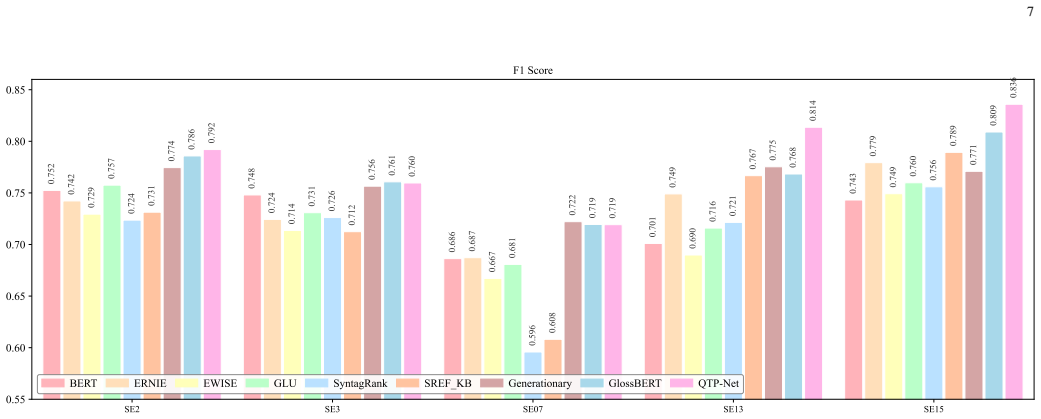
The paper's central claim is that a quantum-enhanced feature embedding, QEPFE, built on an adaptive Grover's algorithm with an unknown number of marked states, can represent multiple word meanings in superposition and extract a probability distribution that is genuinely useful for downstream classification. Combined with ERNIE in QTP-Net, this distribution yields state-of-the-art results: in sentiment classification it outperforms all classical and quantum-inspired models on every dataset examined, with average accuracy and F1 improvements of 0.024 and 0.029; in word sense disambiguation it reaches 0.784 average F1, surpassing GlossBERT by 0.016 and taking the lead on SE2, SE13, and SE15. The author presents these results as evidence that quantum principles can be integrated into pre-trained language models to solve polysemy modeling.
Load-bearing premise
The quantum branch's usefulness rests on the assumption that a word's senses can be encoded as marked basis states in a Grover oracle, but the paper never specifies how that oracle is constructed or whether it can be built at all.
Editorial extensions
If this is right
- Any future model on these eleven benchmarks must beat QTP-Net's reported numbers: average accuracy +0.024 and F1 +0.029 on sentiment, and 0.784 F1 on word senses.
- The architecture shows that a frozen pre-trained language model can be augmented with a quantum feature extractor without retraining the language model itself, making the approach a drop-in addition to existing pipelines.
- The adaptive search handles an unknown number of marked senses, so the method is in principle not restricted to fixed sense inventories and could extend to open-vocabulary polysemy.
- Performance is consistent across metrics, with internal metric ranges at most 0.008, indicating the improvement is not a trade-off of accuracy for recall or precision.
Reading between the lines
- An ablation that swaps the QEPFE probability vector for a random or constant vector of the same length would directly test whether the quantum distribution causes the reported gains; the paper does not report such a control.
- Since the oracle $O_{r_k}$ is left unspecified, a concrete realization, such as marking WordNet synsets, is needed before the method can be reproduced; until then the quantum branch is a conditional construction.
- Because ERNIE is frozen and only a linear layer is trained, the same fusion could be applied to other encoders, and the size of the quantum contribution is likely to depend on the encoder's own disambiguation ability.
- The quadratic speedup of Grover search is a query-complexity result; on near-term hardware the cost of state preparation and measurement may dominate, so the practical speed advantage remains untested.
Editorial analysis
A structured set of objections, weighed in public.
Referee Report
Summary. This paper proposes QTP-Net, a hybrid quantum-classical model that concatenates a 'Quantum Enhanced Pre-training Feature Embedding' (QEPFE) based on an adaptive Grover's algorithm with the pretrained transformer ERNIE. The QEPFE is intended to encode multiple word senses as marked basis states, amplify them with an adaptive Grover circuit, and use the measurement probability distribution as a feature vector. The model is evaluated on six sentiment classification datasets and five WSD benchmarks, reporting average gains over classical and quantum-inspired baselines.
Significance. If the reported gains were reproducible and the quantum feature were well-defined, a quantum-enhanced pretraining feature that improves SC and WSD over strong transformer baselines would be a significant result in quantum NLP. The paper deserves credit for attempting a concrete integration of Grover search with a modern pretrained language model, for providing pseudocode, and for evaluating on multiple standard benchmarks. However, the central quantum mechanism is unspecified: the oracle Or_k is never constructed, the PD termination claim is unproved, and Eq. (15) is not a valid probability expression. The empirical claims are also internally inconsistent (MPQA and SST losses vs. 'comprehensively outperforming') and are not reproducible without code/data or an ablation separating the quantum branch from the frozen ERNIE representation. The contribution as presented is therefore not yet established.
major comments (5)
- [III.A.1 / Eq. (6) / Algorithm 1] The oracle Or_k, which is the core of the QEPFE branch, is never defined. Eq. (6) and Algorithm 1 require a set A of marked states with f(x)=1 iff x∈A, but the paper never specifies what A corresponds to for sentiment or WSD inputs; calling it an 'oracle with unknown structure' (Section III.A.1) leaves the quantum circuit unspecified. This is load-bearing because the feature vector p in Eq. (17) is the measurement distribution of a circuit containing Or_k, so without a definition the reported performance gains cannot be produced. Moreover, for WSD the two plausible definitions are either context-free (A = all dictionary senses, yielding identical features for every occurrence of a word, with no disambiguation power) or circular (A = the correct sense, which leaks the label), so the oracle construction cannot explain the reported 0.016 F1 improvement over GlossBERT.
- [IV.B / Fig. 8 / Abstract] The abstract claims QTP-Net is 'comprehensively outperforming both classical and quantum-inspired models' on six benchmark datasets, but Section IV.B states that QTP-Net's accuracy on MPQA (0.910) and SST (0.941) falls short of TextTN by 0.002 and 0.015, respectively, and those two datasets are among the six listed in Section IV.A. The text also says QTP-Net 'achieves an average accuracy of 0.934 across five datasets', not six. This internal contradiction must be resolved; as written, the headline claim is false, and the reported average gains are based on a different dataset count than the abstract states.
- [III.B / Eq. (15)] Equation (15) defines p(x)=||⟨Ψ_0|AGA⟩||², which is not a well-formed probability. AG_A in Eq. (6) is a unitary operator, not a state, so ⟨Ψ_0|AG_A⟩ is an operator-valued quantity, not a complex amplitude; the expression should be something like |⟨x|AG_A U_encoding|0⟩|² (or a partial trace over the circuit). As written, the feature vector p cannot be computed, and this is the central quantity used for the fusion layer in Eq. (17).
- [III.A.1 / Eqs. (9)-(10) / Algorithm 1] The phase detection operator P_D is claimed to 'automatically terminate when the amplitude of the target state reaches its maximum' (Section III.A.1), but no proof or simulation supports this. Moreover, Algorithm 1 (adapted from [18]) does not use P_D for termination: its while loop terminates when a measured x∈A, and P_D appears only in the Grover iteration (7). The relationship between the P_D termination claim and the actual algorithm is therefore unclear. Since the adaptive termination mechanism is one of the two 'key technologies' the paper claims to develop, this unproved and potentially unused mechanism undermines the contribution's novelty.
- [IV / Experiments] The experiments are not reproducible from the manuscript. No code, model parameters, number of qubits n, encoding structure (amplitude vs angle), Grover iteration counts k, or data splits are given, and the reported results appear only as figures without raw values or error bars. In addition, because ERNIE parameters are frozen (Section III.B) and only the fusion layer is trained, there is no ablation that replaces p with a classical embedding; without such an ablation, the reported gains cannot be attributed to the quantum branch. Given the small margins (0.002 on MPQA, 0.001 on SE3), statistical significance is also unaddressed.
minor comments (4)
- [Section I] The first paragraph contains a duplicated phrase: 'For the SC, For SC' appears in the opening sentence.
- [Tab. I] The gate table lists a 'Multi-controlled Z gate' whose symbol and usage are not defined in the circuit descriptions; the text only describes H and M_CX in the P_D construction, so the table should be reconciled with the actual gates used.
- [Section IV.A.2] The experimental configuration does not specify the number of qubits n, the encoding operator U_encoding choice (amplitude versus angle), or the Grover iteration count k; these are necessary to understand the quantum resource cost and to attempt replication.
- [Section IV.C / Fig. 9] The WSD results are reported only through aggregate F1 scores and a figure; per-dataset scores for all baselines are not tabulated, making it impossible to verify claims such as a 0.006 margin on SE2 or a 0.038 margin on SE13.
Circularity Check
No significant circularity: the reported gains are empirical benchmark outcomes, and the quantum feature vector is measured, not fitted.
full rationale
The paper's central claims are empirical comparisons on SC and WSD benchmarks. The QEPFE branch produces a probability vector p by measuring the output of a fixed adaptive Grover circuit; ERNIE parameters are frozen, and only the fusion layer weights are trained. No fitted parameter is later renamed as a prediction, and no equation reduces a target result to its own input. The adaptive Grover machinery is taken from external prior work [8], [18], with stated assumptions that do not include the benchmark outcomes. There is no load-bearing self-citation chain: the references are external and no author-overlapping citation is used to justify the core method. The main weakness is that the oracle Or_k is left unspecified, which is a reproducibility and specification gap rather than a circular derivation. Similarly, the inconsistency between the abstract's 'comprehensively outperforming' and the reported shortfalls on MPQA and SST is a factual/correctness issue, not circularity. Under the requirement to exhibit a specific equation-level reduction or fitted-input-as-prediction step, no circular step can be identified.
Assumptions & free parameters
free parameters (2)
- Number of qubits n for word encoding =
not reported
- Number of Grover iterations k =
not reported
assumptions (4)
- standard math Standard quantum mechanics: unitarity, Born rule, amplitude encoding
- standard math The adaptive Grover search with randomized k and geometric schedule yields success probability at least 1/4 (Eq. 14)
- ad hoc to paper A word's multiple senses can be encoded as marked basis states in a Grover oracle Or_k, so that amplifying those states yields useful semantic features
- ad hoc to paper The phase detection operator PD automatically terminates when the target amplitude is maximal
Cite this review
Pith. "Pith review of QTP-Net: A Quantum Text Pre-training Network for Natural Language Processing." pith.science (2026). https://pith.science/paper/NJEMTZRN
@misc{pith2026250600321,
  author       = {Pith},
  title        = {Pith review of: QTP-Net: A Quantum Text Pre-training Network for Natural Language Processing},
  year         = {2026},
  howpublished = {\url{https://pith.science/paper/NJEMTZRN}},
  note         = {Machine review of arXiv:2506.00321}
}
read the original abstract
Natural Language Processing (NLP) faces challenges in the ability to quickly model polysemous words. The Grover's Algorithm (GA) is expected to solve this problem but lacks adaptability. To address the above dilemma, a Quantum Text Pre-training Network (QTP-Net) is proposed to improve the performance of NLP tasks. First, a Quantum Enhanced Pre-training Feature Embedding (QEPFE) is developed to encode multiple meanings of words into quantum superposition states and exploit adaptive GA to fast capture rich text features. Subsequently, the QEPFE is combined with the Enhanced Representation through kNowledge IntEgration (ERNIE), a pre-trained language model proposed by Baidu, to construct QTP-Net, which is evaluated on Sentiment Classification (SC) and Word Sense Disambiguation (WSD) tasks. Experiments show that in SC, the QTP-Net improves the average accuracy by 0.024 and the F1 score by 0.029 on six benchmark datasets, comprehensively outperforming both classical and quantum-inspired models. In WSD, it reaches 0.784 average F1 score, which is 0.016 higher than the sub-optimal GlossBERT, and significantly leads on SE2, SE13, and SE15. QTP-Net provides a new solution for implicit semantic modeling in NLP and lays the foundation for future research on quantum-enhanced models.
Figures


Figures from the paper (6 more)


Reference graph
Works this paper leans on
-
[18]
Early days following Grover's quantum search algorithm
F. Song, “Early days following Grover’s quantum search algo- rithm,” arXiv preprint arXiv:1709.01236, 2017
work page Pith review arXiv 2017
-
[1]
Multipolarity-based sentiment classifica- tion using hybrid HDL-Fuzzy-RMDL network,
N. S. Ambekar et al., “Multipolarity-based sentiment classifica- tion using hybrid HDL-Fuzzy-RMDL network,” IEEE Transac- tions on Computational Social Systems, pp. 1-10, 2024
work page 2024
-
[2]
A fuzzy graph convolutional network model for sentence-level sentiment analysis,
H. T. Phan et al., “A fuzzy graph convolutional network model for sentence-level sentiment analysis,” IEEE Transactions on Fuzzy Systems, vol. 32, no. 5, pp. 2953-2965, 2024
work page 2024
-
[3]
A. Ahmed et al., “Urdu word sense disambiguation: Lever- aging contextual stacked embedding, Siamese Transformer en- coder 1DCNN-BiLSTM, and Gloss data augmentation,” ACM Transactions on Asian and Low-Resource Language Information Processing, vol. 24, no. 5 pp. 1-36, 2025
work page 2025
-
[4]
When polysemy matters: Modeling semantic categorization with word embeddings,
E. Soper et al., “When polysemy matters: Modeling semantic categorization with word embeddings,” in Proceedings of the 11th Joint Conference on Lexical and Computational Semantics, pp. 123-131, 2022
work page 2022
-
[5]
Polysemy-evidence from linguistics, behavioral science, and contextualized language models,
J. Haber et al., “Polysemy-evidence from linguistics, behavioral science, and contextualized language models,” Computational Linguistics, vol. 50, no. 1, pp. 351-417, 2024
work page 2024
-
[6]
Lexical meaning, reference and usage,
P. Frath, “Lexical meaning, reference and usage,” in Proceedings of the 1st International Workshop on Generative Approaches to the Lexicon, pp. 26-28, 2001
work page 2001
-
[7]
Large language models for generative recommen- dation: A survey and visionary discussions,
L. Li et al., “Large language models for generative recommen- dation: A survey and visionary discussions,” in Proceedings of the 2024 Joint International Conference on Computational Lin- guistics, Language Resources and Evaluation (LREC-COLING 2024), pp. 10146-10159, 2024
work page 2024
Show all 45 references
-
[8]
A fast quantum mechanical algorithm for database search,
L. K. Grover, “A fast quantum mechanical algorithm for database search,” in Proceedings of the 28th Annual ACM Symposium on Theory of Computing, pp. 212–219, 1996
1996
-
[9]
Grover’s algorithm for question answering,
A. D. Correia et al., “Grover’s algorithm for question answering,” arXiv preprint arXiv:2106.05299, 2021
2021 arXiv
-
[10]
Integrating quantum computing and NLP for advanced cyber threat detection,
P. Ramya et al., “Integrating quantum computing and NLP for advanced cyber threat detection,” Journal of Cybersecurity Information Management, vol. 14, no. 2, pp. 186-197, 2024
2024
-
[11]
GroverGPT: A large language model with 8 billion parameters for quantum searching,
H. Wang et al., “GroverGPT: A large language model with 8 billion parameters for quantum searching,” arXiv preprint arXiv:2501.00135, 2024
2024 arXiv
-
[12]
GroverGPT-2: Simulating Grover’s algorithm via chain-of-thought reasoning and quantum-native tokenization,
M. Chen et al., “GroverGPT-2: Simulating Grover’s algorithm via chain-of-thought reasoning and quantum-native tokenization,” arXiv preprint arXiv:2505.04880, 2025
2025
-
[13]
Grover algorithm for multi-objective searching with iteration auto-controlling,
W. Zhu et al., “Grover algorithm for multi-objective searching with iteration auto-controlling,” in Advances in Swarm Intelli- gence, pp. 357-364, 2014
2014
-
[14]
ERNIE 2.0: A continual pre-training framework for language understanding,
Y . Sun et al., “ERNIE 2.0: A continual pre-training framework for language understanding,” in Proceedings of the AAAI Con- ference on Artificial Intelligence, pp. 8968-8975, 2020
2020
-
[15]
Coggins, Introduction to quantum computing with Qiskit: Scarborough Quantum Computing Ltd, 2021
M. Coggins, Introduction to quantum computing with Qiskit: Scarborough Quantum Computing Ltd, 2021
2021
-
[16]
Configurable sublinear circuits for quantum state preparation,
I. F. Araujo, D. K. Park et al., “Configurable sublinear circuits for quantum state preparation,” Quantum Information Processing, vol. 22, no. 2, pp. 123, 2023
2023
-
[17]
Hybrid classical–quantum convolutional neural network for stenosis de- tection in X-ray coronary angiography,
E. Ovalle-Magallanes, J. G. Avina-Cervantes et al., “Hybrid classical–quantum convolutional neural network for stenosis de- tection in X-ray coronary angiography,” Expert Systems with Applications, vol. 189, pp. 116112, 2022
2022
-
[19]
PennyLane: Automatic differentia- 8 tion of hybrid quantum-classical computations,
V . Bergholm et al., “PennyLane: Automatic differentia- 8 tion of hybrid quantum-classical computations,” arXiv preprint arXiv:1811.04968, 2018
2018 arXiv
-
[20]
L. P. G. Antiga et al., Deep learning with PyTorch: Simon and Schuster, 2020
2020
-
[21]
A novel extreme adaptive GRU for multivariate time series forecasting,
Y . Zhang et al., “A novel extreme adaptive GRU for multivariate time series forecasting,” Scientific Reports, vol. 14, no. 1, pp. 2991, 2024
2024
-
[22]
Sentiment classification using a single- layered BiLSTM model,
Z. Hameed et al., “Sentiment classification using a single- layered BiLSTM model,” IEEE Access, vol. 8, pp. 73992-74001, 2020
2020
-
[23]
Improving text classification with weighted word embeddings via a multi-channel TextCNN model,
B. Guo et al., “Improving text classification with weighted word embeddings via a multi-channel TextCNN model,” Neurocomput- ing, vol. 363, pp. 366-374, 2019
2019
-
[24]
Quantum-inspired complex word embedding,
Q. Li et al., “Quantum-inspired complex word embedding,” in Proceedings of the 3rd Workshop on Representation Learning for NLP, pp. 50-57, 2018
2018
-
[25]
Encoding word order in complex embeddings,
B. Wang et al., “Encoding word order in complex embeddings,” in International Conference on Learning Representations, 2020
2020
-
[26]
TextTN: Probabilistic encoding of language on tensor network,
P. Zhang et al., “TextTN: Probabilistic encoding of language on tensor network,” in International Conference on Learning Representations, 2021
2021
-
[27]
Mining and summarizing customer reviews,
M. Hu et al., “Mining and summarizing customer reviews,” in Proceedings of the tenth ACM SIGKDD international conference on Knowledge discovery and data mining, pp. 168–177, 2004
2004
-
[28]
Multi-perspective question answering using the OpQA corpus,
V . Stoyanov et al., “Multi-perspective question answering using the OpQA corpus,” in Proceedings of the conference on Human Language Technology and Empirical Methods in Natural Lan- guage Processing, pp. 923–930, 2005
2005
-
[29]
Seeing stars: Exploiting class relationships for sentiment categorization with respect to rating scales,
B. Pang et al., “Seeing stars: Exploiting class relationships for sentiment categorization with respect to rating scales,” in Proceedings of the 43rd Annual Meeting on Association for Computational Linguistics, pp. 115–124, 2005
2005
-
[30]
Recursive deep models for semantic com- positionality over a sentiment treebank,
R. Socher et al., “Recursive deep models for semantic com- positionality over a sentiment treebank,” in Proceedings of the 2013 Conference on Empirical Methods in Natural Language Processing, pp. 1631-1642, 2013
2013
-
[31]
A sentimental education: sentiment analysis using subjectivity summarization based on minimum cuts,
B. Pang et al., “A sentimental education: sentiment analysis using subjectivity summarization based on minimum cuts,” in Proceedings of the 42nd Annual Meeting on Association for Computational Linguistics, pp. 271–es, 2004
2004
-
[32]
An empirical study of sentiment analysis for chinese documents,
S. Tan et al., “An empirical study of sentiment analysis for chinese documents,” Expert Systems with Applications, vol. 34, no. 4, pp. 2622-2629, 2008
2008
-
[33]
BERT: Pre-training of deep bidirectional Trans- formers for language understanding,
J. Devlin et al., “BERT: Pre-training of deep bidirectional Trans- formers for language understanding,” in Proceedings of the 2019 Conference of the North American Chapter of the Association for Computational Linguistics: Human Language Technologies, pp. 4171-4186, 2019
2019
-
[34]
Zero-shot word sense disambiguation using sense definition embeddings,
S. Kumar et al., “Zero-shot word sense disambiguation using sense definition embeddings,” in Proceedings of the 57th Annual Meeting of the Association for Computational Linguistics, pp. 5670-5681, 2019
2019
-
[35]
Improved word sense disambiguation us- ing pre-trained contextualized word representations,
C. Hadiwinoto et al., “Improved word sense disambiguation us- ing pre-trained contextualized word representations,” in Proceed- ings of the 2019 Conference on Empirical Methods in Natural Language Processing and the 9th International Joint Conference on Natural Language Proces...
2019
-
[36]
Personalized PageRank with syntagmatic information for multilingual word sense disambiguation,
F. Scozzafava et al., “Personalized PageRank with syntagmatic information for multilingual word sense disambiguation,” in Proceedings of the 58th Annual Meeting of the Association for Computational Linguistics: System Demonstrations, pp. 37-46, 2020
2020
-
[37]
A synset relation-enhanced framework with a try-again mechanism for word sense disambiguation,
M. Wang et al., “A synset relation-enhanced framework with a try-again mechanism for word sense disambiguation,” in Proceed- ings of the 2020 Conference on Empirical Methods in Natural Language Processing (EMNLP), pp. 6229-6240, 2020
2020
-
[38]
Generationary or “how we went beyond word sense inventories and learned to gloss
M. Bevilacqua et al., “Generationary or “how we went beyond word sense inventories and learned to gloss”,” in Proceedings of the 2020 Conference on Empirical Methods in Natural Language Processing (EMNLP), pp. 7207-7221, 2020
2020
-
[39]
GlossBERT: BERT for word sense disam- biguation with gloss knowledge,
L. Huang et al., “GlossBERT: BERT for word sense disam- biguation with gloss knowledge,” in Proceedings of the 2019 Con- ference on Empirical Methods in Natural Language Processing and the 9th International Joint Conference on Natural Language Processing (EMNLP-IJCNLP), pp. 35...
2019
-
[40]
A semantic concordance,
G. A. Miller et al., “A semantic concordance,” in Proceedings of the workshop on Human Language Technology, pp. 303–308, 1993
1993
-
[41]
Anaphora resolution with word sense disambigua- tion,
J. Preiss, “Anaphora resolution with word sense disambigua- tion,” in Proceedings of SENSEV AL-2 2nd International Work- shop on Evaluating Word Sense Disambiguation Systems, pp. 143-146, 2001
2001
-
[42]
The English all-words task,
B. Snyder et al., “The English all-words task,” in Proceedings of SENSEV AL-3, the 3rd International Workshop on the Evaluation of Systems for the Semantic Analysis of Text, pp. 41-43, 2004
2004
-
[43]
Semeval-2007 task-17: English lexical sam- ple, srl and all words,
S. Pradhan et al., “Semeval-2007 task-17: English lexical sam- ple, srl and all words,” in Proceedings of the 4th International Workshop on Semantic Evaluations (Semeval-2007), pp. 87-92, 2007
2007
-
[44]
Semeval-2013 task 12: Multilingual word sense disambiguation,
R. Navigli et al., “Semeval-2013 task 12: Multilingual word sense disambiguation,” in Second Joint Conference on Lexical and Computational Semantics (* SEM), V olume 2: Proceedings of the Seventh International Workshop on Semantic Evaluation (SemEval 2013), pp. 222-231, 2013
2013
-
[45]
Semeval-2015 task 13: Multilingual all-words sense disambiguation and entity linking,
A. Moro et al., “Semeval-2015 task 13: Multilingual all-words sense disambiguation and entity linking,” in Proceedings of the 9th International Workshop on Semantic Evaluation (Semeval 2015), pp. 288-297, 2015
2015
Reviewed August 7, 2026 · model on record in the stance chip above.
Discussion (0). Sign in to comment.