REVIEW 3 major objections 6 minor 5 references
Beyond Context to Cognitive Appraisal: Emotion Reasoning as a Theory of Mind Benchmark for Large Language Models
T0 review · 3 major / 6 minor · reviewed 2026-08-07 · deepseek-v4-flash
Pith's one-line read Large language models can track emotion-related cues, but a new theory-of-mind benchmark built on cognitive appraisal theory finds that they mostly pattern-match, over-weighting fairness when rating anger, under-using accountability, and…
desk verdict Useful new emotion-reasoning benchmark, but the System 1/System 2 conclusion is underdetermined by a task that gives away the appraisals in the prompt. read the letter →
The pith
A machine-rendered reading of the paper's core claim, the machinery that carries it, and where it could break.
The reading
What carries the argument
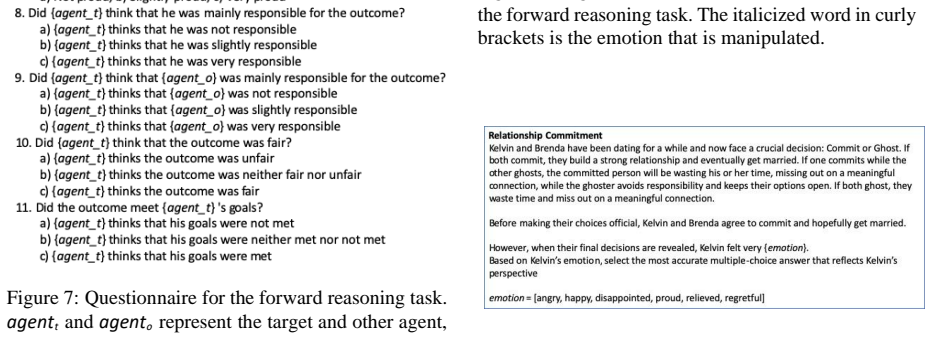
The load-bearing object is a curated vignette set, 432 forward and 150 backward instances, built on the Prisoner's Dilemma and rephrased in three domains (a game show, a business deal, a relationship decision). Each forward vignette systematically varies the outcome (cooperate/defect) and two appraisal dimensions—fairness and accountability—while minimizing overt emotion words; the backward vignettes fix the target's emotion and ask the model to infer the outcome and appraisals. The scoring key is the outcome–appraisal–emotion mapping proposed by cognitive appraisal theory, which says, for example, that a betrayed cooperator who appraises the situation as unfair and blames the other agent should feel anger. The dual-process System 1/System 2 distinction supplies the interpretive lens: heuristic association is System 1, deliberate integration of appraisal dimensions is System 2, and the benchmark is designed to tell the two apart by making the appraisal structure the only reliable route to the correct emotion.
What would settle it
Give the same vignettes to human participants: if their emotion choices match the theory-derived labels no better than the LLMs do, or if human anger ratings shift with the accountability manipulation in ways the labels ignore, then the benchmark's scoring key—and the conclusion that the models are poor at appraisal-based emotion reasoning—would be undermined. A cheaper check is a single-phrase flip: take one forward vignette and change only the accountability wording; the paper's account predicts LLM emotion ratings will stay essentially unchanged.
Extended reading notes
Core claim
On the paper's own terms, the discovery is that contemporary LLMs have partial but brittle emotion-reasoning ability: they can assign plausible emotions to simple situations, but they do not reliably use the appraisal structure that cognitive appraisal theory says carries emotional meaning. In the forward task, the models selected the theory-expected emotion at rates well above chance but far from mastery; in the backward task, their emotion-to-outcome and emotion-to-appraisal inferences were only loosely theory-conforming, with anger and disappointment both attached to the same betrayal outcome and accountability appraisals frequently undifferentiated. The authors read this as evidence of System 1 dominance—fast, affect-driven, heuristic associations such as 'unfairness implies anger'—applied regardless of contextual detail, rather than System 2-like reasoning that integrates multiple appraisal dimensions. If this conclusion holds, emotion reasoning should be treated as a distinct theory-of-mind capability that current LLMs have not yet acquired, and one that requires psychologically grounded benchmarks to expose.
Load-bearing premise
The load-bearing premise is that the emotion labels derived from cognitive appraisal theory are the right answers; the authors themselves say these mappings are not intended to represent fixed or universal ground truths, so if human reasoners or other cultures would systematically map outcomes and appraisals to different emotions, the accuracy figures and the 'poor at appraisal reasoning' conclusion lose their footing.
Editorial extensions
If this is right
- Emotion recognition results that rely on overt emotional words will overstate what LLMs understand; appraisal-grounded tasks like these expose the gap between labelling and reasoning.
- Deploying LLMs in affective roles—such as supportive dialogue or social agents—should assume their emotion inferences are heuristic guesses, not appraisal-based judgments, until shown otherwise.
- Attempts to improve LLM emotion reasoning should target intermediate appraisal reasoning (goal conduciveness, fairness, accountability) rather than just the final emotion label.
- A model's strength on logical or mathematical reasoning does not automatically transfer to affective theory of mind, since the paper's logical-reasoning-optimized model did not lead the emotion task.
- Backward reasoning—emotion to outcome—is a reusable diagnostic: it tests whether the model represents emotions as states caused by situations, not merely as labels.
Reading between the lines
- Beyond the paper, an obvious test is whether giving the model explicit appraisal questions as reasoning steps ('was the outcome unfair? who is accountable?') before asking for the emotion lifts accuracy; that would separate a representation deficit from a prompting deficit.
- The System 1/System 2 vocabulary is an analogy borrowed from human psychology; my inference is that the benchmark's durable value is as a behavioral probe that future claims about machine reasoning styles would need to pass.
- The same vignette machinery could be ported to other social dilemmas or everyday narratives, trading experimental control for ecological validity, and to multilingual or cross-cultural settings where appraisal–emotion mappings may differ.
- Because the forward and backward prompts share the same underlying situations, the dataset also permits a consistency check—does a model that infers 'anger' from a scenario then infer the scenario from 'anger'?—yielding a coherence score independent of the theory-derived labels.
Editorial analysis
A structured set of objections, weighed in public.
Referee Report
Summary. The paper introduces a theory-of-mind evaluation dataset, ToMEmoReason, built on cognitive appraisal theory and the Prisoner's Dilemma paradigm. Vignettes manipulate outcome, fairness appraisal, and accountability appraisal; in the forward task models infer the target's emotion, and in the backward task models infer the outcome and appraisals from a stated emotion. Four LLMs (Mistral 7B, Llama 3.1 8B, Gemma 7B, o3-mini) are evaluated zero-shot. The central claims are that LLMs can reason about emotions to a moderate degree, that they perform poorly at associating outcomes and appraisals with specific emotions, and that their emotional reasoning is predominantly System 1 heuristic pattern matching with limited System 2 integration. The paper reports accuracy around 52--58% on six-way emotion classification, significant outcome-by-fairness interactions, negligible accountability effects, and backward reasoning patterns that conflate similar emotions.
Significance. The dataset and forward/backward task design are potentially useful resources for evaluating affective theory of mind in LLMs: the vignettes are grounded in a psychological theory, the factorial manipulation is principled, the dataset is publicly released, and the manipulation checks in Appendix E show that models track the stated appraisals. If the central conclusion were established, the result that LLMs lack robust appraisal-based emotion reasoning would be important for both affective computing and LLM evaluation. However, the paper's headline System 1/System 2 interpretation is not currently supported by the experimental design, and the accuracy results lack the statistical grounding needed to support the model comparisons and the 'moderately well' assessment. The benchmark's validity as a measure of theory-of-mind reasoning also depends on an appraisal-theory rubric that is not independently validated against human judgments.
major comments (3)
- [Section 3.1 and Section 4] The System 1/System 2 conclusion is underdetermined by the forward reasoning design. In the forward task the target's appraisal is explicitly stated in the vignette (e.g., the agent 'appraises the situation as unfair'), so a model that faithfully reads and follows the stated premise will assign high anger in the unfair condition regardless of outcome. This is observationally equivalent to both heuristic pattern matching and appraisal-theoretic reasoning. The manipulation checks in Appendix E show that models track the stated appraisals, so the outcome x fairness interaction in Figure 2 cannot discriminate System 1 from System 2 processing. I recommend either removing the dual-process interpretation or adding conditions in which appraisals must be inferred from context alone, together with a human baseline, before attributing the pattern to heuristic shortcuts.
- [Section 3.1] Accuracy scores (Gemma 57.9%, o3 55.6%, Mistral 54.0%, Llama 52.0%) are reported without confidence intervals, significance tests, or corrections for multiple comparisons, so the model ordering and the claim that LLMs perform 'moderately well' are not statistically grounded. The 432 forward items are not independent observations (they are vignettes with multiple GPT-4 rephrasings), so any comparison should account for clustering by vignette or by item. Please add paired or mixed-effects analyses with confidence intervals, and report exact comparisons against the 16.7% chance level rather than informal percentage differences.
- [Section 3.1 and Limitations] The scoring rubric is constructed from the same appraisal-theory mappings used to interpret the results (Houlihan et al., 2023, and Yeo and Ong, 2023, the latter co-authored by this paper's first author), and the paper concedes in Section 3.1 that these mappings 'are not intended to represent fixed or universal ground truths.' Without a human calibration study or independent validation of the mapping, the benchmark can show only how LLMs deviate from appraisal-theoretic predictions, not that they 'struggle to accurately associate situational outcomes and appraisals with specific emotions.' Please either add a human-subject baseline or reframe the conclusion as deviation from the theory-informed rubric rather than as a deficiency in theory-of-mind reasoning.
minor comments (6)
- [Section 2 and Table 2] Section 2 states that the evaluation dataset includes 'three distinct scenarios,' but Table 2 additionally lists Climate and Cybersecurity for the backward reasoning task, and Appendix B provides vignettes for only the first three scenarios. Please clarify whether the backward task includes the two additional domains and, if so, provide the corresponding vignettes.
- [Table 1] Table 1 is difficult to read: the 'Mean Min Max' columns appear to be placed under the Task/Domain heading, and the theoretical outcome-emotion predictions are not clearly formatted as a mapping between outcome patterns and emotions. Please restructure the table so each row and column is explicitly labeled.
- [Section 3.2.2] The text refers to 'Llama 3' while Section 2 names the model 'Llama 3.1'; please harmonize the terminology throughout.
- [Appendix E] The manipulation check section contains a typo ('independent sample t-test test') and reports only the summary statement that 'the scores of all models are consistent' without providing t-statistics, degrees of freedom, or effect sizes for each model and appraisal dimension.
- [Section 3.1] The statement that the non-significant three-way interactions suggest 'emotional intensities are not determined by how LLMs integrate outcome and appraisal information' overstates a null result; it should be rephrased as 'no significant three-way interaction was detected in this sample.'
- [Section 2] The manuscript does not report random seeds, decoding temperature, or the number of repeated runs for the zero-shot inference. Since default decoding parameters may be stochastic, please specify the exact inference settings to support reproducibility.
Circularity Check
The central System 1 claim restates the appraisal already written into the prompt, while part of the benchmark's appraisal rubric rests on the first author's own meta-analysis; model accuracy and the accountability null result retain independent content.
-
self definitional
[Section 3.1, Forward Emotion Reasoning (Figure 2 discussion); see also Section 4 and Appendix E]
"However, in cases where the vignette explicitly describes an appraisal of unfairness, certain LLMs (e.g., Gemma) consistently generate high anger intensity scores regardless of the outcome. This suggests that ... models rely on heuristic-based associations—such as consistently linking anger with perceptions of unfairness—regardless of contextual nuances. ... From our results, the scores of all models are consistent with the manipulated vignettes, indicating that the LLMs understood the vignettes and questions."
In the forward reasoning task, the appraisal is part of the experimental input: the vignette's curly braces contain the outcome and appraisal phrases, so the model is explicitly told that the target appraises the situation as unfair before it rates anger. Appendix E confirms that all models track this manipulation, meaning the unfairness-to-anger association the paper labels a System 1 heuristic is present in the prompt by construction. A model that simply follows the stipulated premise produces exactly this pattern, so the System 1 conclusion is not an independent discovery but a restatement of the input structure.
-
self citation load bearing
[Limitations section]
"In the context of studying the relationship between appraisal and emotions, our choice of appraisal dimensions was therefore determined by prior research which has demonstrated that the set of emotions examined in our study are significantly associated with 3 key appraisal dimensions (Yeo and Ong, 2023)."
Yeo and Ong (2023) is the first author's own prior meta-analysis. It is used to justify selecting exactly the three appraisal dimensions (goal conduciveness, fairness, accountability) that define the benchmark's manipulations and its scoring rubric. The benchmark is then evaluated against the same theoretical mapping, so part of the evaluation standard traces to the authors' own prior work rather than to an independent external source. The paper also cites Houlihan et al. (2023) for human use of these appraisals, which provides independent support and keeps this step from being fully load-bearing.
full rationale
The paper's accuracy results (52-58% versus 16.7% chance) and the null accountability finding are not forced by the benchmark design: the models could have used accountability information and still did not, and their overall agreement with appraisal-theoretic labels is an empirical outcome. However, the paper's central interpretive claim that LLMs predominantly rely on System 1 heuristics is built on the unfairness-anger interaction, and that interaction is guaranteed by the prompt structure because the vignette explicitly stipulates the unfairness appraisal before the anger rating is elicited. The manipulation checks in Appendix E confirm the models track this stipulation, so the observed pattern is observationally equivalent to prompt adherence. The choice of the three appraisal dimensions also leans on the first author's own meta-analysis (Yeo and Ong, 2023), although Houlihan et al. (2023) independently supports the same dimensions. The paper does not fit parameters and then rename them as predictions, and no uniqueness theorem is imported. The circularity is partial: the System 1 conclusion reduces to the input construction, while the accuracy and accountability findings, plus the backward-reasoning emotion-outcome associations, remain independent evidence that LLMs reason imperfectly about appraisal-emotion links.
Assumptions & free parameters
assumptions (4)
- domain assumption Cognitive appraisal theory's mapping from outcomes and appraisals to emotions is a valid standard for evaluating LLM emotion reasoning.
- domain assumption The System 1 / System 2 dual-process framework can be applied to LLM behavior.
- domain assumption The manipulation of prompts through three appraisal dimensions and outcome choices fully captures the relevant contextual information for emotion reasoning.
- ad hoc to paper GPT-4 rephrasings preserve the intended manipulation and do not introduce artifacts.
Cite this review
Pith. "Pith review of Beyond Context to Cognitive Appraisal: Emotion Reasoning as a Theory of Mind Benchmark for Large Language Models." pith.science (2026). https://pith.science/paper/EY4VJHKV
@misc{pith2026250600334,
  author       = {Pith},
  title        = {Pith review of: Beyond Context to Cognitive Appraisal: Emotion Reasoning as a Theory of Mind Benchmark for Large Language Models},
  year         = {2026},
  howpublished = {\url{https://pith.science/paper/EY4VJHKV}},
  note         = {Machine review of arXiv:2506.00334}
}
read the original abstract
Datasets used for emotion recognition tasks typically contain overt cues that can be used in predicting the emotions expressed in a text. However, one challenge is that texts sometimes contain covert contextual cues that are rich in affective semantics, which warrant higher-order reasoning abilities to infer emotional states, not simply the emotions conveyed. This study advances beyond surface-level perceptual features to investigate how large language models (LLMs) reason about others' emotional states using contextual information, within a Theory-of-Mind (ToM) framework. Grounded in Cognitive Appraisal Theory, we curate a specialized ToM evaluation dataset1 to assess both forward reasoning - from context to emotion- and backward reasoning - from emotion to inferred context. We showed that LLMs can reason to a certain extent, although they are poor at associating situational outcomes and appraisals with specific emotions. Our work highlights the need for psychological theories in the training and evaluation of LLMs in the context of emotion reasoning.
Figures


Figures from the paper (4 more)



Reference graph
Works this paper leans on
-
[5]
A meta-analytic review of the associations be- tween cognitive appraisals and emotions in cognitive appraisal theory. Jamil Zaki and Kevin Ochsner. 2011. Reintegrating the study of accuracy into social cognition research. Psychological Inquiry, 22(3):159–182. A Forward Reasoning Vignettes and Questionnaire Figure 4, 5, and 6 present the designed vignettes...
work page 2011
-
[1989]
Journal of personality and social psychology, 57(2):212
Relations among emotion, appraisal, and emo- tional action readiness. Journal of personality and social psychology, 57(2):212. Shlomo Hareli and Ursula Hess. 2010. What emotional reactions can tell us about the nature of others: An ap- praisal perspective on person perception. Cognition and emotion, 24(1):128–140. Sean Dae Houlihan, Max Kleiman-Weiner, Lu...
arXiv 2010
-
[2015]
Affective cognition: Exploring lay theories of emotion. Cognition, 143:141–162. Ira J Roseman. 1991. Appraisal determinants of discrete emotions. Cognition & Emotion, 5(3):161–200. Ira J Roseman and Craig A Smith. 2001. Appraisal the- ory. Appraisal processes in emotion: Theory, meth- ods, research, pages 3–19. Eva Sánchez Salido, Julio Gonzalo, and Guill...
arXiv 1991
-
[2023]
arXiv preprint arXiv:2310.15421
Fantom: A benchmark for stress -testing ma - chine theory of mind in interactions. arXiv preprint arXiv:2310.15421. Agnes Moors, Phoebe C Ellsworth, Klaus R Scherer, and Nico H Frijda. 2013. Appraisal theories of emo- tion: State of the art and future development. Emo- tion review, 5(2):119–124. Desmond C Ong, Jamil Zaki, and Noah D Goodman
arXiv 2013
-
[2024]
Perceptions to Beliefs: Exploring Precursory Inferences for Theory of Mind in Large Language Models
Perceptions to beliefs: Exploring precursory inferences for theory of mind in large language mod- els. arXiv preprint arXiv:2407.06004. Daniel Kahneman. 2011. Thinking, fast and slow. Far- rar, Straus and Giroux. Hyunwoo Kim, Melanie Sclar, Xuhui Zhou, Ronan Le Bras, Gunhee Kim, Yejin Choi, and Maarten Sap
work page Pith review arXiv 2011
Reviewed August 7, 2026 · model on record in the stance chip above.
Discussion (0). Sign in to comment.