A systematic review of metaheuristics-based and machine learning-driven intrusion detection systems in IoT
Pith reviewed 2026-05-19 12:13 UTC · model grok-4.3
The pith
Metaheuristic algorithms show hidden correlations with machine learning models in IoT intrusion detection systems.
A machine-rendered reading of the paper's core claim, the machinery that carries it, and where it could break.
Core claim
The review establishes that metaheuristic algorithms can be paired with machine learning models to improve intrusion detection systems for IoT networks. By examining state-of-the-art examples, it uncovers hidden correlations between particular optimization techniques and ML models, evaluates their separate effectiveness when used for feature selection, hyperparameter tuning, or hybrid combinations, and introduces a taxonomy to classify the systems. The analysis also covers practical integration challenges and points toward promising optimization approaches that could increase overall efficiency.
What carries the argument
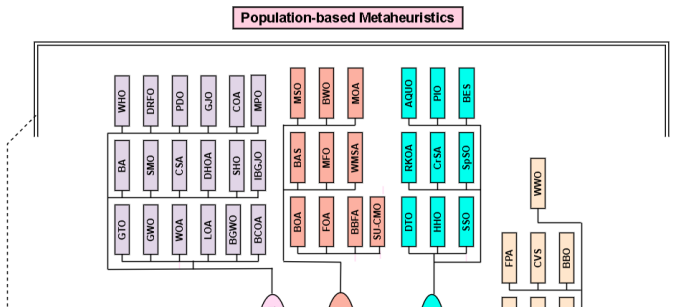
The proposed taxonomy of IoT-IDSs that organizes systems according to their metaheuristic optimization strategies applied to machine learning models for tasks such as feature selection and tuning.
If this is right
- Designers can select metaheuristic-ML pairings that match specific IoT constraints for improved detection accuracy.
- Applications focused on feature selection may lower the data volume processed by resource-limited devices.
- Hybrid metaheuristic and ML configurations could strengthen defenses against both known and novel attacks.
- Resolution of identified integration issues would support more reliable deployment in decentralized IoT setups.
Where Pith is reading between the lines
- The taxonomy could serve as a starting point for classifying IDS in related domains such as edge computing networks.
- Empirical tests in live IoT testbeds would provide concrete performance data to extend the review's observations.
- Similar correlation analysis might apply to other optimization methods outside the metaheuristic category.
Load-bearing premise
The body of published literature examined is complete and representative enough to support claims of hidden correlations and to justify the proposed taxonomy without major omissions or bias.
What would settle it
A follow-up search that locates many recent, high-impact papers on IoT intrusion detection systems whose designs show no alignment with the reported correlations or fall outside the proposed taxonomy would challenge the central findings.
Figures




read the original abstract
The widespread adoption of the Internet of Things (IoT) has raised a new challenge for developers since it is prone to known and unknown cyberattacks due to its heterogeneity, flexibility, and close connectivity. To defend against such security breaches, researchers have focused on building sophisticated intrusion detection systems (IDSs) using machine learning (ML) techniques. Although these algorithms notably improve detection performance, they require excessive computing power and resources, which are crucial issues in IoT networks considering the recent trends of decentralized data processing and computing systems. Consequently, many optimization techniques have been incorporated with these ML models. Specifically, a special category of optimizer adopted from the behavior of living creatures and different aspects of natural phenomena, known as metaheuristic algorithms, has been a central focus in recent years and brought about remarkable results. Considering this vital significance, we present a comprehensive and systematic review of various applications of metaheuristics algorithms in developing a machine learning-based IDS, especially for IoT. A significant contribution of this study is the discovery of hidden correlations between these optimization techniques and machine learning models integrated with state-of-the-art IoT-IDSs. In addition, the effectiveness of these metaheuristic algorithms in different applications, such as feature selection, parameter or hyperparameter tuning, and hybrid usages are separately analyzed. Moreover, a taxonomy of existing IoT-IDSs is proposed. Furthermore, we investigate several critical issues related to such integration. Our extensive exploration ends with a discussion of promising optimization algorithms and technologies that can enhance the efficiency of IoT-IDSs.
Editorial analysis
A structured set of objections, weighed in public.
Referee Report
Summary. The manuscript presents a systematic review of metaheuristic algorithms integrated with machine learning models for intrusion detection systems (IDS) in IoT networks. It claims to identify hidden correlations between these techniques, separately analyze their effectiveness for feature selection, parameter/hyperparameter tuning, and hybrid usages, propose a taxonomy of existing IoT-IDSs, investigate critical integration issues, and discuss promising future optimization approaches.
Significance. If the underlying literature search is exhaustive and free of selection bias, the review could usefully synthesize patterns in how metaheuristics enhance ML-based IoT-IDS performance under resource constraints, with the proposed taxonomy and correlation analysis providing a structured reference for researchers. The separate treatment of feature selection versus tuning applications is a potentially helpful organizational contribution.
major comments (2)
- [Methods] Methods section (or equivalent): no search protocol, database list, query strings, date range, inclusion/exclusion criteria, or PRISMA-style flow diagram is described. This directly undermines the central claims of discovering representative 'hidden correlations' and justifying a general taxonomy, as the completeness and lack of bias cannot be verified from the provided information.
- [Results/Taxonomy] Results and taxonomy sections: the assertion of 'hidden correlations' between specific metaheuristics and ML models is stated without accompanying quantitative support (e.g., co-occurrence counts, statistical measures, or tabulated mappings across the surveyed papers). This makes it impossible to assess whether the correlations are robust or merely descriptive of the selected subset.
minor comments (2)
- [Abstract] Abstract: the phrase 'comprehensive and systematic review' should be qualified by explicit reference to the review protocol or guidelines followed (e.g., PRISMA).
- [Throughout] Notation and terminology: ensure consistent capitalization and abbreviation of 'metaheuristic' versus 'meta-heuristic' and of model names (e.g., SVM, ANN) throughout the taxonomy and analysis sections.
Simulated Author's Rebuttal
We thank the referee for their constructive and detailed comments on our systematic review. We address each major comment below and have revised the manuscript to improve methodological transparency and the empirical grounding of our claims.
read point-by-point responses
-
Referee: [Methods] Methods section (or equivalent): no search protocol, database list, query strings, date range, inclusion/exclusion criteria, or PRISMA-style flow diagram is described. This directly undermines the central claims of discovering representative 'hidden correlations' and justifying a general taxonomy, as the completeness and lack of bias cannot be verified from the provided information.
Authors: We agree that the current manuscript lacks an explicit description of the literature search protocol. Although the review was conducted systematically, these details were omitted from the submitted version. In the revised manuscript we will add a dedicated Methods subsection that specifies the databases searched, exact query strings, date range, inclusion/exclusion criteria, and a PRISMA flow diagram. This addition will enable verification of completeness and bias and thereby strengthen support for the taxonomy and correlation findings. revision: yes
-
Referee: [Results/Taxonomy] Results and taxonomy sections: the assertion of 'hidden correlations' between specific metaheuristics and ML models is stated without accompanying quantitative support (e.g., co-occurrence counts, statistical measures, or tabulated mappings across the surveyed papers). This makes it impossible to assess whether the correlations are robust or merely descriptive of the selected subset.
Authors: We accept that the presentation of hidden correlations would be more convincing with quantitative evidence. The current version relies on qualitative synthesis of the surveyed papers. In the revision we will insert a table (or matrix) reporting co-occurrence frequencies between metaheuristic algorithms and ML models, together with any feasible statistical observations. This will allow readers to evaluate the robustness of the reported correlations beyond descriptive summary. revision: yes
Circularity Check
No circularity in literature synthesis or taxonomy construction
full rationale
This is a systematic review paper that surveys and synthesizes existing literature on metaheuristic optimization integrated with machine learning for IoT intrusion detection systems. It proposes a taxonomy and identifies correlations based on analysis of cited prior works rather than any original mathematical derivation, equations, or first-principles predictions. No steps reduce a claimed result to its own inputs by construction, fitted parameters renamed as predictions, or load-bearing self-citation chains; the central claims rest on external studies and the completeness of the surveyed body of work, which is independent of the present paper's own definitions or outputs.
Axiom & Free-Parameter Ledger
Lean theorems connected to this paper
-
IndisputableMonolith/Foundation/AbsoluteFloorClosure.leanreality_from_one_distinction unclear?
unclearRelation between the paper passage and the cited Recognition theorem.
A significant contribution of this study is the discovery of hidden correlations between these optimization techniques and machine learning models integrated with state-of-the-art IoT-IDSs.
-
IndisputableMonolith/Cost/FunctionalEquation.leanwashburn_uniqueness_aczel unclear?
unclearRelation between the paper passage and the cited Recognition theorem.
We present an extensive review of the existing applications of metaheuristics algorithms to develop machine learning-based intrusion detection systems, especially for IoT.
What do these tags mean?
- matches
- The paper's claim is directly supported by a theorem in the formal canon.
- supports
- The theorem supports part of the paper's argument, but the paper may add assumptions or extra steps.
- extends
- The paper goes beyond the formal theorem; the theorem is a base layer rather than the whole result.
- uses
- The paper appears to rely on the theorem as machinery.
- contradicts
- The paper's claim conflicts with a theorem or certificate in the canon.
- unclear
- Pith found a possible connection, but the passage is too broad, indirect, or ambiguous to say the theorem truly supports the claim.
Reference graph
Works this paper leans on
-
[1]
Applications, deployments, and integration of internet of drones (iod): a review
Laith Abualigah, Ali Diabat, Putra Sumari, and Amir H Gandomi. Applications, deployments, and integration of internet of drones (iod): a review. IEEE Sensors Journal , 21(22):25532–25546, 2021
work page 2021
-
[2]
Understanding the mirai botnet
Manos Antonakakis, Tim April, Michael Bailey, Matt Bernhard, Elie Bursztein, Jaime Cochran, Zakir Durumeric, J Alex Halderman, Luca Invernizzi, Michalis Kallitsis, et al. Understanding the mirai botnet. In 26th USENIX security symposium (USENIX Security 17) , pages 1093–1110, 2017
work page 2017
-
[3]
Adt technician pleads guilty to hacking home security footage
Erin Dooley. Adt technician pleads guilty to hacking home security footage. https://www.justice.gov/usao-ndtx/pr/adt-technician-pleads-gu- ilty hacking-home-security-footage
-
[4]
Linear correlation-based feature selection for network intrusion detection model
Heba F Eid, Aboul Ella Hassanien, Tai-hoon Kim, and Soumya Banerjee. Linear correlation-based feature selection for network intrusion detection model. In Advances in Security of Information and Communication Networks: First International Conference, SecNet 2013, Cairo, Egypt, September 3-5,
work page 2013
- [5]
-
[6]
Extended Comparisons of Best Subset Selection, Forward Stepwise Selection, and the Lasso
Trevor Hastie, Robert Tibshirani, and Ryan J Tibshirani. Extended comparisons of best subset selec- tion, forward stepwise selection, and the lasso. arXiv preprint arXiv:1707.08692 , 2017
work page internal anchor Pith review Pith/arXiv arXiv 2017
-
[7]
Yap Bee Wah, Nurain Ibrahim, Hamzah Abdul Hamid, Shuzlina Abdul-Rahman, and Simon Fong. Feature selection methods: Case of filter and wrapper approaches for maximising classification accuracy. Pertanika Journal of Science & Technology , 26(1), 2018
work page 2018
-
[8]
A comprehensive survey on recent metaheuris- tics for feature selection
Tansel Dokeroglu, Ay¸ ca Deniz, and Hakan Ezgi Kiziloz. A comprehensive survey on recent metaheuris- tics for feature selection. Neurocomputing, 494:269–296, 2022
work page 2022
-
[9]
Heuristic and meta-heuristic algorithms and their relevance to the real world: a survey
Sachin Desale, Akhtar Rasool, Sushil Andhale, and Priti Rane. Heuristic and meta-heuristic algorithms and their relevance to the real world: a survey. Int. J. Comput. Eng. Res. Trends , 351(5):2349–7084, 2015
work page 2015
-
[10]
Review on wrapper feature selection approaches
Naoual El Aboudi and Laila Benhlima. Review on wrapper feature selection approaches. In 2016 International Conference on Engineering & MIS (ICEMIS) , pages 1–5, 2016
work page 2016
-
[11]
Subrato Bharati and Prajoy Podder. Machine and deep learning for iot security and privacy: ap- plications, challenges, and future directions. Security and communication networks , 2022(1):8951961, 2022
work page 2022
-
[12]
Edge computing with artificial intelligence: A machine learning perspective
Haochen Hua, Yutong Li, Tonghe Wang, Nanqing Dong, Wei Li, and Junwei Cao. Edge computing with artificial intelligence: A machine learning perspective. ACM Computing Surveys , 55(9):1–35, 2023. 50
work page 2023
-
[13]
A survey on the edge computing for the internet of things
Wei Yu, Fan Liang, Xiaofei He, William Grant Hatcher, Chao Lu, Jie Lin, and Xinyu Yang. A survey on the edge computing for the internet of things. IEEE access, 6:6900–6919, 2017
work page 2017
-
[14]
Saif S Kareem, Reham R Mostafa, Fatma A Hashim, and Hazem M El-Bakry. An effective feature selection model using hybrid metaheuristic algorithms for iot intrusion detection. Sensors, 22(4):1396, 2022
work page 2022
-
[15]
Network intrusion detection based on feature selection and hybrid metaheuristic optimization
Reem Alkanhel, El-Sayed M El-kenawy, Abdelaziz A Abdelhamid, Abdelhameed Ibrahim, Manal Ab- dullah Alohali, Mostafa Abotaleb, and Doaa Sami Khafaga. Network intrusion detection based on feature selection and hybrid metaheuristic optimization. Computers, Materials & Continua , 74(2), 2023
work page 2023
-
[16]
P Sanju. Enhancing intrusion detection in iot systems: A hybrid metaheuristics-deep learning approach with ensemble of recurrent neural networks. Journal of Engineering Research, 11(4):356–361, 2023
work page 2023
-
[17]
A novel intrusion detection system for internet of things devices and data
Ajay Kaushik and Hamed Al-Raweshidy. A novel intrusion detection system for internet of things devices and data. Wirel. Netw., 30(1):285–294, aug 2023
work page 2023
-
[18]
Feature selection by improved sand cat swarm optimizer for intrusion detection
Dijana Jovanovic, Marina Marjanovic, Milos Antonijevic, Miodrag Zivkovic, Nebojsa Budimirovic, and Nebojsa Bacanin. Feature selection by improved sand cat swarm optimizer for intrusion detection. In 2022 International Conference on Artificial Intelligence in Everything (AIE) , pages 685–690. IEEE, 2022
work page 2022
-
[19]
A novel deep supervised learning- based approach for intrusion detection in iot systems
Sahba Baniasadi, Omid Rostami, Diego Mart´ ın, and Mehrdad Kaveh. A novel deep supervised learning- based approach for intrusion detection in iot systems. Sensors, 22(12):4459, 2022
work page 2022
-
[20]
Wils-trs—a novel optimized deep learning based intrusion detection framework for iot networks
B Jothi and M Pushpalatha. Wils-trs—a novel optimized deep learning based intrusion detection framework for iot networks. Personal and Ubiquitous Computing , 27(3):1285–1301, 2023
work page 2023
-
[21]
Ahmed Bahaa, Abdalla Sayed, Laila Elfangary, and Hanan Fahmy. A novel hybrid optimization enabled robust cnn algorithm for an iot network intrusion detection approach. Plos one, 17(12):e0278493, 2022
work page 2022
-
[22]
Mohammed Basheri and Mahmoud Ragab. Quantum cat swarm optimization based clustering with intrusion detection technique for future internet of things environment. Computer Systems Science & Engineering, 46(3), 2023
work page 2023
-
[23]
P Vijayan and S Sundar. Original research article iot intrusion detection system using ensemble classifier and hyperparameter optimization using tuna search algorithm. Journal of Autonomous Intelligence , 7(2):1–10, 2024
work page 2024
-
[24]
A survey of intrusion detection techniques for cyber-physical systems
Robert Mitchell and Ing-Ray Chen. A survey of intrusion detection techniques for cyber-physical systems. ACM Computing Surveys (CSUR) , 46(4):1–29, 2014
work page 2014
-
[25]
An automata based intrusion detection method for internet of things
Yulong Fu, Zheng Yan, Jin Cao, Ousmane Kon´ e, and Xuefei Cao. An automata based intrusion detection method for internet of things. Mobile Information Systems , 2017(1):1750637, 2017
work page 2017
-
[26]
Kalis—a system for knowledge- driven adaptable intrusion detection for the internet of things
Daniele Midi, Antonino Rullo, Anand Mudgerikar, and Elisa Bertino. Kalis—a system for knowledge- driven adaptable intrusion detection for the internet of things. In 2017 IEEE 37th International Con- ference on Distributed Computing Systems (ICDCS) , pages 656–666. IEEE, 2017. 51
work page 2017
-
[27]
An introduction to metaheuristics for optimization
Bastien Chopard and Marco Tomassini. An introduction to metaheuristics for optimization . Springer, 2018
work page 2018
-
[28]
Zhavat Sherinov and Ahmet ¨Unveren. Multi-objective imperialistic competitive algorithm with multiple non-dominated sets for the solution of global optimization problems.Soft Computing, 22(24):8273–8288, 2018
work page 2018
-
[29]
The arith- metic optimization algorithm
Laith Abualigah, Ali Diabat, Seyedali Mirjalili, Mohamed Abd Elaziz, and Amir H Gandomi. The arith- metic optimization algorithm. Computer methods in applied mechanics and engineering , 376:113609, 2021
work page 2021
-
[30]
Sca: a sine cosine algorithm for solving optimization problems
Seyedali Mirjalili. Sca: a sine cosine algorithm for solving optimization problems. Knowledge-based systems, 96:120–133, 2016
work page 2016
-
[31]
Gunnar W Klau, Neal Lesh, Joe Marks, and Michael Mitzenmacher. Human-guided search. Journal of Heuristics, 16:289–310, 2010
work page 2010
-
[32]
Wengui Hu, Qingsong Cao, Mehdi Darbandi, and Nima Jafari Navimipour. A deep analysis of nature- inspired and meta-heuristic algorithms for designing intrusion detection systems in cloud/edge and iot: state-of-the-art techniques, challenges, and future directions. Cluster Computing, pages 1–27, 2024
work page 2024
-
[33]
Rafika Saadouni, Chirihane Gherbi, Zibouda Aliouat, Yasmine Harbi, and Amina Khacha. Intrusion detection systems for iot based on bio-inspired and machine learning techniques: a systematic review of the literature. Cluster Computing, pages 1–27, 2024
work page 2024
-
[34]
Dukka Karun Kumar Reddy, Janmenjoy Nayak, HS Behera, Vimal Shanmuganathan, Wattana Viriy- asitavat, and Gaurav Dhiman. A systematic literature review on swarm intelligence based intrusion detection system: past, present and future. Archives of Computational Methods in Engineering, 31:1–68, 03 2024
work page 2024
-
[35]
Shubhkirti Sharma, Vijay Kumar, and Kamlesh Dutta. Multi-objective optimization algorithms for intrusion detection in iot networks: A systematic review.Internet of Things and Cyber-Physical Systems, 4:258–267, 2024
work page 2024
-
[36]
Internet of things intrusion detection systems: a comprehensive review and future directions
Arash Heidari and Mohammad Ali Jabraeil Jamali. Internet of things intrusion detection systems: a comprehensive review and future directions. Cluster Computing, 26(6):3753–3780, 2023
work page 2023
-
[37]
Machine learning based intrusion detection systems for iot applications
Abhishek Verma and Virender Ranga. Machine learning based intrusion detection systems for iot applications. Wireless Personal Communications, 111(4):2287–2310, 2020
work page 2020
-
[38]
Intrusion detection systems in the internet of things: A comprehensive investigation
Somayye Hajiheidari, Karzan Wakil, Maryam Badri, and Nima Jafari Navimipour. Intrusion detection systems in the internet of things: A comprehensive investigation. Computer Networks , 160:165–191, 2019
work page 2019
-
[39]
Wisam Elmasry, Akhan Akbulut, and Abdul Halim Zaim. Evolving deep learning architectures for network intrusion detection using a double pso metaheuristic. Computer Networks, 168:107042, 2020
work page 2020
-
[40]
Yakub Kayode Saheed, Aisha Abubakar Usman, Favour Dirwokmwa Sukat, and Muftahu Abdulrahman. A novel hybrid autoencoder and modified particle swarm optimization feature selection for intrusion detection in the internet of things network. Frontiers in Computer Science , 5:997159, 2023. 52
work page 2023
-
[41]
Pavle Dakic, Miodrag Zivkovic, Luka Jovanovic, Nebojsa Bacanin, Milos Antonijevic, Jelena Kaljevic, and Vladimir Simic. Intrusion detection using metaheuristic optimization within iot/iiot systems and software of autonomous vehicles. Scientific Reports, 14(1):22884, 2024
work page 2024
-
[42]
A Biju and S Wilfred Franklin. Evaluated bird swarm optimization based on deep belief network (ebso- dbn) classification technique for iot network intrusion detection. Automatika, 65(1):108–116, 2024
work page 2024
-
[43]
Nojood O Aljehane, Hanan Abdullah Mengash, Majdy M Eltahir, Faiz Abdullah Alotaibi, Sumayh S Aljameel, Ayman Yafoz, Raed Alsini, and Mohammed Assiri. Golden jackal optimization algorithm with deep learning assisted intrusion detection system for network security. Alexandria Engineering Journal, 86:415–424, 2024
work page 2024
-
[44]
C Prajisha and AR Vasudevan. An efficient intrusion detection system for mqtt-iot using enhanced chaotic salp swarm algorithm and lightgbm. International Journal of Information Security , 21(6):1263– 1282, 2022
work page 2022
-
[45]
Feature selection by hybrid artificial bee colony algorithm for intrusion detection
Milos Stankovic, Milos Antonijevic, Nebojsa Bacanin, Miodrag Zivkovic, Marko Tanaskovic, and Dijana Jovanovic. Feature selection by hybrid artificial bee colony algorithm for intrusion detection. In 2022 International Conference on Edge Computing and Applications (ICECAA) , pages 500–505. IEEE, 2022
work page 2022
-
[46]
Chintam Anusha, A Sravani, Jetti Anusha, Choudari Lakshmi, and Gantla Santoshi Kumari. Intrusion detection system in iot network by using metaheuristic algorithm with machine learning dimensional reduction technique. In 2022 3rd International Conference on Computing, Analytics and Networks (ICAN), pages 1–6. IEEE, 2022
work page 2022
-
[47]
Hybrid optimization enabled robust cnn-lstm technique for network intrusion detection
Bhushan Deore and Surendra Bhosale. Hybrid optimization enabled robust cnn-lstm technique for network intrusion detection. Ieee Access, 10:65611–65622, 2022
work page 2022
-
[48]
Improved ant colony optimization and machine learning based ensemble intrusion detection model
S Vanitha and P Balasubramanie. Improved ant colony optimization and machine learning based ensemble intrusion detection model. Intelligent Automation & Soft Computing , 36(1), 2023
work page 2023
-
[49]
Iot intrusion detection system based on machine learning
Bayi Xu, Lei Sun, Xiuqing Mao, Ruiyang Ding, and Chengwei Liu. Iot intrusion detection system based on machine learning. Electronics, 12(20):4289, 2023
work page 2023
-
[50]
EI Elsedimy, Hala Elhadidy, and Sara MM Abohashish. A novel intrusion detection system based on a hybrid quantum support vector machine and improved grey wolf optimizer. Cluster Computing, pages 1–19, 2024
work page 2024
-
[51]
Yakub Kayode Saheed and Sanjay Misra. A voting gray wolf optimizer-based ensemble learning mod- els for intrusion detection in the internet of things. International Journal of Information Security , 23(3):1557–1581, 2024
work page 2024
-
[52]
A bio-inspired hybrid deep learning model for network intrusion detection
MD Moizuddin and M Victor Jose. A bio-inspired hybrid deep learning model for network intrusion detection. Knowledge-based systems, 238:107894, 2022
work page 2022
-
[53]
Swarna Priya RM, Praveen Kumar Reddy Maddikunta, M Parimala, Srinivas Koppu, Thippa Reddy Gadekallu, Chiranji Lal Chowdhary, and Mamoun Alazab. An effective feature engineering for dnn using hybrid pca-gwo for intrusion detection in iomt architecture. Computer Communications, 160:139–149, 2020. 53
work page 2020
-
[54]
Azam Davahli, Mahboubeh Shamsi, and Golnoush Abaei. A lightweight anomaly detection model using svm for wsns in iot through a hybrid feature selection algorithm based on ga and gwo. Journal of Computing and Security , 7(1):63–79, 2020
work page 2020
-
[55]
Nikola Savanovi´ c, Ana Toskovic, Aleksandar Petrovic, Miodrag Zivkovic, Robertas Damaˇ seviˇ cius, Luka Jovanovic, Nebojsa Bacanin, and Bosko Nikolic. Intrusion detection in healthcare 4.0 internet of things systems via metaheuristics optimized machine learning. Sustainability, 15(16):12563, 2023
work page 2023
-
[56]
Intrusion attack detection using firefly optimization algorithm and ensemble classification model
Rekha Gangula, Murali Mohan Vutukuru, and M Ranjeeth Kumar. Intrusion attack detection using firefly optimization algorithm and ensemble classification model. Wireless Personal Communications , 132(3):1899–1916, 2023
work page 1916
-
[57]
Bio-inspired intrusion detection system for internet of things networks security
Yasmine Harbi, Salsabyl Merat, Zibouda Aliouat, and Saad Harous. Bio-inspired intrusion detection system for internet of things networks security. In Proceedings of the Cognitive Models and Artificial Intelligence Conference, pages 14–19, 2024
work page 2024
-
[58]
Effective intrusion detection system for iot using optimized capsule auto encoder model
Chandra Umakantham Om Kumar, Jeyakumar Durairaj, Samsu Aliar Ahamed Ali, Y Justindhas, and Suguna Marappan. Effective intrusion detection system for iot using optimized capsule auto encoder model. Concurrency and Computation: Practice and Experience , 34(13):e6918, 2022
work page 2022
-
[59]
Mohamed Abd Elaziz, Mohammed AA Al-qaness, Abdelghani Dahou, Rehab Ali Ibrahim, and Ahmed A Abd El-Latif. Intrusion detection approach for cloud and iot environments using deep learning and capuchin search algorithm. Advances in Engineering Software, 176:103402, 2023
work page 2023
-
[60]
Wogru-ids—an intelligent intrusion detection system for iot assisted wireless sensor networks
Kadiyala Ramana, A Revathi, A Gayathri, Rutvij H Jhaveri, CV Lakshmi Narayana, and B Naveen Kumar. Wogru-ids—an intelligent intrusion detection system for iot assisted wireless sensor networks. Computer Communications, 196:195–206, 2022
work page 2022
-
[61]
A whale optimization algorithm feature selection model for iot detecting intrusion in environments
Mouaad Mohy-eddine, Azidine Guezzaz, Said Benkirane, Mourade Azrour, and Kamal Bella. A whale optimization algorithm feature selection model for iot detecting intrusion in environments. In The International Conference on Artificial Intelligence and Smart Environment , pages 413–419. Springer, 2023
work page 2023
-
[62]
A hybrid meta-heuristics algorithm: Xgboost-based approach for ids in iot
Soumya Bajpai, Kapil Sharma, and Brijesh Kumar Chaurasia. A hybrid meta-heuristics algorithm: Xgboost-based approach for ids in iot. SN Computer Science , 5(5):1–16, 2024
work page 2024
-
[63]
Thippa Reddy Gadekallu, Neeraj Kumar, Thar Baker, Deepa Natarajan, Prabadevi Boopathy, and Praveen Kumar Reddy Maddikunta. Moth–flame optimization based ensemble classification for in- trusion detection in intelligent transport system for smart cities. Microprocessors and Microsystems, 103:104935, 2023
work page 2023
-
[64]
Improved crow search-based feature selection and ensemble learning for iot intrusion detection
D Jayalatchumy, Rajakumar Ramalingam, Aravind Balakrishnan, Mejdl Safran, and Sultan Alfarhood. Improved crow search-based feature selection and ensemble learning for iot intrusion detection. IEEE Access, 2024
work page 2024
-
[65]
R Geetha, A Jegatheesan, Rajesh Kumar Dhanaraj, K Vijayalakshmi, Anand Nayyar, V Arulkumar, J Velmurugan, and Rajendran Thavasimuthu. Cvs-fln: a novel iot-ids model based on metaheuristic 54 feature selection and neural network classification model. Multimedia Tools and Applications , pages 1–35, 2024
work page 2024
-
[66]
Osama Bassam J Rabie, Shitharth Selvarajan, Tawfiq Hasanin, Abdulrhman M Alshareef, CK Yogesh, and Mueen Uddin. A novel iot intrusion detection framework using decisive red fox optimization and descriptive back propagated radial basis function models. Scientific Reports, 14(1):386, 2024
work page 2024
-
[67]
Multi-objective prairie dog optimization algo- rithm for iot-based intrusion detection
Shubhkirti Sharma, Vijay Kumar, and Kamlesh Dutta. Multi-objective prairie dog optimization algo- rithm for iot-based intrusion detection. Internet Technology Letters, page e516
-
[68]
Intrusion detection sys- tem for iot based on deep learning and modified reptile search algorithm
Abdelghani Dahou, Mohamed Abd Elaziz, Samia Allaoua Chelloug, Mohammed A Awadallah, Mo- hammed Azmi Al-Betar, Mohammed AA Al-Qaness, and Agostino Forestiero. Intrusion detection sys- tem for iot based on deep learning and modified reptile search algorithm. Computational Intelligence and Neuroscience, 2022(1):6473507, 2022
work page 2022
-
[69]
Hossein Asgharzadeh, Ali Ghaffari, Mohammad Masdari, and Farhad Soleimanian Gharehchopogh. Anomaly-based intrusion detection system in the internet of things using a convolutional neural net- work and multi-objective enhanced capuchin search algorithm. Journal of Parallel and Distributed Computing, 175:1–21, 2023
work page 2023
-
[70]
Abdulaziz Fatani, Abdelghani Dahou, Mohammed AA Al-Qaness, Songfeng Lu, and Mohamed Abd Elaziz. Advanced feature extraction and selection approach using deep learning and aquila optimizer for iot intrusion detection system. Sensors, 22(1):140, 2021
work page 2021
-
[71]
Intrusion detection using bat optimization algorithm and densenet for iot and cloud based systems
H Kanakadurga Bella and S Vasundra. Intrusion detection using bat optimization algorithm and densenet for iot and cloud based systems. International Journal on Artificial Intelligence Tools , 33(02):2350065, 2024
work page 2024
-
[72]
Sanjaikanth E Vadakkethil, Kiran Polimetla, Zaid Alsalami, Piyush Kumar Pareek, and Deepak Kumar. Mayfly optimization algorithm with bidirectional long-short term memory for intrusion detection system in internet of things. In 2024 Third International Conference on Distributed Computing and Electrical Circuits and Electronics (ICDCECE) , pages 1–4. IEEE, 2024
work page 2024
-
[73]
An iot-based deep belief network in intrusion detection system using butterfly optimization
Aswathy K Cherian, M Vaidhehi, M Arshey, Serin V Simpson, J Briskilal, and Astitva Singh. An iot-based deep belief network in intrusion detection system using butterfly optimization. In 2024 10th International Conference on Communication and Signal Processing (ICCSP) , pages 1588–1593. IEEE, 2024
work page 2024
-
[74]
Raneem Qaddoura and Hossam Faris. Evolving random weight neural networks based on oversampled- segmented examples for iot intrusion detection. The Journal of Supercomputing , pages 1–35, 2024
work page 2024
-
[75]
Intrusion detection in internet of things-based smart farming using hybrid deep learning framework
Keerthi Kethineni and G Pradeepini. Intrusion detection in internet of things-based smart farming using hybrid deep learning framework. Cluster Computing, 27(2):1719–1732, 2024
work page 2024
-
[76]
Hayam Alamro, Radwa Marzouk, Nuha Alruwais, Noha Negm, Sumayh S Aljameel, Majdi Khalid, Manar Ahmed Hamza, and Mohamed Ibrahim Alsaid. Modeling of blockchain assisted intrusion de- tection on iot healthcare system using ant lion optimizer with hybrid deep learning. IEEE Access, 11:82199–82207, 2023. 55
work page 2023
-
[77]
B Gopalakrishnan and P Purusothaman. A new design of intrusion detection in iot sector using opti- mal feature selection and high ranking-based ensemble learning model. Peer-to-Peer Networking and Applications, 15(5):2199–2226, 2022
work page 2022
-
[78]
Subhash V Pingale and Sanjay R Sutar. Remora based deep maxout network model for network intrusion detection using convolutional neural network features. Computers and Electrical Engineering, 110:108831, 2023
work page 2023
-
[79]
Jos´ e Escorcia-Gutierrez, Margarita Gamarra, Esmeide Leal, Natasha Madera, Carlos Soto, Romany F Mansour, Meshal Alharbi, Ahmed Alkhayyat, and Deepak Gupta. Sea turtle foraging algorithm with hybrid deep learning-based intrusion detection for the internet of drones environment. Computers and Electrical Engineering, 108:108704, 2023
work page 2023
-
[80]
Shahid Latif, Wadii Boulila, Anis Koubaa, Zhuo Zou, and Jawad Ahmad. Dtl-ids: An optimized intrusion detection framework using deep transfer learning and genetic algorithm. Journal of Network and Computer Applications , 221:103784, 2024
work page 2024
discussion (0)
Sign in with ORCID, Apple, or X to comment. Anyone can read and Pith papers without signing in.