REVIEW 4 major objections 5 minor 9 references
Sequence-Based Identification of First-Person Camera Wearers in Third-Person Views
T0 review · 4 major / 5 minor · reviewed 2026-08-07 · deepseek-v4-flash
Pith's one-line read This paper introduces TF2025, a larger synchronized first-/third-person dataset with three generalization splits, and MAF, a motion-and-appearance framework for identifying a camera wearer in third-person views; the framework is proposed…
desk verdict A clear proposal for a larger egocentric-view dataset and a motion-plus-appearance framework, but with zero experimental validation; the central claim that the method works is left entirely to future work. read the letter →
The pith
A machine-rendered reading of the paper's core claim, the machinery that carries it, and where it could break.
The reading
What carries the argument
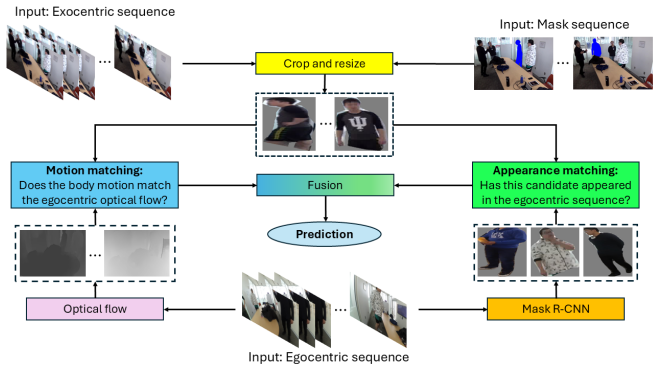
The load-bearing mechanism is the pair of motion summaries in Eqs. (1)-(3): for each egocentric frame, $T_i$ is the median over pixels of depth times flow magnitude and $R_i$ is the median of flow magnitude alone, capturing translation and rotation separately, and the total motion is the tuple of their sums across frames. This gives a training target that is intended to be predicted from third-person body crops by an MLP, and the predicted values are compared by sum of squared errors. The other half is the Confidence-Based Adaptive Fusing rule, which uses the ratio of the two smallest scores within each cue to decide which cue to trust; it needs no training and handles any number of candidates and detected people.
What would settle it
Train MAF on TF2025, then test on the Unseen and Cross-dataset splits; if its accuracy is no better than a motion-only or appearance-only baseline, or if the motion-matching branch fails to predict the first-person motion sums from third-person crops, the central claim that motion and appearance fusion improves wearer identification is refuted. It would also be decisive to replace the depth values in Eq. (1) with two different depth sources and check whether predictions change materially.
Extended reading notes
Core claim
On its own terms, the paper's central claim is that camera-wearer identification can be done by combining two complementary cues: motion and appearance. The motion cue assumes translation of the camera produces depth-dependent optical flow while rotation produces depth-independent flow, so it summarizes each first-person frame by two medians, one depth-weighted and one not, and trains an MLP to predict the sequence-level sums of these values from a third-person crop of each candidate. The appearance cue exploits the fact that the wearer never appears in their own egocentric view, so any third-person candidate who matches a person detected inside the first-person frames is unlikely to be the wearer. A confidence-based fusion module then picks the candidate, using the ratio between the two smallest scores from each source to decide whether motion or appearance should be trusted. The dataset contribution, TF2025, is described as the expanded benchmark that makes this task feasible, with splits that test same-wearer, unseen-wearer, and cross-dataset generalization.
Load-bearing premise
The framework rests on the assumption that the way a person moves, as seen by an outside camera, reliably predicts the pattern of motion that the camera on their body records, and that pixel depth is available for every first-person frame; the paper does not yet report experiments testing this link or state where the depth comes from.
Editorial extensions
If this is right
- If MAF works, a system can watch a third-person video of a group and tell which person is wearing a given egocentric camera, without any special markers.
- TF2025's three splits provide a benchmark on which future methods can be compared for same-wearer, unseen-wearer, and cross-camera-configuration generalization.
- The depth-weighted motion summary gives a principled way to separate translational from rotational egomotion and link it to visible body motion.
- CBAF lets the framework run without per-dataset retraining for fusion, since the confidence rule is dataset-agnostic.
Reading between the lines
- Because the paper reports no experiments, the natural next step is to evaluate MAF on TF2025 against the previous best method and against motion-only or appearance-only ablations; until then, the framework's advantage is unverified.
- The depth term in Eq. (1) is not sourced; if depth comes from a monocular estimator, then the motion labels inherit its errors, and the translation/rotation separation may blur.
- The motion-matching supervision assumes that egocentric optical flow is dominated by the wearer's own body motion; in scenes with moving objects or other people, the third-person crop may not carry enough information to predict the flow sum, so the method may need a flow-decomposition step.
- A testable extension would be to replace the hand-defined medians with a learned egomotion encoder, or to use the same paired-view idea to localize the wearer when more than one first-person camera is active.
Editorial analysis
A structured set of objections, weighed in public.
Referee Report
Summary. The manuscript presents TF2025, a dataset assembled from TF2023, IUShareView, and a newly annotated Ego4D subset, together with a framework called Motion Appearance Fusion (MAF) that identifies the wearer of a first-person camera among candidates visible in third-person footage. MAF combines a motion-matching module that predicts scalar translational and rotational motion summaries from cropped third-person body sequences using an MLP, an appearance-matching module based on person re-identification, and a Confidence-Based Adaptive Fusing (CBAF) rule. The paper defines three train/test splits for TF2025 but reports no experiments, baselines, or ablations, and the conclusion explicitly defers experiments to future work.
Significance. If the method and dataset were validated, the contribution would be useful: TF2025 appears to be the largest dataset for this task, the three splits address a meaningful generalization spectrum, and the motion/appearance fusion idea is reasonable to explore. The paper also gives credit for formulating the problem and describing an end-to-end pipeline with concrete equations. However, none of the central claims are supported by evidence. There are no quantitative results on any component or on the full system, no comparison with prior work, no analysis of the fusion rule, and no reproducibility details for the depth signal required by Eq. (1). I agree with the stress-test note that there is no circularity: the MLP is trained to predict hand-defined motion features, which is ordinary supervised fitting. As submitted, the manuscript is a proposal rather than a validated method, so its significance cannot be assessed.
major comments (4)
- [5, Conclusion] The Conclusion states that 'Future work includes ... conducting more experiments on the model's design,' and no experiments appear anywhere in Sections 1–5. The paper's title claim that MAF identifies camera wearers is therefore entirely unsupported. At minimum, the Seen, Unseen, and Cross-dataset splits introduced in Section 4 should be used to report identification accuracy for MAF, for each component alone, and against the prior method PEN, with error bars across multiple runs.
- [3.2, Eq. (1)] Equation (1) uses depth(p_ij) for every pixel in every first-person frame, but the manuscript never states whether depth comes from a sensor (e.g., a depth camera) or from an estimation network, nor how it is aligned with the optical flow. This makes the training signal irreproducible and the claimed pipeline incomplete. Please specify the depth source and any calibration or synchronization needed.
- [3.2, Motion Matching] The learnability assumption is nontrivial and unvalidated: for head-mounted cameras, egocentric optical flow is dominated by head rotation, which may have little visible correlation with the cropped third-person body appearance. The MLP is asked to regress Texo and Rexo from a body crop, yet the equations for Ti and Ri depend on scene depth and full-frame flow. Without an experiment showing that the predicted motion values correlate with the first-person targets on held-out data, the mechanism has no demonstrated support.
- [3.4, CBAF] CBAF depends on a free constant lambda_Appearance and a hand-designed elimination rule, but no experiments or ablations show how the ratio x(2)/x(1) behaves across the three splits, how lambda_Appearance should be set, or whether the elimination logic is robust to varying M and N. Since this module is load-bearing for the final prediction, it needs at least a sensitivity analysis and a comparison against simpler fusion baselines such as fixed weighting or choosing motion only.
minor comments (5)
- [1, Introduction] The word 'intergrates' is a typo for 'integrates', and 'MotionAppearance Fusion' is missing a space before 'Fusion'.
- [3.2, Eq. (3)] Equation (3) sums over t-1 terms after the text says 'across all frames'; please clarify that optical flow is computed between consecutive frames and why this indexing is correct.
- [4, Dataset] The dataset description lacks basic statistics such as number of videos, actors, hours, frames, and annotation counts, which would be needed to verify the claimed 2.3x size increase over TF2023.
- [2, Related Works] The related-work discussion is very brief; please cite and compare with the specific baselines used in prior work [4,7,8] so the incremental contribution of MAF can be judged.
- [3, Methodology] Figure 2 omits architectural details such as the sequence backbone, temporal aggregation, and the fusion implementation; please expand the figure or add a table of implementation details.
Circularity Check
No circular derivation: MAF is a standard supervised pipeline; missing experiments are a validation gap, not circularity.
full rationale
We looked for reductions of predicted quantities to their own inputs. The motion-matching module trains an MLP to regress hand-defined summary statistics T_i and R_i (Eqs. 1-2), aggregated in Eq. 3, from third-person candidate crops. The ground-truth targets are computed from egocentric optical flow and depth; the third-person input is a different view, so the mapping is a learnable cross-view correspondence, not an identity. No equation in the paper defines a third-person feature in terms of the first-person target or vice versa. The appearance module's 'wearers do not see themselves' constraint is a logical prior, not a fitted parameter renamed as prediction. CBAF is an explicitly hand-designed confidence heuristic, so it is not circular. The main weakness is that no experiments are reported: the Conclusion states 'Future work includes ... conducting more experiments on the model's design,' which is a self-admitted validation gap. That affects correctness and evidence, not circularity. The dataset is assembled from the authors' earlier TF2023 [8] and IUShareView [7], and PEN [8] is cited as prior art; these self-citations are lineage and context, not load-bearing reductions. We therefore find no specific circular step that can be quoted under the 'exhibit the reduction' rule.
Assumptions & free parameters
free parameters (3)
- MLP weights =
learned during training
- lambda_Appearance =
not specified
- number of sampled frames for appearance matching =
3
assumptions (3)
- domain assumption Camera wearers do not appear in their own first-person views
- domain assumption Third-person crop motion is learnably correlated with first-person optical flow statistics
- domain assumption Depth is available and accurate for first-person frames
Cite this review
Pith. "Pith review of Sequence-Based Identification of First-Person Camera Wearers in Third-Person Views." pith.science (2026). https://pith.science/paper/MGELUY7R
@misc{pith2026250600394,
  author       = {Pith},
  title        = {Pith review of: Sequence-Based Identification of First-Person Camera Wearers in Third-Person Views},
  year         = {2026},
  howpublished = {\url{https://pith.science/paper/MGELUY7R}},
  note         = {Machine review of arXiv:2506.00394}
}
read the original abstract
The increasing popularity of egocentric cameras has generated growing interest in studying multi-camera interactions in shared environments. Although large-scale datasets such as Ego4D and Ego-Exo4D have propelled egocentric vision research, interactions between multiple camera wearers remain underexplored-a key gap for applications like immersive learning and collaborative robotics. To bridge this, we present TF2025, an expanded dataset with synchronized first- and third-person views. In addition, we introduce a sequence-based method to identify first-person wearers in third-person footage, combining motion cues and person re-identification.
Figures

Reference graph
Works this paper leans on
-
[1]
write newline
" write newline "" before.all 'output.state := FUNCTION n.dashify 't := "" t empty not t #1 #1 substring "-" = t #1 #2 substring "--" = not "--" * t #2 global.max substring 't := t #1 #1 substring "-" = "-" * t #2 global.max substring 't := while if t #1 #1 substring * t #2 global.max substring 't := if while FUNCTION format.date year duplicate empty "emp...
-
[2]
Ego2top: Matching viewers in egocentric and top-view videos
Shervin Ardeshir and Ali Borji. Ego2top: Matching viewers in egocentric and top-view videos. In ECCV, 2016
work page 2016
-
[3]
Shervin Ardeshir and Ali Borji. Integrating egocentric videos in top-view surveillance videos: Joint identification and temporal alignment. In ECCV, 2018
work page 2018
-
[4]
Shervin Ardeshir, Sandesh Sharma, and Ali Broji. Egoreid: Cross-view self-identification and human re-identification in egocentric and surveillance videos. arXiv:1612.08153, 2016
work page Pith review arXiv 2016
-
[5]
Identifying first-person camera wearers in third-person videos
Chenyou Fan, Jangwon Lee, Mingze Xu, Krishna Kumar Singh, Yong Jae Lee, David J Crandall, and Michael S Ryoo. Identifying first-person camera wearers in third-person videos. In CVPR, 2017
work page 2017
-
[6]
Ego4d: Around the world in 3,000 hours of egocentric video
Kristen Grauman, Andrew Westbury, et al. Ego4d: Around the world in 3,000 hours of egocentric video. In CVPR, 2022
work page 2022
-
[7]
Ego-exo4d: Understanding skilled human activity from first-and third-person perspectives
Kristen Grauman, Andrew Westbury, et al. Ego-exo4d: Understanding skilled human activity from first-and third-person perspectives. In CVPR, 2024
work page 2024
-
[8]
Joint person segmentation and identification in synchronized first-and third-person videos
Mingze Xu, Chenyou Fan, Yuchen Wang, Michael S Ryoo, and David J Crandall. Joint person segmentation and identification in synchronized first-and third-person videos. In ECCV, 2018
work page 2018
Show all 9 references
-
[9]
Fusing personal and environmental cues for identification and segmentation of first-person camera wearers in third-person views
Ziwei Zhao, Yuchen Wang, and Chuhua Wang. Fusing personal and environmental cues for identification and segmentation of first-person camera wearers in third-person views. In CVPR, 2024
2024
Reviewed August 7, 2026 · model on record in the stance chip above.
Discussion (0). Sign in to comment.