REVIEW 3 major objections 6 minor 46 references
TIDFormer: Exploiting Temporal and Interactive Dynamics Makes A Great Dynamic Graph Transformer
T0 review · 3 major / 6 minor · reviewed 2026-08-07 · deepseek-v4-flash
Pith's one-line read TIDFormer claims that defining self-attention over historical interactions, instead of single nodes or mixed node sequences, is what makes a dynamic graph Transformer accurate and efficient.
desk verdict Solid empirical architecture paper, but the BIE module's batch-dependent retrieval could break causality and needs a straight answer before the SOTA claims carry weight. read the letter →
The pith
A machine-rendered reading of the paper's core claim, the machinery that carries it, and where it could break.
The reading
What carries the argument
The load-bearing object is the interaction-level self-attention (SAM at IL): a sequence $H_{IL}\in\mathbb{R}^{n\times(d+d_i)}$ in which each token combines the node and edge features of one historical interaction with a temporal-interactive embedding $I$, preserving the original chronological order. That embedding is the concatenation of three cheap encoders: Mixed-granularity Temporal Encoding (MTE), which adds coarse calendar segment information $\theta\Delta T^{coarse}$ to the fine-grained cosine encoding $\cos(\omega\Delta T^{fine})$; Bidirectional Interaction Encoding (BIE), which for each first-order neighbor not shared by both endpoints retrieves that neighbor's first-order sequence from batch-level source/target dictionaries and splices it in, giving second-order reach without second-order sampling; and Seasonality & Trend Encoding (STE), which applies average pooling to the interaction sequence to obtain trend $Z_t$ and seasonal residual $Z_s = Q - Z_t$. These modules feed the multi-head self-attention in a standard Transformer block, and the paper's efficiency argument is that MTE and STE are $O(n)$, BIE is $O(n)$ via constant-time hash lookups, leaving the $O(n^2 \times dim)$ Transformer as the dominant term.
What would settle it
Run the same TIDFormer configuration on a CTDG dataset with different batch sizes and with batches whose edges are shuffled or drawn from disjoint time windows, and compare AP against DyGFormer and FreeDyG; if the advantage shrinks or reverses when the batch dictionary contents change, the BIE lookup—not the interaction-level attention—is carrying the result.
Extended reading notes
Core claim
The paper's central claim is that the key to a successful dynamic graph Transformer is to tokenize each historical event as an interaction between a source and a target node and to compute attention over those interaction tokens in their true temporal order. This interaction-level self-attention is said to be interpretable: the attention weights it learns are correlated with node interaction frequency, so influential key nodes receive higher attention, whereas the multi-node mixed-sequence attention of prior work does not show this correlation. The paper also claims that two lightweight encoders—Bidirectional Interaction Encoding, which reconstructs source and target sequences from first-order neighbor dictionaries maintained over the current batch, and Seasonality & Trend Encoding, which decomposes the interaction sequence into trend and seasonal parts by average pooling—jointly capture interactive and temporal dynamics without extra complex modules. Together with Mixed-granularity Temporal Encoding, which adds calendar-based weekly/monthly/yearly segments to fine-grained cosine time embeddings, the full model is reported to rank first on most of seven CTDG benchmarks across transductive and inductive link prediction and to be faster per epoch than previous Transformer baselines.
Load-bearing premise
The load-bearing premise is that the BIE module's batch-level dictionaries give a stable, unbiased estimate of each node's true higher-order neighborhood; if the composition of the batch changes what information a node can retrieve, then the model's per-edge representation and the reported gains may be properties of the batching protocol rather than of the interaction-level design.
Editorial extensions
If this is right
- For bipartite graphs, where source and target nodes share no common first-order neighbors, the bidirectional dictionary reconstruction gives BIE a way to carry higher-order interaction information, so interaction encoding no longer degenerates to counting historical interaction times.
- An interpretable attention definition on dynamic graphs means the attention weights themselves can be inspected: nodes with high interaction frequency should receive proportionally higher weights, giving practitioners a diagnostic signal.
- The total time complexity stays $O(n) + O(n^2 \times dim)$, the same order as prior first-order Transformer methods, while avoiding the $O(n^2)$ second-order sampling used by stacked TGAT/TGN-style models.
- If the reported average ranks hold, TIDFormer is a default choice for continuous-time dynamic link prediction across social, interaction, and proximity networks.
Reading between the lines
- Editorial inference: the BIE module's dictionaries are built from the current batch, so the method's accuracy could depend on batch composition; a natural test is to vary batch size or shuffle batch membership and check whether the reported AP advantage persists.
- Editorial inference: the calendar segmentation in MTE is chosen by dataset duration; the same additive coarse-grained term could be replaced by a learnable partition or by adaptive period detection, which might remove the need to pick weekly/monthly/yearly per dataset.
- Editorial inference: the trend-season decomposition is generic enough to be reused as a drop-in input encoding in other sequence-based temporal graph models, not only Transformers.
- Editorial inference: the reported correlation between attention weights and interaction frequency suggests a cheap interpretability check for any future dynamic graph Transformer, independent of link prediction accuracy.
Editorial analysis
A structured set of objections, weighed in public.
Referee Report
Summary. The paper proposes TIDFormer, a continuous-time dynamic graph Transformer whose central design is an interaction-level self-attention mechanism. Each historical interaction is tokenized by combining node and edge features with a temporal-interactive embedding built from three modules: Mixed-granularity Temporal Encoding (MTE), Bidirectional Interaction Encoding (BIE), and Seasonality & Trend Encoding (STE). The authors argue that this SAM is interpretable, that BIE enlarges receptive fields using only first-order neighbor sampling, and that TIDFormer outperforms state-of-the-art baselines on seven dynamic graph datasets under transductive and inductive settings with three negative sampling strategies, while being more efficient than prior Transformer-based methods.
Significance. If the empirical claims are valid, the paper makes a useful contribution: the interaction-level SAM is a principled tokenization for link prediction, the calendar-based MTE is simple and plausible, and BIE is an interesting way to incorporate higher-order interaction information without explicit higher-order sampling. The evaluation is extensive, covering seven datasets, three negative sampling strategies, and transductive/inductive splits, and the authors state that source code is released. The main obstacle is that the BIE module as described may use future information within a batch, which would undermine the reported gains; the interpretability and SOTA claims also need stronger quantitative support.
major comments (3)
- [Section 4.3, Eq. (8)] The BIE module retrieves second-order neighbor sequences from src-Dict and tgt-Dict, which are described as storing the m source and target sequences in the current training or test batch. The paper never states that these dictionary entries are restricted to interactions with timestamps strictly before the timestamp of the edge being processed. Under the chronological train/validation/test splits described in Section 5.1, a test batch contains edges with different timestamps; for an edge (s,t,t0), the dictionary entry for a neighbor v may be built from a batch edge (u,v,t1) with t1 > t0. The BIE token for (s,t,t0) would then encode interactions after t0, violating the causal chronological order that the interaction-level SAM is claimed to preserve. Since the ablation in Figure 4 shows that removing BIE degrades performance, the strong average ranks in Tables 1 and 5 could be partly an artifact of the batch evaluation protocol rather than of the learned per-edge dynamics. Please specify a causal construction, for example processing each batch in timestamp order and updating the dictionaries only with edges whose timestamp is strictly smaller than the current edge's timestamp, or rerun the experiments under such a constraint and report whether the conclusions change.
- [Section 4.2, Figure 2] The interpretability verification is qualitative and limited. The claim of a 'strong correlation' between node interaction frequency and learned attention weights is based on visual inspection of one dataset (MOOC) at two training snapshots, with no correlation coefficient, confidence interval, or comparison across datasets. Please report quantitative measures such as Spearman rank correlation for all three SAM types, ideally across several datasets, and include error bars over seeds.
- [Section 5.2, Tables 1 and 5] The headline claim that TIDFormer 'outperforms SOTA models across most datasets' is not fully supported by the reported numbers. For example, in Table 1 under the transductive/random setting, TIDFormer's Wikipedia AP (99.30±0.03) is below FreeDyG and TPNet (99.32), and on Reddit it is below FreeDyG (99.38 vs 99.48). Many differences from the runner-up are within one standard deviation. Please add significance tests, or at least explicitly discuss overlapping confidence intervals, and qualify the claims accordingly.
minor comments (6)
- [Section 4.3, Eq. (7)] The notation 'or' leaves two alternative MTE formulations; please specify which one is used in the experiments and whether it is addition or concatenation.
- [Section 4.3, Eq. (8)] The notation HH_{tgt2→{src2,src4}} is undefined; please define the reconstruction operation and the interaction-count matrix I clearly.
- [Section 4.3, STE] The input Q is described as the 'normalized index of the interacted neighbor nodes'; the normalization is not defined, and it is unclear why average pooling and subtraction on normalized indices produce meaningful trend and seasonal components. Please justify this choice or replace it with a decomposition on learned embeddings.
- [Section 5.4, Figure 5] The efficiency comparison is run on a single dataset and includes only TGAT, TGN, and DyGFormer; it does not cover FreeDyG, RepeatMixer, or TPNet, which are central to the effectiveness tables, so the efficiency claim should be scoped accordingly.
- [Section 5.1, Appendix B.1] The batch size (200) is a key parameter for BIE because the dictionaries are built from the current batch; please report sensitivity of the results to batch size and confirm that the reported numbers are stable.
- [Section 4 heading] There is a typo in the section title: 'Metholodgy' should be 'Methodology'.
Circularity Check
No significant circularity: TIDFormer's central claims are held-out test-set evaluations against external baselines, and the proposed modules are specified by explicit equations rather than fitted to the target results.
full rationale
TIDFormer's load-bearing assertion is empirical: it reports link prediction AP and node classification AUC-ROC on seven continuous-time dynamic graph datasets using the standard 70%/15%/15% chronological split and three negative sampling strategies, comparing against ten external baselines. These are genuine test-set predictions, not fitted parameters renamed as predictions. The MTE, BIE, and STE modules are each defined by explicit formulas (Equations 6-10), and no module is fitted to the test labels or to the reported performance metric. The BIE module does retrieve second-order neighbor sequences from dictionaries built from the current batch, which raises a legitimate correctness and information-leakage concern if batches are not time-ordered, but this is an evaluation-protocol risk rather than circularity: the predictions are still model outputs on held-out edges, and no equation is equivalent to its own input by construction. The interpretability analysis is a post-hoc diagnostic correlating learned attention weights with interaction frequency; although the BIE tokenization supplies frequency-related features, the paper does not claim to derive a theorem from this correlation, and the diagnostic does not reduce a prediction to a fitted input. Self-citations (references [4], [16], [18], [37], and [44]) are confined to background and related-work discussion and are not load-bearing for the proposed architecture's correctness or for the empirical comparison. No uniqueness theorem, ansatz, or known result is imported from the authors' own prior work to force the design choice. Therefore the derivation chain is self-contained with respect to the reported experiments, and no circular step can be exhibited.
Assumptions & free parameters
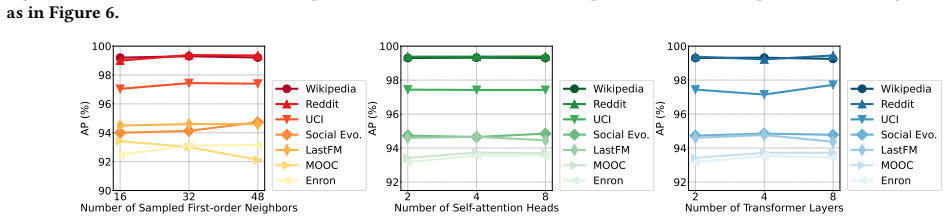
free parameters (5)
- number_of_sampled_first_order_neighbors =
per dataset, e.g., 16 for MOOC, larger for Social Evo
- calendar_segment_R_and_granularity =
e.g., weekly&4, yearly&5, monthly&8, weekly&28
- MTE_alpha_beta =
not reported
- transformer_hidden_dim_and_heads =
2 layers, 2 heads, hidden dim searched
- batch_size =
200
assumptions (5)
- domain assumption First-order neighbor sampling with a fixed-length chronological window is a sufficient representation of a node's temporal neighborhood.
- domain assumption Calendar-based coarse time segments (weekly/monthly/yearly) carry signal for dynamic graph link prediction.
- domain assumption In-batch dictionaries (src-Dict, tgt-Dict) give a valid approximation of second-order neighbors without temporal or label leakage.
- domain assumption Interaction frequency of a node is a valid proxy for its importance, so correlation of attention weights with frequency demonstrates interpretability.
- ad hoc to paper Average pooling and subtraction on a sequence of normalized neighbor node indices yields meaningful trend and seasonal components.
Cite this review
Pith. "Pith review of TIDFormer: Exploiting Temporal and Interactive Dynamics Makes A Great Dynamic Graph Transformer." pith.science (2026). https://pith.science/paper/LOTV6FSF
@misc{pith2026250600431,
  author       = {Pith},
  title        = {Pith review of: TIDFormer: Exploiting Temporal and Interactive Dynamics Makes A Great Dynamic Graph Transformer},
  year         = {2026},
  howpublished = {\url{https://pith.science/paper/LOTV6FSF}},
  note         = {Machine review of arXiv:2506.00431}
}
read the original abstract
Due to the proficiency of self-attention mechanisms (SAMs) in capturing dependencies in sequence modeling, several existing dynamic graph neural networks (DGNNs) utilize Transformer architectures with various encoding designs to capture sequential evolutions of dynamic graphs. However, the effectiveness and efficiency of these Transformer-based DGNNs vary significantly, highlighting the importance of properly defining the SAM on dynamic graphs and comprehensively encoding temporal and interactive dynamics without extra complex modules. In this work, we propose TIDFormer, a dynamic graph TransFormer that fully exploits Temporal and Interactive Dynamics in an efficient manner. We clarify and verify the interpretability of our proposed SAM, addressing the open problem of its uninterpretable definitions on dynamic graphs in previous works. To model the temporal and interactive dynamics, respectively, we utilize the calendar-based time partitioning information and extract informative interaction embeddings for both bipartite and non-bipartite graphs using merely the sampled first-order neighbors. In addition, we jointly model temporal and interactive features by capturing potential changes in historical interaction patterns through a simple decomposition. We conduct extensive experiments on several dynamic graph datasets to verify the effectiveness and efficiency of TIDFormer. The experimental results demonstrate that TIDFormer excels, outperforming state-of-the-art models across most datasets and experimental settings. Furthermore, TIDFormer exhibits significant efficiency advantages compared to previous Transformer-based methods.
Figures


Figures from the paper (6 more)


Reference graph
Works this paper leans on
-
[1]
Unai Alvarez-Rodriguez, Federico Battiston, Guilherme Ferraz de Arruda, Yamir Moreno, Matjaž Perc, and Vito Latora. 2021. Evolutionary dynamics of higher- order interactions in social networks.Nature Human Behaviour5, 5 (2021), 586–595
2021
-
[2]
Oliver D Anderson. 1976. Time-Series. 2nd edn
work page 1976
-
[3]
Khac-Hoai Nam Bui, Jiho Cho, and Hongsuk Yi. 2022. Spatial-temporal graph neural network for traffic forecasting: An overview and open research issues. Applied Intelligence52, 3 (2022), 2763–2774
work page 2022
-
[4]
Ming Chen, Zhewei Wei, Zengfeng Huang, Bolin Ding, and Yaliang Li. 2020. Simple and deep graph convolutional networks. InInternational conference on machine learning. PMLR, 1725–1735
2020
-
[5]
STL Cleveland. [n. d.]. A seasonal-trend decomposition procedure based on Loess (with discussion).J. Off. Stat6, 3 ([n. d.])
-
[6]
Weilin Cong, Yanhong Wu, Yuandong Tian, Mengting Gu, Yinglong Xia, Mehrdad Mahdavi, and Chun-cheng Jason Chen. 2021. Dynamic Graph Representation Learning via Graph Transformer Networks.CoRRabs/2111.10447 (2021)
arXiv 2021
-
[7]
Weilin Cong, Si Zhang, Jian Kang, Baichuan Yuan, Hao Wu, Xin Zhou, Hanghang Tong, and Mehrdad Mahdavi. 2023. Do We Really Need Complicated Model Architectures For Temporal Networks?. InInternational Conference on Learning Representations
work page 2023
-
[8]
Chen Gao, Xiang Wang, Xiangnan He, and Yong Li. 2022. Graph neural net- works for recommender system. InProceedings of the Fifteenth ACM International Conference on Web Search and Data Mining. 1623–1625
work page 2022
Show all 46 references
-
[9]
Zhen Han, Jindong Jiang, Yuyi Wang, Yunpu Ma, and Volker Tresp. 2019. The graph hawkes network for reasoning on temporal knowledge graphs. InLearning with Temporal Point Processes Workshop at at the 33rd Conference on Neural Information Processing Systems (NeurIPS 2019) NeurIPS 2019
2019
-
[10]
Sepp Hochreiter and Jürgen Schmidhuber. 1997. Long short-term memory.Neural computation9, 8 (1997), 1735–1780
1997
-
[11]
Seyed Mehran Kazemi, Rishab Goel, Kshitij Jain, Ivan Kobyzev, Akshay Sethi, Peter Forsyth, and Pascal Poupart. 2020. Representation Learning for Dynamic Graphs: A Survey.J. Mach. Learn. Res.21 (2020), 70:1–70:73
2020
-
[12]
Thomas N Kipf and Max Welling. 2016. Semi-supervised classification with graph convolutional networks.arXiv preprint arXiv:1609.02907(2016)
2016 arXiv
-
[13]
Srijan Kumar, Xikun Zhang, and Jure Leskovec. 2019. Predicting Dynamic Em- bedding Trajectory in Temporal Interaction Networks. InProceedings of the 25th ACM SIGKDD International Conference on Knowledge Discovery & Data Mining. ACM, 1269–1278
2019
-
[14]
Yiming Li, Yanyan Shen, Lei Chen, and Mingxuan Yuan. 2023. Zebra: When tem- poral graph neural networks meet temporal personalized PageRank.Proceedings of the VLDB Endowment16, 6 (2023), 1332–1345
2023
-
[15]
Xiaodong Lu, Leilei Sun, Tongyu Zhu, and Weifeng Lv. 2024. Improving Tem- poral Link Prediction via Temporal Walk Matrix Projection.arXiv preprint arXiv:2410.04013(2024)
2024 arXiv
-
[16]
Jiahong Ma, Mingguo He, and Zhewei Wei. 2023. PolyFormer: Scalable Graph Transformer via Polynomial Attention. (2023)
2023
-
[17]
Franco Manessi, Alessandro Rozza, and Mario Manzo. 2020. Dynamic graph convolutional networks.Pattern Recognition97 (2020), 107000
2020
-
[18]
Jie Peng, Runlin Lei, and Zhewei Wei. 2024. Beyond over-smoothing: Uncovering the trainability challenges in deep graph neural networks. InProceedings of the 33rd ACM International Conference on Information and Knowledge Management. 1878–1887
2024
-
[19]
Farimah Poursafaei, Andy Huang, Kellin Pelrine, and Reihaneh Rabbany. 2022. To- wards Better Evaluation for Dynamic Link Prediction. InThirty-sixth Conference on Neural Information Processing Systems Datasets and Benchmarks Track
2022
-
[20]
Emanuele Rossi, Ben Chamberlain, Fabrizio Frasca, Davide Eynard, Federico Monti, and Michael Bronstein. 2020. Temporal Graph Networks for Deep Learning on Dynamic Graphs. InICML 2020 Workshop on Graph Representation Learning
2020
-
[21]
Aravind Sankar, Yanhong Wu, Liang Gou, Wei Zhang, and Hao Yang. 2020. DySAT: Deep Neural Representation Learning on Dynamic Graphs via Self- Attention Networks. InThe Thirteenth ACM International Conference on Web Search and Data Mining. ACM, 519–527
2020
-
[22]
Amit Sharma, Ashutosh Sharma, Polina Nikashina, Vadim Gavrilenko, Alexey Tselykh, Alexander Bozhenyuk, Mehedi Masud, and Hossam Meshref. 2023. A graph neural network (GNN)-based approach for real-time estimation of traffic speed in sustainable smart cities.Sustainability15, 15...
2023
-
[23]
1995.Fourier transforms
Ian Naismith Sneddon. 1995.Fourier transforms. Courier Corporation
1995
-
[24]
Weiping Song, Zhiping Xiao, Yifan Wang, Laurent Charlin, Ming Zhang, and Jian Tang. 2019. Session-Based Social Recommendation via Dynamic Graph Attention Networks. InProceedings of the Twelfth ACM International Conference on Web Search and Data Mining. ACM, 555–563
2019
-
[25]
Souza, Diego Mesquita, Samuel Kaski, and Vikas Garg
Amauri H. Souza, Diego Mesquita, Samuel Kaski, and Vikas Garg. 2022. Provably expressive temporal graph networks. InNeurIPS
2022
-
[26]
Junwei Su, Difan Zou, and Chuan Wu. 2024. PRES: Toward Scalable Memory- Based Dynamic Graph Neural Networks.arXiv preprint arXiv:2402.04284(2024)
2024 arXiv
-
[27]
Yuxing Tian, Yiyan Qi, and Fan Guo. 2023. FreeDyG: Frequency Enhanced Continuous-Time Dynamic Graph Model for Link Prediction. InThe Twelfth International Conference on Learning Representations
2023
-
[28]
Rakshit Trivedi, Hanjun Dai, Yichen Wang, and Le Song. 2017. Know-evolve: Deep temporal reasoning for dynamic knowledge graphs. Ininternational conference on machine learning. PMLR, 3462–3471
2017
-
[29]
Rakshit Trivedi, Mehrdad Farajtabar, Prasenjeet Biswal, and Hongyuan Zha. 2019. DyRep: Learning Representations over Dynamic Graphs. In7th International Conference on Learning Representations. OpenReview.net
2019
-
[30]
Petar Veličković, Guillem Cucurull, Arantxa Casanova, Adriana Romero, Pietro Lio, and Yoshua Bengio. 2017. Graph attention networks.arXiv preprint arXiv:1710.10903(2017)
2017 arXiv
-
[31]
Xuhong Wang, Ding Lyu, Mengjian Li, Yang Xia, Qi Yang, Xinwen Wang, Xin- guang Wang, Ping Cui, Yupu Yang, Bowen Sun, et al. 2021. Apan: Asynchronous propagation attention network for real-time temporal graph embedding. InPro- ceedings of the 2021 international conference on ma...
2021
-
[32]
Yanbang Wang, Yen-Yu Chang, Yunyu Liu, Jure Leskovec, and Pan Li. 2021. Inductive Representation Learning in Temporal Networks via Causal Anony- mous Walks. In9th International Conference on Learning Representations. Open- Review.net
2021
-
[33]
Haixu Wu, Jiehui Xu, Jianmin Wang, and Mingsheng Long. 2021. Autoformer: De- composition transformers with auto-correlation for long-term series forecasting. Advances in neural information processing systems34 (2021), 22419–22430
2021
-
[34]
Yuxia Wu, Yuan Fang, and Lizi Liao. 2024. On the Feasibility of Simple Trans- former for Dynamic Graph Modeling. InProceedings of the ACM on Web Confer- ence 2024. 870–880
2024
-
[35]
Yi Xie, Yun Xiong, and Yangyong Zhu. 2020. SAST-GNN: a self-attention based spatio-temporal graph neural network for traffic prediction. InDatabase Systems for Advanced Applications: 25th International Conference, DASFAA 2020, Jeju, South Korea, September 24–27, 2020, Proceedi...
2020
-
[36]
Da Xu, Chuanwei Ruan, Evren Körpeoglu, Sushant Kumar, and Kannan Achan
-
[37]
Lu Yi, Jie Peng, Yanping Zheng, Fengran Mo, Zhewei Wei, Yuhang Ye, Yue Zixuan, and Zengfeng Huang. 2025. TGB-Seq Benchmark: Challenging Temporal GNNs with Complex Sequential Dynamics. arXiv:2502.02975 [cs.LG] https://arxiv.org/ abs/2502.02975
2025 arXiv
-
[38]
Chengxuan Ying, Tianle Cai, Shengjie Luo, Shuxin Zheng, Guolin Ke, Di He, Yanming Shen, and Tie-Yan Liu. 2021. Do transformers really perform badly for graph representation?Advances in neural information processing systems34 (2021), 28877–28888
2021
-
[39]
Jiaxuan You, Tianyu Du, and Jure Leskovec. 2022. ROLAND: Graph Learning Framework for Dynamic Graphs. InThe 28th ACM SIGKDD Conference on Knowl- edge Discovery and Data Mining. ACM, 2358–2366
2022
-
[40]
Le Yu, Leilei Sun, Bowen Du, and Weifeng Lv. 2023. Towards better dynamic graph learning: New architecture and unified library.Advances in Neural Information Processing Systems36 (2023), 67686–67700
2023
-
[41]
Mengqi Zhang, Shu Wu, Xueli Yu, Qiang Liu, and Liang Wang. 2022. Dynamic graph neural networks for sequential recommendation.IEEE Transactions on Knowledge and Data Engineering(2022)
2022
-
[42]
Xiaohui Zhang, Yanbo Wang, Xiyuan Wang, and Muhan Zhang. 2024. Efficient Neural Common Neighbor for Temporal Graph Link Prediction.arXiv preprint arXiv:2406.07926(2024)
2024
-
[43]
Ziwei Zhao, Xi Zhu, Tong Xu, Aakas Lizhiyu, Yu Yu, Xueying Li, Zikai Yin, and En- hong Chen. 2023. Time-interval Aware Share Recommendation via Bi-directional Continuous Time Dynamic Graphs. InProceedings of the 46th International ACM SIGIR Conference on Research and Developme...
2023
-
[44]
Yanping Zheng, Lu Yi, and Zhewei Wei. 2024. A survey of dynamic graph neural networks.arXiv preprint arXiv:2404.18211(2024)
2024 arXiv
-
[45]
Tao Zou, Yuhao Mao, Junchen Ye, and Bowen Du. 2024. Repeat-Aware Neighbor Sampling for Dynamic Graph Learning.arXiv preprint arXiv:2405.17473(2024). TIDFormer: Exploiting Temporal and Interactive Dynamics Makes A Great Dynamic Graph Transformer KDD ’25, August 3–7, 2025, Toron...
2024 arXiv
-
[2020]
In8th International Conference on Learning Representations
Inductive representation learning on temporal graphs. In8th International Conference on Learning Representations. OpenReview.net
Reviewed August 7, 2026 · model on record in the stance chip above.
Discussion (0). Sign in to comment.