REVIEW 4 major objections 3 minor 30 references
G2S: A General-to-Specific Learning Framework for Temporal Knowledge Graph Forecasting with Large Language Models
T0 review · 4 major / 3 minor · reviewed 2026-08-07 · deepseek-v4-flash
Pith's one-line read Anonymized time-graphs lift LLM forecasting in zero-shot tests
desk verdict A useful two-stage recipe for LLM-based TKG forecasting, but the anonymization claim is confounded by extra training data and a missing zrLLM baseline. read the letter →
The pith
A machine-rendered reading of the paper's core claim, the machinery that carries it, and where it could break.
The reading
What carries the argument
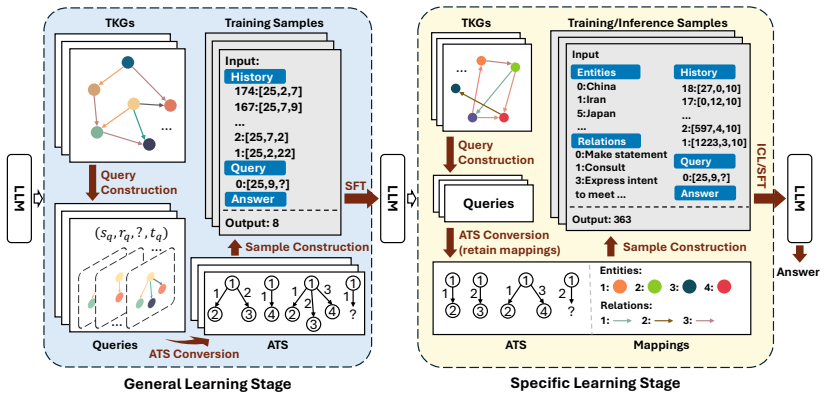
The carrying object is the anonymous temporal structure (ATS): a query-time-relative rendering in which each history line is "A(t):[A(s),A(r),A(o)]" with $A(t) = t_q - t$, and entities/relations mapped to IDs by one of three strategies (frequency rank, global dataset ID, or random ID). The general learning stage fine-tunes an LLM (8B) on these ATS samples from GDELT and WIKI, forcing it to learn structural patterns independent of names; the specific learning stage prepends entity/relation ID mappings and continues with ICL or SFT. The relative timestamp (query time = 0) is what lets patterns from 15-minute-granularity GDELT transfer to daily ICEWS and yearly YAGO.
What would settle it
Train a control model on the same GDELT+WIKI samples but with raw, non-anonymized facts (or with a fixed random ID mapping shared between training and target datasets), and measure zero-shot ICEWS14 performance; if the control matches G2S, the improvement is not caused by anonymized structure learning. Alternatively, a dataset with a radically different schema where anonymous patterns cannot transfer should show no zero-shot gain, which would bound the claim.
Extended reading notes
Core claim
The central claim is that temporal knowledge graphs contain two entangled kinds of knowledge—general patterns (invariant structures such as recurring periodic sequences like [1,1,2],[1,1,4],[1,1,2] → [1,1,4]) and scenario information (the concrete entities, relations, and time granularity). G2S disentangles them by anonymizing the scenario information into abstract IDs during a general learning stage, then restoring it in a specific learning stage. Evidence: zero-shot variants trained only on GDELT and WIKI achieve accuracy close to or above a 20B-parameter ICL model, and fine-tuned G2S beats or matches baselines on three benchmarks. The paper interprets these gains as confirming that separate learning stages prevent interference between general patterns and scenario information.
Load-bearing premise
The load-bearing premise is that anonymizing entities, relations, and timestamps into abstract IDs removes exactly the scenario-specific information while preserving the generalizable temporal structure; if the zero-shot gains instead come from the extra 130,000 training samples or from latent leakage through ID-frequency correlations, the disentanglement story collapses.
Editorial extensions
If this is right
- If the general stage truly learns transferable patterns, a single anonymous-pattern pretrained model should adapt to new TKG domains with only a handful of example mappings, reducing the labeled data needed for forecasting.
- The framework implies that ICL and SFT are complementary rather than competing: the general stage pretrains on structure, and the specific stage can switch modes depending on data availability.
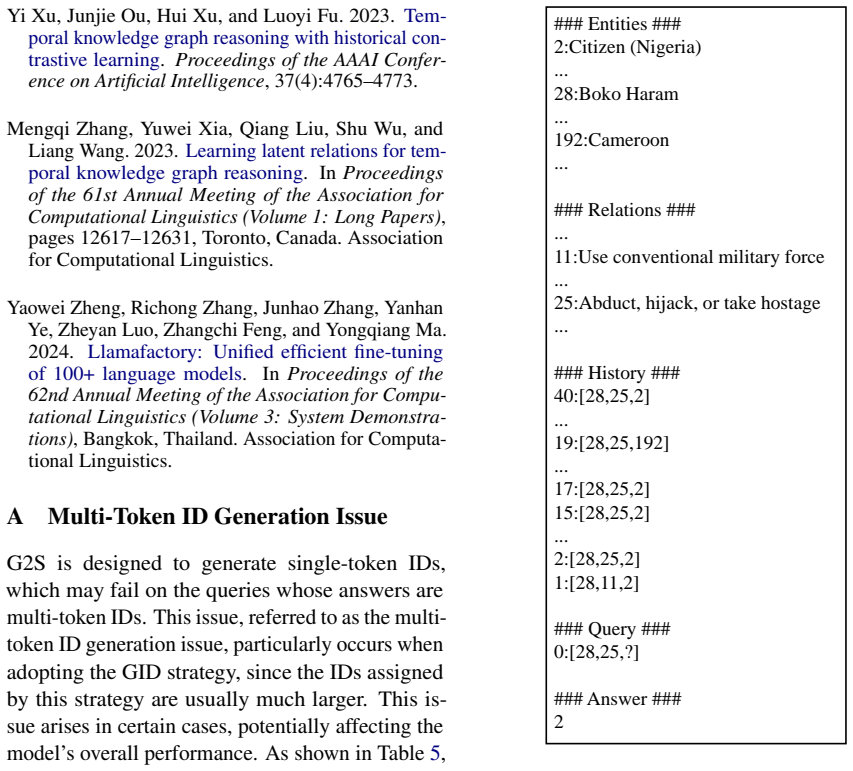
- On ICEWS18 the paper notes G2S slightly underperforms GenTKG, attributing it to multi-token ID generation; fixing single-token decoding for global IDs should close that gap.
- The anonymization strategies matter: global IDs work best with enough data, while frequency IDs are better in low-resource settings, suggesting practical guidance for choosing a strategy per dataset.
Reading between the lines
- Editorial inference: the same anonymize-then-specialize recipe could apply to other LLM sequence tasks with a procedural core and a lexical surface—e.g., event extraction, procedural planning, or code synthesis—where the general pattern (control flow) is masked from domain names.
- Editorial inference: the paper's relative-time encoding (query time = 0) suggests that future work could test whether shifting from absolute calendar time to relative intervals is itself the main transfer mechanism, independent of entity anonymization.
- Editorial inference: a testable extension would be to train the general stage on purely synthetic anonymous temporal structures with known planted patterns; if G2S improves as planted pattern complexity increases, the causal link between structure-learning and generalization strengthens.
Editorial analysis
A structured set of objections, weighed in public.
Referee Report
Summary. The paper proposes G2S, a two-stage framework for temporal knowledge graph (TKG) forecasting with large language models. In the general learning stage, the model is fine-tuned on anonymized temporal structures from GDELT and WIKI, where entities, relations, and timestamps are replaced by abstract IDs. In the specific learning stage, scenario information is injected either via in-context learning or supervised fine-tuning. The framework is evaluated on ICEWS14, ICEWS18, and YAGO under standard, zero-shot, and low-resource settings, reporting improvements over in-context learning and prior fine-tuning baselines. The paper also includes ablations and an analysis of anonymization strategies.
Significance. If the disentanglement claim holds, G2S provides a practical recipe for improving LLM generalization to unseen TKG scenarios, which is timely given the growing interest in LLM-based temporal reasoning. The paper has several strengths: it evaluates across three distinct settings, includes multiple ablation variants, reports hyperparameter and infrastructure details, and provides a concrete case study illustrating a shared pattern across datasets. However, the central causal claim that anonymization in the general learning stage is what drives the zero-shot gains is not isolated by the experimental design. The general stage adds 130k training samples, and the ablations do not control for the effect of additional data or for the change in input format induced by anonymization. As a result, the current evidence supports the conclusion that the proposed framework works well, but not the stronger conclusion that disentanglement is the operative mechanism.
major comments (4)
- [§5.1, §6.2, Table 2] The zero-shot comparison is confounded by the amount of training data. G2SGL(R)w.WIKI is fine-tuned on 130k general-stage samples (100k from GDELT and 30k from WIKI), whereas the ICL baselines (Llama2-ICL, Llama3-ICL, GPT-NeoX-ICL) and the Frequency baseline are not fine-tuned at all. The observed gains could therefore be explained by exposure to additional TKG-forecasting samples and task-format adaptation rather than by the anonymization-induced disentanglement. The paper should include a control trained on the same 130k samples with original entity/relation names and timestamps (i.e., without anonymization) in the general stage. Without such a control, the central claim that anonymization drives the improvement is not supported.
- [§6.4, Table 4] The w/o GL ablation removes the entire general learning stage, but the remaining specific-stage ICL prompt still uses anonymized IDs with entity/relation mapping parts. This is not the same input format as the standard ICL baselines in Table 2 (Llama3-ICL reports H@1 31.9 on ICEWS14, while w/o GL reports 13.67). The large drop could be due to the model being unfamiliar with the ID-based format rather than losing access to general temporal patterns. A control that uses the same G2S prompt structure but with non-anonymized names in the general stage is needed to separate format adaptation from pattern learning.
- [§6.2, Table 2] The result for G2SGL(F+Map) weakens the interference hypothesis. This variant deliberately injects scenario information during general learning, yet it matches or slightly exceeds G2SGL(F) on ICEWS14 (H@1 32.13 vs 31.52) and ICEWS18 (H@3 31.87 vs 31.17). The authors attribute this to the CAMEO schema overlap between GDELT and the ICEWS datasets, but that explanation suggests the improvements come from dataset-specific transfer rather than from learning invariant general patterns. The paper should explicitly reconcile this observation with the claim that simultaneously learning scenario information hurts generalization.
- [§2, §5.3] zrLLM (Ding et al., 2024) is cited in the related work as an LLM-based method for zero-shot relational learning on TKGs, but it is not included among the baselines in Table 2. Since zrLLM is specifically designed for zero-shot TKG forecasting with LLMs, it is directly relevant to the zero-shot generalization claims. The authors should either add this comparison or justify its exclusion in the experimental section.
minor comments (3)
- [§6.2] The description of G2SGL(R)w.WIKI states that it 'jointly utilizes GDELT and Y AGO' and adopts the RID strategy. Given the model name and the subsequent discussion about WIKI, this appears to be a typo: it should read 'GDELT and WIKI'.
- [§6.2] The notation 'w. W IKI' contains an extraneous space; it should be 'w.WIKI' (or 'w/ WIKI') for consistency with the model name in Tables 2 and 4.
- [Appendix A, Table 5] The statistics on multi-token IDs are useful, but the text could clarify whether the 'multi-token ID' percentages are computed on the validation set only and whether the same issue affects the test set used for the reported results.
Circularity Check
No significant circularity: G2S is an empirical framework validated on held-out test sets, and its central claims do not reduce to their inputs by construction.
full rationale
The paper does not present a formal derivation chain; its claims are empirical and are evaluated on held-out test folds of ICEWS14, ICEWS18, and YAGO against non-LLM and LLM baselines. The general learning stage is trained on GDELT and WIKI data, while the reported zero-shot, low-resource, and standard results are genuine forecasts on datasets not used for general-stage training. The anonymization strategies, including the relative timestamp encoding and the FID/GID/RID entity and relation IDs, are operational choices rather than definitions that guarantee the outcome: the paper explicitly compares variants (e.g., G2SGL(F) vs. G2SGL(R) vs. G2SGL(R)w.WIKI) and reports mixed results, which gives the mechanism empirical content. The ablation w/o GL removes the entire general learning stage, so the improvement could partly reflect additional training data rather than anonymization alone; however, this is an experimental confound and a correctness risk, not a circularity in which a prediction equals its fitted input by construction. Validation-based selection of anonymization strategies is standard model selection, not fitting of test outcomes. Self-citations to earlier work by the same authors (e.g., RE-GCN and CluSTeR) appear only as baseline references and are not load-bearing for the framework's central claim, and no uniqueness theorem or self-cited theoretical guarantee is invoked to force the design. Overall, the paper is self-contained against external benchmarks and its central assertions stand or fall on the held-out experimental evidence.
Assumptions & free parameters
free parameters (3)
- Historical context length L =
50
- General-stage training sample sizes =
100,000 from GDELT; 30,000 from WIKI
- Anonymization strategy selection =
RID for general stage; GID for ICEWS14/18 specific; RID for YAGO specific
assumptions (4)
- domain assumption One-hop historical facts are sufficient to capture the temporal context needed for forecasting.
- ad hoc to paper Anonymization to abstract IDs preserves the generalizable temporal patterns while removing scenario information.
- domain assumption LLMs can learn reusable structural patterns from ID-formatted prompts.
- domain assumption Relative timestamps (query time as 0) eliminate train/test timestamp bias.
Cite this review
Pith. "Pith review of G2S: A General-to-Specific Learning Framework for Temporal Knowledge Graph Forecasting with Large Language Models." pith.science (2026). https://pith.science/paper/GNAHJJWL
@misc{pith2026250600445,
  author       = {Pith},
  title        = {Pith review of: G2S: A General-to-Specific Learning Framework for Temporal Knowledge Graph Forecasting with Large Language Models},
  year         = {2026},
  howpublished = {\url{https://pith.science/paper/GNAHJJWL}},
  note         = {Machine review of arXiv:2506.00445}
}
read the original abstract
Forecasting over Temporal Knowledge Graphs (TKGs) which predicts future facts based on historical ones has received much attention. Recent studies have introduced Large Language Models (LLMs) for this task to enhance the models' generalization abilities. However, these models perform forecasting via simultaneously learning two kinds of entangled knowledge in the TKG: (1) general patterns, i.e., invariant temporal structures shared across different scenarios; and (2) scenario information, i.e., factual knowledge engaged in specific scenario, such as entities and relations. As a result, the learning processes of these two kinds of knowledge may interfere with each other, which potentially impact the generalization abilities of the models. To enhance the generalization ability of LLMs on this task, in this paper, we propose a General-to-Specific learning framework (G2S) that disentangles the learning processes of the above two kinds of knowledge. In the general learning stage, we mask the scenario information in different TKGs and convert it into anonymous temporal structures. After training on these structures, the model is able to capture the general patterns across different TKGs. In the specific learning stage, we inject the scenario information into the structures via either in-context learning or fine-tuning modes. Experimental results show that G2S effectively improves the generalization abilities of LLMs.
Figures

Figures from the paper (1 more)
Reference graph
Works this paper leans on
-
[1]
online" 'onlinestring :=
ENTRY address archivePrefix author booktitle chapter edition editor eid eprint eprinttype howpublished institution journal key month note number organization pages publisher school series title type volume year doi pubmed url lastchecked label extra.label sort.label short.list INTEGERS output.state before.all mid.sentence after.sentence after.block STRING...
-
[2]
write newline
" write newline "" before.all 'output.state := FUNCTION n.dashify 't := "" t empty not t #1 #1 substring "-" = t #1 #2 substring "--" = not "--" * t #2 global.max substring 't := t #1 #1 substring "-" = "-" * t #2 global.max substring 't := while if t #1 #1 substring * t #2 global.max substring 't := if while FUNCTION word.in bbl.in capitalize " " * FUNCT...
-
[3]
AI@Meta. 2024. https://github.com/meta-llama/llama3/blob/main/MODEL_CARD.md Llama 3 model card
2024
-
[4]
Sidney Black, Stella Biderman, Eric Hallahan, Quentin Anthony, Leo Gao, Laurence Golding, Horace He, Connor Leahy, Kyle McDonell, Jason Phang, Michael Pieler, Usvsn Sai Prashanth, Shivanshu Purohit, Laria Reynolds, Jonathan Tow, Ben Wang, and Samuel Weinbach. 2022. https://doi.org/10.18653/v1/2022.bigscience-1.9 GPT - N eo X -20 B : An open-source autoreg...
-
[5]
Bin Chen, Chunjing Xiao, and Fan Zhou. 2024. https://doi.org/10.18653/v1/2024.findings-emnlp.543 Natural evolution-based dual-level aggregation for temporal knowledge graph reasoning . In Findings of the Association for Computational Linguistics: EMNLP 2024, pages 9274--9284, Miami, Florida, USA. Association for Computational Linguistics
-
[6]
Zifeng Ding, Heling Cai, Jingpei Wu, Yunpu Ma, Ruotong Liao, Bo Xiong, and Volker Tresp. 2024. https://doi.org/10.18653/v1/2024.naacl-long.104 zr LLM : Zero-shot relational learning on temporal knowledge graphs with large language models . In Proceedings of the 2024 Conference of the North American Chapter of the Association for Computational Linguistics:...
-
[7]
Patrick Ernst, Cynthia Meng, Amy Siu, and Gerhard Weikum. 2014. https://doi.org/10.1109/ICDE.2014.6816754 Knowlife: A knowledge graph for health and life sciences . In 2014 IEEE 30th International Conference on Data Engineering, pages 1254--1257
arXiv 2014
-
[8]
Fuli Feng, Xiangnan He, Xiang Wang, Cheng Luo, Yiqun Liu, and Tat-Seng Chua. 2019. https://doi.org/10.1145/3309547 Temporal relational ranking for stock prediction . ACM Trans. Inf. Syst., 37(2)
doi:10.1145/3309547 2019
Show all 30 references
-
[9]
Zhen Han, Peng Chen, Yunpu Ma, and Volker Tresp. 2021 a . https://openreview.net/forum?id=pGIHq1m7PU Explainable subgraph reasoning for forecasting on temporal knowledge graphs . In International Conference on Learning Representations
2021
-
[10]
Zhen Han, Zifeng Ding, Yunpu Ma, Yujia Gu, and Volker Tresp. 2021 b . https://doi.org/10.18653/v1/2021.emnlp-main.658 Learning neural ordinary equations for forecasting future links on temporal knowledge graphs . In Proceedings of the 2021 Conference on Empirical Methods in Na...
2021 doi
-
[11]
Edward J Hu, yelong shen, Phillip Wallis, Zeyuan Allen-Zhu, Yuanzhi Li, Shean Wang, Lu Wang, and Weizhu Chen. 2022. https://openreview.net/forum?id=nZeVKeeFYf9 Lo RA : Low-rank adaptation of large language models . In International Conference on Learning Representations
2022
-
[12]
Tingsong Jiang, Tianyu Liu, Tao Ge, Lei Sha, Sujian Li, Baobao Chang, and Zhifang Sui. 2016. https://doi.org/10.18653/v1/D16-1260 Encoding temporal information for time-aware link prediction . In Proceedings of the 2016 Conference on Empirical Methods in Natural Language Proce...
2016 doi
-
[13]
Woojeong Jin, Meng Qu, Xisen Jin, and Xiang Ren. 2020. https://doi.org/10.18653/v1/2020.emnlp-main.541 Recurrent event network: Autoregressive structure inferenceover temporal knowledge graphs . In Proceedings of the 2020 Conference on Empirical Methods in Natural Language Pro...
2020 doi
-
[14]
Julien Leblay and Melisachew Wudage Chekol. 2018. https://doi.org/10.1145/3184558.3191639 Deriving validity time in knowledge graph . In Companion Proceedings of the The Web Conference 2018, WWW '18, page 1771–1776, Republic and Canton of Geneva, CHE. International World Wide ...
2018
-
[15]
Dong-Ho Lee, Kian Ahrabian, Woojeong Jin, Fred Morstatter, and Jay Pujara. 2023. https://doi.org/10.18653/v1/2023.emnlp-main.36 Temporal knowledge graph forecasting without knowledge using in-context learning . In Proceedings of the 2023 Conference on Empirical Methods in Natu...
2023 doi
-
[16]
Yujia Li, Shiliang Sun, and Jing Zhao. 2022. https://doi.org/10.24963/ijcai.2022/299 Tirgn: Time-guided recurrent graph network with local-global historical patterns for temporal knowledge graph reasoning . In Proceedings of the Thirty-First International Joint Conference on A...
2022 doi
-
[17]
Zixuan Li, Xiaolong Jin, Saiping Guan, Wei Li, Jiafeng Guo, Yuanzhuo Wang, and Xueqi Cheng. 2021 a . https://doi.org/10.18653/v1/2021.acl-long.365 Search from history and reason for future: Two-stage reasoning on temporal knowledge graphs . In Proceedings of the 59th Annual Me...
2021 doi
-
[18]
Zixuan Li, Xiaolong Jin, Wei Li, Saiping Guan, Jiafeng Guo, Huawei Shen, Yuanzhuo Wang, and Xueqi Cheng. 2021 b . https://doi.org/10.1145/3404835.3462963 Temporal knowledge graph reasoning based on evolutional representation learning . In Proceedings of the 44th International ...
2021
-
[19]
Ke Liang, Lingyuan Meng, Meng Liu, Yue Liu, Wenxuan Tu, Siwei Wang, Sihang Zhou, and Xinwang Liu. 2023. https://doi.org/10.1145/3539618.3591711 Learn from relational correlations and periodic events for temporal knowledge graph reasoning . In Proceedings of the 46th Internatio...
2023
-
[20]
Ruotong Liao, Xu Jia, Yangzhe Li, Yunpu Ma, and Volker Tresp. 2024. https://doi.org/10.18653/v1/2024.findings-naacl.268 G en TKG : Generative forecasting on temporal knowledge graph with large language models . In Findings of the Association for Computational Linguistics: NAAC...
2024 doi
-
[21]
Kangzheng Liu, Feng Zhao, Guandong Xu, Xianzhi Wang, and Hai Jin. 2023. https://doi.org/10.1109/ICDE55515.2023.00138 Retia: Relation-entity twin-interact aggregation for temporal knowledge graph extrapolation . In 2023 IEEE 39th International Conference on Data Engineering (IC...
2023
-
[22]
Yushan Liu, Yunpu Ma, Marcel Hildebrandt, Mitchell Joblin, and Volker Tresp. 2022. https://doi.org/10.1609/aaai.v36i4.20330 Tlogic: Temporal logical rules for explainable link forecasting on temporal knowledge graphs . Proceedings of the AAAI Conference on Artificial Intellige...
2022 doi
-
[23]
Suchanek
Farzaneh Mahdisoltani, Joanna Biega, and Fabian M. Suchanek. 2013. https://imt.hal.science/hal-01699874 YAGO3: A Knowledge Base from Multilingual Wikipedias . In CIDR , Asilomar, United States
2013
-
[24]
Fred Morstatter, Aram Galstyan, Gleb Satyukov, Daniel Benjamin, Andres Abeliuk, Mehrnoosh Mirtaheri, KSM Tozammel Hossain, Pedro Szekely, Emilio Ferrara, Akira Matsui, Mark Steyvers, Stephen Bennet, David Budescu, Mark Himmelstein, Michael Ward, Andreas Beger, Michele Catasta,...
2019 doi
-
[25]
Haohai Sun, Jialun Zhong, Yunpu Ma, Zhen Han, and Kun He. 2021. https://doi.org/10.18653/v1/2021.emnlp-main.655 T ime T raveler: Reinforcement learning for temporal knowledge graph forecasting . In Proceedings of the 2021 Conference on Empirical Methods in Natural Language Pro...
2021 doi
-
[26]
Hugo Touvron, Louis Martin, Kevin Stone, Peter Albert, Amjad Almahairi, Yasmine Babaei, Nikolay Bashlykov, Soumya Batra, Prajjwal Bhargava, Shruti Bhosale, et al. 2023. Llama 2: Open foundation and fine-tuned chat models. arXiv preprint arXiv:2307.09288
2023 arXiv
-
[27]
Yuwei Xia, Ding Wang, Qiang Liu, Liang Wang, Shu Wu, and Xiaoyu Zhang. 2024. https://arxiv.org/abs/2402.14382 Chain-of-history reasoning for temporal knowledge graph forecasting . Preprint, arXiv:2402.14382
2024 arXiv
-
[28]
Yi Xu, Junjie Ou, Hui Xu, and Luoyi Fu. 2023. https://doi.org/10.1609/aaai.v37i4.25601 Temporal knowledge graph reasoning with historical contrastive learning . Proceedings of the AAAI Conference on Artificial Intelligence, 37(4):4765--4773
2023 doi
-
[29]
Mengqi Zhang, Yuwei Xia, Qiang Liu, Shu Wu, and Liang Wang. 2023. https://doi.org/10.18653/v1/2023.acl-long.705 Learning latent relations for temporal knowledge graph reasoning . In Proceedings of the 61st Annual Meeting of the Association for Computational Linguistics (Volume...
2023 doi
-
[30]
Yaowei Zheng, Richong Zhang, Junhao Zhang, Yanhan Ye, Zheyan Luo, Zhangchi Feng, and Yongqiang Ma. 2024. http://arxiv.org/abs/2403.13372 Llamafactory: Unified efficient fine-tuning of 100+ language models . In Proceedings of the 62nd Annual Meeting of the Association for Compu...
2024 arXiv
Reviewed August 7, 2026 · model on record in the stance chip above.
Discussion (0). Sign in to comment.