REVIEW 5 major objections 4 minor 23 references
Towards Temporally Explainable Dysarthric Speech Clarity Assessment
T0 review · 5 major / 4 minor · reviewed 2026-08-07 · deepseek-v4-flash
Pith's one-line read A three-stage framework using off-the-shelf speech-recognition models can score the clarity of dysarthric speech, locate which moments were mispronounced, and classify the type of error, matching a speech therapist's labels 70.1% of the…
desk verdict Genuinely new therapist-labeled temporal dataset for dysarthria, but the headline 70.1% match rate rests on unblinded manual judgments and single-annotator ground truth, so treat the numbers as promising rather than definitive. read the letter →
The pith
A machine-rendered reading of the paper's core claim, the machinery that carries it, and where it could break.
The reading
What carries the argument
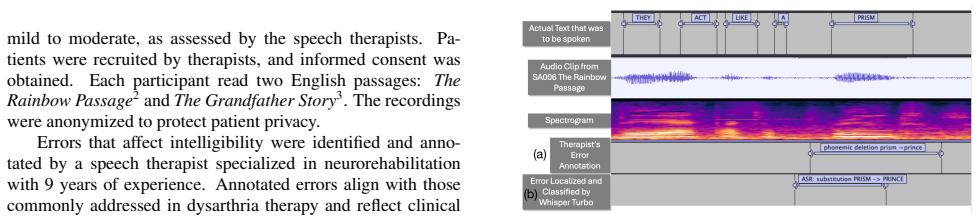
The load-bearing object is the three-stage evaluation pipeline together with a therapist-annotated dataset. The dataset supplies ground-truth temporal segments and error descriptions for each mispronounced word; the localizer uses forced alignment timestamps from whisper-timestamped to get word boundaries from ASR transcripts, then compares ASR-detected error segments to therapist-marked segments by time overlap, computing precision, recall, and F-score. The classifier converts both ASR output and reference text to phoneme lists and applies Levenshtein distance with absolute ($\le 3$) and relative ($\le 0.6$) edit-distance thresholds to separate phoneme-level from word-level substitutions, insertions, and deletions. The framework's novelty is using ASR output not just as a transcript but as a source of timing and error-type labels, generating temporally explainable feedback.
What would settle it
Take the same twelve recordings to a second speech therapist (and ideally a third), have them independently mark error regions and error types, and compute inter-rater agreement on segment boundaries and labels. If agreement is low (for example, Cohen's kappa below 0.4 on error-type labels or poor boundary overlap), then the 70.1% ASR-therapist match cannot be trusted as evidence of ASR accuracy, because it would be measured against an unstable reference.
Extended reading notes
Core claim
The central discovery is that a stage-wise framework built on pretrained ASR models can produce explainable mispronunciation feedback for dysarthric speech. In the overall clarity stage, Whisper medium and large produce clarity scores (computed as $1 - \text{WER}$) that correlate strongly with therapist-provided clarity scores and with severity levels. In the temporal localization stage, larger Whisper models achieve higher precision and F-scores, with recall comparable across models, meaning they reduce false positives rather than find more errors. In classification, substitution errors are classified correctly across models, word deletions do well, while phoneme-level errors are often absorbed into word substitutions and repetition and prosodic errors are barely detected. The headline quantitative claim is a $70.1\% \pm 3.6\%$ exact match between ASR-derived error descriptions and therapist labels on temporally localized errors.
Load-bearing premise
The whole evaluation assumes that the single speech therapist's temporal markers and error descriptions are accurate ground truth, even though no second annotator or agreement statistic is provided to check how subjective those markings are.
Editorial extensions
If this is right
- Patients with mild-to-moderate dysarthria could practice reading passages at home and receive automated segment-level feedback on which words were mispronounced and how, reducing the need for synchronous therapist time.
- Clinicians could use the Whisper-based clarity score ($1 - \text{WER}$) as a quick screening index, with the caveat that it reflects the model's agreement with one therapist's judgment.
- Because larger Whisper models cut false positives without sacrificing recall on localization, deploying the largest model is the recommended default for this task.
- The framework's failure modes—repetition errors, prosodic errors, and phoneme-level misclassification—define a concrete agenda: prosody-aware features and direct phoneme recognition are needed before the system can give complete feedback.
Reading between the lines
- If the single-therapist annotations prove reliable on re-testing, the dataset becomes a benchmark for dysarthric mispronunciation detection, but its six-speaker size means the 70.1% figure is an upper-bound estimate until replicated on a larger cohort.
- The paper's observation that ASR maps non-word mispronunciations to closest-sounding real words suggests that the lexical bias of standard ASR, not just acoustic error, drives many substitution misclassifications; a character-level or phoneme-decoding ASR would be a direct testable improvement.
- The empirical edit-distance thresholds (≤3 and ≤0.6) are dataset-tuned; a sensitivity analysis varying these thresholds would reveal whether the classification stage's accuracy is robust or an artifact of the chosen cutoffs.
Editorial analysis
A structured set of objections, weighed in public.
Referee Report
Summary. This paper presents a three-stage framework for explainable dysarthric speech assessment: (i) overall clarity scoring from ASR word error rate, (ii) temporal localization of mispronounced regions using ASR timestamps, and (iii) mispronunciation type classification via phoneme-level edit distances. The authors collected a new dataset of six dysarthric speakers reading two standard passages, annotated by a single speech therapist with temporal markers and error descriptions, and evaluated several Whisper and wav2vec2 models. They report that medium/large Whisper clarity scores correlate with therapist clarity ratings, that larger Whisper models achieve higher precision and F-scores in temporal localization, and a 70.1% average exact-match rate between ASR-detected and therapist-labeled errors.
Significance. The dataset with temporally aligned therapist annotations is a useful resource, and the qualitative finding that substitution/deletion/insertion errors are far better detected than repetition/prosodic errors is clinically plausible and actionable. The paper ships code and a supplementary webpage, and the central comparison is not circular: the therapist labels are not derived from the ASR outputs. However, the headline quantitative claims rest on a small sample (six speakers), a single annotator, manually adjudicated 'phonetically similar' matches, and thresholds tuned on the same data. These issues do not invalidate the framework as a proof-of-concept, but they prevent the reported numbers from being taken at face value.
major comments (5)
- [Section 4.4] The headline 70.1% exact-match rate is not a well-defined objective metric. The authors state that 'rhyming or phonetically similar words' were manually counted as correct matches, but no similarity criterion, no blinding procedure, and no second rater are described. Because therapist annotations are often non-words (e.g., prism→pris) while ASR outputs are real words (e.g., prism→prince), the match decision is a subjective judgment that could systematically inflate the reported agreement. The paper should define the matching rule a priori (e.g., phonological edit distance with a specified threshold), blind the evaluators to the source of each error, and report inter-rater agreement on a subset of the match decisions; alternatively, report the exact-match rate under both a strict string-match rule and the lenient rule to show sensitivity.
- [Section 2] All ground-truth annotations (temporal markers, error descriptions, clarity scores) come from a single speech therapist, and Section 2 explicitly acknowledges that 'some variability in error marking is expected' while citing [14], yet no inter-rater reliability is reported. Since every stage of the evaluation is measured against this reference, the absence of agreement statistics (e.g., temporal overlap agreement, Cohen's kappa on error-class labels) leaves the precision/recall/F-scores and the 70.1% match rate measured against a potentially idiosyncratic target. A second annotator on at least a subset of the recordings is needed to establish the reliability of the benchmark.
- [Section 3] The phoneme-versus-word classification thresholds (absolute edit distance ≤3, relative ≤0.6) are described as 'selected empirically' on the same dataset used for evaluation. This creates a risk of overfitting in the classification stage; no held-out validation or sensitivity analysis is provided. The authors should either fix the thresholds a priori, perform cross-validation, or at least report how the classification results in Figure 6 change over a range of threshold values.
- [Section 4.2] The claim that ASR clarity scores 'align' with therapist ratings rests on Pearson correlations computed over six speakers (Figure 3c), with no confidence intervals, p-values, or nonparametric alternatives. With n=6 and only two severity levels, a single speaker can drive the correlation; the paper should report uncertainty, for example via bootstrap intervals, and should also qualify the severity-level correlations in Figure 3(a,b) for the authors' dataset.
- [Section 4.3] The definition of a true positive as any 'time overlap' between an ASR-detected error and a therapist-labeled segment is permissive; a minimal temporal overlap counts as a correct localization, which can inflate precision and recall. The paper should specify the overlap criterion (e.g., an IoU threshold or requiring the detected word center to fall within the labeled segment) and report results under a stricter criterion. If the segments are word-level from forced alignment, this should be stated and justified.
minor comments (4)
- [Section 4.4] The sentence 'Across the ASR models, the average percentage ... was 70.1%±3.6%' does not state whether the percentage is averaged over speakers or over models, nor the denominator; please clarify and provide a per-model breakdown.
- [Section 4.2] The explanation for wav2vec2's poor performance ('monolingual training') is not accurate for all wav2vec2 variants and is not supported by a dedicated experiment; either remove or soften this claim.
- [Section 2] The phrase 'custom fine-tuned prompts' is unclear; if GPT-4-turbo was not fine-tuned, say 'custom prompts'; if it was fine-tuned, describe the fine-tuning data and procedure.
- [Section 4.3] The post-hoc Wilcoxon tests are reported without correction for multiple comparisons; please state whether p-values were adjusted and consider reporting effect sizes for the significant model pairs.
Circularity Check
No circularity: therapist labels are external ground truth; ASR outputs are not used to construct them.
full rationale
The paper's three evaluation stages all compare pretrained ASR outputs against therapist annotations, which are collected independently (Sec. 2) and are not computed from ASR outputs. The overall clarity score compares 1-WER to the therapist's percentage-of-correct-words; these are correlated metrics against the same reference passage but neither is defined in terms of the other, so the comparison is a benchmark rather than a tautology. The temporal localizer uses time-overlap precision/recall against therapist-marked segments, and the 70.1% exact-error match (Sec. 4.4) is a manual comparison of ASR transcriptions with therapist labels; even though 'rhyming or phonetically similar' matches are counted and the rule is subjective, the ASR tokens are not generated from the therapist's labels, so the match rate is not forced by construction. The edit-distance thresholds in Sec. 3 are 'selected empirically' on the same dataset and are not evaluated on held-out data; this is an in-sample/overfitting limitation, not a logical circularity. No load-bearing self-citations or author-imported uniqueness claims appear. The acknowledged single-annotator variability (Sec. 2) affects ground-truth reliability but not circularity.
Assumptions & free parameters
free parameters (1)
- Edit-distance thresholds for phoneme versus word error classification =
absolute <=3 phoneme edits; relative <=0.6
assumptions (5)
- domain assumption A single speech therapist's temporal markers and error descriptions are reliable ground truth for mispronunciation.
- domain assumption Forced alignment of ASR transcripts to the target text yields reliable timestamps for error localization.
- ad hoc to paper Rhyming or phonetically similar ASR words count as correct matches to therapist error labels.
- domain assumption The target passage text is available and the patient reads a known paragraph.
- domain assumption Mispronunciation descriptions map to five classes accurately after GPT-4-turbo mapping and manual verification.
Cite this review
Pith. "Pith review of Towards Temporally Explainable Dysarthric Speech Clarity Assessment." pith.science (2026). https://pith.science/paper/AC2PYCRM
@misc{pith2026250600454,
  author       = {Pith},
  title        = {Pith review of: Towards Temporally Explainable Dysarthric Speech Clarity Assessment},
  year         = {2026},
  howpublished = {\url{https://pith.science/paper/AC2PYCRM}},
  note         = {Machine review of arXiv:2506.00454}
}
read the original abstract
Dysarthria, a motor speech disorder, affects intelligibility and requires targeted interventions for effective communication. In this work, we investigate automated mispronunciation feedback by collecting a dysarthric speech dataset from six speakers reading two passages, annotated by a speech therapist with temporal markers and mispronunciation descriptions. We design a three-stage framework for explainable mispronunciation evaluation: (1) overall clarity scoring, (2) mispronunciation localization, and (3) mispronunciation type classification. We systematically analyze pretrained Automatic Speech Recognition (ASR) models in each stage, assessing their effectiveness in dysarthric speech evaluation (Code available at: https://github.com/augmented-human-lab/interspeech25_speechtherapy, Supplementary webpage: https://apps.ahlab.org/interspeech25_speechtherapy/). Our findings offer clinically relevant insights for automating actionable feedback for pronunciation assessment, which could enable independent practice for patients and help therapists deliver more effective interventions.
Figures


Figures from the paper (2 more)


Reference graph
Works this paper leans on
-
[14]
Dysarthric speech database for universal access research
H. Kim, M. Hasegawa-Johnson, A. Perlman, J. R. Gunderson, T. S. Huang, K. L. Watkin, and S. Frame, “Dysarthric speech database for universal access research.” inInterspeech, vol. 2008, 2008, pp. 1741–1744
work page 2008
-
[1]
Reliable assessment tools are needed to support personalized speech therapy
Introduction Dysarthria, a speech disorder caused by neuromuscular im- pairments, affects articulation, phonation, and prosody, lead- ing to communication barriers. Reliable assessment tools are needed to support personalized speech therapy. Current assess- ment methods rely heavily on expert judgment, which is time- consuming, limited in scalability, and...
-
[2]
Towards Temporally Explainable Dysarthric Speech Clarity Assessment
Dataset Design Our dataset comprises 12 speech recordings with a mean speech duration of 1.06 min per recording, from six patients aged 41 to 71 years, diagnosed with various types of dysarthria, such as unilateral upper motor neuron, hyperkinetic, hypokinetic, and ataxic. The severity of their speech intelligibility ranged from arXiv:2506.00454v1 [eess.A...
work page Pith review arXiv 2025
-
[3]
Speech Clarity Assessment Framework We introduce a three-stage framework (Figure 2) for automated speech clarity assessment, designed for scenarios where a pa- tient practices speaking a given text paragraph. In this setup, both the speech recording and the corresponding target text are available, enabling precise evaluation. Our framework is applied to o...
-
[4]
Experiments and Results 4.1. Experimental Setup ASR Models:We employ widely used ASR models: wav2vec2-base and large, Whisper-tiny, base, small, medium, large, and turbo. Whisper models [15] are transformer-based and optimized for robust, multilingual transcription, ranging from the lightweight tiny variant to the highly accurate large model, with turbo o...
-
[5]
Conclusions and Future Work We presented a three-stage framework for automated mispro- nunciation evaluation in dysarthric speech, leveraging ASR models for (1) clarity scoring, (2) temporal mispronunciation localization, and (3) classification. Our expert-annotated dataset enabled systematic evaluation of ASR performance, with clar- ity scores showing st...
-
[6]
Dysarthric speech recog- nition using convolutional lstm neural network
M. J. Kim, B. Cao, K. An, and J. Wang, “Dysarthric speech recog- nition using convolutional lstm neural network.” inInterspeech, 2018, pp. 2948–2952
work page 2018
-
[7]
Enhancing dysarthric speech recognition for unseen speakers via prototype- based adaptation,
S. Wang, S. Zhao, J. Zhou, A. Kong, and Y . Qin, “Enhancing dysarthric speech recognition for unseen speakers via prototype- based adaptation,” inINTERSPEECH, 2024, pp. 1305–1309
work page 2024
Show all 23 references
-
[8]
Training data augmentation for dysarthric automatic speech recognition by text-to-dysarthric-speech synthesis,
W.-Z. Leung, M. Cross, A. Ragni, and S. Goetze, “Training data augmentation for dysarthric automatic speech recognition by text-to-dysarthric-speech synthesis,” inINTERSPEECH, 2024, pp. 2494–2498
2024
-
[9]
Dypcl: Dy- namic phoneme-level contrastive learning for dysarthric speech recognition,
W. Lee, S. Im, H. Do, Y . Kim, J. Ok, and G. G. Lee, “Dypcl: Dy- namic phoneme-level contrastive learning for dysarthric speech recognition,”arXiv preprint arXiv:2501.19010, 2025
2025 arXiv
-
[10]
Whis- per features for dysarthric severity-level classification,
S. Rathod, M. Charola, A. V ora, Y . Jogi, and H. A. Patil, “Whis- per features for dysarthric severity-level classification,” inINTER- SPEECH, 2023, pp. 1523–1527
2023
-
[11]
Speech intelligibility assessment of dysarthric speech by using goodness of pronunci- ation with uncertainty quantification,
E. J. Yeo, K. Choi, S. Kim, and M. Chung, “Speech intelligibility assessment of dysarthric speech by using goodness of pronunci- ation with uncertainty quantification,” inInterspeech 2023, 2023, pp. 166–170
2023
-
[12]
Leveraging allophony in self-supervised speech models for atyp- ical pronunciation assessment,
K. Choi, E. Yeo, K. Chang, S. Watanabe, and D. Mortensen, “Leveraging allophony in self-supervised speech models for atyp- ical pronunciation assessment,”arXiv preprint arXiv:2502.07029, 2025
2025 arXiv
-
[13]
The torgo database of acoustic and articulatory speech from speakers with dysarthria,
F. Rudzicz, A. K. Namasivayam, and T. Wolff, “The torgo database of acoustic and articulatory speech from speakers with dysarthria,”Language resources and evaluation, vol. 46, pp. 523– 541, 2012
2012
-
[15]
Easycall corpus: a dysarthric speech dataset,
R. Turrisi, A. Braccia, M. Emanuele, S. Giulietti, M. Pugliatti, M. Sensi, L. Fadiga, and L. Badino, “Easycall corpus: a dysarthric speech dataset,” inProc. INTERSPEECH International Speech Communication Association, 2021, pp. 2340–2344
2021
-
[16]
L2-arctic: A non- native english speech corpus,
G. Zhao, S. Sonsaat, A. Silpachai, I. Lucic, E. Chukharev- Hudilainen, J. Levis, and R. Gutierrez-Osuna, “L2-arctic: A non- native english speech corpus,” inInterspeech 2018, 2018, pp. 2783–2787
2018
-
[17]
A study on fine- tuning wav2vec2. 0 model for the task of mispronunciation detec- tion and diagnosis
L. Peng, K. Fu, B. Lin, D. Ke, and J. Zhang, “A study on fine- tuning wav2vec2. 0 model for the task of mispronunciation detec- tion and diagnosis.” inInterspeech, 2021, pp. 4448–4452
2021
-
[18]
End-to-end mispronunciation detection and diagnosis from raw waveforms,
B.-C. Yan and B. Chen, “End-to-end mispronunciation detection and diagnosis from raw waveforms,” in2021 29th European Sig- nal Processing Conference (EUSIPCO). IEEE, 2021, pp. 61–65
2021
-
[19]
The re- liability and validity of speech-language pathologists’ estimations of intelligibility in dysarthria,
M. E. Hirsch, A. Thompson, Y . Kim, and K. L. Lansford, “The re- liability and validity of speech-language pathologists’ estimations of intelligibility in dysarthria,”Brain Sciences, vol. 12, no. 8, p. 1011, 2022
2022
-
[20]
Robust speech recognition via large-scale weak su- pervision,
A. Radford, J. W. Kim, T. Xu, G. Brockman, T. McLeavey, and I. Sutskever, “Robust speech recognition via large-scale weak su- pervision,”arXiv preprint arXiv:2212.04356, 2022
2022 arXiv
-
[21]
wav2vec 2.0: A framework for self-supervised learning of speech repre- sentations,
A. Baevski, Y . Zhou, A. Mohamed, and M. Auli, “wav2vec 2.0: A framework for self-supervised learning of speech repre- sentations,”Advances in Neural Information Processing Systems, vol. 33, pp. 12 449–12 460, 2020
2020
-
[22]
whisper-timestamped,
J. Louradour, “whisper-timestamped,” https://github.com/linto-ai/ whisper-timestamped, 2023
2023
-
[23]
An automatic measure for speech intelligibility in dysarthrias—validation across multiple languages and neurological disorders,
J. Tr ¨oger, F. D¨orr, L. Schwed, N. Linz, A. K ¨onig, T. Thies, J. R. Orozco-Arroyave, and J. Rusz, “An automatic measure for speech intelligibility in dysarthrias—validation across multiple languages and neurological disorders,”Frontiers in Digital Health, vol. 6, p. 1440986, 2024
2024
Reviewed August 7, 2026 · model on record in the stance chip above.
Discussion (0). Sign in to comment.