REVIEW 3 major objections 5 minor 51 references
Federated learning framework for collaborative remaining useful life prognostics: an aircraft engine case study
T0 review · 3 major / 5 minor · reviewed 2026-08-07 · deepseek-v4-flash
Pith's one-line read Airlines can train a shared remaining-useful-life model without sharing data, and it beats isolated training for five of six simulated airlines.
desk verdict Useful, honest FL-for-RUL case study with released code, but the headline FL-vs-isolated comparison is confounded by asymmetric test-time normalization. read the letter →
The pith
A machine-rendered reading of the paper's core claim, the machinery that carries it, and where it could break.
The reading
What carries the argument
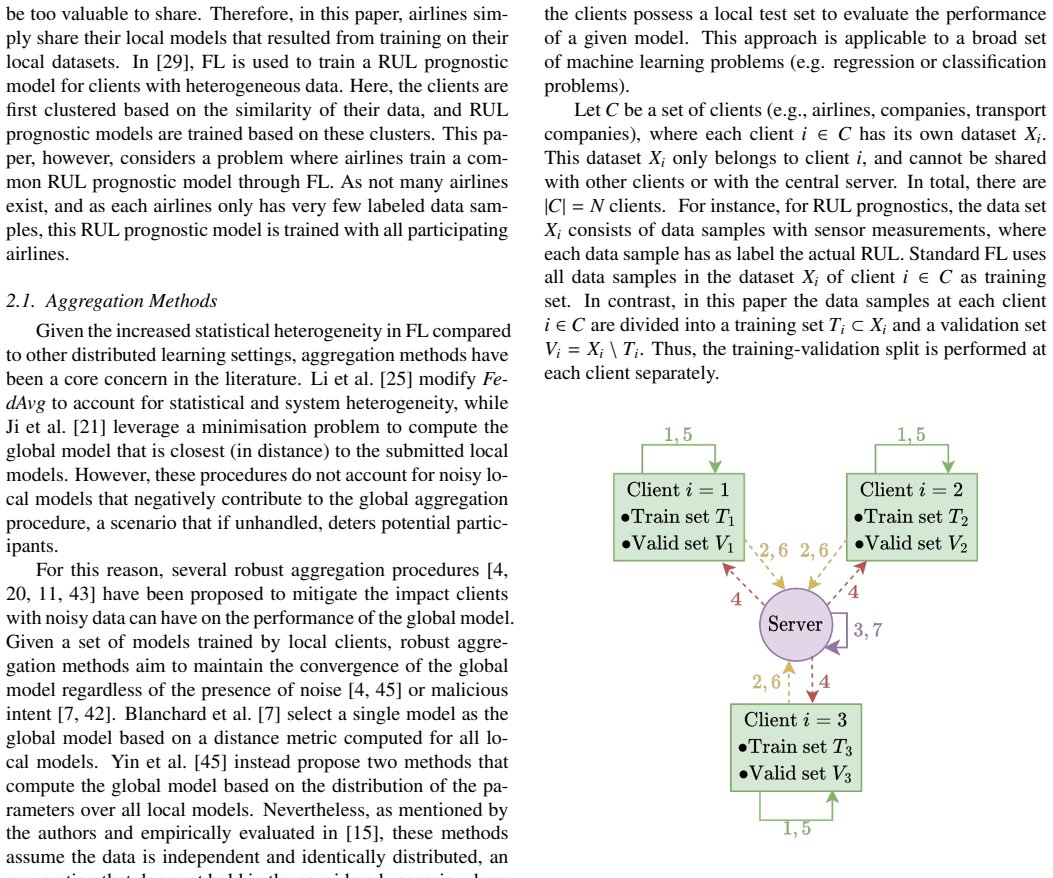
The central machinery is the federated training loop itself, extended with a decentralized validation step. In each round, every client trains a local copy of a shared one-dimensional CNN on its own engine data and sends only the weights to the server. The server then either distributes every local model to every client (full validation) or randomly assigns each local model to one client (random validation); each receiving client reports the loss of that model on its own validation set, and the server combines these losses into an evaluation score $E_j = \mathrm{median}_i L_{\mathrm{metric}}(V^i, W^j)$, taking the median to limit the influence of noisy clients. Two aggregation policies use those scores: the best-model policy sets the global weights to the local model with the lowest score, $W^G = W^{i_{\mathrm{best}}}$, and the softmax policy forms a weighted average $w^G = \sum_i \alpha_i w^i$ with weights from a z-score-normalized softmax over inverse evaluation scores. This score-then-aggregate mechanism is what lets the global model down-weight noisy participants while keeping all data local.
What would settle it
Repeat the comparison while varying the number of engines each airline contributes (for example, one, two, and five engines per airline with total data held fixed) and report RMSE on engines 11, 14, and 15; if an isolated model trained on as few as two or three engines matches or beats the federated model, the claimed benefit is an artifact of the one-engine-per-airline scarcity rather than a general property of FL.
Extended reading notes
Core claim
On the paper's own terms, the central claim is that a federated learning framework with a decentralized validation step can replace centralized data sharing for aircraft-engine remaining-useful-life prognostics: airlines never send raw sensor data to the server, yet the shared model is more accurate than each airline training alone. In the N-CMAPSS DS02 case study, six airlines each train a local one-dimensional CNN on the run-to-failure data of a single engine, and the server aggregates the local model weights. At every round, each local model is scored against the validation sets of the other airlines, with only loss values sent back to the server; the four proposed aggregation methods (Random-Best, Random-Softmax, Full-Best, Full-Softmax) then reweight or select local models according to those scores, down-weighting noisy clients. The reported result is an overall test RMSE of 9.9 flights for the federated model versus 15.8 flights on average for the six isolated models, with the federated model beating five of the six; with a noise multiplier of $\alpha=1$, Full-Softmax keeps the RMSE at 10.1 flights while FedAvg rises to 12.3.
Load-bearing premise
The load-bearing premise is that each airline has only one engine's run-to-failure data, so the isolated comparison models are trained on a single engine; if real airlines possessed data from several engines, the federated model's advantage could shrink or disappear.
Editorial extensions
If this is right
- If the central claim holds, airlines can obtain a shared RUL prognostic model without a central data repository, which removes a major contractual and privacy obstacle to collaborative prognostics.
- The decentralized validation procedure gives a path toward regulatory approval of collaborative ML models: each airline validates the global model locally and shares only the loss, satisfying a validation requirement without raw data leaving the airline.
- The aggregation results imply that standard FedAvg is acceptable when all clients have clean or mildly noisy data, but the proposed softmax methods are preferable when some clients carry substantial sensor noise.
- The comparison with the centralized oracle (RMSE 6.3 flights) bounds the privacy cost of federated learning for this problem, showing the FL model is competitive rather than equal to having all data in one place.
- Because the framework treats validation loss as a generic score, the same decentralized validation and aggregation scheme transfers to other FL regression or classification tasks beyond RUL prognostics.
Reading between the lines
- An unstated consequence of the one-engine-per-airline setup is that the isolated baselines are trained on extremely small datasets; if a real airline held several engines, its isolated model would improve and the reported 5-of-6 advantage could shrink or reverse.
- The 5-of-6 result rests on a single random 80/20 train-validation split and only three test engines; testing across repeated splits would show how much of the headline is due to the specific split.
- The median-based evaluation score limits all four aggregation methods to settings where fewer than half the clients are noisy, a boundary the paper notes but does not quantify in terms of model accuracy.
- The robustness results suggest a concrete testable extension: at a fixed noise level, vary the fraction of noisy clients and measure the crossover where Full-Softmax's advantage over FedAvg disappears, which would give operators a practical guideline for when robust aggregation is needed.
Editorial analysis
A structured set of objections, weighed in public.
Referee Report
Summary. This paper proposes a federated learning (FL) framework for collaborative remaining useful life (RUL) prognostics, with a decentralized validation procedure and four robust parameter aggregation methods (Random/Full validation crossed with Best/Softmax aggregation). The framework is evaluated on the N-CMAPSS DS02 dataset, simulating six airlines, each owning one training engine, with three test engines. The reported results show that the FL model achieves an overall test RMSE of 9.9 flights versus a mean of 15.8 flights for six isolated models, with FL giving better accuracy for five of the six airlines, and that the proposed aggregation methods outperform FedAvg under high synthetic sensor noise.
Significance. If the empirical comparison is made clean, this is a useful applied contribution: it addresses a realistic privacy constraint in aviation prognostics, releases open-source code and evaluation data, and explicitly discusses limitations such as the privacy-robustness trade-off, median breakdown, regulatory approval, and stragglers. The decentralized validation procedure is a sensible adaptation of client-side validation to FL. However, the central quantitative claims are currently weakened by an asymmetric preprocessing protocol between the FL and isolated baselines and by the absence of uncertainty estimates; these issues are fixable within the paper's scope.
major comments (3)
- [Section 5.1 and 5.3] The FL-versus-NI comparison is confounded by different test-time normalization policies. In Section 5.1 each training engine is min-max normalized with its own minimum and maximum, while the three test engines are normalized using the minimum and maximum of all six training engines. In Section 5.3, however, each NI model is tested on test engines normalized with the minimum and maximum of that airline's single training engine. The FL global model is therefore evaluated on feature values produced by an aggregate transform that no client used during training, while the NI models are evaluated on features produced by the same transform used in their training. Since the RMSE differences in Table 5 are the basis for the 'five out of six airlines' claim, the comparison does not isolate the effect of federated collaboration. Please add a sensitivity analysis that evaluates the FL model under the same per-airline normalization as the NI models, and/or evaluates NI models under the aggregate normalization, and report both variants.
- [Section 6.2, Table 5] The headline result rests on a single run over only three test engines. Table 5 reports point RMSE values without confidence intervals, repeated seeds, or any uncertainty measure; the test set consists of engines 11, 14, and 15, which cover three flight classes while all six training engines are class 3. With three test units, a single engine can dominate the aggregate RMSE, and the five-of-six statement is not robustly established. In addition, the setup assigns exactly one training engine per airline (Section 5, Table 3), an artificial data-scarcity assumption; the paper does not test sensitivity to the number of engines per client. Please report multiple seeds and bootstrap confidence intervals over flights or engines, and ideally vary the number of training engines per airline.
- [Section 6.3, Tables 6-8] The robustness advantage of the proposed aggregation methods is not uniform, and the wording in the abstract and conclusion overstates it. At alpha=0, FedAvg has the best overall RMSE (9.9) versus 10.1 for Full-Softmax and 11.6 for Full-Best; at alpha=0.1, FedAvg again has the best overall RMSE (10.2), with Random-Best second at 10.4. The proposed methods only clearly dominate at larger noise levels, e.g., alpha=1, where Full-Best (9.5) and Full-Softmax (10.1) beat FedAvg (12.3). Moreover, the Random-* methods have an additional random allocation step, but no variance is reported for their outcomes, and Table 9 shows only one realized selection sequence. Please scope the claim to large noise, report variance for repeated random allocations, and state clearly which method is recommended in which noise regime.
minor comments (5)
- [Appendix A.5] The artifact description states that run.sh runs 5 clients and 1 server for each federated learning algorithm, while the case study has six airlines; please reconcile this discrepancy so the released code reproduces the reported experiments.
- [Table 3] The mean flight length for Airline E (engine 18) is printed as '12.545' rather than '12,545'; please fix the thousands separator.
- [Section 6.3] The sentence discussing engine 16 contains the typo 'in islotation'; it should read 'in isolation'.
- [Figure 11] The plots would benefit from error bars or shaded intervals, especially for the Random-* methods; as they stand, they convey no uncertainty about the point trajectories.
- [Section 5.1] The min-max normalization is described as producing values in [-1,1], but the exact scaling formula is not given; please specify it, since the normalization confound in the comparison depends on the precise transform.
Circularity Check
No significant circularity: the FL-vs-isolated comparison and the noise-robust aggregation results are empirical and evaluated on an independent test set; the only self-citation is a non-load-bearing preprocessing choice.
full rationale
This is an empirical systems/methods paper rather than a derivation, and no claimed prediction reduces to a fitted input or to a self-citation by construction. The model is trained on N-CMAPSS DS02 training engines and evaluated on the three designated test engines (11, 14, 15), whose RUL labels are not used during training, validation, or aggregation. Hyperparameters such as the learning rate, batch size, and the noise multiplier alpha are chosen by hand, not fitted to test outcomes, so the headline RMSE values are genuine out-of-sample measurements. The decentralized validation procedure uses each client's local validation loss both for epoch selection and for computing aggregation weights; this is standard model selection on validation data, not a circular reuse of the test labels. The comparison with the six non-collaborative (NI) models is likewise an empirical benchmark, and the paper even reports one airline (Airline D, engine 16) that beats the FL model, which shows that the five-of-six claim is not forced by the setup. The only self-citation is to the authors' prior work [12] for the choice of 13 sensors and the 20-second measurement aggregation; this is a preprocessing convention, not a load-bearing theorem, and it does not predetermine the FL-versus-isolated outcome. A reviewer concern about asymmetric test-time normalization between FL and NI models is a validity threat to the comparison, not a circularity, because the normalization statistics are not derived from test RUL values and do not make the reported predictions equivalent to the model's inputs. Overall, the central empirical claims are self-contained against the open N-CMAPSS benchmark and the released code, so no circular step is exhibited.
Assumptions & free parameters
free parameters (5)
- Noise multiplier alpha =
swept from 0 to 2
- Learning rate =
0.001
- Batch size =
128
- Window length and stride =
50 time steps with stride 10
- Validation split fraction =
20% of flights per engine
assumptions (6)
- domain assumption The N-CMAPSS DS02 dataset is a valid proxy for real aircraft engine fleets and fault modes.
- ad hoc to paper Assigning one training engine per airline captures the data scarcity and heterogeneity of real airlines.
- domain assumption Sharing model weights and scalar validation losses is acceptable from a privacy perspective.
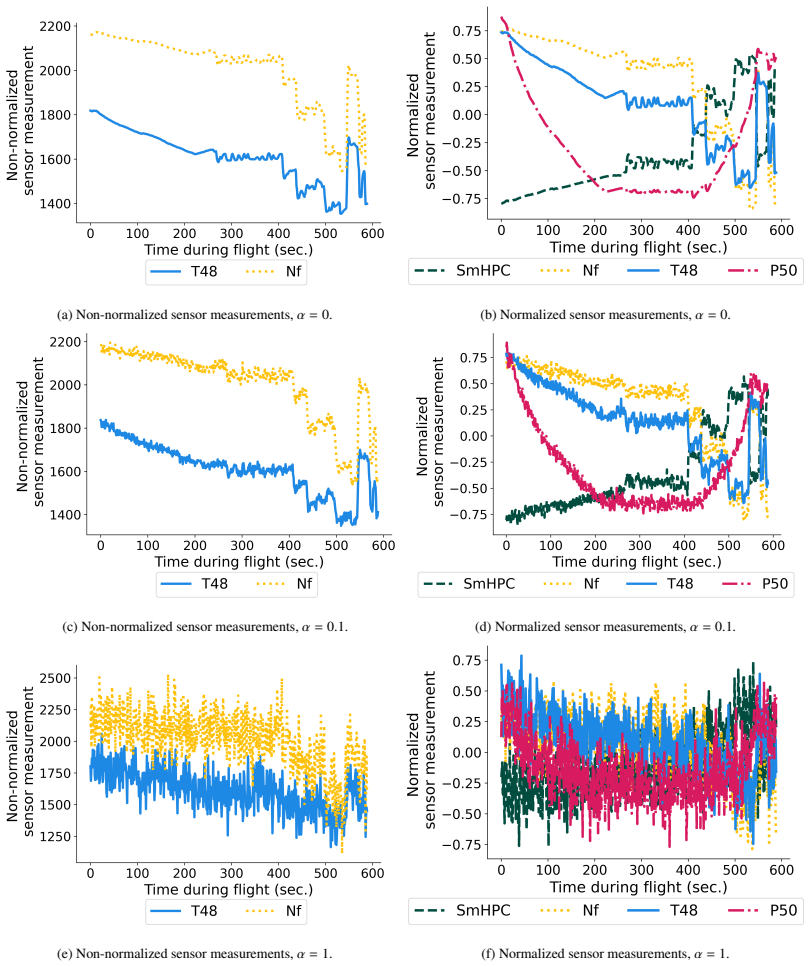
- ad hoc to paper Sensor noise can be modeled as additive Gaussian noise with per-sensor standard deviation scaled by alpha.
- domain assumption Fewer than half of the clients have noisy data.
- domain assumption Clients follow the protocol honestly and do not send maliciously crafted parameters.
Cite this review
Pith. "Pith review of Federated learning framework for collaborative remaining useful life prognostics: an aircraft engine case study." pith.science (2026). https://pith.science/paper/GAGM6ACR
@misc{pith2026250600499,
  author       = {Pith},
  title        = {Pith review of: Federated learning framework for collaborative remaining useful life prognostics: an aircraft engine case study},
  year         = {2026},
  howpublished = {\url{https://pith.science/paper/GAGM6ACR}},
  note         = {Machine review of arXiv:2506.00499}
}
read the original abstract
Complex systems such as aircraft engines are continuously monitored by sensors. In predictive aircraft maintenance, the collected sensor measurements are used to estimate the health condition and the Remaining Useful Life (RUL) of such systems. However, a major challenge when developing prognostics is the limited number of run-to-failure data samples. This challenge could be overcome if multiple airlines would share their run-to-failure data samples such that sufficient learning can be achieved. Due to privacy concerns, however, airlines are reluctant to share their data in a centralized setting. In this paper, a collaborative federated learning framework is therefore developed instead. Here, several airlines cooperate to train a collective RUL prognostic machine learning model, without the need to centrally share their data. For this, a decentralized validation procedure is proposed to validate the prognostics model without sharing any data. Moreover, sensor data is often noisy and of low quality. This paper therefore proposes four novel methods to aggregate the parameters of the global prognostic model. These methods enhance the robustness of the FL framework against noisy data. The proposed framework is illustrated for training a collaborative RUL prognostic model for aircraft engines, using the N-CMAPSS dataset. Here, six airlines are considered, that collaborate in the FL framework to train a collective RUL prognostic model for their aircraft's engines. When comparing the proposed FL framework with the case where each airline independently develops their own prognostic model, the results show that FL leads to more accurate RUL prognostics for five out of the six airlines. Moreover, the novel robust aggregation methods render the FL framework robust to noisy data samples.
Figures


Figures from the paper (7 more)


Reference graph
Works this paper leans on
-
[1]
Federated learning framework for collaborative remaining useful life prognostics: an aircraft engine case study.https://github.com/ EC-labs/rul-fl. Accessed: 2025-05-20
work page 2025
-
[2]
Turbofan dataset.https://phm-datasets.s3.amazonaws.com/ NASA/17.+Turbofan+Engine+Degradation+Simulation+Data+ Set+2.zip. Accessed: 2025-05-20
work page 2025
-
[3]
F. N. Al-Wesabi, H. A. Mengash, R. Marzouk, N. Alruwais, R. Allafi, R. Alabdan, M. Alharbi, and D. Gupta. Pelican optimization algorithm with federated learning driven attack detection model in internet of things environment.Future Generation Computer Systems, 2023
work page 2023
-
[4]
Z. Alebouyeh and A. J. Bidgoly. Benchmarking robustness and privacy- preserving methods in federated learning.Future Generation Computer Systems, 155:18–38, 2024
work page 2024
-
[5]
M. Arias Chao, C. Kulkarni, K. Goebel, and O. Fink. Aircraft engine 14 (a) Non-normalized sensor measurements,α=0. (b) Normalized sensor measurements,α=0. (c) Non-normalized sensor measurements,α=0.1. (d) Normalized sensor measurements,α=0.1. (e) Non-normalized sensor measurements,α=1. (f) Normalized sensor measurements,α=1. Figure 12: Non-normalized and ...
work page 2021
-
[6]
A. N. Bhagoji, S. Chakraborty, P. Mittal, and S. Calo. Analyzing feder- ated learning through an adversarial lens. InInternational Conference on Machine Learning, pages 634–643. PMLR, 2019
work page 2019
-
[7]
P. Blanchard, E. M. El Mhamdi, R. Guerraoui, and J. Stainer. Machine learning with adversaries: Byzantine tolerant gradient descent.Advances in neural information processing systems, 30, 2017
work page 2017
-
[8]
M. A. Chao, C. Kulkarni, K. Goebel, and O. Fink. Fusing physics-based and deep learning models for prognostics.Reliability Engineering&Sys- tem Safety, 217:107961, 2022
work page 2022
Show all 51 references
-
[9]
J. Chen, J. Li, R. Huang, K. Yue, Z. Chen, and W. Li. Federated learning for bearing fault diagnosis with dynamic weighted averaging. In2021 International Conference on Sensing, Measurement&Data Analytics in the era of Artificial Intelligence (ICSMD), pages 1–6. IEEE, 2021
2021
-
[10]
J. Chen, J. Li, R. Huang, K. Yue, Z. Chen, and W. Li. Federated trans- fer learning for bearing fault diagnosis with discrepancy-based weighted federated averaging.IEEE Transactions on Instrumentation and Mea- surement, 71:1–11, 2022
2022
-
[11]
Damaskinos, R
G. Damaskinos, R. Guerraoui, R. Patra, M. Taziki, et al. Asynchronous byzantine machine learning (the case of sgd). InInternational Conference on Machine Learning, pages 1145–1154. PMLR, 2018
2018
-
[12]
de Pater and M
I. de Pater and M. Mitici. Developing health indicators and rul prog- nostics for systems with few failure instances and varying operating con- ditions using a lstm autoencoder.Engineering Applications of Artificial Intelligence, 117:105582, 2023
2023
-
[13]
Djenouri, T
Y . Djenouri, T. P. Michalak, and J. C.-W. Lin. Federated deep learning for smart city edge-based applications.Future Generation Computer Sys- tems, 147:350–359, 2023
2023
-
[14]
Concept paper: First usable guidance for level 1 machine learning 15 applications
EASA. Concept paper: First usable guidance for level 1 machine learning 15 applications. Technical report, European Union Aviation Safety Agency, 2023
2023
-
[15]
M. Fang, X. Cao, J. Jia, and N. Gong. Local model poisoning attacks to {Byzantine-Robust}federated learning. In29th USENIX security sympo- sium (USENIX Security 20), pages 1605–1622, 2020
2020
-
[16]
N. Fei, Y . Gao, Z. Lu, and T. Xiang. Z-score normalization, hubness, and few-shot learning. InProceedings of the IEEE/CVF International Conference on Computer Vision, pages 142–151, 2021
2021
-
[17]
O. Fink, Q. Wang, M. Svensen, P. Dersin, W.-J. Lee, and M. Ducoffe. Potential, challenges and future directions for deep learning in prognos- tics and health management applications.Engineering Applications of Artificial Intelligence, 92:103678, 2020
2020
-
[18]
Geiping, H
J. Geiping, H. Bauermeister, H. Dröge, and M. Moeller. Inverting gradients-how easy is it to break privacy in federated learning?Advances in neural information processing systems, 33:16937–16947, 2020
2020
-
[19]
L. Guo, Y . Yu, M. Qian, R. Zhang, H. Gao, and Z. Cheng. Fedrul: A new federated learning method for edge-cloud collaboration based remaining useful life prediction of machines.IEEE/ASME Transactions on Mecha- tronics, 2022
2022
-
[20]
Hayes and O
J. Hayes and O. Ohrimenko. Contamination attacks and mitigation in multi-party machine learning.Advances in neural information processing systems, 31, 2018
2018
-
[21]
S. Ji, S. Pan, G. Long, X. Li, J. Jiang, and Z. Huang. Learning private neu- ral language modeling with attentive aggregation. In2019 International joint conference on neural networks (IJCNN), pages 1–8. IEEE, 2019
2019
-
[22]
D. P. Kingma and J. Ba. Adam: A method for stochastic optimization. arXiv preprint arXiv:1412.6980, 2014
2014 arXiv
-
[23]
Y . Lei, N. Li, L. Guo, N. Li, T. Yan, and J. Lin. Machinery health prog- nostics: A systematic review from data acquisition to RUL prediction. Mechanical Systems and Signal Processing, 104:799–834, 2018
2018
-
[24]
H. Li, C. Li, J. Wang, A. Yang, Z. Ma, Z. Zhang, and D. Hua. Review on security of federated learning and its application in healthcare.Future Generation Computer Systems, 144:271–290, 2023
2023
-
[25]
T. Li, A. K. Sahu, M. Zaheer, M. Sanjabi, A. Talwalkar, and V . Smith. Federated optimization in heterogeneous networks.arXiv preprint arXiv:1812.06127, 2018
2018 arXiv
-
[26]
X. Li, Q. Ding, and J.-Q. Sun. Remaining useful life estimation in prog- nostics using deep convolution neural networks.Reliability Engineering &System Safety, 172:1–11, 2018
2018
-
[27]
Li, D.-C
X.-C. Li, D.-C. Zhan, Y . Shao, B. Li, and S. Song. Fedphp: Federated personalization with inherited private models. InJoint European Con- ference on Machine Learning and Knowledge Discovery in Databases, pages 587–602. Springer, 2021
2021
-
[28]
H. Lu, A. Thelen, O. Fink, C. Hu, and S. Laflamme. Federated learn- ing with uncertainty-based client clustering for fleet-wide fault diagnosis. arXiv preprint arXiv:2304.13275, 2023
2023 arXiv
-
[29]
H. Lu, A. Thelen, O. Fink, C. Hu, and S. Laflamme. Federated learn- ing with uncertainty-based client clustering for fleet-wide fault diagnosis. Mechanical Systems and Signal Processing, 210:111068, 2024
2024
-
[30]
McMahan, E
B. McMahan, E. Moore, D. Ramage, S. Hampson, and B. A. y Arcas. Communication-efficient learning of deep networks from decentralized data. InArtificial intelligence and statistics, pages 1273–1282. PMLR, 2017
2017
-
[31]
Mihai, N
B. Mihai, N. Saurabh, and D. Kimovski. Multi-objective optimization of federated learning systems in the computing continuum. In M. Farman- bar, M. Tzamtzi, A. K. Verma, and A. Chakravorty, editors,Frontiers of Artificial Intelligence, Ethics, and Multidisciplinary Application...
2024
-
[32]
Mitici, I
M. Mitici, I. de Pater, A. Barros, and Z. Zeng. Dynamic predictive main- tenance for multiple components using data-driven probabilistic rul prog- nostics: The case of turbofan engines.Reliability Engineering&System Safety, 234:109199, 2023
2023
-
[33]
Rezaeianjouybari and Y
B. Rezaeianjouybari and Y . Shang. Deep learning for prognostics and health management: State of the art, challenges, and opportunities.Mea- surement, 163:107929, 2020
2020
-
[34]
Röder, P
M. Röder, P. Kowalczyk, and F. Thiesse. Tracing down the value of co- creation in federated ai ecosystems. InECIS, 2022
2022
-
[35]
S. Ruiz, A. Rungger, J. Busto, S. Toor, and I. Martin. Privacy-preserving federated machine learning in atm: experimental results from two use cases.Proceedings of the 12th SESAR Innovation days, 2022
2022
-
[36]
Sannara, F
E. Sannara, F. Portet, P. Lalanda, and V . German. A federated learning aggregation algorithm for pervasive computing: Evaluation and compar- ison. In2021 IEEE International Conference on Pervasive Computing and Communications (PerCom), pages 1–10. IEEE, 2021
-
[37]
Final project results report: AICHAIN, a platform for privacy- preserving federated machine learning using blockchain to enable opera- tional improvements in ATM., 2022
SESAR. Final project results report: AICHAIN, a platform for privacy- preserving federated machine learning using blockchain to enable opera- tional improvements in ATM., 2022
2022
-
[38]
Shang, D
J. Shang, D. Xu, H. Qiu, L. Gao, C. Jiang, and P. Yi. A novel data augmen- tation framework for remaining useful life estimation with dense convolu- tional regression network.Journal of Manufacturing Systems, 74:30–40, 2024
2024
-
[39]
B. Wang, Y . Lei, N. Li, and T. Yan. Deep separable convolutional network for Remaining Useful Life prediction of machinery.Mechanical Systems and Signal Processing, 134:106330, 2019
2019
-
[40]
Y . Wang, T. Zhu, W. Chang, S. Shen, and W. Ren. Model poisoning defense on federated learning: A validation based approach. InInter- national Conference on Network and System Security, pages 207–223. Springer, 2020
2020
-
[41]
D. Wu, R. Ullah, P. Harvey, P. Kilpatrick, I. Spence, and B. Varghese. Fedadapt: Adaptive offloading for iot devices in federated learning.IEEE Internet of Things Journal, 9(21):20889–20901, 2022
2022
-
[42]
C. Xie, O. Koyejo, and I. Gupta. Generalized byzantine-tolerant sgd. arXiv preprint arXiv:1802.10116, 2018
2018 arXiv
-
[43]
C. Xie, S. Koyejo, and I. Gupta. Zeno: Distributed stochastic gradient descent with suspicion-based fault-tolerance. InInternational Conference on Machine Learning, pages 6893–6901. PMLR, 2019
2019
-
[44]
W. Yang, J. Chen, Z. Chen, Y . Liao, and W. Li. Federated transfer learning for bearing fault diagnosis based on averaging shared layers. In 2021 Global Reliability and Prognostics and Health Management (PHM- Nanjing), pages 1–7. IEEE, 2021
2021
-
[45]
D. Yin, Y . Chen, R. Kannan, and P. Bartlett. Byzantine-robust distributed learning: Towards optimal statistical rates. InInternational conference on machine learning, pages 5650–5659. Pmlr, 2018
2018
-
[46]
T. Yu, E. Bagdasaryan, and V . Shmatikov. Salvaging federated learning by local adaptation.arXiv preprint arXiv:2002.04758, 2020
2002 arXiv
-
[47]
Zhang and X
W. Zhang and X. Li. Federated transfer learning for intelligent fault di- agnostics using deep adversarial networks with data privacy.IEEE/ASME Transactions on Mechatronics, 27(1):430–439, 2021
2021
-
[48]
Zhang and X
W. Zhang and X. Li. Data privacy preserving federated transfer learning in machinery fault diagnostics using prior distributions.Structural Health Monitoring, 21(4):1329–1344, 2022
2022
-
[49]
Zhang, X
W. Zhang, X. Li, H. Ma, Z. Luo, and X. Li. Federated learning for machinery fault diagnosis with dynamic validation and self-supervision. Knowledge-Based Systems, 213:106679, 2021
2021
-
[50]
K. Zhao, J. Hu, H. Shao, and J. Hu. Federated multi-source domain ad- versarial adaptation framework for machinery fault diagnosis with data privacy.Reliability Engineering&System Safety, 236:109246, 2023
2023
-
[51]
L. Zhu, Z. Liu, and S. Han. Deep leakage from gradients.Advances in neural information processing systems, 32, 2019. A. Appendix: Artifact Description We briefly present in this section the reproducibility artifact of our proposed FL framework. A.1. Release The complete protot...
2019
Reviewed August 7, 2026 · model on record in the stance chip above.
Discussion (0). Sign in to comment.