REVIEW 27 references
Scaling DeFi with ZK Rollups: Design, Deployment, and Evaluation of a Real-Time Proof-of-Concept
T0 review · reviewed 2026-08-07 · deepseek-v4-flash
Pith's one-line read A self-hosted ZKsync rollup forked with Uniswap V2 sustained 71 swap transactions per second in a 14-second stress test, versus Ethereum's 12-15 TPS.
desk verdict A useful benchmark data point, but the 71.43 TPS headline is a burst average from a single run, not a demonstrated capacity ceiling. read the letter →
The pith
A machine-rendered reading of the paper's core claim, the machinery that carries it, and where it could break.
The reading
What carries the argument
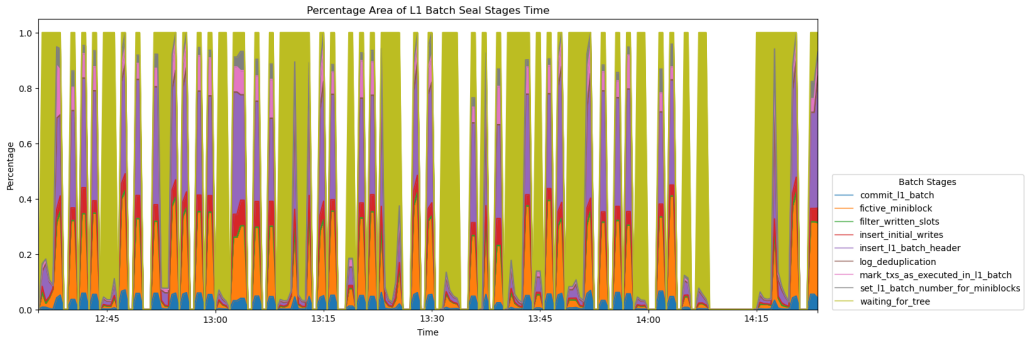
The load-bearing mechanism is the ZKsync rollup stack operated as a standalone chain: a sequencer receives swap transactions, groups them into miniblocks, and later seals them into L1 batches, while a prover generates validity proofs for each batch. The benchmark machinery is a modified transaction generator that uses WebSocket submission from five parallel instances, each with its own IP address, to flood a forked Uniswap V2 router's swapExactTokensForTokens function. The analysis pipeline computes cumulative TPS from submission and inclusion timestamps, and the internal ZKsync logging and parsing path breaks down L1 batch sealing into stages, isolating the Merkle-tree update stage as the dominant delay at up to 2.44 seconds. The paper's key comparative device is gas-per-second reasoning: swap transactions consume far more gas than transfers, so the reported TPS is meant as a conservative estimate of real-world DeFi throughput.
What would settle it
Rerun the same Uniswap V2 swap workload on the same ZKsync deployment with six or more generator instances and a sustained load lasting several minutes; if cumulative TPS collapses toward or below Ethereum L1's rate as generators increase, the 71.43 TPS result is an artifact of the test harness's five-instance ceiling. Alternatively, instrument the sequencer's memory and queue depth during the run: if the sequencer is idle while generators wait, or if transaction inclusion stops despite an open mempool, the bottleneck is not the rollup protocol.
Extended reading notes
Core claim
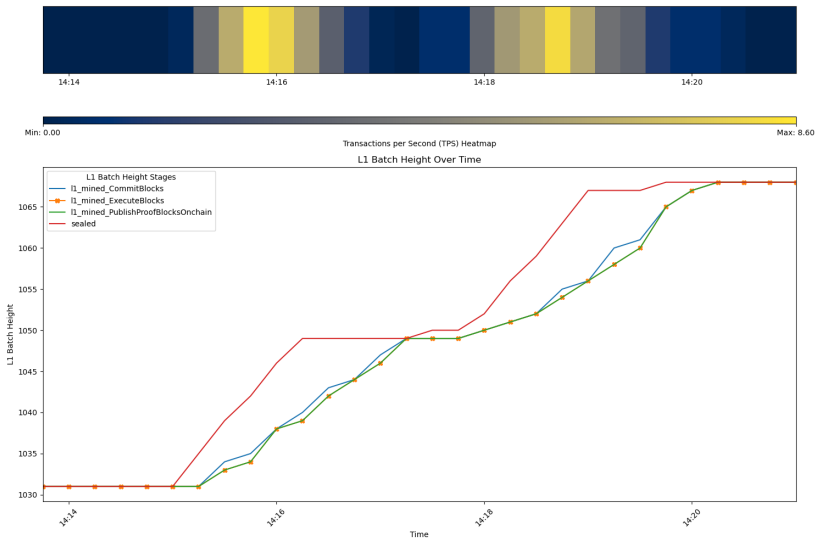
On its own terms, the paper establishes that a locally deployed ZKsync-based ZK rollup can process gas-intensive Uniswap V2 swap transactions at a sustained cumulative rate of 71.43 TPS, peaking at 98.4 TPS at the four-second mark, over a 14-second burst of 1,000 swaps from 50 funded accounts. It contrasts this with Ethereum's native throughput of about 15 TPS and with headline rollup numbers that are often measured using simple transfers. The paper further reports that over 50% of swaps were included in L2 miniblocks within 2.5 seconds (soft finality), while hard finality on L1 took 10-20 minutes, and that adding a sixth generator instance destabilized the sequencer. It identifies sequencer scheduling toggling, Merkle-tree updates (up to 2.44 s per batch), and miniblock under-filling relative to L1 batches as the principal performance limiters in this configuration.
Load-bearing premise
The headline throughput rests on the assumption that the five-generator, 1,000-swap, 14-second run is a true measure of rollup capacity, not a reflection of generator-side saturation or a sequencer that becomes unstable with a sixth generator.
Editorial extensions
If this is right
- If the measured throughput holds, a single self-hosted ZK rollup node of comparable specifications can carry gas-heavy DeFi traffic at several times Ethereum L1's rate, at least for bursts of roughly a thousand transactions.
- Soft finality in under 2.5 seconds means user-facing DEX interactions can feel instant, but settlement-critical logic such as liquidations or bridges must budget for 10-20 minutes to reach hard finality.
- Sequencer instability beyond five parallel generators implies current ZK-rollup deployments need load shedding or decentralized sequencing before they can absorb sustained high-volume traffic.
- Because miniblocks carry fewer than one-third the transactions of L1 batches, latency-oriented sequencing raises per-transaction L1 cost; aligning miniblock size with batch capacity would improve cost amortization.
- Merkle-tree updates dominate batch sealing, so improving that single cryptographic step would shorten hard-finality latency more than most other pipeline optimizations.
Reading between the lines
- Beyond the paper, the 71 TPS figure should not be read as a protocol ceiling; rerunning the same harness on other rollup architectures or with a decentralized sequencer set could show whether throughput is a property of validity proofs or of sequencer scheduling.
- Beyond the paper, a direct implication left implicit is that gas per second, not raw TPS, is the transferable comparison; re-expressing the 1,000 swaps as gas per second would let any DEX workload on any chain be compared without knowing block sizes.
- Beyond the paper, if the six-generator instability is a sequencer memory or priority issue rather than a networking artifact, then a simple queue-depth limiter or backpressure mechanism could raise sustained throughput, and that is testable in the same setup.
- Beyond the paper, extending the 14-second window to several minutes would reveal whether 71 TPS is sustainable or only a burst behavior, since the paper's own data show throughput declining as generator count rises.
Editorial analysis
A structured set of objections, weighed in public.
Circularity Check
No significant circularity: the throughput result is a direct measurement of logged transactions, and the self-citations are contextual only.
full rationale
The paper makes an empirical benchmark claim rather than a derived one. The central quantity, 71.43 TPS, is computed from the paper's own explicitly stated formula in Section V-A: 'Cumulative TPS = Total (swap) transactions processed / Elapsed time (in seconds)', which is just the definition of a throughput measurement applied to logged inclusion data. Nothing is fitted to a subset and then renamed a prediction; the value 1,000/14 = 71.43 is an arithmetic summary of one recorded run. The stress-test harness limits (six generator instances destabilize the sequencer; Table I shows throughput declining with instance count) are validity threats to the generalizability of the measurement, but they are not circularity: the claim does not become true by construction through any parameter fitted from the data or through any self-citation. The cited prior works by the same authors ([3], [17]) are used only as related-work context and motivation, not as premises of the throughput computation; no uniqueness theorem or ansatz is imported from them. The benchmark is externally falsifiable: the code and modifications are public and the measurement depends on independent run-time behavior. Therefore no load-bearing circular step is present.
Assumptions & free parameters
free parameters (3)
- Block capacity normalization =
300 swap transactions per block
- Ethereum baseline TPS =
12, 15, and 15-23 TPS in different places
- Generator instance count =
5 instances
assumptions (3)
- domain assumption A private ZKsync elastic chain on Sepolia with a local sequencer and prover is a representative ZK rollup deployment for benchmarking.
- domain assumption Ethereum L1 throughput estimates from external sources are a valid baseline for comparing swap TPS on the rollup.
- ad hoc to paper One stress-test run is sufficient to estimate sustained throughput.
Cite this review
Pith. "Pith review of Scaling DeFi with ZK Rollups: Design, Deployment, and Evaluation of a Real-Time Proof-of-Concept." pith.science (2026). https://pith.science/paper/AJST6543
@misc{pith2026250600500,
  author       = {Pith},
  title        = {Pith review of: Scaling DeFi with ZK Rollups: Design, Deployment, and Evaluation of a Real-Time Proof-of-Concept},
  year         = {2026},
  howpublished = {\url{https://pith.science/paper/AJST6543}},
  note         = {Machine review of arXiv:2506.00500}
}
read the original abstract
Ethereum's scalability limitations pose significant challenges for the adoption of decentralized applications (dApps). Zero-Knowledge Rollups (ZK Rollups) present a promising solution, bundling transactions off-chain and submitting validity proofs on-chain to enhance throughput and efficiency. In this work, we examine the technical underpinnings of ZK Rollups and stress test their performance in real-world applications in decentralized finance (DeFi). We set up a proof-of-concept (PoC) consisting of ZK rollup and decentralized exchange, and implement load balancer generating token swaps. Our results show that the rollup can process up to 71 swap transactions per second, compared to 12 general transaction by Ethereum. We further analyze transaction finality trade-offs with related security concerns, and discuss the future directions for integrating ZK Rollups into Ethereum's broader ecosystem.
Figures


Figures from the paper (6 more)



Reference graph
Works this paper leans on
-
[1]
Ethereum: A Next-Generation Smart Contract and Decen- tralized Application Platform
V . Buterin, “Ethereum: A Next-Generation Smart Contract and Decen- tralized Application Platform.” 2014
work page 2014
-
[2]
Bitcoin: A Peer-to-Peer Electronic Cash System,
S. Nakamoto, “Bitcoin: A Peer-to-Peer Electronic Cash System,” 2008
2008
-
[3]
SoK: Decentralized Finance (DeFi) - Fundamentals, Taxonomy and Risks,
K. Gogol, C. Killer, M. Schlosser, T. Boeck, and B. Stiller, “SoK: Decentralized Finance (DeFi) - Fundamentals, Taxonomy and Risks,” arXiv preprint arXiv:2404.11281 , 2023
arXiv 2023
-
[4]
Sok: Decentralized finance (defi),
S. M. Werner, D. Perez, L. Gudgeon, A. Klages-Mundt, D. Harz, and W. J. Knottenbelt, “Sok: Decentralized finance (defi),” 2022
work page 2022
-
[5]
Decentralized finance: On blockchain- and smart contract- based financial markets,
F. Sch ¨ar, “Decentralized finance: On blockchain- and smart contract- based financial markets,” 2020. [Online]. Available: https://ssrn.com/ abstract=3571335orhttp://dx.doi.org/10.2139/ssrn.3571335
-
[6]
The technology of decentralized finance (defi),
R. Auer, B. Haslhofer, S. Kitzler, P. Saggese, and F. Victor, “The technology of decentralized finance (defi),” 2023
work page 2023
-
[7]
Total Value Locked All Chains,
DeFi Llama, “Total Value Locked All Chains,” 2024, accessed on February 7, 2025. [Online]. Available: https://defillama.com/chains
work page 2024
-
[8]
The scalability challenge of ethereum: An initial quantitative analysis,
M. Bez, G. Fornari, and T. Vardanega, “The scalability challenge of ethereum: An initial quantitative analysis,” 2019
work page 2019
Show all 27 references
-
[9]
Blockchain Scaling Using Rollups: A Comprehensive Survey,
L. T. Thibault, T. Sarry, and A. S. Hafid, “Blockchain Scaling Using Rollups: A Comprehensive Survey,” 2022
2022
-
[10]
Shades of Finality and Layer 2 Scaling,
B. Yee, D. Song, P. McCorry, and C. Buckland, “Shades of Finality and Layer 2 Scaling,” 2022
2022
-
[11]
zksync era: Overview,
ZKSync, “zksync era: Overview,” 2024
2024
-
[12]
Scaling Actitivy,
L2Beat, “Scaling Actitivy,” 2024, accessed on February 7, 2025. [Online]. Available: https://l2beat.com/scaling/activity
2024
-
[13]
Rollup Gas per Second (GPS),
ConduitXYZ, “Rollup Gas per Second (GPS),” 2024, accessed on February 7, 2025. [Online]. Available: https://rollup.wtf/
2024
-
[14]
SoK: Decentralized exchanges (DEX) with automated market maker (AMM) protocols,
J. Xu, K. Paruch, S. Cousaert, and Y . Feng, “SoK: Decentralized exchanges (DEX) with automated market maker (AMM) protocols,” ACM Computing Surveys, vol. 55, no. 11, pp. 1–50, feb 2023. [Online]. Available: https://doi.org/10.1145%2F3570639
2023
-
[15]
Ethereum, smart contracts and the optimistic roll-up,
M. Armstrong, “Ethereum, smart contracts and the optimistic roll-up,” 2021
2021
-
[16]
Analyzing and Benchmarking ZK-Rollups,
S. Chaliasos, I. Reif, A. Torralba-Agell, J. Ernstberger, A. Kattis, and B. Livshits, “Analyzing and Benchmarking ZK-Rollups,”6th Conference on Advances in Financial Technologies (AFT 2024) , 2024
2024
-
[17]
Quan- tifying arbitrage in automated market makers: An empirical study of ethereum zk rollups,
K. Gogol, J. Messias, D. Miori, C. Tessone, and B. Livshits, “Quan- tifying arbitrage in automated market makers: An empirical study of ethereum zk rollups,” 2024
2024
-
[18]
SoK: Decentralized Exchanges (DEX) with Automated Market Maker (AMM) Protocols,
J. Xu, K. Paruch, S. Cousaert, and Y . Feng, “SoK: Decentralized Exchanges (DEX) with Automated Market Maker (AMM) Protocols,” 2021
2021
-
[19]
A Comprehensive Review of Blockchain Consensus Mechanisms,
B. Lashkari and P. Musilek, “A Comprehensive Review of Blockchain Consensus Mechanisms,” IEEE Access, 2021
2021
-
[20]
SoK: Sharding on Blockchain,
G. Wang, Z. J. Shi, M. Nixon, and S. Han, “SoK: Sharding on Blockchain,” in Proceedings of the 1st ACM Conference on Advances in Financial Technologies, 2019
2019
-
[21]
Layer 2 blockchain scaling: a survey,
C. Sguanci, R. Spatafora, and A. M. Vergani, “Layer 2 blockchain scaling: a survey,” arXiv preprint arXiv:2107.10881 , 2021
2021 arXiv
-
[22]
A Survey of Layer-Two Blockchain Protocols,
A. Gangwal, H. R. Gangavalli, and A. Thirupathi, “A Survey of Layer-Two Blockchain Protocols,” Journal of Network and Computer Applications, Vol 209, 2022
2022
-
[23]
Blockchain Scaling Using Rollups: A Comprehensive Survey,
L. T. Thibault, T. Sarry, and A. S. Hafid, “Blockchain Scaling Using Rollups: A Comprehensive Survey,” IEEE Access, 2022
2022
-
[24]
Towards a formal foundation for blockchain rollups,
B. L. Stefanos Chaliasos, Denis Firsov, “Towards a formal foundation for blockchain rollups,” arXiv preprint arXiv:2406.16219 , 2024. [Online]. Available: https://arxiv.org/abs/2406.16219
2024
-
[25]
SoK: Decentralized Se- quencers for Rollups,
S. Motepalli, L. Freitas, and B. Livshits, “SoK: Decentralized Se- quencers for Rollups,” arXiv preprint arXiv:2310.03616 , 2023
2023 arXiv
-
[26]
(2024) Rollup amm tps test: Transaction generator
github.com/bogatyy. (2024) Rollup amm tps test: Transaction generator. Online, accessed: 2024-10-25. [Online]. Available: https://github.com/ bogatyy/rollup-amm-tps-test/tree/main
2024
-
[27]
Waiting for Tree
T. generator. (2024) Generator of amm swaps. [Online]. Available: https://gitlab.uzh.ch/szczepandominik.gurgul/amm-transactiongenerator APPENDIX APPENDIX : DETAILED BATCH SEALING BREAKDOWN This appendix provides a deeper view into the internal execution stages involved in fina...
2024
Reviewed August 7, 2026 · model on record in the stance chip above.
Discussion (0). Sign in to comment.