REVIEW 4 major objections 5 minor 68 references
Antenna Q-Factor Topology Optimization with Auxiliary Edge Resistivities
T0 review · 4 major / 5 minor · reviewed 2026-08-07 · deepseek-v4-flash
Pith's one-line read Auxiliary edge resistivities turn antenna topology optimization into a fast gradient-descent problem, reaching Q-factors within 6% of the lower bound in 12 seconds for 1408 unknowns.
desk verdict A real speedup in MoM topology optimization, with an honest caveat that the optimized Q is in the relaxed model and shifts by 55-60 MHz when converted to a real antenna. read the letter →
The pith
A machine-rendered reading of the paper's core claim, the machinery that carries it, and where it could break.
The reading
What carries the argument
The load-bearing object is the auxiliary edge resistivity $r_n$ attached to each RWG basis function $\psi_n$, which enters the method-of-moments system as a diagonal lumped-element matrix, changing $\mathbf{Z}\mathbf{I} = \mathbf{V}$ into $[\mathbf{Z} + \Theta(\mathbf{g}_c)]\mathbf{I} = \mathbf{V}$. Because removing a basis function is exactly an infinite resistance on that edge, and because the design vector $\mathbf{g}_c \in [0,1]^N$ is mapped to resistivities through a smooth interpolation with penalization, density filtering, and thresholding projections, the binary question of whether metal is present becomes a differentiable one. Gradients are evaluated by automatic differentiation, and the box-constrained design space is handled by mapping an unconstrained weight through a sigmoid. An outer Bayesian optimization loop selects the delta-gap feed position and the gradient-descent hyperparameters, while a binary regularization term drives $\mathbf{g}_c$ to 0 or 1, reducing the gap between the grayscale optimum and the thresholded design.
What would settle it
Take one of the optimized thresholded designs, replace every intermediate or removed edge by a physical slot of finite width, remove point connections, run a full-wave simulation of the realized antenna, and compare the Q-factor at the shifted resonance with $Q/Q_{\mathrm{TM}}^{\mathrm{lb}} = 1.06$; the paper's own conversion shows a 55–60 MHz resonance shift, so a decisive test is whether the realized Q-factor still lies within a few percent of the lower bound after that shift.
Extended reading notes
Core claim
The central claim is that removing an RWG basis function, equivalently placing an infinitely resistive lumped element on that edge to carve a slot, can be relaxed to a continuous edge resistivity, and that this continuous space is smooth enough for adaptive gradient descent to optimize antenna topology directly. On the Q-factor minimization benchmark with 1408 basis functions at $ka = 0.8$, the auxiliary edge resistivity method reaches $Q/Q_{\mathrm{TM}}^{\mathrm{lb}} = 1.06$ in 12 seconds, compared with 161 seconds and $Q/Q_{\mathrm{TM}}^{\mathrm{lb}} = 1.17$ for the material-density method, 4748 seconds and 1.14 for the memetic scheme, and 5762 seconds and 1.20 for the genetic algorithm; with 2454 basis functions the same $Q/Q_{\mathrm{TM}}^{\mathrm{lb}} = 1.06$ is reached in 44 seconds. The method achieves self-resonance in the method-of-moments model for electrical sizes $ka \ge 0.5$, and the binarization measure stays small, so thresholding barely changes the Q-factor. The paper's own conversion of two optimized designs into manufacturable slot models shows that the idealized method-of-moments topology is not directly realizable: finite slot widths and removed node connections shift the resonance by about 55–60 MHz.
Load-bearing premise
The whole optimization rests on the equivalence between removing a basis function and placing an infinite resistor on that edge, and on the assumption that intermediate resistivity values interpolate physically realizable slot-like topologies; if a continuous resistivity does not correspond to a real slot, the optimized Q-factor is not the Q-factor of the realized antenna.
Editorial extensions
If this is right
- Local, gradient-based antenna topology optimization can now handle tens of thousands of degrees of freedom at practical cost, since each design variable touches only one row and one column of the method-of-moments matrix.
- The binarization problem is substantially reduced, so a thresholded topology inherits most of the optimized Q-factor instead of requiring a separate post-processing redesign.
- For electrical sizes $ka \ge 0.5$, the method finds self-resonant designs that match or slightly beat reference meanderline antennas; for smaller $ka$ the paper attributes the gap to insufficient mesh resolution rather than to the method itself.
- A practical realization of the optimized topology still requires converting infinitely thin slots and point connections into finite-width, manufacturable slots, and this conversion shifts the resonance frequency by roughly 5–6%.
- The same local optimizer can serve as a generator of initial designs for other, more expensive optimization tactics, because it already explores the topology space quickly.
Reading between the lines
- If the cost-geometry advantage generalizes beyond Q-factor, the same edge-resistivity variable could be reused for objectives such as realized gain, input matching, or bandwidth, because automatic differentiation supplies gradients for any scalar loss built on the method-of-moments currents.
- The 55–60 MHz resonance shift in the conversion step suggests that the reported $Q/Q_{\mathrm{TM}}^{\mathrm{lb}}$ values are bounds on an idealized surface-current topology rather than on a directly manufacturable antenna; a natural test is to optimize over finite slot width and node-connection removal during the optimization so the realized antenna, not the idealized one, is what approaches the l
- The method's dependence on careful hyperparameter choice could be reduced by making the outer Bayesian loop also decide the density-filter radius and the thresholding schedule, which the paper fixes manually; that would make the advertised speed reproducible without expert tuning.
Editorial analysis
A structured set of objections, weighed in public.
Referee Report
Summary. The manuscript introduces a topology optimization framework for method-of-moments (MoM) antenna design. Each RWG basis function is assigned an auxiliary edge resistivity, loaded into the EFIE impedance matrix, and these resistivities are relaxed to continuous values via an interpolation with penalization, density filtering, and projection. The Q-factor loss is minimized with automatic differentiation and the AdamW optimizer, and a Bayesian optimization layer selects hyperparameters and the delta-gap feed position. Numerical experiments in rectangular design regions report Q/Q_TM_lb = 1.06 in 12 s with 1408 RWG unknowns, which the authors compare favorably with material-density, memetic, and genetic-algorithm baselines. Bi-level results are shown for ka = 0.1 to 0.7, and two designs at ka = 0.5 and 0.7 are converted to CST models. The CST verification shows self-resonance frequency shifts of 55-60 MHz, corresponding to a change in electrical size to ka = 0.531 and ka = 0.738. The paper concludes that the method outperforms current MoM topology optimization methods in convergence, while acknowledging hyperparameter sensitivity and conversion-related frequency shifts.
Significance. The central idea is genuinely useful: optimizing topology through per-edge auxiliary resistivities, rather than per-triangle material densities, gives a differentiable formulation whose state equation is a modestly modified EFIE system, and automatic differentiation plus AdamW provides a fast local optimizer. The paper also ships code and benchmarks against the external TM Q-factor lower bound, and it includes a CST verification step, which makes the gap between the idealized MoM result and a manufacturable antenna explicit rather than hidden. If the convergence and quality claims survive a repeated, fairly controlled benchmark, this would be a meaningful advance for electrically small antenna topology optimization. The main weakness is that the strongest quantitative claims are established in an idealized MoM representation whose mapping to a realized antenna is only partially verified: the conversion shifts the resonance, the realized Q at the shifted electrical size is not compared with the lower bound, and the benchmark comparisons are based on single runs.
major comments (4)
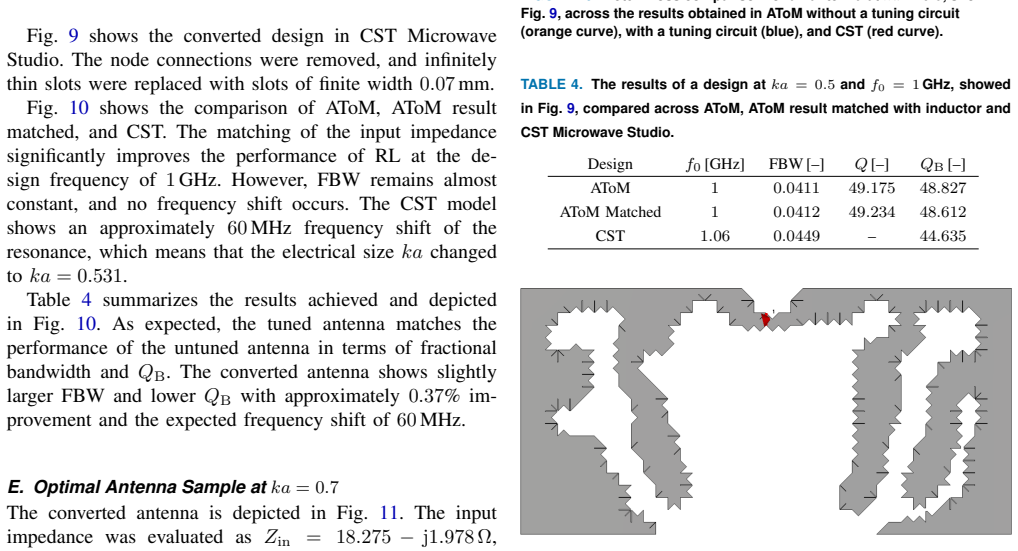
- [Section V-C, Tables 4-5] The CST verification changes the electrical size at which the design is self-resonant: the ka = 0.5 design resonates at f = 1.06 GHz (ka = 0.531) and the ka = 0.7 design at 1.055 GHz (ka = 0.738). Since the TM lower bound decreases as ka increases, the Q/Q_TM_lb values reported at ka = 0.5 and 0.7 are not valid for the realized antennas. The manuscript reports only FBW and QB for the CST models. Please report Q and Q/Q_TM_lb at the actual resonance of each converted design (using both AToM and CST input impedances), and separate the effect of the electrical-size change from the effect of slot widening and point-connection removal.
- [Section V-A, Figure 4, Table 2] The headline claim that auxiliary edge resistivity topology optimization outperforms material-density, memetic, and genetic algorithms rests on one run per method. Given the AdamW instability shown in the orange box of Fig. 4 and the authors' own statement that careful tuning of optimizer hyperparameters is required, a single 12 s result is not a robust basis for the comparison. Please report multiple restarts or Bayesian-optimization seeds for the proposed method, and clarify whether the baseline numbers in Table 2 are best-of-many or single runs; provide at least a range or distribution of Q/Q_TM_lb and wall-clock time.
- [Section II-B/C and Section V-C] The auxiliary edge resistivity formulation is a continuous relaxation of topology: intermediate resistivities allow current distributions that a binary PEC/slot geometry cannot support, and the interpolation in Eqs. (3)-(4) is inherited from Ref. [31] rather than validated here. The paper's own conversion study shows that the thresholded MoM output is not directly manufacturable: point connections are removed and zero-width slots are widened to 0.07-0.08 mm before CST simulation. Therefore the claim that the method 'solves the binarization issue' is only about the optimization's grayscale values, not about the existence of a manufactured structure with the same Q. Please add an explicit cleanup-and-verify step for the exact thresholded geometry and quantify how much of the optimized Q is lost when intermediate resistivities are removed and finite slots are introduced.
- [Section V-A, Figure 5 and Table 2] The variable-count comparison is unclear. The text states that the auxiliary edge-resistivity run uses 1408 DOF while the material-density run uses 1664, yet Table 2 aligns both under N = 1408. Material-density topology optimization optimizes one density per triangle, whereas the proposed method optimizes one resistivity per RWG edge, so 'N' does not refer to the same quantity for both methods unless explicitly stated. Define N for each baseline, report the corresponding mesh statistics (number of triangles, edges, and boundary edges), and ensure that the runtime comparisons are made either at equal geometric mesh resolution or explicitly labeled as different resolutions.
minor comments (5)
- [Table 5] The caption of Table 5 says ka = 0.5, but Section V-E and the surrounding text describe the ka = 0.7 design; correct the caption.
- [Eq. (11) and Appendix A] The symbol p is overloaded: it denotes the line-parametrization variable in Eq. (11) and the fixed penalization parameter in Eq. (16). Rename one of them to avoid confusion.
- [Algorithm 1] The pseudocode lines 'I ← Θ' and 'QE, QU ← I' are telegraphic; clarify that a MoM system is solved and state which matrices are used to evaluate the loss, since reproducible implementation depends on this step.
- [Abstract] The phrase 'utilizes an auxiliary variables' should be 'utilizes auxiliary variables'.
- [Section VI] The Conclusion states that the two converted designs exhibit a 60 MHz frequency shift, but Tables 4 and 5 give 60 MHz and 55 MHz; use '55-60 MHz' for accuracy.
Circularity Check
No significant circularity: the central Q-factor results are benchmarked against an external lower bound and independently verified in CST, and the self-citations are to independent prior derivations rather than to the paper's own conclusions.
full rationale
The paper's central claim, that auxiliary edge resistivity topology optimization reaches Q/Q_TM_lb = 1.06 in 12 s for 1408 RWG degrees of freedom, is evaluated against the transverse-magnetic Q-factor lower bound, which is an external physical benchmark, and two of the optimized designs are converted to CST models whose return loss and bandwidth are independently simulated. The CST results show frequency shifts of 55-60 MHz, meaning the realized antennas operate at slightly different electrical sizes; this is a correctness or generalization concern, not circularity, because the paper does not redefine the Q-factor lower bound or the CST simulation in terms of its own outputs. The edge-resistivity equivalence, cited to [31], is a genuine prior mathematical result: setting the diagonal resistivity to infinity forces the corresponding RWG current coefficient to zero, which is exactly the removal of that basis function, and the interpolation used for intermediate resistivities is a standard, independently published topology-optimization construction. The Bayesian optimization layer does minimize the same loss whose final value is reported in Table 3, but this is a normal optimization procedure, not a circular prediction: the paper does not claim that the reported loss improvement is an out-of-sample or externally validated quantity, only that BO improves the local optimizer on the same objective. Comparisons against material-density TO [28], memetic [12], and genetic algorithms [57] rely on published baseline methods; even though some baselines share authors with the present paper, they are independently published algorithms and the comparison is an empirical benchmark rather than an argument that reduces to a self-citation. No equation in the derivation chain is defined in terms of its own output, and no fitted parameter is renamed as a prediction. Accordingly, no specific circular step can be quoted and the score is set to 0.
Assumptions & free parameters
free parameters (7)
- Resistivity interpolation bounds Ro and Rs =
Ro = 1e5 Ohm, Rs = 0.1 Ohm
- Density filter radius r =
0.2a recommended; adjusted per case in bi-level runs
- Projection level eta =
0.5
- Penalization parameter p =
1
- Scalarization coefficients delta_inc and gamma_max =
0.3 and 1 in bi-level runs; 0 in the convergence comparison
- AdamW learning rate alpha, weight decay lambda, max iterations imax =
Selected per case by Bayesian optimization, e.g., alpha = 0.03, lambda = 0.004, imax = 1947 at ka = 0.5
- Threshold steepness beta_max =
64 in bi-level runs; 32 in the comparison
assumptions (4)
- domain assumption Removing an RWG basis function is equivalent to inserting a lumped resistor of infinite resistance on that edge, and continuous intermediate resistivities interpolate topology.
- domain assumption The Q-factor and self-resonance tuning term QE computed from MoM reactance matrices correctly represent stored energy and radiated power for a single-port lossless antenna.
- domain assumption Near-binary optimized topologies after thresholding retain the performance of the grayscale design.
- standard math The density filter with Euclidean neighborhood correctly enforces minimum feature size on edge resistivities.
invented entities (1)
-
Auxiliary edge resistivities on RWG edges
Cite this review
Pith. "Pith review of Antenna Q-Factor Topology Optimization with Auxiliary Edge Resistivities." pith.science (2026). https://pith.science/paper/DY7OWFEY
@misc{pith2026250600595,
  author       = {Pith},
  title        = {Pith review of: Antenna Q-Factor Topology Optimization with Auxiliary Edge Resistivities},
  year         = {2026},
  howpublished = {\url{https://pith.science/paper/DY7OWFEY}},
  note         = {Machine review of arXiv:2506.00595}
}
read the original abstract
This paper presents a novel bi-level topology optimization strategy within the method-of-moments paradigm. The proposed approach utilizes an auxiliary variables called edge resistivities related to the Rao-Wilton-Glisson method-of-moments basis functions, for a definition of a fast local optimization algorithm. The local algorithm combines automatic differentiation with adaptive gradient descent. A Bayesian optimization scheme is applied on top of the local algorithm to search for an optimum position of the delta-gap feeding and optimizer hyperparameters. The strength of the algorithm is demonstrated on Q-factor minimization for electrically small antennas. Auxiliary edge resistivity topology optimization outperforms current state-of-the-art topology optimization methods, including material density-based approaches and memetic schemes, in terms of convergence. However, due to the nature of gradient descent, careful tuning of the optimizer hyperparameters is required. Furthermore, the proposed method solves the known binarization issue. Two designs that achieved self-resonance and approached the Q-factor lower bound were further assessed in CST Microwave Studio.
Figures


Figures from the paper (6 more)




Reference graph
Works this paper leans on
-
[31]
Shape synthesis based on topology sensitivity,
M. Capek, L. Jelinek, and M. Gustafsson, “Shape synthesis based on topology sensitivity,” IEEE Trans. Antennas Propag. , vol. 67, no. 6, pp. 3889 – 3901, Jun. 2019
work page 2019
-
[1]
C. A. Balanis, Modern Antenna Handbook . Wiley, 2008
work page 2008
-
[2]
Nature-inspired optimization techniques in communication antenna designs,
Y . Rahmat-Samii, J. M. Kovitz, and H. Rajagopalan, “Nature-inspired optimization techniques in communication antenna designs,” Proceed- ings of the IEEE , vol. 100, no. 7, pp. 2132–2144, 2012
work page 2012
-
[3]
Q. Wu, Y . Cao, H. Wang, and W. Hong, “Machine-learning-assisted optimization and its application to antenna designs: Opportunities and challenges,” China Communications, vol. 17, no. 4, pp. 152–164, 2020
work page 2020
-
[4]
M. Bendsøe and O. Sigmund, Topology optimization. Theory, methods, and applications. 2nd ed., corrected printing . Springer, 01 2004
work page 2004
-
[5]
Optimal inverse design based on memetic algorithm – Part II: Examples and proper- ties,
M. Capek, M. Gustafsson, L. Jelinek, and P. Kadlec, “Optimal inverse design based on memetic algorithm – Part II: Examples and proper- ties,” IEEE Trans. Antennas Propag., vol. 71, no. 11, pp. 8817–8829, 2023
work page 2023
-
[6]
Inverse design in nanophotonics,
S. Molesky, Z. Lin, A. Y . Piggott, W. Jin, J. Vuckovi ´c, and A. W. Rodriguez, “Inverse design in nanophotonics,” Nature Photonics , vol. 12, no. 11, p. 659–670, Oct. 2018. [Online]. Available: http://dx.doi.org/10.1038/s41566-018-0246-9
-
[7]
Antenna bandwidth optimization with single frequency simulation,
M. Cismasu and M. Gustafsson, “Antenna bandwidth optimization with single frequency simulation,” IEEE Transactions on Antennas and Propagation, vol. 62, no. 3, pp. 1304–1311, 2014
work page 2014
Show all 68 references
-
[8]
MoM-based topology optimization method for planar metallic antenna design,
S. Liu, Q. Wang, and R. Gao, “MoM-based topology optimization method for planar metallic antenna design,” Acta Mechanica Sinica , vol. 32, no. 6, pp. 1058–1064, Dec. 2016
2016
-
[9]
AI-Assisted antenna optimization: Integrating evolutionary and inverse cascade neural networks with dif- ferential evolution,
F. Peng, X. Chen, and J. Xue, “AI-Assisted antenna optimization: Integrating evolutionary and inverse cascade neural networks with dif- ferential evolution,” IEEE Transactions on Antennas and Propagation, pp. 1–1, 2025
2025
-
[10]
No free lunch theorems for optimiza- tion,
D. Wolpert and W. Macready, “No free lunch theorems for optimiza- tion,” IEEE Transactions on Evolutionary Computation , vol. 1, no. 1, pp. 67–82, 1997
1997
-
[11]
Genetic algorithms and method of moments (GA/MOM) for the design of integrated antennas,
J. Johnson and Y . Rahmat-Samii, “Genetic algorithms and method of moments (GA/MOM) for the design of integrated antennas,” IEEE Transactions on Antennas and Propagation, vol. 47, no. 10, pp. 1606– 1614, 1999
1999
-
[12]
Optimal inverse design based on memetic algorithms – Part I: Theory and implementa- tion,
M. Capek, M. Gustafsson, L. Jelinek, and P. Kadlec, “Optimal inverse design based on memetic algorithms – Part I: Theory and implementa- tion,” IEEE Trans. Antennas Propag., vol. 71, no. 11, pp. 8806–8816, 2023
2023
-
[13]
On the usefulness of non-gradient approaches in topology optimization,
O. Sigmund, “On the usefulness of non-gradient approaches in topology optimization,” Structural and Multidisciplinary Optimization, vol. 43, no. 5, p. 589–596, Mar. 2011. [Online]. Available: http://dx.doi.org/10.1007/s00158-011-0638-7
2011 doi
-
[14]
Closing the gap towards super-long suspension bridges using computational morpho- genesis,
M. Baandrup, O. Sigmund, H. Polk, and N. Aage, “Closing the gap towards super-long suspension bridges using computational morpho- genesis,” Nature Communications, vol. 11, no. 1, 2020
2020
-
[15]
Applications of machine learning and deep learning in antenna design, optimization, and selection: A review,
N. Sarker, P. Podder, M. R. H. Mondal, S. S. Shafin, and J. Kamruzza- man, “Applications of machine learning and deep learning in antenna design, optimization, and selection: A review,” IEEE Access, vol. 11, pp. 103 890–103 915, 2023
2023
-
[16]
On the use of artificial neural networks in topology optimisation,
R. V . Woldseth, N. Aage, J. A. Bærentzen, and O. Sigmund, “On the use of artificial neural networks in topology optimisation,” Structural and Multidisciplinary Optimization , vol. 65, no. 10, Oct. 2022. [Online]. Available: http://dx.doi.org/10.1007/s00158-022-03347-1
2022 doi
-
[17]
Antenna design by simulation-driven optimization,
S. Koziel and S. Ogurtsov, “Antenna design by simulation-driven optimization,” 2014. [Online]. Available: https://api.semanticscholar. org/CorpusID:114063736
2014
-
[18]
Machine-learning- assisted optimization for antenna geometry design,
Q. Wu, W. Chen, C. Yu, H. Wang, and W. Hong, “Machine-learning- assisted optimization for antenna geometry design,”IEEE Transactions on Antennas and Propagation , vol. 72, no. 3, pp. 2083–2095, 2024
2024
-
[19]
On the design of complex EM devices and systems through the System-by-Design paradigm: A framework for dealing with the computational complexity,
A. Massa and M. Salucci, “On the design of complex EM devices and systems through the System-by-Design paradigm: A framework for dealing with the computational complexity,” IEEE Transactions on Antennas and Propagation , vol. 70, no. 2, pp. 1328–1343, 2022
2022
-
[20]
Efficient global optimization of expensive black-box functions,
D. Jones, M. Schonlau, and W. Welch, “Efficient global optimization of expensive black-box functions,” Journal of Global Optimization , vol. 13, pp. 455–492, 12 1998
1998
-
[21]
A tutorial on Bayesian optimization,
P. I. Frazier, “A tutorial on Bayesian optimization,” 2018. [Online]. Available: https://arxiv.org/abs/1807.02811
2018 arXiv
-
[22]
Multimaterial topology opti- mization of electric machines based on normalized Gaussian network,
T. Sato, K. Watanabe, and H. Igarashi, “Multimaterial topology opti- mization of electric machines based on normalized Gaussian network,” IEEE Transactions on Magnetics , vol. 51, no. 3, pp. 1–4, 2015
2015
-
[23]
Fast learning in networks of locally-tuned processing units,
J. Moody and C. J. Darken, “Fast learning in networks of locally-tuned processing units,” Neural Computation , vol. 1, no. 2, pp. 281–294, 1989
1989
-
[24]
Physics-informed neural networks: A deep learning framework for solving forward and inverse problems involving nonlinear partial differential equations,
M. Raissi, P. Perdikaris, and G. Karniadakis, “Physics-informed neural networks: A deep learning framework for solving forward and inverse problems involving nonlinear partial differential equations,” Journal of Computational Physics , vol. 378, p. 686–707, Feb. 2019. [Online]...
2019 doi
-
[25]
A physics-informed neural network-based topology optimization (PINNTO) framework for structural optimization,
H. Jeong, J. Bai, C. Batuwatta-Gamage, C. Rathnayaka, Y . Zhou, and Y . Gu, “A physics-informed neural network-based topology optimization (PINNTO) framework for structural optimization,” Engineering Structures , vol. 278, p. 115484, Mar. 2023. [Online]. Available: http://dx.d...
2023
-
[26]
R. F. Harrington and J. L. Harrington, Field Computation by Moment Methods, 1st ed. USA: Oxford University Press, Inc., 1996
1996
-
[27]
Electromagnetic sensitivity analysis and shape optimiza- tion using method of moments and automatic differentiation,
J. I. Toivanen, R. A. E. Makinen, S. Jarvenpaa, P. Yla-Oijala, and J. Rahola, “Electromagnetic sensitivity analysis and shape optimiza- tion using method of moments and automatic differentiation,” IEEE Transactions on Antennas and Propagation , vol. 57, no. 1, pp. 168– 175, 2009
2009
-
[28]
Density-based topology optimization in method of moments: Q-factor minimization,
J. Tucek, M. Capek, L. Jelinek, and O. Sigmund, “Density-based topology optimization in method of moments: Q-factor minimization,” IEEE Trans. Antennas Propag. , vol. 71, no. 12, p. 9738–9751, Dec. 2023
2023
-
[29]
Optimal planar electric dipole antennas: Searching for antennas reaching the fundamental bounds on selected metrics,
M. Capek, L. Jelinek, K. Schab, M. Gustafsson, B. Jonsson, F. Ferrero, and C. Ehrenborg, “Optimal planar electric dipole antennas: Searching for antennas reaching the fundamental bounds on selected metrics,” IEEE Antennas and Propagation Magazine , vol. 61, no. 4, p. 19–29, Au...
2019
-
[30]
Shape regularization and acceleration of topology optimization via point group symmetries,
M. Capek, V . Neuman, J. Tucek, and L. Jelinek, “Shape regularization and acceleration of topology optimization via point group symmetries,” in 2022 16th European Conference on Antennas and Propagation (EuCAP), 2022, pp. 1–4
2022
-
[32]
Impedance, bandwidth and Q of antennas,
A. D. Yaghjian and S. R. Best, “Impedance, bandwidth and Q of antennas,” IEEE Trans. Antennas Propag. , vol. 53, no. 4, pp. 1298– 1324, Apr. 2005
2005
-
[33]
Fundamentals of antenna bandwidth and quality factor,
A. D. Yaghjian, “Fundamentals of antenna bandwidth and quality factor,” 2025. [Online]. Available: https://arxiv.org/abs/2501.03146
2025 arXiv
-
[34]
Automatic differentiation in machine learning: a survey,
A. G. Baydin, B. A. Pearlmutter, A. A. Radul, and J. M. Siskind, “Automatic differentiation in machine learning: a survey,” 2015. [Online]. Available: https://arxiv.org/abs/1502.05767
2015 arXiv
-
[35]
SGDR: Stochastic gradient descent with warm restarts,
I. Loshchilov and F. Hutter, “SGDR: Stochastic gradient descent with warm restarts,” 2017. [Online]. Available: https://arxiv.org/abs/1608. 03983
2017
-
[36]
C. A. Balanis, Advanced Engineering Electromagnetics , 2nd ed. Hoboken, NJ, USA: Wiley, 2012
2012
-
[37]
Antenna Q-factor Topology Optimization with Auxiliary Edge Resitivities – GitHub Repository,
S. Bosak, M. Capek, and J. Matas, “Antenna Q-factor Topology Optimization with Auxiliary Edge Resitivities – GitHub Repository,” https://github.com/bosakstepan/AER TO, 2025
2025
-
[38]
Electromagnetic scattering by surfaces of arbitrary shape,
S. Rao, D. Wilton, and A. Glisson, “Electromagnetic scattering by surfaces of arbitrary shape,” IEEE Transactions on Antennas and Propagation, vol. 30, no. 3, pp. 409–418, 1982
1982
-
[39]
R. F. Harrington, Time-Harmonic Electromagnetic Fields , 2nd ed. Wiley – IEEE Press, 2001
2001
-
[40]
W. C. Chew, M. S. Tong, and B. Hu, Integral Equation Methods for Electromagnetic and Elastic Waves . Morgan & Claypool, 2009
2009
-
[41]
Control of radar scattering by reactive loading,
R. Harrington and J. Mautz, “Control of radar scattering by reactive loading,” IEEE Transactions on Antennas and Propagation , vol. 20, no. 4, p. 446–454, Jul. 1972. [Online]. Available: http://dx.doi.org/10.1109/TAP.1972.1140234
1972
-
[42]
Towards manufacturing- friendly shapes in discrete topology optimization,
V . Neuman, M. Capek, and L. Jelinek, “Towards manufacturing- friendly shapes in discrete topology optimization,” 2025. [Online]. Available: https://arxiv.org/abs/2503.10133
2025 arXiv
-
[43]
Topology optimization of sub- wavelength antennas,
A. Erentok and O. Sigmund, “Topology optimization of sub- wavelength antennas,” IEEE Transactions on Antennas and Propagation, vol. 59, no. 1, p. 58–69, Jan. 2011. [Online]. Available: http://dx.doi.org/10.1109/TAP.2010.2090451
2011
-
[44]
Topology optimization of non-linear elastic structures and compliant mechanisms,
T. E. Bruns and D. A. Tortorelli, “Topology optimization of non-linear elastic structures and compliant mechanisms,” Computer Methods in Applied Mechanics and Engineering , vol. 190, no. VOLUME , 13 : 26–27, p. 3443–3459, Mar. 2001. [Online]. Available: http: //dx.doi.org/10.1...
2001 doi
-
[45]
On projection methods, convergence and robust formulations in topology optimization,
F. Wang, B. S. Lazarov, and O. Sigmund, “On projection methods, convergence and robust formulations in topology optimization,” Structural and Multidisciplinary Optimization , vol. 43, no. 6, p. 767–784, Dec. 2010. [Online]. Available: http://dx.doi.org/10.1007/ s00158-010-0602-y
2010
-
[46]
Minimization of antenna quality factor,
M. Capek, M. Gustafsson, and K. Schab, “Minimization of antenna quality factor,” IEEE Transactions on Antennas and Propagation , vol. 65, no. 8, p. 4115–4123, Aug. 2017. [Online]. Available: http://dx.doi.org/10.1109/TAP.2017.2717478
2017
-
[47]
145-2013 – IEEE Standard for Definitions of Terms for Antennas , IEEE Std., Mar. 2014
2013
-
[48]
Reactive energies, impedance, and Q factor of radiating structures,
G. Vandenbosch, “Reactive energies, impedance, and Q factor of radiating structures,” IEEE Transactions on Antennas and Propagation, vol. 58, no. 4, p. 1112–1127, Apr. 2010. [Online]. Available: http://dx.doi.org/10.1109/TAP.2010.2041166
2010
-
[49]
Optimal composition of modal currents for minimal quality factor Q,
M. Capek and L. Jelinek, “Optimal composition of modal currents for minimal quality factor Q,” IEEE Transactions on Antennas and Propagation, vol. 64, no. 12, p. 5230–5242, Dec. 2016. [Online]. Available: http://dx.doi.org/10.1109/TAP.2016.2617779
2016
-
[50]
Morphology-based black and white filters for topology optimization,
O. Sigmund, “Morphology-based black and white filters for topology optimization,” Structural and Multidisciplinary Optimization, vol. 33, no. 4–5, p. 401–424, Jan. 2007. [Online]. Available: http://dx.doi.org/10.1007/s00158-006-0087-x
2007 doi
-
[51]
Gustafsson, D
M. Gustafsson, D. Tayli, and M. Cismasu, Physical Bounds of Antennas. Springer Singapore, 2015, p. 1–32. [Online]. Available: http://dx.doi.org/10.1007/978-981-4560-75-7 18-1
2015 doi
-
[52]
Decoupled weight decay regularization,
I. Loshchilov and F. Hutter, “Decoupled weight decay regularization,”
-
[53]
Automatic differen- tiation in PyTorch,
A. Paszke, S. Gross, S. Chintala, G. Chanan, E. Yang, Z. DeVito, Z. Lin, A. Desmaison, L. Antiga, and A. Lerer, “Automatic differen- tiation in PyTorch,” 2017
2017
-
[54]
Han and C
J. Han and C. Moraga, The influence of the sigmoid function parameters on the speed of backpropagation learning . Springer Berlin Heidelberg, 1995, p. 195–201. [Online]. Available: http: //dx.doi.org/10.1007/3-540-59497-3 175
1995 doi
-
[55]
Bayesian Optimization: Open source constrained global optimization tool for Python,
F. Nogueira, “Bayesian Optimization: Open source constrained global optimization tool for Python,” 2014–. [Online]. Available: https://github.com/bayesian-optimization/BayesianOptimization
2014
-
[56]
Czech Technical University in Prague
(2024) Antenna Toolbox for MATLAB (AToM). Czech Technical University in Prague. www.antennatoolbox.com. [Online]. Available: www.antennatoolbox.com
2024
-
[57]
Deb, Multi-Objective Optimization using Evolutionary Algorithms
K. Deb, Multi-Objective Optimization using Evolutionary Algorithms . New York, United States: Wiley, 2001
2001
-
[58]
Optimization of finite dimensional structures,
M. Ohsaki, “Optimization of finite dimensional structures,” Apr
-
[59]
Adam: A method for stochastic optimization,
D. P. Kingma and J. Ba, “Adam: A method for stochastic optimization,” 2017. [Online]. Available: https://arxiv.org/abs/1412. 6980
2017
-
[60]
On the convergence of Adam and beyond,
S. J. Reddi, S. Kale, and S. Kumar, “On the convergence of Adam and beyond,” 2019. [Online]. Available: https://arxiv.org/abs/1904.09237
2019 arXiv
-
[61]
The method of moving asymptotes—a new method for structural optimization,
K. Svanberg, “The method of moving asymptotes—a new method for structural optimization,” International Journal for Numerical Methods in Engineering, vol. 24, no. 2, pp. 359–373, 1987. [Online]. Available: https://onlinelibrary.wiley.com/doi/abs/10.1002/nme.1620240207
1987 doi
-
[62]
A new approach to variable-topology shape design using a constraint on perimeter,
R. B. Haber, C. S. Jog, and M. P. Bendsøe, “A new approach to variable-topology shape design using a constraint on perimeter,” Structural Optimization , vol. 11, no. 1–2, p. 1–12, Feb. 1996. [Online]. Available: http://dx.doi.org/10.1007/BF01279647
1996 doi
-
[63]
Dassault Systemes
(2025) CST Computer Simulation Technology. Dassault Systemes. [Online]. Available: https://www.3ds.com/products-services/simulia/ products/cst-studio-suite/
2025
-
[64]
Filters in topology optimization,
B. Bourdin, “Filters in topology optimization,” International Journal for Numerical Methods in Engineering , vol. 50, no. 9, p. 2143–2158, Feb. 2001. [Online]. Available: http://dx.doi.org/10.1002/nme.116
2001 doi
-
[65]
Antenna current optimization using MATLAB and CVX,
M. Gustafsson, D. Tayli, C. Ehrenborg, M. Cismasu, and S. Norbedo, “Antenna current optimization using MATLAB and CVX,” FERMAT, vol. 15, no. 5, pp. 1–29, May–June 2016. [Online]. Available: https:// efermat.github.io/articles/Gustafsson-ART-2016-V ol15-May Jun-005/ Stepan Bosa...
2016
-
[2016]
Available: http://dx.doi.org/10.1201/EBK1439820032
[Online]. Available: http://dx.doi.org/10.1201/EBK1439820032
-
[2017]
Available: https://arxiv.org/abs/1711.05101
[Online]. Available: https://arxiv.org/abs/1711.05101
-
[2023]
in the area of Machine-Learning-Assisted Inverse Design in Electromagnetism
He is currently pursuing a Ph.D. in the area of Machine-Learning-Assisted Inverse Design in Electromagnetism. Miloslav Capek (M’14, SM’17) received the M.Sc. degree in Electrical Engineering 2009, the Ph.D. degree in 2014, and was appointed a Full Professor in 2023, all from t...
1995
Reviewed August 7, 2026 · model on record in the stance chip above.
Discussion (0). Sign in to comment.