REVIEW 4 major objections 6 minor 1 cited by
Dual-UAV-Aided Covert Communications for Air-to-Ground ISAC Networks
T0 review · 4 major / 6 minor · reviewed 2026-08-07 · deepseek-v4-flash
Pith's one-line read Co-designing two drone trajectories and beamformers, with a jammer's artificial noise reused as a bistatic sensing waveform, maximizes average covert rate and sensing performance in an air-to-ground integrated sensing and communication…
desk verdict A genuinely new dual-UAV covert ISAC concept with a coherent model, but the SCA trajectory update has a missing-factor gradient error that undercuts the main simulation claims until fixed. read the letter →
The pith
A machine-rendered reading of the paper's core claim, the machinery that carries it, and where it could break.
The reading
What carries the argument
The load-bearing object is the distance-normalized beampattern sum-gain, which measures the sensing power arriving at each ground target from both the source UAV and the jamming UAV, normalized by squared slant distances. This quantity couples the jamming beamformer into the sensing constraint and turns the jammer's artificial noise into a sensing resource. The covertness requirement is expressed through a Kullback-Leibler divergence bound derived from the warden's Neyman-Pearson detector, rewritten as a linear inequality in the source beamformer, jamming beamformer, and sensing covariance. The optimization is carried by block coordinate descent over the source trajectory, jammer trajectory, and beamformers, with trust-region successive convex approximation handling the non-concave trajectory subproblems and semidefinite relaxation with a nuclear-norm penalty enforcing the rank-one beamformer structure. Sensing-location selection is a greedy weighted-distance minimization that chooses time slots where the drones are close to both the user and the targets.
What would settle it
Run Algorithm 1 on a small instance, say ten time slots and two targets, from many random initial trajectories and check whether the surrogate value at each iteration bounds the true objective and whether all runs converge to the same average covert rate; alternatively, evaluate the inequalities in Eqs. (37) and (42) on a grid of UAV positions to find any point where the alleged lower bound exceeds the true rate or the alleged upper bound falls below the true covertness term.
Extended reading notes
Core claim
The paper asserts that a dual-UAV configuration, where the source UAV transmits a dual-functional waveform and the jamming UAV transmits artificial noise, can enhance covertness and sensing simultaneously. The artificial noise is included in the sensing beampattern gain, effectively forming a hybrid monostatic-bistatic radar in which the source UAV receives both its own target-echoed waveform and the jammer's scattered noise. The design maximizes the time-averaged covert rate from the source UAV to the ground user while keeping the warden's minimum detection error probability above a required level and the distance-normalized beampattern sum-gain toward each target above a sensing threshold. Imperfect successive interference cancellation at the user is modeled through residual interference levels, which the simulations show degrade the covert rate. The numerical results indicate that the co-designed scheme achieves the highest average covert rate and sensing gain among the compared schemes, and that these gains increase with the number of antennas and with a looser covertness requirement.
Load-bearing premise
The trust-region successive convex approximation assumes that the first-order Taylor expansions in Eqs. (37) and (42) are valid lower and upper bounds for the rate and covertness functions of the UAV positions, but the paper does not establish the needed convexity or concavity; if those bounds fail, the optimized trajectories may not increase the average covert rate and Algorithm 1 may not converge.
Editorial extensions
If this is right
- Covert integrated sensing and communication can use a second UAV as a jammer without sacrificing sensing, because the artificial noise wave is also a radar illumination signal.
- Jointly optimizing trajectories and beamformers outperforms fly-hover-fly trajectories even when those trajectories are followed by optimized beams.
- The proposed scheme maintains a positive average covert rate at high sensing thresholds where the fly-hover-fly benchmarks drop to zero, so sensing constraints need not eliminate covert communication.
- Imperfect successive interference cancellation is a first-order performance factor: better SIC quality directly increases the achievable covert rate.
- Increasing the number of antennas on the UAVs improves both the average covert rate and the sensing performance under the co-designed scheme.
- The simulation results show that the dual-UAV cooperative design achieves a higher average covert rate than the single-UAV scheme across the tested covertness and residual-interference ranges.
Reading between the lines
- A natural extension is to optimize the jammer's artificial noise covariance as a full-rank matrix rather than a single rank-one beam, which could confuse the warden more effectively while adding spatial diversity to the sensing illumination.
- The greedy sensing-slot selection assumes an equal number of slots per target and static target positions; unequal target priorities or moving targets would require an online variant of the weighted-distance minimization.
- Because the covertness guarantee is built on a lower bound of the detection error probability rather than the exact minimum, the design is conservative, and the actual detection probability may be even lower than the constraint suggests.
- The same hybrid monostatic-bistatic idea could apply to passive sensing scenarios where the jamming UAV illuminates targets without receiving echoes, provided synchronization and clock-offset effects are modeled.
Editorial analysis
A structured set of objections, weighed in public.
Referee Report
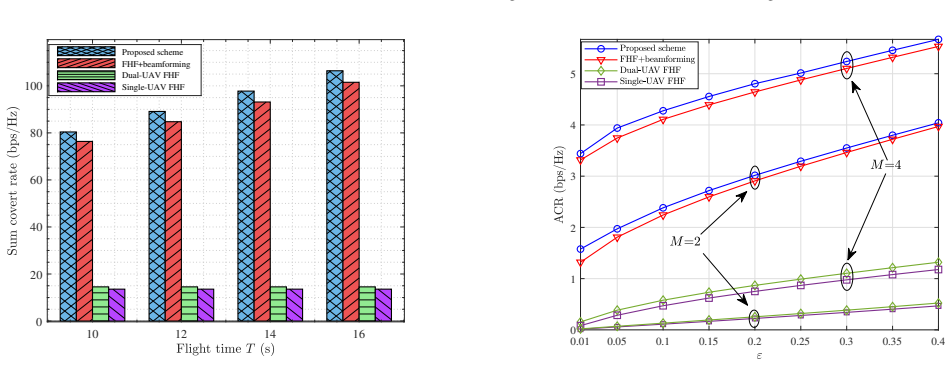
Summary. This paper considers covert communication in an air-to-ground ISAC network with two UAVs: Alice, a dual-functional BS transmitting to Bob while sensing ground targets, and Jack, a cooperative jammer whose artificial noise both confuses Willie and serves as a bistatic sensing illumination. The authors formulate two average-covert-rate maximization problems for the communication-only (CCO) and communication-plus-sensing (CCS) phases, with transmit power, maneuver, KL-divergence-based covertness, and distance-normalized beampattern sum-gain sensing constraints. A BCD method is proposed, alternating between SDR-based beamforming and trust-region SCA trajectory updates for Alice and Jack; the CCS phase selects sensing slots by a weighted-distance greedy algorithm and optimizes the dual-functional beamformers. Simulations compare the proposed scheme with fly-hover-fly and single-UAV benchmarks for different flight times, sensing thresholds, covertness levels, and residual SIC levels. The central claim is that the proposed co-design yields the highest ACR and sensing performance while satisfying all constraints.
Significance. The motivating idea of reusing a cooperative jammer's AN as a bistatic sensing waveform is attractive and is a reasonable extension of the single-UAV ISAC covert-communication literature. The system model is fairly complete: imperfect SIC is incorporated, and the covertness condition is derived from a standard KL-divergence bound rather than imposed ad hoc. The benchmarks and parameter sweeps in Figs. 4-7 provide concrete, falsifiable predictions, and no parameters are fitted to produce the reported curves. However, the algorithmic core of the paper, which generates those predictions, contains demonstrable algebraic errors in the claimed first-order Taylor expansions and provides no convergence proof. The numerical gains are therefore not presently supported. If the derivations are corrected and the simulations regenerated, the paper could be a useful contribution.
major comments (4)
- [III-A, Eq. (39)] The coefficient rho_a^(t1)[n] in Eq. (39) is not a valid first-order Taylor expansion of \hat R_b^cco[n] in Eq. (32). With d^2 = A_a^2 + ||u_a - v_b||^2 and zeta2 = eta_ab + d^2 zeta1, the true gradient is \nabla_{u_a}\hat R = (\gamma_ab + 2 zeta1 (u_a - v_b))/(ln2 * zeta2) - 2 (u_a - v_b)/(ln2 * d^2). Eq. (39) simplifies to \gamma_ab/(ln2 * zeta2) + zeta1 (u_a - v_b)/(ln2 * zeta2) - (u_a - v_b)/(ln2 * d^2), i.e., only half of the zeta1-dependent and distance-dependent terms. Hence Eq. (37) is not even a local linearization, and the inequality \hat R >= \tilde R is unsupported. Since Algorithm 1 updates Alice's trajectory by maximizing this surrogate in (P4.t1), the reported trajectory gains in Figs. 4-7 do not follow from the stated derivation.
- [III-B, Eq. (53)] Jack's trajectory update has the same defect. For zeta3 and zeta4 defined in Eqs. (49)-(50), a correct first-order expansion of \breve R_b^cco gives gradient terms [\varpi_jb \gamma_jb + 2(\sigma_b^2/\beta + K)(u_j - v_b)]/(ln2 * zeta4) - [\varpi_jb \gamma_jb + 2(\sigma_b^2/\beta)(u_j - v_b)]/(ln2 * zeta3), where K = tr(W_a A(u_a,v_b))/d^2(A_a,u_a,v_b). Eq. (53), as printed, lacks the vector (u_j - v_b) in the second term, and the coefficient structure does not match this gradient. Therefore the surrogate in Eq. (51) is not a first-order lower bound, and subproblem (P5.t2) is not the SCA subproblem claimed.
- [III-A, Eqs. (42)-(44)] The linearized covertness constraint (42) is also not the first-order expansion of (36). Expanding (36) at u_a^(t1) yields a linear coefficient \gamma_aw + 2(1-\kappa)(tr(W_j A(u_j,v_w))/d^2(A_j,u_j,v_w) + \sigma_w^2/\beta)(u_a^(t1) - v_w). Eq. (44) instead contains an undefined symbol \gamma_rw and a coefficient without the required factor 2. Thus (42) can admit trajectories that violate the original covertness constraint (31b); the same problem affects Jack's constraint approximation in (57)-(59). Feasibility of the Algorithm 1 output with respect to the covertness constraint is therefore not guaranteed.
- [III-D, Algorithm 1] The convergence claim for Algorithm 1 is unsupported. The paper never establishes that \hat R_b^cco or \breve R_b^cco is convex or concave in the UAV positions, so the first-order expansions in (37) and (51) are not proved to be lower bounds; even with a correct gradient, monotonic increase of the surrogate subproblems does not imply monotonic increase of the true ACR. In addition, the trust-region radii \psi_a and \psi_j are reduced geometrically in every iteration without an acceptance/rejection test based on true-objective improvement, so the sentence 'By iteratively updating ... convergence way' at the end of Section III-A has no basis. Because the simulation results in Figs. 4-7 are produced by this algorithm, the central numerical claim is not currently established.
minor comments (6)
- [II-C, Eq. (20)] In the definition of the detection error probability, the second term is written as Pr(D1|H1), but it should be Pr(D0|H1).
- [II-A, Eq. (19)] Under H1, the jamming signal from Jack should arrive through channel h_jw, but Eq. (19) writes h_aw^H w_j s_j; this is inconsistent with Eq. (26) and with Eq. (18).
- [III-A, Eq. (30)] The symbol A(u_m,v) is introduced as a^H(u_m,v)a(u_m,v), which is a scalar; in the trace expressions such as tr(W_a A(u_a,v_b)) it must be the rank-one matrix a(u_m,v)a^H(u_m,v).
- [Table I] In Table I, both Alice and Jack final locations are labeled u_F_j; one of the two entries should be Alice's final location u_F_a, and the printed coordinates should be checked.
- [III-D, Algorithm 1] Algorithm 1's stopping-criterion indices appear inconsistent: line 5 compares \bar R^{(t3+1)} - \bar R^{(t1)} with a threshold, although t1 is not yet defined in the inner loop; this should be t3.
- [IV-B, Figs. 5-7] The sensing performance is measured by the same distance-normalized beampattern sum-gain that is imposed as constraint (28b); the reported sensing gains are therefore partly by construction. An independent sensing metric, such as detection probability or Cramér-Rao bound, would substantially strengthen the claim.
Circularity Check
No circularity found: the covertness and sensing constraints, the ACR objective, and the optimization surrogates are derived from the stated system model without fitting the reported results to their inputs.
full rationale
The central claim of the paper is that co-designing Alice's beamforming, Jack's jamming beamforming, and the dual-UAV trajectories maximizes the average covert rate under covertness and sensing constraints. This claim rests on the optimization problems P1 and P2, which are solved by BCD/SCA/SDR. The covertness constraint (26) follows from the KL-divergence bound (24)-(25) and the MDEP expression (23); the sensing constraint (28b) is exactly the defined beampattern sum-gain (17), but using the same metric as both a constraint and a performance measure is not a circular reduction because no fitted parameters are involved and the ACR comparisons in Figs. 4-7 are made under that constraint. The trajectory surrogates in Eqs. (37)-(42) and (51)-(57) are derived from the rate expressions (30)-(35) and (48)-(50), not from the final simulation outputs; even if the FOT coefficients contained algebraic errors, that would be a correctness issue rather than circularity. The cited prior work [10] supplies an algebraic expansion for η in Eq. (35), but this is an independent external result, not a load-bearing self-citation, and no author-specific uniqueness theorem is invoked. Accordingly, no step in the derivation reduces by construction to its own inputs.
Assumptions & free parameters
free parameters (2)
- weighting factors alpha1, alpha2 =
not specified
- residual SIC level =
-8 dB
assumptions (5)
- domain assumption All UAV-ground links are strong LoS with distance-dependent path loss and no fading (Eq. (9)).
- domain assumption Sensing performance is measured by the distance-normalized transmit beampattern sum-gain (Eq. (17)).
- domain assumption Willie uses a Neyman-Pearson energy detector with known noise variance and effectively infinite samples (Eqs. (21)-(23)).
- domain assumption The exact locations and channels of Willie are known to the optimizer.
- ad hoc to paper The first-order Taylor expansions in Eqs. (37) and (42) are valid lower and upper bounds for the SCA subproblems.
Cite this review
Pith. "Pith review of Dual-UAV-Aided Covert Communications for Air-to-Ground ISAC Networks." pith.science (2026). https://pith.science/paper/SBFTBIOE
@misc{pith2026250600601,
  author       = {Pith},
  title        = {Pith review of: Dual-UAV-Aided Covert Communications for Air-to-Ground ISAC Networks},
  year         = {2026},
  howpublished = {\url{https://pith.science/paper/SBFTBIOE}},
  note         = {Machine review of arXiv:2506.00601}
}
read the original abstract
To enhance both the sensing and covert communication performance, a dual-unmanned aerial vehicle (UAV)-aided scheme is proposed for integrated sensing and communication networks, in which one UAV maneuvers as the aerial dual-functional base-station (BS), while another UAV flies as the cooperative jammer. Artificial noise (AN) transmitted by the jamming UAV is utilized not only to confuse the ground warden but also to aid the aerial BS to sense multiple ground targets by combing the target-echoed dual-functional waveform and AN components from a perspective of the hybrid monostatitc-bistatic radar. We employ the distance-normalized beampattern sum-gain to measure the sensing performance. To maximize the average covert rate (ACR) from the aerial BS to the ground user, the dual-functional BS beamforming, jamming UAV beamforming, and dual-UAV trajectory are co-designed, subject to transmit power budgets, UAV maneuver constraint, covertness requirement, and sensing performance constraint. The imperfect successive interference cancellation (SIC) effects on the received signal-to-interference-plus-noise ratio are also considered in maximizing the ACR. To tackle the highly complicated non-convex ACR maximization problem, dual-UAV beamforming and dual-UAV trajectory are optimized in a block coordinate descent way using the trust-region successive convex approximation and semidefinite relaxation. To find the dual-UAV maneuver locations suitable for sensing the ground targets, we first optimize the dual-UAV trajectory for the covert communication purpose only and then solve a weighted distance minimization problem for the covert communication and sensing purpose.
Figures


Figures from the paper (2 more)

Forward citations
Cited by 1 Pith paper
-
Secure Energy-Efficient Uplink Transmission in Movable-Element RIS-aided Systems with Movable Antennas and Artificial Noise
Joint optimization of movable base-station antennas, movable-RIS elements, and artificial noise is claimed to improve secure energy efficiency in a full-duplex uplink; the proposed H-GML meta-optimizer outperforms an ...
Reference graph
Works this paper leans on
-
[1]
F. Liu, Y . Cui, C. Masouros , et al. , “Integrated sensing and communi- cations: Toward dual-functional wireless networks for 6G a nd beyond,” IEEE J. Select. Areas Commun. , vol. 40, no. 6, pp. 1728–1767, Jun. 2022
work page 2022
-
[2]
Sensing as a service in 6G perceptive networks: A unified framework for ISAC resource allocation,
F. Dong, F. Liu, Y . Cui , et al. , “Sensing as a service in 6G perceptive networks: A unified framework for ISAC resource allocation, ” IEEE Trans. Wireless Commun. , vol. 22, no. 5, pp. 3522–3536, May 2023
work page 2023
-
[3]
Enabling joint communica- tion and radar sensing in mobile networks - A survey,
J. A. Zhang, M. L. Rahman, K. Wu , et al. , “Enabling joint communica- tion and radar sensing in mobile networks - A survey,” IEEE Commun. Surv. Tutorials, vol. 24, no. 1, pp. 306–345, 2022
work page 2022
-
[4]
UA V meets integrated sensing and communication: Challenges and future directions,
J. Mu, R. Zhang, Y . Cui , et al. , “UA V meets integrated sensing and communication: Challenges and future directions,” IEEE Commun. Mag., vol. 61, no. 5, pp. 62–67, May 2023
work page 2023
-
[6]
Y . Pan, R. Li, X. Da , et al. , “Cooperative trajectory planning and resource allocation for UA V-enabled integrated sensing and communica- tion systems,” IEEE Trans. V eh. Technol., vol. 73, no. 5, pp. 6502–6516, May 2024
work page 2024
-
[7]
Semantic-based channel state information feedback for AA V-assisted ISAC systems,
G. Zhu, Y . Liu, S. Li , et al. , “Semantic-based channel state information feedback for AA V-assisted ISAC systems,” IEEE Internet Things J. , vol. 12, no. 5, pp. 4981–4991, Mar. 2025
work page 2025
-
[8]
Throughput maximization for UA V- enabled integrated periodic sensing and communication,
K. Meng, Q. Wu, S. Ma , et al. , “Throughput maximization for UA V- enabled integrated periodic sensing and communication,” IEEE Trans. Wireless Commun., vol. 22, no. 1, pp. 671–687, Jan. 2023
work page 2023
-
[9]
C. Deng, X. Fang, and X. Wang, “Beamforming design and tra jectory optimization for UA V-empowered adaptable integrated sens ing and communication,” IEEE Trans. Wireless Commun. , vol. 22, no. 11, pp. 8512–8526, Nov. 2023
work page 2023
Show all 34 references
-
[10]
Joint maneuver and beamformin g design for UA V-enabled integrated sensing and communication,
Z. Lyu, G. Zhu, and J. Xu, “Joint maneuver and beamformin g design for UA V-enabled integrated sensing and communication,” IEEE Trans. Wireless Commun., vol. 22, no. 4, pp. 2424–2440, April 2023
2023
-
[11]
Trajectory design and power control for joint radar and communication enabled Multi-UA V cooper ative detection systems,
T. Zhang, K. Zhu, S. Zheng , et al. , “Trajectory design and power control for joint radar and communication enabled Multi-UA V cooper ative detection systems,” IEEE Trans. Commun. , vol. 71, no. 1, pp. 158–172, Jan. 2023
2023
-
[12]
Integrating sensing and communications in 6G? Not until it is secure to do so,
N. Su, F. Liu, J. Zou , et al. , “Integrating sensing and communications in 6G? Not until it is secure to do so,” Mar. 2025. [Online]. Av ailable: https://arxiv.org/abs/2503.15243
2025 arXiv
-
[13]
Improving physical-layer security in ISAC-AA V system: Beamforming and trajectory optimizati on,
Y . Xiu, W. Lyu, P . L. Y eoh , et al. , “Improving physical-layer security in ISAC-AA V system: Beamforming and trajectory optimizati on,” IEEE Trans. V eh. Technol., vol. 74, no. 2, pp. 3503–3508, Feb. 2025
2025
-
[14]
Secrecy enhancement for AA V-enabl ed integrated sensing and communication systems,
C. Son and S. Jeong, “Secrecy enhancement for AA V-enabl ed integrated sensing and communication systems,” IEEE Wireless Commun. Lett. , vol. 14, no. 3, pp. 696–700, Mar. 2025
2025
-
[15]
When UA Vs meet ISAC: Real- time trajectory design for secure communications,
J. Wu, W. Y uan, and L. Hanzo, “When UA Vs meet ISAC: Real- time trajectory design for secure communications,” IEEE Trans. V eh. Technol., vol. 72, no. 12, pp. 16 766–16 771, Dec. 2023
2023
-
[16]
Joint beamforming and UA V trajectory optimization for covert communications in ISAC networks,
D. Deng, W. Zhou, X. Li , et al. , “Joint beamforming and UA V trajectory optimization for covert communications in ISAC networks,” IEEE Trans. Wireless Commun., vol. 24, no. 2, pp. 1016–1030, Feb. 2025
2025
-
[17]
A UA V-enabled integrated sen sing and covert communication system,
Y . Zhou, P . Fan, and Z. Ma, “A UA V-enabled integrated sen sing and covert communication system,” IEEE Trans. V eh. Technol. , pp. 1–6, Early Access, 2025
2025
-
[18]
Multi-UA V-enabled integrated sensing and communications: Joint UA V placement and power c ontrol,
W. Ding, C. Chen, Y . Fang , et al. , “Multi-UA V-enabled integrated sensing and communications: Joint UA V placement and power c ontrol,” in Proc. 2023 IEEE Globecom W orkshops (GC Wkshps) , Kuala Lumpur, Malaysia, 4-8 Dec. 2023, pp. 842–847
2023
-
[19]
Multi-UA V-enabled integrated sensing and communications: Joint beamforming and UA V placement design,
W. Ding, Z. Ren, Y . Fang , et al. , “Multi-UA V-enabled integrated sensing and communications: Joint beamforming and UA V placement design,” in Proc. 2024 16th International Conference on Wireless Commu nications and Signal Processing (WCSP) , Hefei, China, 24-26 Oct. 2024, p...
2024
-
[20]
A joint UA V trajectory, user association, and beamforming design strategy for multi-UA V-assisted ISAC systems,
R. Zhang, Y . Zhang, R. Tang , et al. , “A joint UA V trajectory, user association, and beamforming design strategy for multi-UA V-assisted ISAC systems,” IEEE Internet Things J. , vol. 11, no. 18, pp. 29 360– 29 374, Sept. 2024
2024
-
[21]
Covert wireless communi- cation with artificial noise generation,
R. Soltani, D. Goeckel, D. Towsley , et al. , “Covert wireless communi- cation with artificial noise generation,” IEEE Trans. Wireless Commun. , vol. 17, no. 11, pp. 7252–7267, Nov. 2018
2018
-
[22]
Wireless covert communications aided by distributed cooperative jamming over slow fading c hannels,
T.-X. Zheng, Z. Y ang, C. Wang , et al. , “Wireless covert communications aided by distributed cooperative jamming over slow fading c hannels,” IEEE Trans. Wireless Commun. , vol. 20, no. 11, pp. 7026–7039, Nov. 2021
2021
-
[23]
Covert communication in UA V- assisted air-ground networks,
X. Jiang, X. Chen, J. Tang , et al. , “Covert communication in UA V- assisted air-ground networks,” IEEE Wireless Commun. , vol. 28, no. 4, pp. 190–197, Aug. 2021
2021
-
[24]
Active-RIS-aided covert communica- tions in NOMA systems with cooperative jamming,
X. Kang, H. Lei, L. Y ang , et al. , “Active-RIS-aided covert communica- tions in NOMA systems with cooperative jamming,” IEEE Trans. V eh. Technol., vol. 73, no. 5, pp. 7436–7440, May 2024
2024
-
[25]
Performance analysis and optimiza- tion for jammer-aided multiantenna UA V covert communicati on,
H. Du, D. Niyato, Y .-A. Xie , et al. , “Performance analysis and optimiza- tion for jammer-aided multiantenna UA V covert communicati on,” IEEE J. Sel. Areas Commun. , vol. 40, no. 10, pp. 2962–2979, Oct. 2022
2022
-
[26]
Secure rate maximization for ISAC-UA V assisted communication amidst multiple eavesdroppers,
Y . Liu, X. Liu, Z. Liu , et al. , “Secure rate maximization for ISAC-UA V assisted communication amidst multiple eavesdroppers,” IEEE Trans. V eh. Technol., vol. 73, no. 10, pp. 15 843–15 847, Oct. 2024
2024
-
[27]
Improved targ et localization in multiwaveform multiband hybrid multistatic radar netwo rks,
M. Temiz, H. Griffiths, and M. A. Ritchie, “Improved targ et localization in multiwaveform multiband hybrid multistatic radar netwo rks,” IEEE Sensors J. , vol. 22, no. 21, pp. 20 785–20 796, Nov. 2022
2022
-
[28]
A hybrid bistaticmonosta tic radar tech- nique for calibration-free estimation of lossy wall parame ters,
C. Thajudeen and A. Hoorfar, “A hybrid bistaticmonosta tic radar tech- nique for calibration-free estimation of lossy wall parame ters,” IEEE Antennas Wirel. Propag. Lett. , vol. 16, pp. 1249–1252, Nov. 2016
2016
-
[29]
UA V trajectory and beamforming optimization for integrated periodic sensing and communic ation,
K. Meng, Q. Wu, S. Ma , et al. , “UA V trajectory and beamforming optimization for integrated periodic sensing and communic ation,” IEEE Wireless Commun. Lett. , vol. 11, no. 6, pp. 1211–1215, Jun. 2022
2022
-
[30]
Covert transmission assisted by intelligent reflecting surface,
J. Si, Z. Li, Y . Zhao , et al. , “Covert transmission assisted by intelligent reflecting surface,” IEEE Trans. Commun., vol. 69, no. 8, pp. 5394–5408, Aug. 2021
2021
-
[31]
Joint optimization for covert communi- cations in UA V -assisted NOMA networks,
D. Deng, S. Dang, X. Li , et al. , “Joint optimization for covert communi- cations in UA V -assisted NOMA networks,” IEEE Trans. V eh. Technol., vol. 73, no. 1, pp. 1012–1026, Jan. 2024
2024
-
[32]
Joint trajectory and precoding opti- mization for UA V -assisted NOMA networks,
N. Zhao, X. Pang, Z. Li , et al. , “Joint trajectory and precoding opti- mization for UA V -assisted NOMA networks,” IEEE Trans. Commun. , vol. 67, no. 5, pp. 3723–3735, May 2019
2019
-
[33]
Covert communication in downlink NOMA systems with random transmit power,
L. Tao, W. Y ang, S. Y an , et al. , “Covert communication in downlink NOMA systems with random transmit power,” IEEE Wireless Commun. Lett., vol. 9, no. 11, pp. 2000–2004, Nov. 2020
2000
-
[34]
Bidirectional integrated sensing and commu- nication: Full-duplex or half-duplex?
Y . L. Z. Wang, X. Mu, “Bidirectional integrated sensing and commu- nication: Full-duplex or half-duplex?” IEEE Trans. Wireless Commun. , vol. 23, no. 8, pp. 8184–8199, Aug. 2024
2024
-
[35]
Active RIS-aided covert communications for MISO-NOMA systems,
M. Zhu, K. Guo, Y . Y e , et al. , “Active RIS-aided covert communications for MISO-NOMA systems,” IEEE Wireless Commun. Lett. , vol. 12, no. 12, pp. 2203–2207, Dec. 2023
2023
Reviewed August 7, 2026 · model on record in the stance chip above.
Discussion (0). Sign in to comment.