REVIEW 2 major objections 6 minor 61 references
TPHE-Graphene: A First-Principles Study of a New 2D Carbon Allotrope for Hydrogen Storage
T0 review · 2 major / 6 minor · reviewed 2026-08-07 · deepseek-v4-flash
Pith's one-line read A sodium-decorated 2D carbon allotrope is proposed as a reversible hydrogen storage material reaching 9.52 wt% capacity, with desorption near room temperature.
desk verdict Solid DFT screening of Na-decorated TPHE-graphene, but the thermodynamic model (Eq. 8) cannot produce the reported 9.25 wt% working capacity, so the reversibility claim needs major revision. read the letter →
The pith
A machine-rendered reading of the paper's core claim, the machinery that carries it, and where it could break.
The reading
What carries the argument
The load-bearing object is the enneagonal pore of TPHE-graphene. It anchors four sodium atoms per unit cell through strong chemisorption (-2.08 eV, with about 0.75 e transferred to the sheet), and the resulting 2.69 eV diffusion barrier suppresses clustering that would otherwise poison the storage sites. Hydrogen storage itself is carried by physisorption onto these sodium centers: each H2 develops an induced dipole in the field of the charged Na-decorated surface, with only -0.02 e transferred per molecule, which keeps the interaction in the reversible -0.15 to -0.25 eV regime. The quantitative capacity and reversibility predictions come from a single-particle grand canonical partition function whose inputs are the DFT-D2 adsorption energies and an ideal-gas chemical potential, together with the van't Hoff equation using a fixed phase-change entropy of 75.44 J mol-1 K-1.
What would settle it
Measure the hydrogen uptake of Na-decorated TPHE-graphene at 30 atm and 25 °C and at 3 atm and 100 °C, or recompute the adsorption energies with a different dispersion-corrected method such as DFT-D3 or a nonlocal van der Waals functional. If the uptake difference falls clearly below 9.25 wt%, or if the per-H2 energies move outside -0.15 to -0.25 eV, the central storage claim is contradicted.
Extended reading notes
Core claim
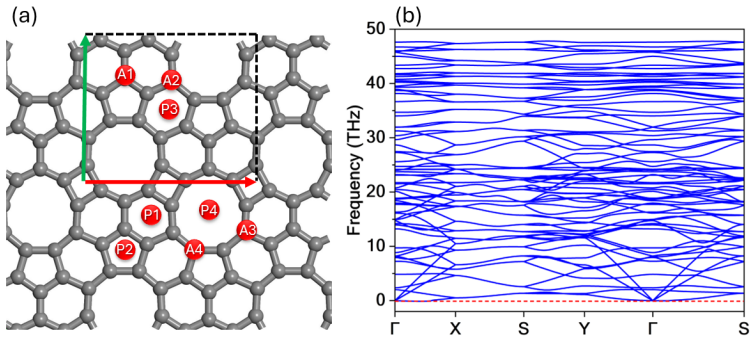
TPHE-graphene is a rectangular Pmma monolayer assembled from square, pentagonal, hexagonal, and enneagonal carbon rings, and its well-separated enneagonal pores are the geometric feature that makes hydrogen storage possible. The authors show that sodium atoms chemisorb at these pores with an adsorption energy of -2.08 eV and transfer about 0.75 electrons to the sheet, and that the 2.69 eV diffusion barrier keeps them from clustering. Each of the four sodium atoms in the unit cell then physisorbs up to five H2 molecules, with average adsorption energies that soften from -0.23 eV at low coverage to -0.18 eV at saturation. A grand canonical thermodynamic model, fed with these DFT-D2 adsorption energies and an ideal-gas chemical potential, predicts that 19.53 H2 molecules adsorb at 30 atm and 25 °C, and only 0.16 remain at 3 atm and 100 °C, corresponding to a reversible capacity of 9.25 wt%.
Load-bearing premise
The predictions depend on the assumption that the DFT-D2 adsorption energies and the fixed phase-change entropy of 75.44 J mol-1 K-1, when used in an ideal-gas single-particle thermodynamic model, faithfully describe how many H2 molecules bind and release at the stated pressures and temperatures.
Editorial extensions
If this is right
- At full saturation the material stores 9.52 wt% hydrogen, exceeding the U.S. DOE's practical target, with a usable capacity of 9.25 wt% between the proposed adsorption and desorption conditions.
- Desorption temperatures between 243 and 312 K mean hydrogen can be released under near-ambient or mildly warmed conditions, avoiding the energy cost of high-temperature desorption.
- The high sodium diffusion barrier of 2.69 eV means the decorated sheet should retain its active sites at room temperature, so capacity will not decay by metal clustering.
- The metallic character of the sheet persists after sodium decoration, and full hydrogen coverage shifts it toward a semi-metallic state, so the storage medium also remains electronically responsive.
- Compared with recently proposed sodium-decorated systems such as Na@B7N5, Na@Irida-graphene, and Na@Graphdiyne, TPHE-graphene offers a higher gravimetric capacity at a comparable adsorption energy.
Reading between the lines
- A direct check would be to recompute the H2 binding using DFT-D3 or a nonlocal van der Waals functional; if those methods shift the energies outside -0.15 to -0.25 eV, the claimed reversibility window would need revision.
- The fixed entropy of 75.44 J mol-1 K-1 is a classical approximation; temperature-dependent or measured entropies could shift the predicted desorption temperatures by tens of kelvin, although the qualitative near-ambient conclusion would likely survive.
- Because the fifth H2 per sodium binds much more weakly (consecutive adsorption energy -0.07 eV), the true cycling capacity under repeated adsorption-desorption may be closer to 16 H2 per cell (7.77 wt%) than to the saturated 9.52 wt%.
- The same enneagonal pore architecture could be probed with lighter alkali decorations such as lithium or potassium, where the trade-off between capacity and clustering is different.
Editorial analysis
A structured set of objections, weighed in public.
Referee Report
Summary. The paper proposes sodium-decorated TPHE-graphene, a 2D carbon allotrope, as a hydrogen storage material. DFT (PBE+D2) calculations are used to characterize the pristine monolayer and its Na-decorated form, reporting dynamical, thermal, energetic, and mechanical stability, a Na adsorption energy of -2.08 eV at the enneagonal pore, a 2.69 eV Na diffusion barrier, stepwise H2 adsorption up to five H2 molecules per Na atom, a maximum gravimetric capacity of 9.52 wt%, and H2 adsorption energies of -0.23 to -0.18 eV. A van't Hoff analysis and a grand canonical partition function (Eq. 8) are then used to claim desorption temperatures of 243-312 K and a practical reversible working capacity of 9.25 wt% under operating conditions of 30 atm/25 °C and 3 atm/100 °C.
Significance. If the thermodynamic predictions survive correction, the material would be a competitive DFT-level hydrogen storage candidate: the structural characterization based on phonons, elastic constants, cohesive energy, and MD is standard, and the NEB diffusion barrier and Bader charge analysis provide meaningful evidence for strong Na anchoring. The stepwise H2 saturation data and the comparison with previously reported systems are useful. However, the paper's headline claims of near-ambient reversibility and 9.25 wt% practical capacity depend on a thermodynamic model that, as written, cannot produce the stated occupancies, together with a debatable entropy input. These issues are load-bearing rather than cosmetic.
major comments (2)
- [Eq. (8); Fig. 14; Conclusions] As written, Z = 1 + sum_i exp[-(E_i - mu)/k_B T] is not a grand canonical partition function for a system that can hold multiple H2 molecules. For any Boltzmann weights y_i, the mean occupancy computed from this Z is sum_i y_i/(1 + sum_i y_i), which is always less than one. It therefore cannot produce the average occupancies of 19.53 and 0.16 shown in Fig. 14, nor the 9.25 wt% practical capacity quoted in the Conclusions. The correct independent-site grand canonical form is prod_i (1 + y_i), whose mean occupation can exceed one. If such a product form was intended, Eq. (8) must be corrected, and the ideal-gas chemical potential mu(T,p) must be stated explicitly so that Fig. 14 can be reproduced. As it stands, the central reversibility and working-capacity claim is unsupported.
- [Eq. (7); Table 2] The desorption temperatures in Table 2 are obtained from T_des = |E_ads| R/(k_B DeltaS) with a fixed DeltaS = 75.44 J mol^-1 K^-1, described as the gas-to-liquid phase transition entropy. For H2 desorption from a solid adsorbent near 300 K, the relevant entropy change is closer to the gas-phase entropy (around 130 J mol^-1 K^-1) minus the adsorbed-phase entropy; using such a value lowers the computed T_des by roughly a factor of two, which would move the system out of the claimed 243-312 K near-ambient window. In addition, Eq. (7) as printed mixes E_ads in eV with R in J mol^-1 K^-1 and k_B in eV/K without an explicit conversion. Please provide a dimensionally consistent derivation, justify DeltaS for this specific adsorption process, and include a sensitivity analysis.
minor comments (6)
- [Eq. (5)] Equation (5) is misprinted: as written it evaluates to (1/4)E_n - E_{n-4} - 4E_H2. The intended consecutive adsorption energy per added H2 is [E_n - E_{n-4} - 4E_H2]/4.
- [Table 2] The table header reads '(n = 2, 4, 6, 8)', but the rows correspond to n = 4, 8, 12, 16, 20; the header should be corrected.
- [Abstract; Table 2] The Abstract states that H2 adsorption energies range from -0.22 to -0.18 eV, whereas Table 2 lists -0.23 eV for the 4H2, 8H2, and 12H2 configurations; these values should be harmonized.
- [Figs. 2, 7, 12; MD simulations] The statement that the MD results provide 'direct evidence' of reversible hydrogen storage rests on only 5 ps of DFTB+ simulation; this wording should be softened, and the H2 desorption claim should be supplemented by a quantitative analysis of the trajectory.
- [Eq. (6); Unit cell composition] The manuscript reports 'nine non-equivalent carbon atoms' but does not state the total number of carbon atoms in the unit cell used in Eq. (6); specifying the full cell composition would make the HAC values reproducible.
- [References] Reference 52 appears incomplete ('Stable and 7.7 wt.'), and the NEB citations (refs 48-50) should be replaced or augmented with the standard nudged elastic band references.
Circularity Check
No significant circularity: DFT-computed adsorption energies drive all storage predictions; self-citations are comparative only.
full rationale
The paper's central quantitative claims (HAC of 9.52 wt%, desorption temperatures of 243-312 K, and practical capacity of 9.25 wt%) all trace back to DFT-computed H2 adsorption energies (Eq. 4) and standard stoichiometric/thermodynamic formulas (Eqs. 6-8). No parameter is fitted to reproduce the reported wt% values; the adsorption energies are obtained from independent VASP DFT-D2 calculations. The desorption temperature in Eq. 7 is a direct van't Hoff conversion of the computed Eads using a fixed literature entropy, and the thermodynamic occupancy in Fig. 14 uses these same computed energies as inputs rather than being tuned to a target. Self-citations (refs 29, 31, 54) appear only in introductory comparisons and in benchmark tables for other materials; they are not load-bearing premises for the new TPHE-graphene results. One caveat: Eq. 8 as written is a one-particle grand canonical partition function whose mean occupancy cannot exceed 1, so the reported occupancies of 19.53 and 0.16 would require a site-product form; this is an internal consistency/support problem, not a circularity between input and output. The derivation chain is therefore self-contained with respect to first-principles inputs, and no circular step is present.
Assumptions & free parameters
assumptions (5)
- domain assumption PBE-GGA with PAW potentials and Grimme DFT-D2 dispersion provides accurate electronic and adsorption energies for carbon allotropes and H2 binding.
- domain assumption The grand canonical partition function (Eq. 8) with an ideal-gas chemical potential for H2 and fixed DFT adsorption energies describes the equilibrium number of adsorbed molecules at finite temperature and pressure.
- domain assumption The van't Hoff equation with a constant entropy change of 75.44 J mol-1 K-1 for H2 gas-to-liquid transition yields reliable desorption temperatures.
- domain assumption DFTB+ with the 3ob parameter set and D4 dispersion adequately represents the potential energy surface for MD simulations of this 2D carbon material with Na and H2.
- standard math Born-Huang elastic stability criteria for 2D rectangular lattices (C11>0, C66>0, C11C22>C12^2) are the correct conditions for mechanical stability.
Cite this review
Pith. "Pith review of TPHE-Graphene: A First-Principles Study of a New 2D Carbon Allotrope for Hydrogen Storage." pith.science (2026). https://pith.science/paper/RVA3QSIS
@misc{pith2026250600609,
  author       = {Pith},
  title        = {Pith review of: TPHE-Graphene: A First-Principles Study of a New 2D Carbon Allotrope for Hydrogen Storage},
  year         = {2026},
  howpublished = {\url{https://pith.science/paper/RVA3QSIS}},
  note         = {Machine review of arXiv:2506.00609}
}
abstract
The shift from fossil fuels to renewable energy sources is essential for reducing global carbon emissions and addressing climate change. Developing advanced materials for efficient hydrogen storage enables sustainable energy solutions in this context. Herein, we propose sodium-decorated TPHE-graphene as a high-performance two-dimensional material for hydrogen storage. Density functional theory (DFT) calculations demonstrate that TPHE-graphene exhibits dynamical, thermal, energetic, and mechanical stability, as confirmed by cohesive energy, phonon dispersion, and molecular dynamics simulations. The monolayer displays metallic behavior and a high Young's modulus of 250.46 N/m. Upon sodium decoration, strong chemisorption occurs with a binding energy of -2.08 eV and minimal tendency for Na atom clustering. Hydrogen adsorption analysis reveals that each Na atom can bind up to five H$_2$ molecules, resulting in a gravimetric storage capacity of 9.52 wt\%. The calculated H$_2$ adsorption energies range from -0.22 eV to -0.18 eV, falling within the ideal range for reversible adsorption under ambient conditions. These findings highlight Na-decorated TPHE-graphene as a structurally robust and efficient hydrogen storage material well-suited for future green energy applications.
Figures


Figures from the paper (11 more)


Reference graph
Works this paper leans on
-
[1]
Pani, A.; Shirkole, S. S.; Mujumdar, A. S. Importance of renewable energy in the fight against global climate change. 2022
work page 2022
-
[2]
Oliveira, A. M.; Beswick, R. R.; Yan, Y. A green hydrogen economy for a renewable energy society. Current Opinion in Chemical Engineering 2021, 33, 100701
work page 2021
-
[3]
Laimon, M.; Yusaf, T. Towards energy freedom: Exploring sustainable solutions for energy independence and self-sufficiency using integrated renewable energy-driven hydrogen system. Renewable Energy 2024, 222, 119948
work page 2024
-
[4]
Large scale of green hydrogen storage: Opportunities and challenges
Ma, N.; Zhao, W.; Wang, W.; Li, X.; Zhou, H. Large scale of green hydrogen storage: Opportunities and challenges. International Journal of Hydrogen Energy 2024, 50, 379--396
work page 2024
-
[5]
K.; Mohan, M.; Kumar, V.; Sharma, A.; Ahn, B
Dewangan, S. K.; Mohan, M.; Kumar, V.; Sharma, A.; Ahn, B. A comprehensive review of the prospects for future hydrogen storage in materials-application and outstanding issues. International Journal of Energy Research 2022, 46, 16150--16177
work page 2022
-
[6]
Reilly Jr, J. J.; Wiswall Jr, R. H. Reaction of hydrogen with alloys of magnesium and nickel and the formation of Mg2NiH4. Inorganic chemistry 1968, 7, 2254--2256
work page 1968
-
[7]
Rusman, N.; Dahari, M. A review on the current progress of metal hydrides material for solid-state hydrogen storage applications. International Journal of Hydrogen Energy 2016, 41, 12108--12126
work page 2016
-
[8]
Pinjari, S.; Bera, T.; Kapur, G.; Kjeang, E. The mechanism and sorption kinetic analysis of hydrogen storage at room temperature using acid functionalized carbon nanotubes. International Journal of Hydrogen Energy 2023, 48, 1930--1942
work page 2023
Show all 61 references
-
[9]
L.; Piquini, P
Cardoso, G. L.; Piquini, P. C.; Khossossi, N.; Ahuja, R. Lithium-functionalized boron phosphide nanotubes (BPNTs) as an efficient hydrogen storage carrier. International Journal of Hydrogen Energy 2021, 46, 20586--20593
2021
-
[10]
P.; Priya, S
Shet, S. P.; Priya, S. S.; Sudhakar, K.; Tahir, M. A review on current trends in potential use of metal-organic framework for hydrogen storage. International Journal of Hydrogen Energy 2021, 46, 11782--11803
2021
-
[11]
H.; Muhammad, R.; Oh, H
Kim, H.; So, S. H.; Muhammad, R.; Oh, H. Comparing the practical hydrogen storage capacity of porous adsorbents: Activated carbon and metal-organic framework. International Journal of Hydrogen Energy 2024, 50, 1616--1625
2024
-
[12]
Architectural design of metal hydrides to improve the hydrogen storage characteristics
Bishnoi, A.; Pati, S.; Sharma, P. Architectural design of metal hydrides to improve the hydrogen storage characteristics. Journal of Power Sources 2024, 608, 234609
2024
-
[13]
L.; Kang, S.; Jeong, S.; Wan, L
Schneemann, A.; White, J. L.; Kang, S.; Jeong, S.; Wan, L. F.; Cho, E. S.; Heo, T. W.; Prendergast, D.; Urban, J. J.; Wood, B. C.; others Nanostructured metal hydrides for hydrogen storage. Chemical reviews 2018, 118, 10775--10839
2018
-
[14]
K.; Torres, J
Abifarin, J. K.; Torres, J. F.; Lu, Y. 2D materials for enabling hydrogen as an energy vector. Nano Energy 2024, 109997
2024
-
[15]
Two-dimensional mesoporous materials for energy storage and conversion: current status, chemical synthesis and challenging perspectives
Qin, J.; Yang, Z.; Xing, F.; Zhang, L.; Zhang, H.; Wu, Z.-S. Two-dimensional mesoporous materials for energy storage and conversion: current status, chemical synthesis and challenging perspectives. Electrochemical Energy Reviews 2023, 6, 9
2023
-
[16]
Advanced two-dimensional materials for green hydrogen generation: strategies toward corrosion resistance seawater electrolysis- review and future perspectives
Lokesh, S.; Srivastava, R. Advanced two-dimensional materials for green hydrogen generation: strategies toward corrosion resistance seawater electrolysis- review and future perspectives. Energy & Fuels 2022, 36, 13417--13450
2022
-
[17]
Ultra-high hydrogen storage capacity of Li-decorated graphyne: A first-principles prediction
Zhang, H.; Zhao, M.; Bu, H.; He, X.; Zhang, M.; Zhao, L.; Luo, Y. Ultra-high hydrogen storage capacity of Li-decorated graphyne: A first-principles prediction. Journal of Applied Physics 2012, 112
2012
-
[18]
Hydrogen storage capacity of alkali and alkaline earth metal ions doped carbon based materials: A DFT study
Gopalsamy, K.; Subramanian, V. Hydrogen storage capacity of alkali and alkaline earth metal ions doped carbon based materials: A DFT study. international journal of hydrogen energy 2014, 39, 2549--2559
2014
-
[19]
Light metal decoration on nitrogen/sulfur codoped graphyne: an efficient strategy for designing hydrogen storage media
Mohajeri, A.; Shahsavar, A. Light metal decoration on nitrogen/sulfur codoped graphyne: an efficient strategy for designing hydrogen storage media. Physica E: Low-dimensional Systems and Nanostructures 2018, 101, 167--173
2018
-
[20]
Study of 2D MXene Cr2C material for hydrogen storage using density functional theory
Yadav, A.; Dashora, A.; Patel, N.; Miotello, A.; Press, M.; Kothari, D. Study of 2D MXene Cr2C material for hydrogen storage using density functional theory. Applied Surface Science 2016, 389, 88--95
2016
-
[21]
Yadav, S.; Tam, J.; Singh, C. V. A first principles study of hydrogen storage on lithium decorated two dimensional carbon allotropes. international journal of hydrogen energy 2015, 40, 6128--6136
2015
-
[22]
High capacity hydrogen storage in Ca decorated graphyne: a first-principles study
Li, C.; Li, J.; Wu, F.; Li, S.-S.; Xia, J.-B.; Wang, L.-W. High capacity hydrogen storage in Ca decorated graphyne: a first-principles study. The Journal of Physical Chemistry C 2011, 115, 23221--23225
2011
-
[23]
Srinivasu, K.; Ghosh, S. K. Graphyne and graphdiyne: promising materials for nanoelectronics and energy storage applications. The Journal of Physical Chemistry C 2012, 116, 5951--5956
2012
-
[24]
Ultrahigh hydrogen storage using metal-decorated defected biphenylene
Kaewmaraya, T.; Thatsami, N.; Tangpakonsab, P.; Kinkla, R.; Kotmool, K.; Menendez, C.; Aguey-Zinsou, K.; Hussain, T. Ultrahigh hydrogen storage using metal-decorated defected biphenylene. Applied Surface Science 2023, 629, 157391
2023
-
[25]
Li-decorated B-doped biphenylene network for reversible hydrogen storage
Ma, L.-J.; Sun, Y.; Jia, J.; Wu, H.-S. Li-decorated B-doped biphenylene network for reversible hydrogen storage. Fuel 2024, 357, 129652
2024
-
[26]
Ca-decorated 2D Irida-graphene as a promising hydrogen storage material: A combination of DFT and AIMD study
Zhang, Y.; Liu, Z.; Guo, J.; Cao, Z.; Wang, J. Ca-decorated 2D Irida-graphene as a promising hydrogen storage material: A combination of DFT and AIMD study. International Journal of Hydrogen Energy 2024, 91, 118--126
2024
-
[27]
Li-decorated 2d irida-graphene as a potential hydrogen storage material: A dispersion-corrected density functional theory calculations
Zhang, Y.-F.; Guo, J. Li-decorated 2d irida-graphene as a potential hydrogen storage material: A dispersion-corrected density functional theory calculations. International Journal of Hydrogen Energy 2024, 50, 1004--1014
2024
-
[28]
Potential reversible hydrogen storage in Li-decorated carbon allotrope PAI-Graphene: a first-principles study
Mahamiya, V.; Shukla, A.; Chakraborty, B. Potential reversible hydrogen storage in Li-decorated carbon allotrope PAI-Graphene: a first-principles study. International Journal of Hydrogen Energy 2023, 48, 37898--37907
2023
-
[29]
A.; Martins, N
Laranjeira, J. A.; Martins, N. F.; Ye, L.; Sambrano, J. R.; Chen, X. Hydrogen storage engineering in PHE-graphene monolayer via potassium (K) decoration. International Journal of Hydrogen Energy 2025, 123, 139--149
2025
-
[30]
M.; Chakraborty, B
Adithya, S.; Jethawa, U.; Ali, S. M.; Chakraborty, B. Ca-decorated holey graphyne for reversible hydrogen storage: Insights from DFT analysis. International Journal of Hydrogen Energy 2024, 90, 470--480
2024
-
[31]
F.; Sambrano, J
Chen, X.; Wang, J.; Martins, N. F.; Sambrano, J. R.; Laranjeira, J. A. Penta-Octa B4C2N3: A New 2D Material for High-Performance Energy Applications. Langmuir 2025,
2025
-
[32]
High-Throughput Screening of Two-Dimensional Planar sp2 Carbon Space Associated with a Labeled Quotient Graph
Shi, X.; Li, S.; Li, J.; Ouyang, T.; Zhang, C.; Tang, C.; He, C.; Zhong, J. High-Throughput Screening of Two-Dimensional Planar sp2 Carbon Space Associated with a Labeled Quotient Graph. The Journal of Physical Chemistry Letters 2021, 12, 11511--11519, PMID: 34797680
2021
-
[33]
P.; Burke, K.; Ernzerhof, M
Perdew, J. P.; Burke, K.; Ernzerhof, M. Generalized Gradient Approximation Made Simple. Phys. Rev. Lett. 1996, 77, 3865--3868
1996
-
[34]
Ernzerhof, M.; Scuseria, G. E. Assessment of the Perdew--Burke--Ernzerhof exchange-correlation functional. The Journal of chemical physics 1999, 110, 5029--5036
1999
-
[35]
Bl\"ochl, P. E. Projector augmented-wave method. Phys. Rev. B 1994, 50, 17953--17979
1994
-
[36]
Ab initio molecular dynamics for liquid metals
Kresse, G.; Hafner, J. Ab initio molecular dynamics for liquid metals. Physical review B 1993, 47, 558
1993
-
[37]
Efficient iterative schemes for ab initio total-energy calculations using a plane-wave basis set
Kresse, G.; Furthm \"u ller, J. Efficient iterative schemes for ab initio total-energy calculations using a plane-wave basis set. Physical review B 1996, 54, 11169
1996
-
[38]
Semiempirical GGA-type density functional constructed with a long-range dispersion correction
Grimme, S. Semiempirical GGA-type density functional constructed with a long-range dispersion correction. Journal of computational chemistry 2006, 27, 1787--1799
2006
-
[39]
The Journal of chemical physics 2020, 152
Hourahine, B.; Aradi, B.; Blum, V.; Bonafe, F.; Buccheri, A.; Camacho, C.; Cevallos, C.; Deshaye, M.; Dumitric a , T.; Dominguez, A.; others DFTB+, a software package for efficient approximate density functional theory based atomistic simulations. The Journal of chemical physi...
2020
-
[40]
Parametrization and Benchmark of DFTB3 for Organic Molecules
Gaus, M.; Goez, A.; Elstner, M. Parametrization and Benchmark of DFTB3 for Organic Molecules. Journal of Chemical Theory and Computation 2013, 9, 338--354, PMID: 26589037
2013
-
[41]
Extension of the D3 dispersion coefficient model
Caldeweyher, E.; Bannwarth, C.; Grimme, S. Extension of the D3 dispersion coefficient model. The Journal of chemical physics 2017, 147
2017
-
[42]
J.; Postma, J
Berendsen, H. J.; Postma, J. v.; Van Gunsteren, W. F.; DiNola, A.; Haak, J. R. Molecular dynamics with coupling to an external bath. The Journal of chemical physics 1984, 81, 3684--3690
1984
-
[43]
J.; Malardier-Jugroot, C
Durbin, D. J.; Malardier-Jugroot, C. Review of hydrogen storage techniques for on board vehicle applications. International journal of hydrogen energy 2013, 38, 14595--14617
2013
-
[44]
Metal functionalized inorganic nano-sheets as promising materials for clean energy storage
Alhameedi, K.; Karton, A.; Jayatilaka, D.; Hussain, T. Metal functionalized inorganic nano-sheets as promising materials for clean energy storage. Applied Surface Science 2019, 471, 887--892
2019
-
[45]
U.; Khan, I.; Son, J.; Hong, J
Hashmi, A.; Farooq, M. U.; Khan, I.; Son, J.; Hong, J. Ultra-high capacity hydrogen storage in a Li decorated two-dimensional C 2 N layer. Journal of Materials Chemistry A 2017, 5, 2821--2828
2017
-
[46]
Mouhat, F.; Coudert, F. m. c.-X. Necessary and sufficient elastic stability conditions in various crystal systems. Phys. Rev. B 2014, 90, 224104
2014
-
[47]
Theoretical Investigation of Monolayer RhTeCl Semiconductors as Photocatalysts for Water Splitting
Ying, Y.; Fan, K.; Zhu, S.; Luo, X.; Huang, H. Theoretical Investigation of Monolayer RhTeCl Semiconductors as Photocatalysts for Water Splitting. The Journal of Physical Chemistry C 2020, 124, 639--646
2020
-
[48]
Makri, S.; Ortner, C.; Kermode, J. R. A preconditioning scheme for minimum energy path finding methods. The Journal of Chemical Physics 2019, 150, 094109
2019
-
[49]
Barzilai, J.; Borwein, J. M. Two-point step size gradient methods. IMA journal of numerical analysis 1988, 8, 141--148
1988
-
[50]
Structural relaxation made simple
Bitzek, E.; Koskinen, P.; G \"a hler, F.; Moseler, M.; Gumbsch, P. Structural relaxation made simple. Physical review letters 2006, 97, 170201
2006
-
[51]
Stable and 7.7 wt
Tan, Y.; Tao, X.; Ouyang, Y.; Peng, Q. Stable and 7.7 wt
-
[52]
Highly efficient hydrogen storage of a Sc decorated biphenylene monolayer near ambient temperature: ab initio simulations
Singh, M.; Shukla, A.; Chakraborty, B. Highly efficient hydrogen storage of a Sc decorated biphenylene monolayer near ambient temperature: ab initio simulations. Sustainable Energy & Fuels 2023, 7, 996--1010
2023
-
[53]
Liu, Z.; Chen, X.; Liao, Y.; Zhang, L.; Laranjeira, J. A. First-principles insights of na-decorated B7N5 monolayer for advanced hydrogen storage. Surfaces and Interfaces 2025, 58, 105802
2025
-
[54]
Reversible hydrogen storage with Na-modified Irida-Graphene: A density functional theory study
Duan, Z.; Shi, S.; Yao, C.; Liu, X.; Diao, K.; Lei, D.; Liu, Y. Reversible hydrogen storage with Na-modified Irida-Graphene: A density functional theory study. International Journal of Hydrogen Energy 2024, 85, 1--11
2024
-
[55]
Lithium and sodium decorated graphdiyne as a candidate for hydrogen storage: First-principles and grand canonical Monte Carlo study
Wang, Y.; Xu, G.; Deng, S.; Wu, Q.; Meng, Z.; Huang, X.; Bi, L.; Yang, Z.; Lu, R. Lithium and sodium decorated graphdiyne as a candidate for hydrogen storage: First-principles and grand canonical Monte Carlo study. Applied Surface Science 2020, 509, 144855
2020
-
[56]
F.; Maia, A
Martins, N. F.; Maia, A. S.; Laranjeira, J. A.; Fabris, G. S.; Albuquerque, A. R.; Sambrano, J. R. Hydrogen storage on the lithium and sodium-decorated inorganic graphenylene. International Journal of Hydrogen Energy 2024, 51, 98--107
2024
-
[57]
Z.; Zanat, K.; Ersan, F
Djebablia, I.; Abdullahi, Y. Z.; Zanat, K.; Ersan, F. Metal-decorated boron phosphide (BP) biphenylene and graphenylene networks for ultrahigh hydrogen storage. International Journal of Hydrogen Energy 2024, 66, 33--39
2024
-
[58]
Me--C8B5: A novel two-dimensional carbon boride as reversible hydrogen storage material with high capacity
Gong, Y.; Chen, D.; Guo, B.; Chen, S.; Zhu, Z.; Cheng, M. Me--C8B5: A novel two-dimensional carbon boride as reversible hydrogen storage material with high capacity. International Journal of Hydrogen Energy 2024, 82, 384--397
2024
-
[59]
E.; Razouk, A.; Balli, M.; Mounkachi, O
Boubkri, M.; Kassaoui, M. E.; Razouk, A.; Balli, M.; Mounkachi, O. Computational investigation of NLi4-cluster decorated phosphorene for reversible hydrogen storage. International Journal of Hydrogen Energy 2024, 72, 1--8
2024
-
[60]
DTT graphene: A novel Dirac semimetal with ultrahigh reversible hydrogen storage capacity
Guo, B.; Chen, D.; Chen, R.; Song, C.; Chen, Y.; Lin, Q.; Cheng, M. DTT graphene: A novel Dirac semimetal with ultrahigh reversible hydrogen storage capacity. International Journal of Hydrogen Energy 2024, 58, 987--999
2024
-
[61]
J. Eletron. Mater
Kumar, N.; Sharma, M.; Pandey, R.; Tit, N. Borophene/graphene heterostructure for effective hydrogen storage with facile dehydrogenation. International Journal of Hydrogen Energy 2024, 70, 510--521 mcitethebibliography JPCC_ACS.tex0000664000000000000000000014735415016621104011...
2024
Reviewed August 7, 2026 · model on record in the stance chip above.
Discussion (0). Sign in to comment.