REVIEW 2 major objections 5 minor 24 references
Over-the-Air Fronthaul Signaling for Uplink Cell-Free Massive MIMO Systems
T0 review · 2 major / 5 minor · reviewed 2026-08-07 · deepseek-v4-flash
Pith's one-line read This paper shows that in cell-free massive MIMO, the global sufficient statistics needed to decode uplink data can be computed over the air at the central processor with performance close to a wired fronthaul.
desk verdict Solid OTA-computation framework for cell-free massive MIMO with clean closed-form analysis; perfect synchronization is a genuine gap that needs sensitivity analysis, but the paper deserves peer review. read the letter →
The pith
A machine-rendered reading of the paper's core claim, the machinery that carries it, and where it could break.
The reading
What carries the argument
The central objects are the local sufficient statistics at each access point: the Gramian $A_l = H_l^H H_l$ and the matched-filter output $t_l = H_l^H y_l$, whose sums $A$ and $t$ are sufficient for ML detection. The mechanism that carries the argument is the combination of local zero-forcing precoding on the fronthaul channel and a common average-power scaling factor $\eta_c^{(i)}$; together they make the CPU's received matrix equal to the desired sum plus noise. The two phases use separate scalings because the matched-filter output's dynamic range depends on user transmit power, and this scaling choice is what creates the observed error floor in symbol-error rate.
What would settle it
Simulate or build a setup where APs transmit a known pilot with the proposed ZF precoder while their clocks have controlled phase offsets relative to the CPU; if the received signal deviates from the coherent sum predicted by Eq. (14) whenever offsets exceed a fraction of a symbol period, the claimed OTA summation and the derived MSE and rate expressions no longer hold.
Extended reading notes
Core claim
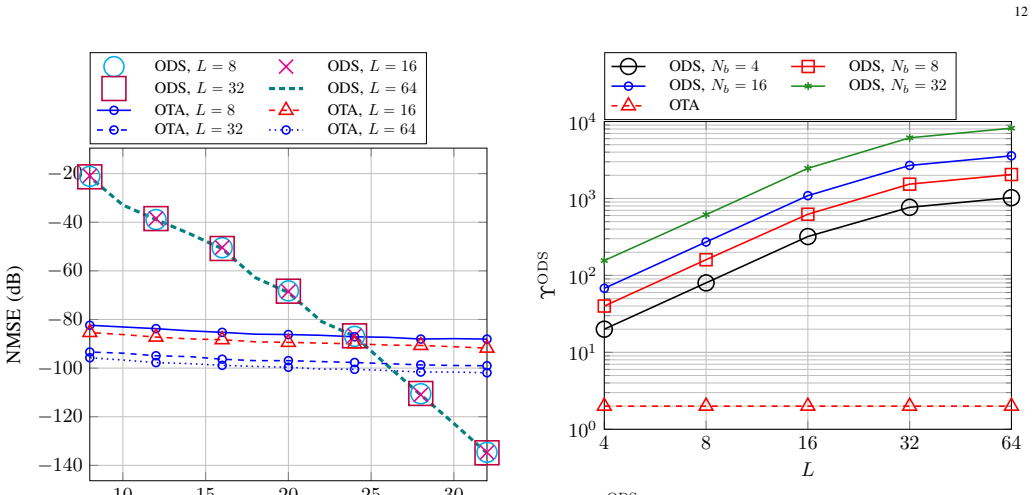
On its own terms, the paper's discovery is that the sufficient statistics for uplink maximum-likelihood detection decompose naturally as sums over access points: the Gramian $A = \sum_l H_l^H H_l$ and the matched-filter output $t = \sum_l H_l^H y_l$. With zero-forcing precoders $W_l = G_l(G_l^H G_l)^{-1}$ and a common power scaling $\eta_c^{(i)}$, the CPU receives $Z^{(i)} = \sqrt{\eta_c^{(i)}} \sum_l \bar{X}_l^{(i)} + E^{(i)}$, a coherent sum of the local sufficient-statistic contributions plus noise. That makes the wireless fronthaul a physical summation channel rather than a data pipe. The paper then provides LMMSE and LS estimators for the summed sufficient statistics, closed-form NMSE expressions, a use-and-then-forget achievable rate, and numerical SER/BER results; the conclusion is that this over-the-air scheme achieves essentially the same performance as an ideal wired fronthaul while keeping fronthaul channel use independent of the number of APs.
Load-bearing premise
The load-bearing premise is that every access point and the CPU share perfect phase and timing synchronization, so all over-the-air contributions arrive aligned at the CPU; the paper assumes this in a footnote and only points to synchronization studies without modeling errors.
Editorial extensions
If this is right
- The number of fronthaul channel uses needed to deliver the sufficient statistics does not grow with the number of access points, unlike orthogonal digital fronthaul.
- With perfect fronthaul CSI and ZF precoding, the CPU can use LMMSE or LS estimation of the summed Gramian and matched-filter output, with closed-form MSE expressions that the paper verifies numerically.
- Per-user achievable rates and SER/BER performance closely match those of an ideal wired fronthaul, and coded transmission further narrows the gap.
- An error floor appears in SER as user transmit power grows, because the common scaling factor $\eta_c^{(2)}$ decreases to satisfy the AP power constraint.
- Imperfect CSI at the APs and at the CPU can be incorporated through approximate sufficient statistics, with only modest degradation when pilot power is adequate.
Reading between the lines
- A natural extension not developed in the paper is to replace the perfect phase-alignment assumption with per-AP phase correction based on a common pilot; then residual synchronization error, rather than the OTA summation itself, would set the achievable accuracy.
- The paper notes that the sufficient-statistic structure is valid for any input distribution, so testing the same two-phase OTA scheme on continuous analog sensor data would be a direct follow-up that the paper does not simulate.
- Because the error floor is caused by the common scaling factor being limited by the weakest AP, a hybrid fronthaul that offloads only the worst APs to digital or wired links should lift the floor without giving up the scalability of OTA for the rest of the network.
Editorial analysis
A structured set of objections, weighed in public.
Referee Report
Summary. The paper proposes an over-the-air (OTA) computation framework for the fronthaul of uplink cell-free massive MIMO systems. Each access point computes local sufficient statistics (the Gramian matrix and the matched-filter output), precodes them with a local zero-forcing precoder, and transmits them simultaneously to the central processing unit (CPU) using a common power-scaling factor, so that the CPU receives a noisy superposition proportional to the desired global sums. The manuscript provides a two-phase transmission protocol, LMMSE and LS estimators for the sufficient statistics, closed-form MSE expressions, an achievable-rate analysis based on the use-and-then-forget bound, an extension to imperfect CSI, and a comparison with a digital orthogonal fronthaul scheme. Numerical results show that the proposed OTA scheme closely matches the performance of a wired fronthaul in the considered scenarios.
Significance. If the claimed results hold, the framework is a notable step toward scalable wireless fronthaul for cell-free massive MIMO, because the number of fronthaul channel uses needed for the sufficient statistics is independent of the number of APs. The paper's strengths include closed-form performance expressions that are verified by simulation, a careful treatment of power scaling and error floors, and a quantitative comparison with digital fronthaul. The main risk is the reliance on perfect synchronization between the APs and the CPU, which is load-bearing for the coherent OTA sum.
major comments (2)
- [Section II-A, Eq. (14) and Footnote 1] The coherent OTA sum in Eq. (14) assumes that all AP-to-CPU transmissions arrive at the CPU perfectly phase-aligned. The paper adopts this as an assumption in Footnote 1 and cites [14], [15], but provides no model or robustness analysis for synchronization errors. With per-AP phase offsets, the received signal becomes a weighted sum with phase rotations that is not proportional to the desired sum, and the LMMSE/LS estimators in Eqs. (25)-(26), the SINR expression in Eq. (41), and the closed-form MSEs in Eqs. (30)-(36) no longer hold. Since the central claim that the global sufficient statistics can be computed OTA depends entirely on this coherent summation, the manuscript should either incorporate synchronization errors into the system model or provide a quantitative study of the degradation, along the lines of the imperfect-CSI treatment in Section III-E and Fig. 10.
- [Section II-A, Eqs. (10) and (13)] The definition of the common power-scaling factor is incomplete. The set V^(i) in Eq. (13) contains only APs that violate the average power constraint, and if no AP violates the constraint, V^(i) is empty and eta_c is undefined; the text should specify eta_c = 1 in that case. In addition, the condition N >= M stated in Section II-A does not guarantee that the expected transmit power in Eq. (10) is finite: for N = M, the expectation E{||G_l(G_l^H G_l)^{-1}||^2} diverges for Gaussian G_l, so the framework should assume N > M (or N >= M+1) for the average power constraint to be meaningful.
minor comments (5)
- [Section I-A] There is a duplicated word in the sentence 'as the the number of APs increases' in the related-work discussion.
- [Abstract] The phrase 'over-the-air(OTA)' is missing a space before the parenthesis; it should read 'over-the-air (OTA)'.
- [Section III-E, Eq. (51)] The pilot model leading to the channel-estimation error covariance in Eq. (51) is not stated. The sum over all UEs in the inverse suggests that all UEs share the same pilot sequence; if orthogonal pilots are used, the formula should be different. Please specify the pilot structure.
- [Section III-B] The statement that 'the CPU does not need to know the Gramian matrix A, but only its first and second order statistics' should be clarified, because the SINR expression in Eq. (41) involves the combining vector v_k, which in the LS example depends on the estimate of A. The required statistical knowledge at the CPU should be stated explicitly.
- [Section IV, Eqs. (56), (61), (62)] The ceiling notation in these equations is garbled in the displayed text (the 'V' symbols appear to represent ceiling brackets). Please typeset the ceiling operators correctly.
Circularity Check
No significant circularity: the OTA sufficient-statistics construction is derived from the stated system model and is benchmarked against independent simulations and wired-fronthaul baselines.
full rationale
The paper's central derivation chain is self-contained. It defines local sufficient statistics A_l = H_l^H H_l and t_l = H_l^H y_l in (2)-(3), observes that the sums A = sum_l A_l and t = sum_l t_l in (4) are the only quantities needed by the ML detector in (5), and then designs the OTA transmissions so that the CPU receives sqrt(eta_c^(i)) sum_l \bar X_l^(i) + E in (14). This is not a fitted prediction; it is a direct algebraic consequence of substituting the chosen ZF precoder W_l = G_l (G_l^H G_l)^{-1} into the received-signal model (9). The power-scaling factor eta_c^(i) is computed from the average transmit-power constraint (10) and from the closed-form statistics in (21)-(24), rather than chosen to match simulation targets. The MSE expressions (30)-(36), the achievable-rate/SINR expressions (39)-(41), and the MSE asymptotics (44)-(45) are derived from the same model and are validated against simulations in Figs. 2-5; the OTA results are compared with wired-fronthaul benchmarks rather than forced to agree with them. The self-citations [1] and [13] are not load-bearing: [1] is a preliminary conference version of this work, and [13] is used only for the approximate-sufficiency statement in the imperfect-CSI extension. The perfect-synchronization idealization in Footnote 1 is an unmodeled assumption and a robustness concern, but an assumption is not circularity: it does not cause any derived quantity to equal an input by construction. No fitted parameter is renamed as a prediction, no uniqueness theorem is imported from the authors' prior work, and no existing result is repackaged under new coordinates. The paper is therefore self-contained against its own model and external benchmarks, with no significant circularity.
Assumptions & free parameters
assumptions (6)
- domain assumption Perfect synchronization between APs and CPU so that all OTA transmissions arrive phase-aligned at the CPU.
- domain assumption APs have perfect CSI of the AP-CPU channels G_l, with full column rank, enabling the ZF precoders W_l = G_l (G_l^H G_l)^{-1}.
- domain assumption UE-AP channel columns are mutually independent, each distributed as CN(0,R_kl).
- domain assumption Each AP has N >= M antennas for the fronthaul link, so it can transmit M symbols per channel use to the M-antenna CPU.
- domain assumption The AP-CPU fronthaul UL and DL channels are reciprocal, so one downlink pilot from the CPU gives APs the uplink CSI.
- domain assumption Quasi-static block fading and zero-mean, unit-energy UE symbols.
Cite this review
Pith. "Pith review of Over-the-Air Fronthaul Signaling for Uplink Cell-Free Massive MIMO Systems." pith.science (2026). https://pith.science/paper/NZQRKS5F
@misc{pith2026250600655,
  author       = {Pith},
  title        = {Pith review of: Over-the-Air Fronthaul Signaling for Uplink Cell-Free Massive MIMO Systems},
  year         = {2026},
  howpublished = {\url{https://pith.science/paper/NZQRKS5F}},
  note         = {Machine review of arXiv:2506.00655}
}
read the original abstract
We propose a novel resource-efficient over-the-air(OTA) computation framework to address the huge fronthaul computational and control overhead requirements in cell-free massive multiple-input multiple-output (MIMO) networks. We show that the global sufficient statistics to decode the data symbols can be computed OTA using the locally available information at the access points (APs). We provide the essential signal processing aspects at the APs and the central processing unit (CPU) to facilitate the OTA computation of sufficient statistics. The proposed framework scales effectively with an increase in the number of APs. We also make a comprehensive study of the benefits of an OTA framework compared to a conventional digital fronthaul in terms of the overhead associated in transferring the sufficient statistics from the APs to the CPU. To evaluate the performance of the OTA framework, we give closed-form expressions for the mean-square error (MSE)of the estimators of sufficient statistics and the overall data estimator. Furthermore, we assess the symbol error rate (SER)and bit error rate (BER) of the user equipment (UEs) data to demonstrate the efficacy of our method, and benchmark them against the state-of-the-art wired fronthaul networks.
Figures


Figures from the paper (3 more)


Reference graph
Works this paper leans on
-
[12]
Over-the-Air Computation in Cell-Free Massive MIMO Systems
C. Chen, E. Bj ¨ornson, and C. Fischione, “Over-the-air computation in cell-free massive MIMO systems,”arXiv preprint arXiv:2409.00517, 2024
work page Pith review arXiv 2024
-
[14]
Massive synchrony in distributed antenna systems,
E. G. Larsson, “Massive synchrony in distributed antenna systems,” IEEE Trans. Signal Process., vol. 72, pp. 855–866, Jan. 2024
work page 2024
-
[15]
Beamsync: Over-the-air synchronization for distributed massive MIMO systems,
U. Kunnath Ganesan, R. Sarvendranath, and E. G. Larsson, “Beamsync: Over-the-air synchronization for distributed massive MIMO systems,” IEEE Trans. Wireless Commun., vol. 23, no. 7, pp. 6824–6837, 2024
work page 2024
-
[1]
Resource efficient over-the-air fronthaul signaling for uplink cell-free massive MIMO systems,
Z. H. Shaik, S. S. Thoota, E. Bj ¨ornson, and E. G. Larsson, “Resource efficient over-the-air fronthaul signaling for uplink cell-free massive MIMO systems,” inProc. ICC, Denver, CO, USA, 2024
work page 2024
-
[2]
Foundations of user- centric cell-free massive MIMO,
¨O. T. Demir, E. Bj ¨ornson, and L. Sanguinetti, “Foundations of user- centric cell-free massive MIMO,”Foundations and Trends® in Signal Processing, vol. 14, no. 3-4, pp. 162–472, 2021
work page 2021
-
[3]
A survey on over-the-air computation,
A. S ¸ahin and R. Yang, “A survey on over-the-air computation,”IEEE Commun. Surveys Tuts., vol. 25, no. 3, pp. 1877–1908, third quarter 2023
work page 1908
-
[4]
Distributed precoding design via over-the-air signaling for cell-free massive MIMO,
I. Atzeni, B. Gouda, and A. T ¨olli, “Distributed precoding design via over-the-air signaling for cell-free massive MIMO,”IEEE Trans. Wireless Commun., vol. 20, no. 2, pp. 1201–1216, 2021
work page 2021
-
[5]
F. Han, Q. Li, and Y . Gong, “Optimized transceiver design for over-the- air distributed computation over cell-free massive MIMO network,” in IEEE 34th Annual International Symposium on Personal, Indoor and Mobile Radio Communications (PIMRC), 2023, pp. 1–6
work page 2023
Show all 24 references
-
[6]
Transceiver beamforming for over-the-air com- putation in massive MIMO systems,
S. Jing and C. Xiao, “Transceiver beamforming for over-the-air com- putation in massive MIMO systems,”IEEE Trans. Wireless Commun., vol. 22, no. 10, pp. 6978–6992, 2023
2023
-
[7]
Joint beamforming optimiza- tion in multi-relay assisted MIMO over-the-air computation for multi- modal sensing data aggregation,
M. Jiang, Y . Li, G. Zhang, and M. Cui, “Joint beamforming optimiza- tion in multi-relay assisted MIMO over-the-air computation for multi- modal sensing data aggregation,”IEEE Commun. Lett., vol. 25, no. 12, pp. 3937–3941, 2021
2021
-
[8]
Hybrid beamforming for massive MIMO over-the-air computation,
X. Zhai, X. Chen, J. Xu, and D. W. Kwan Ng, “Hybrid beamforming for massive MIMO over-the-air computation,”IEEE Trans. Commun., vol. 69, no. 4, pp. 2737–2751, 2021
2021
-
[9]
Y . Shao, D. G ¨und¨uz, and S. C. Liew,IEEE J. Sel. Areas Commun., vol. 41, no. 3, pp. 589–606, March 2023
2023
-
[10]
Channelcomp: A general method for computation by communications,
S. Razavikia, J. M. Barros da Silva, and C. Fischione, “Channelcomp: A general method for computation by communications,”IEEE Trans. Commun., vol. 72, no. 2, pp. 692–706, 2024
2024
-
[11]
Fundamental limits of over-the- air optimization: Are analog schemes optimal?
S. K. Jha, P. Mayekar, and H. Tyagi, “Fundamental limits of over-the- air optimization: Are analog schemes optimal?”IEEE J. Sel. Areas Inf. Theory., vol. 3, no. 2, pp. 217–228, 2022
2022
-
[13]
Distributed computation of a posteriori bit likelihood ratios in cell-free massive MIMO,
Z. H. Shaik, E. Bj ¨ornson, and E. G. Larsson, “Distributed computation of a posteriori bit likelihood ratios in cell-free massive MIMO,” inProc. Eur. Signal Process. Conf., Aug 2021, pp. 935–939
2021
-
[16]
Federated learning: A signal processing perspective,
T. Gafni, N. Shlezinger, K. Cohen, Y . C. Eldar, and H. V . Poor, “Federated learning: A signal processing perspective,”IEEE Signal Processing Magazine, vol. 39, no. 3, pp. 14–41, May 2022
2022
-
[17]
T. J. Rouphael,Wireless Receiver Architectures and Design: Antennas, RF , synthesizers, mixed signal, and digital signal processing. Academic Press, 2014
2014
-
[18]
NR; Physical channels and modulation (Release 17),
3GPP, “NR; Physical channels and modulation (Release 17),” 3GPP, Technical Specification 3GPP TS 38.211 V17.5.0, Dec. 2023. [Online]. Available: https://www.3gpp.org/ftp/Specs/archive/38 series/38.211/
2023
-
[19]
S. M. Kay,Fundamentals of Statistical Signal Processing: Estimation Theory. USA: Prentice-Hall, Inc., 1993
1993
-
[20]
T. L. Marzetta, E. G. Larsson, H. Yang, and H. Q. Ngo,Fundamentals of Massive MIMO. Cambridge University Press, 2016
2016
-
[21]
Massive MIMO: ten myths and one critical question,
E. Bj ¨ornson, E. G. Larsson, and T. L. Marzetta, “Massive MIMO: ten myths and one critical question,”IEEE Communications Magazine, vol. 54, no. 2, pp. 114–123, February 2016
2016
-
[22]
Mutual information as a function of matrix SNR for linear Gaussian channels,
G. Reeves, H. D. Pfister, and A. Dytso, “Mutual information as a function of matrix SNR for linear Gaussian channels,” inProc. IEEE Int. Symp. Inf. Theory, 2018, pp. 1754–1758. [23]Further advancements for E-UTRA physical layer aspects (Release 9). 3GPP TS 36.814, Mar. 2010
2018
-
[24]
“IEEE std. for information tech.–telecommunications and information exchange between systems - local and metropolitan area networks– specific requirements - part 11: Wireless LAN MAC and PHY specs.” IEEE Std. 802.11-2020 (Revision of IEEE Std 802.11-2016), 2021
2020
-
[25]
IEEE standard for floating-point arithmetic,
“IEEE standard for floating-point arithmetic,”IEEE Std. 754-2019 (Revision of IEEE 754-2008), pp. 1–84, 2019
2019
Reviewed August 7, 2026 · model on record in the stance chip above.
Discussion (0). Sign in to comment.