REVIEW 5 major objections 5 minor 27 references
Threshold displacement energies and neutron-induced displacement-per-atom response of CsPbBr3 from molecular dynamics and Monte Carlo simulations
T0 review · 5 major / 5 minor · reviewed 2026-08-07 · deepseek-v4-flash
Pith's one-line read Molecular dynamics and Geant4 simulations give the first atomistic displacement-threshold energies and neutron DPA estimates for the halide perovskite CsPbBr3.
desk verdict First MD threshold-displacement data for CsPbBr3, but the abstract and full text disagree on the crystal phase and the DPA values, so the central numbers are not reliable as printed. read the letter →
The pith
A machine-rendered reading of the paper's core claim, the machinery that carries it, and where it could break.
The reading
What carries the argument
The calculation is carried by three linked tools. A classical interatomic potential—Lennard-Jones 12-6 plus Coulomb, with a Ziegler-Biersack-Littmark repulsive term splined in at short separation—provides the forces for molecular dynamics cascades in LAMMPS. The Wigner-Seitz cell method in OVITO counts vacancies and interstitials after each recoil, defining a displacement as permanent when one net Frenkel pair survives; a bisection search in recoil velocity then finds the threshold energy in each of 361 directions. Geant4 with the FTFP_BERT_HP physics list generates the primary knock-on atom energy spectrum from neutron elastic scattering, and the NRT displacement model with a Lindhard damage-energy partition converts each recoil's damage energy into displaced atoms, giving DPA.
What would settle it
A direct measurement of the 300 K threshold displacement energy in orthorhombic CsPbBr3—for example, tracking the onset of defect production while sweeping incident electron or ion energy and extrapolating the displacement cross-section to zero—compared with the reported averages of about 80 eV (Cs), 63 eV (Pb), and 97 eV (Br) would settle whether the potential and structure choice is predictive; deviations larger than about 20 eV would mean the simulation setup needs revision.
Extended reading notes
Core claim
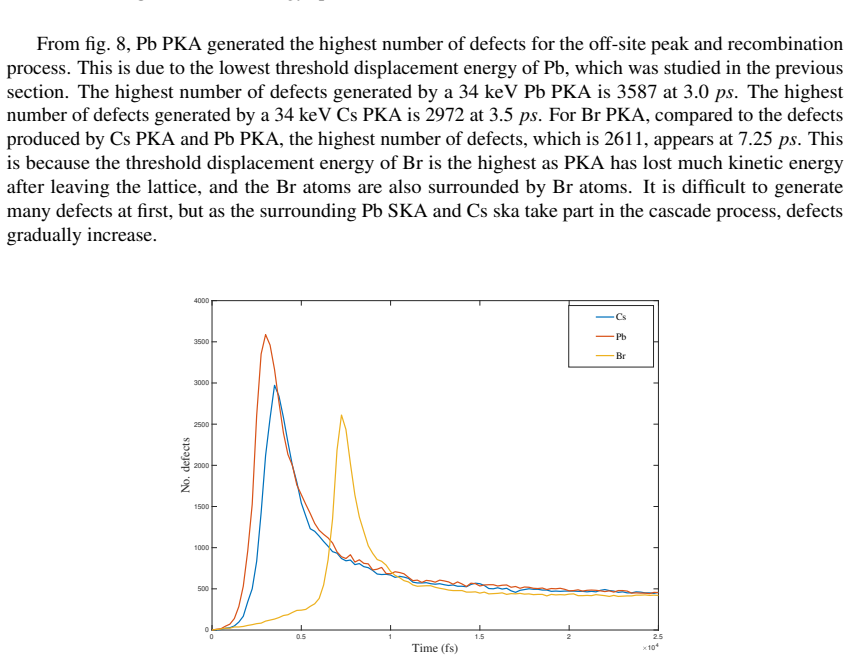
The paper's central claim is that the displacement damage in CsPbBr3 can now be described atomistically: the threshold displacement energy depends strongly on recoil direction and lattice site, and the resulting averages—about 80 eV for Cs, 63 eV for Pb, and 97 eV for Br at 300 K in the body of the paper—are high enough that a 34 keV primary knock-on atom produces a few thousand defects, with Pb recoils creating the most (3587 defects at 3.0 ps) and Cs-on-Pb and Pb-on-Cs antisites surviving as the dominant residual damage. Combining these thresholds with species-resolved recoil spectra from Geant4 and the NRT displacement law yields the first neutron-induced DPA estimates for CsPbBr3, reported as DPA per incident neutron (about $4.35\times10^{-22}\,\mathrm{cm}^2$ for 14 MeV neutrons in the full text, and $1.248\times10^{-21}\,\mathrm{cm}^2$ at 14.1 MeV in the abstract). The intended consequence is a radiation-tolerance benchmark for a candidate fusion neutron detector material.
Load-bearing premise
The results stand or fall on the assumption that the interatomic potential and crystal phase used in the molecular dynamics runs describe real CsPbBr3, and the paper never reconciles its cubic Pm-3m simulation cell with the orthorhombic ICSD structure used for the abstract's DPA numbers; the parameter table's Pb sigma value of 20524 Å is also physically implausible, so any error in the phase or potential changes every threshold and DPA value.
Editorial extensions
If this is right
- If these thresholds are correct, recoils below roughly 60 eV create no stable damage at 300 K, so low-energy neutron scattering events in CsPbBr3 leave the lattice intact.
- Because the thresholds are strongly direction- and site-dependent, a PKA along an easy direction displaces below the average value, so average-TDE comparisons understate the worst-case damage a single recoil can produce.
- The 34 keV cascade simulations identify Pb PKAs as the most damaging (peak 3587 defects at 3.0 ps) and Cs-on-Pb and Pb-on-Cs antisites as the persistent residual damage, giving a concrete target for defect-engineering the material's radiation tolerance.
- The species-resolved PKA spectrum (25.3% Cs, 24.7% Pb, 50% Br; mean PKA energy about 34 keV under 14 MeV neutrons) can feed longer-timescale kinetic Monte Carlo simulations of damage accumulation.
- The reported DPA-per-incident-neutron values give a linear scaling rule, so the NRT-model DPA for any 14.1 MeV neutron fluence to a CsPbBr3 detector can be estimated directly.
Reading between the lines
- If the thresholds transfer from the cubic Pm-3m phase simulated in the MD runs to the orthorhombic phase that real CsPbBr3 detectors use, the same Geant4+NRT pipeline should be rerun entirely in the orthorhombic structure to produce one self-consistent DPA value.
- Taking the reported 14.1 MeV DPA per incident neutron at face value ($\sim10^{-21}\,\mathrm{cm}^2$), a $1\,\mathrm{cm}^3$ detector exposed to a fluence of $10^{18}$ neutrons per $\mathrm{cm}^2$ would accumulate roughly $10^{-3}$ DPA under the NRT model, an order-of-magnitude consequence the authors do not state.
- A useful next test would be to compare the simulated 300 K thresholds with measured displacement onsets from low-energy electron or ion irradiation of orthorhombic CsPbBr3 crystals, which would benchmark the potential independently of the DPA pipeline.
- The same MD-plus-Monte-Carlo workflow transfers directly to other halide perovskites such as CsPbI3 or MAPbBr3, allowing a systematic comparison of displacement thresholds and neutron DPA across candidate detector materials.
Editorial analysis
A structured set of objections, weighed in public.
Referee Report
Summary. The manuscript reports molecular dynamics simulations of threshold displacement energies (TDEs) and displacement cascades in CsPbBr3, combined with Geant4 Monte Carlo calculations of neutron-induced damage. The full text describes a cubic Pm-3m simulation cell at 100–400 K, reports average TDEs of roughly 80 eV for Cs, 63 eV for Pb, and 97 eV for Br at 300 K, and a DPA value of 4.35 × 10^-22 for 14 MeV neutrons. The abstract, however, claims an orthorhombic ICSD-based structure, 100 recoil directions with three seeds per direction, and DPA values of 9.056 × 10^-22 at 2.45 MeV and 1.248 × 10^-21 at 14.1 MeV. The present report focuses on the physical phase used in the simulations, the force-field parameters, and these internal inconsistencies between the abstract and the full text.
Significance. If the calculations were valid, this work would provide a useful first atomistic dataset for the radiation-damage response of CsPbBr3, an emerging neutron-detector material, and it demonstrates a plausible workflow linking MD-computed threshold energies to NRT-based DPA via Geant4. The PKA spectrum and cascade defect analysis are also potentially informative. However, no code or input files are provided, and the internal inconsistencies in the phase, the force field, and the headline DPA numbers undermine the credibility of the quantitative claims. The DPA workflow is not circular in design—the MD thresholds are inputs rather than targets—but the results as presented cannot be accepted without substantial clarification and recalculation.
major comments (5)
- [Methodology, 'Crystallography and potential'; Table 2; Results/Discussion; Conclusions] The simulated structure is explicitly cubic Pm-3m with a = b = c = 6.017 Å, and all threshold displacement energies, 34 keV cascades, and the quoted DPA value of 4.35 × 10^-22 are obtained in this cubic cell at 100–400 K. However, CsPbBr3 is orthorhombic (Pnma-type) in this temperature range, and the abstract claims an ICSD-based orthorhombic structure with distinct apical and equatorial Br sites, which never appears in the full text. Because TDEs depend on local coordination, channeling directions, and recombination barriers, the Table 2 values and the DPA result cannot be assumed to describe the actual detector material. The authors must either repeat the calculations in the correct phase or provide quantitative evidence—not an assertion—that cubic and orthorhombic thresholds are equivalent.
- [Table 1] Table 1 lists the Pb Lennard-Jones σ as 20,524 Å. With this value the LJ interaction would have a zero at roughly 20,000 Å, which is physically impossible for an interatomic potential and would dominate all relevant interatomic distances, making the potential curves and every MD result meaningless. If the entry is a typo (for example, 2.0524 Å), the correct value must be stated and the potential curves re-evaluated; as printed, the force field is not credible.
- [Abstract vs Methodology and Results] The abstract and the full text report different central numbers. The abstract states that 100 recoil directions were used with three random seeds per direction, while the full text (Methodology, 'Search for threshold displacement energy') states that 361 directions were used and does not mention random seeds. The abstract reports DPA per incident neutron of 9.056 × 10^-22 at 2.45 MeV and 1.248 × 10^-21 at 14.1 MeV, whereas the full text reports a single DPA value of 4.35 × 10^-22 for 14 MeV and contains no 2.45 MeV calculation. These are not minor wording differences; they are inconsistent descriptions of the paper's headline results and must be reconciled before the paper can be assessed.
- [Methodology, 'Monte Carlo simulation'; Eq. (5); Results/Discussion] The NRT displacement model in Eq. (5) is garbled in the typeset equation: the intermediate branch '1, Ed ≤ Td < 2Ed' followed by '0.8 0.8Td / 2Ed' does not reproduce the standard NRT formula, and the threshold conditions are internally inconsistent. Moreover, the DPA calculation does not state which Ed values are used (per-site, direction-averaged, or temperature-dependent), and the 'different temperatures' DPA values promised in the text are never reported. Without these details the DPA numbers cannot be reproduced or verified.
- [Abstract vs Methodology, 'Crystallography and potential'] The abstract states that the potential uses Buckingham–ZBL short-range terms, while the full text uses a Lennard-Jones 12-6 plus Coulomb potential with a ZBL spline. These are different potential forms. In addition, the abstract's claim that the potential was checked by structural relaxation, finite-temperature equilibration, and elastic constants against DFT and experimental data is not supported by any data or figures in the full text. The authors need to specify which potential was actually used and provide the promised validation or clearly reference where it appears.
minor comments (5)
- [Keywords] The keyword 'Caesium Lade Bromide' is a typo and should read 'Caesium Lead Bromide'.
- [Throughout] Abbreviations and capitalization are inconsistent, for example 'PKA', 'Pka', 'cs', 'pb', and 'ska'; these should be standardized.
- [Methodology, 'Monte Carlo simulation'] The DPA model is referred to as 'eq. (3)' in the text but is actually Eq. (5); please correct the cross-reference.
- [Figures 4–6] The spherical threshold-energy maps in Figs. 4–6 would benefit from axis labels, a color scale, and a statement of what the plotted quantity represents (for example, average over seeds or a representative direction).
- [Table 2] The text describes 'displacement energy ranges' for each atom site over temperature, but the table entries are averages; please clarify whether the ranges in the text refer to temperature dependence or to direction dependence, and report the statistical spread (for example, standard deviation or minimum–maximum across directions).
Circularity Check
No significant circularity: the MD TDEs and Geant4/NRT DPA are independent outputs; the only self-citations (refs [3] and [22]) are background and a routine NRT implementation, not load-bearing.
full rationale
The derivation chain is: (1) MD equilibration of a cubic Pm-3m CsPbBr3 cell using a Lennard-Jones + Coulomb + ZBL potential taken from ref [17], which was fitted by DFT in prior work; (2) bisection-based MD searches for per-direction threshold displacement energies; (3) Geant4 Monte Carlo with the FTFP_BERT_HP physics list to obtain PKA spectra; (4) application of the standard NRT displacement model, eq. (5), using the computed TDEs as Ed inputs. No quantity in this chain is fitted to the quantity it predicts: the potential was not fitted to TDEs or DPA, and the DPA values are not fed back into the MD threshold energy search. The NRT formula is a standard external model; ref [22] is a self-citation for the authors' prior Geant4 detector comparison and the stated DPA unit (DPA x cm2/incident particle), but the functional form is not derived from that paper and the TDE inputs are new simulation outputs. Ref [3] includes co-author Murphy but is cited only as background for MD radiation-damage simulations and is not load-bearing. These are routine self-citations, not circular steps. The abstract/full-text inconsistency over the crystal structure (abstract: 'An ICSD based orthorhombic structure was used for site specific threshold energy calculations'; full text: 'which crystallises in a cubic lattice' with Pm-3m, used for all TDE and cascade runs) is a serious correctness and reproducibility problem, as is the unphysical Pb sigma value of 20524 Å in Table 1. However, these are concerns about whether the simulation inputs and claims describe the real material; they do not make the outputs equivalent to the inputs by construction. No circular derivation step is established.
Assumptions & free parameters
free parameters (2)
- LJ-Coulomb force field parameters (ε, σ, q) for Cs, Pb, Br =
Cs ε=0.5784 eV, σ=2.927 Å, q=0.86; Pb ε=0.01071 eV, σ=20524 Å (as printed), q=1.03; Br ε=0.01023 eV, σ=4.129 Å, q=-0.63
- ZBL spline switching parameters =
not specified
assumptions (4)
- domain assumption The Bischak et al. force field (ref [17]) describes CsPbBr3 interactions reliably into the displacement cascade regime
- domain assumption The equilibrium crystal structure at each simulated temperature is the one used (cubic Pm-3m in the full text, orthorhombic in the abstract), with no phase transition considered
- domain assumption The Wigner-Seitz cell method with the final equilibration frame as reference correctly identifies stable defects
- domain assumption The NRT model (eq. 5) with a Lindhard damage energy partition is valid for CsPbBr3
Cite this review
Pith. "Pith review of Threshold displacement energies and neutron-induced displacement-per-atom response of CsPbBr3 from molecular dynamics and Monte Carlo simulations." pith.science (2026). https://pith.science/paper/BALINKG5
@misc{pith2026250600675,
  author       = {Pith},
  title        = {Pith review of: Threshold displacement energies and neutron-induced displacement-per-atom response of CsPbBr3 from molecular dynamics and Monte Carlo simulations},
  year         = {2026},
  howpublished = {\url{https://pith.science/paper/BALINKG5}},
  note         = {Machine review of arXiv:2506.00675}
}
read the original abstract
CsPbBr3 is a promising halide perovskite for ionising radiation detection, but its displacement damage under fast neutron irradiation is not yet well understood. This work combines molecular dynamics simulations with Geant4 Monte Carlo calculations to study threshold displacement energies and neutron induced DPA in CsPbBr3. An ICSD based orthorhombic structure was used for site specific threshold energy calculations. The interatomic potential used Buckingham ZBL short range terms and long range Coulomb interactions, and was checked by structural relaxation, finite temperature equilibration and elastic constants against DFT and experimental data. Threshold displacement energies were calculated for Cs, Pb, apical Br and equatorial Br at 100, 200 and 300 K, using 100 recoil directions and three random seeds for each direction. The results show strong site and direction dependence. Pb has the highest average threshold displacement energy, while the two Br sites show different displacement responses. The MD based threshold energies were then used in Geant4 recoil damage calculations for 2.45 MeV and 14.1 MeV fusion relevant neutrons. Species resolved recoil spectra were obtained for Cs, Pb and Br. DPA values were calculated using a Lindhard damage energy partition and an NRT displacement model. For a 1 cm3 CsPbBr3 detector volume, the DPA per incident neutron is 9.056 x 10 to the minus 22 at 2.45 MeV and 1.248 x 10 to the minus 21 at 14.1 MeV. These results provide atomistic threshold displacement data and neutron damage estimates for evaluating the radiation tolerance of CsPbBr3 neutron detectors.
Figures


Figures from the paper (6 more)



Reference graph
Works this paper leans on
-
[1]
Find two velocities, say v1 and v2, such that v1 < v2 and f (v1) =0 and f (v2) > 1
-
[2]
Find the midpoint of v1 and v2; say v3
-
[3]
v3 is the final velocity of the given function if f (v3) =1; else follow the next step
-
[4]
Divide the interval [v1, v2] – If f (v3) > 1, there exist a solution between v1 and v3 – else if f (v3) =0, there exist a solution between v3 and v2
-
[5]
Repeat above steps until f (v) =1. The kinetic energy of an atom with velocity v3 is the threshold displacement energy in this direction. The defect counting is the key to finding the threshold displacement energy from the process. The so-called Wigner-Seitz cell method implemented in OVITO [21] is used to count defects. The final frame from the equilibra...
work page 2000
-
[6]
R. W. Conn, S. Sharafat, F. Najmabadi, R. W. Conn, S. Sharafat, F. Najmabadi, J. P. Holdren, D. Steiner, D. A. Ehst, W. J. Hogan, R. A. Krakowski, R. L. Miller, and K. R. Schultz. Economic, safety and environmental prospects of fusion reactors. Nuclear Fusion, 30(9):1919–1934, 1990
work page 1919
-
[7]
H. Brysk. Fusion neutron energies and spectra. Plasma Physics, 15(7):611–617, 1973
work page 1973
-
[8]
Molecular dynamics simulations of radiation damage in YBa2Cu3O7
R L Gray, M J D Rushton, and S T Murphy. Molecular dynamics simulations of radiation damage in YBa2Cu3O7. Superconductor Science and Technology, 35(3):35010, feb 2022
work page 2022
Show all 27 references
-
[9]
Stoumpos, Christos D
Constantinos C. Stoumpos, Christos D. Malliakas, John A. Peters, Zhifu Liu, Maria Sebastian, Jino Im, Thomas C. Chasapis, Arief C. Wibowo, Duck Young Chung, Arthur J. Freeman, Bruce W. Wessels, and Mercouri G. Kanatzidis. Crystal growth of the perovskite semiconductor CsPbBr3:...
2013
-
[10]
Simplified Perovskite Solar Cell with 4.1Inorganic CsPbBr3 as Light Absorber
Jialong Duan, Yuanyuan Zhao, Benlin He, and Qunwei Tang. Simplified Perovskite Solar Cell with 4.1Inorganic CsPbBr3 as Light Absorber. Small, 14(20):1–6, 2018
2018
-
[11]
Charge carrier mobility of halide perovskite single crystals for ionizing radiation detection
Zheng Zhang and Bayram Saparov. Charge carrier mobility of halide perovskite single crystals for ionizing radiation detection. 030502(July), 2021
2021
-
[12]
Malko, Xiaogang Liu, Huanghao Yang, Osman M
Yuhai Zhang, Ruijia Sun, Xiangyu Ou, Kaifang Fu, Qiushui Chen, Yuchong Ding, Liang Jin Xu, Lingmei Liu, Yu Han, Anton V . Malko, Xiaogang Liu, Huanghao Yang, Osman M. Bakr, Hong Liu, and Omar F. Mohammed. Metal Halide Perovskite Nanosheet for X-ray High-Resolution Scintillatio...
2019
-
[13]
Lei Pan, Yuanxiang Feng, Praneeth Kandlakunta, Jinsong Huang, and Lei R. Cao. Performance of Perovskite CsPbBr3 Single Crystal Detector for Gamma-Ray Detection. IEEE Transactions on Nuclear Science, 67(2):443–449, 2020
2020
-
[14]
Keating, Carlos Avila-Avendano, Martin Gregorio Reyes-Banda, Maria Is- abel Pintor-Monroy, Vidushi Singh, Bayron L
Lidia El Bouanani, Sheila E. Keating, Carlos Avila-Avendano, Martin Gregorio Reyes-Banda, Maria Is- abel Pintor-Monroy, Vidushi Singh, Bayron L. Murillo, Marissa Higgins, and Manuel A. Quevedo- Lopez. Solid-State Neutron Detection Based on Methylammonium Lead Bromide Perovskit...
2021
-
[15]
Molecular dynamics simulations in drug discovery
Sy Bing Choi, Beow Keat Yap, Yee Siew Choong, and Habibah Wahab. Molecular dynamics simulations in drug discovery. Encyclopedia of Bioinformatics and Computational Biology: ABC of Bioinformatics, 1-3:652–665, 2018
2018
-
[16]
Primary damage of 10 keV Ga PKA in bulk GaN material under different temperatures
Huan He, Chaohui He, Jiahui Zhang, Wenlong Liao, Hang Zang, Yonghong Li, and Wenbo Liu. Primary damage of 10 keV Ga PKA in bulk GaN material under different temperatures. Nuclear Engineering and Technology, 52(7):1537–1544, 2020
2020
-
[17]
J. T. Buchan, M. Robinson, H. J. Christie, D. L. Roach, D. K. Ross, and N. A. Marks. Molecular dynamics simulation of radiation damage cascades in diamond. Journal of Applied Physics , 117(24), 2015
2015
-
[18]
Molecular dynamics simulation of self-radiation damages in zirconium and defects identification research
Zhong Rui, Baoqin Fu, Jiechao Cui, and Qing Hou. Molecular dynamics simulation of self-radiation damages in zirconium and defects identification research. Journal of Sichuan University, 57(1), 2020
2020
-
[19]
Allison, K
J. Allison, K. Amako, J. Apostolakis, P. Arce, M. Asai, T. Aso, E. Bagli, A. Bagulya, S. Banerjee, G. Barrand, B. R. Beck, A. G. Bogdanov, D. Brandt, J. M.C. Brown, H. Burkhardt, Ph Canal, D. Cano- Ott, S. Chauvie, K. Cho, G. A.P. Cirrone, G. Cooperman, M. A. Cort´es-Giraldo, ...
2016
-
[20]
Agostinelli, J
S. Agostinelli, J. Allison, K. Amako, J. Apostolakis, H. Araujo, P. Arce, M. Asai, D. Axen, S. Banerjee, G. Barrand, F. Behner, L. Bellagamba, J. Boudreau, L. Broglia, A. Brunengo, H. Burkhardt, S. Chauvie, J. Chuma, R. Chytracek, G. Cooperman, G. Cosmo, P. Degtyarenko, A. Del...
2003
-
[21]
Materials Data on CsPbBr3 (SG:221) by Materials Project
Kristin Persson. Materials Data on CsPbBr3 (SG:221) by Materials Project. (July), 2014
2014
-
[22]
Bischak, Minliang Lai, Zhaochuan Fan, Dylan Lu, Philippe David, Dengpan Dong, Hong Chen, Ahmed S
Connor G. Bischak, Minliang Lai, Zhaochuan Fan, Dylan Lu, Philippe David, Dengpan Dong, Hong Chen, Ahmed S. Etman, Teng Lei, Junliang Sun, Michael Gr¨unwald, David T. Limmer, Peidong Yang, and Naomi S. Ginsberg. Liquid-like Interfaces Mediate Structural Phase Transitions in Le...
2020
-
[23]
Srim–the stopping and range of ions in matter (2010)
James F Ziegler, Matthias D Ziegler, and Jochen P Biersack. Srim–the stopping and range of ions in matter (2010). Nuclear Instruments and Methods in Physics Research Section B: Beam Interactions with Materials and Atoms , 268(11-12):1818–1823, 2010
2010
-
[24]
M Rushton. atsim. potentials—potential model tabulation for atomic scale simulation. 2018
2018
-
[25]
Fast parallel algorithms for short-range molecular dynamics.Journal of computational physics, 117(1):1–19, 1995
Steve Plimpton. Fast parallel algorithms for short-range molecular dynamics.Journal of computational physics, 117(1):1–19, 1995
1995
-
[26]
Visualization and analysis of atomistic simulation data with ovito–the open visualization tool
Alexander Stukowski. Visualization and analysis of atomistic simulation data with ovito–the open visualization tool. Modelling and simulation in materials science and engineering , 18(1):015012, 2009
2009
-
[27]
Zhongming Zhang and Michael D. Aspinal. Comparison of neutron detection performance of four thin-film semiconductor neutron detectors based on geant4. Sensors, 21(23), 2021. 10/10
2021
Reviewed August 7, 2026 · model on record in the stance chip above.
Discussion (0). Sign in to comment.