REVIEW 4 major objections 5 minor 59 references
Narrative Media Framing in Political Discourse
T0 review · 4 major / 5 minor · reviewed 2026-08-07 · deepseek-v4-flash
Pith's one-line read Story structure beats descriptions for detecting news narratives
desk verdict A genuinely useful annotated dataset and framework for narrative framing, with two headline claims that need more empirical support before the paper can be fully trusted. read the letter →
The pith
A machine-rendered reading of the paper's core claim, the machinery that carries it, and where it could break.
The reading
What carries the argument
The framework's central object is the narrative frame as a tuple of component values: stakeholder categories for hero, villain, and victim; a focus among them; a conflict/resolution class; and a cultural story. The conflict/resolution component uses four abstract classes (fuel conflict, fuel resolution, prevent conflict, prevent resolution) that capture both the stance toward the issue and the strategy of supporting one side or opposing the other. The cultural-story component uses a two-dimensional typology of external control and group belonging to define four schemata (fatalist, hierarchical, individualistic, egalitarian), grounding the narrative in shared cultural values. Together these components operationalize the framing functions of problem definition, causal attribution, moral evaluation, and treatment recommendation.
What would settle it
A reader-response experiment in which participants read a sample of articles and freely describe the implied 'story' or values, coded without using the framework's categories; if the grid-group schemata do not align with participants' spontaneous interpretations for a substantial fraction of articles, the cultural-story component fails to capture the framing mechanism it claims to model.
Extended reading notes
Core claim
The central claim is that a narrative frame in news is not a free-floating label but a structured combination of three components. The character component assigns hero, villain, and victim roles to stakeholder categories and singles out one role as the focus, resolving issue ambivalence through implicit moral evaluation. The conflict/resolution component classifies the text as fueling or preventing conflict or resolution, abstracting away from specific events so that the scheme generalizes across topics. The cultural-story component maps the narrative to one of four schemata defined by attitudes toward external control and group belonging, linking the article to pre-existing audience beliefs. The paper demonstrates that this structure distinguishes superficially similar frames, yields reliable annotation (Krippendorff's $\alpha$ from 0.67 to 0.82 across components), and improves LLM-based frame prediction when added to prompts, with remaining errors concentrated on structurally similar pairs.
Load-bearing premise
The framework's cultural-story component assumes that the two dimensions of external control and group belonging capture the cognitive schemata a narrative evokes, and that both annotators and models can reliably map texts to these four abstract categories.
Editorial extensions
If this is right
- Component-wise annotation yields 63% agreement versus 37% for direct narrative selection from descriptions, and takes about half the time, making reliable large-scale narrative annotation more feasible.
- Providing oracle or predicted character and focus labels to LLMs improves narrative frame classification, with uniquely structured frames such as 'Officials declare emergency' predicted near-perfectly while errors concentrate on structurally similar pairs.
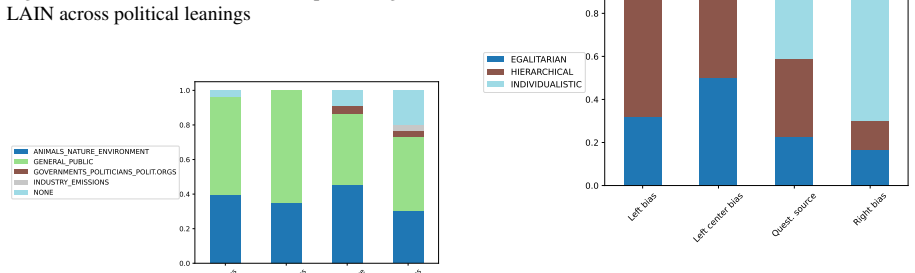
- Component-level analysis across political leanings reveals sharper patterns than narrative labels alone: right-bias outlets dominate individualistic cultural stories and prevent-resolution stances, while left-leaning outlets never use individualistic stories.
- The framework transfers unsupervised to a new topic and genre—politician speeches on COVID-19—producing hero, victim, and cultural-story distributions consistent with prior theoretical analyses.
Reading between the lines
- The cultural-story component is the paper's load-bearing premise: if a reader-response study shows that the four grid-group schemata do not match the interpretations readers spontaneously form, this component would add noise rather than explanatory power.
- The structured-prompt gains suggest that intermediate symbolic representations (characters, conflict, cultural story) could serve as an interpretable interface for LLM-based narrative analysis, enabling verification and correction of model predictions.
- Because the framework abstracts away from topic-specific events, it could support cross-cultural and cross-lingual comparisons of narrative framing, though the current studies are limited to English-language U.S. and Australian texts.
- A direct extension would test whether the component distributions track editorial stance shifts within an outlet over time more sensitively than generic topic frames do.
Editorial analysis
A structured set of objections, weighed in public.
Referee Report
Summary. The paper proposes a structured framework for narrative media framing, decomposing a narrative frame into three components: character roles (hero, villain, victim) plus focus, a four-way conflict/resolution category, and a cultural story drawn from grid-group cultural theory. The authors annotate 100 US climate-change news articles, derive 16 narrative frame types from component combinations, analyze associations with outlet political leaning, evaluate six LLMs on component and frame prediction, and apply the framework in an unsupervised zero-shot setting to COVID-19 political speeches. The central claims are that the framework generalizes across topics and domains, that component-wise annotation is more reliable than direct narrative labeling, and that explicit narrative structure is a more reliable cue for LLM narrative prediction than narrative descriptions alone.
Significance. If the claims hold, this is a useful contribution: it operationalizes narrative policy framework concepts into an annotation scheme, releases a new manually annotated dataset, and provides a computational baseline for narrative frame analysis. The paper carefully quantifies inter-annotator agreement (Krippendorff alpha between 0.67 and 0.82 across components), reports multiple LLM comparisons with repeated runs, and documents the annotation process in unusual detail. The component-wise versus direct-labeling comparison and the oracle-structure prompting experiment are valuable empirical ideas. However, two load-bearing points need strengthening: the construct validity of the cultural story component is asserted rather than demonstrated, and the structured prompting experiment partly encodes the answer by construction because the 16 narrative labels are defined as unique combinations of the components that are then fed back into the prompt. The cross-domain generalization claim also rests on a single zero-shot LLM without human gold labels. These issues are addressable but require additional analysis or explicit reframing.
major comments (4)
- [Section 3.3, Figure 2, Figure 10, Table 8] The cultural story component is not independently operationalized. The annotation instructions in Figure 10 and the LLM prompt in Table 8 describe each cultural story holistically (e.g., 'nature is resilient and will return to equilibrium') rather than requiring annotators or models to judge the two underlying grid-group dimensions (external control and group belonging) separately. Krippendorff alpha of 0.80 in Section 4.1 therefore establishes that the codebook can be applied consistently, but it does not establish that the labels correspond to the two-dimensional cognitive space posited by Thompson (2018) or to schemata readers actually activate. This matters because cultural stories are used to separate superficially similar frames, such as '12 years to save the world' (hierarchical) from 'All talk little action' (egalitarian) in Section 4.3.3. A concrete test would be to have annotators rate the two dimensions separately and check whether their joint ratings predict the holistic cultural story labels, or to validate against established cultural cognition measures.
- [Section 4.3.3, Figure 5, Appendix E] The oracle structured-prompt experiment is partly circular. Appendix E defines each of the 16 narrative frames as a unique combination of hero, villain, victim, focus, conflict, and cultural story. In Section 4.3.3, the structured prompt adds 'informal description of typical stakeholders' that are directly taken from these component combinations, and the model receives oracle labels for hero, villain, victim, and focus. The model is therefore being given parts of the target decomposition that were used to construct the narrative labels in the first place; the performance gain in Figure 5 is expected by construction and does not cleanly demonstrate that explicit structure is a more reliable cue than description. A control condition using component labels that are not derived from the target taxonomy, or a held-out evaluation where narrative labels are not defined as unique component combinations, would be needed. In addition, Figure 5 reports gains without error bars or significance tests, despite the paper noting variance across runs in Section 4.3.1.
- [Appendix D.2] The comparison between component-wise annotation and direct narrative labeling is not apples-to-apples. The structure-based agreement is computed on 30 articles annotated by two internal expert annotators who were given pre-existing hero, villain, and victim labels (as stated in Figure 11), while the direct-labeling agreement is computed on the same articles by two Stage 1 external annotators who chose a narrative frame from descriptions alone. The two settings differ in annotator expertise, task instructions, and the amount of information provided (characters were already fixed in the structured condition). The 63% versus 37% difference may therefore reflect task difficulty or annotator background rather than the benefit of structure. A matched design with the same annotators and randomized order, or a statistical test accounting for the small sample, would be needed to support the claim that component-wise annotation improves reliability.
- [Section 5] The COVID-19 generalization experiment relies entirely on a single zero-shot LLM (Claude Sonnet 3.5) with no gold annotations or human evaluation. The claim that the predicted patterns are 'congruent with prior theoretical work' is weak evidence of framework transfer, because the model may have been exposed to those very analyses (e.g., Mintrom et al., 2021) in its training data, and the prompts themselves mention the cultural story categories from the literature. A stronger evaluation would include a human-annotated subsample of the speeches, a comparison with a non-framework baseline prompt, or multiple models with different training corpora to rule out memorization.
minor comments (5)
- [Section 5.1] There is a typo: 'Boris Johnston' should be 'Boris Johnson'.
- [Throughout] The surname 'Krippendorff' is spelled inconsistently ('Krippendorf' appears in Sections 4.1 and Appendix D), and 'Gwet’t AC1' in Appendix D.1 contains a typo; it should be 'Gwet’s AC1'.
- [Figure 5] The figure would benefit from error bars or a table of per-run values, especially because the text in Section 4.3.1 reports nonzero variance for several models.
- [Section 4.3.3] The phrase 'Section section 4.3.3' in Section 4.3.2 contains a duplicated word.
- [Table 1] The baseline for the Narrative task (0.021) is extremely low because of the high number of classes and small dataset; it would be informative to also report a chance-level baseline or a majority-class baseline per task in the text.
Circularity Check
Partial circularity: narrative frame labels are defined as unique combinations of the framework's components, and the oracle structured-prompt experiment feeds those same components back as input, so the 'structure helps' conclusion is partly by construction.
-
self definitional
[Section 4.1 (Annotation quality); Section 4.3.3 (Predicting narrative frames with component labels); Appendix D.2]
"Since each narrative frame is derived from a unique combination of its elements, the reliable annotation of narrative frame components also ensures a more reliable annotation of resulting narratives than choosing them based on their description only."
The 16 narrative labels are not an independent target: the paper states that each frame is 'derived from a unique combination of its elements,' and the labels were assigned by 'element-wise mapping' of article structures to known frame structures. In Section 4.3.3, the model is given oracle (manually-annotated) hero, villain, victim, and focus labels—the very components used to construct the gold narrative labels—and this is shown to improve narrative prediction (Figure 5, orange). The improvement is therefore partly by construction: the mapping from these components to the frame label is already encoded in the label definitions and in the modified prompt descriptions taken from Appendix E.
full rationale
The paper's main framework—characters, conflict/resolution, and cultural stories—is derived from external sources (NPF, Entman, Thompson) and is not fitted to the target labels. The component prediction tasks in Table 1 (hero, villain, victim, focus, conflict, story) are genuine zero-shot evaluations against human annotations, and the dataset release provides independent benchmark value. The COVID-19 transfer experiment uses domain-agnostic prompts and compares outputs to external prior work; even if LLM prior knowledge could inflate apparent agreement, that is a contamination/validity concern rather than a circular derivation. The self-citations (Frermann et al. 2023; Otmakhova et al. 2024) supply data, stakeholder taxonomies, and survey background, but they are not load-bearing in a way that forces the central conclusions. The identified circularity is real but localized: the oracle structured-prompt experiment feeds back the very components from which the narrative labels were defined, making part of the 'structure helps' result self-definitional. Because the component prediction tasks and the general framework retain independent content, the overall circularity score is moderate rather than high. A separate construct-validity concern about the cultural-story component (whether grid-group dimensions are independently operationalized) is a validity limitation, not a circularity, and is therefore not scored here.
Assumptions & free parameters
assumptions (6)
- domain assumption The Narrative Policy Framework's hero/villain/victim triad is a sufficient and valid description of narrative characters for framing analysis.
- domain assumption Thompson's grid-group cultural theory (external control x group belonging) captures the wider schemata evoked by narrative frames.
- domain assumption News articles are structured as an inverted pyramid, so the most prominent content and proportion of text devoted to a role determines the focus.
- domain assumption Media Bias Fact Check labels of political leaning are reliable for the 18 outlets in the dataset.
- domain assumption The 16 narrative frames and their component structures, taken from Bushell et al. 2017, Bevan 2020, and Lamb et al. 2020, are an accurate ground-truth representation of the climate change narrative space.
- domain assumption LLM outputs at temperature=0 are deterministic enough for reliable comparison across models.
Cite this review
Pith. "Pith review of Narrative Media Framing in Political Discourse." pith.science (2026). https://pith.science/paper/JRPPZUAG
@misc{pith2026250600737,
  author       = {Pith},
  title        = {Pith review of: Narrative Media Framing in Political Discourse},
  year         = {2026},
  howpublished = {\url{https://pith.science/paper/JRPPZUAG}},
  note         = {Machine review of arXiv:2506.00737}
}
read the original abstract
Narrative frames are a powerful way of conceptualizing and communicating complex, controversial ideas, however automated frame analysis to date has mostly overlooked this framing device. In this paper, we connect elements of narrativity with fundamental aspects of framing, and present a framework which formalizes and operationalizes such aspects. We annotate and release a data set of news articles in the climate change domain, analyze the dominance of narrative frame components across political leanings, and test LLMs in their ability to predict narrative frames and their components. Finally, we apply our framework in an unsupervised way to elicit components of narrative framing in a second domain, the COVID-19 crisis, where our predictions are congruent with prior theoretical work showing the generalizability of our approach.
Figures


Figures from the paper (15 more)




Reference graph
Works this paper leans on
-
[1]
Apoorv Agarwal and Owen Rambow. 2010. Automatic detection and classification of social events. In Proceedings of the 2010 Conference on Empirical Methods in Natural Language Processing, pages 1024--1034
work page 2010
-
[2]
Mohammad Ali and Naeemul Hassan. 2022. A survey of computational framing analysis approaches. In Proceedings of the 2022 Conference on Empirical Methods in Natural Language Processing, pages 9335--9348
work page 2022
-
[3]
David Bamman, Ted Underwood, and Noah A. Smith. 2014. https://doi.org/10.3115/v1/P14-1035 A B ayesian mixed effects model of literary character . In Proceedings of the 52nd Annual Meeting of the Association for Computational Linguistics (Volume 1: Long Papers), pages 370--379, Baltimore, Maryland. Association for Computational Linguistics
-
[4]
W Lance Bennett and Murray Edelman. 1985. Toward a new political narrative. Journal of communication
work page 1985
-
[5]
Natalie Reyes Bernard, Abdul Basit, Ernesta Sofija, Hai Phung, Jessica Lee, Shannon Rutherford, Bernadette Sebar, Neil Harris, Dung Phung, and Nicola Wiseman. 2021. Analysis of crisis communication by the prime minister of australia during the covid-19 pandemic. International Journal of Disaster Risk Reduction, 62:102375
work page 2021
-
[6]
Luke D Bevan. 2020. Climate change strategic narratives in the united kingdom: emergency, extinction, effectiveness. Energy research & social science, 69:101580
work page 2020
-
[7]
John Boswell. 2013. Why and how narrative matters in deliberative systems. Political studies, 61(3):620--636
work page 2013
-
[8]
Jerome Bruner. 1991. The narrative construction of reality. Critical inquiry, 18(1):1--21
work page 1991
Show all 59 references
-
[9]
Simon Bushell, G \'e raldine Satre Buisson, Mark Workman, and Thomas Colley. 2017. Strategic narratives in climate change: Towards a unifying narrative to address the action gap on climate change. Energy Research & Social Science, 28:39--49
2017
-
[10]
Nathanael Chambers and Dan Jurafsky. 2009. https://aclanthology.org/P09-1068 Unsupervised learning of narrative schemas and their participants . In Proceedings of the Joint Conference of the 47th Annual Meeting of the ACL and the 4th International Joint Conference on Natural L...
2009
-
[11]
Deserai A Crow and Andrea Lawlor. 2016. Media in the policy process: Using framing and narratives to understand policy influences. Review of Policy Research, 33(5):472--491
2016
-
[12]
Stephen Daniels and Georgina H Endfield. 2009. Narratives of climate change: introduction. Journal of Historical Geography, 35(2):215--222
2009
-
[13]
Rohan Das, Aditya Chandra, I-Ta Lee, and Maria Leonor Pacheco. 2024. https://doi.org/10.18653/v1/2024.wnu-1.15 Media framing through the lens of event-centric narratives . In Proceedings of the 6th Workshop on Narrative Understanding, pages 85--98, Miami, Florida, USA. Associa...
2024 doi
-
[14]
Mary Douglas. 2007. A history of grid and group cultural theory. Toronto, Canada: University of Toronto
2007
-
[15]
Robert M Entman. 1993. Framing: Toward clarification of a fractured paradigm. Journal of communication, 43(4):51--58
1993
-
[16]
Mark Mark Alan Finlayson. 2012. Learning narrative structure from annotated folktales. Ph.D. thesis, Massachusetts Institute of Technology
2012
-
[17]
Walter R Fisher. 1984. Narration as a human communication paradigm: The case of public moral argument. Communications Monographs, 51(1):1--22
1984
-
[18]
Kjersti Fl ttum and yvind Gjerstad. 2017. Narratives in climate change discourse. Wiley Interdisciplinary Reviews: Climate Change, 8(1):e429
2017
-
[19]
Lea Frermann, Jiatong Li, Shima Khanehzar, and Gosia Mikolajczak. 2023. Conflicts, villains, resolutions: Towards models of narrative media framing. In Proceedings of the 61st Annual Meeting of the Association for Computational Linguistics (Volume 1: Long Papers), pages 8712--...
2023
-
[20]
Northrop H Frye. 1957. Anatomy of criticism. Princeton
1957
-
[21]
Kai Sebastian Gehring and Matteo Grigoletto. 2023. Analyzing climate change policy narratives with the character-role narrative framework. SSRN Electronic Journal, 10429
2023
-
[22]
Algirdas Julien Greimas. 1987. On meaning: Selected writings in semiotic theory. Actants, Actors, and Figures
1987
-
[23]
C Dominik G \"u ss and Ma Teresa Tuason. 2021. Individualism and egalitarianism can kill: how cultural values predict coronavirus deaths across the globe. Frontiers in Psychology, 12:620490
2021
-
[24]
Xiaochuang Han, Eunsol Choi, and Chenhao Tan. 2019. https://doi.org/10.18653/v1/N19-1167 No permanent F riends or enemies: Tracking relationships between nations from news . In Proceedings of the 2019 Conference of the North A merican Chapter of the Association for Computation...
2019 doi
-
[25]
Edward J Hu, Yelong Shen, Phillip Wallis, Zeyuan Allen-Zhu, Yuanzhi Li, Shean Wang, Lu Wang, and Weizhu Chen. 2021. Lo RA : Low-rank adaptation of large language models. arXiv preprint arXiv:2106.09685
2021 arXiv
-
[26]
Mohit Iyyer, Anupam Guha, Snigdha Chaturvedi, Jordan Boyd-Graber, and Hal Daum \'e III. 2016. https://doi.org/10.18653/v1/N16-1180 Feuding families and former F riends: Unsupervised learning for dynamic fictional relationships . In Proceedings of the 2016 Conference of the Nor...
2016 doi
-
[27]
Labiba Jahan and Mark Finlayson. 2019. https://doi.org/10.18653/v1/W19-2402 Character identification refined: A proposal . In Proceedings of the First Workshop on Narrative Understanding, pages 12--18, Minneapolis, Minnesota. Association for Computational Linguistics
2019 doi
-
[28]
Michael D Jones. 2014. Cultural characters and climate change: How heroes shape our perception of climate science. Social Science Quarterly, 95(1):1--39
2014
-
[29]
Michael D Jones, Aaron Smith-Walter, Mark K McBeth, and Elizabeth A Shanahan. 2023. The narrative policy framework. In Theories of the policy process, pages 161--195. Routledge
2023
-
[30]
Omar Khattab, Arnav Singhvi, Paridhi Maheshwari, Zhiyuan Zhang, Keshav Santhanam, Sri Vardhamanan, Saiful Haq, Ashutosh Sharma, Thomas T Joshi, Hanna Moazam, et al. 2023. Dspy: Compiling declarative language model calls into self-improving pipelines. arXiv preprint arXiv:2310.03714
2023 arXiv
-
[31]
William F Lamb, Giulio Mattioli, Sebastian Levi, J Timmons Roberts, Stuart Capstick, Felix Creutzig, Jan C Minx, Finn M \"u ller-Hansen, Trevor Culhane, and Julia K Steinberger. 2020. Discourses of climate delay. Global Sustainability, 3:e17
2020
-
[32]
Effi Levi, Guy Mor, Tamir Sheafer, and Shaul Shenhav. 2022. https://doi.org/10.18653/v1/2022.findings-naacl.133 Detecting narrative elements in informational text . In Findings of the Association for Computational Linguistics: NAACL 2022, pages 1755--1765, Seattle, United Stat...
2022 doi
-
[33]
Stephanie Lukin, Kevin Bowden, Casey Barackman, and Marilyn Walker. 2016. https://aclanthology.org/L16-1163 P ersona B ank: A corpus of personal narratives and their story intention graphs . In Proceedings of the Tenth International Conference on Language Resources and Evaluat...
2016
-
[34]
Michael Mintrom, Maria Rost Rublee, Matteo Bonotti, and Steven T Zech. 2021. Policy narratives, localisation, and public justification: responses to covid-19. Journal of European Public Policy, 28(8):1219--1237
2021
-
[35]
Thomas E Nelson, Zoe M Oxley, and Rosalee A Clawson. 1997. Toward a psychology of framing effects. Political behavior, 19:221--246
1997
-
[36]
Fredrik Olsson, Magnus Sahlgren, Fehmi ben Abdesslem, Ariel Ekgren, and Kristine Eck. 2020. https://aclanthology.org/2020.aespen-1.5 Text categorization for conflict event annotation . In Proceedings of the Workshop on Automated Extraction of Socio-political Events from News 2...
2020
-
[37]
Yulia Otmakhova, Shima Khanehzar, and Lea Frermann. 2024. https://doi.org/10.18653/v1/2024.acl-long.822 Media framing: A typology and survey of computational approaches across disciplines . In Proceedings of the 62nd Annual Meeting of the Association for Computational Linguist...
2024 doi
-
[38]
Molly Patterson and Kristen Renwick Monroe. 1998. Narrative in political science. Annual review of political science, 1(1):315--331
1998
-
[39]
Andrew Piper, Richard Jean So, and David Bamman. 2021. https://doi.org/10.18653/v1/2021.emnlp-main.26 Narrative theory for computational narrative understanding . In Proceedings of the 2021 Conference on Empirical Methods in Natural Language Processing, pages 298--311, Online ...
2021 doi
-
[40]
Gerald Prince. 2003. A dictionary of narratology. U of Nebraska P
2003
-
[41]
Vladimir Propp. 1968. Morphology of the folktale. U of Texas P
1968
-
[42]
Dominique Robert and Shaul Shenhav. 2014. Fundamental assumptions in narrative analysis: Mapping the field. The qualitative report, 19(38):1--17
2014
-
[43]
Miquel Rodrigo-Alsina. 2019. Talking about climate change: the power of narratives. In Climate Change Denial and Public Relations, pages 103--120. Routledge
2019
-
[44]
Bertram T Scheufele and Dietram A Scheufele. 2010. Of spreading activation, applicability, and schemas: Conceptual distinctions and their operational implications for measuring frames and framing effects. In Doing News Framing Analysis , pages 126--150. Routledge
2010
-
[45]
Holli A Semetko and Patti M Valkenburg. 2000. Framing european politics: A content analysis of press and television news. Journal of communication, 50(2):93--109
2000
-
[46]
Shadi Shahsavari, Pavan Holur, Tianyi Wang, Timothy R Tangherlini, and Vwani Roychowdhury. 2020. Conspiracy in the time of corona: automatic detection of emerging covid-19 conspiracy theories in social media and the news. Journal of computational social science, 3(2):279--317
2020
-
[47]
Elizabeth A Shanahan, Michael D Jones, and Mark K McBeth. 2018. How to conduct a narrative policy framework study. The Social Science Journal, 55(3):332--345
2018
-
[48]
Elizabeth A Shanahan, Mark K McBeth, and Paul L Hathaway. 2011. Narrative policy framework: The influence of media policy narratives on public opinion. Politics & Policy, 39(3):373--400
2011
-
[49]
Mike Shanahan. 2007. Talking about a revolution: climate change and the media
2007
-
[50]
Jocelyn Shen, Maarten Sap, Pedro Colon-Hernandez, Hae Park, and Cynthia Breazeal. 2023. https://doi.org/10.18653/v1/2023.emnlp-main.383 Modeling empathic similarity in personal narratives . In Proceedings of the 2023 Conference on Empirical Methods in Natural Language Processi...
2023 doi
-
[51]
Shaul R Shenhav. 2005. Thin and thick narrative analysis: On the question of defining and analyzing political narratives. Narrative inquiry, 15(1):75--99
2005
-
[52]
Current issues of linguistics and didactics: The interdisciplinary approach in humanities
IV Skrynnikova, TN Astafurova, and NA Sytina. 2017. Power of metaphor: cultural narratives in political persuasion. In 7th International Scientific and Practical Conference" Current issues of linguistics and didactics: The interdisciplinary approach in humanities"(CILDIAH 2017...
2017
-
[53]
Paul M Sniderman and Sean M Theriault. 2004. The structure of political argument and the logic of issue framing. Studies in public opinion: Attitudes, nonattitudes, measurement error, and change, 3(03):133--65
2004
-
[54]
Dominik Stammbach, Maria Antoniak, and Elliott Ash. 2022. Heroes, villains, and victims, and GPT -3: Automated extraction of character roles without training data. In Proceedings of the 4th Workshop of Narrative Understanding (WNU2022), pages 47--56. Association for Computatio...
2022
-
[55]
Timothy R Tangherlini, Shadi Shahsavari, Behnam Shahbazi, Ehsan Ebrahimzadeh, and Vwani Roychowdhury. 2020. An automated pipeline for the discovery of conspiracy and conspiracy theory narrative frameworks: Bridgegate, pizzagate and storytelling on the web. PloS one, 15(6):e0233879
2020
-
[56]
Michael Thompson. 2018. Cultural theory. Routledge
2018
-
[57]
Jin Zhao, Jingxuan Tu, Han Du, and Nianwen Xue. 2024. https://doi.org/10.18653/v1/2024.emnlp-main.954 Media attitude detection via framing analysis with events and their relations . In Proceedings of the 2024 Conference on Empirical Methods in Natural Language Processing, page...
2024 doi
-
[58]
URL: " 'urlintro :=
ENTRY address author booktitle chapter edition editor howpublished institution journal key month note number organization pages publisher school series title type volume year eprint doi pubmed url lastchecked label extra.label sort.label short.list INTEGERS output.state before...
-
[59]
write newline
" write newline "" before.all 'output.state := FUNCTION n.dashify 't := "" t empty not t #1 #1 substring "-" = t #1 #2 substring "--" = not "--" * t #2 global.max substring 't := t #1 #1 substring "-" = "-" * t #2 global.max substring 't := while if t #1 #1 substring * t #2 gl...
Reviewed August 7, 2026 · model on record in the stance chip above.
Discussion (0). Sign in to comment.