REVIEW 3 major objections 6 minor 38 references
Breaker: Removing Shortcut Cues with User Clustering for Single-slot Recommendation System
T0 review · 3 major / 6 minor · reviewed 2026-08-07 · deepseek-v4-flash
Pith's one-line read Clustering similar users lifts one-slot recommendation recall by 7%.
desk verdict Solid applied paper from Meituan; method works, but the shortcut-removal mechanism is not cleanly isolated from generic auxiliary-task regularization. read the letter →
The pith
A machine-rendered reading of the paper's core claim, the machinery that carries it, and where it could break.
The reading
What carries the argument
The load-bearing mechanism is the cluster-weighted mixture of pointwise preference towers: $P(Y|U,I)=\sum_{C}Q(Y|U,I,C)P(C|U)$, implemented as $K$ MLP towers, each scoring the concatenated user/item representation, with the final prediction the probability-weighted sum of tower outputs. The clustering module computes soft assignments with a Student-$t$ kernel, produces pseudo-labels by square normalization, and drives the KL clustering loss; the delayed parameter update (copying main-network parameters to the target network every $M$ steps) stabilizes joint training. This machinery converts 'similar users' into a harder discrimination problem and lets each tower specialize on one cluster's preferences.
What would settle it
Replace the clustering auxiliary module with an equally complex non-clustering auxiliary task, such as predicting a random fixed user partition or reconstructing user features, while keeping the multi-tower preference module; if this control matches Breaker's Recall@1 and AER gains, the clustering-specific mechanism is not what drives the improvement. Separately, if item-based AUC does not decline while Recall@1 rises during training, the claimed shift from intrinsic-tendency shortcut to user-item preference is not happening.
Extended reading notes
Core claim
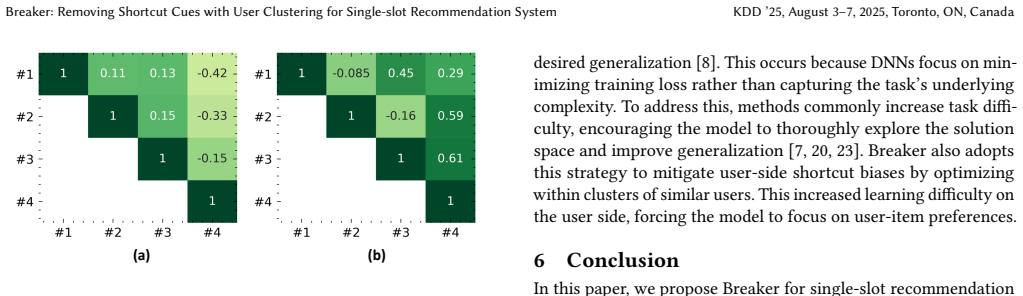
Breaker's central claim is that user intrinsic tendency, the propensity to click or convert regardless of item, acts as a shortcut cue in single-slot pointwise recommenders, and that this cue can be deliberately suppressed by clustering. The model factorizes the preference score as $P(Y|U,I)=\sum_{C}Q(Y|U,I,C)P(C|U)$: a user representation is produced by the representation module, a deep-embedding-clustering module assigns soft cluster probabilities $q'_{ij}$ via a Student-$t$ kernel, and the cluster-specific preference module sums the outputs of $K$ pointwise towers weighted by those probabilities. The auxiliary clustering loss, a KL divergence against square-normalized pseudo-labels, is trained end-to-end with a delayed parameter update that copies main-network weights to the target network every $M$ steps. The paper claims this makes user-side learning harder and shifts the model toward user-item preferences: item-based AUC drops while Recall@1 rises during training, towers learn weakly correlated predictions, and the ablation without the clustering task underperforms, supporting the mechanism rather than the multi-tower structure alone.
Load-bearing premise
The load-bearing premise is that clustering users by their learned representations makes the user side harder in a way that specifically suppresses the general click-habit shortcut; if the measured gains come from generic regularization, added capacity, or the multi-tower structure instead, the paper's explanation is unsupported even if the gains are real.
Editorial extensions
If this is right
- If the shortcut-bias diagnosis is right, any single-slot pointwise recommender can be improved by adding an unsupervised user-clustering objective, with no change to the serving item pool.
- Breaker's efficiency is part of the claim: at 1.41M parameters it runs about 40% faster at inference than the best neural baselines, so the debiasing gains are available in production-latency settings.
- The observed pattern of decreasing item-based AUC and increasing Recall@1 implies a training-time diagnostic: monitor item-based AUC to detect when the model is being pushed off the intrinsic-tendency shortcut.
- The delayed update mechanism makes the clustering and classification tasks jointly trainable, so the approach extends to other end-to-end systems that combine self-training with a predictive loss.
- Cluster count matters: tuning $K$ around 4 gave best results, so deployments need to re-tune cluster number per scenario.
Reading between the lines
- A direct test the paper does not run is to replace the clustering auxiliary task with an equally expressive non-clustering auxiliary task; if such a control matched Breaker's gains, the explanation would shift from 'clustering suppresses shortcut cues' to 'any extra user-side difficulty helps.'
- The same recipe could transfer to list-based ranking or any prediction problem with a rich nuisance side: intentionally making the nuisance dimension hard to fit may be a general debiasing trick, but that extension is an inference, not a paper claim.
- If clusters truly correspond to intrinsic tendencies, one could test interpretability by examining whether cluster assignment predicts raw click rate independent of items, and whether debiasing strength varies with cluster separation.
Editorial analysis
A structured set of objections, weighed in public.
Referee Report
Summary. The paper studies single-slot recommendation (one item shown at a time) in Meituan Payment's targeted marketing display system. It argues that pointwise models exploit an abundance of user-side features as shortcut cues from users' intrinsic click/conversion tendencies, at the expense of learning user-item preferences. To counteract this, Breaker adds an auxiliary deep-embedding clustering task on user representations, a multi-tower prediction structure in which each cluster has its own tower, and a delayed parameter update mechanism that periodically copies main-network user parameters into a target network used to produce clustering pseudo-labels. The training objective combines a binary classification loss with a KL-divergence clustering loss. Offline experiments on two logged datasets report Recall@1 and AER improvements over several baselines, and a 7-day online A/B test reports conversion lifts of 4.93% and 7.15% with p-values of 0.0039 and 0.0174. The paper also reports silhouette-based clustering analysis, sensitivity to the number of clusters, parameter efficiency, and an item-based AUC trajectory that is used to support the shortcut-removal mechanism.
Significance. If the shortcut-removal mechanism were established, the paper would be a useful contribution: it identifies a failure mode specific to single-slot pointwise recommendation, proposes a cheap auxiliary clustering objective, reports consistent offline and deployed online gains, and releases the source code. The deployment context and the efficiency comparisons give the empirical claims practical credibility. However, the central explanatory claim—that clustering similar users raises user-side difficulty and specifically suppresses intrinsic-tendency shortcuts—rests on indirect evidence. The offline results are point estimates without error bars or significance tests, the main ablation removes the entire auxiliary task rather than isolating clustering from generic regularization, and the online A/B test uses only seven daily observations. The paper's strengths are real, but the mechanism claim needs sharper experimental support before the contribution can be judged at face value.
major comments (3)
- [Sec. 4.2.1, Table 2] The ablation Breaker1− removes the clustering loss, the target network, and the cluster-weighted aggregation in Eq. (9) simultaneously, so it cannot separate the effect of clustering users by intrinsic tendencies from the effect of adding any auxiliary task that regularizes the user representation. A stronger control would keep the multi-tower architecture and add an auxiliary task of comparable computational complexity but without cluster semantics—for example, random pseudo-label self-training, a reconstruction head, or a contrastive user-representation loss—and report the same Recall@1 and AER metrics. Without such a control, the offline gains reported in Table 2 do not uniquely support the shortcut-bias explanation in Sec. 4.3.3.
- [Sec. 4.3.3, Fig. 7] The item-based AUC evidence is a single training trajectory with no comparison to Breaker1−, Breaker2−, or any non-clustering control. A declining item-based AUC can result from the delayed target updates, from learning-rate schedules, or from generic auxiliary regularization, so it does not by itself show that intrinsic-tendency shortcuts are removed. I request multiple independent runs and the corresponding trajectories for a non-clustering control, plus a more direct shortcut measure—for example, the change in predictive performance when user-side features are ablated, or feature-attribution scores before and after training—to connect the AUC decline to user intrinsic tendencies rather than to generic model behavior.
- [Sec. 4.1.4 and Sec. 4.2.1] The offline numbers are point estimates without error bars or significance tests. In particular, the AER gain in Scenario B over EDCN is 0.0005210 versus 0.0005155, a relative difference of about 1.07%, which is small relative to the scale of the metric. In addition, K is tuned over {2,3,4,5} and set to 4 in both scenarios, and lambda is fixed at 0.1, but no validation split or model-selection protocol is described. The paper should report standard deviations or confidence intervals over multiple test-set samples or bootstraps, and it should specify how K and lambda were chosen, so that the claimed 7.05% and 7.14% Recall@1 improvements can be separated from noise and from tuning effects.
minor comments (6)
- [Table 2] The table formatting is corrupted in places: for example, the LightGBM row reads "-4.070.05040 0.002055" and "-9.740.08259 0.0004800," which merges the parameter count, Recall@1, and AER values. The table should be regenerated with clearly separated columns.
- [Sec. 4.1.1] The phrase "randomized controlled experiment (RCT)" is a misnomer for the described data-collection procedure, which hashes users into buckets to expose each bucket to the same item. This is a randomized exposure scheme for uniform item coverage, not a treatment RCT; please rename it to something like "randomized exposure logging" to avoid overclaiming.
- [Sec. 3.2 and Algorithm 1] The roles of Q and Q' are confusing. Definition 1 defines Q' as the main-network assignment matrix, Definition 2 then introduces a similarity q_ij "identical to that of q'_ij in the main network," and Algorithm 1 says both q_ij and q'_ij are calculated "based on theta^- and theta respectively." Please define Q, Q', and the target-network pseudo-label matrix P once, and use consistent notation throughout the paper.
- [Algorithm 1, line 12] The text says "reset theta^- = theta" every M steps, but the intended operation is a parameter copy, not a reset or reinitialization. Please change the wording to "copy theta to theta^-" to match the delayed update mechanism.
- [Sec. 4.1.4] The sentence "we employ the same hyperparameters across two scenarios, which are determined based on empirical considerations and computational efficiency" is too vague to be reproducible. Please state the validation procedure used to set K, lambda, and M, or explicitly mark them as chosen by fixed heuristic.
- [Sec. 4.4, Fig. 9] The online significance test is a paired samples t-test over seven daily conversion-rate observations. With only seven paired points, the normality and independence assumptions are fragile; please report the individual daily lifts or a confidence interval for the mean lift, and note the small number of observation days.
Circularity Check
No significant circularity: the recommendation gains are evaluated against external baselines and an online A/B test, while the clustering auxiliary task is a self-training regularizer rather than a fitted input to the target metric.
full rationale
The paper's central effectiveness claim is supported by offline Recall@1 and AER comparisons against independently implemented baselines (LightGBM, DeepFM, xDeepFM, DCN-V2, EDCN, AutoInt, FRNet, MultiCR) and by a 7-day online A/B test with reported p-values. The clustering auxiliary task uses DEC-style square-normalized pseudo-labels (Eqs. 4-6) that are self-generated during training, but they serve as an auxiliary regularizer; the claimed prediction is user-item preference quality measured by holdout and online metrics, not the pseudo-labels themselves. The ablation Breaker1- removes the whole clustering loss and target network, so it does not isolate the mechanism, but this is a limitation of explanatory support rather than a circular derivation. The paper cites prior work by overlapping authors ([24], and [28] co-authored by Yu Chen) only to support contextual claims about manually configured items and multi-step conversion modeling in the business setting; these citations are not load-bearing for the core derivation of Breaker, which is defined by its own equations and evaluated independently. No step was found where a prediction reduces by construction to its own input or where a fitted parameter is renamed as a prediction. Therefore, the circularity score is 0.
Assumptions & free parameters
free parameters (5)
- Number of clusters K =
4
- Clustering loss weight lambda =
0.1
- Target network update frequency M =
10% of total steps in an epoch
- Embedding dimension =
10
- Tower width and depth =
(32-10) per tower
assumptions (4)
- domain assumption User intrinsic tendencies are shortcut cues in single-slot DNN recommenders
- domain assumption Clustering users with similar intrinsic tendencies raises user-side task difficulty and forces item-preference learning
- standard math Randomized controlled trial data collection (hash(userID) mod n) makes AER an unbiased estimate
- standard math Deep embedding clustering self-training pseudo-label refinement is a valid auxiliary objective
Cite this review
Pith. "Pith review of Breaker: Removing Shortcut Cues with User Clustering for Single-slot Recommendation System." pith.science (2026). https://pith.science/paper/3GYRZTGL
@misc{pith2026250600828,
  author       = {Pith},
  title        = {Pith review of: Breaker: Removing Shortcut Cues with User Clustering for Single-slot Recommendation System},
  year         = {2026},
  howpublished = {\url{https://pith.science/paper/3GYRZTGL}},
  note         = {Machine review of arXiv:2506.00828}
}
read the original abstract
In a single-slot recommendation system, users are only exposed to one item at a time, and the system cannot collect user feedback on multiple items simultaneously. Therefore, only pointwise modeling solutions can be adopted, focusing solely on modeling the likelihood of clicks or conversions for items by users to learn user-item preferences, without the ability to capture the ranking information among different items directly. However, since user-side information is often much more abundant than item-side information, the model can quickly learn the differences in user intrinsic tendencies, which are independent of the items they are exposed to. This can cause these intrinsic tendencies to become a shortcut bias for the model, leading to insufficient mining of the most concerned user-item preferences. To solve this challenge, we introduce the Breaker model. Breaker integrates an auxiliary task of user representation clustering with a multi-tower structure for cluster-specific preference modeling. By clustering user representations, we ensure that users within each cluster exhibit similar characteristics, which increases the complexity of the pointwise recommendation task on the user side. This forces the multi-tower structure with cluster-driven parameter learning to better model user-item preferences, ultimately eliminating shortcut biases related to user intrinsic tendencies. In terms of training, we propose a delayed parameter update mechanism to enhance training stability and convergence, enabling end-to-end joint training of the auxiliary clustering and classification tasks. Both offline and online experiments demonstrate that our method surpasses the baselines. It has already been deployed and is actively serving tens of millions of users daily on Meituan, one of the most popular e-commerce platforms for services.
Figures


Figures from the paper (6 more)



Reference graph
Works this paper leans on
-
[1]
Bo Chen, Yichao Wang, Zhirong Liu, Ruiming Tang, Wei Guo, Hongkun Zheng, Weiwei Yao, Muyu Zhang, and Xiuqiang He. 2021. Enhancing Explicit and Implicit Feature Interactions via Information Sharing for Parallel Deep CTR Models. InProceedings of the 30th ACM International Conference on Information & Knowledge Management(Virtual Event, Queensland, Australia)...
arXiv 2021
-
[3]
Jiawei Chen, Hande Dong, Xiang Wang, Fuli Feng, Meng Wang, and Xiangnan He. 2023. Bias and debias in recommender system: A survey and future directions. ACM Transactions on Information Systems41, 3 (2023), 1–39
2023
-
[4]
Paul Covington, Jay Adams, and Emre Sargin. 2016. Deep Neural Networks for YouTube Recommendations. InProceedings of the 10th ACM Conference on Recommender Systems(Boston, Massachusetts, USA)(RecSys ’16). Association for Computing Machinery, New York, NY, USA, 191–198. https://doi.org/10.1145/ 2959100.2959190
arXiv 2016
-
[5]
Yue Cui, Liwei Deng, Yan Zhao, Bin Yao, Vincent W. Zheng, and Kai Zheng
-
[6]
Ahmed El-Kishky, Thomas Markovich, Serim Park, Chetan Verma, Baekjin Kim, Ramy Eskander, Yury Malkov, Frank Portman, Sofía Samaniego, Ying Xiao, and Aria Haghighi. 2022. TwHIN: Embedding the Twitter Heterogeneous Information Network for Personalized Recommendation. InProceedings of the 28th ACM SIGKDD Conference on Knowledge Discovery and Data Mining(Wash...
arXiv 2022
-
[7]
Yixin Fei, Zhongkai Zhao, Siwei Yang, and Bingchen Zhao. 2022. XCon: Learning with Experts for Fine-grained Category Discovery. In33rd British Machine Vision Conference 2022, BMVC 2022, London, UK, November 21-24, 2022. BMVA Press. https://bmvc2022.mpi-inf.mpg.de/0096.pdf
work page 2022
-
[8]
Robert Geirhos, Jörn-Henrik Jacobsen, Claudio Michaelis, Richard Zemel, Wieland Brendel, Matthias Bethge, and Felix A Wichmann. 2020. Shortcut learn- ing in deep neural networks.Nature Machine Intelligence2, 11 (2020), 665–673
2020
-
[9]
Huifeng Guo, Bo Chen, Ruiming Tang, Weinan Zhang, Zhenguo Li, and Xiuqiang He. 2021. An Embedding Learning Framework for Numerical Features in CTR Prediction. InProceedings of the 27th ACM SIGKDD Conference on Knowledge Discovery & Data Mining(Virtual Event, Singapore)(KDD ’21). Association for Computing Machinery, New York, NY, USA, 2910–2918. https://do...
arXiv 2021
Show all 38 references
-
[10]
Huifeng Guo, Ruiming Tang, Yunming Ye, Zhenguo Li, and Xiuqiang He. 2017. DeepFM: a factorization-machine based neural network for CTR prediction. In Proceedings of the 26th International Joint Conference on Artificial Intelligence (Melbourne, Australia)(IJCAI’17). AAAI Press,...
2017
-
[11]
Xiangnan He, Lizi Liao, Hanwang Zhang, Liqiang Nie, Xia Hu, and Tat-Seng Chua. 2017. Neural Collaborative Filtering. InProceedings of the 26th International Conference on World Wide Web(Perth, Australia)(WWW ’17). International World Wide Web Conferences Steering Committee, Re...
2017
-
[12]
Tongwen Huang, Zhiqi Zhang, and Junlin Zhang. 2019. FiBiNET: combining fea- ture importance and bilinear feature interaction for click-through rate prediction. InProceedings of the 13th ACM Conference on Recommender Systems(Copenhagen, Denmark)(RecSys ’19). Association for Com...
2019
-
[13]
Yanhua Huang, Weikun Wang, Lei Zhang, and Ruiwen Xu. 2021. Sliding Spec- trum Decomposition for Diversified Recommendation. InProceedings of the 27th ACM SIGKDD Conference on Knowledge Discovery & Data Mining(Virtual Event, Singapore)(KDD ’21). Association for Computing Machin...
2021
-
[14]
Guolin Ke, Qi Meng, Thomas Finley, Taifeng Wang, Wei Chen, Weidong Ma, Qiwei Ye, and Tie-Yan Liu. 2017. LightGBM: a highly efficient gradient boosting decision tree. InProceedings of the 31st International Conference on Neural Information Processing Systems(Long Beach, Califor...
2017
-
[15]
Liangwei Li, Liucheng Sun, Chenwei Weng, Chengfu Huo, and Weijun Ren
-
[16]
Jianxun Lian, Xiaohuan Zhou, Fuzheng Zhang, Zhongxia Chen, Xing Xie, and Guangzhong Sun. 2018. xDeepFM: Combining Explicit and Implicit Feature Interactions for Recommender Systems. InProceedings of the 24th ACM SIGKDD International Conference on Knowledge Discovery & Data Min...
2018
-
[17]
Shiwei Lyu, Hongbo Cai, Chaohe Zhang, Shuai Ling, Yue Shen, Xiaodong Zeng, Jinjie Gu, Guannan Zhang, and Haipeng Zhang. 2022. See Clicks Differently: Mod- eling User Clicking Alternatively with Multi Classifiers for CTR Prediction. In Proceedings of the 31st ACM International ...
2022
-
[18]
Volodymyr Mnih, Koray Kavukcuoglu, David Silver, Alex Graves, Ioannis Antonoglou, Daan Wierstra, and Martin Riedmiller. 2013. Playing atari with deep reinforcement learning.arXiv preprint arXiv:1312.5602(2013)
2013 arXiv
-
[19]
Luca Scimeca, Seong Joon Oh, Sanghyuk Chun, Michael Poli, and Sangdoo Yun
-
[20]
Nimit Sohoni, Jared Dunnmon, Geoffrey Angus, Albert Gu, and Christopher Ré. 2020. No subclass left behind: Fine-grained robustness in coarse-grained classification problems.Advances in Neural Information Processing Systems33 (2020), 19339–19352
2020
-
[21]
Weiping Song, Chence Shi, Zhiping Xiao, Zhijian Duan, Yewen Xu, Ming Zhang, and Jian Tang. 2019. AutoInt: Automatic Feature Interaction Learning via Self-Attentive Neural Networks. InProceedings of the 28th ACM International Conference on Information and Knowledge Management(B...
2019
-
[22]
Laurens van der Maaten and Geoffrey Hinton. 2008. Visualizing Data using t-SNE.Journal of Machine Learning Research9, 86 (2008), 2579–2605. http: //jmlr.org/papers/v9/vandermaaten08a.html
2008
-
[23]
Tan Wad, Qianru Sun, Sugiri Pranata, Karlekar Jayashree, and Hanwang Zhang
-
[24]
Chao Wang, Xiaowei Shi, Shuai Xu, Zhe Wang, Zhiqiang Fan, Yan Feng, An You, and Yu Chen. 2023. A Multi-stage Framework for Online Bonus Allocation Based on Constrained User Intent Detection. InProceedings of the 29th ACM SIGKDD Conference on Knowledge Discovery and Data Mining...
2023
-
[25]
Fangye Wang, Yingxu Wang, Dongsheng Li, Hansu Gu, Tun Lu, Peng Zhang, and Ning Gu. 2022. Enhancing CTR Prediction with Context-Aware Feature Representation Learning. InProceedings of the 45th International ACM SIGIR Conference on Research and Development in Information Retriev...
2022
-
[26]
Ruoxi Wang, Rakesh Shivanna, Derek Cheng, Sagar Jain, Dong Lin, Lichan Hong, and Ed Chi. 2021. DCN V2: Improved Deep & Cross Network and Practical Lessons for Web-scale Learning to Rank Systems. InProceedings of the Web Conference 2021(Ljubljana, Slovenia)(WWW ’21). Associatio...
2021
-
[27]
InEuropean Conference on Computer Vision
Equivariance and invariance inductive bias for learning from insufficient data. InEuropean Conference on Computer Vision. Springer, 241–258
-
[28]
Dongbo Xi, Zhen Chen, Peng Yan, Yinger Zhang, Yongchun Zhu, Fuzhen Zhuang, and Yu Chen. 2021. Modeling the Sequential Dependence among Audience Multi- step Conversions with Multi-task Learning in Targeted Display Advertising. InProceedings of the 27th ACM SIGKDD Conference on ...
2021 doi
-
[29]
Junyuan Xie, Ross Girshick, and Ali Farhadi. 2016. Unsupervised Deep Embedding for Clustering Analysis. InProceedings of The 33rd International Conference on Machine Learning (Proceedings of Machine Learning Research, Vol. 48), Maria Flo- rina Balcan and Kilian Q. Weinberger (...
2016
-
[31]
Zhiqiang Wang, Qingyun She, and Junlin Zhang. 2021. MaskNet: Introducing feature-wise multiplication to CTR ranking models by instance-guided mask. arXiv preprint arXiv:2102.07619(2021)
2021 arXiv
-
[32]
Runlong Yu, Yuyang Ye, Qi Liu, Zihan Wang, Chunfeng Yang, Yucheng Hu, and Enhong Chen. 2021. XCrossNet: Feature Structure-Oriented Learning for Click-Through Rate Prediction. InAdvances in Knowledge Discovery and Data Mining: 25th Pacific-Asia Conference, PAKDD 2021, Virtual E...
2021 doi
-
[33]
Shuai Zhang, Lina Yao, Aixin Sun, and Yi Tay. 2019. Deep Learning Based Recommender System: A Survey and New Perspectives.ACM Comput. Surv.52, 1, Article 5 (feb 2019), 38 pages
2019
-
[34]
Weiqi Zhao, Dian Tang, Xin Chen, Dawei Lv, Daoli Ou, Biao Li, Peng Jiang, and Kun Gai. 2023. Disentangled Causal Embedding With Contrastive Learning For Recommender System. InCompanion Proceedings of the ACM Web Conference 2023 (Austin, TX, USA)(WWW ’23 Companion). Association...
2023
-
[35]
Li Yu, Zhengwei Wu, Tianchi Cai, Ziqi Liu, Zhiqiang Zhang, Lihong Gu, Xiaodong Zeng, and Jinjie Gu. 2021. Joint Incentive Optimization of Customer and Merchant in Mobile Payment Marketing.Proceedings of the AAAI Conference on Artificial Intelligence35, 17 (May 2021), 15000–150...
2021 doi
-
[36]
Guorui Zhou, Xiaoqiang Zhu, Chenru Song, Ying Fan, Han Zhu, Xiao Ma, Yanghui Yan, Junqi Jin, Han Li, and Kun Gai. 2018. Deep Interest Network for Click- Through Rate Prediction. InProceedings of the 24th ACM SIGKDD International Conference on Knowledge Discovery & Data Mining(...
2018
-
[39]
Yan Zhao, Xiao Fang, and David Simchi-Levi. 2017. Uplift modeling with mul- tiple treatments and general response types. InProceedings of the 2017 SIAM International Conference on Data Mining. SIAM, 588–596
2017
-
[2019]
InProceedings of the 25th ACM SIGKDD International Conference on Knowledge Discovery & Data Mining (Anchorage, AK, USA)(KDD ’19)
Hidden POI Ranking with Spatial Crowdsourcing. InProceedings of the 25th ACM SIGKDD International Conference on Knowledge Discovery & Data Mining (Anchorage, AK, USA)(KDD ’19). Association for Computing Machinery, New York, NY, USA, 814–824. https://doi.org/10.1145/3292500.3330844
-
[2020]
InProceedings of the 29th ACM International Con- ference on Information & Knowledge Management(Virtual Event, Ireland)(CIKM ’20)
Spending Money Wisely: Online Electronic Coupon Allocation based on Real-Time User Intent Detection. InProceedings of the 29th ACM International Con- ference on Information & Knowledge Management(Virtual Event, Ireland)(CIKM ’20). Association for Computing Machinery, New York,...
-
[2022]
InThe Tenth International Conference on Learning Representa- tions, ICLR 2022, Virtual Event, April 25-29, 2022
Which Shortcut Cues Will DNNs Choose? A Study from the Parameter- Space Perspective. InThe Tenth International Conference on Learning Representa- tions, ICLR 2022, Virtual Event, April 25-29, 2022. OpenReview.net
2022
Reviewed August 7, 2026 · model on record in the stance chip above.
Discussion (0). Sign in to comment.