REVIEW 4 major objections 6 minor 24 references
Advancing from Automated to Autonomous Beamline by Leveraging Computer Vision
T0 review · 4 major / 6 minor · reviewed 2026-08-07 · deepseek-v4-flash
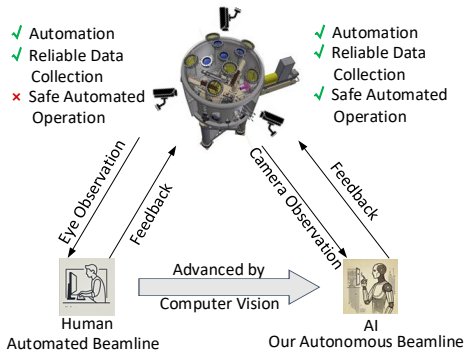
Pith's one-line read Multi-view computer vision can catch beamline collisions before they happen, enabling unattended synchrotron experiments.
desk verdict Solid engineering integration for beamline collision safety, but the headline accuracy and the 198-year reliability claim are unsupported by the evaluation. read the letter →
The pith
A machine-rendered reading of the paper's core claim, the machinery that carries it, and where it could break.
The reading
What carries the argument
The load-bearing mechanism is the multi-view AND-condition on contour distance. Segmentation produces binary masks per equipment class; a geometry regularization enforces known relative spatial positions, such as the holder always above the stage, and temporal smoothing via tracking stabilizes mask identities. The system samples sparse points on each contour and computes the minimum pairwise Euclidean distance; a collision is declared only when that distance is below a 10-pixel threshold in every camera view. Requiring agreement across views and across consecutive frames turns single-view segmentation errors into rare events, which is what allows the paper to project a 198-year mean time between detection errors.
What would settle it
Run the two-system, consecutive-frame protocol continuously on a real beamline while deliberately varying lighting, adding occlusions, and moving equipment at operational speeds, then count detection errors over weeks; if errors cluster under particular conditions or occur far more often than 16 frames per trillion, the independence assumption fails. Separately, place two objects at a known physical separation and compare the pixel-distance measurement with a calibrated physical distance in each camera view; a large mismatch would invalidate the 10-pixel threshold as a safety measure.
Extended reading notes
Core claim
The paper's central claim is that collisions between beamline equipment can be detected reliably enough for unattended operation by fusing segmentation, tracking, and thresholded contour distances across multiple camera views. Each camera frame is segmented into equipment instances; a transformer-based tracker stabilizes masks over time; and a collision warning is issued only when the minimum Euclidean distance between two equipment contours is below a pixel threshold in every view. On a 300-frame held-out set from a real beamline with four equipment classes, this three-view fusion reaches 99.8% accuracy, up from 81.9% with the front view alone. The paper asserts that this accuracy, combined with a redundant parallel camera system and a two-consecutive-frame confirmation rule, makes the theoretical error rate small enough for long-term autonomous operation.
Load-bearing premise
The safety projection assumes that errors from the two redundant camera systems are statistically independent, and that errors in consecutive frames are independent, so that combining them multiplies away the failure rate; if segmentation failures cluster in time or across cameras during lighting changes or occlusions, the one-error-per-198-years estimate does not follow.
Editorial extensions
If this is right
- If the reported 99.8% accuracy generalizes beyond the 300-frame test set, multi-view vision can replace static limit switches as the primary collision guard for automated beamline motion.
- The transfer-learning pipeline from a lab simulation to the real beamline suggests new beamline configurations can deploy the system without collecting large on-site datasets.
- The interactive annotation module implies that users bringing custom sample cells or in-situ equipment can add new safety classes during an experiment, keeping collision monitoring current as setups change.
- The system's measured 6 FPS on one GPU, expected to reach 10 FPS on faster hardware, is sufficient because beamline equipment moves slowly, meaning real-time collision prevention does not require high frame rates.
Reading between the lines
- The long-term reliability claim depends on errors being statistically independent across the two redundant camera systems and across consecutive frames; in practice shared lighting and occlusion can make segmentation failures correlate, so the one-error-per-198-years figure is an ideal that should be tested by continuous long-duration operation under varied conditions.
- The pixel-distance threshold is never mapped to physical millimeters through camera calibration; a testable extension would calibrate each view and report distances in physical units, letting safety thresholds be set by actual hardware clearances.
- The AND-across-views rule assumes each piece of equipment stays visible in every camera; when equipment leaves a view or is occluded, the system would need an explicit visibility rule, otherwise a missing object could suppress a valid warning.
Editorial analysis
A structured set of objections, weighed in public.
Referee Report
Summary. The paper proposes a computer-vision-based collision monitoring system for autonomous synchrotron beamline operation. The system uses three synchronized cameras, YOLOv8 instance segmentation with geometry regularization, AOT-based multi-object tracking, and a multi-view geometric distance computation to issue warnings when equipment contours come within a pixel threshold. A transfer learning protocol from a simulated beamline to the real 7-BM beamline at NSLS-II and an interactive annotation module for new equipment classes are also described. On a 300-frame test set the authors report roughly 90% mIoU for segmentation, distance measurement errors below 3.9 pixels MAE, and 99.8% collision-detection accuracy when fusing all three views. They then extrapolate the per-frame error rate to claim that a parallel system with consecutive-frame confirmation would produce one detection error every 198 years at 10 FPS.
Significance. If validated, the system would address a genuine gap: replacing human safety oversight with an automated vision-based interlock could enable unattended operation of synchrotron beamlines. The paper's strengths are its real deployment at NSLS-II, the transfer-learning and interactive-annotation pipeline, and the multi-view fusion design. However, the central quantitative claims are not yet supported: the headline accuracy is based on a small and partly circular evaluation, and the long-term reliability estimate rests on untested independence assumptions. This is a promising application report, but the safety claims require substantially stronger evidence before they can be accepted.
major comments (4)
- [3.5, Table 3] The reported 99.8% collision-detection accuracy is not adequately supported. The test set consists of 300 frames (100 per view); 99.8% of 300 is not an integer, so the denominator behind this accuracy is unclear. More importantly, accuracy is the wrong headline metric for a safety interlock: no confusion matrix, false-negative count, or prevalence of collision frames is reported. A system that almost never warns can still achieve high accuracy if collision frames are rare, while missing the collisions that matter. The paper should report per-view and fused precision, recall, F1, and the actual number of true/false positives and negatives, with confidence intervals appropriate for a 300-frame sample.
- [3.5] The collision threshold is set in a circular fashion. The text states 'we empirically set the collision threshold to 10 pixels' based on the MAE and STD in Table 2, and the same test set is then used to compute the collision-detection accuracy in Table 3. Selecting the decision boundary on the evaluation data and then measuring accuracy on the same data inflates the reported performance. Additionally, the statistical justification is incorrect: 'the range of MAE + 2 × STD covers approximately 95% of the data' conflates mean absolute error with the mean of signed errors and is not a valid coverage interval. The threshold should be chosen a priori from physical clearance requirements or from a separate validation set, and accuracy should be presented as a function of the threshold.
- [3.5] The long-term reliability extrapolation (one error per 198 years) depends on two unverified independence assumptions: that two identical camera systems have independent errors, and that errors in consecutive frames are independent. The paper offers no evidence for either assumption; segmentation and tracking failures are likely to be correlated across cameras under shared lighting and occlusion conditions, and across time because object appearance and pose change slowly. The calculation also inherits the circular and undersampled base rate from the accuracy claim above. The 198-year statement should be removed or replaced with an empirically grounded reliability analysis, such as measuring error autocorrelation and evaluating fault-injection scenarios.
- [2.2.3, Eqs. (4)-(5)] The collision detection is performed in pixel space without camera calibration or conversion to physical units. A 10-pixel threshold corresponds to different physical clearances in different views and at different depths, so the warning cannot be shown to ensure physical safety. For a system that is intended to stop hardware movement, the paper must either calibrate the cameras and map pixel distances to millimeters in the working volume, or explicitly restrict the claims to pixel-space proximity and discuss the resulting safety implications. This is a fundamental gap for a safety-critical application.
minor comments (6)
- [3.7] The tracking ablation reports an accuracy improvement 'from 97.1% to 99.8%,' but no table or experimental details for the 97.1% baseline are provided; please add the corresponding results.
- [Section V] The section numbering jumps from III to V with no Section IV present; the sections should be renumbered or a missing section should be added.
- [2.2.1, Eq. (2)] The use of '==' in Eq. (2) is nonstandard notation; a single equals sign with a defined predicate or an explicit definition of the geometry-prior comparison would be clearer.
- [3.6] The measured running speed is 6 FPS; the 10 FPS figure used in the reliability calculation is described only as an achievable projection with stronger hardware. This distinction should be made explicit so that the reliability estimate is not reported as a measured operating condition.
- [Conclusion] There is a typo in the concluding paragraph: 'paving the way for the the next generation' should read 'paving the way for the next generation.'
- [Figure 3 caption] The caption contains a formatting artifact: 'T ransfer Learning' should be 'Transfer Learning.'
Circularity Check
The headline 99.8% collision-detection accuracy is partly self-confirming: the 10-pixel threshold is fitted to the test set's own distance-error statistics (Table 2), and the 198-year safety projection then multiplies that contaminated base rate.
-
fitted input called prediction
[Section 3.5, 'Collision Detection Result' (threshold selection from Table 2, accuracy in Table 3)]
"Based on Table 2, the maximum observed MAE is 3.9 and the corresponding standard deviation is 2.8. Therefore, we empirically set the collision threshold to 10 pixels. Specifically, if the distance between any two objects is less than 10 pixels, a collision warning is triggered; otherwise, the system is safe. To evaluate the performance of the collision detection module, we use Accuracy as a metric. The system achieves a high accuracy of 99.8%."
Table 2 reports distance-measurement MAE/STD computed on the same evaluation set that Table 3 scores (the 300-frame Real QAS BNL test split of Section 3.4). The decision threshold delta=10 is chosen as max(MAE + 2*STD) ~ 9.5 from those very error statistics, so the collision rule's operating point is calibrated to the evaluation frames' noise. The 99.8% accuracy then re-measures those same frames under a rule tuned to them, making the headline rate partly self-confirming rather than an independent measurement. Pairs reported as 0/0 ('always in contact', e.g., Detector-Stage in every view) trivially satisfy distance <= 10 in every frame and inflate the aggregate.
full rationale
One genuine circular step is present: the collision threshold is fitted to the error statistics of the very test set on which the 99.8% accuracy is then reported, so the central safety number is not an independent evaluation of the system. The long-term '16 frames per trillion / 198 years' estimate is arithmetically derived but inherits this contaminated base rate and additionally assumes uncorrelated errors across systems and frames; that independence assumption is a statistical correctness risk rather than a circularity per se. The rest of the derivation is not circular: segmentation and tracking are evaluated on held-out frames with mIoU, single-view accuracies (70-84%) vs three-view 99.8% show multi-view integration contributes real signal, and the geometry regularization is a stated prior, not derived from the output. Self-citations (refs [9], [10], with co-author Du) are background on beamline optimization and are not load-bearing; no uniqueness theorem or ansatz is imported from the authors' prior work. The non-integer implication of '99.8% on 300 frames', the absence of a confusion matrix, and the rare-event accuracy concern are reporting/metric issues, not circularity. Score 6 because the single most load-bearing claim of the paper (collision accuracy - and hence the autonomous-safety conclusion) is partially self-confirming by construction, while the vision pipeline itself retains independent content.
Assumptions & free parameters
free parameters (1)
- collision threshold delta =
10 pixels
assumptions (4)
- domain assumption Distance errors follow a Gaussian distribution, so MAE + 2*STD covers approximately 95% of the data
- ad hoc to paper Errors from two identical independent systems are statistically independent, and errors in consecutive frames are also independent
- domain assumption Pixel-space distances across three 2D camera views are a valid proxy for physical collision risk
- domain assumption Beamline equipment moves slowly enough that 6 to 10 FPS processing is sufficient for safety
Cite this review
Pith. "Pith review of Advancing from Automated to Autonomous Beamline by Leveraging Computer Vision." pith.science (2026). https://pith.science/paper/7FH22OWK
@misc{pith2026250600836,
  author       = {Pith},
  title        = {Pith review of: Advancing from Automated to Autonomous Beamline by Leveraging Computer Vision},
  year         = {2026},
  howpublished = {\url{https://pith.science/paper/7FH22OWK}},
  note         = {Machine review of arXiv:2506.00836}
}
read the original abstract
The synchrotron light source, a cutting-edge large-scale user facility, requires autonomous synchrotron beamline operations, a crucial technique that should enable experiments to be conducted automatically, reliably, and safely with minimum human intervention. However, current state-of-the-art synchrotron beamlines still heavily rely on human safety oversight. To bridge the gap between automated and autonomous operation, a computer vision-based system is proposed, integrating deep learning and multiview cameras for real-time collision detection. The system utilizes equipment segmentation, tracking, and geometric analysis to assess potential collisions with transfer learning that enhances robustness. In addition, an interactive annotation module has been developed to improve the adaptability to new object classes. Experiments on a real beamline dataset demonstrate high accuracy, real-time performance, and strong potential for autonomous synchrotron beamline operations.
Figures


Figures from the paper (4 more)


Reference graph
Works this paper leans on
-
[1]
Willmott, An introduction to synchrotron radiation: techniques and applications
P. Willmott, An introduction to synchrotron radiation: techniques and applications. John Wiley & Sons, 2019
work page 2019
-
[2]
Autonomous discovery of emergent morphologies in directed self-assembly of block copolymer blends,
G. S. Doerk, A. Stein, S. Bae, M. M. Noack, M. Fukuto, and K. G. Yager, “Autonomous discovery of emergent morphologies in directed self-assembly of block copolymer blends,” Science Advances, vol. 9, no. 2, p. eadd3687, 2023
work page 2023
-
[3]
L. Pithan, V. Starostin, D. Mareˇ cek, L. Petersdorf, C. V¨ olter, V. Munteanu, M. Jankowski, O. Kono- valov, A. Gerlach, A. Hinderhofer et al., “Closing the loop: autonomous experiments enabled by machine-learning-based online data analysis in synchrotron beamline environments,” Journal of syn- chrotron radiation, vol. 30, no. 6, 2023
work page 2023
-
[4]
Delivering real-time multi- modal materials analysis with enterprise beamlines,
P. M. Maffettone, S. Campbell, M. D. Hanwell, S. Wilkins, and D. Olds, “Delivering real-time multi- modal materials analysis with enterprise beamlines,” Cell Reports Physical Science, vol. 3, no. 11, 2022. 11
work page 2022
-
[5]
B. N. Slautin, Y. Liu, Y. Liu, R. Emery, S. Hong, A. Dubey, V. V. Shvartsman, D. C. Lupascu, S. L. Sanchez, M. Ahmadi et al., “Materials discovery in combinatorial and high-throughput synthesis and processing: A new frontier for spm,” arXiv:2501.02503, 2025
arXiv 2025
-
[6]
Fully automated beamline control system for xas beamlines,
S. Mangold, “Fully automated beamline control system for xas beamlines,” Journal of Synchrotron Radiation, vol. 25, no. 4, pp. 960–966, 2018
work page 2018
-
[7]
Amx–the highly automated macromolecular crystallography (17-id-1) beamline at the nsls-ii,
D. K. Schneider, A. S. Soares, E. O. Lazo, D. F. Kreitler, K. Qian, M. R. Fuchs, D. K. Bhogadi, S. An- tonelli, S. S. Myers, B. S. Martins et al., “Amx–the highly automated macromolecular crystallography (17-id-1) beamline at the nsls-ii,” Journal of Synchrotron Radiation, vol. 29, no. 6, pp. 1480–1494, 2022
work page 2022
-
[8]
Combining diagnostics, modeling, and control systems for automated alignment of the tes beamline,
B. Nash, D. Abell, R. Nagler, P. Moeller, M. Keilman, I. Pogorelov, N. Goldring, M. Rakitin, J. Lynch, A. Giles et al., “Combining diagnostics, modeling, and control systems for automated alignment of the tes beamline,” in Journal of Physics: Conference Series, vol. 2380, no. 1. IOP Publishing, 2022, p. 012103
work page 2022
Show all 24 references
-
[9]
General method for automatic on-line beamline optimization based on genetic algorithm,
S. Xi, L. S. Borgna, and Y. Du, “General method for automatic on-line beamline optimization based on genetic algorithm,” Synchrotron Radiation, vol. 22, no. 3, pp. 661–665, 2015
2015
-
[10]
Ai-bl1. 0: a program for automatic on-line beamline optimization using the evolutionary algorithm,
S. Xi, L. S. Borgna, L. Zheng, Y. Du, and T. Hu, “Ai-bl1. 0: a program for automatic on-line beamline optimization using the evolutionary algorithm,” Synchrotron Radiation, vol. 24, no. 1, pp. 367–373, 2017
2017
-
[11]
Intelligent control system for the hard x-ray nanoprobe beamline beam optimization based on automatic evolution algorithm and expert system,
Y. Liu, Y. Zhao, Y. He, Z. Zhang, and A. Li, “Intelligent control system for the hard x-ray nanoprobe beamline beam optimization based on automatic evolution algorithm and expert system,” Sensors (Basel, Switzerland), vol. 24, no. 22, p. 7211, 2024
2024
-
[12]
Real-time data analysis and autonomous steering of synchrotron light source experiments,
T. Bicer, D. Gursoy, R. Kettimuthu, I. T. Foster, B. Ren, V. De Andrede, and F. De Carlo, “Real-time data analysis and autonomous steering of synchrotron light source experiments,” in 2017 IEEE 13th International Conference on e-Science (e-Science). IEEE, 2017, pp. 59–68
2017
-
[13]
Automated data collection and real-time data analysis suite for serial synchrotron crystallography,
S. Basu, J. W. Kaminski, E. Panepucci, C.-Y. Huang, R. Warshamanage, M. Wang, and J. A. Wojdyla, “Automated data collection and real-time data analysis suite for serial synchrotron crystallography,” Synchrotron Radiation, vol. 26, no. 1, pp. 244–252, 2019
2019
-
[14]
A comprehensive review of yolo: From yolov1 to yolov8 and beyond,
J. Terven and D. Cordova-Esparza, “A comprehensive review of yolo: From yolov1 to yolov8 and beyond,” arXiv preprint arXiv:2304.00501, 2023
2023 arXiv
-
[15]
Faster r-cnn: Towards real-time object detection with region proposal networks,
S. Ren, K. He, R. Girshick, and J. Sun, “Faster r-cnn: Towards real-time object detection with region proposal networks,” Advances in neural information processing systems, vol. 28, 2015
2015
-
[16]
An overview of contour detection approaches,
X.-Y. Gong, H. Su, D. Xu, Z.-T. Zhang, F. Shen, and H.-B. Yang, “An overview of contour detection approaches,” International Journal of Automation and Computing, vol. 15, pp. 656–672, 2018
2018
-
[17]
Computer vision for real-time extrusion quality monitoring and control in robotic construction,
A. Kazemian, X. Yuan, O. Davtalab, and B. Khoshnevis, “Computer vision for real-time extrusion quality monitoring and control in robotic construction,” Automation in Construction, vol. 101, pp. 92–98, 2019
2019
-
[18]
Head pose estimation and augmented reality tracking: An integrated system and evaluation for monitoring driver awareness,
E. Murphy-Chutorian and M. M. Trivedi, “Head pose estimation and augmented reality tracking: An integrated system and evaluation for monitoring driver awareness,” IEEE Transactions on intelligent transportation systems, vol. 11, no. 2, pp. 300–311, 2010
2010
-
[19]
Computer vision technology in agricultural automa- tion—a review,
H. Tian, T. Wang, Y. Liu, X. Qiao, and Y. Li, “Computer vision technology in agricultural automa- tion—a review,” Information Processing in Agriculture, vol. 7, no. 1, pp. 1–19, 2020
2020
-
[20]
A review of computer vision–based structural health monitoring at local and global levels,
C.-Z. Dong and F. N. Catbas, “A review of computer vision–based structural health monitoring at local and global levels,” Structural Health Monitoring, vol. 20, no. 2, pp. 692–743, 2021. 12
2021
-
[21]
Ultralytics yolov8,
G. Jocher, A. Chaurasia, and J. Qiu, “Ultralytics yolov8,” 2023. [Online]. Available: https: //github.com/ultralytics/ultralytics
2023
-
[22]
Associating objects with transformers for video object segmentation,
Z. Yang, Y. Wei, and Y. Yang, “Associating objects with transformers for video object segmentation,” Advances in Neural Information Processing Systems, vol. 34, pp. 2491–2502, 2021
2021
-
[23]
Segment anything,
A. Kirillov, E. Mintun, N. Ravi, H. Mao, C. Rolland, L. Gustafson, T. Xiao, S. Whitehead, A. C. Berg, W.-Y. Lo et al., “Segment anything,” in IEEE/CVF International Conference on Computer Vision, 2023, pp. 4015–4026
2023
-
[24]
Adversarial style mining for one-shot unsupervised domain adaptation,
Y. Luo, P. Liu, T. Guan, J. Yu, and Y. Yang, “Adversarial style mining for one-shot unsupervised domain adaptation,” Advances in neural information processing systems, vol. 33, pp. 20 612–20 623, 2020. 13
2020
Reviewed August 7, 2026 · model on record in the stance chip above.
Discussion (0). Sign in to comment.