REVIEW 3 major objections 4 minor 39 references
Work Extraction from Classically Correlated States in Noisy Quantum Channels with Memory
T0 review · 3 major / 4 minor · reviewed 2026-08-07 · deepseek-v4-flash
Pith's one-line read This paper claims that non-unital noise can serve as a thermodynamic resource: a local channel applied to one qubit of a classically correlated pair creates correlations that raise the daemonic ergotropy, and channel memory amplifies this…
desk verdict The central claim collapses because the channel in Eq. (15) is an excitation pump, not amplitude damping, and the output states they call quantum correlated are diagonal in a product basis. read the letter →
The pith
A machine-rendered reading of the paper's core claim, the machinery that carries it, and where it could break.
The reading
What carries the argument
The load-bearing object is the daemonic gain $\delta W=\max_{\{\Pi^A_a\}}(W_{\{\Pi^A_a\}}-W)$, the maximum extra work made available by optimizing projective measurements on the ancilla. It is carried by the non-unital channel's off-diagonal Kraus term $K_1$, which turns the initially product-diagonal state into one with system-ancilla correlations, and by the memory-parameterized Kraus operators $E_{ij}=\sqrt{P_i[(1-\mu)P_j+\mu\delta_{ij}]}\,K_i\otimes K_j$, which interpolate between independent noise ($\mu=0$) and fully correlated noise ($\mu=1$). The conditional states $\rho_{S|a}$ are the concrete objects whose ergotropies are averaged to define $W_{\{\Pi^A_a\}}$.
What would settle it
Take the same classically correlated input state and apply the standard amplitude-damping Kraus operators $K_0=\mathrm{diag}(1,\sqrt{1-\gamma})$, $K_1=\sqrt{\gamma}\,|g\rangle\langle e|$ with $H_S=\omega|e\rangle\langle e|$; if the reduced-state ergotropy and daemonic gain are zero for all $\gamma$, the paper's linear work $W=\gamma\omega$ and its noise-as-resource conclusion cannot be reproduced with the conventional channel.
Extended reading notes
Core claim
The central claim is that daemonic ergotropy—the average extractable work when an ancilla is measured and the outcome guides a unitary on the system—can exceed ordinary ergotropy for a classically correlated state after one qubit passes through a non-unital channel. For the input state $\rho_{SA}=\tfrac12(|ee\rangle\langle ee|+|gg\rangle\langle gg|)$ and the map with Kraus operators $K_0=\mathrm{diag}(1,\sqrt{1-\gamma})$ and $K_1=\sqrt{\gamma}\,|e\rangle\langle g|$, the reduced system becomes $\rho_S=\tfrac{1+\gamma}{2}|e\rangle\langle e|+\tfrac{1-\gamma}{2}|g\rangle\langle g|$, so the paper obtains ergotropy $W=\gamma\omega$. It then computes the conditional states after projective measurements on the ancilla and finds a positive daemonic gain $\delta W=W_{\{\Pi^A_a\}}-W$ for $\gamma\le 0.5$ in the memoryless case. With correlated amplitude-damping Kraus operators parameterized by memory $\mu$, the same calculation gives daemonic ergotropy that grows with both $\gamma$ and $\mu$, and a gain that remains nonzero up to $\gamma=1$ when $\mu=1$. The paper concludes that non-unital noise and channel memory act as thermodynamic resources, not limitations.
Load-bearing premise
Everything depends on the map in Eq. (15) being treated as amplitude damping while its Kraus operators push population into the excited state; if the usual damping direction is used, the reduced state is passive and the reported work $W=\gamma\omega$ disappears.
Editorial extensions
If this is right
- For the channel orientation used in the paper, a system that starts with zero ergotropy can acquire extractable work purely from local non-unital noise, because the noise makes its reduced state non-passive.
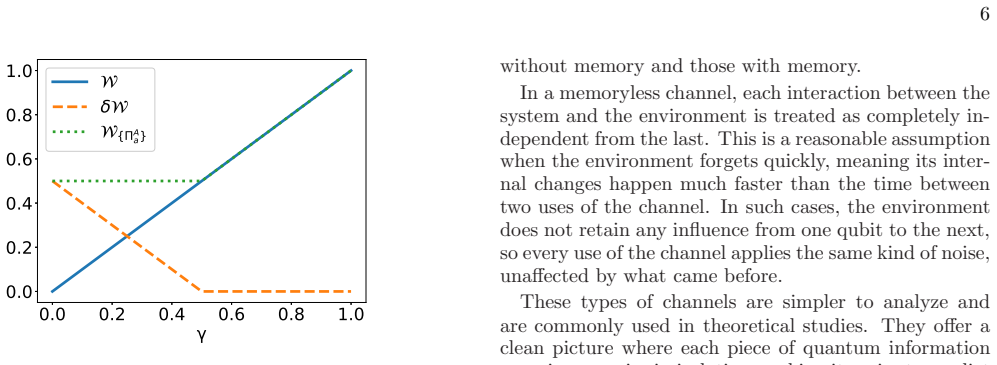
- Measurement-based feedback pays off precisely when the bare ergotropy is small: the daemonic gain is positive for $\gamma\le 0.5$ in the memoryless case and vanishes once the noise alone orders the state.
- Channel memory extends the advantage: at $\mu=1$ the daemonic gain remains nonzero even as $\gamma$ approaches 1, so memory can be used to widen the operating regime of ancilla-assisted engines.
- The protocol gives a concrete quantitative map from the channel parameters ($\gamma$, $\mu$) and measurement basis ($\theta$) to the extractable work $W$ and gain $\delta W$, so it can be compared directly with experiments.
Reading between the lines
- The paper's "amplitude damping" map actually increases the excited-state population of the system qubit, so the claimed resource is better described as a directional energy pump; under the conventional damping orientation the ergotropy $W=\gamma\omega$ would vanish.
- Read as a design principle, the result suggests that any local non-unital channel whose fixed point lies above the system's ground state could be used in place of the specific map here, provided it also creates the needed system-ancilla correlations.
- A direct experimental test would be to send one qubit of a classically correlated pair through a tunable dissipative channel with known level ordering and measure both $W$ and the daemonic gain; the sign of $\delta W$ would show whether the environment is adding or removing excitation.
Editorial analysis
A structured set of objections, weighed in public.
Referee Report
Summary. The paper studies work extraction from an initially classically correlated two-qubit state, using daemonic ergotropy with an ancilla measurement, when one qubit is sent through a local amplitude-damping channel and, in a second scenario, through a two-use channel with memory. It claims that local non-unital noise can generate quantum correlations from classically correlated states and that these correlations, together with channel memory, enhance the extractable work quantified by the daemonic gain. The manuscript presents analytical expressions for the output states, conditional states, ergotropies, and daemonic gain, supported by plots of these quantities versus the damping parameter γ and memory parameter μ.
Significance. If the central claim were correct, the paper would offer a concrete thermodynamic role for non-unital noise and channel memory, with analytical formulas and falsifiable predictions. The authors use the standard definition of daemonic ergotropy and provide explicit derivations, which is a strength. However, the advertised mechanism -- generation of quantum correlations by amplitude damping -- is not realized in the manuscript's own equations. The channel in Eq. (15) is an excitation pump rather than a damping channel, and the output states in Eqs. (18) and (30) are diagonal in product bases, so they contain no quantum discord. The reported linear ergotropy W=γω and the claimed daemonic gain therefore rest on a mislabeled map and on classical population reweighting rather than on quantum correlations. Because correcting the channel label makes the single-use ergotropy vanish, the paper's core conclusion is not established.
major comments (3)
- [Section III, Eq. (15)] The Kraus operators in Eq. (15) do not describe amplitude damping (spontaneous emission) for the Hamiltonian H_S = ω|e⟩⟨e| defined in Section III. With the basis ordered as (|e⟩, |g⟩), K0|e⟩ = |e⟩ and K1|g⟩ = √γ |e⟩, so the channel promotes population from |g⟩ to |e⟩; Eq. (19) confirms this by giving an excited-state population of (1+γ)/2. The standard amplitude-damping channel in this basis is K0 = diag(√(1−γ), 1) and K1 = √γ |g⟩⟨e|. Under that standard map, the reduced state obtained from Eq. (13) has excited-state population (1−γ)/2, is passive, and has zero ergotropy. Therefore the reported result W = γω in Section III is an artifact of an excitation-pumping channel, not of amplitude damping.
- [Section III, Eq. (18)] The claim following Eq. (18) that the output state is 'no longer diagonal in any product basis' is contradicted by the displayed state itself. Equation (18) is diagonal in the product basis {|e⟩_S|e⟩_A, |e⟩_S|g⟩_A, |g⟩_S|g⟩_A}. The state therefore has no off-diagonal coherences and remains classically correlated in the sense of Eq. (12). Consequently, the paper does not demonstrate that the local non-unital channel generates quantum correlations from the initially classically correlated state, and the daemonic gain shown in Fig. 1 cannot be attributed to quantum correlations. Since this is the central mechanism advertised in the abstract and introduction, the main claim is unsupported.
- [Section IV, Eq. (30)] The correlated-channel output in Eq. (30) is also diagonal in the product basis {|e⟩_S|e⟩_A, |e⟩_S|g⟩_A, |g⟩_S|e⟩_A, |g⟩_S|g⟩_A}. Therefore the repeated statements that memory 'preserves' or 'amplifies' quantum correlations, made in Section IV and in the discussion of Figs. 2-4, are not supported by the state itself. The increase of W_{Π^A} with μ observed in the figures is a change in the classical population weights of a diagonal state under an excitation-type channel, not a memory-enabled preservation of quantum correlations. The memory-resource conclusion thus inherits the same defect as the single-use conclusion.
minor comments (4)
- [Title] The title contains a spacing typo: 'Nois y' should read 'Noisy'.
- [Eq. (12)] The notation '|j⟩j' should be '|j⟩_A' for consistency with the ancilla labeling.
- [Eqs. (24) and (35)] The ergotropy expressions in Eqs. (24) and (35) are written as dimensionless population differences, while Eq. (19) gives W = γω. The energy scale ω appears to be set to unity without being stated; this should be clarified.
- [Eqs. (26)-(27)] The Kraus-operator construction in Eq. (26) already contains the memory weighting (1−μ)P_j + μδ_{i,j}, but Eq. (27) then applies an additional convex combination with weights (1−μ) and μ. As written, this double-counts the memory probability and makes the normalization of the channel unclear.
Circularity Check
No significant circularity: the central derivations are self-contained analytic calculations; the main concern is a physical mislabeling of the channel, not circular reasoning.
full rationale
The derivation chain is not circular. The paper defines daemonic ergotropy using the external framework of Ref. [24], chooses an initial classically correlated state in Eq. (13), applies a local map with Kraus operators in Eq. (15), and then computes the conditional states, probabilities, and ergotropies analytically in Eqs. (18)-(25) for the memoryless case and Eqs. (30)-(36) for the memory case. No parameter is fitted to reproduce a target result, and the daemonic gain is evaluated directly from the definitions. The authors' own prior works (Refs. [11], [17], [18]) appear only as background citations in the introduction and are not load-bearing for any of the paper's new claims. The skeptical objection is physical rather than logical: with the basis ordered as (|e>, |g>) and H_S = ω|e><e|, the Kraus operators in Eq. (15) describe a map that excites the qubit rather than the standard amplitude-damping channel that relaxes it. Consequently the non-passivity and W = γω follow from the channel prescription itself, but this is a modeling or correctness issue, not a circularity: the result is not hidden in the input in the sense of being identical to it by construction, and the derivation would be falsifiable by recomputing with the standard amplitude-damping convention. Because no circular step is exhibited, the circularity score is low.
Assumptions & free parameters
free parameters (3)
- gamma (damping strength) =
swept over [0, 1]
- mu (memory parameter) =
swept over [0, 1]
- theta (measurement basis angle) =
optimized, not explicitly reported
assumptions (4)
- standard math Standard quantum mechanics: density matrices, CPTP maps, projective measurements, and Born rule.
- domain assumption Definition of daemonic ergotropy and daemonic gain from Ref. 24.
- ad hoc to paper The map in Eq. (15) is treated as amplitude damping (spontaneous emission).
- ad hoc to paper Local non-unital noise generates genuine quantum correlations from the initial state in Eq. (13).
Cite this review
Pith. "Pith review of Work Extraction from Classically Correlated States in Noisy Quantum Channels with Memory." pith.science (2026). https://pith.science/paper/FZKPD74B
@misc{pith2026250600905,
  author       = {Pith},
  title        = {Pith review of: Work Extraction from Classically Correlated States in Noisy Quantum Channels with Memory},
  year         = {2026},
  howpublished = {\url{https://pith.science/paper/FZKPD74B}},
  note         = {Machine review of arXiv:2506.00905}
}
read the original abstract
This study investigates the potential of local non-unital noise and quantum channel memory to enhance work extraction from classically correlated quantum states. Utilizing the framework of daemonic ergotropy, which incorporates measurement-based feedback via an ancillary system, we show that amplitude damping channels can induce quantum correlations that enable additional extractable work. Through analytical derivations and numerical simulations, we quantify the daemonic gain and demonstrate that channel memory significantly amplifies this advantage by preserving system-ancilla correlations. Our results reveal that non-unital noise can serve not as a limitation but as a valuable thermodynamic resource in quantum protocols.
Figures


Reference graph
Works this paper leans on
-
[1]
The blue solid line shows the ergotropy W in terms of damping strength γ
shows the interplay between ergotropy, dae- monic ergotropy, and daemonic gain in a qubit system subjected to an amplitude damping channel, as a func- tion of the damping strength γ. The blue solid line shows the ergotropy W in terms of damping strength γ. As the damping strength γ in- creases, the population in the excited state increases, which results ...
-
[2]
(16) From above, it can be seen that rather than preserving this state, the channel transforms it into a non-uniform, or biased, state, highlighting its non-unital nature and its tendency to favor lower energy populations. When the amplitude damping channel Λ AD is applied locally to the system component of a bipartite state that is initially classically ...
- [3]
- [4]
-
[5]
S. Deffner and S. Campbell, Quantum Thermodynam- ics: An introduction to the thermodynamics of quantum information, (Morgan and Claypool Publishers, 2019)
work page 2019
-
[6]
Giazotto, F. & Martinez-Perez, M. The Josephson heat interferometer. Nature 492, 401 (2012)
work page 2012
-
[7]
Martinez-Perez, M. J. & Giazotto, F. A quantum diffrac- tor for thermal flux. Nat. Commun. 5, 3579 (2014)
work page 2014
-
[8]
Martinez-Perez, M. J., Solinas, P. & Giazotto, F. Coher- ent caloritronics in Josephson-based nanocircuits. J. Low Temp. Phys. 175, 813 (2014)
work page 2014
Show all 39 references
-
[9]
J. P. Pekola, D. S. Golubev and D. V. Averin, Maxwell’s demon based on a single qubit. Phys. Rev. B 93, 024501 (2016)
2016
-
[10]
J. V. Koski, V. F. Maisi, J. P. Pekola and D. V. Averin, Experimental realization of a Szilard engine with a single electron. PNAS USA 111, 13786 (2014)
2014
-
[11]
A. E. Allahverdyan, R. Balian, and Th. M. Nieuwen- huizen, Maximal work extraction from finite quantum systems. EPL 67, 565 (2004)
2004
-
[12]
Castellano, R
R. Castellano, R. Nery, K. Simonov and Donato Farina, Phys. Rev. A 111, 012212 (2025)
2025
-
[13]
Hadipour and S
M. Hadipour and S. Haseli, Scientific Reports 14, 24876 (2024)
2024
-
[14]
Biswas, M
T. Biswas, M. Lobejko1, P. Mazurek, K.Jalowiecki, and M. Horodecki, Quantum 6, 841 (2022)
2022
-
[15]
D. T. Hoang, F. Metz, A. Thomasen, T. D. Anh-Tai, T. Busch and T. Fogarty, Phys. Rev. Research 6, 013038 (2024)
2024
-
[16]
Francica, L
G. Francica, L. Dell’Anna Phys. Rev. E 109, 044119 (2024)
2024
-
[17]
Lobejko Quantum 6, 762 (2022)
M. Lobejko Quantum 6, 762 (2022)
2022
-
[18]
J. M. Z. Choquehuanca, P. A. C. Obando, F. M. de Paula, M. S. Sarandy, arXiv:2403.04698 (2024)
2024 arXiv
-
[19]
M Hadipour, S Haseli The European Physical Journal Plus 140 (1), 1-10 (2025)
2025
-
[20]
M Hadipour, S Haseli Europhysics Letters 147 (2), 29003 (2024)
2024
-
[21]
F. H. Kamin, S. Salimi and Alan C. Santos, Phys. Rev. E 104, 034134 (2021)
2021
-
[22]
Manzano, F
G. Manzano, F. Plastina and R.Zambrini, Phys. Rev. Lett. 121, 120602(2018)
2018
-
[23]
Touil, B
A. Touil, B. Cakmak and S. Deffner, J. Phys. A: Math. Theor. 55 025301 (2022)
2022
-
[24]
Francica, Phys
G. Francica, Phys. Rev. E 105, L052101 (2022)
2022
-
[25]
Korzekwa, M
K. Korzekwa, M. Lostaglio, J. Oppenheim and D. Jen- nings, New J. Phys. 18 023045 (2016)
2016
-
[26]
Francica, J
G. Francica, J. Goold, F. Plastina1 and M. Paternos- tro,npj Quantum Information, 3, 12 (2017)
2017
-
[27]
Scully, M
M. Scully, M. S. Zubairy, G. S. Agarwal and H. Walther, Extracting work from a single heat bath via vanishing quantum coherence. Science 299, 862 (2003)
2003
-
[28]
Karimi, J
B. Karimi, J. P. Pekola, Otto refrigerator based on a superconducting qubit: Classical and quantum perfor- mance. Phys. Rev. B 94, 184503 (2016)
2016
-
[29]
Uzdin, A
R. Uzdin, A. Levy and R. Kosloff, Equivalence of quan- tum heat machines, and quantum-thermodynamic signa- tures. Phys. Rev. X 5, 031044 (2015)
2015
-
[30]
K. V. Hovhannisyan, M. Perarnau-Llobet, M. Huber, and A. Acin, Entanglement generation is not necessary for optimal work extraction. Phys. Rev. Lett. 111, 240401 (2013)
2013
-
[31]
Fusco, M
L. Fusco, M. Paternostro and De G. Chiara, Work extrac- tion and energy storage in the dicke model. Phys. Rev. E 94, 052122 (2016)
2016
-
[32]
Perarnau-Llobet, K
M. Perarnau-Llobet, K. V. Hovhannisyan, M. Huber, P. Skrzypczyk1, N. Brunner and A. Acin1, Extractable work from correlations. Phys. Rev. X 5, 041011 (2015)
2015
-
[33]
Campisi and R
M. Campisi and R. Fazio, Dissipation, Correlation and Lags in Heat Engines J. Phys. A: Math. Theor. 49, 345002 (2016)
2016
-
[34]
C. B. Dag, W. Niedenzu, ¨O. E. M¨ustecaplioglu and G. Kurizki, Multiatom quantum coherences in micromasers as fuel for thermal and nonthermal machines. Entropy 18, 244 (2016)
2016
-
[35]
Korzekwa, M
K. Korzekwa, M. Lostaglio, J. Oppenheim and D. Jen- nings, The extraction of work from quantum coherence. New J. Phys. 18, 023045 (2016)
2016
-
[36]
Streltsov, H
A. Streltsov, H. Kampermann and D. Bruß, Phys. Rev. Lett. 107, 170502 (2011)
2011
-
[37]
T. Abad, V. Karimipour, and L. Memarzadeh, Phys. Rev. A 86, 062316 (2012)
2012
-
[38]
Macchiavello, G
C. Macchiavello, G. M. Palma, Phys. Rev. A 65, 050301 (2002)
2002
-
[39]
Y. Yeo, A. Skeen, Phys. Rev. A 67, 064301 (2003)
2003
Reviewed August 7, 2026 · model on record in the stance chip above.
Discussion (0). Sign in to comment.