REVIEW 4 major objections 5 minor 85 references
Hybrid scaling mechanism of critical behavior in the overlapping critical regions of classical and quantum Yang-Lee edge singularities
T0 review · 4 major / 5 minor · reviewed 2026-08-07 · deepseek-v4-flash
Pith's one-line read The paper claims that in overlapping critical regions of classical and quantum Yang-Lee edge singularities, both scaling functions apply simultaneously and are linked by constraint equations that let finite-temperature data expose quantum…
desk verdict A plausible, well-verified-in-one-model extension of hybrid scaling to classical–quantum Yang-Lee overlaps, but the central constraint equations are an ansatz rather than a derivation. read the letter →
The pith
A machine-rendered reading of the paper's core claim, the machinery that carries it, and where it could break.
The reading
What carries the argument
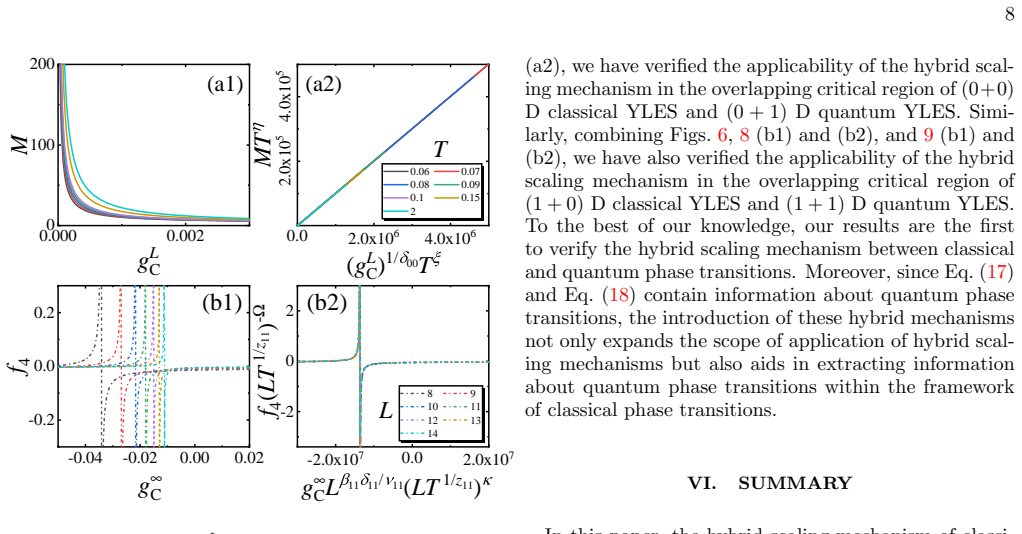
The hybrid scaling mechanism is the central device. It has two assertions: (i) in the overlap of two critical regions, the scaling functions of both regions apply to the same data; (ii) those scaling functions obey a constraint obtained by substituting one scaling form into the other, giving hybrid functions whose prefactors and arguments mix exponents from both universality classes. The specific machinery on display is the substitution chain: Eq. (15) into Eq. (12) yields Eq. (17), and Eqs. (13) and (16) yield Eq. (18), with exponents such as $\xi = \beta_{01}/(\nu_{01}z_{01})$ and $\eta = \beta_{01}\delta_{01}/(\nu_{01}z_{01}\delta_{00})$ carrying quantum information into classical scaling functions. The numerical verification is data collapse after rescaling by these hybrid exponents.
What would settle it
Compute the order parameter on a second model with overlapping classical and quantum Yang-Lee regions in the same temperature range and test whether the rescaled curves collapse according to Eqs. (17) and (18). Failure to collapse, or fitted exponents that drift with $\lambda$ or $T$, would show that the assumed power-law crossover is not universal.
Extended reading notes
Core claim
The central claim is that the scaling hypothesis can be extended across overlapping critical regions of different universality classes. In the overlap, the order parameter obeys the scaling function of each region simultaneously; substituting one scaling form into the other produces hybrid constraint equations. For the transverse Ising chain in an imaginary longitudinal field, the paper derives and numerically verifies four constraints: Eq. (11) for (0+1)D and (1+1)D quantum YLES, Eq. (14) for (0+0)D and (1+0)D classical YLES, Eq. (17) for (0+0)D classical and (0+1)D quantum YLES, and Eq. (18) for (1+0)D classical and (1+1)D quantum YLES. Because the classical-quantum constraints contain quantum critical exponents, they enable extraction of quantum phase transition properties from finite-temperature data.
Load-bearing premise
Everything rests on the assumption that, inside the overlap, one class's scaling function simply becomes the other class's power law, for example $f_3[x] \sim x^{1/\delta_{00}}$ in Eq. (17); if that crossover fails in another model, the mechanism is model-specific.
Editorial extensions
If this is right
- The hybrid mechanism, verified here for the static order parameter, extends the earlier hybrid Kibble-Zurek scaling for non-equilibrium dynamics to static critical behavior in the same system.
- In the overlapping classical-quantum region, the constraint equations mix exponents of both classes, so finite-temperature measurements of a classical YLES carry quantum YLES exponents.
- The same mechanism works for the overlap of two quantum YLES regions and for the overlap of two classical YLES regions, indicating a common pattern across classical and quantum criticality.
- The transverse Ising chain in an imaginary longitudinal field thereby becomes a model system that bridges classical and quantum Yang-Lee critical phenomena, and the paper expects the mechanism to be testable in current experimental realizations of YLES.
- The approach also suggests a route toward handling regions where three or four critical regions coexist, though the paper notes that such cases need more careful parameter control.
Reading between the lines
- Because the mechanism is formulated as a generic substitution of scaling forms, the same construction should produce hybrid constraints for any pair of overlapping critical regions, not only Yang-Lee singularities; this is the paper's implicit program.
- Equation (17) can be read as an inverse protocol: fitting finite-temperature data to $M = T^{\xi-\eta}(g_C^L)^{1/\delta_{00}}$ yields quantum exponents without ever cooling to $T=0$, an application the authors mention but do not develop.
- The paper notes regions where three or four critical regions coexist; a natural extension is to demand joint consistency of several hybrid constraints, which would impose nontrivial relations among exponent ratios.
- A direct experimental check could be made in engineered non-Hermitian quantum simulators where the finite-temperature classical-quantum overlap of YLES can be realized, testing whether the data collapse holds beyond this specific chain.
Editorial analysis
A structured set of objections, weighed in public.
Referee Report
Summary. The paper studies the scaling behavior of the order parameter M in the transverse Ising chain in an imaginary longitudinal field, focusing on overlapping critical regions of classical and quantum Yang-Lee edge singularities (YLES). The authors introduce a 'hybrid scaling mechanism' in which, inside the overlap, the scaling functions of both critical regions apply simultaneously and are mutually constrained. They verify the individual scaling forms for (0+1)D and (1+1)D quantum YLES and for (0+0)D and (1+0)D classical YLES, then propose constraint equations, Eqs. (17) and (18), that connect classical and quantum YLES. The paper claims these constraints allow quantum critical information to be extracted from finite-temperature classical measurements.
Significance. If the hybrid scaling mechanism is correct, the paper would provide a rare link between classical and quantum Yang-Lee criticality and a practical route to extract quantum critical information from finite-temperature data. The paper's strengths include the systematic organization of four different YLES universality classes in one model and the use of literature exponents rather than fitted ones, which makes the reported data collapses genuine tests of the individual scaling forms. The verification of the independent scaling forms, Eqs. (9), (10), (12), (13), (15), and (16), is a useful contribution. However, the central constraint equations are not derived from the scaling forms but assume a power-law crossover of the scaling functions; the numerical support for them is based on collapses using critical points extracted from the same data, without error bars. The generality of the mechanism across models is therefore not established by the manuscript as it stands.
major comments (4)
- [Sec. V B] The statement that Eq. (17) is obtained by substituting Eq. (15) into Eq. (12) is not a derivation. Eq. (12) has no temperature prefactor, so Eq. (17) can only result if the quantum scaling function f3[x] in Eq. (15) crosses over to a pure power law x^{1/δ00} at the temperature-dependent argument x_C = (h_C^L − h_L^Q) T^{−β01δ01/(ν01 z01)}. That power-law crossover is precisely the content of the hybrid mechanism, not a consequence of the two scaling forms. The collapse in Fig. 9(a2) therefore verifies the assumed crossover rather than independently confirming a prediction. To support the general claim, the crossover would need to be derived from the scaling forms, or verified in a different model or at a different value of λ.
- [Sec. V B / Fig. 9] The critical fields h_C^L and h_Q^L in Fig. 9 are located from the same M(T,h) data used to test the collapse, and no error bars or alternative determinations are reported. This makes the data collapse a consistency check rather than an independent validation of Eq. (17). Similarly, the verification of Eq. (7) in Fig. 1(b4) reports a fitted exponent of 2.2311, about 7% off the theoretical value 2.4, with no uncertainty or goodness-of-fit measure. The relation between h_C^∞ and h_Q^∞ is therefore not quantitatively established.
- [Sec. V B] Eq. (18) is a two-variable scaling constraint, but it is tested only along the single path LT^{1/z11} = 2.4. The collapse in Fig. 9(b2) therefore only demonstrates consistency along this chosen curve. To support the claim that Eq. (18) holds generally, the authors should show collapses for multiple values of LT^{1/z11} (for example 1.2, 1.8, and 3.0) and compare the resulting exponents Ω and κ with the theoretical values.
- [Secs. III–V] The paper claims a general hybrid scaling mechanism for overlapping critical regions, but all quantitative evidence is from a single model at λ = 5 with selected values of L and T. The size and location of the overlapping regions depend on L and T, yet no systematic scan over λ, L, or T is reported. A statement about universality would require at least one additional model or a different λ value to demonstrate that the power-law crossover of the scaling functions is not a special feature of this particular parameter choice.
minor comments (5)
- [Sec. IV] The title of Sec. IV, 'HYBRIDIZED SCALING MECHANSIM FOR THE CLASSICAL YLES AT FINITE TEMPERATURE', contains a typo: 'MECHANSIM' should be 'MECHANISM'.
- [Sec. II A] In the text near Eq. (1), 'YELS' appears where 'YLES' is intended. This typo occurs once in Sec. II A.
- [Fig. 4 caption] The caption of Fig. 4 reads 'The rescaled cures according to Eq. (11)'; 'cures' should be 'curves'. The same typo appears in the caption of Fig. 7.
- [Fig. 7(a)] The axis label in Fig. 7(a), 'M versus gLCL', appears to be a typo; it should read 'M versus g_C^L'.
- [Sec. V B, Eq. (18)] Eq. (18) is written as a relation between the scaling functions f4 and f2, but the numerical test in Fig. 9(b2) uses the order parameter M. Please state explicitly how Eq. (18) is converted into a plot of rescaled M and how the collapse is performed.
Circularity Check
Hybrid-scaling 'constraints' Eqs. (17)-(18) are not derived from the scaling forms; they assume a power-law crossover/pole of the quantum scaling function at the classical critical point and are validated only by data collapse with critical points fitted from the same data.
-
other
[Sec. V B, Eq. (17), obtained from Eqs. (15) and (12)]
"In the overlapping critical region constructed by the critical regions of (0+0) D YLES and (0+1) D YLES, the constraints between the scaling functions can be obtained by substituting Eq. (15) into Eq. (12), which reads M = T ξ−η(gL C) 1 δ00 , with ξ = β01/(ν01z01) and η = β01δ01/(ν01z01δ00)."
Eq. (15) has a T^{β01/(ν01z01)} prefactor and a scaling argument g_L^Q T^{-β01δ01/(ν01z01)}, while Eq. (12) is a pure power law in g_L^C with no T prefactor. A substitution alone cannot produce the T^{ξ-η} prefactor and the variable g_L^C; one must additionally assume that f3 has a power-law branch point at the finite argument x_C = (h_L^C - h_L^Q)T^{-β01δ01/(ν01z01)} and that g_L^Q ≈ g_L^C. That power-law crossover of the quantum scaling function at the classical YLES critical point is exactly the content of the hybrid mechanism, not a consequence of the two scaling forms. Hence Eq. (17) is an ansatz presented as a derivation, and the collapse in Fig. 9(a2) verifies the assumed crossover post hoc rather than testing a prediction produced from the scaling forms.
-
other
[Sec. V B, Eq. (18) and Fig. 9(b2)]
"Similarly, in the overlapping region constructed by the critical regions of (1 + 0) D YLES and (1 + 1) D YLES, the constraints between the scaling functions Eq. (13) and Eq. (16) reads f4[g∞ Q T − β11 δ11 ν11 z11 , g∞ Q L β11 δ11 ν11 ] = ( LT 1 z11 )Ωf2[g∞ C L β11 δ11 ν11 (LT 1 z11 )κ]."
The same logical gap appears: Eq. (18) is not obtained by substitution unless one assumes a specific power-law matching between f4 and f2 at finite scaling arguments. This matching is the hybrid-scaling ansatz. In addition, the variables g∞_C, g∞_Q and the combination LT^{1/z11} are constructed using critical points that are extrapolated from the same M(T,h,L) data later collapsed in Fig. 9(b2), so the collapse is a consistency check of the assumed functional relation rather than an independent confirmation.
1 more flagged steps
-
fitted input called prediction
[Sec. II B Eqs. (6)-(7), used in Sec. V B; Fig. 9(a1)-(a2)]
"To validate Eq. (7), we use numerically obtained values of hL Q for different L to fit h∞ Q at T = 0, and use the numerically obtained values of hL C for different L to fit h∞ C at different temperatures."
The critical positions h_L^C(T), h_L^Q, h∞_C and h∞_Q that enter the scaling variables of Eqs. (17) and (18) are located from the divergence of M in the same datasets that are subsequently rescaled to demonstrate collapse. No independent determination of these positions or error bars is reported. Choosing each h_L^C to make M diverge at that point already imposes the leading power-law behavior of Eq. (12); the collapse of Fig. 9(a2) therefore confirms the T-dependent prefactor of the assumed crossover but does not provide an independent test of the hybrid mechanism against data not used to set its parameters.
full rationale
The exponents in Table I are taken from the literature, so the scaling-function collapses in Figs. 2, 3, 5, 6 and 8 are genuine consistency tests with externally fixed exponents, not parameter fits. The hybrid mechanism is attributed to earlier papers [75,76], one coauthored by a current author, but the present numerical verification does not rest on that citation as a proof, so self-citation is not the main circularity. The central circular element is that Eqs. (17) and (18) are labelled as obtained by substituting scaling forms into each other, but the substitution only produces the T and L prefactors after assuming the relevant scaling function has a pure power-law crossover/pole at the finite argument set by the other critical point. That crossover is the hybrid mechanism's content. The accompanying data collapse is a consistency check: the critical positions used to build the scaling variables are extracted from the same M(T,h) data, without error bars. The paper does not provide a second model or independent parameter-free confirmation that the crossover form holds generally, so the claim that Eqs. (17)-(18) connect classical and quantum YLES in general reduces to the assumed ansatz in this one model. Hence a moderate, partial circularity score.
Assumptions & free parameters
free parameters (4)
- h∞_Q (infinite-size quantum YLES critical field) =
2.292657 (for λ=5)
- h∞_C (infinite-size classical YLES critical field) =
2.297034 (for λ=5, T=0.3)
- Finite-size critical fields h^L_Q and h^L_C =
Listed in figure captions, e.g. h^L_Q=2.433731 to 2.309176 for L=4..10
- Constant LT^(1/z11) =
2.4
assumptions (5)
- domain assumption Critical exponents for YLES universality classes (Table I) from Refs. [3,9,75,76] apply to model (1).
- domain assumption Order parameter M obeys homogeneous scaling forms Eqs. (9), (10), (12), (13), (15), (16) near the relevant critical points.
- ad hoc to paper In the overlapping critical region, both scaling forms are simultaneously valid.
- ad hoc to paper The scaling functions f1, f3, f4 reduce to pure power laws of the other universality class in the overlap (e.g., f3[x] ~ x^(1/δ00)).
- domain assumption Biorthogonal eigenvector formalism for non-Hermitian H defines the order parameter via Eq. (3).
Cite this review
Pith. "Pith review of Hybrid scaling mechanism of critical behavior in the overlapping critical regions of classical and quantum Yang-Lee edge singularities." pith.science (2026). https://pith.science/paper/4UGJ7DIT
@misc{pith2026250600919,
  author       = {Pith},
  title        = {Pith review of: Hybrid scaling mechanism of critical behavior in the overlapping critical regions of classical and quantum Yang-Lee edge singularities},
  year         = {2026},
  howpublished = {\url{https://pith.science/paper/4UGJ7DIT}},
  note         = {Machine review of arXiv:2506.00919}
}
abstract
Recently, the study of scaling behavior in Yang-Lee edge singularities (YLES) has attracted sustained attention. However, the scaling mechanism for the overlapping critical region between classical and quantum YLES remains unclear. In this work, we investigate this question, and a hybrid scaling mechanism is introduced to characterize the scaling behavior in the overlapping regions. The hybrid scaling mechanism asserts that in the overlapping region the scaling behavior can be described by the scaling function for both critical regions simultaneously, and it results in a constraint on the scaling functions. The transverse Ising chain in an imaginary longitudinal field, which exhibits $(0+1)$ dimensional (D) and $(1+1)$ D quantum YLES phase transitions at zero temperature, and $(0+0)$ D and $(1+0)$ D classical YLES phase transitions at finite temperature, is employed as a model to test this hybrid scaling mechanism. The scaling functions in the critical regions of $(0+1)$ D and $(1+1)$ D quantum YLES as well as $(0+0)$ D and $(1+0)$ D classical YLES of such model are systematically investigated. Furthermore, the hybrid scaling mechanisms in overlapping critical regions, particularly between classical and quantum YLES, are thoroughly examined. Through this study, we have established a scaling mechanism capable of describing behaviors in the overlapping critical regions between classical and quantum phase transitions, which also facilitates the extraction of quantum phase transition information from classical phase transition systems.
Figures


Figures from the paper (5 more)


Reference graph
Works this paper leans on
-
[1]
C. N. Yang and T. D. Lee, Statistical Theory of Equa- tions of State and Phase Transitions. i. Theory of Con- densation, Phys. Rev. 87, 404 (1952)
1952
-
[2]
Lee and C.-N
T.-D. Lee and C.-N. Yang, Statistical theory of equations of state and phase transitions. ii. lattice gas and ising model, Phys. Rev. 87, 410 (1952)
1952
-
[3]
M. E. Fisher, Yang-Lee Edge Singularity and ϕ3 Field Theory, Phys. Rev. Lett. 40, 1610 (1978)
1978
-
[4]
Kortman and R
P. Kortman and R. Griffiths, Density of Zeros on the Lee-Yang Circle for Two Ising Ferromagnets, Phys. Rev. Lett. 27, 1439 (1971)
1971
-
[5]
D. A. Kurtze and M. E. Fisher, Yang-Lee edge singulari- ties at high temperatures, Phys. Rev. B 20, 2785 (1979)
1979
-
[6]
M. E. Fisher, Yang-Lee Edge Behavior in One- Dimensional Systems, Prog. Theor. Phys. Suppl., 69, 14 (1980)
work page 1980
-
[7]
J. L. Cardy, Conformal Invariance and the Yang-Lee Edge Singularity in Two Dimensions, Phys. Rev. Lett. 54, 1354 (1985)
work page 1985
-
[8]
D. A. Kurtze and M. E. Fisher, The Yang-Lee edge singu- larity in spherical models, J. Stat. Phys. 19, 205 (1978)
work page 1978
Show all 85 references
-
[9]
Uzelac, P
K. Uzelac, P. Pfeuty, and R. Jullien,Yang-Lee Edge Singularity from a Real-Space Renormalization-Group Method, Phys. Rev. Lett. 43, 805 (1979)
1979
-
[10]
Wang and J
X.-Z. Wang and J. S. Kim, Yang-Lee edge singularity of a one-dimensional Ising ferromagnet with arbitrary spin, Phys. Rev. E 58, 4174 (1998)
1998
-
[11]
O. F. de Alcantara Bonfim, J. E. Kirkham, and A. J. McKane, Critical exponents for the percolation problem and the Yang-Lee edge singularity, Phys. Rev. B14, 2391 (1981)
1981
-
[12]
Glumac and K
Z. Glumac and K. Uzelac, Yang-Lee edge singularity in the one-dimensional long-range Ising model, Phys. Rev. B 24, 501 (1991)
1991
-
[13]
Ba¸ sar, Universality, Lee-Yang Singularities, and Series Expansions, Phys
G. Ba¸ sar, Universality, Lee-Yang Singularities, and Series Expansions, Phys. Rev. Lett. 127, 171603 (2021)
2021
-
[14]
Cardy, The Yang-Lee edge singularity and related problems, In 50 Years of the Renormalization Group, (World Scientific, 2023)
J. Cardy, The Yang-Lee edge singularity and related problems, In 50 Years of the Renormalization Group, (World Scientific, 2023)
2023
-
[15]
Wei, Probing Yang–Lee Edge Singularity by Cen- tral Spin Decoherence, New J
B.-B. Wei, Probing Yang–Lee Edge Singularity by Cen- tral Spin Decoherence, New J. Phys. 19, 083009 (2017)
2017
-
[16]
L. Xiao, D. Qu, K. Wang, H.-W. Li, J.-Y. Dai, B. D´ ora, M. Heyl, R. Moessner, W. Yi, and P. Xue, Non-Hermitian Kibble-Zurek Mechanism with Tunable Complexity in Single-Photon Interferometry, Phys. Rev. X Quantum 2, 020313 (2021)
2021
-
[17]
Binek, Density of zeros on the Lee-Yang circle ob- tained from magnetization data of a two-dimensional Ising ferromagnet, Phys
C. Binek, Density of zeros on the Lee-Yang circle ob- tained from magnetization data of a two-dimensional Ising ferromagnet, Phys. Rev. Lett. 81, 5644 (1998)
1998
-
[18]
Binek, W
C. Binek, W. Kleemann, and H. A. Katori, Yang-Lee edge singularities determined from experimental high- field magnetization data, J. Phys.: Condens. Matter, 13, L811 (2001)
2001
-
[19]
Wei and R.-B
B.-B. Wei and R.-B. Liu, Lee-yang zeros and critical times in decoherence of a probe spin coupled to a bath, Phys. Rev. Lett. 109, 185701 (2012)
2012
-
[20]
X. Peng, H. Zhou, B.-B. Wei, J. Cui, J. Du, and R.-B. Liu, Experimental Observation of Lee-Yang Zeros, Phys. Rev. Lett. 114, 010601 (2015)
2015
-
[21]
Matsumoto, M
N. Matsumoto, M. Nakagawa, and M. Ueda, Embedding the Yang-Lee quantum criticality in open quantum sys- tems, Phys. Rev. Research 4, 033250 (2022)
2022
-
[22]
R. Shen, T. Chen, M. M. Aliyu, F. Qin, Y. Zhong, H. Loh, and C. H. Lee, Proposal for observing yang-lee crit- icality in rydberg atomic arrays, Phys. Rev. Lett. 131, 080403 (2023)
2023
-
[23]
Brandner, V
K. Brandner, V. F. Maisi, J. P. Pekola, J. P. Garrahan, and C. Flindt, Experimental determination of dynamical Lee-Yang zeros, Phys. Rev. Lett. 118, 180601 (2017)
2017
-
[24]
Billy, V
J. Billy, V. Josse, Z. Zuo, A. Bernard, B. Hambrecht, P. Lugan, D. Cl` ement, L. Sanchez-Palencia, P. Bouyer, and A. Aspect, Direct observation of Anderson localization of matter waves in a controlled disorder, Nature (London) 453, 891 (2008)
2008
-
[25]
R. -J. Lin, T. Tai, L.-H. Li, and C. H. Lee, Topological non-Hermitian skin effect, Front. Phys.18, 53605 (2023)
2023
-
[26]
Lin, T.-Y Li, L
Q. Lin, T.-Y Li, L. Xiao, K. -K Wang, W. Yi, and P. Xue, Topological Phase Transitions and Mobility Edges in Non-Hermitian Quasicrystals, Phys. Rev. Lett. 129, 113601 (2022)
2022
-
[27]
Lin, T.-Y Li, L
Q. Lin, T.-Y Li, L. Xiao, K. -K Wang, W. Yi, and P. Xue, Observation of non-Hermitian topological Anderson insulator in quantum dynamics, Nat. Commun. 13, 3229 (2022)
2022
-
[28]
L. Xiao, D. -K. Qu, K. -K. Wang, H. -W Li, J.-Y Dai, B. D´ ora , M. Heyl, R. Moessner, W. Yi, and P. Xue, Non- Hermitian Kibble-Zurek Mechanism with Tunable Com- plexity in Single-Photon Interferometry, PRX QUAN- TUM 2, 020313 (2021)
2021
-
[29]
Jiang, L.-J
H. Jiang, L.-J. Lang, C. Yang, S.-L. Zhu, and S. Chen, Interplay of non-hermitian skin effects and Anderson lo- calization in nonreciprocal quasiperiodic lattices, Phys. Rev. B 100, 054301 (2019)
2019
-
[30]
E. J. Bergholtz, J. C. Budich, and F. K. Kunst, Ex- ceptional topology of non-Hermitian systems, Rev. Mod. Phys. 93, 015005 (2021)
2021
-
[31]
Ashida, Z
Y. Ashida, Z. P. Gong, and M. Ueda, Non-Hermitian physics, Adv. Phys. 69, 249 (2021)
2021
-
[32]
Z. S. Yang, K.Zhang, C. Fang, and J. P. Hu, Non- Hermitian Bulk-Boundary Correspondence and Auxil- iary Generalized Brillouin Zone Theory, Phys. Rev. Lett. 125, 226402 (2020). 10
2020
-
[33]
Okuma, K
N. Okuma, K. Kawabata, K. Shiozaki, and M. Sato, Topological Origin of Non-Hermitian Skin Effects, Phys. Rev. Lett. 124, 086801 (2020)
2020
-
[34]
Zhang, Z
K. Zhang, Z. S. Yang, and C. Fang, Correspondence between Winding Numbers and Skin Modes in Non- Hermitian Systems, Phys. Rev. Lett. 125, 126402 (2020)
2020
-
[35]
D. S. Borgnia, A. J. Kruchkov, and R.-J. Slager, Non- Hermitian Boundary Modes and Topology, Phys. Rev. Lett. 124, 056802(2020)
2020
-
[36]
H. Gao, K. Wang, L. Xiao, M. Nakagawa, N. Matsumoto, D. Qu, H. Lin, M. Ueda, and P. Xue, Experimental Ob- servation of the Yang-Lee Quantum Criticality in Open Quantum Systems, Phys. Rev. Lett. 132, 176601 (2024)
2024
-
[37]
Z. Lan, W. Liu, Y. Wu, X. Ye, Z. Yang, C.-K. Duan, Y. Wang, and X. Rong, Experimental Investigation of Lee- Yang Criticality Using Non-Hermitian Quantum System, Chin. Phys. Lett. 41, 050301 (2024)
2024
-
[38]
Lencs´ es, A
M. Lencs´ es, A. Miscioscia, G. Mussardo, and G. Tak´ acs, Multicriticality in Yang-Lee edge singularity, J. High En- erg. Phys. 2023, 46 (2023)
2023
-
[39]
Johnson, F
G. Johnson, F. Rennecke, and V. V. Skokov, Universal location of Yang-Lee edge singularity in classic O(N) uni- versality classes, Phys. Rev. D 107, 116013 (2023)
2023
-
[40]
Karsch, C
F. Karsch, C. Schmidt, and S. Singh, Lee-Yang and Langer edge singularities from analytic continuation of scaling functions, Phys. Rev. D 109, 014508 (2024)
2024
-
[41]
Xu and A
H.-L. Xu and A. Zamolodchikov, 2D Ising Field Theory in a magnetic field: the Yang-Lee singularity, J. High Energ. Phys. 2022, 57 (2022)
2022
-
[42]
Dimopoulos, L
P. Dimopoulos, L. Dini, F. Di Renzo, J. Goswami, G. Nicotra, C. Schmidt, S. Singh, K. Zambello, and F. Zi- esch´ e, Contribution to understanding the phase structure of strong interaction matter: Lee-Yang edge singularities from lattice QCD, Phys. Rev. D 105, 034513 (2022)
2022
-
[43]
Ba¸ sar, G
G. Ba¸ sar, G. V. Dunne, and Z. L. Yin, Uniformizing Lee- Yang singularities, Phys. Rev. D 105, 105002 (2022)
2022
-
[44]
Ba¸ sar, QCD critical point, Lee-Yang edge singulari- ties, and Pad´ e resummations, Phys
G. Ba¸ sar, QCD critical point, Lee-Yang edge singulari- ties, and Pad´ e resummations, Phys. Rev. C110, 015203 (2024)
2024
-
[45]
Lencs´ es, A
M. Lencs´ es, A. Miscioscia, G. Mussardo, and G. Tak´ acs, Ginzburg-Landau description for multicritical Yang-Lee models, J. High Energ. Phys. 2024, 224 (2024)
2024
-
[46]
Jian, Z.-C
S.-K. Jian, Z.-C. Yang, Z. Bi, and X. Chen, Yang-Lee edge singularity triggered entanglement transition, Phys. Rev. B 104, L161107 (2021)
2021
-
[47]
Lu, S.-H
M.-C. Lu, S.-H. Shi, and G. Sun, Dynamical signatures of the Yang-Lee edge singularity in non-Hermitian systems, Phys. Rev. B, 111, 054309 (2025)
2025
-
[48]
Y.-M. Sun, X. Wang, and L.-J. Zhai, Critical relaxation in the quantum Yang-Lee edge singularity, Entropy 27, 170 (2025)
2025
-
[49]
M. Xu, W. Yi, and D.-H. Cai, Characterizing the Yang- Lee zeros of the classical Ising model through dynamic quantum phase transitions, Phys. Rev. A 111, 042204 (2025)
2025
-
[50]
Zhai, G.-Y
L.-J. Zhai, G.-Y. Huang, and H.-Y. Wang, Pseudo-Yang- Lee edge singularity critical behavior in a non-Hermitian Ising model, Entropy 22, 780 (2020)
2020
-
[51]
Sachdev, Quantum Phase Transitions(Cambridge Uni- versity Press, 2011)
S. Sachdev, Quantum Phase Transitions(Cambridge Uni- versity Press, 2011)
2011
-
[52]
S. V. Isakov and R. Moessner, Interplay of quantum and thermal fluctuations in a frustrated magnet, Phys. Rev. B 68, 104409 (2003)
2003
-
[53]
Witkowska, T
E. Witkowska, T. ´Swis locki, and M. Matuszewski, Ther- mal fluctuations and quantum phase transition in anti- ferromagnetic Bose-Einstein condensates, Phys. Rev. A 90, 033604 (2014)
2014
-
[54]
Werlang, C
T. Werlang, C. Trippe, G. A. P. Ribeiro, and G. Rigolin, Quantum Correlations in Spin Chains at Finite Temper- atures and Quantum Phase Transitions, Phys. Rev. Lett. 105, 095702 (2010)
2010
-
[55]
Werlang, G
T. Werlang, G. A. P. Ribeiro, and G. Rigolin, Interplay between quantum phase transitions and the behavior of quantum correlations at finite temperatures, Int. J. Mod. Phys. B 27, 1345032 (2012)
2012
-
[56]
Vojta, Quantum phase transitions, Rep
M. Vojta, Quantum phase transitions, Rep. Prog. Phys. 66, 2069 (2003)
2003
-
[57]
M. A. Continentino, Interplay of Quantum and Classi- cal Fluctuations Near Quantum Critical Points, Braz. J. Phys. 41, 201 (2011)
2011
-
[58]
G. A. P. Ribeiro and G. Rigolin, Finite-temperature de- tection of quantum critical points: A comparative study, Phys. Rev. B 109, 245122 (2024)
2024
-
[59]
Goldenfeld, Lectures on Phase Transitions and the Renormalization Group(Westview Press, Boulder, 1992)
N. Goldenfeld, Lectures on Phase Transitions and the Renormalization Group(Westview Press, Boulder, 1992)
1992
-
[60]
A. J. Millis, Effect of a nonzero temperature on quantum critical points in itinerant fermion systems, Phys. Rev. B 48, 7183 (1993)
1993
-
[61]
H. v. L¨ ohneysen, A. Rosch, M. Vojta, and P. W¨ olfle, Fermi-liquid instabilities at magnetic quantum phase transitions, Rev. Mod. Phys. 79, 1015 (2007)
2007
-
[62]
Y. Cui, L. Liu, H. Lin, K.-H. Wu, W. Hong, X. Liu, C. Li, Z. Hu, N. Xi, S. Li, R. Yu, A. W. Sandvik, and W. Yu, Proximate deconfined quantum critical point in SrCu2(BO3)2, Science 380, 1179 (2023)
2023
-
[63]
Senthil, M
T. Senthil, M. Vojta, and S. Sachdev, Weak mag- netism and non-Fermi liquid quantum criticality in heavy fermion metals, Phys. Rev. B 69, 035111 (2004)
2004
-
[64]
Coleman, A
P. Coleman, A. J. Schofield, and H. v. L¨ ohneysen, Quan- tum criticality, Nature 433, 226 (2005)
2005
-
[65]
Gegenwart, Q
P. Gegenwart, Q. Si, and F. Steglich, Quantum criticality in heavy-fermion metals, Nature Phys. 4, 186 (2008)
2008
-
[66]
Sachdev and B
S. Sachdev and B. Keimer, Quantum criticality, Phys. Today 64, 29 (2011)
2011
-
[67]
J. A. Hertz, Quantum critical phenomena, Phys. Rev. B 14, 1165 (1976)
1976
-
[68]
Cuccoli, A
A. Cuccoli, A. Taiti, R. Vaia, and P. Verrucchi, Ex- tracting signatures of quantum criticality in the finite- temperature behavior of many-body systems, Phys. Rev. B 76, 064405 (2007)
2007
-
[69]
Lavagna and C
M. Lavagna and C. P´ epin, Critical phenomena near the antiferromagnetic quantum critical point of heavy fermions, Phys. Rev. B 62, 6450 (2000)
2000
-
[70]
D. Jost, L. Peis, G. He, A. Baum, S. Gepr¨ ags, J. C. Palm- strom, M. S. Ikeda, I. R. Fisher, T. Wolf, S. Lederer, S. A. Kivelson, and R. Hackl, Quantum critical fluctua- tions in an Fe-based superconductor, Commu. Phys. 5, 201 (2022)
2022
-
[71]
Jakubczyk, J
P. Jakubczyk, J. Bauer, and W. Metzner,, Finite temper- ature crossovers near quantum tricritical points in met- als, Phys. Rev. B 82, 045103 (2010)
2010
-
[72]
Elstner and R
N. Elstner and R. R. P. Singh, Field-dependent thermo- dynamics and quantum critical phenomena in the dimer- ized spin system Cu 2(C5H12N2)2Cl4, Phys. Rev. B 58, 11484 (1998)
1998
-
[73]
Merchant, B
P. Merchant, B. Normand, K. Kr¨ amer, M. Boehm, D. F. McMorrow, and C. R¨ uegg, Quantum and classical crit- 11 icality in a dimerized quantum antiferromagnet, Nature Phys. 10, 373 (2014)
2014
-
[74]
Vasin, V
M. Vasin, V. Ryzhov, and V. M. Vinokur, Quantum-to- classical crossover near quantum critical point, Sci. Rep. 5, 18600 (2015)
2015
-
[75]
S. Yin, G. Y. Huang, C. Y. Lo, and P. Chen, Kibble- Zurek Scaling in the Yang-Lee Edge Singularity, Phys. Rev. Lett 118, 065701 (2017)
2017
-
[76]
Zhai, H.-Y
L.-J. Zhai, H.-Y. Wang, and S. Yin, Hybridized Kibble- Zurek scaling in the driven critical dynamics across an overlapping critical region, Phys. Rev. B 97, 134108 (2018)
2018
-
[77]
Liang, L.-Z
E.-W. Liang, L.-Z. Tang, and D.-W. Zhang, Quantum criticality and Kibble-Zurek scaling in the Aubry-Andr´ e- Stark model, Phys. Rev. B 110, 024207 (2024)
2024
-
[78]
Sahoo, A
A. Sahoo, A. Saha, and D. Rakshit, Stark localization near Aubry-Andr´ e criticality, Phys. Rev. B111, 024205 (2025)
2025
-
[79]
Bu, L.-J
X. Bu, L.-J. Zhai, and S. Yin, Quantum criticality in the disordered Aubry-Andr´ e model, Phys. Rev. B 106, 214208 (2022)
2022
-
[80]
Bu, L.-J
X. Bu, L.-J. Zhai, and S. Yin, Kibble-Zurek scaling in one-dimensional localization transitions, Phys. Rev. A 108, 023312 (2023)
2023
-
[81]
Sun, X.-Y
Y.-M. Sun, X.-Y. Wang, and L.-J. Zhai, Hybrid scal- ing properties of the localization transition in a non- Hermitian disordered Aubry-Andr´ e model, Phys. Rev. B 110, 054202 (2024)
2024
-
[82]
Sun, X.-Y
Y.-M. Sun, X.-Y. Wang, and L.-J. Zhai, Nonequilibrium dynamics of localization phase transition in the non- hermitian disorder-aubry-andr´ e model, arXiv:2411.12540 (2024)
2024 arXiv
-
[83]
Uzelac, R
K. Uzelac, R. Jullien, and P. Pfeuty, One-dimensional transverse-field Ising model in a complex longitudinal field from a real-space renormalization-group method at T = 0, Phys. Rev. B 22, 436 (1980)
1980
-
[84]
von Gehlen, Critical and off-critical conformal analysis of the Ising quantum chain in an imaginary field, J
G. von Gehlen, Critical and off-critical conformal analysis of the Ising quantum chain in an imaginary field, J. Phys. A: Math. Gen. 24, 5371 (1991)
1991
-
[85]
R. K. Pathria and P. D. Beale, Statistical Mechanics, 4th ed (Elsevier Science & Technology, 2024)
2024
Reviewed August 7, 2026 · model on record in the stance chip above.
Discussion (0). Sign in to comment.