REVIEW 4 major objections 5 minor 78 references
Deformable registration and generative modelling of aortic anatomies by auto-decoders and neural ODEs
T0 review · 4 major / 5 minor · reviewed 2026-08-07 · deepseek-v4-flash
Pith's one-line read This paper introduces AD-SVFD, a single auto-decoder model that registers vascular anatomies to a reference by neural-ODE flows and generates new anatomies by sampling latent codes.
desk verdict Solid integration of auto-decoder and neural ODE registration for aortic shapes, but the headline accuracy claim rests on a test set mostly made of augmented copies of training patients. read the letter →
The pith
A machine-rendered reading of the paper's core claim, the machinery that carries it, and where it could break.
The reading
What carries the argument
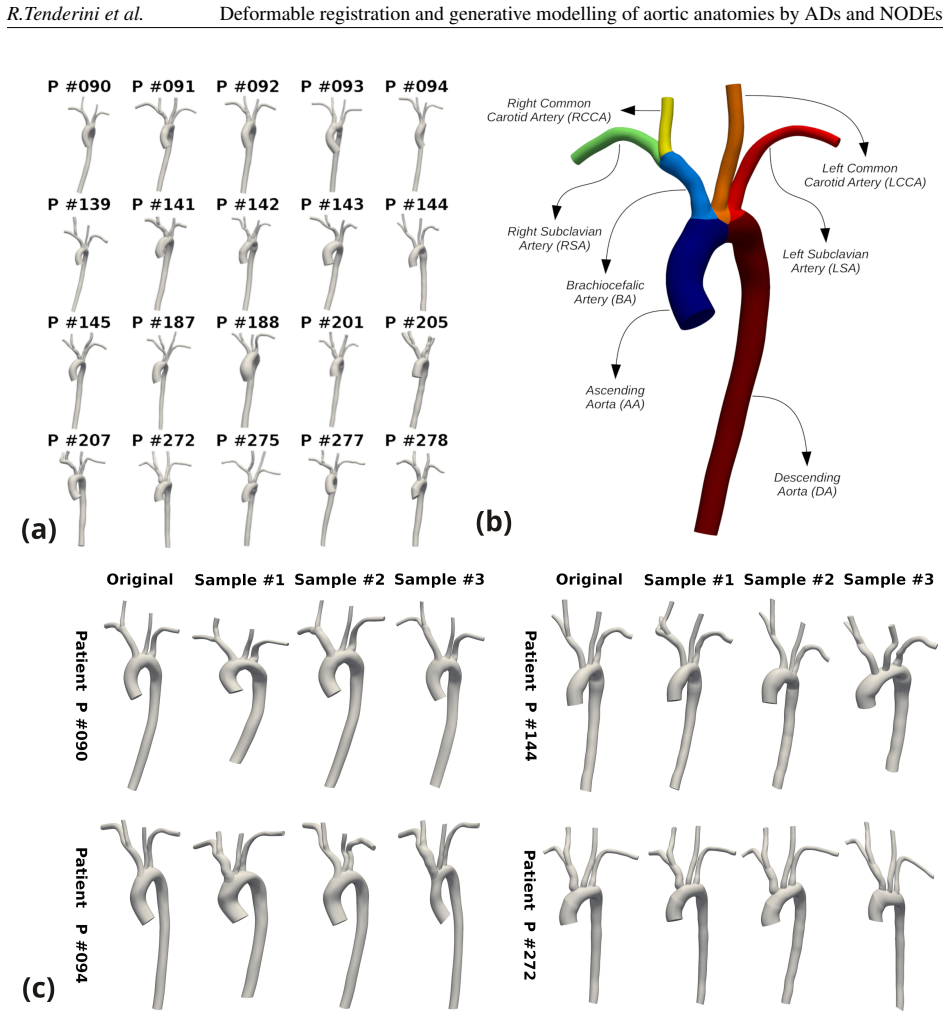
The central object is the auto-decoder stationary vector field diffeomorphism (AD-SVFD). It names the combination of three mechanisms: (1) a per-shape latent code in $R^{256}$, reshaped into a 2x2x2x32 grid and trilinearly interpolated at each query point, which makes the network self-conditioning; (2) a fully connected velocity network with Fourier positional encoding, whose output is the time-independent right-hand side of the ODE d/dt $\varphi$(x;t) = v($\varphi$(x;t); Theta, z_i); and (3) bidirectional Chamfer-distance training with forward Euler integration for the direct map and a modified Euler step for the inverse map. The identity that carries the argument is that integrating the same ODE forward and backward yields a diffeomorphism and its inverse, so one network simultaneously solves both registration directions and can be repurposed for generation by sampling latent codes.
What would settle it
Hold out several patients whose anatomy contains features absent from the 18 training aortas, such as a subclavian artery bending toward the carotid or an unsegmented branch, run the frozen model, and measure pointwise error; if maximal error on these patients substantially exceeds the reported 0.2-0.28 cm range, the generalization claim fails.
Extended reading notes
Core claim
The paper's central claim is that deformable registration and generative modelling can be unified in a single auto-decoder architecture, AD-SVFD. Each source anatomy carries a trainable 256-dimensional code; the code is reshaped into a low-resolution grid and interpolated at every spatial point to condition a fully connected network whose output is a stationary velocity field. The diffeomorphism between source and template is the unit-time flow of the ODE defined by that field, so the direct map is found by forward Euler integration and the inverse map by a modified Euler backward step. Both maps are trained jointly by minimising the Chamfer distance between the deformed point clouds, together with code and velocity regularisation. On the two held-out patients the baseline model achieves maximal forward local distances of 0.2777 cm and 0.2166 cm, average direct-test errors of 0.0387 cm and 0.0379 cm, and it improves on LDDMM for the inverse map while running in roughly one and a half minutes per shape. The same latent space, sampled with a fitted Gaussian, generates new anatomies by applying the inverse deformation to the reference.
Load-bearing premise
The load-bearing premise is that the thin-plate-spline-augmented dataset of synthetic aortas is a faithful proxy for real aortic variability, so accuracy on the synthetic test shapes and two held-out patients transfers to new patients; the paper's own cross-validation shows maximal test errors above 0.65 cm for patients with unique anatomy, so this premise is the fragile one.
Editorial extensions
If this is right
- A single trained AD-SVFD model can register many unseen aortic shapes to the same reference in about 90 seconds each, without running an expensive optimisation from scratch.
- Because the map is a diffeomorphism, the computed direct and inverse correspondences are guaranteed to be smooth, invertible, and topology-preserving, so registered geometries cannot tangle or tear.
- The same latent space that drives registration doubles as a generative model: drawing codes from the fitted Gaussian and applying the inverse map to the reference yields new plausible aortic anatomies.
- Weight sharing across the cohort makes the model substantially lighter and faster at inference than an auto-encoder, since only the low-dimensional code is fine-tuned for a new shape.
- Training with plain Chamfer distance is sufficient; the paper finds that normals-based and Sinkhorn alternatives do not improve accuracy on this dataset.
Reading between the lines
- The paper leaves implicit that the same code-sampling recipe could populate simulation cohorts with controlled geometric variability for haemodynamic studies, an application mentioned only as motivation.
- The cross-validation results suggest the method's weakest spot is rare anatomy: several folds with unique patient features show maximal test errors above 0.5 cm, so a natural testable extension is to condition the latent space on clinical variables so that codes interpolate along disease-relevant directions rather than purely geometric ones.
- Because the inverse map is trained on a bidirectional loss, the same model could in principle morph the template onto each source and then register sources to one another through the common reference, enabling population-level statistical shape analysis.
Editorial analysis
A structured set of objections, weighed in public.
Referee Report
Summary. The paper introduces AD-SVFD, a deep-learning model for deformable registration of aortic point clouds to a common template and for generative shape synthesis. Each anatomy is represented by a weighted point cloud and by a trainable latent code; the deformation is the unit-time flow of a stationary velocity field parameterized by a fully-connected neural network, integrated with K=10 Euler steps. Training minimizes a bidirectional Chamfer distance plus regularization on codes and velocities; at inference only the latent code is optimized. Experiments use 902 aortic geometries (882 generated by TPS-based augmentation from 20 real patients), compare several data attachment losses, and benchmark against CPD, TPS, LDDMM, ResNet-LDDMM, and SDF4CHD. The paper reports small average and maximal FLD/BLD values on the chosen test split, an average inference time of about 1m28s per shape, and a 10-fold cross-validation showing larger errors on patients with unique anatomy.
Significance. If the reported accuracy held on genuinely unseen anatomies, AD-SVFD would be a practically attractive combination of auto-decoder latent codes and neural-ODE diffeomorphisms: it offers fast inference, bidirectional registration, and a generative latent space, with a reasonable comparison against established baselines. The authors provide a public dataset link, perform a 10-fold cross-validation, and compare against LDDMM and several deep alternatives, which are concrete strengths. However, the central accuracy claim is not established for unseen anatomies: the main test split is dominated by TPS-augmented copies of training patients, and the paper's own cross-validation reports maximal test FLD values of 0.50-0.66 cm on several held-out patients, comparable to half the template inlet diameter. The abstract's unqualified 'extremely accurate' claim therefore overstates the evidence. The metric issue (FLD/BLD are components of the Chamfer training loss) and the lack of published code further limit verification.
major comments (4)
- [Results, Test 4 (Table 3)] The abstract's claim that AD-SVFD 'yields extremely accurate approximations' is not supported for genuinely unseen anatomies. Of the 38 test shapes, 36 are TPS-augmented versions of the 18 training patients, and the two original test patients (P#093, P#278) appear to be a favorable selection: in the 10-fold cross-validation, maximum direct test FLD reaches 0.5000 cm for P#275, 0.6429 cm for P#207, 0.6567 cm for P#188, and 0.5114 cm for P#205, against a template inlet diameter of 1.31 cm. These errors are of the same order as the vessel diameter and do not support the unqualified accuracy claim. The paper should either qualify the headline claim to the within-distribution/interpolation setting or provide evidence on genuinely held-out patients with unique anatomy.
- [Methods, Eq. (8); Results, Tables 1-2] The evaluation metrics FLD and BLD are the two per-point nearest-neighbor components of the Chamfer distance used as the training loss. Thus Tables 1 and 2 partly re-measure the training objective; they are valid for comparing methods trained with the same objective, but they are not an independent accuracy certificate. Please report at least one metric not minimized during training (for example volumetric overlap, surface-to-surface distance on the original meshes, or landmark-based distances if correspondences are available) to substantiate the absolute accuracy claim.
- [Appendix A.2, Algorithm 2] The data augmentation generates new anatomies by TPS interpolation between two existing patients with matching factors C_l uniformly drawn from [0.5,1]. The 36 synthetic test shapes used in the main test split are therefore convex combinations of training anatomies and lie close to the training manifold. This largely explains why test errors in Tables 1 and 2 are low while cross-validation on original anatomies shows much larger errors. The paper should state this limitation when interpreting the main results and should not present the 36 augmented test shapes as evidence of generalization to unseen anatomies.
- [Methods, Eqs. (5)-(7)] The inverse map used in all experiments is the modified-Euler approximation of an implicit backward Euler step, not the exact inverse of the discrete forward map. No experiment quantifies the inverse-consistency error (for example, mean and maximum of the composition error ||phi_i^{-1}(phi_i(x)) - x|| on the source points or its reverse). Since the abstract highlights invertibility and the method is explicitly discrete, please report this quantity and discuss the effect of K=10 on the inverse consistency.
minor comments (5)
- [Eq. (4)] The loss in Eq. (4) contains a weight-decay term w_Theta ||Theta||^2_2, but no value for w_Theta is reported in the text or in the hyperparameter tables; please state whether it was used and its value.
- [Abstract] The phrase 'extremely accurate approximations at competitive computational costs' should be qualified in light of the cross-validation results, or replaced by a claim limited to the tested distribution.
- [Results, Test 1] The sentence 'the training errors are computed only on the 18 original shapes' is useful, but Figure 3 also reports testing errors; please clarify in the caption that the testing set includes both original and augmented shapes.
- [Data and code availability] The code availability statement says the code is 'currently not available' and the text notes that exact reproducibility cannot be guaranteed due to non-deterministic PyTorch algorithms; releasing the code, trained weights, and random seeds would substantially strengthen the empirical contribution.
- [Appendix A] There is a typo 'seep learning' in the first sentence of Appendix A; also, the phrase 'quantifies' in the Table 4 caption should be 'quantified'.
Circularity Check
Reported accuracy partly re-measures the Chamfer training loss; no derivation-level circularity, but the generalization claim is further weakened by a test set that is mostly TPS-augmented copies of training patients.
-
self definitional
[Results (Test 2, metric definition); Methods, 'Data attachment measures', Eq. (8); Algorithm 1 and Remark 2]
"The model accuracy is quantified through the forward and backward local distances (FLD and BLD), expressed in cm. The former identifies the distance of each point in the mapped geometry from the closest one in the target, while the latter is the distance of each point in the target from the closest one in the mapped geometry. ... DCD (Y, Y′) := 1/M \sum_{i=1}^M \min_{c′∈Y ′} \|Y_i − c ′\|_2^2 + 1/M ′ \sum_{i′=1}^{M ′} \min_{c∈Y} \|c−Y ′_{i′}\|_2^2 ."
FLD/BLD are the per-point nearest-neighbor distances whose squares are summed in the Chamfer distance of Eq. (8). The training loss in Eq. (4) is exactly E(S_i,T;φ) = D_CD(φ(S_i),T) + D_CD(φ^{−1}(T),S_i), and at inference Remark 2 states that 'only the latent code entries ... have to be optimized', using the same data-attachment loss. Thus the average FLD/BLD numbers reported in Tables 1-2 are essentially the two summands of the very objective being minimized, so the headline 'extremely accurate approximations' partly restates the training fit rather than an independent accuracy measure.
full rationale
The paper's methodological chain is self-contained: the neural-ODE/SVF formulation, the auto-decoder latent codes, and the backward integration for the inverse map are all stated as explicit model choices (Eqs. 2-7) rather than imported from a self-citation. The authors do cite their own prior SDF4CHD work [33] for the position-aware shape-encoding strategy and as a baseline, but nothing load-bearing is justified only by that self-citation, and no uniqueness theorem is invoked to forbid alternatives. The main circularity-adjacent issue is evaluative: FLD and BLD are the per-point components of the Chamfer distance used as the training loss, so the reported test errors partly re-measure the optimized objective. A second, non-circular but important confound is the test split: 36 of the 38 test shapes are TPS-augmented versions of the 18 training patients, so the statement that training and testing errors are comparable partly reflects near-training-manifold test data. The paper's own 10-fold cross-validation (Table 3) reports max direct FLD values up to 0.6567 cm on genuinely held-out patients with unique anatomy, and the discussion candidly attributes this to data paucity. Those honest limitations and the external comparisons to LDDMM, ResNet-LDDMM, and SDF4CHD give the central claim independent empirical content; they prevent a score above 3, while the loss/evaluation overlap prevents a score of 0.
Assumptions & free parameters
free parameters (8)
- Neural network parameters Theta =
approximately 278k parameters
- Latent shape codes z_i =
256-dimensional, one per training anatomy
- Latent dimension N_z =
256
- Code regularization weight w_z =
1e-3
- Velocity regularization weight w_v =
1e-4
- Learning rate lambda =
1e-3
- Integration steps K =
10
- Adaptive sampling fraction a =
0.15
assumptions (6)
- domain assumption All source and template anatomies share the same topology.
- standard math A fully-connected ANN with Leaky-ReLU activations is Lipschitz, ensuring a well-posed ODE.
- ad hoc to paper K=10 forward/modified Euler discretizations approximate the continuous flow and its inverse well enough.
- domain assumption Cell-center point clouds with cell-area weights faithfully represent vessel surfaces for Chamfer-based registration.
- domain assumption TPS-augmented shapes are physiologically plausible and representative of true anatomical variability.
- domain assumption Gaussian sampling in the learned latent space produces realistic new anatomies.
Cite this review
Pith. "Pith review of Deformable registration and generative modelling of aortic anatomies by auto-decoders and neural ODEs." pith.science (2026). https://pith.science/paper/LFEIOHXO
@misc{pith2026250600947,
  author       = {Pith},
  title        = {Pith review of: Deformable registration and generative modelling of aortic anatomies by auto-decoders and neural ODEs},
  year         = {2026},
  howpublished = {\url{https://pith.science/paper/LFEIOHXO}},
  note         = {Machine review of arXiv:2506.00947}
}
read the original abstract
This work introduces AD-SVFD, a deep learning model for the deformable registration of vascular shapes to a pre-defined reference and for the generation of synthetic anatomies. AD-SVFD operates by representing each geometry as a weighted point cloud and models ambient space deformations as solutions at unit time of ODEs, whose time-independent right-hand sides are expressed through artificial neural networks. The model parameters are optimized by minimizing the Chamfer Distance between the deformed and reference point clouds, while backward integration of the ODE defines the inverse transformation. A distinctive feature of AD-SVFD is its auto-decoder structure, that enables generalization across shape cohorts and favors efficient weight sharing. In particular, each anatomy is associated with a low-dimensional code that acts as a self-conditioning field and that is jointly optimized with the network parameters during training. At inference, only the latent codes are fine-tuned, substantially reducing computational overheads. Furthermore, the use of implicit shape representations enables generative applications: new anatomies can be synthesized by suitably sampling from the latent space and applying the corresponding inverse transformations to the reference geometry. Numerical experiments, conducted on healthy aortic anatomies, showcase the high-quality results of AD-SVFD, which yields extremely accurate approximations at competitive computational costs.
Figures


Figures from the paper (4 more)


Reference graph
Works this paper leans on
-
[1]
Jan Modersitzki.Numerical methods for image registration. OUP Oxford, 2003
work page 2003
-
[2]
Jan Modersitzki.FAIR: flexible algorithms for image registration. SIAM, 2009
work page 2009
-
[3]
A fast diffeomorphic image registration algorithm.Neuroimage, 38(1):95–113, 2007
John Ashburner. A fast diffeomorphic image registration algorithm.Neuroimage, 38(1):95–113, 2007
work page 2007
-
[4]
Deformable medical image registration: a survey
Aristeidis Sotiras, Christos Davatzikos, and Nikos Paragios. Deformable medical image registration: a survey. IEEE transactions on medical imaging, 32(7):1153–1190, 2013
work page 2013
-
[5]
Deep learning in medical image registration: a survey.Machine Vision and Applications, 31(1):8, 2020
Grant Haskins, Uwe Kruger, and Pingkun Yan. Deep learning in medical image registration: a survey.Machine Vision and Applications, 31(1):8, 2020
work page 2020
-
[6]
Diffeomorphic demons: Efficient non–parametric image registration.NeuroImage, 45(1):S61–S72, 2009
Tom Vercauteren, Xavier Pennec, Aymeric Perchant, and Nicholas Ayache. Diffeomorphic demons: Efficient non–parametric image registration.NeuroImage, 45(1):S61–S72, 2009
work page 2009
-
[7]
M Faisal Beg, Michael I Miller, Alain Trouv ´e, and Laurent Younes. Computing large deformation metric map- pings via geodesic flows of diffeomorphisms.International journal of computer vision, 61:139–157, 2005
work page 2005
-
[8]
Marc Vaillant and Joan Glaunes. Surface matching via currents. InBiennial international conference on infor- mation processing in medical imaging, pages 381–392. Springer, 2005
work page 2005
Show all 78 references
-
[9]
Deformetrica 4: an open-source soft- ware for statistical shape analysis
Alexandre B ˆone, Maxime Louis, Benoˆıt Martin, and Stanley Durrleman. Deformetrica 4: an open-source soft- ware for statistical shape analysis. InShape in Medical Imaging: International Workshop, ShapeMI 2018, Held R.Tenderini et al.Deformable registration and generative mode...
2018
-
[10]
Unsupervised probabilis- tic deformation modeling for robust diffeomorphic registration
Julian Krebs, Tommaso Mansi, Boris Mailh ´e, Nicholas Ayache, and Herv´e Delingette. Unsupervised probabilis- tic deformation modeling for robust diffeomorphic registration. InDeep Learning in Medical Image Analysis and Multimodal Learning for Clinical Decision Support: 4th In...
2018
-
[11]
Unsupervised learning of probabilistic diffeomorphic registration for images and surfaces.Medical image analysis, 57:226–236, 2019
Adrian V Dalca, Guha Balakrishnan, John Guttag, and Mert R Sabuncu. Unsupervised learning of probabilistic diffeomorphic registration for images and surfaces.Medical image analysis, 57:226–236, 2019
2019
-
[12]
V oxelmorph: a learning framework for deformable medical image registration.IEEE transactions on medical imaging, 38(8):1788–1800, 2019
Guha Balakrishnan, Amy Zhao, Mert R Sabuncu, John Guttag, and Adrian V Dalca. V oxelmorph: a learning framework for deformable medical image registration.IEEE transactions on medical imaging, 38(8):1788–1800, 2019
2019
-
[13]
Smooth shells: Multi–scale shape registration with functional maps
Marvin Eisenberger, Zorah Lahner, and Daniel Cremers. Smooth shells: Multi–scale shape registration with functional maps. InProceedings of the IEEE/CVF Conference on Computer Vision and Pattern Recognition, pages 12265–12274, 2020
2020
-
[14]
Neuromorph: Unsupervised shape interpolation and correspondence in one go
Marvin Eisenberger, David Novotny, Gael Kerchenbaum, Patrick Labatut, Natalia Neverova, Daniel Cremers, and Andrea Vedaldi. Neuromorph: Unsupervised shape interpolation and correspondence in one go. InProceed- ings of the IEEE/CVF Conference on Computer Vision and Pattern Reco...
2021
-
[15]
CycleMorph: cycle consistent unsupervised deformable image registration.Medical image analysis, 71:102036, 2021
Boah Kim, Dong Hwan Kim, Seong Ho Park, Jieun Kim, June-Goo Lee, and Jong Chul Ye. CycleMorph: cycle consistent unsupervised deformable image registration.Medical image analysis, 71:102036, 2021
2021
-
[16]
Diffusemorph: Unsupervised deformable image registration using diffusion model
Boah Kim, Inhwa Han, and Jong Chul Ye. Diffusemorph: Unsupervised deformable image registration using diffusion model. InEuropean conference on computer vision, pages 347–364. Springer, 2022
2022
-
[17]
Transmorph: Transformer for unsupervised medical image registration.Medical image analysis, 82:102615, 2022
Junyu Chen, Eric C Frey, Yufan He, William P Segars, Ye Li, and Yong Du. Transmorph: Transformer for unsupervised medical image registration.Medical image analysis, 82:102615, 2022
2022
-
[18]
A review of deep learning–based deformable medical image registration.Frontiers in Oncology, 12:1047215, 2022
Jing Zou, Bingchen Gao, Youyi Song, and Jing Qin. A review of deep learning–based deformable medical image registration.Frontiers in Oncology, 12:1047215, 2022
2022
-
[19]
A survey of non–rigid 3D registration.Computer Graphics Forum, 41(2):559–589, 2022
Bailin Deng, Yuxin Yao, Roberto M Dyke, and Juyong Zhang. A survey of non–rigid 3D registration.Computer Graphics Forum, 41(2):559–589, 2022
2022
-
[20]
Medical image registration in the era of Transformers: a recent review.Informatics in Medicine Unlocked, page 101540, 2024
Hiba Ramadan, Dounia El Bourakadi, Ali Yahyaouy, and Hamid Tairi. Medical image registration in the era of Transformers: a recent review.Informatics in Medicine Unlocked, page 101540, 2024
2024
-
[21]
In vivo preclinical photoacoustic imaging of tumor vasculature development and therapy.Journal of biomedical optics, 17(5):056016–056016, 2012
Jan Laufer, Peter Johnson, Edward Zhang, Bradley Treeby, Ben Cox, Barbara Pedley, and Paul Beard. In vivo preclinical photoacoustic imaging of tumor vasculature development and therapy.Journal of biomedical optics, 17(5):056016–056016, 2012
2012
-
[22]
Dual–scan photoacoustic tomography for the imaging of vascular structure on foot.IEEE Transactions on Ultrasonics, Ferroelectrics, and Frequency Control, 70(12):1703–1713, 2023
Chuqin Huang, Yanda Cheng, Wenhan Zheng, Robert W Bing, Huijuan Zhang, Isabel Komornicki, Linda M Harris, Praveen R Arany, Saptarshi Chakraborty, Qifa Zhou, et al. Dual–scan photoacoustic tomography for the imaging of vascular structure on foot.IEEE Transactions on Ultrasonics...
2023
-
[23]
A fast all–optical 3D photoacoustic scanner for clinical vascular imaging.Nature Biomedical Engineering, pages 1–18, 2024
NT Huynh, E Zhang, O Francies, F Kuklis, T Allen, J Zhu, O Abeyakoon, F Lucka, M Betcke, J Jaros, et al. A fast all–optical 3D photoacoustic scanner for clinical vascular imaging.Nature Biomedical Engineering, pages 1–18, 2024
2024
-
[24]
Registration of 3D point clouds and meshes: A survey from rigid to nonrigid
Gary KL Tam, Zhi-Quan Cheng, Yu-Kun Lai, Frank C Langbein, Yonghuai Liu, David Marshall, Ralph R Martin, Xian-Fang Sun, and Paul L Rosin. Registration of 3D point clouds and meshes: A survey from rigid to nonrigid. IEEE transactions on visualization and computer graphics, 19(7...
2012
-
[25]
A review of non–rigid transformations and learning–based 3D point cloud registration methods.ISPRS journal of photogrammetry and remote sensing, 196:58–72, 2023
Sara Monji-Azad, J ¨urgen Hesser, and Nikolas L ¨ow. A review of non–rigid transformations and learning–based 3D point cloud registration methods.ISPRS journal of photogrammetry and remote sensing, 196:58–72, 2023
2023
-
[26]
Flownet3D: Learning scene flow in 3D point clouds
Xingyu Liu, Charles R Qi, and Leonidas J Guibas. Flownet3D: Learning scene flow in 3D point clouds. In Proceedings of the IEEE/CVF conference on computer vision and pattern recognition, pages 529–537, 2019
2019
-
[27]
Unsupervised diffeomorphic surface registration and nonlinear modelling
Balder Croquet, Daan Christiaens, Seth M Weinberg, Michael Bronstein, Dirk Vandermeulen, and Peter Claes. Unsupervised diffeomorphic surface registration and nonlinear modelling. InMedical Image Computing and Computer Assisted Intervention–MICCAI 2021: 24th International Confe...
2021
-
[28]
ResNet–LDDMM: advancing the LDDMM framework using deep residual networks.IEEE Transactions on Pattern Analysis and Machine Intelligence, 45(3):3707– 3720, 2022
Boulbaba Ben Amor, Sylvain Arguill `ere, and Ling Shao. ResNet–LDDMM: advancing the LDDMM framework using deep residual networks.IEEE Transactions on Pattern Analysis and Machine Intelligence, 45(3):3707– 3720, 2022
2022
-
[29]
Learning implicit fields for generative shape modeling
Zhiqin Chen and Hao Zhang. Learning implicit fields for generative shape modeling. InProceedings of the IEEE/CVF conference on computer vision and pattern recognition, pages 5939–5948, 2019
2019
-
[30]
DISN: Deep implicit surface network for high–quality single–view 3D reconstruction.Advances in neural information processing systems, 32, 2019
Qiangeng Xu, Weiyue Wang, Duygu Ceylan, Radomir Mech, and Ulrich Neumann. DISN: Deep implicit surface network for high–quality single–view 3D reconstruction.Advances in neural information processing systems, 32, 2019
2019
-
[31]
DeepSDF: learning continuous signed distance functions for shape representation
Jeong Joon Park, Peter Florence, Julian Straub, Richard Newcombe, and Steven Lovegrove. DeepSDF: learning continuous signed distance functions for shape representation. InProceedings of the IEEE/CVF conference on computer vision and pattern recognition, pages 165–174, 2019
2019
-
[32]
Topology–preserving shape reconstruction and registration via neural diffeomorphic flow
Shanlin Sun, Kun Han, Deying Kong, Hao Tang, Xiangyi Yan, and Xiaohui Xie. Topology–preserving shape reconstruction and registration via neural diffeomorphic flow. InProceedings of the IEEE/CVF Conference on Computer Vision and Pattern Recognition, pages 20845–20855, 2022
2022
-
[33]
SDF4CHD: Generative modeling of cardiac anatomies with congenital heart defects.Medical Image Analysis, 97:103293, 2024
Fanwei Kong, Sascha Stocker, Perry S Choi, Michael Ma, Daniel B Ennis, and Alison L Marsden. SDF4CHD: Generative modeling of cardiac anatomies with congenital heart defects.Medical Image Analysis, 97:103293, 2024
2024
-
[34]
Neural ordinary differential equa- tions.Advances in neural information processing systems, 31, 2018
Ricky TQ Chen, Yulia Rubanova, Jesse Bettencourt, and David K Duvenaud. Neural ordinary differential equa- tions.Advances in neural information processing systems, 31, 2018
2018
-
[35]
Conditional neural fields.Advances in neural information processing systems, 22, 2009
Jian Peng, Liefeng Bo, and Jinbo Xu. Conditional neural fields.Advances in neural information processing systems, 22, 2009
2009
-
[36]
Auto–encoding variational bayes.arXiv preprint arXiv:1312.6114, 2013
Diederik P Kingma and Max Welling. Auto–encoding variational bayes.arXiv preprint arXiv:1312.6114, 2013
2013 arXiv
-
[37]
InInternational conference on learning representations, 2016
Irina Higgins, Loic Matthey, Arka Pal, Christopher Burgess, Xavier Glorot, Matthew Botvinick, Shakir Mo- hamed, and Alexander Lerchner.β–V AE: learning basic visual concepts with a constrained variational frame- work. InInternational conference on learning representations, 2016
2016
-
[38]
An introduction to variational autoencoders.Foundations and Trends in Machine Learning, 12(4):307–392, 2019
Diederik P Kingma, Max Welling, et al. An introduction to variational autoencoders.Foundations and Trends in Machine Learning, 12(4):307–392, 2019
2019
-
[39]
Sam Bond-Taylor, Adam Leach, Yang Long, and Chris G Willcocks. Deep generative modelling: a comparative review of V AEs, GANs, normalizing flows, energy–based and autoregressive models.IEEE transactions on pattern analysis and machine intelligence, 2021
2021
-
[40]
Point set registration: coherent point drift.IEEE transactions on pattern analysis and machine intelligence, 32(12):2262–2275, 2010
Andriy Myronenko and Xubo Song. Point set registration: coherent point drift.IEEE transactions on pattern analysis and machine intelligence, 32(12):2262–2275, 2010
2010
-
[41]
Morphometry of anatomical shape complexes with dense deformations and sparse parameters.Neu- roImage, 101:35–49, 2014
Stanley Durrleman, Marcel Prastawa, Nicolas Charon, Julie R Korenberg, Sarang Joshi, Guido Gerig, and Alain Trouv´e. Morphometry of anatomical shape complexes with dense deformations and sparse parameters.Neu- roImage, 101:35–49, 2014
2014
-
[42]
A Bayesian framework for joint morphometry of surface and curve meshes in multi–object complexes.Medical image analysis, 35:458–474, 2017
Pietro Gori, Olivier Colliot, Linda Marrakchi-Kacem, Yulia Worbe, Cyril Poupon, Andreas Hartmann, Nicholas Ayache, and Stanley Durrleman. A Bayesian framework for joint morphometry of surface and curve meshes in multi–object complexes.Medical image analysis, 35:458–474, 2017
2017
-
[43]
ImplicitAtlas: learning deformable shape templates in medical imaging
Jiancheng Yang, Udaranga Wickramasinghe, Bingbing Ni, and Pascal Fua. ImplicitAtlas: learning deformable shape templates in medical imaging. InProceedings of the IEEE/CVF Conference on Computer Vision and Pattern Recognition, pages 15861–15871, 2022
2022
-
[44]
Registration of anatomical images using paths of diffeomorphisms parameterized with stationary vector field flows.International Journal of Computer Vision, 85: 291–306, 2009
Monica Hernandez, Matias N Bossa, and Salvador Olmos. Registration of anatomical images using paths of diffeomorphisms parameterized with stationary vector field flows.International Journal of Computer Vision, 85: 291–306, 2009
2009
-
[45]
CortexODE: Learning cortical surface reconstruction by neural ODEs.IEEE Transactions on Medical Imaging, 42(2):430– 443, 2022
Qiang Ma, Liu Li, Emma C Robinson, Bernhard Kainz, Daniel Rueckert, and Amir Alansary. CortexODE: Learning cortical surface reconstruction by neural ODEs.IEEE Transactions on Medical Imaging, 42(2):430– 443, 2022
2022
-
[46]
Recent advances in shape correspondence.The Visual Computer, 36(8):1705–1721, 2020
Yusuf Sahillio ˘glu. Recent advances in shape correspondence.The Visual Computer, 36(8):1705–1721, 2020
2020
-
[47]
Optimal transport for diffeomorphic registration
Jean Feydy, Benjamin Charlier, Franc ¸ois-Xavier Vialard, and Gabriel Peyr´e. Optimal transport for diffeomorphic registration. InMedical Image Computing and Computer Assisted Intervention- MICCAI 2017: 20th Interna- tional Conference, Quebec City, QC, Canada, September 11-13,...
2017
-
[48]
Geometric distortion metrics for point cloud compression
Dong Tian, Hideaki Ochimizu, Chen Feng, Robert Cohen, and Anthony Vetro. Geometric distortion metrics for point cloud compression. In2017 IEEE International Conference on Image Processing (ICIP), pages 3460–3464. IEEE, 2017
2017
-
[49]
Sinkhorn distances: Lightspeed computation of optimal transport.Advances in neural information processing systems, 26, 2013
Marco Cuturi. Sinkhorn distances: Lightspeed computation of optimal transport.Advances in neural information processing systems, 26, 2013
2013
-
[50]
Adam: A method for stochastic optimization.arXiv preprint arXiv:1412.6980, 2014
Diederik P Kingma and Jimmy Ba. Adam: A method for stochastic optimization.arXiv preprint arXiv:1412.6980, 2014
2014 arXiv
-
[51]
Optimization methods for large–scale machine learning.SIAM review, 60(2):223–311, 2018
L ´eon Bottou, Frank E Curtis, and Jorge Nocedal. Optimization methods for large–scale machine learning.SIAM review, 60(2):223–311, 2018
2018
-
[52]
SimVascular: an open source pipeline for cardiovascular simulation.Annals of biomedical engineering, 45:525– 541, 2017
Adam Updegrove, Nathan M Wilson, Jameson Merkow, Hongzhi Lan, Alison L Marsden, and Shawn C Shadden. SimVascular: an open source pipeline for cardiovascular simulation.Annals of biomedical engineering, 45:525– 541, 2017
2017
-
[53]
The vascular model repository: a public resource of medical imaging data and blood flow simulation results.Journal of medical devices, 7(4), 2013
Nathan M Wilson, Ana K Ortiz, and Allison B Johnson. The vascular model repository: a public resource of medical imaging data and blood flow simulation results.Journal of medical devices, 7(4), 2013
2013
-
[54]
Splines minimizing rotation–invariant semi–norms in Sobolev spaces
Jean Duchon. Splines minimizing rotation–invariant semi–norms in Sobolev spaces. InConstructive Theory of Functions of Several Variables: Proceedings of a Conference Held at Oberwolfach April 25–May 1, 1976, pages 85–100. Springer, 1977
1976
-
[55]
Algorithms for hyper–parameter optimization
James Bergstra, R ´emi Bardenet, Yoshua Bengio, and Bal´azs K´egl. Algorithms for hyper–parameter optimization. Advances in neural information processing systems, 24, 2011
2011
-
[56]
Making a science of model search: Hyperparameter optimization in hundreds of dimensions for vision architectures
James Bergstra, Daniel Yamins, and David Cox. Making a science of model search: Hyperparameter optimization in hundreds of dimensions for vision architectures. InInternational conference on machine learning, pages 115–
-
[57]
Variational auto–decoder: A method for neural generative modeling from incomplete data.arXiv preprint arXiv:1903.00840, 2019
Amir Zadeh, Yao-Chong Lim, Paul Pu Liang, and Louis-Philippe Morency. Variational auto–decoder: A method for neural generative modeling from incomplete data.arXiv preprint arXiv:1903.00840, 2019
1903 arXiv
-
[58]
Surrogate modeling for fluid flows based on physics– constrained deep learning without simulation data.Computer Methods in Applied Mechanics and Engineering, 361:112732, 2020
Luning Sun, Han Gao, Shaowu Pan, and Jian-Xun Wang. Surrogate modeling for fluid flows based on physics– constrained deep learning without simulation data.Computer Methods in Applied Mechanics and Engineering, 361:112732, 2020
2020
-
[59]
Geometry–aware physics–informed neural network surrogate for solving Navier–Stokes equation (GAPINN).Advanced Mod- eling and Simulation in Engineering Sciences, 9(1):8, 2022
Jan Oldenburg, Finja Borowski, Alper ¨Oner, Klaus-Peter Schmitz, and Michael Stiehm. Geometry–aware physics–informed neural network surrogate for solving Navier–Stokes equation (GAPINN).Advanced Mod- eling and Simulation in Engineering Sciences, 9(1):8, 2022
2022
-
[60]
Francesco Regazzoni, Stefano Pagani, and Alfio Quarteroni. Universal Solution Manifold Networks (USM– Nets): non–intrusive mesh–free surrogate models for problems in variable domains.Journal of Biomechanical Engineering, 144(12):121004, 2022
2022
-
[61]
Francisco Sahli Costabal, Simone Pezzuto, and Paris Perdikaris.∆–PINNs: Physics–informed neural networks on complex geometries.Engineering Applications of Artificial Intelligence, 127:107324, 2024
2024
-
[62]
Simone Brivio, Stefania Fresca, and Andrea Manzoni. Handling geometrical variability in nonlinear reduced order modeling through continuous geometry–aware DL-ROMs.Computer Methods in Applied Mechanics and Engineering, 442:117989, 2025
2025
-
[63]
UNIST: unpaired neural implicit shape translation network
Qimin Chen, Johannes Merz, Aditya Sanghi, Hooman Shayani, Ali Mahdavi-Amiri, and Hao Zhang. UNIST: unpaired neural implicit shape translation network. InProceedings of the IEEE/CVF Conference on Computer Vision and Pattern Recognition, pages 18614–18622, 2022
2022
-
[64]
Fourier features let networks learn high frequency functions in low–dimensional domains.Advances in Neural Information Processing Systems, 33:7537–7547, 2020
Matthew Tancik, Pratul Srinivasan, Ben Mildenhall, Sara Fridovich-Keil, Nithin Raghavan, Utkarsh Singhal, Ravi Ramamoorthi, Jonathan Barron, and Ren Ng. Fourier features let networks learn high frequency functions in low–dimensional domains.Advances in Neural Information Proce...
2020
-
[65]
On the spectral bias of neural networks
Nasim Rahaman, Aristide Baratin, Devansh Arpit, Felix Draxler, Min Lin, Fred Hamprecht, Yoshua Bengio, and Aaron Courville. On the spectral bias of neural networks. InInternational conference on machine learning, pages 5301–5310. PMLR, 2019
-
[66]
The earth mover’s distance as a metric for image retrieval
Yossi Rubner, Carlo Tomasi, and Leonidas J Guibas. The earth mover’s distance as a metric for image retrieval. International journal of computer vision, 40:99–121, 2000
2000
-
[67]
DeepEMD: A transformer–based fast estimation of the earth mover’s distance
Atul Kumar Sinha and Franc ¸ois Fleuret. DeepEMD: A transformer–based fast estimation of the earth mover’s distance. InInternational Conference on Pattern Recognition, pages 1–15. Springer, 2024. R.Tenderini et al.Deformable registration and generative modelling of aortic anat...
2024
-
[68]
Faster Wasserstein distance estimation with the Sinkhorn divergence.Advances in Neural Information Processing Systems, 33: 2257–2269, 2020
Lenaic Chizat, Pierre Roussillon, Flavien L ´eger, Franc ¸ois-Xavier Vialard, and Gabriel Peyr´e. Faster Wasserstein distance estimation with the Sinkhorn divergence.Advances in Neural Information Processing Systems, 33: 2257–2269, 2020
2020
-
[69]
Diffeomorphic registration using Sinkhorn divergences.SIAM Journal on Imaging Sciences, 16(1):250–279, 2023
Lucas De Lara, Alberto Gonz ´alez-Sanz, and Jean-Michel Loubes. Diffeomorphic registration using Sinkhorn divergences.SIAM Journal on Imaging Sciences, 16(1):250–279, 2023
2023
-
[70]
Inter- polating between optimal transport and mmd using Sinkhorn divergences
Jean Feydy, Thibault S´ejourn´e, Franc ¸ois-Xavier Vialard, Shunichi Amari, Alain Trouv´e, and Gabriel Peyr´e. Inter- polating between optimal transport and mmd using Sinkhorn divergences. InThe 22nd international conference on artificial intelligence and statistics, pages 268...
2019
-
[71]
Density–aware chamfer distance as a comprehensive metric for point cloud completion.arXiv preprint arXiv:2111.12702, 2021
Tong Wu, Liang Pan, Junzhe Zhang, Tai Wang, Ziwei Liu, and Dahua Lin. Density–aware chamfer distance as a comprehensive metric for point cloud completion.arXiv preprint arXiv:2111.12702, 2021
2021 arXiv
-
[72]
Delving deep into rectifiers: Surpassing human– level performance on ImageNet classification
Kaiming He, Xiangyu Zhang, Shaoqing Ren, and Jian Sun. Delving deep into rectifiers: Surpassing human– level performance on ImageNet classification. InProceedings of the IEEE international conference on computer vision, pages 1026–1034, 2015
2015
-
[73]
There is more than one way to frame a curve.The American Mathematical Monthly, 82(3): 246–251, 1975
Richard L Bishop. There is more than one way to frame a curve.The American Mathematical Monthly, 82(3): 246–251, 1975
1975
-
[74]
A low order, torsion deformable spatial beam element based on the absolute nodal coordinate formulation and Bishop frame.Multibody System Dynamics, 51(3):247– 278, 2021
Mehran Ebrahimi, Adrian Butscher, and Hyunmin Cheong. A low order, torsion deformable spatial beam element based on the absolute nodal coordinate formulation and Bishop frame.Multibody System Dynamics, 51(3):247– 278, 2021
2021
-
[75]
Method for registration of 3D shapes
Paul J Besl and Neil D McKay. Method for registration of 3D shapes. InSensor fusion IV: control paradigms and data structures, volume 1611, pages 586–606. Spie, 1992
1992
-
[76]
Robust registration of 2D and 3D point sets.Image and vision computing, 21(13-14): 1145–1153, 2003
Andrew W Fitzgibbon. Robust registration of 2D and 3D point sets.Image and vision computing, 21(13-14): 1145–1153, 2003
2003
-
[77]
New algorithms for 2D and 3D point matching: pose estimation and correspondence.Pattern recognition, 31(8):1019–1031, 1998
Steven Gold, Anand Rangarajan, Chien-Ping Lu, Suguna Pappu, and Eric Mjolsness. New algorithms for 2D and 3D point matching: pose estimation and correspondence.Pattern recognition, 31(8):1019–1031, 1998
1998
-
[78]
extended
Haili Chui and Anand Rangarajan. A new algorithm for non–rigid point matching. InProceedings IEEE Con- ference on Computer Vision and Pattern Recognition. CVPR 2000 (Cat. No. PR00662), volume 2, pages 44–51. IEEE, 2000. R.Tenderini et al.Deformable registration and generative ...
2000
Reviewed August 7, 2026 · model on record in the stance chip above.
Discussion (0). Sign in to comment.