REVIEW 4 major objections 7 minor 72 references
TIGeR: Text-Instructed Generation and Refinement for Template-Free Hand-Object Interaction
T0 review · 4 major / 7 minor · reviewed 2026-08-07 · deepseek-v4-flash
Pith's one-line read Text-instructed priors replace hand-crafted templates for hand-object reconstruction.
desk verdict First text-instructed prior generation for template-free HOI, with strong DexYCB gains but an overreaching Obman claim and an unvalidated distributional assumption about prior quality. read the letter →
The pith
A machine-rendered reading of the paper's core claim, the machinery that carries it, and where it could break.
The reading
What carries the argument
The load-bearing component is the text-instructed prior generation pipeline feeding a 2D-3D collaborative attention refinement. A captioning model (InstructBLIP) identifies the held object, a text-to-image model (FLUX) renders a clean canonical view, and an image-to-point-cloud model (Point-E) lifts that view into a coarse shape prior. The refinement stage uses a PointNet++ geometric encoder and an HRNet visual encoder; two collaborative attention blocks compute per-patch attention weights that link 3D prior points to informative 2D image regions, and the fused features are decoded through a U-Net-style point decoder into the refined object. An auxiliary ICP alignment between the prior and the ground-truth mesh generates pseudo correspondences used to supervise the attention weights and projected coordinates during training, but is not used at inference.
What would settle it
Measure reconstruction on objects with large intra-class shape variation in functional state, such as scissors in open versus closed configurations; if TIGeR's Chamfer distance on such states is no better than a sphere-initialized baseline, then the text-generated prior does not supply the claimed category-level geometric knowledge. The paper's own limitation section states that the current implementation struggles with exactly these cases.
Extended reading notes
Core claim
The central claim is that a text-instructed, generated 3D prior, combined with a learned vision-guided refinement, reconstructs hand-object interactions with higher fidelity than template-free methods that start from a sphere or rely solely on SDF decoders. TIGeR reports median object Chamfer distances of 1.979 on Dex-YCB and 5.468 on Obman, and when objects are center-normalized the object-only Chamfer distance drops to 0.62 and 2.78, surpassing the re-implemented baselines. The paper also shows that the generated prior is more similar to ground-truth shapes than a unit-sphere initialization and that the method retains lower Chamfer distance than gSDF across all tested occlusion levels.
Load-bearing premise
The whole pipeline relies on the off-the-shelf captioning, image generation, and point-cloud generation models producing a shape prior that is close enough to the real held object that the learned refinement can correct the remaining difference; if the prior is frequently far from the true shape, refinement cannot recover.
Editorial extensions
If this is right
- TIGeR removes the need to collect or hand-craft 3D templates, so reconstruction can be applied to a wider set of objects whenever text-to-3D systems can describe them.
- The framework stays robust under heavy hand occlusion because the shape prior supplies geometric cues the image alone lacks, as shown by the occlusion-rate analysis.
- The method is compatible with heterogeneous prior sources: retrieved real images work nearly as well as synthetic images, so deployment can choose the most reliable and cheapest prior.
- Hand reconstruction also improves in the reported metrics, suggesting the object prior helps constrain the joint hand-object optimization.
- The two-stage design means future improvements in text-to-image and image-to-point-cloud models should directly improve TIGeR's reconstructions without retraining the refinement module.
Reading between the lines
- An implicit consequence is that TIGeR's ceiling is tied to the category coverage of the off-the-shelf generators; objects outside that distribution, such as tools with movable parts, will likely fall back on the refinement stage's limited ability to add unseen geometry.
- The refinement module learns a mapping from prior geometry plus image evidence to object shape, so a natural extension is to train it jointly across many prior sources (retrieval, synthetic, hand-crafted) to make the system robust to arbitrary prior quality.
- The ICP-based pseudo alignment used only in training could be replaced by a differentiable registration objective, potentially removing the need for ground-truth meshes at training time and moving the framework toward self-supervised adaptation.
- Because the prior generation is category-driven, the method could be extended to multi-object interactions by generating one prior per detected held object and refining them jointly.
Editorial analysis
A structured set of objections, weighed in public.
Referee Report
Summary. The paper proposes TIGeR, a two-stage framework for single-image hand-object interaction reconstruction. In the first stage, a coarse object shape prior is generated from the input image by combining an off-the-shelf captioning model (InstructBLIP), a text-to-image diffusion model (FLUX), and an image-to-point-cloud model (Point-E). In the second stage, a vision-guided refinement module uses 2D-3D collaborative attention to fuse the prior with image features and regress a refined object point cloud, while a MANO-based hand branch predicts the hand mesh and pose. The authors claim that TIGeR surpasses existing template-free methods on the DexYCB and Obman benchmarks and shows robustness to occlusion, with compatibility with heterogeneous prior sources.
Significance. The central idea of replacing hand-crafted 3D templates with text-generated priors is timely and potentially valuable for open-world hand-object interaction reconstruction. The paper provides a concrete pipeline, evaluations on two standard benchmarks, occlusion robustness analysis, and ablations of the proposed losses. It also states an intention to release code. If the claims are supported by rigorous statistical and distributional analysis, the work would be a solid contribution to template-free HOI reconstruction. However, the current evidence is not yet sufficient: several headline claims are metric-dependent, no error bars are provided, and the prior-quality assumption is not validated as a distribution over test cases.
major comments (4)
- [Abstract and Section 5 (Conclusion)] The claim in the abstract that TIGeR is 'surpassing existing template-free methods' is not supported uniformly by Table 2 on Obman: while the Chamfer distance is lower (5.468 vs 5.584/5.626), the F-scores FSo@5 and FSo@10 are lower than both AlignSDF and gSDF (0.199 vs 0.203/0.207 for FSo@5; 0.462 vs 0.476/0.482 for FSo@10). Similarly, the conclusion's statement 'outperforming existing methods by 0.034 in F-score@5 while reducing shape reconstruction Chamfer Distance by 0.69' does not match Table 1 or Table 2: on DexYCB the FSo@5 improvement over gSDF is 0.034 but the CD reduction is 0.79, and on Obman the F-score decreases. The abstract and conclusion should be revised to state metric-specific results and to qualify the Obman result as 'competitive' or 'lower Chamfer distance' rather than an overall improvement.
- [Section 4.1 and NeurIPS Checklist item 7] The quantitative comparisons lack error bars and statistical tests. Tables 1 and 2 report single numbers, and the only mention of repeated runs is in the checklist, which answers 'NA' to the statistical-significance question but then states 'We report the average result with 5 runs.' This is internally contradictory. Since the claimed advantages on Obman are small in Chamfer distance and negative in F-scores, the paper should report mean and standard deviation over the 5 runs (or otherwise provide variance information) for all metrics, and ideally a paired significance test for the main claims. Without this, the 'surpassing' claim is not statistically grounded.
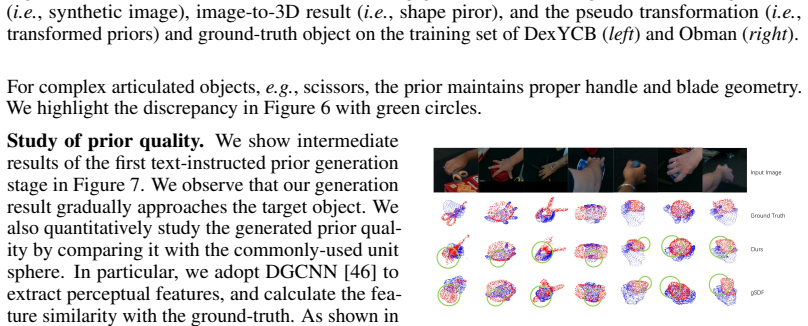
- [Section 3.1 and Section 4.2 (Study of prior quality)] The load-bearing assumption that the generated prior is close enough to the true object for the refinement network to recover is not validated as a distribution. Section 3.1 acknowledges 'the geometric gap between the synthesized prototype and the real object,' but the only quantitative evidence is Figure 8, which is computed on the training set and reports a feature-similarity measure without error bars or a definition of the similarity metric. There is no test-set histogram of prior-to-ground-truth Chamfer distance after the ICP alignment, no category-wise failure analysis, and no analysis conditioning the final reconstruction error on prior quality. The paper's own Limitation section admits failures on intra-class state variation (e.g., scissors) but does not quantify the frequency of such failures. Please add a test-set distribution of prior Chamfer distances per category, a scatter or bucketed analysis of final CD versus prior CD, and an explicit discussion of which prior errors are correctable by the refinement stage.
- [Section 4.2, Table 4b] The ablation study shows a dramatic sensitivity to the Lweight loss: removing it degrades the centered object Chamfer distance from 0.62 to 3.88, a six-fold increase, while removing Lproj degrades it to 1.32. This indicates that the method's performance is strongly driven by the training-time auxiliary loss built on the ICP pseudo-correspondence (Eqs. 1-2). The paper does not report error bars for the ablations or a sensitivity sweep for the hyperparameter lambda_weight (set to 0.1). Given this brittleness, the authors should report a sensitivity study over lambda_weight (e.g., 0.01, 0.05, 0.1, 0.2, 0.5) and discuss why the model depends so heavily on this loss. This is necessary to evaluate the robustness of the central claim in practical deployments.
minor comments (7)
- [Section 3.1] There is a typo: 'InstrucBLIP' should be 'InstructBLIP'.
- [Section 4.1 and Table 1] The text states 'our method has arrived at 1.979 median Chamfer Distance' for DexYCB, but the abstract and Table 1 report '1.979' without specifying whether this is a median or mean; the same ambiguity applies to the Obman CD of 5.468. Please clarify in the tables and text which statistic is reported for each metric.
- [Appendix, Compared Methods and Datasets] Reference [49] is cited as 'YCB-Video' but the reference list entry [49] is PoseCNN. The YCB-Video dataset citation appears to be missing or misnumbered; please correct the citation.
- [Section 4.2, Table 3] The numbers in Table 3 differ substantially from Tables 1 and 2 because objects are center-normalized, and the text mentions 'our re-implementation of three competitive methods' without giving details of the re-implementation protocol. Please state explicitly in the caption or text that these are centered-object evaluations and describe how the re-implementations were verified against the original papers.
- [Section 4.2, Figure 8] The DGCNN-based 'similarity' in Figure 8 is not defined: is it cosine similarity in the feature space, and which features are used? Since this figure is the main quantitative support for prior quality, please define the metric and report test-set numbers, not only training-set numbers.
- [Section 5] The conclusion's numerical summary 'outperforming existing methods by 0.034 in F-score@5 while reducing shape reconstruction Chamfer Distance by 0.69' does not match the tables; please align it with the reported results (on DexYCB the CD reduction vs gSDF is 0.79 and FSo@5 improvement is 0.034; on Obman the F-score decreases).
- [Limitation paragraph] The limitation paragraph is a useful acknowledgment, but it should be expanded to include a quantitative failure analysis, e.g., the percentage of test samples for which the generated prior has the wrong category or a Chamfer distance above a threshold, and how often the final reconstruction fails in those cases.
Circularity Check
No significant circularity: TIGeR is an empirically trained reconstruction system whose shape prior comes from external off-the-shelf generators and whose refinement is supervised by standard losses; the two overlapping self-citations are background inspiration only.
full rationale
TIGeR does not present a derivational chain whose output is defined in terms of its input. The text-instructed prior Vbar is produced by InstructBLIP, FLUX, and Point-E, all external off-the-shelf models, and the vision-guided refinement network is trained with conventional Chamfer, mask, and pose losses against ground truth. The only ground-truth-dependent auxiliary quantities are the ICP alignment A and pseudo-correspondence J(i) in Eqs. (1)-(3). These are explicitly training-time losses that supervise attention and projection; they are not used at inference and are not presented as predictions. The self-citations [44] and [54] are cited merely as inspiration for cross-modal 3D generation, not as load-bearing assumptions, uniqueness theorems, or ansatz-justifying authorities. The limitation section candidly states that the method inherits constraints from off-the-shelf generative models, which is an empirical risk rather than circular reasoning. The Obman results show lower Chamfer distance but also lower F-scores than some baselines, which is a metric-consistency and correctness concern, not circularity. Overall, the central claim is empirically testable and does not reduce to its own inputs by construction.
Assumptions & free parameters
free parameters (2)
- lambda_weight =
0.1
- lambda_proj =
0.01
assumptions (3)
- domain assumption Off-the-shelf captioning (InstructBLIP), text-to-image (FLUX), and image-to-point-cloud (Point-E) produce a shape prior with category-level geometry close enough to the real object for refinement.
- domain assumption ICP between the generated prior and the ground-truth mesh (Eq. 1) yields a reliable pseudo one-to-one correspondence J(i) for training Lweight and Lproj.
- domain assumption The 2D projection phi and camera intrinsics are known, and ground-truth amodal masks are available for training.
Cite this review
Pith. "Pith review of TIGeR: Text-Instructed Generation and Refinement for Template-Free Hand-Object Interaction." pith.science (2026). https://pith.science/paper/3MQYQSZA
@misc{pith2026250600953,
  author       = {Pith},
  title        = {Pith review of: TIGeR: Text-Instructed Generation and Refinement for Template-Free Hand-Object Interaction},
  year         = {2026},
  howpublished = {\url{https://pith.science/paper/3MQYQSZA}},
  note         = {Machine review of arXiv:2506.00953}
}
read the original abstract
Pre-defined 3D object templates are widely used in 3D reconstruction of hand-object interactions. However, they often require substantial manual efforts to capture or source, and inherently restrict the adaptability of models to unconstrained interaction scenarios, e.g., heavily-occluded objects. To overcome this bottleneck, we propose a new Text-Instructed Generation and Refinement (TIGeR) framework, harnessing the power of intuitive text-driven priors to steer the object shape refinement and pose estimation. We use a two-stage framework: a text-instructed prior generation and vision-guided refinement. As the name implies, we first leverage off-the-shelf models to generate shape priors according to the text description without tedious 3D crafting. Considering the geometric gap between the synthesized prototype and the real object interacted with the hand, we further calibrate the synthesized prototype via 2D-3D collaborative attention. TIGeR achieves competitive performance, i.e., 1.979 and 5.468 object Chamfer distance on the widely-used Dex-YCB and Obman datasets, respectively, surpassing existing template-free methods. Notably, the proposed framework shows robustness to occlusion, while maintaining compatibility with heterogeneous prior sources, e.g., retrieved hand-crafted prototypes, in practical deployment scenarios.
Figures


Figures from the paper (5 more)




Reference graph
Works this paper leans on
-
[1]
Cao, Z., Radosavovic, I., Kanazawa, A., Malik, J.: Reconstructing hand-object interactions in the wild. ICCV (2021)
work page 2021
-
[2]
Chang, A.X., Funkhouser, T., Guibas, L., Hanrahan, P., Huang, Q., Li, Z., Savarese, S., Savva, M., Song, S., Su, H., Xiao, J., Yi, L., Yu, F.: Shapenet: An information-rich 3d model repository (2015), https: //arxiv.org/abs/1512.03012
arXiv 2015
-
[3]
In: Proceedings of the IEEE/CVF Conference on Computer Vision and Pattern Recognition (CVPR)
Chao, Y .W., Yang, W., Xiang, Y ., Molchanov, P., Handa, A., Tremblay, J., Narang, Y .S., Van Wyk, K., Iqbal, U., Birchfield, S., Kautz, J., Fox, D.: Dexycb: A benchmark for capturing hand grasping of objects. In: Proceedings of the IEEE/CVF Conference on Computer Vision and Pattern Recognition (CVPR). pp. 9044–9053 (June 2021)
work page 2021
-
[4]
In: 2017 IEEE Conference on Computer Vision and Pattern Recognition (CVPR)
Charles, R.Q., Su, H., Kaichun, M., Guibas, L.J.: Pointnet: Deep learning on point sets for 3d classification and segmentation. In: 2017 IEEE Conference on Computer Vision and Pattern Recognition (CVPR). pp. 77–85 (2017). https://doi.org/10.1109/CVPR.2017.16
-
[5]
In: Proceedings of the IEEE/CVF International Conference on Computer Vision (ICCV)
Chen, P., Chen, Y ., Yang, D., Wu, F., Li, Q., Xia, Q., Tan, Y .: I2uv-handnet: Image-to-uv prediction network for accurate and high-fidelity 3d hand mesh modeling. In: Proceedings of the IEEE/CVF International Conference on Computer Vision (ICCV). pp. 12929–12938 (October 2021)
work page 2021
-
[6]
In: Proceedings of the IEEE/CVF Conference on Computer Vision and Pattern Recognition (CVPR)
Chen, W., Jia, X., Chang, H.J., Duan, J., Shen, L., Leonardis, A.: Fs-net: Fast shape-based network for category-level 6d object pose estimation with decoupled rotation mechanism. In: Proceedings of the IEEE/CVF Conference on Computer Vision and Pattern Recognition (CVPR). pp. 1581–1590 (June 2021)
work page 2021
-
[7]
In: Proceedings of the IEEE/CVF Conference on Computer Vision and Pattern Recognition
Chen, Y ., Tu, Z., Kang, D., Bao, L., Zhang, Y ., Zhe, X., Chen, R., Yuan, J.: Model-based 3d hand reconstruction via self-supervised learning. In: Proceedings of the IEEE/CVF Conference on Computer Vision and Pattern Recognition. pp. 10451–10460 (2021)
work page 2021
-
[8]
Chen, Z., Chen, S., Schmid, C., Laptev, I.: gSDF: Geometry-driven signed distance functions for 3d hand-object reconstruction. In: CVPR (2023)
work page 2023
Show all 72 references
-
[9]
In: ECCV (2022)
Chen, Z., Hasson, Y ., Schmid, C., Laptev, I.: AlignSDF: Pose-aligned signed distance fields for hand-object reconstruction. In: ECCV (2022)
2022
-
[10]
In: Oh, A., Naumann, T., Globerson, A., Saenko, K., Hardt, M., Levine, S
Dai, W., Li, J., LI, D., Tiong, A., Zhao, J., Wang, W., Li, B., Fung, P.N., Hoi, S.: Instructblip: Towards general-purpose vision-language models with instruction tuning. In: Oh, A., Naumann, T., Globerson, A., Saenko, K., Hardt, M., Levine, S. (eds.) Advances in Neural Inform...
2023
-
[11]
In: 2009 IEEE Conference on Computer Vision and Pattern Recognition
Deng, J., Dong, W., Socher, R., Li, L.J., Li, K., Fei-Fei, L.: Imagenet: A large-scale hierarchical image database. In: 2009 IEEE Conference on Computer Vision and Pattern Recognition. pp. 248–255 (2009). https://doi.org/10.1109/CVPR.2009.5206848
2009
-
[12]
In: Proceedings of the IEEE/CVF Conference on Computer Vision and Pattern Recognition (CVPR)
Fan, Z., Parelli, M., Kadoglou, M.E., Chen, X., Kocabas, M., Black, M.J., Hilliges, O.: Hold: Category- agnostic 3d reconstruction of interacting hands and objects from video. In: Proceedings of the IEEE/CVF Conference on Computer Vision and Pattern Recognition (CVPR). pp. 494...
2024
-
[13]
arXiv preprint arXiv:2401.02117 (2024)
Fu, Z., Zhao, T.Z., Finn, C.: Mobile aloha: Learning bimanual mobile manipulation with low-cost whole-body teleoperation. arXiv preprint arXiv:2401.02117 (2024)
2024 arXiv
-
[14]
In: Proceedings of the IEEE Conference on Computer Vision and Pattern Recognition (CVPR) (June 2018)
Groueix, T., Fisher, M., Kim, V .G., Russell, B.C., Aubry, M.: A papier-mâché approach to learning 3d surface generation. In: Proceedings of the IEEE Conference on Computer Vision and Pattern Recognition (CVPR) (June 2018)
2018
-
[15]
Computational Visual Media 7(2), 187–199 (Jun 2021)
Guo, M.H., Cai, J.X., Liu, Z.N., Mu, T.J., Martin, R.R., Hu, S.M.: Pct: Point cloud transformer. Computational Visual Media 7(2), 187–199 (Jun 2021). https://doi.org/10.1007/s41095-021-0229-5, http: //dx.doi.org/10.1007/s41095-021-0229-5
2021 doi
-
[16]
In: CVPR (2020) 10
Hasson, Y ., Tekin, B., Bogo, F., Laptev, I., Pollefeys, M., Schmid, C.: Leveraging photometric consistency over time for sparsely supervised hand-object reconstruction. In: CVPR (2020) 10
2020
-
[17]
In: 2021 International Conference on 3D Vision (3DV)
Hasson, Y ., Varol, G., Schmid, C., Laptev, I.: Towards unconstrained joint hand-object reconstruction from rgb videos. In: 2021 International Conference on 3D Vision (3DV). pp. 659–668. IEEE (2021)
2021
-
[18]
In: CVPR (2019)
Hasson, Y ., Varol, G., Tzionas, D., Kalevatykh, I., Black, M.J., Laptev, I., Schmid, C.: Learning joint reconstruction of hands and manipulated objects. In: CVPR (2019)
2019
-
[19]
In: 2016 IEEE Conference on Computer Vision and Pattern Recognition (CVPR)
He, K., Zhang, X., Ren, S., Sun, J.: Deep residual learning for image recognition. In: 2016 IEEE Conference on Computer Vision and Pattern Recognition (CVPR). pp. 770–778 (2016). https://doi.org/10.1109/CVPR.2016.90
2016 doi
-
[20]
In: ECCV (2018)
Iqbal, U., Molchanov, P., Gall, T.B.J., Kautz, J.: Hand pose estimation via latent 2.5D heatmap regression. In: ECCV (2018)
2018
-
[21]
CoRR abs/1412.6980 (2014), https: //api.semanticscholar.org/CorpusID:6628106
Kingma, D.P., Ba, J.: Adam: A method for stochastic optimization. CoRR abs/1412.6980 (2014), https: //api.semanticscholar.org/CorpusID:6628106
2014 arXiv
-
[22]
https://github.com/black-forest-labs/flux (2024)
Labs, B.F.: Flux. https://github.com/black-forest-labs/flux (2024)
2024
-
[23]
In: IEEE/CVF Conference on Computer Vision and Pattern Recognition (CVPR)
Li, J., Hee Lee, G.: Deepi2p: Image-to-point cloud registration via deep classification. In: IEEE/CVF Conference on Computer Vision and Pattern Recognition (CVPR). pp. 15955–15964 (2021). https://doi.org/10.1109/CVPR46437.2021.01570
2021
-
[24]
In: Proceedings of the IEEE/CVF Conference on Computer Vision and Pattern Recognition (CVPR)
Li, J., Xu, C., Chen, Z., Bian, S., Yang, L., Lu, C.: Hybrik: A hybrid analytical-neural inverse kinematics solution for 3d human pose and shape estimation. In: Proceedings of the IEEE/CVF Conference on Computer Vision and Pattern Recognition (CVPR). pp. 3383–3393 (June 2021)
2021
-
[25]
In: IEEE/CVF Conf
Li, M., An, L., Zhang, H., Wu, L., Chen, F., Yu, T., Liu, Y .: Interacting attention graph for single image two-hand reconstruction. In: IEEE/CVF Conf. on Computer Vision and Pattern Recognition (CVPR) (Jun 2022)
2022
-
[26]
In: Proceedings of the IEEE/CVF conference on computer vision and pattern recognition
Lin, K., Wang, L., Liu, Z.: End-to-end human pose and mesh reconstruction with transformers. In: Proceedings of the IEEE/CVF conference on computer vision and pattern recognition. pp. 1954–1963 (2021)
2021
-
[27]
In: 2023 IEEE/CVF Conference on Computer Vision and Pattern Recognition (CVPR)
Lin, Z., Ding, C., Yao, H., Kuang, Z., Huang, S.: Harmonious feature learning for interactive hand-object pose estimation. In: 2023 IEEE/CVF Conference on Computer Vision and Pattern Recognition (CVPR). pp. 12989–12998 (2023). https://doi.org/10.1109/CVPR52729.2023.01248
2023
-
[28]
In: Proceedings of the IEEE/CVF Conference on Computer Vision and Pattern Recognition
Liu, S., Wu, W., Wu, J., Lin, Y .: Spatial-temporal parallel transformer for arm-hand dynamic estimation. In: Proceedings of the IEEE/CVF Conference on Computer Vision and Pattern Recognition. pp. 20523–20532 (2022)
2022
-
[29]
ACM Trans
Loper, M., Mahmood, N., Romero, J., Pons-Moll, G., Black, M.J.: Smpl: a skinned multi-person linear model. ACM Trans. Graph. 34(6) (Oct 2015). https://doi.org/10.1145/2816795.2818013, https://doi.org/ 10.1145/2816795.2818013
2015
-
[30]
IEEE Robotics & Automation Magazine 11(4), 110–122 (2004)
Miller, A., Allen, P.: Graspit! a versatile simulator for robotic grasping. IEEE Robotics & Automation Magazine 11(4), 110–122 (2004). https://doi.org/10.1109/MRA.2004.1371616
2004 arXiv
-
[31]
In: CVPR (2018)
Mueller, F., Bernard, F., Sotnychenko, O., Mehta, D., Sridhar, S., Casas, D., Theobalt, C.: Ganerated hands for real-time 3D hand tracking from monocular RGB. In: CVPR (2018)
2018
-
[32]
Nichol, A., Jun, H., Dhariwal, P., Mishkin, P., Chen, M.: Point-e: A system for generating 3d point clouds from complex prompts (2022), https://arxiv.org/abs/2212.08751
2022 arXiv
-
[33]
In: Proceedings of the IEEE/CVF Conference on Computer Vision and Pattern Recognition (CVPR) (June 2019)
Park, J.J., Florence, P., Straub, J., Newcombe, R., Lovegrove, S.: Deepsdf: Learning continuous signed distance functions for shape representation. In: Proceedings of the IEEE/CVF Conference on Computer Vision and Pattern Recognition (CVPR) (June 2019)
2019
-
[34]
Qi, C.R., Yi, L., Su, H., Guibas, L.J.: Pointnet++: deep hierarchical feature learning on point sets in a metric space. p. 5105–5114. NIPS’17, Curran Associates Inc., Red Hook, NY , USA (2017)
2017
-
[35]
IEEE Transactions on Circuits and Systems for Video Technology 33(3), 1198–1208 (2023)
Ren, S., Zeng, Y ., Hou, J., Chen, X.: Corri2p: Deep image-to-point cloud registration via dense cor- respondence. IEEE Transactions on Circuits and Systems for Video Technology 33(3), 1198–1208 (2023). https://doi.org/10.1109/TCSVT.2022.3208859
2023
-
[36]
ACM Transactions on Graphics, (Proc
Romero, J., Tzionas, D., Black, M.J.: Embodied hands: Modeling and capturing hands and bodies together. ACM Transactions on Graphics, (Proc. SIGGRAPH Asia) 36(6) (Nov 2017)
2017
-
[37]
In: Navab, N., Hornegger, J., Wells, W.M., Frangi, A.F
Ronneberger, O., Fischer, P., Brox, T.: U-net: Convolutional networks for biomedical image segmentation. In: Navab, N., Hornegger, J., Wells, W.M., Frangi, A.F. (eds.) Medical Image Computing and Computer-Assisted Intervention – MICCAI 2015. pp. 234–241. Springer International...
2015
-
[38]
In: Proceedings of the 31st International Conference on Neural Information Processing Systems
Siddharth, N., Paige, B., van de Meent, J.W., Desmaison, A., Goodman, N.D., Kohli, P., Wood, F., Torr, P.H.: Learning disentangled representations with semi-supervised deep generative models. In: Proceedings of the 31st International Conference on Neural Information Processing...
2017
-
[39]
In: CVPR (2014)
Tang, D., Jin Chang, H., Tejani, A., Kim, T.K.: Latent regression forest: Structured estimation of 3D articulated hand posture. In: CVPR (2014)
2014
-
[40]
In: Proceedings of the IEEE/CVF Conference on Computer Vision and Pattern Recognition
Tse, T.H.E., Kim, K.I., Leonardis, A., Chang, H.J.: Collaborative learning for hand and object reconstruc- tion with attention-guided graph convolution. In: Proceedings of the IEEE/CVF Conference on Computer Vision and Pattern Recognition. pp. 1664–1674 (2022)
2022
-
[41]
In: ICCV (2023)
Tse, T.H.E., Mueller, F., Shen, Z., Tang, D., Beeler, T., Dou, M., Zhang, Y ., Petrovic, S., Chang, H.J., Taylor, J., et al.: Spectral graphormer: Spectral graph-based transformer for egocentric two-hand reconstruction using multi-view color images. In: ICCV (2023)
2023
-
[42]
In: Proceedings of the IEEE/CVF Conference on Computer Vision and Pattern Recognition (CVPR) (June 2019)
Wang, C., Xu, D., Zhu, Y ., Martin-Martin, R., Lu, C., Fei-Fei, L., Savarese, S.: Densefusion: 6d object pose estimation by iterative dense fusion. In: Proceedings of the IEEE/CVF Conference on Computer Vision and Pattern Recognition (CVPR) (June 2019)
2019
-
[43]
In: 2019 IEEE/CVF Conference on Computer Vision and Pattern Recognition (CVPR)
Wang, H., Sridhar, S., Huang, J., Valentin, J., Song, S., Guibas, L.J.: Normalized object coordinate space for category-level 6d object pose and size estimation. In: 2019 IEEE/CVF Conference on Computer Vision and Pattern Recognition (CVPR). pp. 2637–2646 (2019). https://doi.o...
2019
-
[44]
arXiv preprint arXiv:2411.18866 (2024)
Wang, J., Zheng, Z., Xu, W., Liu, P.: Rigi: Rectifying image-to-3d generation inconsistency via uncertainty- aware learning. arXiv preprint arXiv:2411.18866 (2024)
2024 arXiv
-
[45]
IEEE Transactions on Pattern Analysis and Machine Intelligence 43(10), 3349–3364 (2021)
Wang, J., Sun, K., Cheng, T., Jiang, B., Deng, C., Zhao, Y ., Liu, D., Mu, Y ., Tan, M., Wang, X., Liu, W., Xiao, B.: Deep high-resolution representation learning for visual recognition. IEEE Transactions on Pattern Analysis and Machine Intelligence 43(10), 3349–3364 (2021). h...
2021
-
[46]
ACM Trans
Wang, Y ., Sun, Y ., Liu, Z., Sarma, S.E., Bronstein, M.M., Solomon, J.M.: Dynamic graph cnn for learning on point clouds. ACM Trans. Graph. 38(5) (Oct 2019). https://doi.org/10.1145/3326362, https: //doi.org/10.1145/3326362
2019 doi
-
[47]
In: Guyon, I., Luxburg, U.V ., Bengio, S., Wallach, H., Fergus, R., Vishwanathan, S., Garnett, R
Wu, J., Wang, Y ., Xue, T., Sun, X., Freeman, B., Tenenbaum, J.: Marrnet: 3d shape re- construction via 2.5d sketches. In: Guyon, I., Luxburg, U.V ., Bengio, S., Wallach, H., Fergus, R., Vishwanathan, S., Garnett, R. (eds.) Advances in Neural Information Processing Systems. vo...
2017
-
[49]
Xiang, Y ., Schmidt, T., Narayanan, V ., Fox, D.: Posecnn: A convolutional neural network for 6d object pose estimation in cluttered scenes (2018), https://arxiv.org/abs/1711.00199
2018 arXiv
-
[50]
Yan, X., Yang, J., Yumer, E., Guo, Y ., Lee, H.: Perspective transformer nets: learning single-view 3d object reconstruction without 3d supervision. p. 1704–1712. NIPS’16, Curran Associates Inc., Red Hook, NY , USA (2016)
2016
-
[51]
In: Proceedings of the IEEE/CVF international conference on computer vision
Yang, L., Li, S., Lee, D., Yao, A.: Aligning latent spaces for 3d hand pose estimation. In: Proceedings of the IEEE/CVF international conference on computer vision. pp. 2335–2343 (2019)
2019
-
[52]
In: Proceedings of the IEEE/CVF conference on computer vision and pattern recognition
Yang, L., Yao, A.: Disentangling latent hands for image synthesis and pose estimation. In: Proceedings of the IEEE/CVF conference on computer vision and pattern recognition. pp. 9877–9886 (2019)
2019
-
[53]
In: Proceedings of the IEEE Conference on Computer Vision and Pattern Recognition (CVPR) (June 2018)
Yang, Y ., Feng, C., Shen, Y ., Tian, D.: Foldingnet: Point cloud auto-encoder via deep grid deformation. In: Proceedings of the IEEE Conference on Computer Vision and Pattern Recognition (CVPR) (June 2018)
2018
-
[54]
arXiv preprint arXiv:2309.14600 (2023)
Yi, H., Zheng, Z., Xu, X., Chua, T.s.: Progressive text-to-3d generation for automatic 3d prototyping. arXiv preprint arXiv:2309.14600 (2023)
2023 arXiv
-
[55]
Yu, F., Seff, A., Zhang, Y ., Song, S., Funkhouser, T., Xiao, J.: Lsun: Construction of a large-scale image dataset using deep learning with humans in the loop (2016), https://arxiv.org/abs/1506.03365
2016 arXiv
-
[56]
Yu, Z., Yang, L., Xie, Y ., Chen, P., Yao, A.: Uv-based 3d hand-object reconstruction with grasp optimization (2022)
2022
-
[57]
In: Proceedings of the IEEE/CVF International Conference on Computer Vision (ICCV)
Zhao, H., Jiang, L., Jia, J., Torr, P.H., Koltun, V .: Point transformer. In: Proceedings of the IEEE/CVF International Conference on Computer Vision (ICCV). pp. 16259–16268 (October 2021)
2021
-
[58]
In: ICCV (2017) 12 NeurIPS Paper Checklist
Zimmermann, C., Brox, T.: Learning to estimate 3D hand pose from single RGB images. In: ICCV (2017) 12 NeurIPS Paper Checklist
2017
-
[59]
Claims Question: Do the main claims made in the abstract and introduction accurately reflect the paper’s contributions and scope? Answer: [Yes] Justification: We have introduced our motivation, contribution, and method both in the abstract and introduction
-
[60]
Limitations Question: Does the paper discuss the limitations of the work performed by the authors? Answer: [Yes] Justification: TIGeR inherits the constraints from off-the-shelf generative models. Specifi- cally, our current implementation struggles with objects exhibiting sig...
-
[61]
Theory Assumptions and Proofs Question: For each theoretical result, does the paper provide the full set of assumptions and a complete (and correct) proof? Answer: [NA] Justification: We do not include theoretical results
-
[62]
Please also refer to the implementation details
Experimental Result Reproducibility Question: Does the paper fully disclose all the information needed to reproduce the main ex- perimental results of the paper to the extent that it affects the main claims and/or conclusions of the paper (regardless of whether the code and da...
-
[63]
Open access to data and code Question: Does the paper provide open access to the data and code, with sufficient instruc- tions to faithfully reproduce the main experimental results, as described in supplemental material? Answer: [NA] Justification: We will release our codes soon
-
[64]
Noting we follow previous works for some chosen of hyper-parameter for a fair comparison
Experimental Setting/Details Question: Does the paper specify all the training and test details ( e.g., data splits, hyper- parameters, how they were chosen, type of optimizer, etc.) necessary to understand the results? Answer: [Yes] Justification: We have specified training d...
-
[65]
We report the average result with 5 runs
Experiment Statistical Significance Question: Does the paper report error bars suitably and correctly defined or other appropriate information about the statistical significance of the experiments? Answer: [NA] Justification: We mainly follow the previous work to report the ev...
-
[66]
Experiments Compute Resources Question: For each experiment, does the paper provide sufficient information on the com- puter resources (type of compute workers, memory, time of execution) needed to reproduce the experiments? Answer: [Yes] Justification: The computation resourc...
-
[67]
Code Of Ethics Question: Does the research conducted in the paper conform, in every respect, with the NeurIPS Code of Ethics https://neurips.cc/public/EthicsGuidelines? Answer: [Yes] Justification: We carefully follow the NeurIPS code of Ethics
-
[68]
Broader Impacts Question: Does the paper discuss both potential positive societal impacts and negative societal impacts of the work performed? Answer: [Yes] Justification: Please see the Appendix
-
[69]
Safeguards Question: Does the paper describe safeguards that have been put in place for responsible release of data or models that have a high risk for misuse (e.g., pretrained language models, image generators, or scraped datasets)? Answer: [Yes] Justification: Our work based...
-
[70]
We have cited all the work we used
Licenses for existing assets Question: Are the creators or original owners of assets (e.g., code, data, models), used in the paper, properly credited and are the license and terms of use explicitly mentioned and properly respected? Answer: [Yes] Justification: Our work is base...
-
[71]
New Assets Question: Are new assets introduced in the paper well documented and is the documentation provided alongside the assets? Answer: [NA] Justification: We doesn’t release new assets
-
[72]
Crowdsourcing and Research with Human Subjects Question: For crowdsourcing experiments and research with human subjects, does the paper include the full text of instructions given to participants and screenshots, if applicable, as well as details about compensation (if any)? A...
-
[73]
14 A Appendix Metrics
Institutional Review Board (IRB) Approvals or Equivalent for Research with Human Subjects Question: Does the paper describe potential risks incurred by study participants, whether such risks were disclosed to the subjects, and whether Institutional Review Board (IRB) approvals...
Reviewed August 7, 2026 · model on record in the stance chip above.
Discussion (0). Sign in to comment.