REVIEW 4 major objections 5 minor 14 references
From Objectives to Questions: A Planning-based Framework for Educational Mathematical Question Generation
T0 review · 4 major / 5 minor · reviewed 2026-08-07 · deepseek-v4-flash
Pith's one-line read This paper claims that framing educational math question generation as a search with critic-guided reflection yields better objective alignment than single-pass LLM generation.
desk verdict Useful new task, dataset, and framework for objective-aligned math question generation, but the headline SOTA gains rest on a same-family LLM judge and a small human study, so treat them as provisional. read the letter →
The pith
A machine-rendered reading of the paper's core claim, the machinery that carries it, and where it could break.
The reading
What carries the argument
The load-bearing mechanism is the EQPR 'plan-evaluate-optimize' loop, which pairs Monte Carlo Tree Search (MCTS) with an LLM-based Critic and an LLM-based Reflection module. MCTS explores the space of candidate question rewrites; the Critic scores each candidate against the educational objectives on a 1-10 scale and outputs a modification direction; the Reflection module consumes the trajectory and rewrites the question. Selection uses the UCT formula $\mathrm{UCT}(s_t,a_t)=Q(s_t,a_t)+c\sqrt{\ln N(s_t)/N(ch(s_t,a_t))}$, where $Q$ is the backpropagated future reward, $N$ counts visits, and $c$ tunes exploration, and the final output is taken from the highest-average-reward path.
What would settle it
Run the full EQGEVAL evaluation with a judge from a different model family (for example, GPT-4o or Claude-3.5) and with human raters on a substantially larger sample than 100; if EQPR's win-rate advantage over DEAR collapses or reverses, the central claim's dependence on a same-family judge is exposed. Alternatively, permute the MCTS branches randomly while keeping the Reflection prompt; if win rates stay the same, the gain may be due to iterative rewriting, not to planning.
Extended reading notes
Core claim
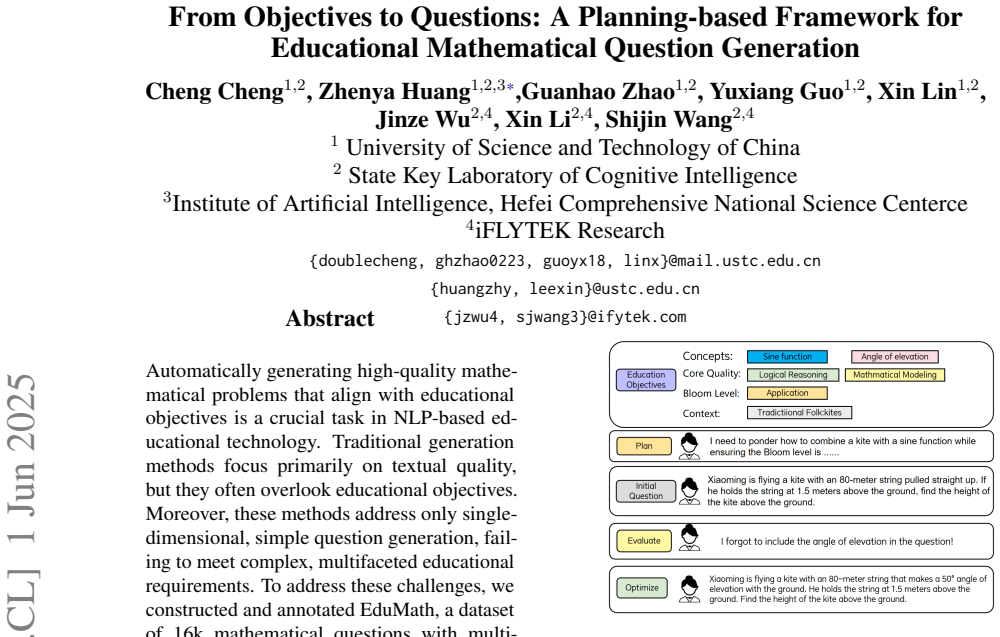
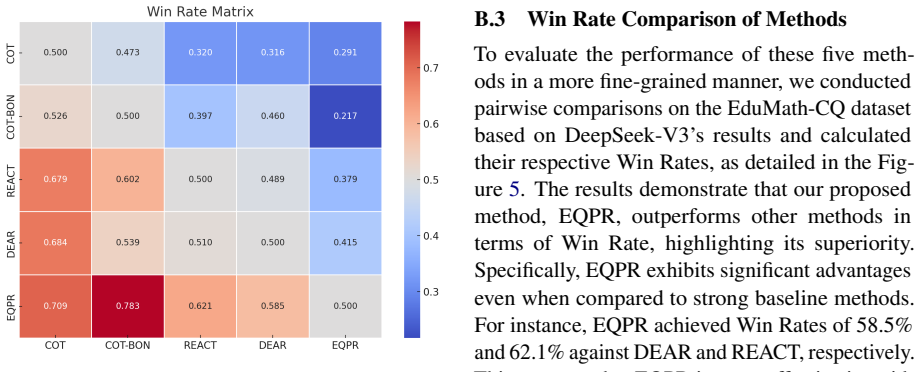
EQPR treats objective-aligned question design as a Markov decision process: each state is the current version of the question, each action is a modification direction proposed by a Critic LLM, and the transition is a Reflection LLM that rewrites the question using the full history. Monte Carlo Tree Search with the UCT rule explores competing refinements, balancing exploitation of high-scoring branches against exploration of new ones, and the highest-average-reward path provides the final question. On the EduMath-CQ and EduMath-SQ test sets, EQPR achieves the best Win Rate and Pass Rate among CoT, CoT-BON, ReAct, and DEAR baselines across GPT-4o-Mini, DeepSeek-V3, GPT-4o, and Claude-3.5, with the largest gain on EduMath-CQ with DeepSeek-V3 (46.23% vs. DEAR's 41.8%). The paper interprets these results as evidence that planning and reflection, rather than raw generation skill, are what make questions satisfy multi-dimensional educational objectives.
Load-bearing premise
The evaluation metrics (solvability, pass rate, win rate) are produced and verified by the same LLM family (DeepSeek-V3) that also powers the Critic and one of the generators, so the reported gains assume this judge's preference reflects true educational quality rather than self-similarity.
Editorial extensions
If this is right
- If the claim holds, objective-aligned question generation becomes a search problem, so planning depth should improve alignment independently of the generator model.
- The EduMath dataset and EQGEVAL benchmark give the field a reusable testbed that measures educational criteria instead of BLEU/ROUGE similarity.
- Because EQPR runs with GPT-4o, GPT-4o-Mini, DeepSeek-V3, and Claude-3.5, the method transfers across model families, with stronger base models amplifying the gain.
- Per-question costs under $0.01 for DeepSeek and under $0.1 for Claude-3.5 indicate that LLM-driven iterative item design can be cheaper than manual writing, enabling large-scale objective-specific practice.
Reading between the lines
- If the judge model were swapped for a different family (e.g., all outputs evaluated by GPT-4o or by human raters on the full test set), the win-rate margins could shrink or reverse, since a same-family judge may prefer questions matching its own generation style; that swap is a direct test of the benchmark's objectivity.
- The framework could extend to other subjects or to explicit difficulty control, but the paper's own limitation states that difficulty estimation remains subjective and unstandardized, so coupling EQPR with a difficulty estimator is a plausible next step rather than an established result.
- Because the Reflection prompt forbids introducing new concepts or competencies, the search stays inside a fixed objective envelope; relaxing that constraint could yield more creative questions but risks coverage drift.
Editorial analysis
A structured set of objections, weighed in public.
Referee Report
Summary. The paper introduces EduMath, a dataset of 16k high-school mathematics questions annotated with multi-dimensional educational objectives; EQGEVAL, an LLM-based benchmark with Solvability, Pass Rate, and Win Rate metrics; and EQPR, a generation framework that combines Monte Carlo Tree Search with LLM-based Critic and Reflection modules to iteratively refine questions against the objectives. Experiments on EduMath-SQ and EduMath-CQ with GPT-4o-mini and DeepSeek-V3 backbones report that EQPR achieves the highest Win Rate and Pass Rate on most settings, alongside a small human evaluation of 100 samples.
Significance. If the reported gains are real, the dataset and benchmark would be a useful resource for objective-aligned question generation, and the MCTS-plus-reflection design is a reasonable instantiation of search-based text generation. The paper also ships a fairly complete specification of prompts and hyperparameters. However, the central empirical claim is currently supported mainly by evaluations in which the judge, the generator, and the Critic all belong to the same model family, so the headline improvements may reflect in-family agreement rather than independent educational quality. The human evaluation is too small to resolve this concern. These issues are fixable with additional experiments, so the contribution is not fundamentally unsound, but it needs substantial verification.
major comments (4)
- [5, 6.2, Appendix A.4, Table 1] The central SOTA claim rests on EQGEVAL metrics computed by DeepSeek-V3. For the DeepSeek-V3 results, the Critic that drives MCTS selection and the Reflection module are also DeepSeek-V3, and the EduMath annotations were produced and verified by DeepSeek-V3. The Pass Rate and Win Rate prompts (Tables 11 and 12) ask for judgments along the same dimensions that the Critic optimizes. This symmetry makes the headline numbers an in-family agreement measure rather than independent evidence of educational quality. Please provide a cross-model evaluation (e.g., judging outputs with GPT-4o or Claude-3.5) and report agreement with human judgments, or the claim of 'new state-of-the-art results' is not adequately supported.
- [6.3, Table 2] The human evaluation is far too weak to validate the automatic results. On 100 EduMath-CQ samples, EQPR's human win rate is 36.67% versus 35.00% for REACT and 31.00% for DEAR; the 1.67-point gap against REACT is within sampling error. No significance test, confidence interval, or error bar is reported. Fleiss' kappa of 0.47 for win-rate judgments indicates only moderate agreement, and the stated credibility threshold of 0.41 is not justified. A larger sample with formal significance testing is needed before the human results can be used as independent confirmation.
- [6.4, Figure 3, Table 1] The ablation text swaps the metric labels. In Table 1, DeepSeek-V3 on EduMath-CQ shows Win Rate 46.23 and Pass Rate 43.11, but Section 6.4 says 'the Pass Rate decreased from 46.23% to 43.51%, and the Win Rate declined from 43.11% to 40.74%'. The MCTS ablation similarly says 'pass rate (from 46.23% to 41.57%) and win rate (from 43.11% to 38.79%)'. These labels should be corrected and the corresponding conclusions restated, because the claimed effect of each component depends on which metric is being discussed.
- [4.4, Algorithm 1, A.5] The MCTS implementation is underspecified in load-bearing places. Equation (4) defines UCT in terms of Q(s_t,a_t), but the text never defines how Q is computed from the Critic reward in the backpropagation step, and Algorithm 1 refers to 'node.Qvalue' without a formula. The expansion width k, the number of child nodes generated per expansion, the terminal condition, and the reward aggregation for selecting the best path are also unspecified. Since the claimed benefits of MCTS-based planning depend on these choices, please provide the missing definitions and a sensitivity analysis of max_iterations, max_depth, c, and k.
minor comments (5)
- [Table 1] Several entries are missing spacing or delimiters (e.g., '18.9053.2036.7272.55' in the REACT row), making the table hard to read.
- [A.5] The method is referred to as 'EPQR' in 'our proposed EPQR method' and 'COT-BOT' appears instead of 'COT-BON'; please use consistent names.
- [1, 2.1, 5] There are repeated typos, such as 'generaton' for 'generation' in several places; the manuscript would benefit from proofreading.
- [A.3] The paper states that EduMath is 'open-source' and 'the first and only open-source high school mathematics dataset' with such annotations, but no dataset URL or release link is provided; please include it.
- [6.3] The human evaluation criteria in A.7 are clear, but the reported Fleiss' kappa values are for clarity (0.71) and win rate (0.47); the win-rate kappa of 0.47 is described as exceeding a threshold of 0.41, but the threshold is not sourced or justified.
Circularity Check
The headline SOTA numbers (e.g., 46.23% Win Rate on EduMath-CQ with DeepSeek-V3) are certified by DeepSeek-V3, the same model family that, as Critic, supplies the optimization reward EQPR maximizes (Eq. 1; Algorithm 1; Tables 8 vs 11, 12); the reported gains are partly in-family agreement, with only a weak human check (Section 6.3).
-
fitted input called prediction
[Sections 3, 4.2, 4.4, 5, 6.2, A.4, A.5; Eq. (1); Tables 1, 8, 11, 12]
"the system receives a reward based on the revised question's quality. This reward reflects multiple educational criteria including conceptual clarity, cognitive depth, and contextual appropriateness, assessed by a critic module providing both numerical scores and formative feedback (Section 3); Win Rate where we present educational objectives and two problems to DeepSeek-V3 evaluators (Section 5); Table 12 asks the judge to compare Completeness of Concept Coverage ... Matching of Cognitive Levels ... Relevance to Ability Development ... Development of Mathematical Literacy."
EQPR's final output is, by design (Appendix A.5), the question on the MCTS path with the highest average reward, where the reward is the Critic score of Eq. (1) (Table 8: concept coverage, cognitive level, competencies). The headline results (Table 1) are certified by DeepSeek-V3, the same family that provided the optimization reward, annotated the objectives, and judges Pass Rate/Win Rate via prompts (Tables 11, 12) that check the same dimensions (concept coverage, Bloom level, ability/literacy). For the headline rows (46.23% Win Rate), the reported superiority is largely in-family agreement: EQPR maximizes a DeepSeek-V3 critic's criteria and DeepSeek-V3 certifies them.
-
other
[Section 5 (EduMath annotation and verification)]
"Using DeepSeek-V3, we conduct an iterative three-round annotation process. Initial annotations are reviewed for accuracy and consistency. Specifically, we employ Chain-of-Thought prompting to guide multiple large language models in evaluating annotation correctness through a voting mechanism. Annotations flagged as inaccurate are re-annotated to resolve identified issues. This rigorous, multi-stage process results in an annotation accuracy of 95.2% across all dimensions."
The educational objectives that define the generation task (q = LLM(O), Section 3), drive the Critic and Reflection optimization, and serve as the Pass Rate ground truth (Appendix A.4 inputs 'both educational objectives and generated questions into the large language model' for a pass/fail judgment on each objective) were produced by DeepSeek-V3 and validated only by LLM voting, not against an independent human standard. The reported 95.2% annotation accuracy is therefore self-assessed within the same model family that is later used to evaluate the method.
full rationale
The empirical claim (Section 6.2, Table 1) rests on EQGEVAL, whose three metrics (Solvability, Pass Rate, Win Rate) are all computed by DeepSeek-V3 (Section 5; Appendix A.4). For the headline DeepSeek-V3 rows, the same model family also annotated the educational objectives (Section 5), provided the Critic reward that drives MCTS selection and backpropagation (Eq. (1); Algorithm 1), and certified the Pass Rate and Win Rate via prompts (Tables 11, 12) whose dimensions — concept coverage, Bloom level, ability and literacy development — are the dimensions the Critic optimizes (Table 8). Appendix A.5 confirms the final output is the question with the highest average Critic reward on the best path, so the reported superiority is substantially an in-family agreement measure: questions are selected to maximize DeepSeek-V3's criteria and then judged by DeepSeek-V3 on those same criteria. This is a partial circularity, not full equivalence: the judge prompts differ from the Critic prompt; the gold questions are human-authored exam items; the GPT-4o-Mini, GPT-4o, and Claude-3.5 rows (Tables 1 and 5) are judged cross-model and also favor EQPR; and Solvability is not optimized away. The only external check, the human study (Section 6.3), shows the same ordering but with much smaller margins (36.67% vs 35.00% vs 31.00% on 100 samples, no significance test reported, Fleiss' kappa 0.47 for win-rate judgments, which the paper calls 'credible' despite only moderate agreement). The paper's own Limitations explicitly concede that LLM evaluators 'may exhibit certain biases' and 'do not always align perfectly with the professional judgment of human educators'; that concession is located in the Limitations paragraph after Section 7 and weighs against treating the EQGEVAL numbers as independent confirmation. No load-bearing self-citation chains, imported uniqueness theorems, or ansatz-by-citation were found: overlapping-author citations (DEAR as baseline, MapKG and SocraticLM as related work) are not the load-bearing evidence for the central claim. Score 5 reflects partial circularity of the central empirical claim: it is not forced by construction (hence not 6-10), but the evaluation is not independent of the optimization target (hence not 0-4).
Assumptions & free parameters
free parameters (5)
- MCTS max_iterations =
4
- MCTS max_depth =
3
- MCTS exploration constant c =
2.5
- LLM temperature =
0.7
- Number of self-consistency samples =
5
assumptions (3)
- domain assumption Educational objectives can be reliably identified and annotated by LLMs without expert human validation.
- domain assumption LLM-based EQGEVAL scores (Solvability, Pass Rate, Win Rate) are valid proxies for educational question quality.
- domain assumption MCTS-guided iterative reflection over LLM-generated questions improves objective alignment.
Cite this review
Pith. "Pith review of From Objectives to Questions: A Planning-based Framework for Educational Mathematical Question Generation." pith.science (2026). https://pith.science/paper/HGI72362
@misc{pith2026250600963,
  author       = {Pith},
  title        = {Pith review of: From Objectives to Questions: A Planning-based Framework for Educational Mathematical Question Generation},
  year         = {2026},
  howpublished = {\url{https://pith.science/paper/HGI72362}},
  note         = {Machine review of arXiv:2506.00963}
}
read the original abstract
Automatically generating high-quality mathematical problems that align with educational objectives is a crucial task in NLP-based educational technology. Traditional generation methods focus primarily on textual quality, but they often overlook educational objectives. Moreover, these methods address only single-dimensional, simple question generation, failing to meet complex, multifaceted educational requirements. To address these challenges, we constructed and annotated EduMath, a dataset of 16k mathematical questions with multi-dimensional educational objectives. Based on this dataset, we developed EQGEVAL, which incorporates three evaluation dimensions and is designed to assess the ability of models to generate educational questions. Drawing inspiration from teachers' problem design processes, we propose the Educational Question Planning with self-Reflection (EQPR) method for educational mathematical question generation, following a "plan-evaluate-optimize" approach. Specifically, by combining planning algorithm based on Monte Carlo Tree Search with the generative capabilities of Large Language Models, we continuously optimize questions through iterative feedback. This self-optimization mechanism ensures that the generated questions both fit the educational context and strategically achieve specific basic educational objectives. Through extensive experiments based on EQGEVAL, we have demonstrated that EQPR achieves significant improvements in generating questions that meet multi-dimensional educational objectives.
Figures


Figures from the paper (2 more)

Reference graph
Works this paper leans on
-
[1]
concept Coverage:- Verify complete coverage of all required concepts - Any omission or introduction of unmentioned points is non-compliant
-
[2]
Bloom’s Taxonomy Level:- Analyze cognitive level alignment with objectives - Must neither exceed nor fall short of target level
-
[3]
Student Problem-Solving Skills:- Confirm comprehensive assessment of all targeted skills
-
[4]
Mathematical Core Competencies:- Evaluate cultivation of: * Log- ical reasoning * Mathematical operations * Spatial visualization * Data analysis * Mathematical modeling * Mathematical abstraction
-
[5]
Rigor Requirement:- Maintain objectivity and rigor throughout evaluation - Any non-compliance results in direct failure (0) Output Format: { "reason": "Detailed explanation of the reasoning and process behind the evaluation", "pass_rate": 1 or 0 } Required Input:Education_Objectives: {educational objectives} Ques- tion: {question} Table 11: Pass rate eval...
-
[6]
Text Clarity and Coherence:- Assess clarity and conciseness of wording - Evaluate effectiveness of problem-solving communication Output Format: { "better_question": 1 or 2, "reason": "Detailed evaluation reasons, ex- plaining why the selected question is better and specifying which dimen- sion(s) show superior performance." } Required Input:Education_Obje...
-
[9]
Completeness of Concept Coverage:- Analyze coverage of required concepts - Check for missing or redundant points
-
[10]
Matching of Cognitive Levels:- Assess alignment with specified cognitive level - Verify appropriate goal alignment
Show all 14 references
-
[11]
Relevance to Ability Development:- Confirm effective training of specified abilities - Verify alignment with outlined requirements
-
[12]
Development of Mathematical Literacy:- Analyze contribution to mathematical literacy development
-
[13]
Scientific Design of the Structure:- Evaluate reasonableness of question structure - Assess organization and guidance quality
-
[2021]
arXiv preprint arXiv:2109.04546
Math word problem generation with mathe- matical consistency and problem context constraints. arXiv preprint arXiv:2109.04546. Jason Wei, Xuezhi Wang, Dale Schuurmans, Maarten Bosma, Fei Xia, Ed Chi, Quoc V Le, Denny Zhou, et al. 2022. Chain-of-thought prompting elicits rea- s...
2022 arXiv
-
[2022]
arXiv preprint arXiv:2205.00355
Towards process-oriented, modular, and versa- tile question generation that meets educational needs. arXiv preprint arXiv:2205.00355. Zichao Wang, Andrew S Lan, and Richard G Baraniuk
-
[2024]
categoriz- ing random events
Tree of thoughts: Deliberate problem solving with large language models.Advances in Neural Information Processing Systems, 36. Shunyu Yao, Jeffrey Zhao, Dian Yu, Nan Du, Izhak Shafran, Karthik R Narasimhan, and Yuan Cao. 2023. React: Synergizing reasoning and acting in languag...
2023 arXiv
Reviewed August 7, 2026 · model on record in the stance chip above.
Discussion (0). Sign in to comment.