REVIEW 3 major objections 4 minor 103 references
Globally Consistent RGB-D SLAM with 2D Gaussian Splatting
T0 review · 3 major / 4 minor · reviewed 2026-08-07 · deepseek-v4-flash
Pith's one-line read Replacing 3D Gaussian ellipsoids with 2D Gaussian disks in an RGB-D SLAM map yields depth-consistent rendering, accurate on-manifold pose tracking, and online globally consistent map correction after loop closure.
desk verdict A solid 2DGS-SLAM system with a genuinely new on-manifold pose-Jacobian derivation and strong tracking results; the online global-consistency claim is real but slightly oversold by metrics that mostly come after offline refinement. read the letter →
The pith
A machine-rendered reading of the paper's core claim, the machinery that carries it, and where it could break.
The reading
What carries the argument
The central object is the 2D Gaussian splat: a flat disk parameterized by a center, two tangent vectors with scales, a normal, color, and opacity, rendered by explicit ray-disk intersection rather than by projecting a 3D ellipsoid, which makes depth rendering multi-view consistent. The argument is carried by three mechanisms. First, analytic $\mathrm{SE}(3)$ Jacobians are derived for the 2DGS rendering process, propagating the rendering loss through the ray-splat homography to the splat's center and rotation in camera space, so pose tracking is an on-manifold gradient optimization that stays on the pose group. Second, loop closure is handled by MASt3R, which both retrieves candidate keyframes through aggregated image features and predicts dense point maps from which a coarse relative pose is extracted; that pose is scale-corrected with real depth and refined by tracking against the active map before being added as a pose graph constraint. Third, each splat records the ID of its closest observing keyframe, so after pose graph optimization the whole map is deformed by applying that keyframe's pose increment to the splat's position and orientation, with an active/inactive map state keeping the tracked subset local and reactivating splats when areas are revisited.
What would settle it
Render the online pre-refinement map after a loop closure in a scene where the same surface is observed on both sides of a long trajectory, and measure the depth misalignment of that overlapping region against a fresh depth capture; if surfaces observed by multiple keyframes retain errors comparable to the spread of their keyframe pose corrections while surfaces seen by a single keyframe align, the single-association update is insufficient. A cheaper check is to instrument the pipeline and compare per-splat residual misalignment against the number of observing keyframes and the variance of their pose increments.
Extended reading notes
Core claim
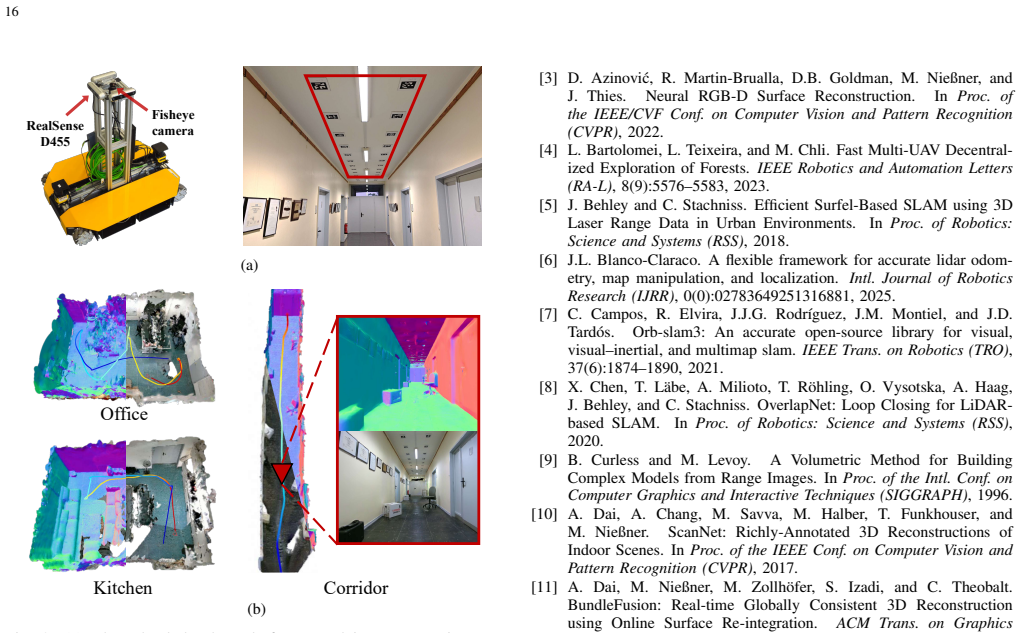
The central claim is that 2D Gaussian splatting is a better backbone than 3D Gaussian splatting for RGB-D SLAM because it supplies multi-view consistent depth rendering, and that this property can be exploited for both tracking and globally consistent mapping. The paper derives analytic $\mathrm{SE}(3)$ Jacobians for the 2DGS rasterizer, enabling rendering-based camera pose optimization directly on the manifold rather than through automatic differentiation of pose matrix elements. For global consistency, every splat stores the ID of the keyframe that observed it at closest range; after a detected loop, pose graph optimization updates keyframe poses and each splat is rigidly transformed by its associated keyframe's pose increment, while an active/inactive map state prevents stale regions from corrupting tracking and allows reactivation upon revisits. Experiments on the Replica, TUM-RGBD, and ScanNet datasets plus self-recorded robot data report sub-millimeter average trajectory error on Replica, reconstruction F1 scores matching or exceeding 3DGS baselines, higher-fidelity rendering in the no-refinement comparison, and roughly 6-7x faster runtime with a map far smaller than that of the loop-closure baselines.
Load-bearing premise
The global consistency claim rests on the assumption that updating each Gaussian splat by the pose correction of its single closest observing keyframe is enough to keep the map aligned, even when a splat is seen from many keyframes that drift differently; if that assumption fails, the map is fully consistent only after the offline 26,000-iteration refinement stage, not during online operation.
Editorial extensions
If this is right
- Rendering-based RGB-D SLAM can dispense with external odometry: the same 2DGS map supports tracking, mapping, and loop closure in one representation.
- Global map consistency is achievable online without submap management, because map correction is a direct transformation of splats keyed to keyframe pose increments.
- Depth-consistent rendering carries over to downstream geometry: meshes extracted from the map are smoother and more globally consistent than those from 3DGS methods, particularly in real-world scenes with noisy depth.
- Loop closure becomes computationally affordable for online robotics, with a 6-7x runtime speedup and a much smaller stored map than previous loop-closure-enabled radiance-field SLAM systems.
Reading between the lines
- The single-association map correction suggests a testable extension: splats observed by many keyframes with divergent drift corrections could be updated by a weighted or averaged transform across their observing keyframes, potentially reducing residual misalignment before the offline refinement stage.
- Because MASt3R supplies dense point maps, the same loop-closure pipeline could be adapted to monocular or RGB-only input by replacing the depth-based scale correction with predicted depth or scale-from-motion, making the design less dependent on an RGB-D sensor.
- The active/inactive map state is a general strategy that could be transferred to other elastic map representations, such as surfels or neural points, to keep online tracking local while preserving global consistency after loop closure.
Editorial analysis
A structured set of objections, weighed in public.
Referee Report
Summary. The paper presents 2DGS-SLAM, a coupled RGB-D SLAM system that uses 2D Gaussian splatting as its sole map representation. It derives analytic SE(3) pose Jacobians for the 2DGS rasterizer, introduces an active/inactive Gaussian map state, and adds MASt3R-based loop closure detection and relocalization followed by pose-graph optimization and elastic deformation of Gaussian splats. The system is evaluated on Replica, TUM-RGBD, ScanNet, and self-recorded robot sequences, reporting very low ATE on Replica (0.07 cm average), competitive tracking on TUM, a compact map (9.7 MB on ScanNet 0000), and strong rendering metrics. Reconstruction metrics in Table V are reported after an offline 26,000-iteration refinement stage described in Sec. IV-A.
Significance. If the claims are fully supported, the paper would make a useful contribution: it is the first 2DGS SLAM system with an on-manifold pose-gradient derivation, it avoids submap management by deforming individual Gaussian splats, and it provides open-source code. The analytic Jacobian derivation in Sec. III-B is a genuine technical step beyond prior 3DGS-based formulations, and the raw-map rendering comparison in Table VIII is valuable because it isolates the online map quality from post-processing. The main weakness is that the headline claim of online global consistency is not directly measured: the map correction in Sec. III-H uses a per-splat single-keyframe association, and the quantitative reconstruction results are obtained after offline refinement, so the evidence does not yet establish that the map is globally consistent at the moment a loop is closed.
major comments (3)
- [Sec. III-H, Eq. (32); Sec. IV-A] The online global-consistency claim is not supported by the reported evidence. Eq. (32) updates each Gaussian splat only by the pose increment of its single closest observing keyframe f_k^c. After pose-graph optimization, the other keyframes that observe the same splat generally receive different increments, so the deformed splat cannot satisfy all of them; splats on the same surface but associated with different keyframes will be displaced relative to each other. The paper reports no quantitative measure of this residual misalignment in overlap regions. Fig. 6 and Table VIII are qualitative or rendering-based and do not measure geometric consistency of the corrected map before refinement. This matters because the quantitative reconstruction results in Table V are obtained after the 26,000-iteration offline refinement described in Sec. IV-A, which can repair exactly this kind of inconsistency. Please report a direct metric of corrected-map consistency, e.g., the residual distance between corresponding splats in overlap regions or the ATE of the raw map immediately after pose-graph optimization, both before and after the offline refinement stage.
- [Sec. IV-A2 and Table I] The experimental evaluation lacks ablations and error bars, and two tracking hyperparameters are tuned per dataset. The text states that all settings are kept consistent across experiments, but then states that the depth loss weight lambda_d and the tracking success threshold epsilon_t are adjusted individually for each dataset. Because lambda_d directly controls the balance between color and depth in the tracking loss in Eq. (19), and epsilon_t gates loop closures in Sec. III-G, the reported gains could depend on this tuning. Please provide a sensitivity study for these two parameters and report multiple runs or uncertainty bounds for the main tables. An ablation isolating the contributions of the analytic SE(3) Jacobians, the normal/opacity masks in Eqs. (17)-(18), the active/inactive map update, and the loop closure module would also help support the central claims.
- [Sec. IV-C, Table V; Sec. IV-B, Table IV] Several claims in the abstract and conclusion are stated more strongly than the tables support. In Table V, 2DGS-SLAM has an average F1 of 89.7%, lower than LoopSplat's 90.4%, so the statement that the method outperforms 3DGS-based approaches in surface reconstruction is only true on a per-metric basis and not consistently. On ScanNet in Table IV, 2DGS-SLAM is second to GO-SLAM in average ATE, and in Table VII it is second to LoopSplat in PSNR and SSIM. The introduction's hedged claim of being 'on par' is acceptable, but the abstract and conclusion should be calibrated to these numbers, and the claim of 'more consistent global map reconstruction' should be backed by a quantitative consistency metric rather than only by the qualitative comparison in Fig. 7.
minor comments (4)
- [Sec. III-H, Eq. (32)] The notation is inconsistent: the text defines the updated center as mu'_k, but Eq. (32) writes x'_k. The symbol x is not introduced for the splat center in this section.
- [Sec. III-G] The scaled relative pose is introduced as T^r_lc in Eq. (29) but later written as T^t_lc after the scan-to-model refinement; please use distinct symbols consistently, since the two poses are different quantities.
- [Sec. IV-B] The text contains typos such as 'baselinws', 'theis', and 'caculate'; these should be corrected before publication.
- [Sec. IV and conclusion] The paper does not include a limitations section. Given that MASt3R-based relocalization is a central component, a short discussion of known failure cases, such as highly repetitive or textureless environments, would improve the manuscript.
Circularity Check
No circular derivation chain found; pose gradients and benchmark comparisons are externally grounded, and the disclosed refinement stage is an evidence gap, not a circular step.
full rationale
The paper's central derivations are self-contained against external inputs. The pose-optimization gradients in Sec. III-B (Eqs. 9-13) are obtained analytically from the 2DGS rendering process, with no fitted constant or target quantity entering the chain rule. Tracking and mapping losses (Eqs. 15, 19, 26) compare rendered outputs to sensor observations, and all headline results are measured on public benchmarks (Replica, TUM-RGBD, ScanNet) with standard metrics (ATE, Depth L1, F1, PSNR, SSIM, LPIPS); no benchmark outcome is fitted and then renamed as a prediction. Loop closure relies on the external MASt3R model for an initial relative pose, with the scale estimated from observed depth (Eq. 29) and refined by active-map tracking; this is a per-frame estimate, not a global fit. Self-citations such as PINGS, PIN-SLAM, and ActiveGS are used for context or inspiration, not as load-bearing evidence; no uniqueness theorem or unverified prior result is invoked to force the paper's choices. The map-correction step in Eqs. 31-32 applies only the closest keyframe's pose increment to each splat, which may leave residual inconsistency for splats observed by multiple keyframes with different increments; this is a real limitation for the online global-consistency claim, especially since some reconstruction tables use a disclosed 26,000-iteration offline refinement. However, this is an evidential or robustness gap, not circularity: Eq. 32 does not make any reported quantity equal to an input by construction, and Table VIII provides raw-map results without refinement. Overall, the paper's predictions are not forced by definition or by self-citation.
Assumptions & free parameters
free parameters (2)
- λd (tracking depth loss weight) =
per-dataset
- εt (tracking success threshold) =
per-dataset
assumptions (4)
- domain assumption 2DGS renders geometrically consistent depth and normal images for arbitrary viewpoints.
- domain assumption MASt3R provides metrically-scaled (up to scale) point clouds and relative poses for image pairs, and its features support image retrieval via ASMK.
- domain assumption The rendered depth and normal images from the active map are accurate enough for the proposed masks (Eqs. 17-18) to filter invalid pixels without biasing the tracking loss.
- standard math Lie algebra exp/log maps and the chain rule for SE(3) as used in the derivation (Sec. III-B).
Cite this review
Pith. "Pith review of Globally Consistent RGB-D SLAM with 2D Gaussian Splatting." pith.science (2026). https://pith.science/paper/66A5BGZU
@misc{pith2026250600970,
  author       = {Pith},
  title        = {Pith review of: Globally Consistent RGB-D SLAM with 2D Gaussian Splatting},
  year         = {2026},
  howpublished = {\url{https://pith.science/paper/66A5BGZU}},
  note         = {Machine review of arXiv:2506.00970}
}
read the original abstract
Recently, 3D Gaussian splatting-based RGB-D SLAM displays remarkable performance of high-fidelity 3D reconstruction. However, the lack of depth rendering consistency and efficient loop closure limits the quality of its geometric reconstructions and its ability to perform globally consistent mapping online. In this paper, we present 2DGS-SLAM, an RGB-D SLAM system using 2D Gaussian splatting as the map representation. By leveraging the depth-consistent rendering property of the 2D variant, we propose an accurate camera pose optimization method and achieve geometrically accurate 3D reconstruction. In addition, we implement efficient loop detection and camera relocalization by leveraging MASt3R, a 3D foundation model, and achieve efficient map updates by maintaining a local active map. Experiments show that our 2DGS-SLAM approach achieves superior tracking accuracy, higher surface reconstruction quality, and more consistent global map reconstruction compared to existing rendering-based SLAM methods, while maintaining high-fidelity image rendering and improved computational efficiency.
Figures


Figures from the paper (6 more)


Reference graph
Works this paper leans on
-
[1]
Arandjelovic, P
R. Arandjelovic, P. Gronat, A. Torii, T. Pajdla, and J. Sivic. NetVLAD: CNN Architecture for Weakly Supervised Place Recog- nition. In Proc. of the IEEE Conf. on Computer Vision and Pattern Recognition (CVPR) , 2016
2016
-
[2]
Arandjelovic and A
R. Arandjelovic and A. Zisserman. All About VLAD. In Proc. of the IEEE Conf. on Computer Vision and Pattern Recognition (CVPR) , 2013
2013
-
[3]
Azinovi ´c, R
D. Azinovi ´c, R. Martin-Brualla, D.B. Goldman, M. Nießner, and J. Thies. Neural RGB-D Surface Reconstruction. In Proc. of the IEEE/CVF Conf. on Computer Vision and Pattern Recognition (CVPR), 2022
2022
-
[4]
Bartolomei, L
L. Bartolomei, L. Teixeira, and M. Chli. Fast Multi-UA V Decentral- ized Exploration of Forests. IEEE Robotics and Automation Letters (RA-L), 8(9):5576–5583, 2023
2023
-
[5]
Behley and C
J. Behley and C. Stachniss. Efficient Surfel-Based SLAM using 3D Laser Range Data in Urban Environments. In Proc. of Robotics: Science and Systems (RSS) , 2018
2018
-
[6]
Blanco-Claraco
J.L. Blanco-Claraco. A flexible framework for accurate lidar odom- etry, map manipulation, and localization. Intl. Journal of Robotics Research (IJRR), 0(0):02783649251316881, 2025
2025
-
[7]
Campos, R
C. Campos, R. Elvira, J.J.G. Rodr ´ıguez, J.M. Montiel, and J.D. Tard´os. Orb-slam3: An accurate open-source library for visual, visual–inertial, and multimap slam. IEEE Trans. on Robotics (TRO) , 37(6):1874–1890, 2021
2021
-
[8]
X. Chen, T. L ¨abe, A. Milioto, T. R ¨ohling, O. Vysotska, A. Haag, J. Behley, and C. Stachniss. OverlapNet: Loop Closing for LiDAR- based SLAM. In Proc. of Robotics: Science and Systems (RSS) , 2020
2020
Show all 103 references
-
[9]
Curless and M
B. Curless and M. Levoy. A V olumetric Method for Building Complex Models from Range Images. In Proc. of the Intl. Conf. on Computer Graphics and Interactive Techniques (SIGGRAPH) , 1996
1996
-
[10]
A. Dai, A. Chang, M. Savva, M. Halber, T. Funkhouser, and M. Nießner. ScanNet: Richly-Annotated 3D Reconstructions of Indoor Scenes. In Proc. of the IEEE Conf. on Computer Vision and Pattern Recognition (CVPR) , 2017
2017
-
[11]
A. Dai, M. Nießner, M. Zollh ¨ofer, S. Izadi, and C. Theobalt. BundleFusion: Real-time Globally Consistent 3D Reconstruction using Online Surface Re-integration. ACM Trans. on Graphics (TOG), 36(3):1–18, 2017
2017
-
[12]
P. Dai, J. Xu, W. Xie, X. Liu, H. Wang, and W. Xu. High- quality Surface Reconstruction using Gaussian Surfels. In Proc. of the Intl. Conf. on Computer Graphics and Interactive Techniques (SIGGRAPH), 2024
2024
-
[13]
Della Corte, I
B. Della Corte, I. Bogoslavskyi, C. Stachniss, and G. Grisetti. A General Framework for Flexible Multi-Cue Photometric Point Cloud Registration. In Proc. of the IEEE Intl. Conf. on Robotics & Automation (ICRA) , 2018
2018
-
[14]
Dellaert
F. Dellaert. Factor graphs and GTSAM: A hands-on introduction. Georgia Institute of Technology, Tech. Rep , 2:4, 2012
2012
-
[15]
T. Deng, G. Shen, T. Qin, J. Wang, W. Zhao, J. Wang, D. Wang, and W. Chen. PLGSLAM: Progressive Neural Scene Represenation with Local to Global Bundle Adjustment. In Proc. of the IEEE/CVF Conf. on Computer Vision and Pattern Recognition (CVPR) , 2024
2024
-
[16]
Di Giammarino, L
L. Di Giammarino, L. Brizi, T. Guadagnino, C. Stachniss, and G. Grisetti. Md-slam: Multi-cue direct slam. In Proc. of the IEEE/RSJ Intl. Conf. on Intelligent Robots and Systems (IROS) , 2022
2022
-
[17]
Dosovitskiy, L
A. Dosovitskiy, L. Beyer, A. Kolesnikov, D. Weissenborn, X. Zhai, T. Unterthiner, M. Dehghani, M. Minderer, G. Heigold, S. Gelly, J. Uszkoreit, and N. Houlsby. An Image is Worth 16x16 Words: Transformers for Image Recognition at Scale. In Proc. of the Intl. Conf. on Learning R...
2021
-
[18]
Duisterhof, Z
B. Duisterhof, Z. Lojze, W. Philippe, L. Vincent, C. Yohann, and R. Jerome. MASt3R-SfM: A Fully-Integrated Solution for Uncon- strained Structure-from-Motion. In Proc. of the Intl. Conf. on 3D Vision (3DV), 2025
2025
-
[19]
Endres, J
F. Endres, J. Hess, J. Sturm, D. Cremers, and W. Burgard. 3D Mapping with an RGB-D Camera. IEEE Trans. on Robotics (TRO) , 30(1):177–187, 2014
2014
-
[20]
Forster, M
C. Forster, M. Pizzoli, and D. Scaramuzza. SVO: Fast semi-direct monocular visual odometry. In Proc. of the IEEE Intl. Conf. on Robotics & Automation (ICRA) , 2014
2014
-
[21]
Galvez-L ´opez and J.D
D. Galvez-L ´opez and J.D. Tard ´os. Bags of Binary Words for Fast Place Recognition in Image Sequences. IEEE Trans. on Robotics (TRO), 28(5):1188–1197, 2012
2012
-
[22]
Giacomini, L
E. Giacomini, L. Di Giammarino, L.D. Rebott, G. Grisetti, and M.R. Oswald. Splat-LOAM: Gaussian Splatting LiDAR Odometry and Mapping. arXiv preprint, arXiv:2503.17491, 2025
2025 arXiv
-
[23]
Glocker, J
B. Glocker, J. Shotton, A. Criminisi, and S. Izadi. Real-time RGB-D camera relocalization via randomized ferns for keyframe encoding. IEEE Trans. on Visualization and Computer Graphics , 21(5):571– 583, 2014
2014
-
[24]
Glover, W
A. Glover, W. Maddern, M. Warren, S. Reid, M. Milford, and G. Wyeth. Openfabmap: An open source toolbox for appearance- 17 based loop closure detection. In Proc. of the IEEE Intl. Conf. on Robotics & Automation (ICRA) , 2012
2012
-
[25]
Guadagnino, B
T. Guadagnino, B. Mersch, S. Gupta, I. Vizzo, G. Grisetti, and C. Stachniss. KISS-SLAM: A Simple, Robust, and Accurate 3D LiDAR SLAM System With Enhanced Generalization Capabilities. arXiv preprint, arXiv:2503.12660, 2025
2025 arXiv
-
[26]
S. Ha, J. Yeon, and H. Yu. RGBD GS-ICP SLAM. In Proc. of the Europ. Conf. on Computer Vision (ECCV) , 2024
2024
-
[27]
Hornung, K
A. Hornung, K. Wurm, M. Bennewitz, C. Stachniss, and W. Burgard. OctoMap: An Efficient Probabilistic 3D Mapping Framework Based on Octrees. Autonomous Robots , 34(3):189–206, 2013
2013
-
[28]
J. Hu, M. Mao, H. Bao, G. Zhang, and Z. Cui. CP-SLAM: Collaborative Neural Point-based SLAM System. In Proc. of the Conf. on Neural Information Processing Systems (NeurIPS) , 2023
2023
-
[29]
Huang, Z
B. Huang, Z. Yu, A. Chen, A. Geiger, and S. Gao. 2D Gaussian Splatting for Geometrically Accurate Radiance Fields. In Proc. of the Intl. Conf. on Computer Graphics and Interactive Techniques (SIGGRAPH), 2024
2024
-
[30]
Huang, O
C. Huang, O. Mees, A. Zeng, and W. Burgard. Audio visual language maps for robot navigation. In Proc. of the Intl. Symp. on Experimental Robotics (ISER) , 2023
2023
-
[31]
Huang, L
H. Huang, L. Li, C. Hui, and S.K. Yeung. Photo-SLAM: Real-time Simultaneous Localization and Photorealistic Mapping for Monocu- lar, Stereo, and RGB-D Cameras. In Proc. of the IEEE/CVF Conf. on Computer Vision and Pattern Recognition (CVPR) , 2024
2024
-
[32]
Huang, B
Y . Huang, B. Cui, L. Bai, Z. Chen, J. Wu, Z. Li, H. Liu, and H. Ren. Advancing Dense Endoscopic Reconstruction with Gaussian Splatting-driven Surface Normal-aware Tracking and Mapping. In Proc. of the IEEE Intl. Conf. on Robotics & Automation (ICRA) , 2025
2025
-
[33]
Izquierdo and J
S. Izquierdo and J. Civera. Close, But Not There: Boosting Geo- graphic Distance Sensitivity in Visual Place Recognition. In Proc. of the Europ. Conf. on Computer Vision (ECCV) , 2024
2024
-
[34]
Izquierdo and J
S. Izquierdo and J. Civera. Optimal Transport Aggregation for Visual Place Recognition. In Proc. of the IEEE/CVF Conf. on Computer Vision and Pattern Recognition (CVPR) , 2024
2024
-
[35]
Jiaxin and S
W. Jiaxin and S. Leutenegger. GSFusion: Online RGB-D Mapping Where Gaussian Splatting Meets TSDF Fusion. IEEE Robotics and Automation Letters (RA-L) , 9(12):11865–11872, 2024
2024
-
[36]
L. Jin, X. Zhong, Y . Pan, J. Behley, C. Stachniss, and M. Popovic. ActiveGS: Active Scene Reconstruction using Gaussian Splatting. IEEE Robotics and Automation Letters (RA-L) , 10(5):4866–4873, 2025
2025
-
[37]
Johari, C
M.M. Johari, C. Carta, and F. Fleuret. ESLAM: Efficient Dense SLAM System Based on Hybrid Representation of Signed Distance Fields. In Proc. of the IEEE/CVF Conf. on Computer Vision and Pattern Recognition (CVPR) , 2023
2023
-
[38]
Keetha, J
N. Keetha, J. Karhade, K.M. Jatavallabhula, G. Yang, S. Scherer, D. Ramanan, and J. Luiten. SplaTAM: Splat Track & Map 3D Gaussians for Dense RGB-D SLAM. In Proc. of the IEEE/CVF Conf. on Computer Vision and Pattern Recognition (CVPR) , 2024
2024
-
[39]
Keller, D
M. Keller, D. Lefloch, M. Lambers, and S. Izadi. Real-time 3D Reconstruction in Dynamic Scenes using Point-based Fusion. In Proc. of the Intl. Conf. on 3D Vision (3DV) , 2013
2013
-
[40]
Kerbl, G
B. Kerbl, G. Kopanas, T. Leimk ¨uhler, and G. Drettakis. 3D Gaussian Splatting for Real-Time Radiance Field Rendering. ACM Trans. on Graphics (TOG), 42(4):1–14, 2023
2023
-
[41]
C. Kerl, J. Sturm, and D. Cremers. Robust Odometry Estimation for RGB-D Cameras. In Proc. of the IEEE Intl. Conf. on Robotics & Automation (ICRA) , 2013
2013
-
[42]
C. Kerl, J. Sturm, and D. Cremers. Dense visual slam for rgb-d cameras. In Proc. of the IEEE/RSJ Intl. Conf. on Intelligent Robots and Systems (IROS) , 2013
2013
-
[43]
Labbe and F
M. Labbe and F. Michaud. RTAB-Map: An open-source lidar and visual simultaneous localization and mapping library for large-scale and long-term online operation. Journal of Field Robotics (JFR) , 36(1):416–446, 2019
2019
-
[44]
Leroy, Y
V . Leroy, Y . Cabon, and J. Revaud. Grounding Image Matching in 3D with MASt3R. In Proc. of the Europ. Conf. on Computer Vision (ECCV), 2024
2024
-
[45]
T.Y . Lim, B. Sun, M. Pollefeys, and H. Blum. Loop Closure from Two Views: Revisiting PGO for Scalable Trajectory Estimation through Monocular Priors. arXiv preprint, arXiv:2503.16275, 2025
2025
-
[46]
L. Liso, E. Sandstr ¨om, V . Yugay, L. Van Gool, and M.R. Oswald. Loopy-slam: Dense neural slam with loop closures. In Proc. of the IEEE/CVF Conf. on Computer Vision and Pattern Recognition (CVPR), 2024
2024
-
[47]
Loshchilov and F
I. Loshchilov and F. Hutter. Decoupled weight decay regularization. In Proc. of the Intl. Conf. on Learning Representations (ICLR) , 2019
2019
-
[48]
Maier, A
D. Maier, A. Hornung, and M. Bennewitz. Real-time navigation in 3D environments based on depth camera data. In Proc. of the IEEE Intl. Conf. on Humanoid Robots , 2012
2012
-
[49]
Y . Mao, X. Yu, K. Wang, Y . Wang, R. Xiong, and Y . Liao. NGEL-SLAM: Neural Implicit Representation-based Global Consis- tent Low-Latency SLAM System. In Proc. of the IEEE Intl. Conf. on Robotics & Automation (ICRA) , 2024
2024
-
[50]
Matsuki, R
H. Matsuki, R. Murai, P.H. Kelly, and A.J. Davison. Gaussian splatting SLAM. In Proc. of the IEEE/CVF Conf. on Computer Vision and Pattern Recognition (CVPR) , 2024
2024
-
[51]
Matthias, R
Z. Matthias, R. Jussi, B. Mario, D. Carsten, and P. Mark. Perspective accurate splatting. In Proc. of Graphics Interface (GI) , 2004
2004
-
[52]
Mildenhall, P
B. Mildenhall, P. Srinivasan, M. Tancik, J. Barron, R. Ramamoorthi, and R. Ng. NeRF: Representing Scenes as Neural Radiance Fields for View Synthesis. In Proc. of the Europ. Conf. on Computer Vision (ECCV), 2020
2020
-
[53]
Milford and G
M. Milford and G. Wyeth. SeqSLAM: Visual route-based navigation for sunny summer days and stormy winter nights. In Proc. of the IEEE Intl. Conf. on Robotics & Automation (ICRA) , 2012
2012
-
[54]
Mur-Artal and J
R. Mur-Artal and J. Tard ´os. ORB-SLAM2: An Open-Source SLAM System for Monocular, Stereo, and RGB-D Cameras. IEEE Trans. on Robotics (TRO), 33(5):1255–1262, 2017
2017
-
[55]
Murai, E
R. Murai, E. Dexheimer, and A.J. Davison. MASt3R-SLAM: Real- Time Dense SLAM with 3D Reconstruction Priors. In Proc. of the IEEE/CVF Conf. on Computer Vision and Pattern Recognition (CVPR), 2025
2025
-
[56]
Newcombe, S
R.A. Newcombe, S. Izadi, O. Hilliges, D. Molyneaux, D. Kim, A.J. Davison, P. Kohli, J. Shotton, S. Hodges, and A. Fitzgibbon. KinectFusion: Real-Time Dense Surface Mapping and Tracking. In Proc. of the Intl. Symp. on Mixed and Augmented Reality (ISMAR) , 2011
2011
-
[57]
Oquab, T
M. Oquab, T. Darcet, T. Moutakanni, H.V . V o, M. Szafraniec, V . Khalidov, P. Fernandez, D. Haziza, F. Massa, A. El-Nouby, R. Howes, P.Y . Huang, H. Xu, V . Sharma, S.W. Li, W. Galuba, M. Rabbat, M. Assran, N. Ballas, G. Synnaeve, I. Misra, H. Jegou, J. Mairal, P. Labatut, A....
2024
-
[58]
Palazzolo, J
E. Palazzolo, J. Behley, P. Lottes, P. Giguere, and C. Stachniss. ReFu- sion: 3D Reconstruction in Dynamic Environments for RGB-D Cam- eras Exploiting Residuals. In Proc. of the IEEE/RSJ Intl. Conf. on Intelligent Robots and Systems (IROS) , 2019
2019
-
[59]
Y . Pan, P. Xiao, Y . He, Z. Shao, and Z. Li. MULLS: Versatile LiDAR SLAM Via Multi-Metric Linear Least Square. In Proc. of the IEEE Intl. Conf. on Robotics & Automation (ICRA) , 2021
2021
-
[60]
Y . Pan, X. Zhong, L. Jin, L. Wiesmann, M. Popovi ´c, J. Behley, and C. Stachniss. PINGS: Gaussian Splatting Meets Distance Fields within a Point-Based Implicit Neural Map. In Proc. of Robotics: Science and Systems (RSS) , 2025
2025
-
[61]
Y . Pan, X. Zhong, L. Wiesmann, T. Posewsky, J. Behley, and C. Stachniss. PIN-SLAM: LiDAR SLAM Using a Point-Based Im- plicit Neural Representation for Achieving Global Map Consistency. IEEE Trans. on Robotics (TRO) , 40:4045–4064, 2024
2024
-
[62]
J.J. Park, P. Florence, J. Straub, R. Newcombe, and S. Lovegrove. DeepSDF: Learning Continuous Signed Distance Functions for Shape Representation. In Proc. of the IEEE/CVF Conf. on Computer Vision and Pattern Recognition (CVPR) , 2019
2019
-
[63]
Z. Peng, T. Shao, L. Yong, J. Zhou, Y . Yang, J. Wang, and K. Zhou. RTG-SLAM: Real-time 3D Reconstruction at Scale using Gaussian Splatting. In Proc. of the Intl. Conf. on Computer Graphics and Interactive Techniques (SIGGRAPH) , 2024
2024
-
[64]
Reijgwart, A
V . Reijgwart, A. Millane, H. Oleynikova, R. Siegwart, C. Cadena, and J. Nieto. V oxgraph: Globally consistent, volumetric mapping using signed distance function submaps. IEEE Robotics and Automation Letters (RA-L) , 5(1):227–234, 2019
2019
-
[65]
Rublee, V
E. Rublee, V . Rabaud, K. Konolige, and G. Bradski. Orb: an efficient alternative to sift or surf. In Proc. of the IEEE Intl. Conf. on Computer Vision (ICCV), 2011
2011
-
[66]
R. Rusu, N. Blodow, and M. Beetz. Fast point feature histograms (fpfh) for 3d registration. In Proc. of the IEEE Intl. Conf. on Robotics & Automation (ICRA) , 2009
2009
-
[67]
Sandstr ¨om, K
E. Sandstr ¨om, K. Tateno, M. Oechsle, M. Niemeyer, L. Van Gool, M.R. Oswald, and F. Tombari. Splat-SLAM: Globally Opti- mized RGB-only SLAM with 3D Gaussians. arXiv preprint , arXiv:2405.16544, 2024. 18
2024 arXiv
-
[68]
Sandstr ¨om, Y
E. Sandstr ¨om, Y . Li, L. Van Gool, and M. R. Oswald. Point-SLAM: Dense Neural Point Cloud-based SLAM. In Proc. of the IEEE/CVF Intl. Conf. on Computer Vision (ICCV) , 2023
2023
-
[69]
Schops, T
T. Schops, T. Sattler, and M. Pollefeys. BAD SLAM: Bundle Adjusted Direct RGB-D SLAM. In Proc. of the IEEE/CVF Conf. on Computer Vision and Pattern Recognition (CVPR) , 2019
2019
-
[70]
Segal, D
A. Segal, D. Haehnel, and S. Thrun. Generalized-ICP. In Proc. of Robotics: Science and Systems (RSS) , 2009
2009
-
[71]
Stachniss
C. Stachniss. Springer Handbuch der Geod ¨asie, chapter Simultane- ous Localization and Mapping. Springer Verlag, 2016. In German, invited
2016
-
[72]
Straub, T
J. Straub, T. Whelan, L. Ma, Y . Chen, E. Wijmans, S. Green, J.J. Engel, R. Mur-Artal, C. Ren, S. Verma, et al. The Replica dataset: A digital replica of indoor spaces. arXiv preprint, arXiv:1906.05797, 2019
1906 arXiv
-
[73]
St ¨uckler and S
J. St ¨uckler and S. Behnke. Multi-Resolution Surfel Maps for Efficient Dense 3D Modeling and Tracking. Journal of Visual Communication and Image Representation (JVCIR) , 25(1):137–147, 2014
2014
-
[74]
Sturm, N
J. Sturm, N. Engelhard, F. Endres, W. Burgard, and D. Cremers. A Benchmark for the Evaluation of RGB-D SLAM Systems. In Proc. of the IEEE/RSJ Intl. Conf. on Intelligent Robots and Systems (IROS) , 2012
2012
-
[75]
Sucar, S
E. Sucar, S. Liu, J. Ortiz, and A.J. Davison. imap: Implicit mapping and positioning in real-time. In Proc. of the IEEE/CVF Intl. Conf. on Computer Vision (ICCV) , 2021
2021
-
[76]
S. Sun, M. Mielle, A.J. Lilienthal, and M. Magnusson. High-Fidelity SLAM Using Gaussian Splatting with Rendering-Guided Densifi- cation and Regularized Optimization. In Proc. of the IEEE/RSJ Intl. Conf. on Intelligent Robots and Systems (IROS) , 2024
2024
-
[77]
Y . Tang, J. Zhang, Z. Yu, H. Wang, and K. Xu. MIPS-Fusion: Multi- Implicit-Submaps for Scalable and Robust Online Neural RGB-D Reconstruction. ACM Trans. on Graphics (TOG) , 42(6):1–14, 2023
2023
-
[78]
Teed and J
Z. Teed and J. Deng. Droid-slam: Deep visual slam for monocular, stereo, and rgb-d cameras. In Proc. of the Conf. on Neural Informa- tion Processing Systems (NeurIPS) , 2021
2021
-
[79]
Tolias, Y
G. Tolias, Y . Avrithis, and H. J´egou. To aggregate or not to aggregate: Selective match kernels for image search. In Proc. of the IEEE/CVF Intl. Conf. on Computer Vision (ICCV) , 2013
2013
-
[80]
S. Umeyama. Least-squares estimation of transformation parameters between two point patterns. IEEE Trans. on Pattern Analysis and Machine Intelligence (TPAMI) , 13(4):376–380, 1991
1991
-
[81]
Vincent, M.N
L. Vincent, M.N. Francesc, and F. Pascal. EPnP: An Accurate O(n) Solution to the PnP Problem. Intl. Journal of Computer Vision (IJCV), 81:255–166, 2009
2009
-
[82]
Vizzo, T
I. Vizzo, T. Guadagnino, J. Behley, and C. Stachniss. VDBFusion: Flexible and Efficient TSDF Integration of Range Sensor Data. Sensors, 22(3):1296, 2022
2022
-
[83]
Vizzo, T
I. Vizzo, T. Guadagnino, B. Mersch, L. Wiesmann, J. Behley, and C. Stachniss. KISS-ICP: In Defense of Point-to-Point ICP – Simple, Accurate, and Robust Registration If Done the Right Way. IEEE Robotics and Automation Letters (RA-L) , 8(2):1029–1036, 2023
2023
-
[84]
Vysotska and C
O. Vysotska and C. Stachniss. Lazy Data Association For Image Sequences Matching Under Substantial Appearance Changes. IEEE Robotics and Automation Letters (RA-L) , 1(1):213–220, 2016
2016
-
[85]
H. Wang, J. Wang, and L. Agapito. Co-SLAM: Joint Coordinate and Sparse Parametric Encodings for Neural Real-Time SLAM. In Proc. of the IEEE/CVF Conf. on Computer Vision and Pattern Recognition (CVPR) , 2023
2023
-
[86]
S. Wang, V . Leroy, Y . Cabon, B. Chidlovskii, and J. Revaud. DUst3R: Geometric 3D Vision Made Easy. In Proc. of the IEEE/CVF Conf. on Computer Vision and Pattern Recognition (CVPR) , 2024
2024
-
[87]
Wang, A.C
Z. Wang, A.C. Bovik, H.R. Sheikh, and E.P. Simoncelli. Image quality assessment: from error visibility to structural similarity. IEEE Trans. on Image Processing , 13(4):600–612, 2004
2004
-
[88]
Werby, C
A. Werby, C. Huang, M. B ¨uchner, A. Valada, and W. Burgard. Hierarchical open-vocabulary 3d scene graphs for language-grounded robot navigation. In Proc. of Robotics: Science and Systems (RSS) , 2024
2024
-
[89]
Whelan, M
T. Whelan, M. Kaess, M. Fallon, H. Johannsson, J. Leonard, and J. McDonald. Kintinuous: Spatially Extended KinectFusion. In Proc. of the RSS Workshop on RGB-D: Advanced Reasoning with Depth Cameras , 2012
2012
-
[90]
Whelan, S
T. Whelan, S. Leutenegger, R.S. Moreno, B. Glocker, and A. Davison. ElasticFusion: Dense SLAM Without A Pose Graph. In Proc. of Robotics: Science and Systems (RSS) , 2015
2015
-
[91]
K. Wu, Z. Zhang, M. Tie, Z. Ai, Z. Gan, and W. Ding. VINGS- Mono: Visual-Inertial Gaussian Splatting Monocular SLAM in Large Scenes. arXiv preprint, arXiv:2501.08286, 2025
2025 arXiv
-
[92]
C. Yan, D. Qu, D. Xu, B. Zhao, Z. Wang, D. Wang, and X. Li. GS- SLAM: Dense Visual SLAM with 3D Gaussian Splatting. In Proc. of the IEEE/CVF Conf. on Computer Vision and Pattern Recognition (CVPR), 2024
2024
-
[93]
X. Yang, H. Li, H. Zhai, Y . Ming, Y . Liu, and G. Zhang. V ox-Fusion: Dense Tracking and Mapping with V oxel-based Neural Implicit Representation. In Proc. of the Intl. Symp. on Mixed and Augmented Reality (ISMAR) , 2022
2022
-
[94]
S. Yu, C. Cheng, Y . Zhou, X. Yang, and H. Wang. OpenGS- SLAM: RGB-Only Gaussian Splatting SLAM for Unbounded Out- door Scenes. In Proc. of the IEEE Intl. Conf. on Robotics & Automation (ICRA) , 2025
2025
-
[95]
Yugay, T
V . Yugay, T. Gevers, and M.R. Oswald. MAGiC-SLAM: Multi-Agent Gaussian Globally Consistent SLAM. In Proc. of the IEEE/CVF Conf. on Computer Vision and Pattern Recognition (CVPR) , 2025
2025
-
[96]
Yugay, Y
V . Yugay, Y . Li, T. Gevers, and M.R. Oswald. Gaussian-SLAM: Photo-realistic Dense SLAM with Gaussian Splatting. arXiv preprint, arXiv:2312.10070, 2023
2023 arXiv
-
[97]
Zhang, E
G. Zhang, E. Sandstr ¨om, Y . Zhang, M. Patel, L. Van Gool, and M.R. Oswald. GlORIE-SLAM: Globally Optimized Rgb-only Implicit Encoding Point Cloud SLAM. arXiv preprint , arXiv:2403.19549, 2024
2024 arXiv
-
[98]
Zhang, P
R. Zhang, P. Isola, A.A. Efros, E. Shechtman, and O. Wang. The unreasonable effectiveness of deep features as a perceptual metric. In Proc. of the IEEE/CVF Conf. on Computer Vision and Pattern Recognition (CVPR) , 2018
2018
-
[99]
Zhang, F
Y . Zhang, F. Tosi, S. Mattoccia, and M. Poggi. GO-SLAM: Global Optimization for Consistent 3D Instant Reconstruction. In Proc. of the IEEE/CVF Intl. Conf. on Computer Vision (ICCV) , 2023
2023
-
[100]
Zhong, Y
X. Zhong, Y . Pan, J. Behley, and C. Stachniss. SHINE-Mapping: Large-Scale 3D Mapping Using Sparse Hierarchical Implicit Neural Representations. In Proc. of the IEEE Intl. Conf. on Robotics & Automation (ICRA) , 2023
2023
-
[101]
X. Zhou, Z. Lin, X. Shan, Y . Wang, D. Sun, and M.H. Yang. DrivingGaussian: Composite Gaussian Splatting for Surrounding Dynamic Autonomous Driving Scenes. In Proc. of the IEEE/CVF Conf. on Computer Vision and Pattern Recognition (CVPR) , 2024
2024
-
[102]
L. Zhu, Y . Li, E. Sandstr ¨om, S. Huang, K. Schindler, and I. Armeni. LoopSplat: Loop Closure by Registering 3D Gaussian Splats. In Proc. of the Intl. Conf. on 3D Vision (3DV) , 2025
2025
-
[103]
Z. Zhu, S. Peng, V . Larsson, W. Xu, H. Bao, Z. Cui, M.R. Oswald, and M. Pollefeys. Nice-slam: Neural implicit scalable encoding for slam. In Proc. of the IEEE/CVF Conf. on Computer Vision and Pattern Recognition (CVPR) , 2022
2022
Reviewed August 7, 2026 · model on record in the stance chip above.
Discussion (0). Sign in to comment.