REVIEW 2 major objections 5 minor 31 references
LEMONADE: A Large Multilingual Expert-Annotated Abstractive Event Dataset for the Real World
T0 review · 2 major / 5 minor · reviewed 2026-08-07 · deepseek-v4-flash
Pith's one-line read A new 20-language dataset reframes event extraction as abstractive, structured document understanding, with zero-shot systems reaching 58.3% end-to-end F1 and a retrieval-based entity linker doubling the zero-shot baseline.
desk verdict Valuable dataset and task, but the zero-shot entity linking numbers are inflated by test-time leakage in the entity descriptions; supervised results and the resource itself still merit serious peer review. read the letter →
The pith
A machine-rendered reading of the paper's core claim, the machinery that carries it, and where it could break.
The reading
What carries the argument
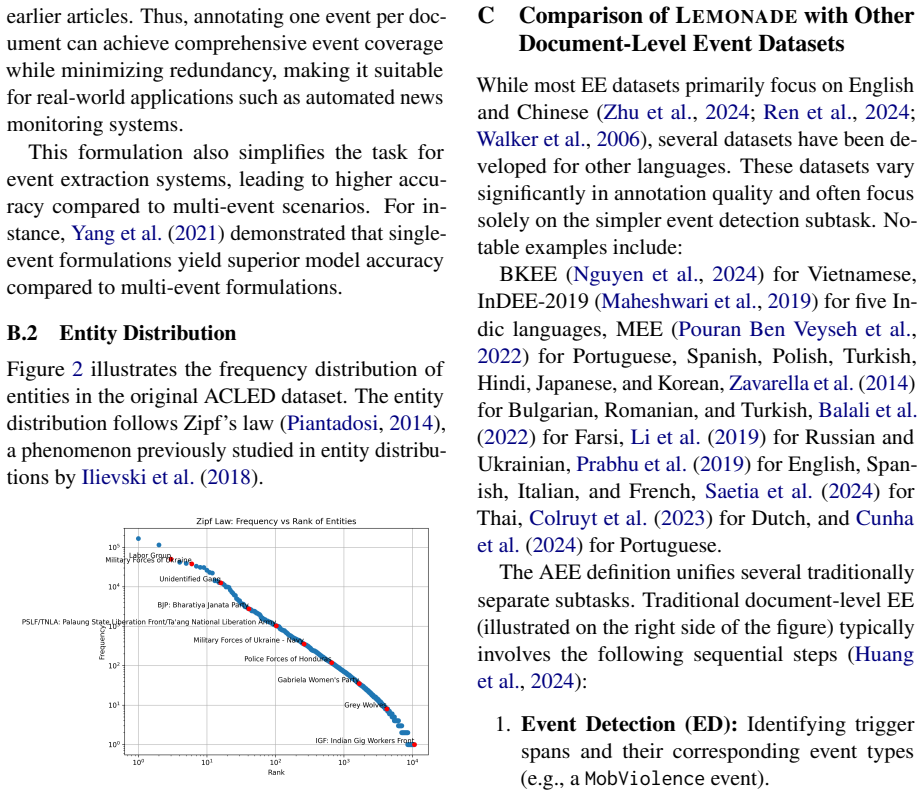
The load-bearing object is the abstractive event annotation: a Python-class event signature with typed arguments — lists of entity IDs from a curated 10,707-entity database, boolean enum flags, numerical values, and location fields — rather than text spans. The benchmark's event types number 25 in the socio-political domain. The entity database, accompanied by one-paragraph descriptions, is the second mechanism: it defines the universe for abstractive entity linking (AEL) and allows ZEST's retrieve-filter-assign pipeline to work, generating content-based queries for vector retrieval, filtering candidates by evidence in the document, and finally assigning entities to role arguments.
What would settle it
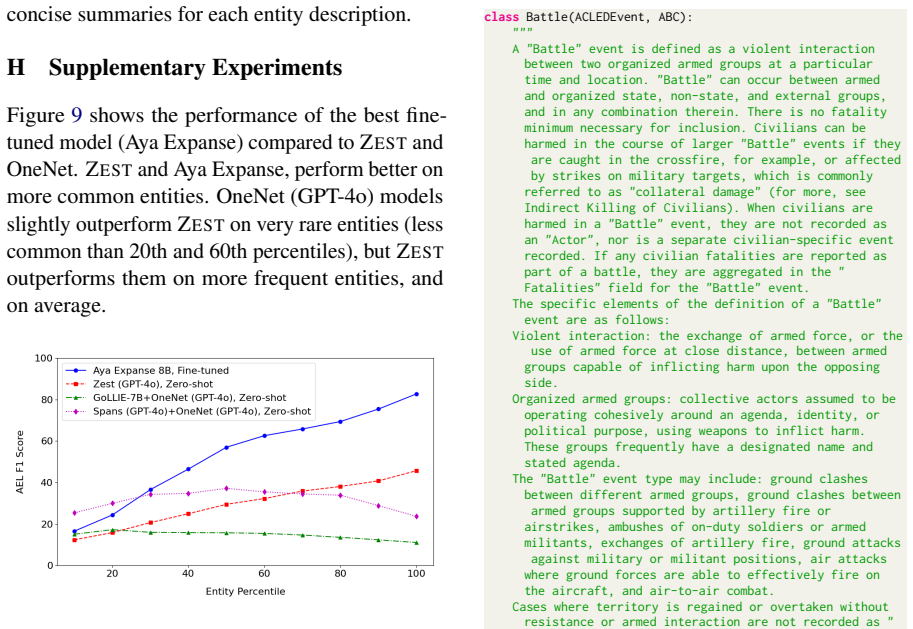
Rebuild the ZEST retrieval database using only the training split's article set to generate or prune entity descriptions, then recompute the AEL F1 and end-to-end F1 on the existing test split. If the gap between ZEST (45.7%) and OneNet (23.7%) shrinks substantially or vanishes, the zero-shot claim is inflated; if it persists, the retrieval-based approach is validated under information-safe conditions.
Extended reading notes
Core claim
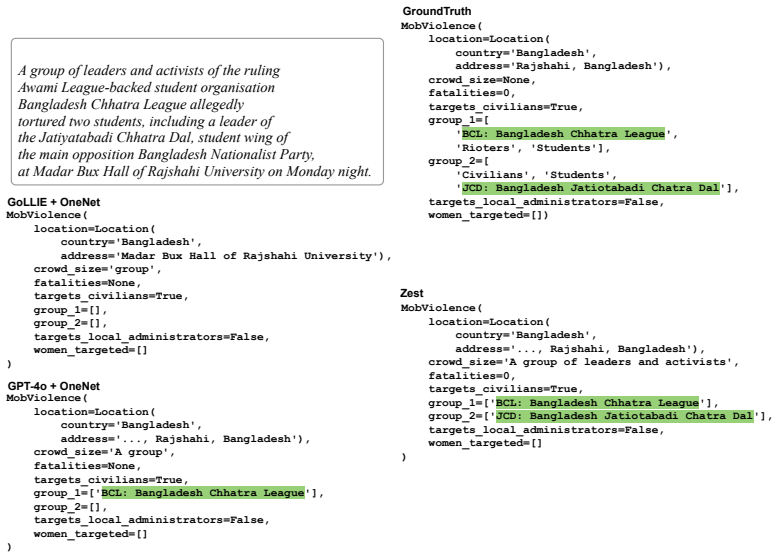
The central claim is that a large, real-world conflict event dataset can be built by transforming expert-annotated ACLED records into document-level abstractive annotations, and that abstractive event extraction is the right formulation for studying real-world phenomena because it captures information not stated as text spans — such as that targeted women were government officials, or that no fatalities occurred. The paper further claims that its zero-shot retrieval-based linker, ZEST, achieves 45.7% AEL F1, almost twice the 23.7% of the zero-shot span-based baseline OneNet, while supervised models reach 82.7%. The authors conclude that existing span-based models such as GoLLIE and OneNet transfer poorly to the abstractive setting, and that zero-shot multilingual LLMs can approach but not yet match supervised quality for event extraction.
Load-bearing premise
The assumption that the zero-shot evaluation is information-safe: the entity descriptions in the retrieval database are generated from all 13 months of articles, including test-period articles, so any test article that mentions a database entity could have its own content fed back into that entity's description, making zero-shot linking look better than it would without that leakage.
Editorial extensions
If this is right
- If the abstractive formulation is adopted more broadly, event extraction systems could directly serve analytical queries such as 'fatalities from violence against female government officials in 2024' without a separate pipeline of span detection, coreference resolution and entity linking. Adopting abstractive event extraction would mean re-tooling evaluation from span matching to exact-match on ty
- The 20-language, 171-country coverage with region-specific tail entities would enable more truly global studies of civil conflict and protest — the paper's results support the feasibility of monitoring dozens of languages with LLMs and suggest that low-resource languages such as Burmese, Somali and Nepali are now tractable for event extraction, though still the hardest cases. Supervised models are
- Zero-shot entity linking, as measured by ZEST, can beat span+link pipelines by a wide margin, so the dominant bottleneck is no longer entity resolution but unseen-entity linking and explicit span detection. On unseen entities, the best supervised model reaches only 30.4% AEL F1, showing a fundamental gap in generalizing to new participants.
- Because the dataset is temporally split (train Jan–Mar 2024; dev/test Apr 2024–Jan 2025) and 44.3% of dev/test entities never appear in training, LEMONADE can measure temporal generalization, not just language transfer.
- The dataset and code are released, so future work can use LEMONADE to train multilingual AEE models and to improve unseen-entity linking, a direction the paper explicitly highlights for future research.
Reading between the lines
- Inference beyond the paper: the abstractive formulation decouples system output from surface form; if it becomes the standard for event data, it would obsolete the intermediate stages of trigger and mention detection that dominated MUC/ACE-style extraction, and datasets could be built directly from humanitarian codebooks.
- Inference beyond the paper: because the entity descriptions are generated from the same corpus that contains test documents (Appendix A.2), a critical external test would be to regenerate the entity database using only training-period documents and rerun the reported zero-shot comparisons. If ZEST's advantage persists under that regime, the claim of retrieval-based zero-shot entity linking would b
- Inference beyond the paper: LEMONADE's single-event-per-document format with 25 event types could be extended to multi-event and cross-document aggregation. The paper itself notes cross-document event coreference is left out of scope; combining AEE with the existing coreference methods mentioned in the Limitations section is a natural next test.
Editorial analysis
A structured set of objections, weighed in public.
Referee Report
Summary. The paper introduces LEMONADE, a multilingual document-level abstractive event extraction dataset derived from ACLED expert annotations, covering 39,786 events in 20 languages with a curated entity database of 10,707 entities. It defines abstractive event extraction (AEE) and its subtask abstractive entity linking (AEL), and presents ZEST, a retrieval-based zero-shot entity linker. Experiments compare zero-shot and supervised models on event detection, argument extraction, entity linking, and end-to-end extraction, reporting ZEST AEL F1 of 45.7 and a best zero-shot end-to-end F1 of 58.3, versus 78.4 for the best supervised model. The paper's central performance claims depend on ZEST's zero-shot evaluation, which is compromised by entity descriptions generated from test-period articles.
Significance. If the zero-shot results survive a leakage-free re-evaluation, the paper would provide a substantial resource: expert-annotated multilingual event data with temporal splits, a domain-specific entity database, and a new abstractive task formulation. The dataset construction is transparent, the temporal split is a good design choice, and the supervised benchmarks are carefully adapted from existing models. However, the central zero-shot claim is currently not supported because the retrieval database contains entity descriptions generated from test-period news articles. This issue does not affect the dataset itself or the supervised results, but it invalidates the headline comparison between ZEST and OneNet as a zero-shot comparison. The contribution is therefore potentially significant but needs a corrected evaluation.
major comments (2)
- [Appendix A.2, §5.1, Tables 3 and 5] The entity descriptions stored in the retrieval database are generated by GPT-4o "using the news articles that are annotated to have involved each entity" (Appendix A.2), and the corpus spans January 2024–January 2025 with the test split covering April 2024–January 2025 (Section 4.1). Consequently, descriptions for entities appearing in test articles can contain facts, names, or wording drawn from those exact test documents. ZEST's Stage 1 prompt explicitly instructs the LLM to generate queries that "closely match the descriptions of the gold entities" (§5.1), so the retrieval step is effectively given test-document content through the descriptions; Stage 2 then presents each candidate description alongside the test article (Table 17). This makes the reported zero-shot AEL F1 of 45.7 and the end-to-end F1 of 58.3 inflated, and it breaks the advertised zero-shot property. The comparison with OneNet is also one-sided, because ZEST's query-generation can exploit the leaked descriptions more directly than OneNet's span-based pipeline. The supervised results are not affected, but the zero-shot claims in the abstract and Section 7.3 require re-evaluation with entity descriptions generated only from pre-test (January–March 2024) sources, plus a report of how many test entities have descriptions that cite test-period articles.
- [Table 4 and §7.3] The Seen/Unseen entity breakdown is directly affected by the same leakage. An entity that is unseen in training (44.3% of validation and test entities, per Section 4.1) may still have a description generated from its test-period article, so ZEST's 20.0 F1 on unseen entities does not measure generalization to genuinely new entities. The paper's claim that zero-shot methods outperform supervised methods on unseen entities should be re-computed under a leakage-free protocol, and the discussion of the "Unseen" category should be revised accordingly.
minor comments (5)
- [Section 7.3] The text states ZEST surpasses OneNet by 20.0 percentage points, but Table 3 shows 45.7 − 23.7 = 22.0; the arithmetic should be corrected.
- [Abstract vs §6.1] OneNet is called a "state-of-the-art zero-shot baseline" in the abstract but a "few-shot entity linking model" in §6.1; the paper should clarify the adaptation and terminology.
- [Section 7.3] The sentence "with OneNet performing even better in this regard" is ambiguous with respect to Table 4, since OneNet's Specific score (37.2) is not a decline from its Generic score (10.5); rephrase to state the intended comparison.
- [Section 3] The sentence "each argument field ai,j in in domain Di,j" contains a duplicated "in"; please fix the typo.
- [Appendix A.2] The entity-description generation procedure should state explicitly whether any filtering was applied to remove test-period content; currently the description is silent on this, which is the source of the leakage concern.
Circularity Check
Entity descriptions are generated from the annotated news articles themselves, so ZEST's zero-shot AEL result is partly a retrieval-by-construction artifact rather than a clean zero-shot measurement.
-
self definitional
[Appendix A.2 (Entity Descriptions); Section 5 (ZEST Stage 1); Section 4.1 (Entity Database)]
"These descriptions are generated by GPT-4o using the news articles that are annotated to have involved each entity. ... At test time, since the model does not have access to the gold entity descriptions, the LLM approximates these descriptions based solely on the information available in the input document."
The entity database is built by describing each entity from 'the news articles that are annotated to have involved each entity,' and those articles include the April 2024–January 2025 test articles, since LEMONADE's full span is January 2024–January 2025. ZEST's retrieval stage embeds exactly these entity descriptions and generates queries 'to closely match the descriptions of the gold entities'; Stage 2 then scores each candidate by presenting its description alongside the test article. For an entity whose description was written from the very test article being processed, the database already contains the answer to the linking question.
full rationale
The circularity is concentrated in the construction of the entity-description database used by ZEST. Appendix A.2 states that each entity description is generated by GPT-4o from the news articles annotated as involving that entity, and the dataset's test split falls inside the same 13-month window from which those articles are drawn. Since ZEST retrieves and filters candidates by matching the test document against these descriptions, the gold entities in a test article can be described by content from that same article, which is a direct form of evaluation leakage. This does not undermine the supervised results, the ED and AEAE results, or the value of the dataset itself, but it does invalidate the zero-shot AEL and end-to-end claims as clean zero-shot measurements. No other major circularity was found: the AEE task definition, supervised fine-tuning, and the baseline comparisons do not reduce to fitted inputs or self-citation chains. The score of 6 reflects that one central performance claim is partially determined by the construction of the retrieval database, while the rest of the paper remains independently supported.
Assumptions & free parameters
free parameters (1)
- minimum events per language =
500
assumptions (4)
- domain assumption ACLED expert annotations are accurate enough to serve as gold labels
- domain assumption GPT-4o-generated entity descriptions are faithful and do not introduce errors
- domain assumption Single-event-per-document annotation captures the main event adequately for real-world monitoring
- domain assumption Exact string matching after OSM normalization is a valid evaluation metric
Cite this review
Pith. "Pith review of LEMONADE: A Large Multilingual Expert-Annotated Abstractive Event Dataset for the Real World." pith.science (2026). https://pith.science/paper/576CO5EH
@misc{pith2026250600980,
  author       = {Pith},
  title        = {Pith review of: LEMONADE: A Large Multilingual Expert-Annotated Abstractive Event Dataset for the Real World},
  year         = {2026},
  howpublished = {\url{https://pith.science/paper/576CO5EH}},
  note         = {Machine review of arXiv:2506.00980}
}
read the original abstract
This paper presents LEMONADE, a large-scale conflict event dataset comprising 39,786 events across 20 languages and 171 countries, with extensive coverage of region-specific entities. LEMONADE is based on a partially reannotated subset of the Armed Conflict Location & Event Data (ACLED), which has documented global conflict events for over a decade. To address the challenge of aggregating multilingual sources for global event analysis, we introduce abstractive event extraction (AEE) and its subtask, abstractive entity linking (AEL). Unlike conventional span-based event extraction, our approach detects event arguments and entities through holistic document understanding and normalizes them across the multilingual dataset. We evaluate various large language models (LLMs) on these tasks, adapt existing zero-shot event extraction systems, and benchmark supervised models. Additionally, we introduce ZEST, a novel zero-shot retrieval-based system for AEL. Our best zero-shot system achieves an end-to-end F1 score of 58.3%, with LLMs outperforming specialized event extraction models such as GoLLIE. For entity linking, ZEST achieves an F1 score of 45.7%, significantly surpassing OneNet, a state-of-the-art zero-shot baseline that achieves only 23.7%. However, these zero-shot results lag behind the best supervised systems by 20.1% and 37.0% in the end-to-end and AEL tasks, respectively, highlighting the need for further research.
Figures


Figures from the paper (6 more)




Reference graph
Works this paper leans on
-
[1]
Initial Review: Annotations are first re- viewed by another researcher familiar with the same region
-
[2]
Regional Manager Review: A region- specific research manager, familiar with some (but not necessarily all) languages of the re- gion, conducts a second review, primarily re- lying on the provided English summaries and notes
-
[3]
Centralized Review: A central team per- forms a final review, again using the English summaries and notes, to ensure methodologi- cal consistency across different regions. In addition to these review rounds, the ACLED quality assurance team conducted a separate re- view of 1,265 randomly selected events against the ACLED codebook, reporting the following ...
work page 2021
-
[4]
Entity Coreference Resolution and/or Link- ing: Resolving entity coreferences and link- ing them to corresponding entries in an entity database. It is worth noting that conventional EE systems often limit event arguments exclusively to enti- ties (Wadden et al., 2019). D Examples of Entities from LEMONADE Tables 10, 11, 12, 13 and 14 contain examples of L...
work page 2010
-
[5]
RetroMAE: Pre-training retrieval-oriented lan- guage models via masked auto-encoder. In Proceed- ings of the 2022 Conference on Empirical Methods in Natural Language Processing, pages 538–548, Abu Dhabi, United Arab Emirates. Association for Com- putational Linguistics. Zhenran Xu, Yulin Chen, Baotian Hu, and Min Zhang
work page 2022
-
[6]
A Read-and-Select Framework for Zero-shot Entity Linking
A read-and-select framework for zero-shot entity linking. ArXiv preprint, abs/2310.12450. Linting Xue, Noah Constant, Adam Roberts, Mihir Kale, Rami Al-Rfou, Aditya Siddhant, Aditya Barua, and Colin Raffel. 2021. mT5: A massively multilingual pre-trained text-to-text transformer. In Proceedings of the 2021 Conference of the North American Chap- ter of the...
work page Pith review arXiv 2021
-
[10]
(2014) for Bulgarian, Romanian, and Turkish, Balali et al
for Portuguese, Spanish, Polish, Turkish, Hindi, Japanese, and Korean, Zavarella et al. (2014) for Bulgarian, Romanian, and Turkish, Balali et al. (2022) for Farsi, Li et al. (2019) for Russian and Ukrainian, Prabhu et al. (2019) for English, Span- ish, Italian, and French, Saetia et al. (2024) for Thai, Colruyt et al. (2023) for Dutch, and Cunha et al. (...
work page 2014
-
[11]
Event Detection (ED): Identifying trigger spans and their corresponding event types (e.g., a MobViolence event)
Show all 31 references
-
[12]
Event Argument Extraction (EAE): Identi- fying argument spans and their roles for each event
-
[13]
Entity Detection: Finding text spans (men- tions) that refer to entities
-
[15]
For each event type, determine how well it matches the article content. Consider the following factors: - How closely the event description aligns with the main focus of the article - The presence of key actors or entities mentioned in the event type description - The occurren...
-
[16]
Only include event types that have a meaningful connection to the article
Rank the event types based on their relevance to the article content. Only include event types that have a meaningful connection to the article
-
[17]
Hezbollah
Output your results using the following format: - List the relevant event types in descending order of match quality - Use the ">" symbol to separate the event types Your output should look like this: [Explain your reasoning for the event types you decide to include, and their...
-
[18]
Labor Group
Be as thorough as possible. Think about what groups are implicitly or indirectly involved in the event. Ask yourself: - Can the identity group (religion, gender, occupation etc.) of the victims or perpetrators be inferred? If so, you should create an entity for that group. - D...
-
[19]
Include alternative names or spellings of each entity if mentioned in the article
-
[20]
For individuals, infer their role, affiliation, or social group as explained above
-
[21]
entity 1
For each entity you identify, think about its affiliated, parent or member groups. For example, if a politician is mentioned, think about their political party or any other group they are associated with. If a union is mentioned, think about the workers or labor groups it repr...
-
[22]
Read the article carefully to understand the context of the event
First, you will be provided with the full text of the news article. Read the article carefully to understand the context of the event
-
[23]
Next, you will be given a list of entities involved with the event
-
[24]
Madrasa" could be an evidence for
Identify all supporting evidence of each given entity. Each evidence should be a short span from the article that has one of the following: - Contains the entity name, abbreviation or variations of its name - Implies the entity indirectly. For example "Madrasa" could be an evi...
-
[25]
If no evidence is found for an entity, respond with a mostly empty `EntitySpan` and only fill the ` explanation` field
If there are multiple evidence for the involvement of an entity, output one of them. If no evidence is found for an entity, respond with a mostly empty `EntitySpan` and only fill the ` explanation` field
-
[26]
Include the original entity name in the `entity_name` field to denote which entities the evidence is for
For each evidence you find for an entity, provide your answer in the provided JSON format. Include the original entity name in the `entity_name` field to denote which entities the evidence is for
-
[27]
Hezbollah
If unsure, err on the side of including the span as evidence. # input <article> Country of event: {{ country }} {{ article }} </article> <entities> {% - {{ e.name }} {{ e.description }} {% </entities> Table 17: Prompt for the second stage of ZEST. 31 You will be given a news a...
-
[28]
Analyze the news article and the {{ event_type }} event carefully
-
[29]
For each entity in the provided list, determine their appropriate field based on the information in the news article
-
[30]
Government of India
Assign each entity to the most appropriate field. Try to assign all entities, event if their involvement in the event is very indirect. For example, "Government of India" is still an actor if the Indian congress is involved in the event
-
[31]
field_name 1
If a field doesn 't have a corresponding entity, leave it as an empty list. Output the assignment of entities to fields in the following JSON format. Note that you should always include the full name of the entities without change. { "field_name 1" : ["entity 1", "entity 2", ....
2024
-
[2017]
In Proceedings of the 55th An- nual Meeting of the Association for Computational Linguistics (Volume 1: Long Papers), pages 1139– 1149, Vancouver, Canada
Abstract syntax networks for code generation and semantic parsing. In Proceedings of the 55th An- nual Meeting of the Association for Computational Linguistics (Volume 1: Long Papers), pages 1139– 1149, Vancouver, Canada. Association for Computa- tional Linguistics. 13 Clionad...
2010 arXiv
-
[2019]
In Proceedings of the 2019 Conference of the North American Chapter of the Association for Computational Linguistics (Demon- strations), pages 110–115, Minneapolis, Minnesota
Multilingual entity, relation, event and hu- man value extraction. In Proceedings of the 2019 Conference of the North American Chapter of the Association for Computational Linguistics (Demon- strations), pages 110–115, Minneapolis, Minnesota. Association for Computational Ling...
2019
-
[2022]
SSRN Electronic Journal
Cofee: A comprehensive ontology for event extraction from text. SSRN Electronic Journal. Luisa Bentivogli, Pamela Forner, Claudio Giu- liano, Alessandro Marchetti, Emanuele Pianta, and Kateryna Tymoshenko. 2010. Extending English ACE 2005 corpus annotation with ground-truth li...
2010 arXiv
-
[2023]
In Proceedings of the 61st Annual Meet- ing of the Association for Computational Linguistics (Volume 2: Short Papers), pages 1666–1688, Toronto, Canada
Event extraction as question generation and answering. In Proceedings of the 61st Annual Meet- ing of the Association for Computational Linguistics (Volume 2: Short Papers), pages 1666–1688, Toronto, Canada. Association for Computational Linguistics. Yi-Fan Lu, Xian-Ling Mao, ...
2024 arXiv
Reviewed August 7, 2026 · model on record in the stance chip above.
Discussion (0). Sign in to comment.