REVIEW 3 major objections 5 minor 2 cited by
No Soundness in the Real World: On the Challenges of the Verification of Deployed Neural Networks
T0 review · 3 major / 5 minor · reviewed 2026-08-07 · deepseek-v4-flash
Pith's one-line read The paper proves that theoretically sound neural verifiers are not sound for deployed networks, and shows every tested verifier misses its backdoors.
desk verdict A clean, correct proof that interval-based verifiers are not practically sound for sum-like computations, but the paper's universal title claim outruns its formal results. read the letter →
The pith
A machine-rendered reading of the paper's core claim, the machinery that carries it, and where it could break.
The reading
What carries the argument
The load-bearing objects are the deployed network $r(x;\theta,E)$ and the special floating-point number $\omega$, defined as the smallest representable positive number whose successor is $\omega+2$ ($\omega=2^{24}$ in binary32, $2^{53}$ in binary64). The environment $E$ is modelled by the number representation, rounding mode, and the set of possible binary expression trees with non-zero probability; because floating-point addition is non-associative, different trees give different outputs. The proofs show that interval arithmetic on one tree can exclude the true extremal value $L_r$ or $U_r$, so the verifier's interval is not practically sound, and detector neurons built from sums like $\omega+1-\omega$ trigger adversarial behavior exactly when the deployment evaluation order differs from the verifier's assumption.
What would settle it
Run a verifier that explicitly models every expression tree in the deployment set, for example by exhaustive enumeration of tree shapes for the detector sum in Equation (5), and check whether it bounds all observed outputs across the eight environments of Table 2. If such a verifier certifies the Order3 backdoored network as robust while the network flips classes in one of those environments, the claim that environment-blind verifiers are unsound would be falsified; if it succeeds, the negative result is limited to methods that ignore the environment.
Extended reading notes
Core claim
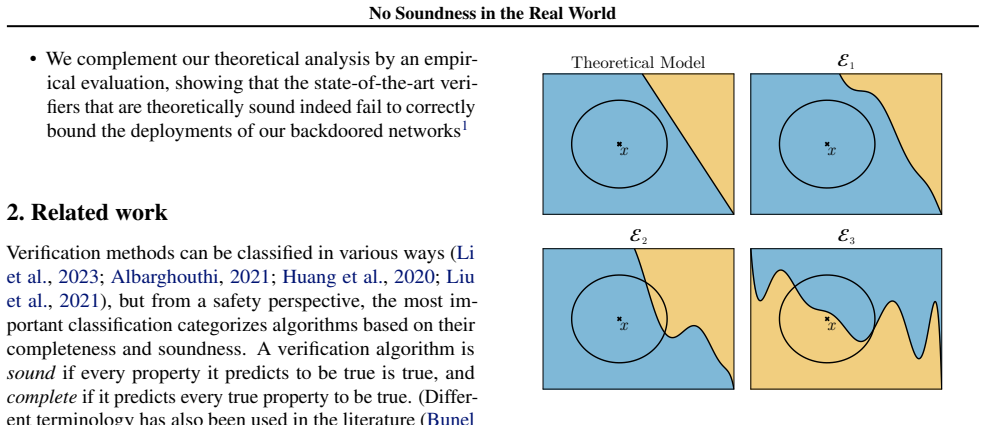
The central discovery is that the deployed network is a different mathematical object from the full-precision model: floating-point arithmetic is non-associative, so the same network can produce different outputs depending on the expression tree, rounding mode, and precision chosen by hardware and software. The deployed function $r(x;\theta,E)$ is defined over a set of possible outputs, and a practically sound verifier must bound every possible output. The paper proves (Propositions 6.2 and 6.5) that interval bound propagation and zonotope widening, evaluated on a single expression tree, can miss the true minimum or maximum floating-point output even for a sum of constants. It then shows how detector neurons using the number $\omega$ can make a deployed network behave arbitrarily while the full-precision model looks safe, and demonstrates that the tested verifiers certify the backdoored networks as robust.
Load-bearing premise
The argument depends on modelling the deployment environment as a set of possible expression trees, rounding modes, and precisions with possibly random choice among them; if a particular deployment is deterministic with a single known evaluation order, the proof's negative conclusion does not apply.
Editorial extensions
If this is right
- A verifier that is only theoretically sound can certify a network that is unsafe in a stochastic deployment, because the certification is about the wrong function.
- Practical soundness requires knowing or bounding the set of possible expression trees in the deployment environment, which is generally harder than the theoretical verification problem.
- Deterministic deployment with a known expression tree restores practical soundness, because interval propagation along the actual tree bounds the actual output.
- Backdoor detectors can be embedded into any network using the paper's construction, so the attack does not require altering the input.
- The same proof strategy extends to symbolic bound propagation methods, which reduce to interval analysis on the sum-of-constants case.
Reading between the lines
- If accepted, this result shifts the verification target: certification should be issued for a specific deployment environment, not for a network in the abstract.
- A natural extension is to test whether enumerating all expression trees for small sums, or using exact rational arithmetic, yields practically sound bounds; the paper does not implement such a verifier.
- The same deployment-gap argument likely applies to other non-associative computations beyond sums, such as matrix multiplications in convolutions, though the paper proves the worst-case only for sums.
- Standardized benchmark pairs of verifier and deployment environment would be a concrete next step for comparing practical soundness.
Editorial analysis
A structured set of objections, weighed in public.
Referee Report
Summary. The paper argues that neural network verifiers which are sound with respect to a full-precision, theoretical model of a network are not necessarily sound with respect to the actually deployed, floating-point implementation in a given environment. It formalizes the deployed network r(.;θ,E) as a function whose output set is determined by the environment E (number representation, rounding mode, and a set of possible expression trees with nonzero probability). It proves that interval bound propagation (IBP) and zonotope-based widening can fail to cover the full deployed output range, even for the simple function f(x)=Σx_i with constant representable inputs (Propositions 6.2, 6.3, 6.5). It then constructs backdoored MNIST networks containing detector neurons that are triggered by precision or expression-tree order, and empirically shows that ten configurations of six state-of-the-art verifiers all fail to detect the precision backdoor and the hardest order backdoor (Table 3). The paper concludes that 'theoretical soundness does not imply practical soundness' and that the deployment environment should be part of the verification problem.
Significance. If the result is taken at face value, it is significant: it challenges the common practice of verifying a full-precision model while ignoring the nondeterminism of floating-point execution, and it provides a concrete attack that the tested verifiers provably miss. The formal counterexamples for interval and zonotope bound propagation are simple, explicit, and correctly proved; they are a genuine and useful addition to the literature. The paper also gives credit where due: it ships source code, specifies hardware/software environments, and includes the proofs in the appendix. The main weakness is that the formal results cover only the sum of constants, while the sweeping title and abstract claim a universal absence of practical soundness for all verifiers. The empirical evaluation is solid but limited to 100 MNIST inputs and ten configurations, so the universal conclusion rests on an unproven transfer from the sum-of-constants counterexample to arbitrary ReLU networks. With a rigorous transfer argument or appropriately scoped claims, this would be an accept-quality contribution.
major comments (3)
- [§6.1, §7, Appendix B] The formal results (Propositions 6.2, 6.3, 6.5) are proved only for the function f(x)=Σx_i with constant representable inputs. The paper asserts in §6.1 that generalizations to neural network architectures 'will inherit these problems', but no theorem in the paper proves that any theoretically sound verifier of a full ReLU network must miss the embedded detector. Appendix B describes a backdoor construction and Table 3 gives empirical evidence on ten verifier configurations, but that does not establish the universal claim 'no soundness in the real world'. Indeed, Table 3 shows that Order2 is detected by six of the ten configurations, demonstrating that ReLU propagation and verifier-specific widening can cover adversarial outputs even when IBP on a fixed default tree would not. The authors should either prove a transfer theorem (e.g., showing that for the embedded detector, the bounds computed by any interval or zonotope verifier on the full network are exactly the bounds on the corresponding sum, up to ReLU composition) or explicitly limit the scope of the theoretical claim to the sum function and treat the neural-network failure as an empirical observation on the tested verifiers.
- [§5.1, §6.1, §9] The negative results rely on a specific modeling choice: practical soundness is defined as bounding the output for every expression tree in the set E, and the counterexamples require an E that contains 'every correct expression tree'. The paper itself acknowledges in §9 that deterministic environments are an advantage and that IBP following the deterministic expression tree is practically sound (Proposition 6.1). Hence the abstract's claim that 'all the state-of-the-art verifiers we are aware of fail to reach this goal' is an overstatement: a verifier that is explicitly given the deterministic tree and the deployment precision would be practically sound by Proposition 6.1. The universal claim should be scoped to environments with multiple or stochastic expression trees, or the environment model should be defended as the only realistic threat model. As written, the paper risks conflating 'not practically sound for every possible E' with 'not practically sound for any interesting deployment'.
- [§8.2.2, Table 2, §8.4, Table 3] The Order3 column in Table 3 labels every verifier as unsound even though Table 2 shows that the Order3 adversarial behavior is not triggered in any of the eight deployment environments tested (accuracy is 98.11% in all environments). The justification in §8.4 is that it is hard to model the set of possible expression trees, so a practically sound verifier should be prepared for all of them. This is a normative threat-model decision, not a demonstrated empirical failure. Under the paper's own definition of E as the set of trees with nonzero probability in a given environment, if the triggering tree has zero probability in the tested environments, then missing the backdoor is not practical unsoundness for those environments. To support the Order3 unsound verdict, the authors should either exhibit a concrete environment where Order3's adversarial behavior occurs (or a reproducible stochastic model with nonzero triggering probability), or explicitly state that they are adopting a conservative universal-E threat model and separate that definitional claim from the empirical evaluation.
minor comments (5)
- [§6 and Table 3] The labels 'sound' and 'unsound' in Table 3 describe whether the verifier detected the backdoor, which is not the standard use of 'sound' in verification. The paper should define these labels operationally (e.g., 'detected' vs. 'missed') or explicitly state that 'sound' here means 'correctly reported 0% verified robust accuracy'.
- [Appendix A.2, proof of Proposition 6.5] The notation in the proof is sloppy: 'the multiset of nine 1s and ω {1,1,1,1,1,1,1,1,1,ω}' is missing a set brace and the count is ten numbers, not nine. Also, the variables δ_l and δ_u are said to satisfy '0<δ_l ≪1' without a precise bound, which makes the inequalities in Equations (9) and (10) slightly informal.
- [§4.4] The example '253 + 1 − 253 = 0 when computed in double-precision arithmetic and with rounding towards −∞' is correct for double precision, but the text uses '253' without a superscript; using 2^{53} and 2^{24} consistently would improve readability.
- [§6.3] The statement 'We hypothesize that finding the expression tree that maximizes or minimizes the output is an NP-hard problem in general' is accompanied by a citation to Kao & Wang for a 'very similar problem'. Since this is only a hypothesis and is not used later (the paper only claims that approximation is not enough), it could be moved to future work or made conditional.
- [Appendix C.2.1] In the MIPVerify description, the sentence 'MIPVerify was attacked using the 32-bit adversarial precision backdoor, leading to incorrect outputs of 97 safe answers' is unclear: it is the verifier's verification result that is incorrect, not the 'outputs of MIPVerify' in the sense of the network output. Please rephrase to avoid ambiguity.
Circularity Check
No significant circularity: the unsoundness theorems rest on explicit counterexamples, not on self-referential predictions.
full rationale
The paper's central formal claims are self-contained. Proposition 6.2 is proved by constructing explicit witness inputs and expression trees (e.g., (1+1)+omega with appropriate rounding modes) and showing that the interval evaluation misses L_r or U_r. Proposition 6.5 is likewise proved with explicit multisets and zonotope widening formulas from Miné (2004). No parameter is fitted to verifier outputs and no empirical result is renamed as a theoretical prediction: the attack networks in Section 7 are constructive witnesses to the claimed gap, and the empirical Table 3 tests whether those witnesses defeat existing verifiers. The only potentially definitional element is the model of the deployment environment E in Sections 5.1 and 6.1, where practical soundness is defined as bounding every output over all expression trees with nonzero probability; the negative theorems are then derived from that definition with explicit arithmetic examples rather than assumed. The generalization from constant-sum counterexamples to full ReLU networks is an extrapolation supported by construction, not a circular reduction. The paper does cite the authors' prior work (Zombori et al., 2021) for the backdoor insertion method, but that citation is methodological and not load-bearing for the formal theorems, and the construction is described in Section B with released code. This is at most a minor self-citation, well below the threshold for circularity.
Assumptions & free parameters
free parameters (3)
- h1, h2 =
4, 15
- h =
512
- alpha, beta backdoor shifts =
alpha1=1, alpha2=-2, beta1=0, beta2=1 and swapped
assumptions (4)
- domain assumption IEEE 754 floating point with a fixed rounding mode is a faithful model of the deployed computation.
- ad hoc to paper A deployment environment E can be represented by the number representation, rounding mode, and the set of possible expression trees, and a practically sound verifier must cover all trees in that set.
- domain assumption The detector neurons can be embedded into an arbitrary ReLU network using the method of Zombori et al. without changing the verifier's view of the theoretical model.
- standard math Standard arithmetic background: interval arithmetic with outward rounding contains the full-precision value.
invented entities (2)
-
Precision detector neuron (omega + 1 - omega)
independent evidence
-
Expression-tree detector neurons (Order1, Order2, Order3)
independent evidence
Cite this review
Pith. "Pith review of No Soundness in the Real World: On the Challenges of the Verification of Deployed Neural Networks." pith.science (2026). https://pith.science/paper/52MBQUTA
@misc{pith2026250601054,
  author       = {Pith},
  title        = {Pith review of: No Soundness in the Real World: On the Challenges of the Verification of Deployed Neural Networks},
  year         = {2026},
  howpublished = {\url{https://pith.science/paper/52MBQUTA}},
  note         = {Machine review of arXiv:2506.01054}
}
read the original abstract
The ultimate goal of verification is to guarantee the safety of deployed neural networks. Here, we claim that all the state-of-the-art verifiers we are aware of fail to reach this goal. Our key insight is that theoretical soundness (bounding the full-precision output while computing with floating point) does not imply practical soundness (bounding the floating point output in a potentially stochastic environment). We prove this observation for the approaches that are currently used to achieve provable theoretical soundness, such as interval analysis and its variants. We also argue that achieving practical soundness is significantly harder computationally. We support our claims empirically as well by evaluating several well-known verification methods. To mislead the verifiers, we create adversarial networks that detect and exploit features of the deployment environment, such as the order and precision of floating point operations. We demonstrate that all the tested verifiers are vulnerable to our new deployment-specific attacks, which proves that they are not practically sound.
Figures

Forward citations
Cited by 2 Pith papers
-
Lipschitz-Based Robustness Certification Under Floating-Point Execution
Lipschitz-based robustness certificates that assume real arithmetic can be unsound under floating-point execution; a formal FP-aware theory and certifier close that gap for dense ReLU networks.
-
TAO: Tolerance-Aware Optimistic Verification for Floating-Point Neural Networks
A tolerance-aware optimistic verification protocol makes floating-point neural-network inference verifiable on heterogeneous GPUs by accepting outputs within per-operator error bounds and resolving disputes via a Merk...
Reference graph
Works this paper leans on
-
[1]
write newline
" write newline "" before.all 'output.state := FUNCTION n.dashify 't := "" t empty not t #1 #1 substring "-" = t #1 #2 substring "--" = not "--" * t #2 global.max substring 't := t #1 #1 substring "-" = "-" * t #2 global.max substring 't := while if t #1 #1 substring * t #2 global.max substring 't := if while FUNCTION format.date year duplicate empty "emp...
-
[2]
Introduction to neural network verification
Albarghouthi, A. Introduction to neural network verification. Foundations and Trends in Programming Languages, 7 0 (1-2): 0 1--157, 2021. ISSN 2325-1107. doi:10.1561/2500000051. URL http://dx.doi.org/10.1561/2500000051
-
[3]
Alefeld, G. and Herzberger, J. Introduction to Interval Computation. Academic Press, 1983. ISBN 9780120498208
work page 1983
-
[4]
Bunel, R., Lu, J., Turkaslan, I., Torr, P. H. S., Kohli, P., and Kumar, M. P. Branch and bound for piecewise linear neural network verification. Journal of Machine Learning Research, 21 0 (42): 0 1--39, 2020. URL http://jmlr.org/papers/v21/19-468.html
work page 2020
-
[5]
Cordeiro, L. C., Daggitt, M. L., Girard - Satabin, J., Isac, O., Johnson, T. T., Katz, G., Komendantskaya, E., Lemesle, A., Manino, E., Sinkarovs, A., and Wu, H. Neural network verification is a programming language challenge. In Vafeiadis, V. (ed.), Programming Languages and Systems - 34th European Symposium on Programming, ESOP 2025, Held as Part of the...
work page 2025
-
[6]
de Figueiredo, L. H. and Stolfi, J. Affine arithmetic: Concepts and applications. Numer. Algorithms, 37 0 (1-4): 0 147--158, 2004. doi:10.1023/B:NUMA.0000049462.70970.B6. URL https://doi.org/10.1023/B:NUMA.0000049462.70970.b6
arXiv 2004
-
[7]
Output range analysis for deep feedforward neural networks
Dutta, S., Jha, S., Sankaranarayanan, S., and Tiwari, A. Output range analysis for deep feedforward neural networks. In Dutle, A., Mu \ n oz, C. A., and Narkawicz, A. (eds.), NASA Formal Methods - 10th International Symposium, NFM 2018, Newport News, VA, USA, April 17-19, 2018, Proceedings , volume 10811 of Lecture Notes in Computer Science, pp.\ 121--138...
-
[8]
Formal verification of piece-wise linear feed-forward neural networks
Ehlers, R. Formal verification of piece-wise linear feed-forward neural networks. In D'Souza, D. and Kumar, K. N. (eds.), Automated Technology for Verification and Analysis - 15th International Symposium, ATVA 2017, Pune, India, October 3-6, 2017, Proceedings , volume 10482 of Lecture Notes in Computer Science, pp.\ 269--286. Springer, 2017. doi:10.1007/9...
Show all 41 references
-
[9]
N., Jovanovic, N., and Vechev, M
Ferrari, C., M \" u ller, M. N., Jovanovic, N., and Vechev, M. T. Complete verification via multi-neuron relaxation guided branch-and-bound. In The Tenth International Conference on Learning Representations, ICLR 2022, Virtual Event, April 25-29, 2022 . OpenReview.net, 2022. U...
2022
-
[10]
The zonotope abstract domain taylor1+
Ghorbal, K., Goubault, E., and Putot, S. The zonotope abstract domain taylor1+. In Bouajjani, A. and Maler, O. (eds.), Computer Aided Verification, pp.\ 627--633, Berlin, Heidelberg, 2009. Springer Berlin Heidelberg. ISBN 978-3-642-02658-4
2009
-
[11]
A., and Kohli, P
Gowal, S., Dvijotham, K., Stanforth, R., Bunel, R., Qin, C., Uesato, J., Arandjelovic, R., Mann, T. A., and Kohli, P. On the effectiveness of interval bound propagation for training verifiably robust models. CoRR, abs/1810.12715, 2018. URL http://arxiv.org/abs/1810.12715
-
[12]
A survey of safety and trustworthiness of deep neural networks: Verification, testing, adversarial attack and defence, and interpretability
Huang, X., Kroening, D., Ruan, W., Sharp, J., Sun, Y., Thamo, E., Wu, M., and Yi, X. A survey of safety and trustworthiness of deep neural networks: Verification, testing, adversarial attack and defence, and interpretability. Comput. Sci. Rev., 37: 0 100270, 2020. doi:10.1016/...
2020
-
[13]
and Rinard, M
Jia, K. and Rinard, M. Exploiting verified neural networks via floating point numerical error. In Dr a goi, C., Mukherjee, S., and Namjoshi, K. (eds.), Static Analysis, pp.\ 191--205, Cham, 2021. Springer International Publishing. ISBN 978-3-030-88806-0
2021
-
[14]
and Wang, J
Kao, M.-Y. and Wang, J. Linear-time approximation algorithms for computing numerical summation with provably small errors. SIAM J. Comput., 29 0 (5): 0 1568–1576, March 2000. ISSN 0097-5397
2000
-
[15]
L., Julian, K., and Kochenderfer, M
Katz, G., Barrett, C., Dill, D. L., Julian, K., and Kochenderfer, M. J. Reluplex: An efficient smt solver for verifying deep neural networks. In Majumdar, R. and Kun c ak, V. (eds.), Computer Aided Verification, pp.\ 97--117, Cham, 2017. Springer International Publishing. ISBN...
2017
-
[16]
J., and Bengio, S
Kurakin, A., Goodfellow, I. J., and Bengio, S. Adversarial machine learning at scale. In 5th International Conference on Learning Representations, ICLR 2017, Toulon, France, April 24-26, 2017, Conference Track Proceedings , 2017. URL https://openreview.net/forum?id=BJm4T4Kgx
2017
-
[17]
Sok: Certified robustness for deep neural networks
Li, L., Xie, T., and Li, B. Sok: Certified robustness for deep neural networks. In 44th IEEE Symposium on Security and Privacy, SP 2023, San Francisco, CA, USA, May 21-25, 2023 , pp.\ 1289--1310. IEEE , 2023. doi:10.1109/SP46215.2023.10179303. URL https://doi.org/10.1109/SP462...
2023
-
[18]
A., Barrett, C
Liu, C., Arnon, T., Lazarus, C., Strong, C. A., Barrett, C. W., and Kochenderfer, M. J. Algorithms for verifying deep neural networks. Found. Trends Optim., 4 0 (3-4): 0 244--404, 2021. doi:10.1561/2400000035. URL https://doi.org/10.1561/2400000035
2021 doi
-
[19]
Sound mixed fixed-point quantization of neural networks
Lohar, D., Jeangoudoux, C., Volkova, A., and Darulova, E. Sound mixed fixed-point quantization of neural networks. ACM Trans. Embed. Comput. Syst. , 22 0 (5s): 0 136:1--136:26, 2023. doi:10.1145/3609118. URL https://doi.org/10.1145/3609118
2023 doi
-
[20]
Towards deep learning models resistant to adversarial attacks
Madry, A., Makelov, A., Schmidt, L., Tsipras, D., and Vladu, A. Towards deep learning models resistant to adversarial attacks. In International Conference on Learning Representations, 2018. URL https://openreview.net/forum?id=rJzIBfZAb
2018
-
[21]
Relational abstract domains for the detection of floating-point run-time errors
Min \'e , A. Relational abstract domains for the detection of floating-point run-time errors. In Schmidt, D. (ed.), Programming Languages and Systems, pp.\ 3--17, Berlin, Heidelberg, 2004. Springer Berlin Heidelberg. ISBN 978-3-540-24725-8
2004
-
[22]
Differentiable abstract interpretation for provably robust neural networks
Mirman, M., Gehr, T., and Vechev, M. Differentiable abstract interpretation for provably robust neural networks. In Dy, J. and Krause, A. (eds.), Proceedings of the 35th International Conference on Machine Learning, volume 80 of Proceedings of Machine Learning Research, pp.\ 3...
2018
-
[23]
D., Behl, H
Palma, A. D., Behl, H. S., Bunel, R., Torr, P. H. S., and Kumar, M. P. Scaling the convex barrier with active sets. In 9th International Conference on Learning Representations, ICLR 2021, Virtual Event, Austria, May 3-7, 2021 . OpenReview.net, 2021. URL https://openreview.net/...
2021
-
[24]
Sanders, D. P. and Benet, L. Intervalarithmetic.jl, 2014. URL https://github.com/JuliaIntervals/IntervalArithmetic.jl
2014
-
[25]
o gl, A., Hofer, N., and B \
Schl \" o gl, A., Hofer, N., and B \" o hme, R. Causes and effects of unanticipated numerical deviations in neural network inference frameworks. In Oh, A., Naumann, T., Globerson, A., Saenko, K., Hardt, M., and Levine, S. (eds.), Advances in Neural Information Processing Syste...
2023
-
[26]
R., Coletti, M., and Sedova, A
Shanmugavelu, S., Taillefumier, M., Culver, C., Hernandez, O. R., Coletti, M., and Sedova, A. Impacts of floating-point non-associativity on reproducibility for HPC and deep learning applications. In SC24-W: Workshops of the International Conference for High Performance Comput...
2024
-
[27]
R., and Sedova, A
Shanmugavelu, S., Taillefumier, M., Culver, C., Ganesh, V., Hernandez, O. R., and Sedova, A. Robustness of deep learning classification to adversarial input on GPUs : asynchronous parallel accumulation is a source of vulnerability. CoRR, abs/2503.17173, 2025. doi:10.48550/ARXI...
-
[28]
Singh, G., Gehr, T., Mirman, M., P \" u schel, M., and Vechev, M. T. Fast and effective robustness certification. In Bengio, S., Wallach, H. M., Larochelle, H., Grauman, K., Cesa - Bianchi, N., and Garnett, R. (eds.), Advances in Neural Information Processing Systems 31: Annua...
2018
-
[29]
An abstract domain for certifying neural networks
Singh, G., Gehr, T., P\" u schel, M., and Vechev, M. An abstract domain for certifying neural networks. Proc. ACM Program. Lang., 3 0 (POPL), January 2019 a . doi:10.1145/3290354. URL https://doi.org/10.1145/3290354
2019 doi
-
[30]
Boosting robustness certification of neural networks
Singh, G., Gehr, T., Püschel, M., and Vechev, M. Boosting robustness certification of neural networks. In International Conference on Learning Representations (ICLR). 2019 b
2019
-
[31]
uller, C., Maurer, J., Hoffmann, A., Baader, M., Mirman, M., Gehr, T., Tsankov, P., Drachsler Cohen, D., P\
Singh, G., Balunovic, M., Ruoss, A., M\"uller, C., Maurer, J., Hoffmann, A., Baader, M., Mirman, M., Gehr, T., Tsankov, P., Drachsler Cohen, D., P\"uschel, M., and Vechev, M. ERAN user manual, 2025. URL https://files.sri.inf.ethz.ch/eran/docs/eran_manual.pdf. accessed: 2025:01:13
2025
-
[32]
J., and Fergus, R
Szegedy, C., Zaremba, W., Sutskever, I., Bruna, J., Erhan, D., Goodfellow, I. J., and Fergus, R. Intriguing properties of neural networks. In 2nd International Conference on Learning Representations (ICLR), 2014. URL http://arxiv.org/abs/1312.6199
2014 arXiv
-
[33]
Y., and Tedrake, R
Tjeng, V., Xiao, K. Y., and Tedrake, R. Evaluating robustness of neural networks with mixed integer programming. In International Conference on Learning Representations, 2017. URL https://api.semanticscholar.org/CorpusID:47016770
2017
-
[34]
Effects of floating-point non-associativity on numerical computations on massively multithreaded systems
Villa, O., Chavarr \' i a-Miranda, D., Gurumoorthi, V., M \' a rquez, A., and Krishnamoorthy, S. Effects of floating-point non-associativity on numerical computations on massively multithreaded systems. In Proceedings of the Cray User Group Meeting (CUG), 2009. URL https://cug...
2009
-
[35]
Wang, S., Zhang, H., Xu, K., Lin, X., Jana, S., Hsieh, C., and Kolter, J. Z. Beta-crown: Efficient bound propagation with per-neuron split constraints for neural network robustness verification. In Ranzato, M., Beygelzimer, A., Dauphin, Y. N., Liang, P., and Vaughan, J. W. (ed...
2021
-
[36]
and Kolter, Z
Wong, E. and Kolter, Z. Provable defenses against adversarial examples via the convex outer adversarial polytope. In Dy, J. and Krause, A. (eds.), Proceedings of the 35th International Conference on Machine Learning, volume 80 of Proceedings of Machine Learning Research, pp.\ ...
2018
-
[37]
Automatic perturbation analysis for scalable certified robustness and beyond
Xu, K., Shi, Z., Zhang, H., Wang, Y., Chang, K., Huang, M., Kailkhura, B., Lin, X., and Hsieh, C. Automatic perturbation analysis for scalable certified robustness and beyond. In Larochelle, H., Ranzato, M., Hadsell, R., Balcan, M., and Lin, H. (eds.), Advances in Neural Infor...
2020
-
[38]
Fast and Complete : Enabling complete neural network verification with rapid and massively parallel incomplete verifiers
Xu, K., Zhang, H., Wang, S., Wang, Y., Jana, S., Lin, X., and Hsieh, C.-J. Fast and Complete : Enabling complete neural network verification with rapid and massively parallel incomplete verifiers. In International Conference on Learning Representations, 2021. URL https://openr...
2021
-
[39]
Efficient neural network robustness certification with general activation functions
Zhang, H., Weng, T., Chen, P., Hsieh, C., and Daniel, L. Efficient neural network robustness certification with general activation functions. In Bengio, S., Wallach, H. M., Larochelle, H., Grauman, K., Cesa - Bianchi, N., and Garnett, R. (eds.), Advances in Neural Information ...
2018
-
[40]
Zhang, H., Wang, S., Xu, K., Li, L., Li, B., Jana, S., Hsieh, C., and Kolter, J. Z. General cutting planes for bound-propagation-based neural network verification. In Koyejo, S., Mohamed, S., Agarwal, A., Belgrave, D., Cho, K., and Oh, A. (eds.), Advances in Neural Information...
2022
-
[41]
Fooling a complete neural network verifier
Zombori, D., B \' a nhelyi, B., Csendes, T., Megyeri, I., and Jelasity, M. Fooling a complete neural network verifier. In 9th International Conference on Learning Representations, ICLR 2021, Virtual Event, Austria, May 3-7, 2021 . OpenReview.net, 2021. URL https://openreview.n...
2021
Reviewed August 7, 2026 · model on record in the stance chip above.
Discussion (0). Sign in to comment.