REVIEW 4 major objections 5 minor 34 references
IDCloak: A Practical Secure Multi-party Dataset Join Framework for Vertical Privacy-preserving Machine Learning
T0 review · 4 major / 5 minor · reviewed 2026-08-07 · deepseek-v4-flash
Pith's one-line read IDCloak claims the first practical multi-party dataset join for vertical PPML that keeps IDs private with no non-colluding auxiliary server.
desk verdict A solid systems paper that closes a real gap in multi-party vPPML join, but the security argument rests on unproven OKVS properties and the proof sketches need tightening. read the letter →
The pith
A machine-rendered reading of the paper's core claim, the machinery that carries it, and where it could break.
The reading
What carries the argument
The load-bearing object is the oblivious key-value store (OKVS), an encoding that takes key-value pairs and produces a table from which decoding recovers the value for an input key, while decoding with any non-input key yields a value that must be computationally indistinguishable from uniform (the "random decoding" property); the paper also relies on OKVS double obliviousness, meaning the encoding itself looks uniformly random. Around this primitive, IDCloak wraps OPRF evaluations on hashed IDs of the form $id\|\text{bin}$ to stop brute-force membership tests, secret-shared random masks per bin to form the output flags, and a new $n$-round secure shuffle in which each party adds its own private permutation to an aggregated masked share. These pieces let the parties build a secret-shared dataset that contains aligned features for intersection rows and random filler otherwise, then delete the filler after a shuffle hides which rows were real.
What would settle it
Encode $h\cdot m$ random key-value pairs with the paper's 3H-GCT OKVS (cluster size $2^{14}$, weight 3) and decode with thousands of fresh non-input keys: if the decoded values deviate detectably from uniform over $Z_{2^{64}}$, or if two distinct key-value sets yield encodings that agree on some fresh key, the random-decoding property that Theorems 1 and 2 invoke fails.
Extended reading notes
Core claim
The paper's central claim is that a secure dataset join can be made multi-party, ID-private, and free of a trusted auxiliary server by replacing the two-party OPPRF machinery of iPrivJoin with a combination of OKVS and OPRF. In cmPSI, each party encodes its hashed IDs and PRF values into OKVS tables that are routed to P1 through a latency-aware optimized tree; P1 decodes only the values for its own cuckoo-hashed rows, and the shared random masks held by the other parties turn the result into secret-shared flags that are zero exactly on intersection IDs. In smFA, feature rows are masked with the same PRF values and shared random values, aligned through OKVS decoding by P1, and then a new multi-party shuffle—where each party applies its own random permutation to aggregated masked shares over $n$ rounds—randomizes the flags so the redundant rows can be dropped without revealing which IDs were in the intersection. Theorems 1 and 2 assert semi-honest security against coalitions of $n-1$ parties in the random-oracle and OPRF-hybrid model, and the experiments report efficiency gains over iPrivJoin, the prior cmPSI, and the MP-SPDZ shuffle.
Load-bearing premise
The whole scheme's ID privacy rests on the OKVS random-decoding property—that encoding random key-value pairs and then decoding with any key that was not an input produces a value computationally indistinguishable from uniform—and on the claim that reusing the same oblivious PRF outputs across the two protocol phases does not let a coalition of $n-1$ parties test membership guesses.
Editorial extensions
If this is right
- Multi-party vPPML can run on a secret-shared joint dataset that contains only aligned intersection rows, with no party or auxiliary server learning which IDs those rows correspond to.
- The honest-majority restriction of prior cmPSI protocols can be relaxed to dishonest majority (up to $n-1$ colluding parties) while still improving time and communication, assuming the OKVS instantiations meet their stated properties.
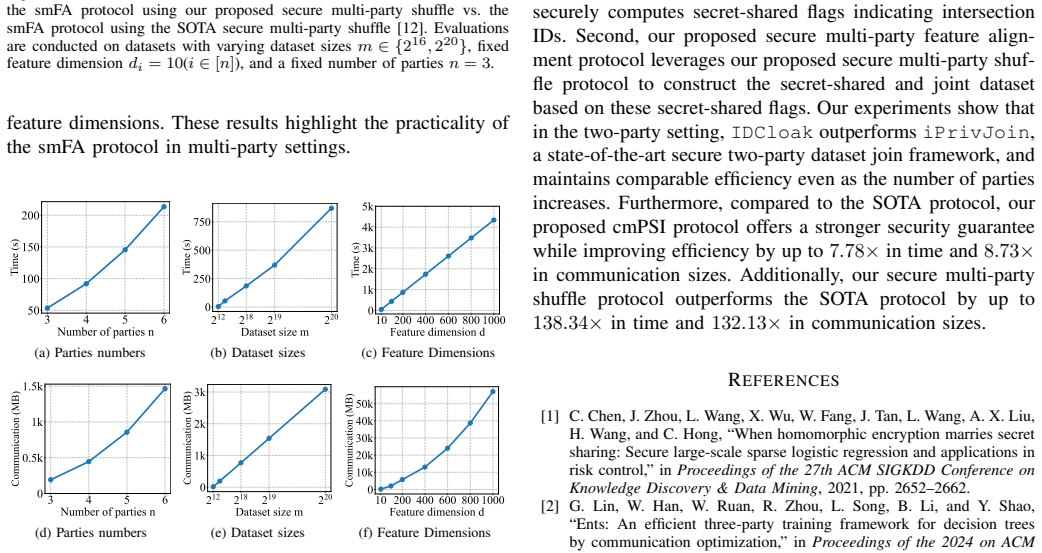
- The proposed shuffle reduces per-party communication for feature alignment from $O(ndlm\log m)$ to $O(ndlm)$, which is what makes the multi-party setting practical at large data sizes.
- IDCloak reveals only the intersection size $c$, and the paper argues this is sufficient for vPPML workflows to decide whether to continue training, so the privacy cost is bounded and explicit.
- The same two-protocol structure—secret-shared flags from cmPSI, then shuffle-based alignment—can be reused by other vertical PPML frameworks that accept additive secret-shared training data.
Reading between the lines
- A direct empirical test of the 3H-GCT OKVS would be to decode with thousands of non-input keys and measure whether the outputs are truly uniform over $Z_{2^{64}}$; any detectable bias would break the simulator's argument even if the high-level protocols are sound.
- The paper reuses OPRF outputs across cmPSI and smFA; if the two OKVS tables for the same ID are ever linkable, a coalition of $n-1$ parties might test membership of a candidate ID, so a composition proof that explicitly handles the two tables together is the crux to scrutinize.
- Since the scheme reveals intersection size and requires semi-honest behavior, a natural extension would be malicious-secure versions or threshold versions that hide $c$ when $c$ is small; the OKVS/OPRF structure seems compatible with both directions.
- The optimized communication tree is tuned to the time to send one OKVS table and the network delay, so in heterogeneous networks (parties with different bandwidths or latencies) the greedy grouping may need re-derivation; the paper's experiments assume symmetric links.
Editorial analysis
A structured set of objections, weighed in public.
Referee Report
Summary. The paper proposes IDCloak, a framework for secure multi-party dataset join in vertical privacy-preserving machine learning. It consists of two protocols: cmPSI, which uses OKVS and OPRF to compute secret-shared flags indicating intersection IDs while keeping IDs private, and smFA, which aligns features using a new secure multi-party shuffle and then removes redundant data based on reconstructed flags. The authors claim this is the first practical multi-party dataset-join framework that keeps IDs private without a non-colluding auxiliary server, and report large efficiency improvements over iPrivJoin, a prior cmPSI protocol, and an MP-SPDZ-based shuffle baseline. The paper includes open-source code, uses standard primitives with parameters inherited from prior work, and presents experiments on six real-world datasets with up to six parties.
Significance. If the security claims are substantiated, this is a strong practical contribution: it removes the non-colluding-server assumption, supports a dishonest majority of up to n-1 corrupted parties, and demonstrates orders-of-magnitude gains in shuffle communication and time. The manuscript is refreshingly concrete: the protocols are specified in detail, the code is public, the parameter choices are not tuned to the results, and the efficiency measurements are reported for realistic WAN/LAN settings. The main risk is that the central security proofs rest on OKVS properties that are asserted rather than proven for the concrete 3H-GCT instantiation, and the secure shuffle component lacks a formal security argument. These are fixable but currently load-bearing.
major comments (4)
- [Section IV-B and Section VI.A.2] The security proofs of Theorems 1 and 2 rely critically on the 3H-GCT OKVS instantiation satisfying 'double obliviousness' and 'random decoding' as defined in Definition 2. In the proofs, the honest party's real OKVS table is replaced by a uniformly random string (Theorem 1, Hybrid 2; Theorem 2, Hybrid 1), which is only valid if decoding an encoding with any non-input key yields a value indistinguishable from uniform. The paper asserts these properties for the abstraction, but neither proves them for the concrete 3H-GCT construction nor provides an empirical validation, such as a statistical test of Decode(S,k) over many non-input keys. This is not a cosmetic gap: if there exists a non-input key whose probed positions cancel or decode to a fixed value, a corrupted P1 could distinguish true matches from non-matches in cmPSI and test membership guesses in smFA, directly breaking ID privacy. The manuscript should either supply a proof (or a precise theorem from a cited reference) that 3H-GCT satisfies random decoding and double obliviousness, or add an empirical validation for the chosen parameters. This is the core of the security claim and must be resolved before the theorems can be accepted.
- [Section V.B, Theorem 1, and Section V.C, Theorem 2] The proofs of Theorems 1 and 2 claim that the OKVS substitution yields transcripts that are 'statistically indistinguishable' from real ones. However, the OKVS obliviousness properties in Section IV-B are defined with respect to a 'computational adversary' and are therefore computational notions. Statistical indistinguishability would require the actual distribution of the honest party's OKVS table to be exactly (or nearly) uniform, which is a stronger property than computational obliviousness. The paper does not establish this stronger property for 3H-GCT. The authors should either prove that the concrete OKVS is statistically oblivious (and state the resulting security parameter) or revise the hybrids to claim computational indistinguishability in the standard simulation-based sense. As written, the proof's stated security notion does not match the primitives' properties.
- [Section V.C, Protocol 2 and Theorem 2] The secure multi-party shuffle protocol ΠsmShuffle (Protocol 2) is a central component of smFA, and Theorem 2's security depends on it, yet no formal security proof is provided for Protocol 2, and the proof sketch of Theorem 2 does not describe how the shuffle messages are simulated in the hybrid argument. For example, in Case 1 (P1 corrupted), the corrupted parties' view includes all messages exchanged in ΠsmShuffle, but the proof only states that the simulator 'can pick shares of random value' and does not account for the sequential rounds in which each party sends masked values W^{i',i} and permutation-dependent updates. Without a proof that ΠsmShuffle realizes FsmShuffle (or a reduction to the security of ΠO−Shuffle), the security of IDCloak's feature-alignment phase is incomplete. The authors should either provide a full security proof for Protocol 2 or explicitly prove Theorem 2 in a model where FsmShuffle is an ideal functionality used as a hybrid.
- [Section VI.D, Table VII and Figure 11] The headline shuffle speedups (up to 138.34x in time and 132.13x in communication) are computed from 'online time' only, as stated in the header of Table VII. The offline phase of Protocol 2 includes multiple invocations of ΠO−Shuffle, random mask generation, and setup that may be substantial; the paper does not report these costs or compare total (offline+online) time with the MP-SPDZ baseline. If the offline costs are non-negligible, the claimed end-to-end improvement could be significantly smaller. The authors should report offline, online, and total time and communication for both IDCloak's shuffle and the baseline, or justify clearly why an online-only comparison is the relevant metric for the target application.
minor comments (5)
- [Section V.B, Theorem 1, Case 2, Hybrid 1] The text says 'the OPPF execution is replaced by the OPRF sender's simulator'; 'OPPF' should be 'OPRF'.
- [Section V.C.2, Equation (1)] Equation (1) has mismatched parentheses: after 'Decode(S, F_{k_i}(id^1||j))' there is an opening parenthesis before 'H_o' that is never closed on the same line. Also, the notation v^i is used in the equation while the text uses V^i_f; please unify.
- [Section IV.B, Definition 2] In Definition 2, the input length is denoted m but the set is written as {i ∈ [n]}; should be {i ∈ [m]} for consistency with the rest of the paper.
- [Section V.A] In the setup phase, the notation for the transformed ID is ambiguous: the text says ID^1[j] = (id^1||j), but later uses ID^1[j] as the key in OPRF; it would help to explicitly define that keys are the concatenated bit-strings with the bin index, and that the bin index is encoded in a fixed-length field to avoid collisions.
- [Section VI.D, Table VII] The table formatting for the MP-SPDZ baseline entries (e.g., '12484.92' and '249687.80') appears to run together with the adjacent column; please add explicit separators to improve readability.
Circularity Check
No significant circularity: IDCloak's security claims invoke independently established OKVS/OPRF properties, and its efficiency gains are measured rather than derived from fitted parameters.
full rationale
The paper's central claims are not circular in any of the enumerated senses. The security proofs of Theorems 1 and 2 rely on the OKVS properties of 'double obliviousness' and 'random decoding' stated in Section IV-B. These properties are not introduced by this paper as assumptions tailored to make its conclusions true; they are attributed to prior independent work ([18]–[20]), and the concrete 3H-GCT instantiation is explicitly taken from Rindal and Raghuraman [20], whose authors do not overlap with the present paper. A proof step that invokes a stated, cited primitive property is a standard reduction, not a self-referential derivation. The reader's skeptical concern—that the concrete 3H-GCT instantiation may not fully realize 'random decoding' or 'double obliviousness'—is a legitimate verification/correctness risk, but it is not circularity: the paper does not redefine those properties in terms of the protocol's own outputs, nor does it fit parameters to force its security claims. Similarly, the performance claims (7.78x/8.73x cmPSI improvements and 138.34x/132.13x shuffle improvements) are empirical measurements against baselines under stated network settings and dataset sizes, not predictions obtained from a fitted model. The only self-citation in the paper is reference [2] (an earlier decision-tree training framework by overlapping authors), and it is used only as an example application of vPPML, not as load-bearing evidence for IDCloak's security or efficiency. No parameter is fitted to make any headline result come out, and no known empirical result is renamed as a new protocol. Therefore the appropriate circularity score is 0.
Assumptions & free parameters
free parameters (4)
- Cuckoo hash table size b =
b = 1.27m
- Number of hash functions h =
3
- OKVS cluster size and weight =
2^14 and 3
- Security and statistical parameters =
kappa=128, lambda=40, l=64
assumptions (6)
- domain assumption Semi-honest simulation-based security model (Definition 1)
- standard math Random oracle model for OPRF and Ho
- standard math OKVS obliviousness, double obliviousness, and random decoding
- domain assumption Security of two-party oblivious shuffle O-Shuffle from [10]
- domain assumption Equal dataset size m across parties
- domain assumption Stash-free cuckoo hashing success probability
Cite this review
Pith. "Pith review of IDCloak: A Practical Secure Multi-party Dataset Join Framework for Vertical Privacy-preserving Machine Learning." pith.science (2026). https://pith.science/paper/V2QY4IIB
@misc{pith2026250601072,
  author       = {Pith},
  title        = {Pith review of: IDCloak: A Practical Secure Multi-party Dataset Join Framework for Vertical Privacy-preserving Machine Learning},
  year         = {2026},
  howpublished = {\url{https://pith.science/paper/V2QY4IIB}},
  note         = {Machine review of arXiv:2506.01072}
}
abstract
Vertical privacy-preserving machine learning (vPPML) enables multiple parties to train models on their vertically distributed datasets while keeping datasets private. In vPPML, it is critical to perform the secure dataset join, which aligns features corresponding to intersection IDs across datasets and forms a secret-shared and joint training dataset. However, existing methods for this step could be impractical due to: (1) they are insecure when they expose intersection IDs; or (2) they rely on a strong trust assumption requiring a non-colluding auxiliary server; or (3) they are limited to the two-party setting. This paper proposes IDCloak, the first practical secure multi-party dataset join framework for vPPML that keeps IDs private without a non-colluding auxiliary server. IDCloak consists of two protocols: (1) a circuit-based multi-party private set intersection protocol (cmPSI), which obtains secret-shared flags indicating intersection IDs via an optimized communication structure combining OKVS and OPRF; (2) a secure multi-party feature alignment protocol, which obtains the secret-shared and joint dataset using secret-shared flags, via our proposed efficient secure shuffle protocol. Experiments show that: (1) compared to the state-of-the-art secure two-party dataset join framework (iPrivjoin), IDCloak demonstrates higher efficiency in the two-party setting and comparable performance when the party number increases; (2) compared to the state-of-the-art cmPSI protocol under honest majority, our proposed cmPSI protocol provides a stronger security guarantee (dishonest majority) while improving efficiency by up to $7.78\times$ in time and $8.73\times$ in communication sizes; (3) our proposed secure shuffle protocol outperforms the state-of-the-art shuffle protocol by up to $138.34\times$ in time and $132.13\times$ in communication sizes.
Figures


Figures from the paper (8 more)


Reference graph
Works this paper leans on
-
[1]
C. Chen, J. Zhou, L. Wang, X. Wu, W. Fang, J. Tan, L. Wang, A. X. Liu, H. Wang, and C. Hong, “When homomorphic encryption marries secret sharing: Secure large-scale sparse logistic regression and applications in risk control,” in Proceedings of the 27th ACM SIGKDD Conference on Knowledge Discovery & Data Mining , 2021, pp. 2652–2662
work page 2021
-
[2]
Ents: An efficient three-party training framework for decision trees by communication optimization,
G. Lin, W. Han, W. Ruan, R. Zhou, L. Song, B. Li, and Y . Shao, “Ents: An efficient three-party training framework for decision trees by communication optimization,” in Proceedings of the 2024 on ACM SIGSAC Conference on Computer and Communications Security , 2024, pp. 4376–4390
work page 2024
-
[3]
Secureml: A system for scalable privacy- preserving machine learning,
P. Mohassel and Y . Zhang, “Secureml: A system for scalable privacy- preserving machine learning,” in 2017 IEEE symposium on security and privacy (SP). IEEE, 2017, pp. 19–38
work page 2017
-
[4]
Practi- cal multi-party private set intersection from symmetric-key techniques,
V . Kolesnikov, N. Matania, B. Pinkas, M. Rosulek, and N. Trieu, “Practi- cal multi-party private set intersection from symmetric-key techniques,” in Proceedings of the 2017 ACM SIGSAC Conference on Computer and Communications Security, 2017, pp. 1257–1272
work page 2017
-
[5]
Scalable private set intersection based on ot extension,
B. Pinkas, T. Schneider, and M. Zohner, “Scalable private set intersection based on ot extension,” ACM Transactions on Privacy and Security (TOPS), vol. 21, no. 2, pp. 1–35, 2018
work page 2018
-
[6]
Multi-party private set intersection protocols for practical applications
A. Bay, Z. Erkin, M. Alishahi, and J. V os, “Multi-party private set intersection protocols for practical applications.” in SECRYPT, 2021, pp. 515–522
work page 2021
-
[7]
O-Ring and K-Star: Efficient multi- party private set intersection,
M. Wu, T. H. Yuen, and K. Y . Chan, “O-Ring and K-Star: Efficient multi- party private set intersection,” in 33rd USENIX Security Symposium (USENIX Security 24) . Philadelphia, PA: USENIX Association, Aug. 2024, pp. 6489–6506
work page 2024
-
[8]
Comprehensive analysis of privacy leakage in vertical federated learning during prediction
X. Jiang, X. Zhou, and J. Grossklags, “Comprehensive analysis of privacy leakage in vertical federated learning during prediction.” Proc. Priv. Enhancing Technol., vol. 2022, no. 2, pp. 263–281, 2022
work page 2022
Show all 34 references
-
[9]
Peafowl: Private entity alignment in multi-party privacy-preserving machine learning,
Y . Gao, H. Deng, Z. Zhu, X. Chen, Y . Xie, P. Duan, and P. Chen, “Peafowl: Private entity alignment in multi-party privacy-preserving machine learning,” IEEE Transactions on Information Forensics and Security, vol. 20, pp. 2706–2720, 2025
2025
-
[10]
iprivjoin: An id-private data join framework for privacy-preserving machine learning,
Y . Liu, B. Zhang, Y . Ma, Z. Ma, and Z. Wu, “iprivjoin: An id-private data join framework for privacy-preserving machine learning,” IEEE Transactions on Information Forensics and Security , 2023
2023
-
[11]
Circuit-psi with linear complexity via relaxed batch opprf,
N. Chandran, D. Gupta, and A. Shah, “Circuit-psi with linear complexity via relaxed batch opprf,” Cryptology ePrint Archive , 2021. 13
2021
-
[12]
MP-SPDZ: A versatile framework for multi-party computa- tion,
M. Keller, “MP-SPDZ: A versatile framework for multi-party computa- tion,” in Proceedings of the 2020 ACM SIGSAC Conference on Computer and Communications Security , 2020
2020
-
[13]
Efficient scalable multiparty private set-intersection via garbled bloom filters,
R. Inbar, E. Omri, and B. Pinkas, “Efficient scalable multiparty private set-intersection via garbled bloom filters,” in Security and Cryptography for Networks: 11th International Conference, SCN 2018, Amalfi, Italy, September 5–7, 2018, Proceedings 11 . Springer, 2018, pp. 235–252
2018
-
[14]
Efficient scalable multi-party private set intersection using oblivious prf,
A. Kavousi, J. Mohajeri, and M. Salmasizadeh, “Efficient scalable multi-party private set intersection using oblivious prf,” in Security and Trust Management: 17th International Workshop, STM 2021, Darmstadt, Germany, October 8, 2021, Proceedings 17. Springer, 2021, pp. 81–99
2021
-
[15]
Practical multi-party private set intersection protocols,
A. Bay, Z. Erkin, J.-H. Hoepman, S. Samardjiska, and J. V os, “Practical multi-party private set intersection protocols,” IEEE Transactions on Information Forensics and Security , vol. 17, pp. 1–15, 2021
2021
-
[16]
O-ring and k-star: Efficient multi- party private set intersection,
M. Wu, T. H. Yuen, and K. Y . Chan, “O-ring and k-star: Efficient multi- party private set intersection,” in 33rd USENIX Security Symposium (USENIX Security 24) . USENIX Association, 2024
2024
-
[17]
Private set intersection: Are garbled circuits better than custom protocols?
Y . Huang, D. Evans, and J. Katz, “Private set intersection: Are garbled circuits better than custom protocols?” in NDSS, 2012
2012
-
[18]
V ole-psi: fast oprf and circuit-psi from vector-ole,
P. Rindal and P. Schoppmann, “V ole-psi: fast oprf and circuit-psi from vector-ole,” in Advances in Cryptology–EUROCRYPT 2021: 40th Annual International Conference on the Theory and Applications of Cryptographic Techniques, Zagreb, Croatia, October 17–21, 2021, Pro- ceedings, ...
2021
-
[19]
Obliv- ious key-value stores and amplification for private set intersection,
G. Garimella, B. Pinkas, M. Rosulek, N. Trieu, and A. Yanai, “Obliv- ious key-value stores and amplification for private set intersection,” in Advances in Cryptology–CRYPTO 2021: 41st Annual International Cryptology Conference, CRYPTO 2021, Virtual Event, August 16–20, 2021, P...
2021
-
[20]
Blazing fast psi from improved okvs and subfield vole
P. Rindal and S. Raghuraman, “Blazing fast psi from improved okvs and subfield vole.” IACR Cryptol. ePrint Arch. , vol. 2022, p. 320, 2022
2022
-
[21]
Secure-computation-friendly private set intersection from oblivious compact graph evaluation,
J. P. Ma and S. S. Chow, “Secure-computation-friendly private set intersection from oblivious compact graph evaluation,” in Proceedings of the 2022 ACM on Asia Conference on Computer and Communications Security, 2022, pp. 1086–1097
2022
-
[22]
Prism: Private verifiable set computation over multi-owner outsourced databases,
Y . Li, D. Ghosh, P. Gupta, S. Mehrotra, N. Panwar, and S. Sharma, “Prism: Private verifiable set computation over multi-owner outsourced databases,” in Proceedings of the 2021 International Conference on Management of Data , 2021, pp. 1116–1128
2021
-
[23]
Efficient linear multiparty psi and extensions to circuit/quorum psi,
N. Chandran, N. Dasgupta, D. Gupta, S. L. B. Obbattu, S. Sekar, and A. Shah, “Efficient linear multiparty psi and extensions to circuit/quorum psi,” in Proceedings of the 2021 ACM SIGSAC Conference on Computer and Communications Security , 2021, pp. 1182–1204
2021
-
[24]
Universally composable security: A new paradigm for cryptographic protocols,
R. Canetti, “Universally composable security: A new paradigm for cryptographic protocols,” in Proceedings 42nd IEEE Symposium on Foundations of Computer Science . IEEE, 2001, pp. 136–145
2001
-
[25]
Cuckoo hashing,
R. Pagh and F. F. Rodler, “Cuckoo hashing,” in Algorithms—ESA 2001: 9th Annual European Symposium ˚Arhus, Denmark, August 28–31, 2001 Proceedings. Springer, 2001, pp. 121–133
2001
-
[26]
Keyword search and oblivious pseudorandom functions,
M. J. Freedman, Y . Ishai, B. Pinkas, and O. Reingold, “Keyword search and oblivious pseudorandom functions,” in Theory of Cryptography: Second Theory of Cryptography Conference, TCC 2005, Cambridge, MA, USA, February 10-12, 2005. Proceedings 2 . Springer, 2005, pp. 303–324
2005
-
[27]
Aby-a framework for efficient mixed-protocol secure two-party computation
D. Demmler, T. Schneider, and M. Zohner, “Aby-a framework for efficient mixed-protocol secure two-party computation.” in NDSS, 2015
2015
-
[28]
Pir-psi: scaling private contact discovery,
D. Demmler, P. Rindal, M. Rosulek, and N. Trieu, “Pir-psi: scaling private contact discovery,” Cryptology ePrint Archive , 2018
2018
-
[29]
Aby3: A mixed protocol framework for machine learning,
P. Mohassel and P. Rindal, “Aby3: A mixed protocol framework for machine learning,” in Proceedings of the 2018 ACM SIGSAC conference on computer and communications security , 2018, pp. 35–52
2018
-
[30]
The uci machine learning repository,
M. Kelly, R. Longjohn, and K. Nottingham, “The uci machine learning repository,” 2023. [Online]. Available: https://archive.ics.uci.edu
2023
-
[31]
Give me some credit,
W. C. Credit Fusion, “Give me some credit,” 2011. [Online]. Available: https://kaggle.com/competitions/GiveMeSomeCredit
2011
-
[32]
A permutation network,
A. Waksman, “A permutation network,” Journal of the ACM (JACM) , vol. 15, no. 1, pp. 159–163, 1968
1968
-
[33]
The communication complexity of threshold private set intersection,
S. Ghosh and M. Simkin, “The communication complexity of threshold private set intersection,” inAdvances in Cryptology–CRYPTO 2019: 39th Annual International Cryptology Conference, Santa Barbara, CA, USA, August 18–22, 2019, Proceedings, Part II . Springer, 2019, pp. 3–29
2019
-
[34]
Multi- party threshold private set intersection with sublinear communication,
S. Badrinarayanan, P. Miao, S. Raghuraman, and P. Rindal, “Multi- party threshold private set intersection with sublinear communication,” in Public-Key Cryptography–PKC 2021: 24th IACR International Con- ference on Practice and Theory of Public Key Cryptography, Virtual Event,...
2021
Reviewed August 7, 2026 · model on record in the stance chip above.
Discussion (0). Sign in to comment.