REVIEW 3 major objections 5 minor 26 references
Choices and their Provenance: Explaining Stable Solutions of Abstract Argumentation Frameworks
T0 review · 3 major / 5 minor · reviewed 2026-08-07 · deepseek-v4-flash
Pith's one-line read Stable solutions of abstract argumentation frameworks can be explained by a minimal set of critical attacks: delete those attacks and the chosen stable extension becomes the grounded extension of the repaired graph.
desk verdict A sensible incremental idea for explaining stable AF semantics, but the paper's own Clingo program doesn't actually implement Definition 16 as stated, and the undec-only restriction is unproven. read the letter →
The pith
A machine-rendered reading of the paper's core claim, the machinery that carries it, and where it could break.
The reading
What carries the argument
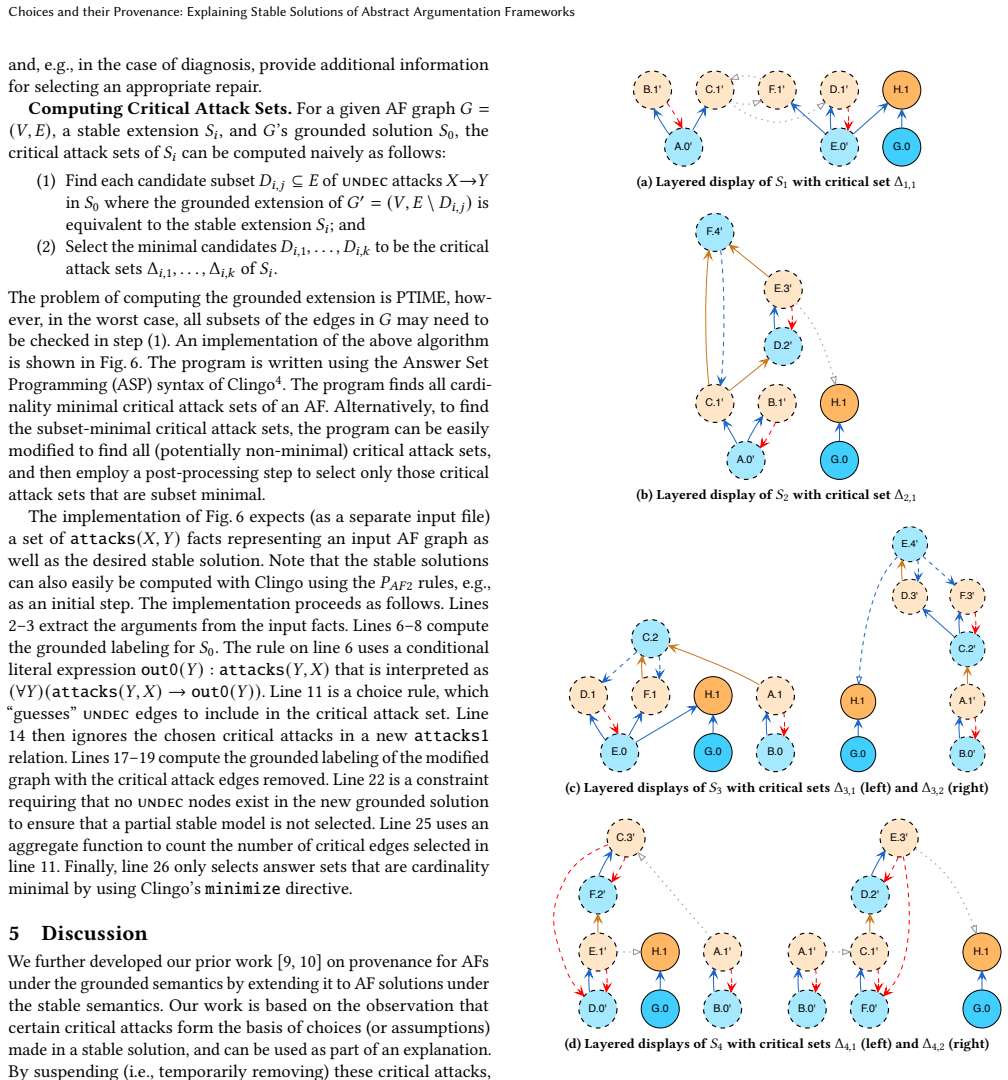
The central object is the critical attack set (Definition 16): a minimal set $\Delta_{i,j}$ of attack edges such that a chosen stable extension $S_i$ is the grounded extension of the framework with those edges removed, $G'=(V,E\setminus \Delta_{i,j})$. This definition lets the authors transfer the well-founded game provenance of grounded semantics—optimal argument lengths, and edge types such as primary and secondary successful attacks, failed attacks, undecided attacks, and blunders—to stable solutions via a provenance overlay, in which undecided arguments are recolored by their stable verdict and lengths are taken from the repaired grounded labeling. Computationally, the search is a generate-and-test loop written in Clingo: the choice rule at line 11 guesses a subset of undec-to-undec attacks, lines 17–19 recompute the grounded labeling of the reduced graph, and the constraint at line 22 plus the minimize directive at line 26 select cardinality-minimal critical attack sets.
What would settle it
Construct a finite AF and a stable extension $S$ such that every set of attacks whose deletion makes $S$ the grounded extension contains at least one attack with an endpoint labeled in or out in the original grounded labeling; running the Clingo program of Fig. 6 would then return no critical attack set, contradicting the promise that such a minimal set exists for the stable solution.
Extended reading notes
Core claim
The paper's central discovery is that the non-deterministic part of stable semantics can be localized and made well-founded. Concretely, for a framework $G=(V,E)$ with grounded extension $S_0$ and a stable extension $S_i$, there exists a minimal set of attacks $\Delta_{i,j} \subseteq E$ such that $S_i$ is the grounded extension of the repaired framework $G'=(V, E \setminus \Delta_{i,j})$. The paper calls these sets critical attack sets; they identify exactly which attacks a stable solution discounts in order to turn its chosen 2-valued model into the unique skeptical solution. Because the repaired graph has a well-founded grounded labeling, the full game-based provenance machinery—argument lengths, primary and secondary successful attacks, failed attacks, and blunders—can be reused to annotate the stable solution as a provenance overlay. In the examples, different stable solutions of the same framework correspond to different minimal critical attack sets, such as suspending $C \to D$ versus $D \to C$ for the two stable models of a two-cycle, so the choice between alternative rational positions is made explicit.
Load-bearing premise
The load-bearing premise is that suspending only attacks whose two endpoints are both undecided in the original grounded labeling is always enough to turn a stable extension into the grounded extension; no lemma proves that a required repair could never involve an attack touching an already decided argument.
Editorial extensions
If this is right
- A stable solution together with a critical attack set can be re-expressed as the grounded well-founded solution of the graph with those attacks suspended, so the game-based provenance of grounded semantics—lengths, primary and secondary attacks, failed attacks—applies to stable semantics.
- The minimal critical attack sets expose the choices a stable model makes: alternative stable solutions of the same framework correspond to different minimal edge deletions, so the source of ambiguity is localized to specific edges.
- Provenance overlays give each argument in a stable solution a length and attack-type provenance drawn from the repaired grounded labeling, enabling the layered visualization and regular-path-query style inspection previously available only for grounded solutions.
- The Clingo implementation enumerates all cardinality-minimal critical attack sets for a finite AF and a given stable extension, and a variant that first finds all candidate sets and then post-filters yields subset-minimal sets, making diagnosis and minimal repair computable.
Reading between the lines
- The paper leaves open whether the undec-attacks-only restriction is complete; a natural benchmark is to search random AFs for a stable extension whose only repairs touch decided endpoints.
- The repair view yields a counterfactual reading—if the critical attacks were suspended, the stable model would be the unique grounded solution—which suggests connecting critical attack sets to counterfactual explanation frameworks for argumentation.
- Overlay lengths offer a secondary criterion for choosing among multiple minimal critical attack sets of the same stable solution, for example preferring the repair that minimizes the maximal derivation length.
Editorial analysis
A structured set of objections, weighed in public.
Referee Report
Summary. The paper proposes to explain stable extensions of abstract argumentation frameworks by identifying minimal sets of critical attacks whose removal makes the chosen stable extension equal to the grounded extension of the repaired framework. It defines provenance overlays that annotate stable solutions with grounded derivation lengths and critical edges, illustrates the idea on several examples (Figs. 1, 2, 4, 5), and gives a naive algorithm plus an ASP (Clingo) implementation (Fig. 6). The central claim is that every stable solution can be diagnosed as a well-founded solution of a minimally repaired graph, combining grounded derivation steps with explicit choice steps.
Significance. The notion of critical attack sets is appealing and goes beyond the authors' prior grounded-provenance work by making the nondeterministic choice component of stable semantics explicit. The paper ships concrete examples and a concrete ASP program, and the central definition does not rely on fitted parameters or self-derived benchmarks. If the correctness and completeness of the computation are established, the approach would provide a useful diagnostic tool for explaining ambiguity in AFs, with natural applications in legal reasoning and visualization. However, the current manuscript's computational core has a correctness gap and an unproven search-space restriction, so the central claim is not yet fully supported.
major comments (3)
- [Fig. 6, lines 17–22] The Clingo program does not enforce that the grounded labeling of the modified AF equals the target stable extension. Lines 17–19 compute the grounded labeling of G'=(V,E\critical), and line 22 only rejects candidates with any undec argument; there is no constraint relating the computed in/out labeling to the desired stable solution S_i. As a result, any deletion set that makes the grounded extension total is accepted, including sets that correspond to other stable extensions. For the AF of Fig. 1, both {C→D} and {D→C} make the grounded extension total, so both are returned as cardinality-minimal, although they correspond to the two different stable solutions S1 and S2. If the intended target constraints are assumed to be supplied externally, the listing is incomplete and the caption's claim that the program computes critical attack sets for a specified stable solution is misleading.
- [Section 4, step (1) and Fig. 6, line 11] The restriction of candidate critical attacks to edges whose endpoints are both undecided in the original grounded labeling is unproven. No lemma shows that every minimal critical attack set of a stable extension can be chosen from the undec-induced subgraph, nor that no repair outside this set is ever required. Since the algorithm enumerates only undec-undec edges, completeness of the computation depends on this missing result. The paper should either prove the restriction or remove it and adjust the search space accordingly.
- [Definition 16 and Fig. 6, line 26] The notion of minimality is ambiguous. Definition 16 says “minimal” without qualification, while the algorithm minimizes cardinality and the text mentions subset-minimal sets as an alternative. If the intended notion is subset-minimality, the #minimize directive in line 26 is insufficient because it selects only cardinality-minimal sets and can discard larger subset-minimal sets. The definition and the implementation should be aligned, and the paper should state explicitly which notion of minimality is used.
minor comments (5)
- [Section 4, Definition 16] The existence of a critical attack set for an arbitrary stable extension is asserted implicitly but never proved; a short argument (e.g., deleting all attacks from arguments outside S_i to arguments inside S_i) would make the definition self-contained.
- [Section 4, paragraph after Definition 16] The definition of a provenance overlay is informal; the notation for dashed labels, primed lengths, and the provenance-relevant edge types could be formalized so that the examples can be reproduced by readers.
- [Figure 3] The labels b-1, b-2, b-3 and n/a in the type graph are not explained in the text; a short explanation in the caption or surrounding prose would improve readability.
- [Section 5, related work] The comparison with Baumann and Ulbricht's explanation approach is high-level; a more precise account of the differences and overlaps would clarify the novelty of critical attack sets.
- [Fig. 6, comments] The source code comments contain spacing artifacts (e.g., “E li mi na te c an di da te s ol ut io ns” and “c r i t i c a l _ c n t”) that should be cleaned up.
Circularity Check
No circularity found: the critical-attack construction is defined and computed directly from the AF, with only background self-citation.
full rationale
The paper's central notion, Definition 16, defines a critical attack set as a minimal set of attacks whose deletion makes a specified stable extension the grounded extension of the repaired graph. The computation in Section 4 and Fig. 6 directly searches for such sets and evaluates grounded semantics on the repaired AF; it does not fit a parameter from the target and then rename that parameter as the output. The provenance/overlay machinery borrows language and background from the authors' prior game-provenance work, but the core claim about critical attacks is stated and computed from the AF itself rather than imported from those papers. The substantive caveat is a correctness/completeness issue, not a circularity one: Fig. 6 lines 17-22 only reject candidates leaving undecided arguments, and the printed listing does not show the constraints relating the repaired grounded extension to the selected stable solution. That is a gap in the algorithm as presented, but it is not a case of an output being definitionally equal to an input. There are no fitted inputs called predictions, no uniqueness theorems imported from the authors' previous work, and no reduction of the central derivation to a self-citation chain.
Assumptions & free parameters
assumptions (4)
- domain assumption The grounded extension is the well-founded model of P_AF1 and stable extensions are the stable models of P_AF1, following Dung (1995).
- ad hoc to paper For any stable extension S_i there exists a minimal set of attacks Delta whose deletion makes S_i the grounded extension of the modified AF.
- ad hoc to paper Only attacks between undecided arguments in the original grounded labeling need to be considered as candidate critical attacks.
- domain assumption The provenances for well-founded games transfer to grounded AF labelings as established in the authors' prior work [9,10].
Cite this review
Pith. "Pith review of Choices and their Provenance: Explaining Stable Solutions of Abstract Argumentation Frameworks." pith.science (2026). https://pith.science/paper/LBYNOFWG
@misc{pith2026250601087,
  author       = {Pith},
  title        = {Pith review of: Choices and their Provenance: Explaining Stable Solutions of Abstract Argumentation Frameworks},
  year         = {2026},
  howpublished = {\url{https://pith.science/paper/LBYNOFWG}},
  note         = {Machine review of arXiv:2506.01087}
}
abstract
The rule $\mathrm{Defeated}(x) \leftarrow \mathrm{Attacks}(y,x),\, \neg \, \mathrm{Defeated}(y)$, evaluated under the well-founded semantics (WFS), yields a unique 3-valued (skeptical) solution of an abstract argumentation framework (AF). An argument $x$ is defeated ($\mathrm{OUT}$) if there exists an undefeated argument $y$ that attacks it. For 2-valued (stable) solutions, this is the case iff $y$ is accepted ($\mathrm{IN}$), i.e., if all of $y$'s attackers are defeated. Under WFS, arguments that are neither accepted nor defeated are undecided ($\mathrm{UNDEC}$). As shown in prior work, well-founded solutions (a.k.a. grounded labelings) "explain themselves": The provenance of arguments is given by subgraphs (definable via regular path queries) rooted at the node of interest. This provenance is closely related to winning strategies of a two-player argumentation game. We present a novel approach for extending this provenance to stable AF solutions. Unlike grounded solutions, which can be constructed via a bottom-up alternating fixpoint procedure, stable models often involve non-deterministic choice as part of the search for models. Thus, the provenance of stable solutions is of a different nature, and reflects a more expressive generate & test paradigm. Our approach identifies minimal sets of critical attacks, pinpointing choices and assumptions made by a stable model. These critical attack edges provide additional insights into the provenance of an argument's status, combining well-founded derivation steps with choice steps. Our approach can be understood as a form of diagnosis that finds minimal "repairs" to an AF graph such that the well-founded solution of the repaired graph coincides with the desired stable model of the original AF graph.
Figures


Figures from the paper (3 more)


Reference graph
Works this paper leans on
-
[3]
R. Baumann, S. Doutre, J.-G. Mailly, and J.P. Wallner. 2021. Enforcement in Formal Argumentation. InHandbook of Formal Argumentation. Vol. 2. 445–510
work page 2021
-
[4]
R. Baumann and M. Ulbricht. 2021. Choices and their Consequences - Explaining Acceptable Sets in Abstract Argumentation Frameworks. InKR. 110–119
work page 2021
- [1]
- [2]
-
[5]
T. Bench-Capon. 2002. Representation of Case Law as an Argumentation Frame- work. InJURIX. 103–112
work page 2002
-
[6]
T. Bench-Capon. 2020. Before and after Dung: Argumentation in AI and Law. Argument & Computation.11, 1-2 (2020), 221–238
work page 2020
-
[7]
T. Bench-Capon and S. Modgil. 2009. Case law in extended argumentation frameworks. InICAIL. 118–127
work page 2009
-
[8]
A. Borg and F. Bex. 2024. Minimality, necessity and sufficiency for argumentation and explanation.Int. J. Approx. Reasoning168, C (May 2024)
work page 2024
Show all 26 references
-
[9]
Bowers, Y
S. Bowers, Y. Xia, and B. Ludäscher. 2024. The Skeptic’s Argumentation Game or: Well-Founded Explanations for Mere Mortals. InWorkshop on Systems and Algorithms for Formal Argumentation (SAFA) (CEUR, Vol. 3757). 104–118
2024
-
[10]
Bowers, Y
S. Bowers, Y. Xia, and B. Ludäscher. 2024. On the Structure of Game Provenance and its Applications. InTaPP. 602–609
2024
-
[11]
Cabrio and S
E. Cabrio and S. Villata. 2012. Combining Textual Entailment and Argumentation Theory for Supporting Online Debates Interactions. InAnnual Meeting of the Association for Computational Linguistics. 208–212
2012
-
[12]
Caminada
M. Caminada. 2006. On the Issue of Reinstatement in Argumentation. InLogics in Artificial Intelligence. 111–123
2006
-
[13]
Caminada
M. Caminada. 2018. Argumentation Semantics as Formal Discussion. See [ 2], Chapter 10, 487–518
2018
-
[14]
Caminada and P
M. Caminada and P. Dunne. 2020. Strong Admissibility Revisited: Theory and Applications.Argument & Computation10, 3 (2020), 277–300
2020
-
[15]
Caminada, S
M. Caminada, S. Sá, J. Alcântara, and W. Dvořák. 2015. On the Equivalence between Logic Programming Semantics and Argumentation Semantics.Approx. Reasoning58 (2015), 87–111
2015
-
[16]
P.M. Dung. 1995. On the Acceptability of Arguments and Its Fundamental Role in Nonmonotonic Reasoning, Logic Programming and n-Person Games.AI77, 2 (1995), 321–357
1995
-
[17]
Gelfond and V
M. Gelfond and V. Lifschitz. 1988. The Stable Model Semantics for Logic Pro- gramming. InILPS. 1070–1080
1988
-
[18]
Köhler, B
S. Köhler, B. Ludäscher, and D. Zinn. 2013. First-Order Provenance Games. InIn Search of Elegance in the Theory and Practice of Computation. 382–399
2013
-
[19]
Longo and L
L. Longo and L. Hederman. 2013. Argumentation Theory for Decision Support in Health-Care: A Comparison with Machine Learning. InBrain and Health Informatics. 168–180
2013
-
[20]
Ludäscher, S
B. Ludäscher, S. Bowers, and Y. Xia. 2023. Games, Queries, and Argumentation Frameworks: Towards a Family Reunion. InAdvances in Argumentation in AI, Vol. 3546. CEUR
2023
-
[21]
Odekerken, A.M
D. Odekerken, A.M. Borg, and M. Berthold. 2023. Demonstrating PyArg 2.0. In Advances in Argumentation in AI (AI 3), Vol. 3546. CEUR
2023
-
[22]
Rahwan and K
I. Rahwan and K. Larson. 2009.Argumentation and Game Theory. 321–339
2009
-
[23]
Van Gelder
A. Van Gelder. 1993. The Alternating Fixpoint of Logic Programs with Negation. J. Comput. System Sci.47, 1 (1993), 185–221
1993
-
[24]
Van Gelder, K.A
A. Van Gelder, K.A. Ross, and J.S. Schlipf. 1991. The Well-founded Semantics for General Logic Programs.J. ACM38, 3 (1991), 619–649
1991
-
[25]
Y. Xia, D. Odekerken, S. Bowers, and B. Ludäscher. 2024. Layered Visualization of Argumentation Frameworks. InCOMMA, Vol. 388. 373–374
2024
-
[26]
Y. Xia, H. Zheng, S. Bowers, and B. Ludäscher. 2025. AF-Xray: Visual Explanation and Resolution of Ambiguity in Legal Argumentation Frameworks. In20th Intl. Conf. on Artificial Intelligence and Law (ICAIL). https://github.com/idaks/xray
2025
Reviewed August 7, 2026 · model on record in the stance chip above.
Discussion (0). Sign in to comment.