REVIEW 2 major objections 5 minor 46 references
ReTern: Exploiting Natural Redundancy and Sign Transformations for Enhanced Fault Tolerance in Compute-in-Memory based Ternary LLMs
T0 review · 2 major / 5 minor · reviewed 2026-08-07 · deepseek-v4-flash
Pith's one-line read ReTern combines column-wise sign flips with a redundant bit-cell state to recover most perplexity lost to stuck-at faults in ternary LLMs, at under 3% energy overhead.
desk verdict A sound, modest extension of the authors' TFix work; the main caveat is that its headline fault-tolerance numbers apply only to feedforward weights under a hybrid architecture. read the letter →
The pith
A machine-rendered reading of the paper's core claim, the machinery that carries it, and where it could break.
The reading
What carries the argument
The load-bearing identity is the differential bit-cell encoding $W = M_1 - M_2$, where two binary memory elements realize three weight states and leave one unused state, 11, that behaves like the 00 zero state because equal discharges on both bitlines cancel. That redundancy is what zero-fix re-programs. The second mechanism is FAST, a per-column sign flip: for each column the algorithm measures $|w_{hw} - w_{ideal}|$ against $|w_{hw,flipped} + w_{ideal}|$ and stores the standard or negated column, tracked by a col_flip bit; the output subtractor then routes $x-y$ or $y-x$. Together they cover faults in both zero and non-zero weights, which is what makes the method work at the low sparsity levels of ternary LLMs.
What would settle it
Inject the same 5% and 10% stuck-at fault rates into the query, key, and value projection weights (or into the digital attention datapath) and re-run the Wikitext perplexity comparison; ReTern's reported improvements would shrink or disappear because FAST and zero-fix are applied only to the feedforward columns stored in TCiM arrays.
Extended reading notes
Core claim
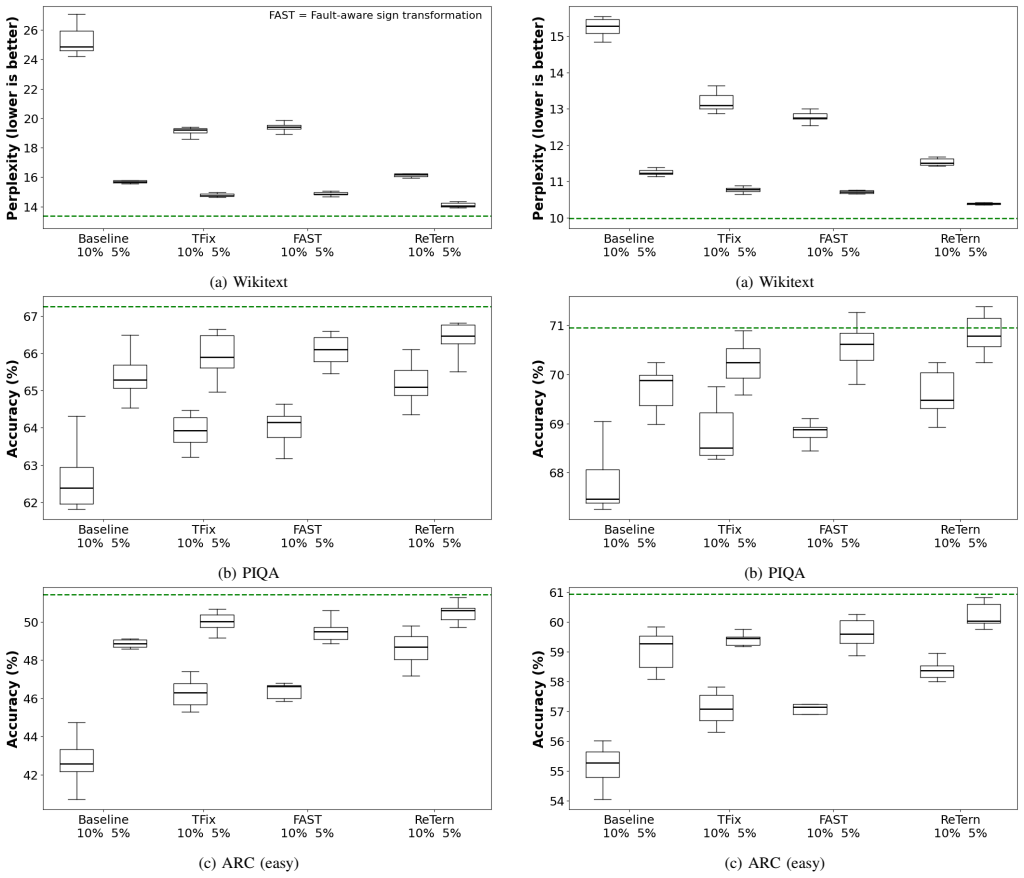
The paper's central claim is that combining per-column sign flipping with the unused '11' bit-cell state restores most of the accuracy that stuck-at faults take away from ternary LLMs, without retraining. A TCiM bitcell stores a ternary weight as $W = M_1 - M_2$ with two binary memory elements; the 11 state is functionally equivalent to 00 for the zero weight, giving a free second encoding. Zero-fix uses that redundancy to repair single faults in zero weights, while FAST compares, for each column, the summed $|w_{hw} - w_{ideal}|$ errors under the standard and negated encodings and picks the smaller, recording the choice in a one-bit col_flip vector whose output negation keeps the matrix multiply correct. Because zero-fix and FAST touch disjoint weight values, they compose cleanly. The paper reports that this recovers roughly 35% (700M) and 25% (3B) of the Wikitext perplexity degradation at a 10% stuck-at-fault rate, with small accuracy gains on PIQA and ARC (easy).
Load-bearing premise
All stuck-at faults are assumed to hit only the feedforward-layer ternary weights stored in TCiM arrays, while self-attention runs on fault-free digital compute; if faults also corrupt attention weights or digital logic, the reported 35% and 25% perplexity improvements would not cover the full model.
Editorial extensions
If this is right
- Deploying ReTern on a 64x64 TCiM macro costs less than 3% energy, 7% latency, and 1% area, with the same peripheral structure across SRAM, ReRAM, and FeFET arrays.
- ReTern remains training-free and requires only the SAF diagnosis information plus the pre-trained weights; no fine-tuning or labeled data is needed.
- The technique should transfer in principle to other ternary precision models, including CNNs and transformers, because FAST is sparsity-independent and zero-fix simply uses the bit-cell redundancy.
- Because zero-fix and FAST act on disjoint weight sets (zeros versus ±1), the two steps can be applied in any order without interfering.
- Larger ternary LLMs (3B) already show more intrinsic tolerance to SAFs than the 700M model, and ReTern still adds a meaningful improvement on top.
Reading between the lines
- Editorial inference: because FAST operates at column granularity, its benefit should shrink as TCiM arrays get taller, since one sign flip must serve more weights; the paper acknowledges this trade-off but leaves it unquantified, so measuring perplexity recovery at 128 and 256 rows would directly probe the method's practical ceiling.
- Editorial inference: because SAFs are assumed absent from attention weights and digital logic, the 35% and 25% figures likely represent an upper bound for a fully analog implementation; extending FAST to dynamically generated Q/K/V matrices would require a different mechanism, since those weights are not static.
- Editorial inference: the col_flip vector is effectively one sign bit per column, so ReTern can be seen as recycling the unused bit-cell state plus a cheap per-column sign bit to buy fault tolerance, which suggests a natural comparison against column-level error-correcting codes with the same overhead.
- Editorial inference: a testable extension is to apply ReTern to 4-bit-activation ternary LLMs, where the activation quantizer changes the error landscape and may alter which column-flip choices are optimal.
Editorial analysis
A structured set of objections, weighed in public.
Referee Report
Summary. The paper proposes ReTern, a training-free post-mapping technique for mitigating stuck-at faults (SAFs) in ternary compute-in-memory (TCiM) accelerators used for ternary LLM inference. ReTern combines zero-fix, which re-encodes zero weights using an alternate redundant bitcell state, with fault-aware sign transformation (FAST), which flips the sign of an entire column of weights and compensates by negating the corresponding dot-product output. The authors evaluate the method on BitNet b1.58 700M and 3B models, using Wikitext perplexity and PIQA/ARC-easy accuracy, under randomly injected SAFs at 5% and 10% rates. They report a 35% relative improvement in Wikitext perplexity for the 700M model at 10% SAF, and macro-level hardware overheads of 2.0-2.2% energy, 3.2-6.6% latency, and <1% area across SRAM, ReRAM, and FeFET TCiM arrays.
Significance. The proposed technique is practically appealing because it is training-free, requires only two 2:1 multiplexers and a per-column flip register, and is evaluated on publicly available pretrained ternary LLMs across three tasks and two fault rates. The identification of TFix's limited effectiveness on low-sparsity ternary LLMs is a useful contribution, and the explicit combination of zero-fix and FAST is a simple but effective extension. If the results are reproducible, ReTern would be a strong candidate for SAF mitigation in edge TCiM LLM accelerators. However, the headline fault-tolerance numbers are obtained under a restricted fault model (feedforward-only SAFs), and the 'perplexity reduction' metric is not precisely defined, which limits the strength of the claims as stated.
major comments (2)
- [IV-A and Abstract/Conclusion] The fault model in Section IV-A injects SAFs only into feedforward-layer ternary weights, with self-attention layers assumed SAF-free and running on digital compute cores. This restriction is not stated in the abstract or the conclusion, where the results are summarized as applying to 'ternary LLMs' and 'TCiM accelerators' generally. Since BitNet b1.58 also contains ternarized attention projection weights, the reported 35%/25% figures cannot be interpreted as full-model SAF tolerance under a general TCiM mapping. Please add an explicit scope statement in the abstract and conclusion, or better, include an additional experiment or discussion that addresses SAFs in attention weights (e.g., a sensitivity study with attention arrays also faulted) to quantify the limitation.
- [IV-B] The text reports '35%' and '25%' reductions in Wikitext perplexity without specifying whether these are reductions in absolute perplexity from the faulty baseline or reductions in the SAF-induced perplexity degradation relative to the ideal model. These interpretations lead to different quantitative claims; for example, the 700M model at 10% SAF degrades from roughly 12 to roughly 26, so a 35% absolute reduction would give about 16.9, while a 35% reduction in degradation would give about 21.1. Please define the metric and report the underlying median or mean perplexity values (e.g., in a table) so that the claimed benefit can be verified unambiguously.
minor comments (5)
- [Algorithm 1 and Eq. (5)] The algorithm does not explicitly define whw_flipped before Eq. (5); please state that for the flipped option, the hardware-mapped weights are computed by applying the SAF map to -Wideal, and clarify the notation in the pseudocode.
- [Section III-A] The notation for zero-weight encodings is confusing: the text says the '11' state is referred to as '01'. Use explicit M1M2 bit-pattern notation throughout (e.g., 00 and 11) to avoid ambiguity about which memory element is programmed.
- [Section IV-B] The paper does not report confidence intervals or statistical significance for the 5% SAF-rate improvements, which appear to be small (6-10%); please indicate whether these differences are within the Monte Carlo variance shown in the box plots.
- [Section IV-C] The PTM reference [34] is given only as a URL with no document title; please provide a complete citation with title and access date.
- [Section II-D and Fig. 2] The sparsity comparison in Fig. 2 mixes previously reported sparsities from various ternary CNN/DNN models with the BitNet LLMs; since model architecture and sparsity definitions may differ, please state the source and definition of each sparsity value, and report feedforward-layer sparsity separately if that is where SAFs are injected.
Circularity Check
No significant circularity: ReTern's FAST and zero-fix are evaluated against independent perplexity and accuracy metrics, and the only reuse of prior self-authored work (TFix) is as a component and baseline, not as justification.
full rationale
The central claim is measured, not derived from a fitted target: Algorithm 1 selects column flips by comparing errstandard = Σ|whw − wideal| with errflipped = Σ|whw_flipped + wideal| (Eqs. 4–5), and Section IV-B then reports Wikitext perplexity, PIQA, and ARC (easy) results after fault injection. No parameter is fitted to the perplexity metric itself, so the reported 35% and 25% reductions are not forced by construction. The zero-fix component is attributed to the authors' prior TFix [21], but the manuscript independently explains the mechanism ('the 11 state would produce a voltage drop of Δ on both BL1 and BL2 ... cancel out'), and TFix is explicitly used as a baseline in the experiments; this is component reuse rather than load-bearing self-citation. The main caveat, that SAFs are injected only into feedforward-layer ternary weights while self-attention runs fault-free on digital cores (Section IV-A), limits the generality of the fault-tolerance claim but is a scope and correctness concern rather than a circularity. Overall, the derivation chain is self-contained and the empirical evaluation is independent of the optimization objective.
Assumptions & free parameters
assumptions (5)
- domain assumption Two binary memory elements per ternary weight with W = M1 - M2, and the unused '11' state is functionally equivalent to zero.
- domain assumption SAFs are randomly and uniformly distributed across array cells, and only unmasked faults (where stored value differs from stuck state) corrupt output.
- domain assumption Fault diagnosis is exact, providing correct position and type of every SAF before mapping.
- domain assumption All SAFs occur only in feedforward-layer weights stored in TCiM; self-attention runs on fault-free digital cores.
- domain assumption Hardware peripheral and memory models (PTM, NeuroSim, compact ReRAM/FeFET models) accurately represent 7nm TCiM energy, latency, and area.
Cite this review
Pith. "Pith review of ReTern: Exploiting Natural Redundancy and Sign Transformations for Enhanced Fault Tolerance in Compute-in-Memory based Ternary LLMs." pith.science (2026). https://pith.science/paper/CXRXOPWZ
@misc{pith2026250601140,
  author       = {Pith},
  title        = {Pith review of: ReTern: Exploiting Natural Redundancy and Sign Transformations for Enhanced Fault Tolerance in Compute-in-Memory based Ternary LLMs},
  year         = {2026},
  howpublished = {\url{https://pith.science/paper/CXRXOPWZ}},
  note         = {Machine review of arXiv:2506.01140}
}
read the original abstract
Ternary large language models (LLMs), which utilize ternary precision weights and 8-bit activations, have demonstrated competitive performance while significantly reducing the high computational and memory requirements of full-precision LLMs. The energy efficiency and performance of Ternary LLMs can be further improved by deploying them on ternary computing-in-memory (TCiM) accelerators, thereby alleviating the von-Neumann bottleneck. However, TCiM accelerators are prone to memory stuck-at faults (SAFs) leading to degradation in the model accuracy. This is particularly severe for LLMs due to their low weight sparsity. To boost the SAF tolerance of TCiM accelerators, we propose ReTern that is based on (i) fault-aware sign transformations (FAST) and (ii) TCiM bit-cell reprogramming exploiting their natural redundancy. The key idea is to utilize FAST to minimize computations errors due to SAFs in +1/-1 weights, while the natural bit-cell redundancy is exploited to target SAFs in 0 weights (zero-fix). Our experiments on BitNet b1.58 700M and 3B ternary LLMs show that our technique furnishes significant fault tolerance, notably 35% reduction in perplexity on the Wikitext dataset in the presence of faults. These benefits come at the cost of < 3%, < 7%, and < 1% energy, latency and area overheads respectively.
Figures


Figures from the paper (2 more)

Reference graph
Works this paper leans on
-
[33]
S. Jain et al., “A heterogeneous and programmable compute-in-memory accelerator architecture for analog-ai using dense 2-d mesh,” IEEE Transactions on Very Large Scale Integration (VLSI) Systems , vol. 31, no. 1, pp. 114–127, 2023
work page 2023
-
[19]
Handling stuck-at- faults in memristor crossbar arrays using matrix transformations,
B. Zhang, N. Uysal, D. Fan, and R. Ewetz, “Handling stuck-at- faults in memristor crossbar arrays using matrix transformations,” in Proceedings of the 24th Asia and South Pacific Design Automation Conference, ser. ASPDAC ’19. New York, NY , USA: Association for Computing Machinery, 2019, p. 438–443. [Online]. Available: https://doi.org/10.1145/3287624.3287707
-
[20]
Zero-Space Cost Fault Tolerance for Transformer-based Language Models on ReRAM
B. Li et al. , “Zero-space cost fault tolerance for transformer- based language models on reram,” 2024. [Online]. Available: https://arxiv.org/abs/2401.11664
work page Pith review arXiv 2024
-
[1]
From words to watts: Benchmarking the energy costs of large language model inference,
S. Samsi et al., “From words to watts: Benchmarking the energy costs of large language model inference,” in 2023 IEEE High Performance Extreme Computing Conference (HPEC) , 2023, pp. 1–9
work page 2023
-
[2]
Pim gpt a hybrid process in memory accelerator for autoregressive transformers,
Y . Wu, Z. Wang, and W. D. Lu, “Pim gpt a hybrid process in memory accelerator for autoregressive transformers,” npj Unconventional Computing, vol. 1, no. 1, p. 4, Jul 2024. [Online]. Available: https://doi.org/10.1038/s44335-024-00004-2
-
[3]
Transpim: A memory- based acceleration via software-hardware co-design for transformer,
M. Zhou, W. Xu, J. Kang, and T. Rosing, “Transpim: A memory- based acceleration via software-hardware co-design for transformer,” in 2022 IEEE International Symposium on High-Performance Computer Architecture (HPCA), 2022, pp. 1071–1085
work page 2022
-
[4]
S. Liu et al., “Hardsea: Hybrid analog-reram clustering and digital-sram in-memory computing accelerator for dynamic sparse self-attention in transformer,” IEEE Transactions on Very Large Scale Integration (VLSI) Systems, vol. 32, no. 2, pp. 269–282, 2024
work page 2024
-
[5]
J. B ¨uchel et al. , “Efficient scaling of large language models with mixture of experts and 3d analog in-memory computing,” Nature Computational Science , vol. 5, no. 1, pp. 13–26, Jan 2025. [Online]. Available: https://doi.org/10.1038/s43588-024-00753-x
Show all 46 references
-
[6]
Paretoq: Scaling laws in extremely low-bit llm quantiza- tion,
Z. Liu et al., “Paretoq: Scaling laws in extremely low-bit llm quantiza- tion,” arXiv preprint arXiv:2502.02631 , 2025
2025
-
[7]
Bitnet: Scaling 1-bit transformers for large language models,
H. Wang, S. Ma, L. Dong, S. Huang, H. Wang, L. Ma, F. Yang, R. Wang, Y . Wu, and F. Wei, “Bitnet: Scaling 1-bit transformers for large language models,” 2023. [Online]. Available: https://arxiv.org/abs/2310.11453
2023 arXiv
-
[8]
The era of 1-bit llms: All large language models are in 1.58 bits,
S. Ma et al. , “The era of 1-bit llms: All large language models are in 1.58 bits,” 2024. [Online]. Available: https://arxiv.org/abs/2402.17764
2024 arXiv
-
[9]
Bitnet a4.8: 4-bit activations for 1-bit llms,
H. Wang, S. Ma, and F. Wei, “Bitnet a4.8: 4-bit activations for 1-bit llms,” 2024. [Online]. Available: https://arxiv.org/abs/2411.04965
2024 arXiv
-
[10]
Site cim: Signed ternary computing-in-memory for ultra-low precision deep neural networks,
N. Thakuria, A. Malhotra, S. K. Thirumala, R. Elangovan, A. Raghunathan, and S. K. Gupta, “Site cim: Signed ternary computing-in-memory for ultra-low precision deep neural networks,”
-
[11]
Tim-dnn: Ternary in-memory accelerator for deep neural networks,
S. Jain, S. K. Gupta, and A. Raghunathan, “Tim-dnn: Ternary in-memory accelerator for deep neural networks,” IEEE Transactions on Very Large Scale Integration (VLSI) Systems , vol. 28, no. 7, pp. 1567–1577, 2020
2020
-
[12]
A ternary neural net- work computing-in-memory processor with 16t1c bitcell architecture,
H. Jeong, S. Kim, K. Park, J. Jung, and K. J. Lee, “A ternary neural net- work computing-in-memory processor with 16t1c bitcell architecture,” IEEE Transactions on Circuits and Systems II: Express Briefs , vol. 70, no. 5, pp. 1739–1743, 2023
2023
-
[13]
A 2941-tops/w charge-domain 10t sram compute-in- memory for ternary neural network,
S. Cheon et al. , “A 2941-tops/w charge-domain 10t sram compute-in- memory for ternary neural network,” IEEE Transactions on Circuits and Systems I: Regular Papers , vol. 70, no. 5, pp. 2085–2097, 2023
2023
-
[14]
Drop-connect as a fault-tolerance approach for rram- based deep neural network accelerators,
M. Xiang et al., “Drop-connect as a fault-tolerance approach for rram- based deep neural network accelerators,” in 2024 IEEE 42nd VLSI Test Symposium (VTS), 2024, pp. 1–7
2024
-
[15]
Fault-tolerant training with on-line fault detection for rram-based neural computing systems,
L. Xia, M. Liu, X. Ning, K. Chakrabarty, and Y . Wang, “Fault-tolerant training with on-line fault detection for rram-based neural computing systems,” in 2017 54th ACM/EDAC/IEEE Design Automation Confer- ence (DAC), 2017, pp. 1–6
2017
-
[16]
Artificial Intelligence Index Report 2024,
Stanford University, “Artificial Intelligence Index Report 2024,” 2024, accessed: 2025-02-25. [Online]. Available: https://aiindex.stanford.edu/ wp-content/uploads/2024/04/HAI 2024 AI-Index-Report.pdf
2024
-
[17]
Wesco: Weight-encoded reliability and security co-design for in- memory computing systems,
J. Zhang, C. Wang, Y . Cai, Z. Zhu, D. Kline, H. Yang, and Y . Wang, “Wesco: Weight-encoded reliability and security co-design for in- memory computing systems,” in 2022 IEEE Computer Society Annual Symposium on VLSI (ISVLSI) , 2022, pp. 296–301
2022
-
[18]
Fault-free: A framework for analysis and mitigation of stuck-at-fault on realistic reram-based dnn accelerators,
H. Shin et al., “Fault-free: A framework for analysis and mitigation of stuck-at-fault on realistic reram-based dnn accelerators,” IEEE Transac- tions on Computers , vol. 72, no. 7, pp. 2011–2024, 2023
2011
-
[21]
Tfix: Exploiting the natural redundancy of ternary neural networks for fault tolerant in-memory vec- tor matrix multiplication,
A. Malhotra, C. Wang, and S. K. Gupta, “Tfix: Exploiting the natural redundancy of ternary neural networks for fault tolerant in-memory vec- tor matrix multiplication,” in 2023 60th ACM/IEEE Design Automation Conference (DAC), 2023, pp. 1–6
2023
-
[22]
Learning sparse & ternary neural networks with entropy-constrained trained ternarization (ec2t),
A. Marban et al. , “Learning sparse & ternary neural networks with entropy-constrained trained ternarization (ec2t),” in 2020 IEEE/CVF Conf. on Computer Vision and Pattern Recognition Workshops , 2020
2020
-
[23]
FAT: An in-memory accelerator with fast addition for ternary weight neural networks,
S. Zhu et al. , “FAT: An in-memory accelerator with fast addition for ternary weight neural networks,” IEEE Transactions on Computer-Aided Design of Integrated Circuits and Systems , 2022
2022
-
[24]
Nonvolatile multistates memories for high-density data storage,
Q. Cao et al. , “Nonvolatile multistates memories for high-density data storage,” ACS Appl. Mater. Interfaces, vol. 12, no. 38, pp. 42 449–42 471, Sep. 2020
2020
-
[25]
Stuck-at fault tolerance in rram computing systems,
L. Xia et al., “Stuck-at fault tolerance in rram computing systems,” IEEE Journal on Emerging and Selected Topics in Circuits and Systems, vol. 8, no. 1, pp. 102–115, 2018
2018
-
[26]
Analog computing for AI sometimes needs correction by digital computing: Why and when,
C. Kim, D. Yoon, T. Kim, Y . Jeong, K. Kim, K. Koh, and E. Pak, “Analog computing for AI sometimes needs correction by digital computing: Why and when,” in NeurIPS 2024 Workshop Machine Learning with new Compute Paradigms , 2024. [Online]. Available: https://openreview.net/for...
2024
-
[27]
Rtn: Reparameterized ternary network,
Y . Li et al. , “Rtn: Reparameterized ternary network,” Proceedings of the AAAI Conference on Artificial Intelligence , vol. 34, no. 04, pp. 4780–4787, Apr. 2020. [Online]. Available: https://ojs.aaai.org/index. php/AAAI/article/view/5912
2020
-
[28]
Rram defect modeling and failure analysis based on march test and a novel squeeze-search scheme,
C.-Y . Chen, H.-C. Shih, C.-W. Wu, C.-H. Lin, P.-F. Chiu, S.-S. Sheu, and F. T. Chen, “Rram defect modeling and failure analysis based on march test and a novel squeeze-search scheme,” IEEE Transactions on Computers, vol. 64, no. 1, pp. 180–190, 2015
2015
-
[29]
Bitnet b1.58-large,
1bitLLM, “Bitnet b1.58-large,” https://huggingface.co/1bitLLM/bitnet b1 58-large, accessed: 2025-03-07
2025
-
[30]
Bitnet b1.58-3b,
——, “Bitnet b1.58-3b,” https://huggingface.co/1bitLLM/bitnet b1 58-3B, accessed: 2025-03-07
2025
-
[31]
Piqa: Reasoning about physical commonsense in natural language,
Y . Bisk, R. Zellers, R. L. Bras, J. Gao, and Y . Choi, “Piqa: Reasoning about physical commonsense in natural language,” 2019. [Online]. Available: https://arxiv.org/abs/1911.11641
2019 arXiv
-
[32]
Think you have solved question answering? try arc, the ai2 reasoning challenge,
P. Clark et al. , “Think you have solved question answering? try arc, the ai2 reasoning challenge,” 2018. [Online]. Available: https://arxiv.org/abs/1803.05457
2018 arXiv
-
[34]
[Online]
Accessed: August 2024. [Online]. Available: https://asap.asu.edu/
2024
-
[35]
A compact model for metal–oxide resistive random access memory with experiment verification,
Z. Jiang et al. , “A compact model for metal–oxide resistive random access memory with experiment verification,” IEEE Transactions on Electron Devices, vol. 63, no. 5, pp. 1884–1892, 2016
2016
-
[36]
Modeling and comparative analysis of hysteretic ferroelectric and anti-ferroelectric fets,
A. K. Saha and S. K. Gupta, “Modeling and comparative analysis of hysteretic ferroelectric and anti-ferroelectric fets,” in 2018 76th Device Research Conference (DRC), 2018, pp. 1–2
2018
-
[37]
In-memory computing primitive for sensor data fusion in 28 nm hkmg fefet technology,
K. Ni et al. , “In-memory computing primitive for sensor data fusion in 28 nm hkmg fefet technology,” in 2018 IEEE International Electron Devices Meeting (IEDM) , 2018, pp. 16.1.1–16.1.4
2018
-
[38]
Ferroelectric thickness dependent domain interactions in fefets for memory and logic: A phase-field model based analysis,
A. K. Saha et al., “Ferroelectric thickness dependent domain interactions in fefets for memory and logic: A phase-field model based analysis,” in 2020 IEEE International Electron Devices Meeting (IEDM) , 2020, pp. 4.3.1–4.3.4
2020
-
[39]
Comparative evaluation of memory technologies for synaptic crossbar arrays – part i: Robustness-driven device-circuit co-design and system implications,
C. Wang, J. Victor, and S. K. Gupta, “Comparative evaluation of memory technologies for synaptic crossbar arrays – part i: Robustness-driven device-circuit co-design and system implications,”
-
[40]
Modeling and circuit analysis of interconnects with tas2 barrier/liner,
X. Chen et al. , “Modeling and circuit analysis of interconnects with tas2 barrier/liner,” in 2021 Device Research Conference (DRC) , 2021, pp. 1–2
2021
-
[41]
Available: https://arxiv.org/abs/2307.04261
[Online]. Available: https://arxiv.org/abs/2307.04261
-
[42]
Dnn+neurosim: An end- to-end benchmarking framework for compute-in-memory accelerators with versatile device technologies,
X. Peng, S. Huang, Y . Luo, X. Sun, and S. Yu, “Dnn+neurosim: An end- to-end benchmarking framework for compute-in-memory accelerators with versatile device technologies,” in 2019 IEEE International Electron Devices Meeting (IEDM) , 2019, pp. 32.5.1–32.5.4
2019
-
[43]
Interconnect performance and scaling strategy at 7 nm node,
J. H.-C. Chen et al., “Interconnect performance and scaling strategy at 7 nm node,” in IEEE International Interconnect Technology Conference, 2014, pp. 93–96
2014
-
[45]
TernaryBERT: Distillation-aware ultra-low bit BERT,
W. Zhang, L. Hou, Y . Yin, L. Shang, X. Chen, X. Jiang, and Q. Liu, “TernaryBERT: Distillation-aware ultra-low bit BERT,” in Proceedings of the 2020 Conference on Empirical Methods in Natural Language Processing (EMNLP) , B. Webber, T. Cohn, Y . He, and Y . Liu, Eds. Online: A...
2020
-
[521]
Available: https://aclanthology.org/2020.emnlp-main.37/
[Online]. Available: https://aclanthology.org/2020.emnlp-main.37/
2020
-
[2024]
Available: https://arxiv.org/abs/2408.13617
[Online]. Available: https://arxiv.org/abs/2408.13617
Reviewed August 7, 2026 · model on record in the stance chip above.
Discussion (0). Continue with ORCID to comment.