REVIEW 3 major objections 4 minor 75 references
Polariton Chern Bands in 2D Photonic Crystals Beyond Dirac Cones
T0 review · 3 major / 4 minor · reviewed 2026-08-07 · deepseek-v4-flash
Pith's one-line read The paper shows that 2D photonic-crystal polaritons can form Chern bands from symmetry-protected bound states in the continuum and quadratic touching bands, not just Dirac cones, and that a practical GaP/TMD design can open a topological…
desk verdict Solid quadratic-touching platform with a credible 12 meV gap; the BIC higher-Chern scheme needs one concrete dark-exciton separation calculation. read the letter →
The pith
A machine-rendered reading of the paper's core claim, the machinery that carries it, and where it could break.
The reading
What carries the argument
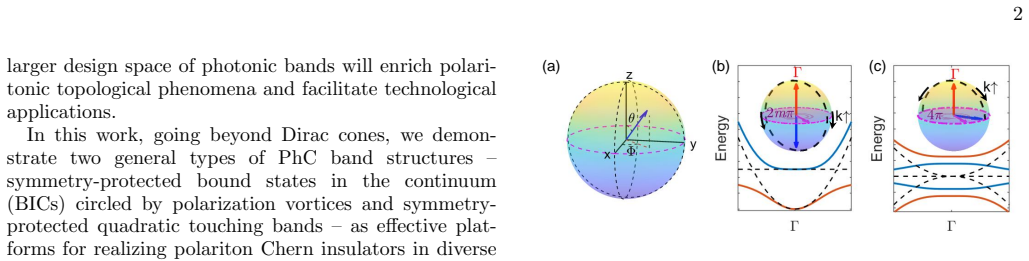
The engine of the argument is the winding coupling $g_k e^{im\phi_k}$ between a photonic mode and an exciton mode, where $\phi_k$ is the azimuthal angle of the in-plane wave vector and $m$ is an integer fixed by the lattice point-group symmetry. Around a symmetry-protected BIC, the polarization vortex of the photonic band supplies this winding; around a quadratic touching point, the two rotational eigenmodes of the lattice carry a winding phase $e^{\pm 2i\phi_k}$ with $m=2$. A nonzero exciton splitting $\Delta\omega$ breaks time-reversal symmetry, and the spinor eigenstates of the two-band Hamiltonian trace a trajectory on the Bloch sphere whose winding number determines the Chern number. For the quadratic-touching platform the paper upgrades this to a 6×6 Hamiltonian with two photon modes and two spin-exciton modes, and uses it to map the topological gaps as a function of detuning, total coupling $g=\sqrt{|\alpha|^2+|\beta|^2}$, coupling imbalance $|\alpha|/|\beta|$, and Zeeman splitting $\Delta\omega$, finding that optimal gaps reach roughly the total coupling strength. This machinery also yields the ring-shaped Berry curvature distribution around Γ that the paper connects with favorable conditions for quantum Hall physics.
What would settle it
Compute the full band structure of a BIC-coupled polariton system with a realistic set of dark exciton modes included but no bright-dark separation; if the Chern numbers vanish (bands trivialize) and no energy shift of the bright exciton reopens the topological gap without also destroying the winding coupling, the BIC platform is refuted.
Extended reading notes
Core claim
The central claim is that polariton Chern bands are not tied to the Dirac-cone framework. The authors show that two symmetry-protected photonic bands commonly found in 2D photonic crystals—a non-degenerate band with a bound state in the continuum surrounded by a polarization vortex, and a pair of bands with a quadratic touching degeneracy at Γ—can each be turned into a Chern insulator by strong coupling to a single bright exciton or to spin-split exciton states. In both cases the winding coupling $g_k e^{im\phi_k}$ between photon and exciton modes, together with a finite time-reversal-symmetry-breaking splitting $\Delta\omega$, makes the pseudospin eigenstates trace a loop on the Bloch sphere; the loop is full for the BIC case and half for the quadratic-touching case, yielding Chern numbers $\pm m$ and $\pm m/2$, respectively. The paper validates the picture with a 6×6 effective Hamiltonian for the quadratic-touching platform, showing three topological gaps whose sizes depend on detuning, coupling strength, and splitting, and with FDTD simulations of a triangular-lattice GaP photonic crystal coupled to a TMD monolayer. The simulated device exhibits six polariton Chern bands with Chern numbers $\pm1$ and a middle topological gap near 12 meV, plus chiral edge states consistent with bulk–edge correspondence.
Load-bearing premise
The load-bearing premise is that, in the BIC scheme, the bright exciton can be energetically separated from the many dark exciton modes without closing the topological gap or destroying the winding coupling; the paper states this separation can be done (e.g., by an optical Stark shift) but provides no simulation showing it works.
Editorial extensions
If this is right
- Polariton Chern insulators can be designed at the Γ point in lattices with C3, C4, and C6 symmetry, greatly expanding the material and geometry choices beyond hexagonal Dirac-cone lattices.
- Higher Chern numbers (up to ±2 in the shown examples) become accessible through high-order BICs, which can support multiple chiral edge channels.
- The demonstrated ~12 meV middle gap in the GaP/TMD design is roughly two orders of magnitude larger than the 0.1 meV gap of the previous micropillar experiment, opening the way to robust topological devices at elevated temperatures.
- The quasi-uniform ring-shaped Berry curvature around Γ may facilitate observation of quantum Hall effects and is argued in the paper to help stabilize fractional excitations.
- Chiral edge states appear in each topological gap, with opposite chirality in the middle gap compared with the upper and lower gaps, exactly as bulk–edge correspondence demands.
Reading between the lines
- A concrete next step the paper leaves open is to simulate the mode-selective optical Stark shift on the bright exciton while explicitly including all dark exciton modes; such a calculation would confirm whether the reconstructed Chern bands survive in the full exciton manifold.
- Because the Berry curvature forms a broad ring around Γ rather than a sharp Dirac peak, these polariton bands may be favorable for observing the anomalous Hall drift of polariton wavepackets over a wide momentum range.
- Applying the same design rules to moiré excitons, whose valley splittings can exceed 40 meV, could push the achievable topological gap in the quadratic-touching platform beyond the 12 meV reported here.
Editorial analysis
A structured set of objections, weighed in public.
Referee Report
Summary. The paper proposes two general mechanisms for realizing polariton Chern bands in 2D photonic crystals (PhCs) beyond the usual Dirac-cone framework: (i) bands with symmetry-protected bound states in the continuum (BICs) whose surrounding polarization vortex provides a winding coupling to excitons, and (ii) symmetry-protected quadratic touching bands at the Brillouin-zone center. For each mechanism the authors derive effective Hamiltonians, compute Chern numbers (|C|=1 and |C|=2), analyze the dependence of the topological gap on detuning, coupling, and time-reversal breaking, and propose a concrete GaP/TMD design. The quadratic-touching platform is validated by FDTD band-structure calculations, a 12 meV middle gap, and chiral edge-state simulations, whereas the BIC platform is illustrated with model band structures.
Significance. The work is significant because it broadens the design space for polariton Chern insulators, which have so far been limited to Dirac-cone-based hexagonal lattices with sub-meV gaps. The quadratic-touching platform with a predicted ~12 meV gap, supported by FDTD and edge-state simulations, is a concrete, experimentally accessible step toward topological polaritonics at optical frequencies. The BIC-based proposal, if realized, would enable higher Chern numbers (|C|=2) with ring-shaped Berry curvature. The effective-Hamiltonian analysis is standard and the parameters are drawn from realistic ranges or extracted from FDTD spectra, and the 12 meV gap is an output rather than a fitted target, which strengthens the credibility of the quadratic-touching results. However, the BIC platform rests on an unquantified bright–dark exciton separation step that is not yet demonstrated, and the full-Brillouin-zone gap of the practical design is not completely mapped.
major comments (3)
- [Sec. III, Fig. 2(b)-(c)] The central claim for the BIC-based platform, including the higher-Chern (|C|=2) example, depends on the assertion that 'Chern bands can be reconstructed by energetically separating bright excitons from dark ones' via the mode-selective optical Stark effect. No simulation, model, or quantitative estimate is provided for the achievable Stark shift relative to the exciton-photon coupling, the dark-exciton bandwidth, or the required energy separation. Because the topological gap must open near the crossing of the photon and exciton bands, where a dense manifold of dark exciton modes resides within the PhC Brillouin zone, the residual coupling to dark excitons could close the topological gap or open trivial gaps. A concrete multi-mode calculation including the dark-exciton continuum is required to support the claim that the BIC platform produces the advertised Chern bands.
- [Sec. VI, Fig. 5(c)] The paper claims a 'large topological gap across the BZ' (Introduction and Sec. VI), but the FDTD band structure and the middle-gap size are shown only along the Γ–K–M path. The global gap in the full 2D Brillouin zone is not mapped, leaving open the possibility that bands approach elsewhere in the BZ and reduce the global topological gap. The authors should either compute the gap over the full BZ or provide a symmetry-based argument, together with checks at all high-symmetry points and along the BZ boundary, to establish the global gap.
- [Sec. IV, paragraph on dark excitons] For the quadratic-touching platform, the statement that 'dark excitons in this system are inside the trivial gaps and would not affect the topological gaps or edge states' is made without quantitative support. The actual energy range of dark-exciton modes relative to the topological gaps is not estimated for the GaP/TMD parameters. If dark excitons overlap in energy with the topological gaps, they could hybridize with the polariton modes and alter the gap and edge states. A quantitative estimate or a calculation including a dark-exciton continuum would substantiate this assumption.
minor comments (4)
- [Sec. IV] There is a typographical error: 'quratic dispersions' should be 'quadratic dispersions' in the paragraph on quadratic touching bands.
- [Sec. II, Eq. (1)] The basis of the two-component Hamiltonian in Eq. (1) is not explicitly defined. Clarifying which states (e.g., the two circular polarizations of the exciton or photon and exciton) form the spinor would improve readability.
- [Sec. III, Eq. (5)] The relationship between the general Hamiltonian in Eq. (1) and the BIC coupling Hamiltonian in Eq. (5) is not spelled out, in particular how Δω, g_k, and Φ_k map to ω_c, ω_x, and the winding coupling. A short sentence or a parameter mapping would help the reader.
- [Sec. VI, Fig. 5(b)] The extraction of ħg = 22 meV and |α|/|β| = 1.73 from the FDTD polariton splittings is described briefly; providing the fitting procedure or the underlying spectra would make the parameter extraction more reproducible.
Circularity Check
No circular derivation chain; Chern numbers and the 12 meV gap are genuine outputs of a self-contained model, though the BIC bright-dark exciton separation is asserted without simulation.
full rationale
The central derivation is self-contained. In Sec. II, the Hamiltonian H_k in Eq. (1) with winding coupling e^{imφ} is solved explicitly for eigenstates (2)-(3), and the Chern numbers m or m/2 follow from the spinor covering of the Bloch sphere; this is a direct model calculation, not a restatement of an input. The BIC case (Eq. (5)) and quadratic-touching case (Eq. (6)) similarly produce band structures and Berry curvatures (Figs. 2-3) from stated symmetry properties, with the winding coupling cited to external literature on polarization vortices and quadratic degeneracies [43-45,63-65], not to a self-citation. Section VI's practical design is also non-circular: ħg=22 meV and |α|/|β|=1.73 are extracted from FDTD polariton splittings, Δω=42.5 meV is chosen, and the ~12 meV middle gap is then computed and confirmed by FDTD bandstructure and edge modes; the gap is not used as a fitting target. The paper does contain self-citations, notably refs. [68], [70], and [71], but they support general experimental capabilities (TMD-PhC integration, valley-selective optical Stark effect) rather than the topological claim, and equivalent external references ([69]) are also cited. The one genuine weakness is an omitted proof, not circularity: Sec. III admits that dark excitons trivialize the BIC polariton bands and asserts that 'Chern bands can be reconstructed by energetically separating bright excitons from dark ones' via the optical Stark effect, but provides no simulation or quantitative estimate. That gap undercuts the BIC platform's practicality, especially the |C|=2 example, but it is not a step in which a prediction reduces to its own input. Hence no significant circularity; score 2 for minor non-load-bearing self-citations and the explicit feasibility caveat.
Assumptions & free parameters
free parameters (4)
- Zeeman splitting Δω =
40 meV (model), 42.5 meV (FDTD)
- Total coupling strength ħg =
30 meV (model), 22 meV (FDTD)
- Coupling ratio |α|/|β| =
1.56 (model), 1.73 (FDTD)
- Exciton-photon detuning δ =
0 (optimal)
assumptions (4)
- domain assumption A symmetry-protected BIC at Γ is surrounded by a polarization vortex with a conserved topological charge m.
- domain assumption Quadratic-touching bands in 2D PhCs have a winding coupling of the form ν k^2 e^{-i2φ} with winding number m=2.
- domain assumption The six-band effective Hamiltonian (Eq. 6) fully captures the coupled PhC-exciton system, including the two photonic modes and two spin exciton branches.
- domain assumption TMD excitons can be represented as Lorentz holes in the permittivity tensor in FDTD simulations.
Cite this review
Pith. "Pith review of Polariton Chern Bands in 2D Photonic Crystals Beyond Dirac Cones." pith.science (2026). https://pith.science/paper/4BTSTLFM
@misc{pith2026250601240,
  author       = {Pith},
  title        = {Pith review of: Polariton Chern Bands in 2D Photonic Crystals Beyond Dirac Cones},
  year         = {2026},
  howpublished = {\url{https://pith.science/paper/4BTSTLFM}},
  note         = {Machine review of arXiv:2506.01240}
}
abstract
Polaritons, formed by strong light-matter interactions, open new avenues for studying topological phases, where the spatial and time symmetries can be controlled via the light and matter components, respectively. However, most research on topological polaritons has been confined to hexagonal photonic lattices featuring Dirac cones at large wavenumbers. This restricts key topological properties and device performance, including sub-meV gap sizes that hinder further experimental investigations and future applications of polariton Chern insulator systems. In this study, we move beyond the traditional Dirac cone framework and introduce two alternative band structures in photonic crystals (PhCs) as promising platforms for realizing polariton Chern bands: bands with symmetry-protected bound states in the continuum (BICs) and bands with symmetry-protected degeneracies at the $\Gamma$ points. These band structures are prevalent in various PhC lattices and have features crucial for experimental studies. We show examples of higher Chern number bands, more uniform Berry curvature distributions, and an experimentally feasible system capable of achieving a large topological gap. Our findings show the broad applicability of polariton Chern bands in 2D PhCs, provide design principles for enhancing the functionality and performance of topological photonic devices, opening up exciting possibilities for better understanding and using topological physics.
Figures


Figures from the paper (3 more)


Reference graph
Works this paper leans on
-
[1]
L. Lu, J. D. Joannopoulos, and M. Soljaˇ ci´ c, Topological photonics, Nat. Photonics8, 821 (2014)
2014
-
[2]
A. B. Khanikaev and G. Shvets, Two-dimensional topo- logical photonics, Nat. Photonics11, 763 (2017)
work page 2017
-
[3]
Ozawa, H
T. Ozawa, H. M. Price, A. Amo, N. Goldman, M. Hafezi, L. Lu, M. C. Rechtsman, D. Schuster, J. Simon, O. Zil- berberg, and I. Carusotto, Topological photonics, Rev. Mod. Phys.91, 015006 (2019)
2019
-
[4]
D. Smirnova, D. Leykam, Y. Chong, and Y. Kivshar, Nonlinear topological photonics, Appl. Phys. Rev.7, 021306 (2020)
work page 2020
-
[5]
M. Kim, Z. Jacob, and J. Rho, Recent advances in 2D, 3D and higher-order topological photonics, Light Sci. Appl. 9, 130 (2020)
work page 2020
-
[6]
R. O. Umucalılar and I. Carusotto, Artificial gauge field for photons in coupled cavity arrays, Phys. Rev. A84, 043804 (2011)
work page 2011
- [7]
- [8]
Show all 75 references
-
[9]
Wu and X
L.-H. Wu and X. Hu, Scheme for Achieving a Topologi- cal Photonic Crystal by Using Dielectric Material, Phys. Rev. Lett.114, 223901 (2015)
2015
-
[10]
Dong, X.-D
J.-W. Dong, X.-D. Chen, H. Zhu, Y. Wang, and X. Zhang, Valley photonic crystals for control of spin and topology, Nat. Mater.16, 298 (2017)
2017
-
[11]
M. I. Shalaev, W. Walasik, A. Tsukernik, Y. Xu, and N. M. Litchinitser, Robust topologically protected trans- port in photonic crystals at telecommunication wave- lengths, Nat. Nanotechnol.14, 31 (2019)
2019
-
[12]
W. Liu, Z. Ji, Y. Wang, G. Modi, M. Hwang, B. Zheng, V. J. Sorger, A. Pan, and R. Agarwal, Generation of helical topological exciton-polaritons, Science370, 600 (2020)
2020
-
[13]
M. Li, I. Sinev, F. Benimetskiy, T. Ivanova, E. Khes- tanova, S. Kiriushechkina, A. Vakulenko, S. Guddala, M. Skolnick, V. M. Menon, D. Krizhanovskii, A. Al` u, A. Samusev, and A. B. Khanikaev, Experimental ob- servation of topological Z2 exciton-polaritons in transi- tion met...
2021
-
[14]
Arregui, J
G. Arregui, J. Gomis-Bresco, C. M. Sotomayor-Torres, and P. D. Garcia, Quantifying the Robustness of Topo- logical Slow Light, Phys. Rev. Lett.126, 027403 (2021)
2021
-
[15]
C. A. Rosiek, G. Arregui, A. Vladimirova, M. Albrecht- sen, B. Vosoughi Lahijani, R. E. Christiansen, and S. Sto- bbe, Observation of strong backscattering in valley-Hall photonic topological interface modes, Nat. Photonics17, 386 (2023)
2023
-
[16]
A. B. Khanikaev and A. Al` u, Topological photonics: Ro- bustness and beyond, Nat. Commun.15, 931 (2024)
2024
-
[17]
F. D. M. Haldane and S. Raghu, Possible Realization of Directional Optical Waveguides in Photonic Crystals with Broken Time-Reversal Symmetry, Phys. Rev. Lett. 100, 013904 (2008)
2008
-
[18]
Raghu and F
S. Raghu and F. D. M. Haldane, Analogs of quantum- Hall-effect edge states in photonic crystals, Phys. Rev. A 78, 033834 (2008)
2008
-
[19]
Z. Wang, Y. Chong, J. D. Joannopoulos, and M. Soljaˇ ci´ c, Observation of unidirectional backscattering-immune topological electromagnetic states, Nature461, 772 (2009)
2009
-
[20]
M. C. Rechtsman, J. M. Zeuner, Y. Plotnik, Y. Lumer, D. Podolsky, F. Dreisow, S. Nolte, M. Segev, and A. Sza- meit, Photonic Floquet topological insulators, Nature 496, 196 (2013)
2013
-
[21]
Lustig, S
E. Lustig, S. Weimann, Y. Plotnik, Y. Lumer, M. A. Bandres, A. Szameit, and M. Segev, Photonic topolog- ical insulator in synthetic dimensions, Nature567, 356 (2019)
2019
-
[22]
N. H. Lindner, G. Refael, and V. Galitski, Floquet topo- logical insulator in semiconductor quantum wells, Nat. Phys.7, 490 (2011)
2011
-
[23]
K. Fang, Z. Yu, and S. Fan, Realizing effective magnetic field for photons by controlling the phase of dynamic modulation, Nat. Photonics6, 782 (2012)
2012
-
[24]
L. J. Maczewsky, J. M. Zeuner, S. Nolte, and A. Szameit, Observation of photonic anomalous Floquet topological insulators, Nat. Commun.8, 13756 (2017)
2017
-
[25]
H. Zhao, X. Qiao, T. Wu, B. Midya, S. Longhi, and L. Feng, Non-Hermitian topological light steering, Sci- ence365, 1163 (2019)
2019
-
[26]
L. Xiao, T. Deng, K. Wang, G. Zhu, Z. Wang, W. Yi, and P. Xue, Non-Hermitian bulk–boundary correspondence in quantum dynamics, Nat. Phys.16, 761 (2020)
2020
-
[27]
T. Dai, Y. Ao, J. Mao, Y. Yang, Y. Zheng, C. Zhai, Y. Li, J. Yuan, B. Tang, Z. Li, J. Luo, W. Wang, X. Hu, Q. Gong, and J. Wang, Non-Hermitian topological phase transitions controlled by nonlinearity, Nat. Phys.20, 101 (2024)
2024
-
[28]
Weisbuch, M
C. Weisbuch, M. Nishioka, A. Ishikawa, and Y. Arakawa, Observation of the coupled exciton-photon mode split- ting in a semiconductor quantum microcavity, Phys. Rev. Lett.69, 3314 (1992)
1992
-
[29]
Karzig, C.-E
T. Karzig, C.-E. Bardyn, N. H. Lindner, and G. Refael, Topological Polaritons, Phys. Rev. X5, 031001 (2015)
2015
-
[30]
Gianfrate, O
A. Gianfrate, O. Bleu, L. Dominici, V. Ardizzone, M. De Giorgi, D. Ballarini, G. Lerario, K. W. West, L. N. Pfeiffer, D. D. Solnyshkov, D. Sanvitto, and G. Malpuech, Measurement of the quantum geometric tensor and of the anomalous Hall drift, Nature578, 381 (2020)
2020
-
[31]
Polimeno, G
L. Polimeno, G. Lerario, M. De Giorgi, L. De Marco, L. Dominici, F. Todisco, A. Coriolano, V. Ardizzone, M. Pugliese, C. T. Prontera, V. Maiorano, A. Moliterni, C. Giannini, V. Olieric, G. Gigli, D. Ballarini, Q. Xiong, A. Fieramosca, D. D. Solnyshkov, G. Malpuech, and D. Sanv...
2021
-
[32]
A. V. Nalitov, D. D. Solnyshkov, and G. Malpuech, Po- laritonZTopological Insulator, Phys. Rev. Lett.114, 116401 (2015)
2015
-
[33]
Bardyn, T
C.-E. Bardyn, T. Karzig, G. Refael, and T. C. H. Liew, Topological polaritons and excitons in garden-variety sys- tems, Phys. Rev. B91, 161413 (2015)
2015
-
[34]
Yi and T
K. Yi and T. Karzig, Topological polaritons from pho- tonic Dirac cones coupled to excitons in a magnetic field, Phys. Rev. B93, 104303 (2016)
2016
-
[35]
L. He, J. Wu, J. Jin, E. J. Mele, and B. Zhen, Po- laritonic Chern Insulators in Monolayer Semiconductors, Phys. Rev. Lett.130, 043801 (2023)
2023
-
[36]
Klembt, T
S. Klembt, T. H. Harder, O. A. Egorov, K. Winkler, R. Ge, M. A. Bandres, M. Emmerling, L. Worschech, T. C. H. Liew, M. Segev, C. Schneider, and S. H¨ ofling, Exciton-polariton topological insulator, Nature562, 552 (2018)
2018
-
[37]
von Neumann and E
J. von Neumann and E. P. Wigner, ¨Uber merkw¨ urdige diskrete Eigenwerte, inThe Collected Works of Eu- gene Paul Wigner: Part A, edited by A. S. Wightman (Springer, Berlin, Heidelberg, 1993) pp. 291–293
1993
-
[38]
C. W. Hsu, B. Zhen, A. D. Stone, J. D. Joannopoulos, and M. Soljaˇ ci´ c, Bound states in the continuum, Nat. Rev. Mater.1, 1 (2016)
2016
-
[39]
M. Kang, T. Liu, C. T. Chan, and M. Xiao, Applications of bound states in the continuum in photonics, Nat. Rev. Phys.5, 659 (2023)
2023
-
[40]
C. W. Hsu, B. Zhen, J. Lee, S.-L. Chua, S. G. John- son, J. D. Joannopoulos, and M. Soljaˇ ci´ c, Observation of trapped light within the radiation continuum, Nature 499, 188 (2013)
2013
-
[41]
J. Jin, X. Yin, L. Ni, M. Soljaˇ ci´ c, B. Zhen, and C. Peng, Topologically enabled ultrahigh-Q guided resonances ro- bust to out-of-plane scattering, Nature574, 501 (2019)
2019
-
[42]
M. Kang, L. Mao, S. Zhang, M. Xiao, H. Xu, and C. T. Chan, Merging bound states in the continuum by har- nessing higher-order topological charges, Light Sci. Appl. 11, 228 (2022)
2022
-
[43]
B. Zhen, C. W. Hsu, L. Lu, A. D. Stone, and M. Soljaˇ ci´ c, Topological Nature of Optical Bound States in the Con- tinuum, Phys. Rev. Lett.113, 257401 (2014)
2014
-
[44]
Zhang, A
Y. Zhang, A. Chen, W. Liu, C. W. Hsu, B. Wang, F. Guan, X. Liu, L. Shi, L. Lu, and J. Zi, Observation of Polarization Vortices in Momentum Space, Phys. Rev. Lett.120, 186103 (2018)
2018
-
[45]
Yoda and M
T. Yoda and M. Notomi, Generation and Annihilation of Topologically Protected Bound States in the Continuum and Circularly Polarized States by Symmetry Breaking, Phys. Rev. Lett.125, 053902 (2020)
2020
-
[46]
B. Wang, W. Liu, M. Zhao, J. Wang, Y. Zhang, A. Chen, F. Guan, X. Liu, L. Shi, and J. Zi, Generating optical vortex beams by momentum-space polarization vortices centred at bound states in the continuum, Nat. Photonics 14, 623 (2020)
2020
-
[47]
Huang, C
C. Huang, C. Zhang, S. Xiao, Y. Wang, Y. Fan, Y. Liu, N. Zhang, G. Qu, H. Ji, J. Han, L. Ge, Y. Kivshar, and Q. Song, Ultrafast control of vortex microlasers, Science 367, 1018 (2020)
2020
-
[48]
Ardizzone, F
V. Ardizzone, F. Riminucci, S. Zanotti, A. Gianfrate, M. Efthymiou-Tsironi, D. G. Su` arez-Forero, F. Todisco, 9 M. De Giorgi, D. Trypogeorgos, G. Gigli, K. Baldwin, L. Pfeiffer, D. Ballarini, H. S. Nguyen, D. Gerace, and D. Sanvitto, Polariton Bose–Einstein condensate from a ...
2022
-
[49]
X. Wu, S. Zhang, J. Song, X. Deng, W. Du, X. Zeng, Y. Zhang, Z. Zhang, Y. Chen, Y. Wang, C. Jiang, Y. Zhong, B. Wu, Z. Zhu, Y. Liang, Q. Zhang, Q. Xiong, and X. Liu, Exciton polariton condensation from bound states in the continuum at room temperature, Nat. Com- mun.15, 3345 (2024)
2024
-
[50]
W. Liu, B. Wang, Y. Zhang, J. Wang, M. Zhao, F. Guan, X. Liu, L. Shi, and J. Zi, Circularly Polarized States Spawning from Bound States in the Continuum, Phys. Rev. Lett.123, 116104 (2019)
2019
-
[51]
Y. Chen, H. Deng, X. Sha, W. Chen, R. Wang, Y.-H. Chen, D. Wu, J. Chu, Y. S. Kivshar, S. Xiao, and C.-W. Qiu, Observation of intrinsic chiral bound states in the continuum, Nature613, 474 (2023)
2023
-
[52]
Kodigala, T
A. Kodigala, T. Lepetit, Q. Gu, B. Bahari, Y. Fainman, and B. Kant´ e, Lasing action from photonic bound states in continuum, Nature541, 196 (2017)
2017
-
[53]
Hwang, H.-C
M.-S. Hwang, H.-C. Lee, K.-H. Kim, K.-Y. Jeong, S.- H. Kwon, K. Koshelev, Y. Kivshar, and H.-G. Park, Ultralow-threshold laser using super-bound states in the continuum, Nat. Commun.12, 4135 (2021)
2021
-
[54]
Y. Yu, A. Sakanas, A. R. Zali, E. Semenova, K. Yvind, and J. Mørk, Ultra-coherent Fano laser based on a bound state in the continuum, Nat. Photonics15, 758 (2021)
2021
-
[55]
Y. Ren, P. Li, Z. Liu, Z. Chen, Y.-L. Chen, C. Peng, and J. Liu, Low-threshold nanolasers based on miniaturized bound states in the continuum, Sci. Adv.8, eade8817 (2022)
2022
-
[56]
Z. Liu, Y. Xu, Y. Lin, J. Xiang, T. Feng, Q. Cao, J. Li, S. Lan, and J. Liu, High-Q Quasibound States in the Continuum for Nonlinear Metasurfaces, Phys. Rev. Lett. 123, 253901 (2019)
2019
-
[57]
Koshelev, S
K. Koshelev, S. Kruk, E. Melik-Gaykazyan, J.-H. Choi, A. Bogdanov, H.-G. Park, and Y. Kivshar, Subwave- length dielectric resonators for nonlinear nanophotonics, Science367, 288 (2020)
2020
-
[58]
Schiattarella, S
C. Schiattarella, S. Romano, L. Sirleto, V. Mocella, I. Rendina, V. Lanzio, F. Riminucci, A. Schwartzberg, S. Cabrini, J. Chen, L. Liang, X. Liu, and G. Zito, Di- rective giant upconversion by supercritical bound states in the continuum, Nature626, 765 (2024)
2024
-
[59]
Z. Liu, T. Guo, Q. Tan, Z. Hu, Y. Sun, H. Fan, Z. Zhang, Y. Jin, and S. He, Phase Interrogation Sensor Based on All-Dielectric BIC Metasurface, Nano Lett.23, 10441 (2023)
2023
-
[60]
S. A. Skirlo, L. Lu, and M. Soljaˇ ci´ c, Multimode One-Way Waveguides of Large Chern Numbers, Phys. Rev. Lett. 113, 113904 (2014)
2014
-
[61]
L. Lu, J. D. Joannopoulos, and M. Soljaˇ ci´ c, Topological states in photonic systems, Nat. Phys.12, 626 (2016)
2016
-
[62]
Y. Wu, C. Li, X. Hu, Y. Ao, Y. Zhao, and Q. Gong, Applications of Topological Photonics in Integrated Pho- tonic Devices, Adv. Opt. Mater.5, 1700357 (2017)
2017
-
[63]
Y. D. Chong, X.-G. Wen, and M. Soljaˇ ci´ c, Effective the- ory of quadratic degeneracies, Phys. Rev. B77, 235125 (2008)
2008
-
[64]
J. Mei, Y. Wu, C. T. Chan, and Z.-Q. Zhang, First- principles study of Dirac and Dirac-like cones in phononic and photonic crystals, Phys. Rev. B86, 035141 (2012)
2012
-
[65]
Z. Gao, H. Zhao, T. Wu, X. Feng, Z. Zhang, X. Qiao, C.-K. Chiu, and L. Feng, Topological quadratic-node semimetal in a photonic microring lattice, Nat Commun. 14, 3206 (2023)
2023
-
[66]
Ochiai and M
T. Ochiai and M. Onoda, Photonic analog of graphene model and its extension: Dirac cone, symmetry, and edge states, Phys. Rev. B80, 155103 (2009)
2009
-
[67]
M. J. Collins, F. Zhang, R. Bojko, L. Chrostowski, and M. C. Rechtsman, Integrated optical Dirac physics via inversion symmetry breaking, Phys. Rev. A94, 063827 (2016)
2016
-
[68]
Zhang, R
L. Zhang, R. Gogna, W. Burg, E. Tutuc, and H. Deng, Photonic-crystal exciton-polaritons in monolayer semi- conductors, Nat. Commun.9, 713 (2018)
2018
-
[69]
P. D. Cunningham, A. T. Hanbicki, T. L. Reinecke, K. M. McCreary, and B. T. Jonker, Resonant optical Stark ef- fect in monolayer WS 2, Nat. Commun.10, 5539 (2019)
2019
-
[70]
C.-K. Yong, M. I. B. Utama, C. S. Ong, T. Cao, E. C. Regan, J. Horng, Y. Shen, H. Cai, K. Watan- abe, T. Taniguchi, S. Tongay, H. Deng, A. Zettl, S. G. Louie, and F. Wang, Valley-dependent exciton fine struc- ture and Autler–Townes doublets from Berry phases in monolayer MoSe2...
2019
-
[71]
L. Zhou, B. Liu, Y. Liu, Y. Lu, Q. Li, X. Xie, N. Lydick, R. Hao, C. Liu, K. Watanabe, T. Taniguchi, Y.-H. Chou, S. R. Forrest, and H. Deng, Cavity Floquet engineering, Nat. Commun.15, 7782 (2024)
2024
-
[72]
K. F. Mak and J. Shan, Semiconductor moir´ e materials, Nat. Nanotechnol.17, 686 (2022)
2022
-
[73]
Chang, C.-X
C.-Z. Chang, C.-X. Liu, and A. H. MacDonald, Collo- quium: Quantum anomalous Hall effect, Rev. Mod. Phys. 95, 011002 (2023)
2023
-
[74]
W. Zhao, K. Kang, Y. Zhang, P. Kn¨ uppel, Z. Tao, L. Li, C. L. Tschirhart, E. Redekop, K. Watanabe, T. Taniguchi, A. F. Young, J. Shan, and K. F. Mak, Realization of the Haldane Chern insulator in a moir´ e lattice, Nat. Phys.20, 275 (2024)
2024
-
[75]
Y. Li, A. Chernikov, X. Zhang, A. Rigosi, H. M. Hill, A. M. van der Zande, D. A. Chenet, E.-M. Shih, J. Hone, and T. F. Heinz, Measurement of the optical dielectric function of monolayer transition-metal dichalcogenides: MoS2, MoSe2, WS2, and WSe2, Phys. Rev. B90, 205422 (2014)
2014
Reviewed August 7, 2026 · model on record in the stance chip above.
Discussion (0). Sign in to comment.