REVIEW 2 major objections 7 minor 56 references
Equation of State and First Principles Prediction of the Vibrational Matrix Shift of Solid Parahydrogen
T0 review · 2 major / 7 minor · reviewed 2026-08-07 · deepseek-v4-flash
Pith's one-line read First-principles simulation predicts solid parahydrogen's vibrational shift within 8% of experiment.
desk verdict A credible first-principles prediction of the solid parahydrogen vibrational shift, with the pairwise-only approximation as the main unquantified caveat. read the letter →
The pith
A machine-rendered reading of the paper's core claim, the machinery that carries it, and where it could break.
The reading
What carries the argument
The load-bearing object is the FSH potential, the first-principles adiabatic hindered-rotor pair potential obtained by solving the dimer's hindered-rotor Hamiltonian on Hinde's six-dimensional H₂–H₂ surface, separately for the joint vibrational ground state and the singly excited state. The vibrational matrix shift is then a first-order perturbation result, $\Delta\nu = 4\pi\rho(N-1)\int dr\, r^2 g(r)\,\Delta V(r)$ with $\Delta V(r)=V^1(r)-V^0(r)$, so the quantity that carries the argument is the product of the potential difference and the solid's radial distribution function. Two controlled extrapolations carry the numerical weight: the imaginary-time step is removed by fitting $\tau^2$ and $\tau^4$ corrections to $\tau\to0$, and the finite cell size is removed by the $1/N$ tail correction to $N\to\infty$; each correction changes the answer by an order of magnitude more than the hcp–fcc energy difference.
What would settle it
Repeat the same PIMC calculation with Hinde's three-body parahydrogen potential added to the FSH pair potential: if the predicted shift does not move toward the measured $-11.43\ \text{cm}^{-1}$ and the pressure above $\rho \approx 0.028\ \text{Å}^{-3}$ does not drop toward the experimental values, then the pairwise-only attribution of the discrepancy is wrong. A separate check is to measure the Q₁(0) shift in density-tuned solid parahydrogen under pressure, which would test the predicted $\Delta\nu(\rho)$ curve and its shallow minimum near $0.0248\ \text{Å}^{-3}$.
Extended reading notes
Core claim
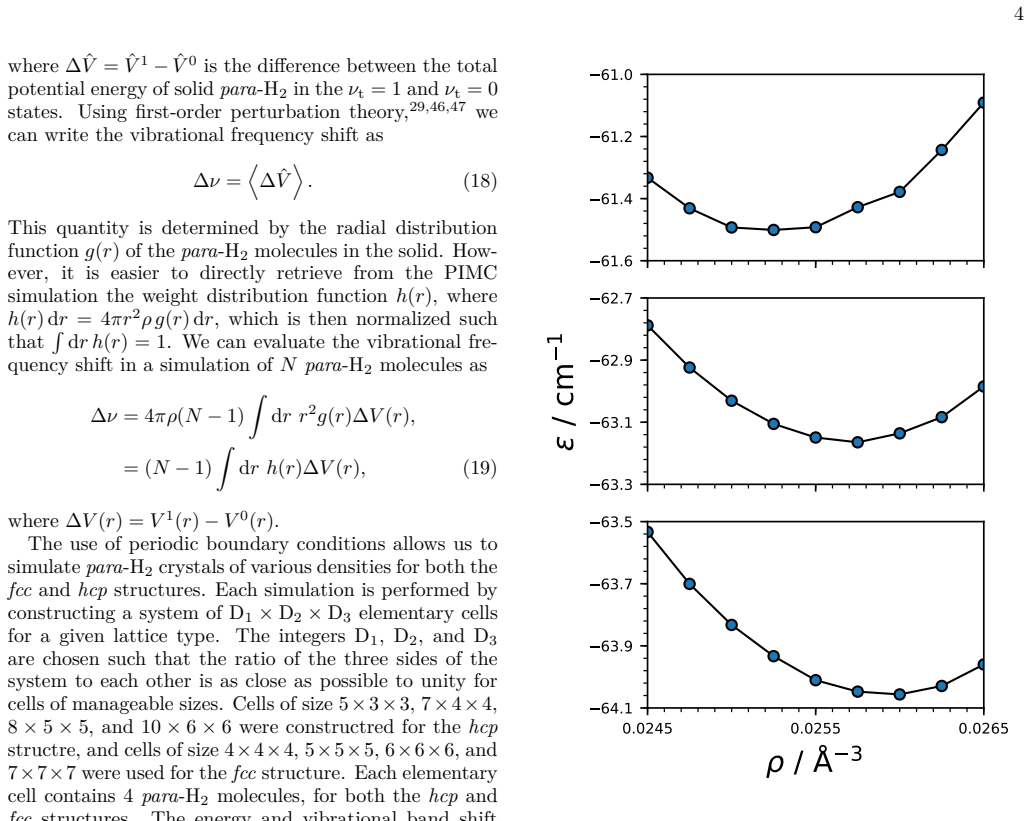
The paper's central claim is that the vibrational band-origin shift of solid parahydrogen is computable a priori from the two-body physics of the para-H₂ dimer, using the adiabatic hindered-rotor pair surfaces $V^0(r)$ (both molecules in the vibrational ground state) and $V^1(r)$ (one quantum of stretch) and evaluating the shift as the expectation value $\Delta\nu = \langle V^1 - V^0\rangle$ against the radial distribution function of the simulated solid. At the equilibrium density this yields $\Delta\nu_0 = -10.59\ \text{cm}^{-1}$, an eight percent deviation from the measured $-11.43\ \text{cm}^{-1}$, with the shift's magnitude growing as the density is lowered toward a minimum near $0.0248\ \text{Å}^{-3}$ and remaining essentially identical in the hcp and fcc structures. The authors further claim that the same machinery reproduces the experimental equilibrium density, the temperature invariance of that density below $4.2\ \text{K}$, and the stability of hcp over fcc, and that the factor-of-two gap between the cluster shift ($-3$ to $-4\ \text{cm}^{-1}$) and the solid shift follows from the larger coordination of the lattice seen in $g(r)$.
Load-bearing premise
The calculation assumes the crystal is exactly a sum of independent two-body interactions: the attractive three-body forces that exist between real parahydrogen molecules are left out, and the paper gives no error estimate for the effect this omission has on the predicted shift.
Editorial extensions
If this is right
- If the claim holds, the vibrational matrix shift of a quantum solid stops being an empirical input: the two-surface pair-potential construction yields it from the dimer alone, giving a template for other molecular crystals.
- The computed $\Delta\nu(\rho)$ curve places the magnitude peak of the shift slightly below the equilibrium density, so spectroscopies that tune the lattice density will probe the same pair potential that fixes the equation of state.
- Because the shift is nearly identical in hcp and fcc, a band-origin measurement cannot identify the crystal structure of a parahydrogen sample; the $0.04\ \text{cm}^{-1}$ stability difference must show up elsewhere.
- The two extrapolations ($\tau\to0$, $N\to\infty$) each alter the result by more than the hcp–fcc stability gap, setting a minimum standard for future path-integral equation-of-state work on quantum crystals.
Reading between the lines
- A direct, quantitative test follows from the paper's own diagnosis: adding Hinde's three-body parahydrogen surface to the same PIMC setup should pull $\Delta\nu_0$ from $-10.59$ toward the measured $-11.43\ \text{cm}^{-1}$ and lower the high-density pressure; if it does not, the pairwise-only explanation of the residual error is wrong.
- The same $\nu_t=0/\nu_t=1$ pair-surface machinery should transfer to mixed quantum crystals, such as a single HD molecule in parahydrogen, yielding dopant vibrational shifts with no empirical adjustment.
- Because the $N\to\infty$ correction lowers the shift by about $0.3\ \text{cm}^{-1}$, published finite-cluster shifts may systematically understate the magnitude of the bulk shift, meaning part of the cluster-to-solid gap is a size effect layered on top of the coordination effect the paper identifies.
- The predicted density dependence implies that a parahydrogen lattice held under slight negative pressure should display a more negative shift; annealed low-density films or crystals near the melting line are a testable venue for this signature.
Editorial analysis
A structured set of objections, weighed in public.
Referee Report
Summary. The manuscript reports path-integral Monte Carlo simulations of solid parahydrogen using the Faruk-Schmidt-Hinde (FSH) adiabatic hindered-rotor pair potential derived from Hinde's six-dimensional H2-H2 surface. The authors extrapolate the imaginary-time step and the system size to zero and infinity, respectively, and fit the resulting energy per particle and vibrational band-origin shift to a Murnaghan-type curve. They find the hcp lattice more stable than fcc by about 0.04 cm^-1, an equilibrium density rho0 = 0.02546 Å^-3 and equilibrium energy -63.10 cm^-1 for hcp, in reasonable agreement with experiment. They further compute pressure and compressibility and compare with experiment, and report the vibrational matrix shift at equilibrium density, Δν0 = -10.59 cm^-1, versus the experimental -11.43 cm^-1, claiming the first a priori prediction of a vibrational matrix shift from first-principles two-body potentials.
Significance. If the central result is robust, this is a valuable demonstration that a first-principles pair potential can capture both the quantum-crystal equation of state and a vibrational band-origin shift to approximately 8% without any fit to the solid. The extrapolation protocol is careful and well documented, the hcp/fcc ordering is physically sensible, and no empirical solid-state parameter enters the spectroscopic prediction, so the result is not circular. The paper is also transparent in separating the fitted Murnaghan and extrapolation parameters from the physical input. The main value of the paper rests on the unquantified pairwise-only approximation; the authors themselves note that three-body forces are attractive at short range and affect pressure and compressibility. With a bounded three-body estimate, this would be a strong benchmark contribution.
major comments (2)
- [Section IV E / Eq. (19) / Table IV] The headline shift Δν0 = −10.59 cm−1 is computed entirely within the pairwise-additive approximation: g(r) is generated by PIMC with V0 and ΔV(r) is the two-body difference V1 − V0. The authors state in Sections IV C and IV D that the three-body para-H2 potential is attractive at short range and that its omission makes the computed pressure too high and compressibility too low, and the FSH equilibrium density (0.02546 Å−3) is already below experiment (0.02600 Å−3). The three-body force is therefore not a remote high-density issue; it affects the state point at which Δν0 is quoted. No estimate is provided for either the direct three-body contribution to the excitation energy or the indirect change in g(r). The 8% agreement with experiment may be partly fortuitous, and the 'first a priori prediction' claim is conditional on an unevaluated approximation. Please add a bound or estimate of the three-body correction, or explicitly weaken the claim.
- [Sections III and IV, Tables II and IV] None of the extrapolated quantities carries a statistical or systematic uncertainty. The finite-size extrapolation moves Δν0 from −10.26 cm−1 (N=180) to −10.59 cm−1, and the difference from the experimental −11.43 cm−1 is 0.84 cm−1; with two decimal places quoted, the reported precision is not supported. The τ→0 extrapolation (Eq. (20)), the N→∞ extrapolation (Eq. (22)), and the Murnaghan fit (Eq. (23)) are all fitting procedures whose parameters and functional-form choices should be varied to produce error estimates for ρ0, ε0, and Δν0. At minimum, report the fit residuals and confidence intervals from the fits.
minor comments (7)
- [Section III B] The phrase 'the imaginary time extrapolation τ→∞' should read τ→0, consistent with Eq. (20).
- [Section II B and Section IV D] The typos 'constructred' and 'structre' appear in Section II B, and 'FHS' appears in Section IV D where 'FSH' is meant.
- [Table III caption and Section IV B] The table caption gives τ≈0.00254 K−1 while the text states τ≈0.00248 K−1; please reconcile these values.
- [Figure 10] The vertical axis shows positive values while the text discusses negative Δν; label the axis as −Δν (in cm−1) to avoid ambiguity.
- [Figure 13] The axis label 'g(r)/Å^3' is inconsistent with the normalization described in the text, which is based on ρg(r); clarify the plotted quantity.
- [References] References 32 and 36 cite the same Silvera–Goldman paper; merge them or cite them distinctly.
- [Tables II and III] The finite-simulation equilibrium densities in Table III (≈0.02590 Å−3) differ from the extrapolated value in Table II (0.02546 Å−3); add a sentence explaining that this difference is the systematic correction removed by the τ→0 and N→∞ extrapolations.
Circularity Check
No significant circularity: the vibrational shift is computed directly from an externally derived ab initio pair potential, with no parameter fitted to the solid-state observable.
full rationale
The paper's central claim, the vibrational matrix shift Δν0 = -10.59 cm^-1, is obtained from Eq. (19) as the integral of the ab initio difference potential ΔV(r) = V1(r) - V0(r) against the PIMC-sampled radial distribution g(r). The potentials V0 and V1 are not fitted to the solid para-H2 shift; they are the Faruk-Schmidt-Hinde (FSH) potentials derived by Schmidt et al. from Hinde's external 6D H2-H2 dimer PES, and the paper uses them as inputs without adjusting them to the target observable. The PIMC simulation is performed with the ground-state Hamiltonian H0, and Δν is evaluated by first-order perturbation theory, a standard approximation that is independently cited. The N→∞ and τ→0 extrapolations are numerical convergence procedures, not calibrations. The comparison with the experimental value -11.43 cm^-1 is a genuine test, and the paper honestly reports an 8% discrepancy. The acknowledged omission of three-body forces is a physical approximation that affects accuracy, but it is not circular reasoning: the predicted shift is not defined in terms of the experimental shift, nor is any parameter fitted to it. References 29 and 39 are self-citations for the potential and perturbation formalism, but the potential's source is Hinde's external PES and the formalism is standard; no load-bearing argument reduces to an unverified self-citation. The hcp stability result and pressure/compressibility curves are similarly direct outputs of the same simulation and are compared with external experiment and previous simulations. Overall, the derivation chain is self-contained and falsifiable, so no circular step is present.
Assumptions & free parameters
free parameters (4)
- Murnaghan EOS fit parameters (a, b, c, gamma) for FSH fcc and hcp =
a=28.17/27.51 cm-1, b=-4791.96/-4762.14 cm-1 A^3, c=6.32311e7/6.29562e7 cm-1 A^{3 gamma}, gamma=3.96
- Murnaghan shift fit parameters (a, b, c, gamma) for Delta nu =
fcc: a=8.0384, b=-1077.01, c=1.60252e6, gamma=3.30; hcp: a=8.0160, b=-1075.66, c=1.60036e6, gamma=3.30
- Imaginary-time extrapolation coefficients B2, B4 =
not tabulated
- Finite-size extrapolation constant C =
not tabulated
assumptions (8)
- domain assumption The interparticle potential is pairwise additive; many-body terms are neglected (Eq. 7, Eq. 11, Eq. 12).
- domain assumption Born-Oppenheimer-like adiabatic separation of the intermolecular distance from internal ro-vibrational states is valid (Eq. 2).
- domain assumption The FSH two-body potentials from Ref 39, derived from Hinde's ab initio dimer PES, are accurate in the solid environment.
- domain assumption The vibrational matrix shift is given by first-order perturbation theory, Delta nu = <Delta V> (Eq. 18).
- domain assumption The symmetrized excited-state combinatorics c1 = 2/N and the resulting Eq. (19) are valid for the delocalized excitation in the solid.
- domain assumption Bose exchange is negligible in the density and temperature ranges considered.
- ad hoc to paper The Murnaghan form Eq. (23) adequately represents the EOS and the shift-density curves on the fitted interval.
- standard math Finite-size corrections scale as 1/N because the long-range tail is r^-6 (Eq. 21).
Cite this review
Pith. "Pith review of Equation of State and First Principles Prediction of the Vibrational Matrix Shift of Solid Parahydrogen." pith.science (2026). https://pith.science/paper/HP7WR5VY
@misc{pith2026250601294,
  author       = {Pith},
  title        = {Pith review of: Equation of State and First Principles Prediction of the Vibrational Matrix Shift of Solid Parahydrogen},
  year         = {2026},
  howpublished = {\url{https://pith.science/paper/HP7WR5VY}},
  note         = {Machine review of arXiv:2506.01294}
}
read the original abstract
We generate the equation of state (EOS) of solid parahydrogen using a path-integral Monte Carlo (PIMC) simulation based on a highly accurate first-principles adiabatic hindered rotor (AHR) potential energy curve for the parahydrogen dimer. The EOS curves for the fcc and hcp structures of solid parahydrogen near the equilibrium density show that the hcp structure is the more stable of the two, in agreement with experiment. To accurately reproduce the structural and energy properties of solid parahydrogen, we eliminated by extrapolation the systematic errors associated with the choice of simulation parameters used in the PIMC calculation. We also investigate the temperature dependence of the EOS curves, and the invariance of the equilibrium density with temperature is satisfyingly reproduced. The pressure as a function of density, and the compressibility as a function of pressure, are both calculated using the obtained EOS and are compared with previous simulation results and experiments. We also report the first ever a priori prediction of a vibrational matrix shift from first-principles two-body potential functions, and its result for the equilibrium state agrees well with experiment.
Figures


Figures from the paper (7 more)


Reference graph
Works this paper leans on
-
[1]
L. H. Nosanow, Phys.\ Rev. 146 , 120 (1966)
work page 1966
-
[2]
I. F. Silvera, Rev.\ Mod.\ Phys. 52 , 393 (1980)
work page 1980
-
[3]
H. P. Gush, W. F. J. Hare, E. J. Allin, and H. L. Welsh, Can.\ J.\ Phys. 38 , 176 (1960)
work page 1960
-
[4]
C. S. Barrett, L. Meyer, and J. Wasserman, J.\ Chem.\ Phys. 45 , 834 (1966)
work page 1966
-
[5]
O. Bostanjoglo and R. Kleinschmidt, J.\ Chem.\ Phys. 46 , 2004 (1967)
work page 1967
- [6]
- [7]
- [8]
Show all 56 references
-
[9]
Oka, Ann.\ Rev.\ Phys.\ Chem
T. Oka, Ann.\ Rev.\ Phys.\ Chem. 44 , 299 (1993)
1993
-
[10]
Zoppi, M
M. Zoppi, M. Neumann, and M. Celli, Phys.\ Rev.\ B 65 , 092204 (2002)
2002
-
[11]
Operetto and F
F. Operetto and F. Pederiva, Phys.\ Rev.\ B 73 , 184124 (2006)
2006
-
[12]
Lindenau et al
T. Lindenau et al. , Int.\ J.\ Mod.\ Phys.\ B 20 , 5035 (2006)
2006
-
[13]
Grebenev, B
S. Grebenev, B. G. Sartakov, J. P. Toennies, and A. F. Vilesov, Science 289 , 1532 (2000)
2000
-
[14]
Grebenev et al
S. Grebenev et al. , Faraday Disc. 118 , 19 (2001)
2001
-
[15]
Grebenev, B
S. Grebenev, B. G. Sartakov, J. P. Toennies, and A. F. Vilesov, J.\ Chem.\ Phys. 114 , 617 (2001)
2001
-
[16]
Grebenev, B
S. Grebenev, B. G. Sartakov, J. P. Toennies, and A. F. Vilesov, Phys.\ Rev.\ Lett. 89 , 225301 (2002)
2002
-
[17]
Grebenev, B
S. Grebenev, B. G. Sartakov, J. P. Toennies, and A. F. Vilesov, J.\ Chem.\ Phys. 118 , 8656 (2003)
2003
-
[18]
Paesani, R
F. Paesani, R. E. Zillich, Y. Kwon, and K. B. Whaley, J.\ Chem.\ Phys. 122 , 181106 (2005)
2005
-
[19]
Grebenev, B
S. Grebenev, B. G. Sartakov, J. P. Toennies, and A. F. Vilesov, J.\ Chem.\ Phys. 132 , 064501 (2010)
2010
-
[20]
H. Li, R. J. Le Roy, P.-N. Roy, and A. R. W. McKellar, Phys.\ Rev.\ Lett. 105 , 133401 (2010)
2010
-
[21]
T. Zeng, H. Li, and P.-N. Roy, J.\ Phys.\ Chem.\ Lett. 4 , 18 (2013)
2013
-
[22]
T. Zeng, G. Guillon, J. T. Cantin, and P.-N. Roy, J.\ Phys.\ Chem.\ Lett. 4 , 2391 (2013)
2013
-
[23]
O. N. Osychenko, R. Rota, and J. Boronat, Phys.\ Rev.\ B 85 , 224513 (2012)
2012
-
[24]
D. P. Weliky et al. , J.\ Chem.\ Phys. 105 , 4461 (1996)
1996
-
[25]
Zhang et al
Y. Zhang et al. , Phys.\ Rev.\ B 58 , 218 (1998)
1998
-
[26]
Momose, H
T. Momose, H. Honshina, M. Fushitani, and H. Katsuki, Vib.\ Spectrosc. 34 , 95 (2004)
2004
-
[27]
M. E. Fajardo, J.\ Phys.\ Chem.\ A 117 , 13504 (2013)
2013
-
[28]
Tejeda et al
G. Tejeda et al. , Phys.\ Rev.\ Lett. 92 , 223401 (2004)
2004
-
[29]
Faruk et al
N. Faruk et al. , J.\ Chem.\ Phys. 141 , 014310 (2014)
2014
-
[30]
R. D. Goodwin and H. M. Roder, Cryogenics 3 , 12 (1963)
1963
-
[31]
S. C. Durana and J. P. McTague, J.\ Low Temp.\ Phys. 21 , 21 (1975)
1975
-
[32]
I. F. Silvera and V. V. Goldman, J.\ Chem.\ Phys. 69 , 4209 (1978)
1978
-
[33]
Driessen, J
A. Driessen, J. A. de Waal, and I. F. Silvera, J.\ Low Temp.\ Phys. 34 , 255 (1979)
1979
-
[34]
A. F. Schuch, R. L. Mills, and D. A. Depatie, Phys.\ Rev. 165 , 1032 (1968)
1968
-
[35]
Cheng and K
E. Cheng and K. B. Whaley, J.\ Chem.\ Phys. 104 , 3155 (1996)
1996
-
[36]
Buck et al
U. Buck et al. , J.\ Chem.\ Phys. 78 , 4439 (1978)
1978
-
[37]
R. J. Hinde, J.\ Chem.\ Phys. 128 , 154308 (2008)
2008
-
[38]
Schmidt et al
M. Schmidt et al. , J.\ Phys.\ Chem.\ A 119 , 12551 (2015)
2015
-
[39]
Zeng and P.-N
T. Zeng and P.-N. Roy, Rep.\ Prog.\ Phys. 77 , 046601 (2014)
2014
-
[40]
can Kranendonk, Physica 25 , 1080 (1959)
J. can Kranendonk, Physica 25 , 1080 (1959)
1959
-
[41]
van Kranendonk and G
J. van Kranendonk and G. Karl, Rev.\ Mod.\ Phys. 40 , 531 (1968)
1968
-
[42]
Pachucki and J
K. Pachucki and J. Komasa, J.\ Chem.\ Phys. 130 , 164113 (2009)
2009
-
[43]
Zeng et al
T. Zeng et al. , Comp.\ Phys.\ Comm. 204 , 170 (2016)
2016
-
[44]
D. M. Ceperley, Rev.\ Mod.\ Phys. 67 , 279 (1995)
1995
-
[45]
H. Li, N. Blinov, P.-N. Roy, and R. J. Le Roy, J.\ Chem.\ Phys. 130 , 144305 (2009)
2009
-
[46]
L. Wang, D. Xie, R. J. Le Roy, and P.-N. Roy, J.\ Chem.\ Phys. 137 , 104311 (2012)
2012
-
[47]
Yan and D
Y. Yan and D. Blume, J.\ Phys.\ B: At.\ Mol.\ Opt.\ Phys. 50 , 223001 (2017)
2017
-
[48]
Wang et al
L. Wang et al. , J.\ Mol.\ Spectrosc. 267 , 136 (2011)
2011
-
[49]
Yeh and G
I.-C. Yeh and G. Hummer, J.\ Phys.\ Chem.\ B 108 , 15873 (2004)
2004
-
[50]
Nakano and A
H. Nakano and A. Terai, J.\ Phys.\ Soc.\ Jpn. 78 , 014003 (2009)
2009
-
[51]
Li, P.-N
H. Li, P.-N. Roy, and R. J. Le Roy, J.\ Chem.\ Phys. 133 , 104305 (2010)
2010
-
[52]
M. P. Allen and D. J. Tildesley, Computer Simulation of Liquids (Oxford University Press, New York, 1987)
1987
-
[53]
F. D. Murnaghan, Proc.\ Nat.\ Acad.\ Sci.\ (US) 30 , 244 (1944)
1944
-
[54]
R. J. Hinde, Chem.\ Phys.\ Lett. 460 , 141 (2008)
2008
-
[55]
B. G. Udovidchenko and V. G. Manzhelii, J.\ Low Temp.\ Phys. 3 , 429 (1970)
1970
-
[56]
" 'skip if FUNCTION emphasize duplicate empty pop
" write newline FUNCTION fin.entry add.period write newline FUNCTION not #0 #1 if FUNCTION and 'skip pop #0 if FUNCTION or pop #1 'skip if FUNCTION field.or.null duplicate empty pop "" 'skip if FUNCTION emphasize duplicate empty pop "" " " swap * " " * if FUNCTION embolden dup...
Reviewed August 7, 2026 · model on record in the stance chip above.
Discussion (0). Sign in to comment.