REVIEW 4 major objections 4 minor 7 references
Asymptotic of Coulomb gas integral, Temperley-Lieb type algebras and pure partition functions
T0 review · 4 major / 4 minor · reviewed 2026-08-07 · deepseek-v4-flash
Pith's one-line read The paper claims that the asymptotic evaluation of Coulomb gas integrals reproduces the Temperley–Lieb meander/Gram matrix, yielding pure partition functions for multiple SLE systems.
desk verdict Plausible meander-matrix program, but the central fusion identity is unproved and the affine determinant is identically zero as printed; needs major repair. read the letter →
The pith
A machine-rendered reading of the paper's core claim, the machinery that carries it, and where it could break.
The reading
What carries the argument
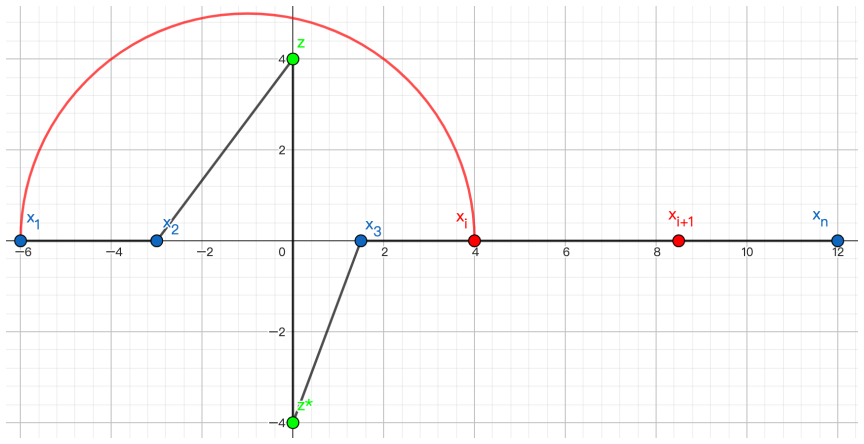
The object carrying the argument is the asymptotic evaluation functional $l_\beta$: it takes a Coulomb gas integral $J^{(m,n)}_\alpha$ and collapses the boundary points pairwise according to $\beta$, reading off the constant picked up at each fusion. In the five local configurations two neighbouring points can fall into — neither is a contour endpoint, both are endpoints of one contour, one is an endpoint, the two are endpoints of distinct contours, or the collapse happens along the complementary arc — the constants are $0$, $n(\kappa)$, $1$, and $2$, and these are claimed to multiply to the loop-weight product $\delta^{\ell(\alpha,\beta)} a^{n_a} b^{n_b}$. The counterpart on the algebra side is the Gram/meander matrix of the (affine) Temperley–Lieb standard module, whose entries count contractible and non-contractible loops formed by gluing the reflection of one link pattern to another; its determinant, nonzero for irrational $\kappa$, is what upgrades the asymptotic identity to linear independence.
What would settle it
Compute $l_\beta(J^{(m,n)}_\alpha)$ for the smallest nontrivial pair, e.g. $n=4$, $m=2$, by direct iterated contour integration as $x_{i+1}\to x_i$, and compare each entry with the meander matrix at $\delta=-2\cos(4\pi/\kappa)$; a mismatch in any entry would settle the issue. A second direct check is evaluating the printed affine determinant at $k=1$, where the factor $a^2-4\cos^2(4\pi/\kappa)$ is identically zero, which would force a correction to the displayed formula.
Extended reading notes
Core claim
The paper's central claim is that the leading short-distance asymptotics of the Coulomb gas integrals $J^{(m,n)}_\alpha$ — the screening-charge solutions of the null vector equations indexed by non-crossing link patterns $\alpha$ — are exactly the Gram pairings of the Temperley–Lieb standard module. For each link pattern $\beta$, the paper defines an evaluation functional $l_\beta$ that fuses the boundary insertion points according to $\beta$ and proves (Theorem 1.1, chordal; Theorem 1.4, radial) that $l_\beta(J^{(m,n)}_\alpha) = \langle\alpha,\beta\rangle$, where $\langle\alpha,\beta\rangle = \delta^{\ell(\alpha,\beta)}$ with $\delta = -2\cos(4\pi/\kappa)$, and in the radial/affine case $\langle\alpha\,|\,\beta\rangle = a^{n_a} b^{n_b}$ with $a=\delta$ and $b=2$. It then uses the known invertibility of these meander matrices for irrational $\kappa\in(0,8)$ to conclude that the ground states $J^{(m,n)}_\alpha$ are linearly independent and that $Z_\beta = \sum_\alpha M^{-1}_{\alpha\beta} J^{(m,n)}_\alpha$ are the pure partition functions of multiple chordal and radial $\mathrm{SLE}(\kappa)$ systems.
Load-bearing premise
The construction rests on the fusion identity: when insertion points are collapsed one pair at a time according to β, the constants picked up at each step (0, n(κ), 1, or 2) multiply to exactly $δ^{{ℓ(α,β)}}$ $a^{{n_a}}$ $b^{{n_b}}$; the paper sketches this assembly in two sentences rather than carrying out the bookkeeping.
Editorial extensions
If this is right
- The ground-state solutions $J^{(m,n)}_\alpha$ form a basis of their solution space for irrational $\kappa\in(0,8)$, since linear independence follows from $\det M\neq 0$.
- The pure partition functions $Z_\beta=\sum_\alpha M^{-1}_{\alpha\beta}J^{(m,n)}_\alpha$ satisfy the defining fusion asymptotics of multiple chordal and radial $\mathrm{SLE}(\kappa)$ systems.
- The radial case carries an independent non-contractible loop weight $b=2$, so the affine Temperley–Lieb module, not the ordinary one, is the right combinatorial model for radial SLE connectivity.
- The same asymptotic evaluation machinery is claimed to extend to excited solutions $K^{(m,n)}_\alpha$, giving fusion data for excited-state partition functions as well.
- Because the meander matrix depends on $\kappa$ only through $\delta=-2\cos(4\pi/\kappa)$, the construction is uniform for all irrational $\kappa\in(0,8)$ rather than case-by-case.
Reading between the lines
- If the fusion-constant assembly holds verbatim, the same dictionary should let one compute connection probabilities of multiple SLEs as ratios of meander-matrix entries, bypassing the integrals altogether.
- The printed determinant formula for the affine meander matrix appears to contain a factor at $k=1$ that vanishes identically, so identifying the intended correction would pin down exactly which $\kappa$ are allowed before the irrational-$\kappa$ conclusion.
- A natural direct test is the $n=3$ or $n=4$ case: explicit contour integrals give the fusion constants, and matching them against the loop-counting Gram matrix would turn the two-sentence sketch into a checkable pattern.
- The same asymptotic-to-Gram mechanism could transfer to other Coulomb gas bases, such as different screening charge assignments or higher excited states, reducing those fusion computations to linear algebra in standard modules.
Editorial analysis
A structured set of objections, weighed in public.
Referee Report
Summary. The paper aims to prove that the Coulomb gas integrals J_α^{(m,n)} for multiple chordal and radial SLE(κ) have fusion asymptotics equal to the Temperley–Lieb and affine Temperley–Lieb Gram pairings (Theorems 1.1 and 1.4). It then uses invertibility of the meander matrix, asserted for irrational κ, to conclude linear independence of the ground states and to define pure partition functions Z_β = Σ_α M^{-1}_{αβ} J_α. Sections 3–4 compute single-pair collapse asymptotics; Section 5 reviews Temperley–Lieb algebras and states a determinant formula for the affine meander matrix; Section 6 defines pure partition functions and conjectures the connection to Coulomb gas integrals; Section 7 sketches the extension to excited solutions.
Significance. The intended bridge is valuable: if the fusion identity and the determinant formula held, the paper would give a Coulomb-gas proof of linear independence and an explicit algebraic construction of pure partition functions for multiple SLE(κ). The paper is also explicit about the two conjectures it relies on, namely the spanning property of screening solutions and the positivity of Z_β. However, the two load-bearing pillars are not established: the multi-pair fusion identity is only sketched and its single-pair input is inconsistent, and the printed affine determinant vanishes identically for d = 0. Hence the advertised consequences do not currently follow, and the paper is not in publishable shape.
major comments (4)
- [Theorems 3.1 and 4.1] The single-pair fusion rules that would have to be iterated are internally inconsistent. In Theorem 3.1, Configuration 2 (Eq. 3.4) keeps the pair (m,n) unchanged when a contour with endpoints (x_i, x_{i+1}) collapses; Configuration 3 (Eq. 3.6) changes (m,n) to (m-1,n), although the collapsed point x_i or x_{i+1} should disappear from the marked set; and the two-contour collapse (Section 3.4, Eq. 3.10) changes (m,n) to (m-1,n-2). The same bookkeeping is repeated in Theorem 4.1 (Eqs. 4.3, 4.5, 4.7). Because no rule is given for how the screening-contour count and the marked-point count change consistently under fusion, these steps cannot be iterated to all pairs of β, and the factor δ^{ℓ(α,β)} in Theorems 1.1 and 1.4 is never derived.
- [Theorem 5.20 and Remark 5.21] The displayed formula for d = 0 contains the factor a² - 4cos²(4π/κ) at k = 1. Since Definition 1.6 and Theorem 1.4 set a = n(κ) = -2cos(4π/κ), this factor is identically zero, so det eG^0_n = 0 for every κ; for example, n = 2 already gives determinant zero. This contradicts the claimed invertibility for irrational κ and invalidates the use of M^{-1} in (1.1), (6.4), and (6.8). A corrected determinant formula and a proof would be needed.
- [Theorems 1.1 and 1.4] The central identity is supported only by the two-sentence sketch on page 4. The functional l_β is defined as the asymptotic limit 'with respect to β', but the theorem does not contain an independent computation of that limit; in particular, no argument shows that the constants 0, n(κ), 1, and 2 from the single-pair cases assemble into δ^{ℓ(α,β)} a^{n_a} b^{n_b}, including the non-contractible loop weight b = 2. Without such a multi-pair fusion computation, the equality l_β(J_α) = ⟨α,β⟩ is an assumption rather than a proved statement.
- [Section 6, Definitions 6.2/6.5 and Conjectures 6.3/6.6] The construction of the pure partition functions is incomplete as stated. The functions Z_β = Σ_α M^{-1}_{αβ} J_α are said to satisfy the required boundary asymptotics, but the manuscript explicitly states that their positivity is not rigorously established. Since pure partition functions are defined as positive solutions with prescribed asymptotics, positivity is part of the defining property, not an optional extra. Even granting the algebraic invertibility, the probabilistic interpretation of the constructed Z_β therefore does not follow.
minor comments (4)
- [Definition 1.5] Step 3 says 'if m closed loops are formed' and then writes a^{n_a} b^{n_b}; the letter m is already used for the number of screening charges, so the total number of loops and the split into n_a and n_b should be named differently.
- [Section 4.3, after Eq. (4.22)] The sentence 'The factor n(κ)^{-1} emerges naturally from the product of phase factors and gamma functions' is unexplained and appears to contradict the displayed limit, which has no such factor.
- [Section 6.1, Theorem 6.1] The proof is labelled 'Sketch of proof' and the displayed SDE contains the expression cot(Y_t/2) after a change of variables that is not defined; either supply the derivation or mark the result as heuristic.
- [Abstract and Section 3] The notation B_{m,n} is used without definition; the reader must infer from context that it denotes the space of ground-state Coulomb gas solutions.
Circularity Check
No significant circularity: the meander-matrix identity is a substantive claimed equality between an independently defined fusion limit and a diagrammatic Gram pairing, not a definitional reduction.
full rationale
The paper's central claim, Theorems 1.1 and 1.4, asserts that the asymptotic evaluation functional l_beta(J_alpha), defined as a fusion limit of Coulomb gas integrals, equals the Temperley-Lieb Gram pairing <alpha,beta> with the specified loop weights. These two objects are defined independently: the Gram pairing is defined diagrammatically in Definitions 1.2 and 1.5, while l_beta is defined analytically by a limiting procedure. Nothing in the definitions sets l_beta(J_alpha) equal to <alpha,beta> by construction; that equality is the content of the theorem. The later construction Z_beta = sum_alpha M^{-1}_{alpha beta} J_alpha in equation (1.1) is a linear-algebra consequence of the claimed identity, not an input into it, and it is used to engineer the fusion asymptotics of Z_beta only after the identity is assumed. The Coulomb gas integrals J_alpha are imported from the author's own preprints, but their defining formulas are restated in Section 2, and the load-bearing asymptotic identity is not justified by citing those preprints. The proof sketch for the multi-pair fusion identity is admittedly only a two-sentence sketch, and the internal fusion rules in Theorems 3.1 and 4.1 appear inconsistent regarding the indices (m,n) after collapsing contours. Theorem 5.20's d=0 determinant formula also contains a factor a^2 - 4cos^2(4pi/kappa) that vanishes identically, contradicting the claimed invertibility. These are serious correctness gaps and omitted proofs, but they are not circularity: the asserted conclusions do not reduce by definition to the inputs, no fitted parameter is renamed as a prediction, and no load-bearing uniqueness theorem is imported from the authors' own work. The derivation chain is incomplete but not self-referential.
Assumptions & free parameters
free parameters (2)
- non-contractible loop weight b =
2
- loop weight δ = n(κ) =
-2cos(4π/κ)
assumptions (6)
- domain assumption The Coulomb gas integrals J_α^{(m,n)} satisfy the null vector equations (2.1) and Ward identities (2.2).
- ad hoc to paper The screening solutions span the full solution space of the null vector equations.
- ad hoc to paper Positivity of the constructed functions Z_β.
- standard math Invertibility of the meander matrices for irrational κ ∈ (0,8).
- domain assumption Existence of non-intersecting Pochhammer contour choices for every link pattern.
- domain assumption The BPZ/CFT dictionary: solutions of the null vector equations with Ward identities are partition functions of multiple SLE(κ).
Cite this review
Pith. "Pith review of Asymptotic of Coulomb gas integral, Temperley-Lieb type algebras and pure partition functions." pith.science (2026). https://pith.science/paper/D2RZR6GV
@misc{pith2026250601306,
  author       = {Pith},
  title        = {Pith review of: Asymptotic of Coulomb gas integral, Temperley-Lieb type algebras and pure partition functions},
  year         = {2026},
  howpublished = {\url{https://pith.science/paper/D2RZR6GV}},
  note         = {Machine review of arXiv:2506.01306}
}
abstract
In this supplementary note, we study the asymptotic behavior of several types of Coulomb gas integrals and construct the pure partition functions for multiple radial $\mathrm{SLE}(\kappa)$ and general multiple chordal $\mathrm{SLE}(\kappa)$ systems. For both radial and chordal cases, we prove the linear independence of the ground state solutions $J_{\alpha}^{(m,n)}(\boldsymbol{x})$ to the null vector equations for irrational values of $\kappa \in (0,8)$. In particular, we show that the ground state solutions $J^{(m,n)}_\alpha \in B_{m,n}$, indexed by link patterns $\alpha$ with $m$ screening charges, are linearly independent when $\kappa$ is irrational. This is achieved by constructing, for each link pattern $\beta$, a dual functional $l_\beta \in B^{*}_{m,n}$ such that the meander matrix of the corresponding Temperley-Lieb type algebra is given by $M_{\alpha\beta} = l_{\beta}(J^{(m,n)}_\alpha)$. The determinant of this matrix admits an explicit expression and is nonzero for irrational $\kappa$, establishing the desired linear independence. As a consequence, we construct the pure partition functions $Z_{\alpha}(\boldsymbol{x})$ of the multiple $\mathrm{SLE}(\kappa)$ systems for each link pattern $\alpha$ by multiplying the inverse of the meander matrix. This method can also be extended to the asymptotic analysis of the excited state solutions $K_{\alpha}$ in both radial and chordal cases.
Figures


Figures from the paper (6 more)




Reference graph
Works this paper leans on
-
[1]
Conformal field theories of stochastic Loewner evolutions
[BB03] M. Bauer and D. Bernard. “Conformal field theories of stochastic Loewner evolutions”. In: Communications in Mathematical Physics 239.3 (2003), pp. 493–521. [Car03] J. L. Cardy. “Stochastic Loewner evolution and Dyson’s circular ensembles”. In: Jour- nal of Physics A 36.24 (2003), pp. L379–L386. [Dub06] Julien Dub´ edat. “Euler integrals for commuti...
work page 2003
-
[4]
Towards a conformal field theory for Schramm-Loewner evolutions
arXiv: 2410.21544 [math.PR]. url: https://arxiv.org/ abs/2410.21544. [Pel19] E. Peltola. “Towards a conformal field theory for Schramm-Loewner evolutions”. In: Journal of Mathematical Physics 60.10 (2019), p. 103305. [PW19] E. Peltola and H. Wu. “Global and local multiple SLEs for κ ≤ 4 and connection probabilities for level lines of GFF”. In: Communicati...
arXiv 2019
-
[6]
url: https://arxiv.org/abs/2505.16093
arXiv: 2505.16093 [math.PR]. url: https://arxiv.org/abs/2505.16093. [Zha25b] Jiaxin Zhang. Multiple chordal SLE(0) and classical Calogero-Moser system
-
[7]
On Multiple SLE Systems and their Deterministic Limits
arXiv: 2505.17129 [math.PR]. url: https://arxiv.org/abs/2505.17129. [Zha25c] Jiaxin Zhang. “On Multiple SLE Systems and their Deterministic Limits”. PhD thesis. California Institute of Technology,
-
[50]
Pure partition functions of multiple SLEs
Fields Institute Communications. Providence, RI: American Mathematical Society, 2007, pp. 199–224. [KP16] K. Kyt¨ ol¨ a and E. Peltola. “Pure partition functions of multiple SLEs”. In: Communi- cations in Mathematical Physics 346.1 (2016), pp. 237–292. [Law09] G. Lawler. “Partition functions, loop measure, and versions of SLE”. In: Journal of Statistical ...
2016
-
[2014]
Scaling limits of loop-erased random walks and uniform spanning trees
arXiv: 1204.4505 [math-ph]. url: https://arxiv.org/abs/ 1204.4505. [Sch00] O. Schramm. “Scaling limits of loop-erased random walks and uniform spanning trees”. In: Israel Journal of Mathematics 118.1 (2000), pp. 221–288. [Sim+11] J. J. Simmons et al. “Cluster densities at 2D critical points in rectangular geometries”. In: Journal of Physics A: Mathematica...
arXiv 2000
-
[2025]
url: https://arxiv.org/ abs/2505.14762
arXiv: 2505.14762 [math.PR]. url: https://arxiv.org/ abs/2505.14762. [MZ25b] Nikolai Makarov and Jiaxin Zhang. Multiple radial SLE(0) and classical Calogero- Sutherland System
Reviewed August 7, 2026 · model on record in the stance chip above.
Discussion (0). Sign in to comment.