REVIEW 5 major objections 5 minor 16 references
CSVAR: Enhancing Visual Privacy in Federated Learning via Adaptive Shuffling Against Overfitting
T0 review · 5 major / 5 minor · reviewed 2026-08-07 · deepseek-v4-flash
Pith's one-line read By shuffling image blocks, CSVAR cuts membership-inference attacks in federated learning to near-random while losing only 0.21% accuracy.
desk verdict A sensible, clearly specified shuffling heuristic for visual privacy in FL, with a plausible but under-validated variance proxy and an underpowered evaluation. read the letter →
The pith
A machine-rendered reading of the paper's core claim, the machinery that carries it, and where it could break.
The reading
What carries the argument
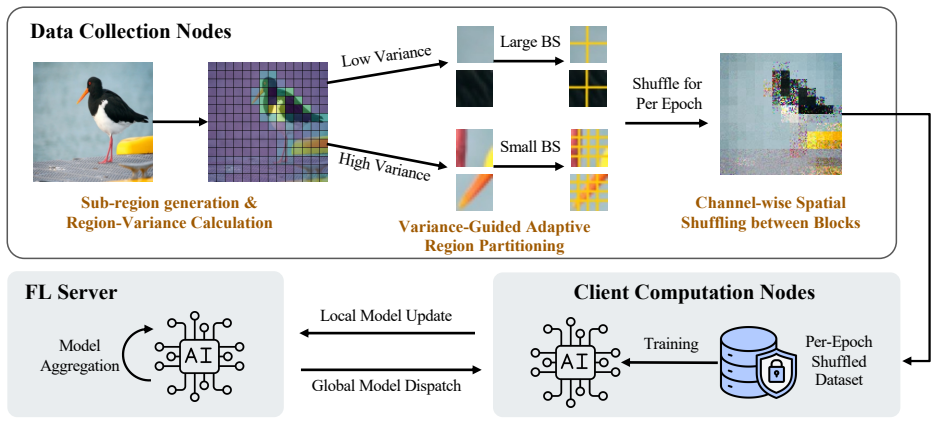
The load-bearing object is the region-variance score $RV^2_{i,j}$, the mean per-channel pixel variance in each region. It is used as a proxy for visual privacy sensitivity: high-variance regions get block size $\lfloor S/4 \rfloor$, low-variance regions get $\lfloor S/2 \rfloor$, and the resulting blocks are shuffled spatially and independently across RGB channels. This single metric carries the whole adaptive trade-off, so the argument hinges on the ranking of regions by variance matching human-recognizable privacy importance.
What would settle it
Show one image from a face or medical dataset where the identifiable part (an eye, a scar, a patient ID) does not rank among the high-variance regions by the paper's equation, and demonstrate that CSVAR's adaptive block sizes leave that identifiable part recognizable after shuffling while over-obfuscating smooth background. A quantitative version: compute the rank correlation between region-variance and human-annotated privacy-saliency over a standard face dataset; if it is near zero or negative, the central mechanism is misdirecting protection.
Extended reading notes
Core claim
CSVAR's central claim is that overfitting is the mechanism that turns federated model weights into a visual privacy leak, and that the same obfuscation mechanism that prevents overfitting can also secure data in transit. Concretely, CSVAR partitions each image into regions, scores each region by pixel-value variance, uses the median variance to split regions into small blocks for high-variance, privacy-sensitive regions and large blocks for low-variance background, and shuffles between blocks in both spatial positions and per-channel so color correlations are destroyed. Because every training epoch sees a different shuffled version of each image, the model cannot memorize a single fixed input; the reported result is that membership-inference attack AUC falls from 0.70 to 0.60 on MNIST and from 0.71 to 0.61 on CelebA, GAN-based reconstruction recovers only noise-like images, and model accuracy stays within about 0.2% of vanilla FL on MNIST and CIFAR-10.
Load-bearing premise
The argument assumes that a region's pixel-value variance reliably marks how privacy-sensitive it is; a face against a busy background can have lower variance than a textured shirt, in which case the adaptive shuffler would obfuscate the wrong places.
Editorial extensions
If this is right
- Client-side raw-image transmission is replaced by transmission of shuffled images, so the sensor-to-compute network link no longer carries the original private image.
- Membership-inference attacks against the trained model approach random-guess level (AUC 0.60 on MNIST, 0.61 on CelebA), indicating less memorization of training samples.
- Model utility stays close to unprotected FL (average 0.21% accuracy loss on MNIST and CIFAR-10), unlike DP-enhanced FL which loses up to 24.25% on CelebA.
- GAN-based reconstruction from the model yields noise-like outputs with no recognizable facial features, suggesting model inversion is also mitigated.
Reading between the lines
- Extending the paper's logic, variance-guided shuffling is a local operation: because obfuscation happens before data leaves the collection node, the same mechanism could protect federated deployments even against a fully malicious server, not just a curious-but-honest one.
- If region-variance is a good saliency proxy, the same per-region block-size schedule could serve as a general regularizer for small non-IID client datasets, improving generalization beyond the privacy metrics reported.
- A direct testable extension is to compare CSVAR's variance ranking against human-annotated privacy-saliency maps on face or medical datasets; the paper illustrates the link with a single bird image but does not quantify its reliability.
Editorial analysis
A structured set of objections, weighed in public.
Referee Report
Summary. The paper proposes CSVAR, a client-side visual-privacy mechanism for federated learning that obfuscates images before transmission and before each training epoch. The method partitions each image into fixed-size regions, computes a per-region pixel variance (Eq. 2), classifies regions as privacy-sensitive or insensitive via the median variance, and then adaptively partitions each region into small blocks (for high-variance regions) or large blocks (for low-variance regions) before shuffling the blocks both spatially and across color channels (Eq. 3). The authors argue that this prevents overfitting-induced privacy leakage and protects client-side image transmission. Experiments on MNIST, CIFAR-10, and CelebA with ResNet-50, ShuffleNet, and MobileNet report that CSVAR reduces membership-inference AUC from about 0.70 to about 0.60, produces visually unrecognizable reconstructions under a GAN-based attack, and incurs only about 0.21% average accuracy loss on MNIST and CIFAR-10 compared with vanilla FL.
Significance. If the results are robust, CSVAR would be an appealingly simple and practical visual-privacy defense for FL: it requires no changes to the training objective, no trusted server, and no per-client cryptographic overhead beyond generating shuffled images. The idea of using a computable image statistic to allocate obfuscation strength adaptively is reasonable, and the paper addresses a real gap by considering client-side transmission of raw images in addition to model-update leakage. However, the current evidence is not yet convincing. The central assumption that region variance measures visual privacy sensitivity is supported only by a single illustrative bird image; the evaluation lacks error bars and multiple seeds; the only DP baseline uses an extreme, non-standard noise setting; and reconstruction resistance is reported without any quantitative metric. These weaknesses are load-bearing because the main claims are empirical privacy-utility trade-offs. The paper is clearly written and the system is easy to understand, but the empirical validation needs substantial strengthening before the claims can be accepted.
major comments (5)
- [Section III-B, Eq. (2)-(3)] The load-bearing assumption that region variance is a reliable proxy for visual privacy sensitivity is not quantitatively validated. The only evidence is Figure 2, which shows one bird image, and the text asserts a 'strong alignment' without any numeric measure. This matters because Eq. (3) maps high variance to small blocks (strong obfuscation) and low variance to large blocks (weak obfuscation). For face images, identity-critical regions such as skin, cheeks, and forehead are typically smooth and low-variance, while textured hair or backgrounds are high-variance. CSVAR would therefore obfuscate backgrounds finely and leave face interiors coarsely intact, the opposite of the intended allocation. Since the CelebA results in Figure 7 and Table I are whole-image averages, they can conceal this misallocation. Please provide a quantitative validation of the variance-privacy correlation (e.g., against segmentation/face-part annotations), an ablation that replaces the variance ranking with random or inverted assignments, and reconstruction or membership results focused on low-variance face regions.
- [Section V-A, Table I, Figure 7] The experimental results are reported as single numbers without error bars, multiple seeds, or significance tests. The central utility claim is that CSVAR incurs a 'negligible' average accuracy loss of 0.21% on MNIST and CIFAR-10, but under federated-learning stochasticity (client sampling, data shuffling, weight initialization) such small differences are likely within run-to-run noise. The MIA AUC figures (0.70 vs. 0.60) also lack confidence intervals. Please report mean and standard deviation over at least three to five independent runs, and specify the number of communication rounds, local epochs, client sampling rate, and other FL hyperparameters needed to reproduce the numbers.
- [Section V-B, Figure 6] Resistance to reconstruction attacks is demonstrated only qualitatively. Figure 6 shows example reconstructions, but there is no quantitative metric such as SSIM, PSNR, attack success rate, or face-recognition accuracy on reconstructed images. The statement that CSVAR-produced reconstructions show 'only random noise patterns' is anecdotal and cannot be verified from the figure alone. Moreover, whole-image visual inspection is exactly the kind of assessment that can miss recovery from low-variance face regions, which the variance proxy may under-protect. Please add a quantitative reconstruction metric and, ideally, per-region or per-attribute reconstruction results.
- [Section V-A, Table I] The DP baseline, FL+DP, adds Gaussian noise with sigma=50 directly to training images, but no clipping, noise calibration, or privacy-accounting mechanism is described. This is not a standard DP-SGD baseline for federated learning; it is a high-noise image perturbation. Consequently, the comparison does not support the claim that CSVAR is superior to DP-based privacy protection, only that it is less destructive than one particular extreme noise setting. Please either replace this with a proper DP mechanism (e.g., DP-SGD with a meaningful epsilon) or revise the claims to refer specifically to 'naive strong Gaussian perturbation' rather than to differential privacy.
- [Section III-C, Section V-C] The paper's narrative is that shuffling prevents overfitting, which in turn prevents privacy leakage, but no direct overfitting metric is reported. Figure 1 motivates the link by showing MIA AUC increases with training epochs for vanilla FL, and the CSVAR results show lower MIA AUC, but the manuscript never measures the train-test generalization gap or per-client loss of CSVAR versus vanilla FL. Without this evidence, the claim that CSVAR works 'against overfitting' is an inference rather than a demonstrated mechanism. Please add direct overfitting measures, such as the gap between training and validation accuracy or a comparison of local-loss trajectories.
minor comments (5)
- [Throughout] The name 'CSVAR' is typeset inconsistently as 'CSV AR' and 'CSV AR' in several places; please unify the notation.
- [Section IV-B, Eq. (1)] Equation (1) uses max(H,W) to set the region size S, but for non-square images this can produce S larger than the smaller dimension. Please clarify how rectangular images are handled, or restrict the formula to square inputs.
- [Section V-A, CelebA description] The paper states that CelebA contains 400 grayscale images, but the proposed channel-wise shuffling is described for RGB color images. Please clarify whether CelebA is treated as a single-channel or three-channel input and how channel shuffling is applied in that case.
- [Section V-B, Figure 5] The visual comparison in Figure 5 would be more informative if the same source image were shown across all three methods; currently the examples appear to be different images, which makes the perceptual comparison less direct.
- [References] The reference list omits the canonical federated-learning paper (McMahan et al., 2017) and includes [1], which is an offline-reinforcement-learning paper, as the first citation in the introduction; please add the standard FL reference and check that all citations in the introduction are appropriate.
Circularity Check
No significant circularity: CSVAR's privacy-utility results are measured against external attacks (MIA, GAN reconstruction), not derived from its own Eqs. (2)-(3); the region-variance proxy is an unvalidated empirical premise (a correctness risk), not a circular input.
full rationale
The derivation chain is self-contained: the central claim (variance-guided shuffling prevents overfitting-induced visual privacy leakage, Section I) is tested with the Shokri et al. membership inference attack (AUC 0.70 to 0.60 on MNIST, 0.71 to 0.61 on CelebA, Fig. 7) and the Hitaj et al. GAN reconstruction attack (Fig. 6). Neither benchmark is defined in terms of Eq. (2) or Eq. (3), so no reported prediction reduces to its own input by construction. The adaptive rule BlockSize = floor(S/4) for RV^2 above the median, floor(S/2) otherwise (Eq. 3) is a fixed design choice; the paper reports no calibration of the variance threshold or block sizes to attack outcomes, so this is not a fitted parameter renamed as a prediction. Self-citations exist but are not load-bearing: reference [2] (overlapping authors) backs the generic small/non-IID dataset premise, and reference [7] (overlapping authors) supports the claim that DP noise leaves visual features exposed, a claim the paper independently re-demonstrates in Figures 5 and 6. No uniqueness theorem is imported, and the shuffling design is motivated by the paper's own Figure 3 rather than smuggled in via citation. One flagged gap is missing support rather than circularity: Section III-B asserts that 'the strong alignment between variance and visual sensitivity confirms region-variance's suitability,' but the verification is one bird image (Fig. 2), with no quantitative validation on faces or textured backgrounds; on CelebA, identity-critical facial regions are often low-variance, so the proxy may misallocate obfuscation. That is a validity and generality risk, which per the review rules counts as a correctness concern, not circularity.
Assumptions & free parameters
free parameters (4)
- Region size S =
S = 2^ceil(log2(sqrt(max(H,W))))
- High-variance block size =
floor(S/4)
- Low-variance block size =
floor(S/2)
- Sensitivity threshold =
median of region variances
assumptions (3)
- domain assumption Region-variance is a reliable proxy for visual privacy sensitivity.
- domain assumption Per-epoch shuffling of training images reduces overfitting and therefore reduces overfitting-induced privacy leakage.
- domain assumption Shuffling within local regions preserves enough spatial structure for the model to learn useful features.
Cite this review
Pith. "Pith review of CSVAR: Enhancing Visual Privacy in Federated Learning via Adaptive Shuffling Against Overfitting." pith.science (2026). https://pith.science/paper/HJV36LRT
@misc{pith2026250601425,
  author       = {Pith},
  title        = {Pith review of: CSVAR: Enhancing Visual Privacy in Federated Learning via Adaptive Shuffling Against Overfitting},
  year         = {2026},
  howpublished = {\url{https://pith.science/paper/HJV36LRT}},
  note         = {Machine review of arXiv:2506.01425}
}
read the original abstract
Although federated learning preserves training data within local privacy domains, the aggregated model parameters may still reveal private characteristics. This vulnerability stems from clients' limited training data, which predisposes models to overfitting. Such overfitting enables models to memorize distinctive patterns from training samples, thereby amplifying the success probability of privacy attacks like membership inference. To enhance visual privacy protection in FL, we present CSVAR(Channel-Wise Spatial Image Shuffling with Variance-Guided Adaptive Region Partitioning), a novel image shuffling framework to generate obfuscated images for secure data transmission and each training epoch, addressing both overfitting-induced privacy leaks and raw image transmission risks. CSVAR adopts region-variance as the metric to measure visual privacy sensitivity across image regions. Guided by this, CSVAR adaptively partitions each region into multiple blocks, applying fine-grained partitioning to privacy-sensitive regions with high region-variances for enhancing visual privacy protection and coarse-grained partitioning to privacy-insensitive regions for balancing model utility. In each region, CSVAR then shuffles between blocks in both the spatial domains and chromatic channels to hide visual spatial features and disrupt color distribution. Experimental evaluations conducted on diverse real-world datasets demonstrate that CSVAR is capable of generating visually obfuscated images that exhibit high perceptual ambiguity to human eyes, simultaneously mitigating the effectiveness of adversarial data reconstruction attacks and achieving a good trade-off between visual privacy protection and model utility.
Figures


Figures from the paper (2 more)


Reference graph
Works this paper leans on
-
[1]
S. Yue, Y. Deng, G. Wang, J. Ren, and Y. Zhang, ``Federated offline reinforcement learning with proximal policy evaluation,'' Chinese Journal of Electronics, vol. 33, no. 6, pp. 1360--1372, 2024
work page 2024
-
[2]
Y. Deng, F. Lyu, J. Ren, H. Wu, Y. Zhou, Y. Zhang, and X. Shen, ``Auction: Automated and quality-aware client selection framework for efficient federated learning,'' IEEE Transactions on Parallel and Distributed Systems, vol. 33, no. 8, pp. 1996--2009, 2021
work page 1996
-
[3]
Y. Zhang, R. Jia, H. Pei, W. Wang, B. Li, and D. Song, ``The secret revealer: Generative model-inversion attacks against deep neural networks,'' in 2020 IEEE/CVF Conference on Computer Vision and Pattern Recognition, CVPR 2020, Seattle, WA, USA, June 13-19, 2020 . 1em plus 0.5em minus 0.4em Computer Vision Foundation / IEEE , 2020, pp. 250--258
work page 2020
-
[4]
R. Shokri, M. Stronati, C. Song, and V. Shmatikov, ``Membership inference attacks against machine learning models,'' in 2017 IEEE Symposium on Security and Privacy, SP 2017, San Jose, CA, USA, May 22-26, 2017 . 1em plus 0.5em minus 0.4em IEEE Computer Society, 2017, pp. 3--18
work page 2017
-
[5]
J. Geiping, H. Bauermeister, H. Dr \"o ge, and M. Moeller, ``Inverting gradients-how easy is it to break privacy in federated learning?'' Advances in neural information processing systems, vol. 33, pp. 16\,937--16\,947, 2020
work page 2020
-
[6]
M. Abadi, A. Chu, I. J. Goodfellow, H. B. McMahan, I. Mironov, K. Talwar, and L. Zhang, ``Deep learning with differential privacy,'' in 2016 ACM SIGSAC Conference on Computer and Communications Security, Vienna, Austria, October 24-28, 2016 , E. R. Weippl, S. Katzenbeisser, C. Kruegel, A. C. Myers, and S. Halevi, Eds. 1em plus 0.5em minus 0.4em ACM , 2016...
work page 2016
-
[7]
Q. Li, Y. Zhang, J. Ren, Q. Li, and Y. Zhang, ``You can use but cannot recognize: Preserving visual privacy in deep neural networks,'' in 31st Annual Network and Distributed System Security Symposium, NDSS 2024, San Diego, California, USA, February 26 - March 1, 2024 . 1em plus 0.5em minus 0.4em The Internet Society, 2024
work page 2024
- [8]
Show all 16 references
-
[9]
Eason, B
G. Eason, B. Noble, and I. N. Sneddon, ``On certain integrals of Lipschitz-Hankel type involving products of Bessel functions,'' Phil. Trans. Roy. Soc. London, vol. A247, pp. 529--551, April 1955
1955
-
[10]
Clerk Maxwell, A Treatise on Electricity and Magnetism, 3rd ed., vol
J. Clerk Maxwell, A Treatise on Electricity and Magnetism, 3rd ed., vol. 2. Oxford: Clarendon, 1892, pp.68--73
-
[11]
I. S. Jacobs and C. P. Bean, ``Fine particles, thin films and exchange anisotropy,'' in Magnetism, vol. III, G. T. Rado and H. Suhl, Eds. New York: Academic, 1963, pp. 271--350
1963
-
[12]
Elissa, ``Title of paper if known,'' unpublished
K. Elissa, ``Title of paper if known,'' unpublished
-
[13]
Nicole, ``Title of paper with only first word capitalized,'' J
R. Nicole, ``Title of paper with only first word capitalized,'' J. Name Stand. Abbrev., in press
-
[14]
Yorozu, M
Y. Yorozu, M. Hirano, K. Oka, and Y. Tagawa, ``Electron spectroscopy studies on magneto-optical media and plastic substrate interface,'' IEEE Transl. J. Magn. Japan, vol. 2, pp. 740--741, August 1987 [Digests 9th Annual Conf. Magnetics Japan, p. 301, 1982]
1987
-
[15]
Young, The Technical Writer's Handbook
M. Young, The Technical Writer's Handbook. Mill Valley, CA: University Science, 1989
1989
-
[16]
11em plus .33em minus .07em 4000 4000 100 4000 4000 500 `\.=1000 = #1 \@IEEEnotcompsoconly \@IEEEcompsoconly #1 * [1] 0pt [0pt][0pt] #1 * [1] 0pt [0pt][0pt] #1 * \| ** #1 \@IEEEauthorblockNstyle \@IEEEcompsocnotconfonly \@IEEEauthorblockAstyle \@IEEEcompsocnotconfonly \@IEEEco...
2024
Reviewed August 7, 2026 · model on record in the stance chip above.
Discussion (0). Sign in to comment.