REVIEW 3 major objections 8 minor 1 cited by
Model-agnostic Mitigation Strategies of Data Imbalance for Regression
T0 review · 3 major / 8 minor · reviewed 2026-08-07 · deepseek-v4-flash
Pith's one-line read The paper claims that crbSMOGN with density-ratio relevance reduces error on rare target values in regression better than existing imbalance strategies, and that a mean-based ensemble of mitigated and unmitigated models recovers…
desk verdict A solid, clearly-described benchmark of imbalanced-regression strategies whose headline claim that crbSMOGN is best for rare samples rests on a single train/test split per dataset, so the central comparison needs re-validation before it can be trusted. read the letter →
The pith
A machine-rendered reading of the paper's core claim, the machinery that carries it, and where it could break.
The reading
What carries the argument
The load-bearing object is density-ratio relevance, defined as $\Lambda_{\mathrm{ratio}}(y_i) = f_x(y_i)/f_r(y_i)$, the ratio of the empirical density of the target value to the domain relevance density, inverted to a weight $w(y_i) = 1/\Lambda_{\mathrm{ratio}}(y_i)$ so that under-represented samples get high relevance. Carrying that signal is crbSMOGN, a continuous ratio-based SMOGN sampling method that over-samples each sample in proportion to its ratio relevance, uses a discretization-bounded search for interpolation partners, and falls back to Gaussian noise when no similar neighbor exists; it needs no user-set relevance threshold or sample count. The third piece is the mean-based ensemble, which averages the predictions of a model trained with mitigation and one trained without, thereby preserving rare-sample gains while canceling most frequent-sample degradation.
What would settle it
Repeat the real-world benchmark drawing several independent train/test splits per dataset and averaging the very-rare-bin error over splits; if crbSMOGN no longer beats the next-best strategies on most datasets, the reported advantage is an artifact of the chosen split.
Extended reading notes
Core claim
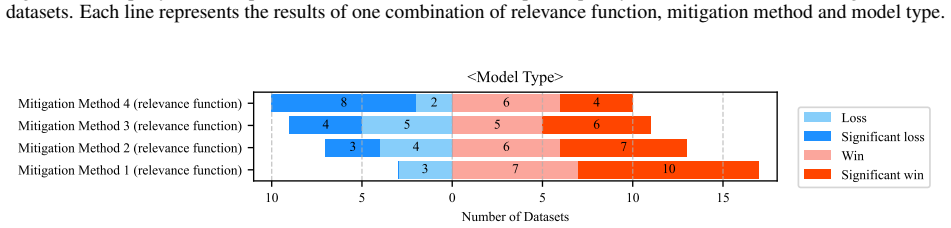
The central claim is that treating imbalance as the ratio between the empirical distribution of the target variable and a domain relevance distribution yields a better sampling signal than density alone. Concretely, the paper claims that crbSMOGN—a continuous, threshold-free variant of SMOGN that over-samples in proportion to a ratio-based relevance—combined with the new density-ratio relevance function, is by far the best mitigation strategy for reducing error on very rare samples when the model is a multilayer perceptron. In the real-world benchmark it produces the most significant wins in the rare bins, and the effect is smaller for XGBoost and Random Forest, which are harder to influence by resampling. The paper also claims that every mitigation strategy that helps rare samples hurts frequent ones, and that averaging a mitigated model with an unmitigated one avoids most of that loss.
Load-bearing premise
The finding rests on the assumption that the single train/test split with the lowest mean imbalance ratio, chosen from 100 random splits for each dataset, is representative enough that 50 training repetitions on that one split can stand in for variation across splits.
Editorial extensions
If this is right
- For MLP models, crbSMOGN with density-ratio relevance is the best tested way to lower error on very rare target values, at only a moderate cost on frequent values.
- Under-sampling generally hurts MLP performance, so over-sampling alone is the recommended configuration for neural networks.
- A mean-based ensemble of a mitigated and an unmitigated model largely cancels the frequent-sample degradation while keeping most of the rare-sample improvement.
- Sampling-based strategies are more effective than cost-sensitive weighting for MLP and Random Forest models, while cost-sensitive weighting works better for XGBoost.
- The choice of mitigation method matters more than the choice of relevance function, and the simple WERCS method becomes competitive when paired with density-distance relevance.
Reading between the lines
- Because density-ratio relevance is anchored at $w=1$ for balanced samples, the same crbSMOGN machinery could accept a non-uniform, expert-defined domain relevance distribution without changing the algorithm; the paper mentions this only as future work.
- The evaluation uses a single train/test split per dataset, so the reported advantage of crbSMOGN may partly reflect split luck; a multi-split study would give a more reliable estimate of the effect.
- Since under-sampling lowers the mean imbalance ratio but hurts MLP performance, the mIR alone is not a reliable predictor of which strategy will help a given model; separating data imbalance from model error imbalance would be a useful next step.
Editorial analysis
A structured set of objections, weighed in public.
Referee Report
Summary. The paper addresses imbalanced regression by separating the problem into relevance functions and mitigation methods. It proposes two new relevance functions (density-distance and density-ratio) and two new sampling methods (cSMOGN and crbSMOGN), and evaluates combinations of relevance functions and mitigation methods on 10 synthetic and 42 real-world datasets with MLP, XGBoost, and Random Forest models. The central claim, stated in the abstract and in Section 4.2.3, is that crbSMOGN with density-ratio relevance is the best strategy for reducing error on (very) rare samples, particularly for MLP models, and that a mean-based ensemble of a mitigated and an unmitigated model avoids the frequent-sample degradation.
Significance. If the central claim holds, the paper makes a useful practical contribution: it systematizes the taxonomy of relevance functions and mitigation methods, introduces interpretable relevance functions that can incorporate domain preference, provides two new resampling algorithms with pseudocode and public code, and reports a broad benchmark across many datasets and three model families. The ensemble idea is simple and plausibly useful, and the paper is honest about several limitations, including the difficulty of predicting when a mitigation strategy will help and the similarity of density-distance relevance to existing methods under a uniform domain distribution. The main strength is therefore empirical breadth plus accessible methodology; the main weakness is that the headline superiority claim rests on a statistical protocol that does not sample the split distribution.
major comments (3)
- [Sec. 4.2] The central comparison uses a single train/test split per dataset. The text states: 'Only the most similar (lowest mIR) split is kept and used for model training.' All 50 model repetitions, and hence all Wilcoxon signed-rank populations formed 'from the mean errors of 50 modeling repetitions per dataset and bin', are obtained on that same split. These 50 values are pseudo-replicates: they measure variation over model initializations only, not over data splits. Consequently, the per-dataset win counts and the normalized bin errors in Figs. 8-11 do not sample the split distribution, and the claim that crbSMOGN 'by far' outperforms other methods may be an artifact of the chosen split. The paper should either repeat the evaluation over multiple splits (for example, several low-mIR splits) and treat split as a random factor, or substantially temper the generalization claim.
- [Sec. 4.2 / Appendix A] Before splitting, 'all datasets are cleaned of outliers using an isolation forest outlier detection' with a probability threshold of 0.8. This pre-processing can delete the extreme target values that the mitigation strategies are designed to predict, and it changes the composition of the 'very rare' bin for every method and dataset. The paper does not report how many samples are removed per dataset, nor whether the removal disproportionately affects the tails of the target distribution. The robustness of the crbSMOGN advantage should be checked without outlier removal, or at least the number and location of removed samples should be documented and discussed.
- [Sec. 4.2] The statistical reporting is not sufficient to support the strength of the headline claim. The Wilcoxon tests are applied per bin to 50 correlated repetitions from one split, and then the number of significant datasets is used as a summary. This procedure does not control for multiple comparisons across the 47 mitigation strategies and five bins, and it does not provide a single test of whether crbSMOGN differs from the second-best method across datasets. In addition, Fig. 9 shows that other methods are competitive in terms of significant wins, so the 'by far the best' wording in Sec. 4.2.3 is stronger than the displayed evidence. Reporting effect sizes, confidence intervals for normalized bin errors, and a proper paired comparison across datasets would make the claim more credible.
minor comments (8)
- [Abstract] The abstract contains the typo 'asses' for 'assess'; this should be corrected.
- [Sec. 3.1.1] The phrase 'very marked trails' should be 'very marked tails', since the intended meaning is distribution tails.
- [Sec. 3.2.8 / Sec. 3.2.9] The phrase 'bare similarity' should be 'bear similarity' in both cSMOGN and crbSMOGN descriptions.
- [Sec. 3.3] Equation reference 'Ep. 16' should be 'Eq. (16)'.
- [Sec. 3.2.9] The bulleted algorithm description has two items labeled '4b'; the second should be '4c'.
- [Sec. 4.2.4 / Fig. 10] The caption says 'different different ensemble-formation techniques'; one 'different' should be removed.
- [Appendix B, Table 5] The Friedman3 dataset is described as using 'make_friedman2'; this should be 'make_friedman3'.
- [Appendix B, Table 4] The dataset name 'mortage' should be 'mortgage'.
Circularity Check
No significant circularity; the central performance claims are empirical held-out evaluations with fixed hyperparameters.
full rationale
The paper's central claim — that crbSMOGN with density-ratio relevance best reduces error on rare samples for MLPs — is an empirical benchmark result, not a quantity derived from a fitted constant. Relevance values are computed from training-target density with a uniform domain relevance and are not calibrated to test data; hyperparameters are fixed before evaluation as listed in Appendix A. The split-selection protocol uses the authors' own mIR metric from Wibbeke et al. (2025), but that metric is externally published with available code and is used only to choose a train/test split, not to construct the bin errors or the Wilcoxon populations; the measured bin errors are independent of the mIR value. The self-citations to Wibbeke et al. (2025) and Kowatsch et al. (2024) motivate the two-distribution formalism, but the performance comparison would stand even if any inverse-density relevance were used; no uniqueness theorem or prior result is invoked to forbid alternatives. The new density-ratio relevance with uniform f_r reduces to an inverse empirical density, a known construction, and the paper's own Discussion (Sec. 5) concedes that density-distance, KDE, and DenseWeight differ only slightly under uniform preference; the advantage of crbSMOGN is attributed to the sampling scheme rather than to a new derivation. The acknowledged limitations (Sec. 5: 'no reliable statements can be made about which properties a dataset or a modeling task must fulfill') and the single-split, 50-repeat protocol are statistical-validity concerns, not circularity: the 'prediction' is a measured held-out bin error, not an input recycled as output. Therefore no circular step is exhibited.
Assumptions & free parameters
free parameters (6)
- isolation forest outlier probability threshold =
0.8
- number of bins for discretization (cSMOGN, crbSMOGN) =
10
- allowed bin deviation delta_b (cSMOGN, crbSMOGN) =
1
- Gaussian noise level delta_n =
0.01 * std
- SMOGN relevance threshold =
0.8
- number of random splits scored for mIR selection =
100
assumptions (5)
- domain assumption The domain relevance distribution f_r is uniform in all experiments.
- domain assumption Kernel density estimates use Silverman's rule of thumb for bandwidth.
- domain assumption The isolation forest outlier removal does not discard the rare samples that the study targets.
- ad hoc to paper The lowest-mIR split is representative of typical train/test conditions.
- standard math Standard mathematical and ML background assumptions (kNN distances, SMOTE interpolation, etc.) hold.
Cite this review
Pith. "Pith review of Model-agnostic Mitigation Strategies of Data Imbalance for Regression." pith.science (2026). https://pith.science/paper/XMOT5WPA
@misc{pith2026250601486,
  author       = {Pith},
  title        = {Pith review of: Model-agnostic Mitigation Strategies of Data Imbalance for Regression},
  year         = {2026},
  howpublished = {\url{https://pith.science/paper/XMOT5WPA}},
  note         = {Machine review of arXiv:2506.01486}
}
read the original abstract
Data imbalance persists as a pervasive challenge in regression tasks, introducing bias in model performance and undermining predictive reliability. This is particularly detrimental in applications aimed at predicting rare events that fall outside of the domain of the bulk of the training data. In this study, we review the current state-of-the-art regarding sampling-based methods and cost-sensitive learning. Additionally, we propose novel approaches to mitigate model bias. To better assess the importance of data, we introduce the density-distance and density-ratio relevance functions, which effectively integrate empirical frequency of data with domain-specific preferences, offering enhanced interpretability for end-users. Furthermore, we present advanced mitigation techniques (cSMOGN and crbSMOGN), which build upon and improve existing sampling methods. In a quantitative evaluation, we benchmark state-of-the-art methods on 10 synthetic and 42 real-world datasets, using neural networks, XGBoosting trees and Random Forest models. Our analysis shows that while most strategies improve performance on rare samples, they degrade it on frequent ones. The trade-off becomes larger the more the performance on rare samples is increased. However, to reduce this effect we demonstrate that constructing an ensemble of models -- one trained with imbalance mitigation and another without -- can be used. The key findings underscore the superior performance of our novel crbSMOGN sampling technique with the density-ratio relevance function for neural networks, outperforming state-of-the-art methods.
Figures


Figures from the paper (8 more)



Forward citations
Cited by 1 Pith paper
-
Sustainability or Survivability? Eliminating the Need to Choose in LEO Satellite Constellations
The abstract claims a sun-synchronous LEO constellation design cuts required satellite count by up to 10x and radiation by ~23%, but the manuscript text contains a different paper entirely, leaving the claim without a...
Reference graph
Works this paper leans on
-
[3]
Imbalance in Regression Datasets
Daniel Kowatsch, Nicolas M Müller, Kilian Tscharke, Philip Sperl, and Konstantin Bötinger. Imbalance in regression datasets.arXiv preprint arXiv:2402.11963,
-
[5]
33 Model-agnostic Mitigation Strategies of Data Imbalance for RegressionA PREPRINT No
Some of the synthetic datasets are created using the sklearn library [Pedregosa et al., 2011]. 33 Model-agnostic Mitigation Strategies of Data Imbalance for RegressionA PREPRINT No. Name Features Description 1 Euclidean distance 2y= √ a2 +b 2 2 Nernst equation 6y= R·T z·F ·log a1 a2 3 Stribeck translational friction 6y=µ 1 ·F+ (µ 2 ·F+µ 1 ·F)·exp −| ϑ1 ϑ2...
work page 2011
-
[6]
Histogram Approaches for Imbalanced Data Streams Regression
URLhttps://arxiv.org/abs/2501.17568. Jiawei Ren, Mingyuan Zhang, Cunjun Yu, and Ziwei Liu. Balanced MSE for imbalanced visual regression. In Proceedings of the IEEE/CVF Conference on Computer Vision and Pattern Recognition, pages 7926–7935,
-
[13]
https: //doi.org/10.24432/C5PG66. Kam Hamidieh. Superconductivty data. UCI Machine Learning Repository,
-
[14]
https://doi.org/10.24432/ C53P47. Synchronous machine data set. UCI Machine Learning Repository, 2021.https://doi.org/10.24432/C5W32R. Elaheh Ordoni, Jakob Bach, and Ann-Katrin Fleck. Analyzing and predicting verification of data-aware process models–a case study with spectrum auctions.IEEE Access, 10:31699–31713,
-
[15]
https://doi.org/10.24432/C5VW2C. I-Cheng Yeh. Concrete slump test. UCI Machine Learning Repository,
-
[23]
Table 3: Used hyperparameters of the individual relevance functions and mitigation methods. Method name Hyperparameter Value Interpolation with control points method balanced extremes both coefficients 1.5 Histogram-based relevance number of bins 10 Label distribution smoothing number of bins 50 kernel width (bins) 5 kernel variance (bins) 4 DenseWeight a...
work page 2012
-
[1987]
Warwick Nash, Tracy Sellers, Simon Talbot, Andrew Cawthorn, and Wes Ford
https://doi.org/10.24432/ C5830D. Warwick Nash, Tracy Sellers, Simon Talbot, Andrew Cawthorn, and Wes Ford. Abalone. UCI Machine Learning Repository, 1995.https://doi.org/10.24432/C55C7W. An Dinh, Stacey Miertschin, Amber Young, and Somya D. Mohanty. A data-driven approach to predicting diabetes and cardiovascular disease with machine learning.BMC medical...
doi:10.24432/c55c7w 1995
Show all 24 references
-
[1993]
Luis Torgo and Rita P. Ribeiro. Precision and recall for regression. InDiscovery Science: 12th International Conference, DS 2009, Porto, Portugal, October 3-5, 2009 12, pages 332–346. Springer,
2009
-
[1995]
A Selection of Hyperparameters This sections lists the various hyper-parameters used for model training, relevance functions and mitigation methods
Accessed: 2023-10-26. A Selection of Hyperparameters This sections lists the various hyper-parameters used for model training, relevance functions and mitigation methods. As hyperparameters for the neural network, a batch size of 16, a layer size of 128 with 2 hidden layers an...
2023
-
[1996]
Mitchell R
Accessed: 2023-10-26. Mitchell R. Watnik. Pay for play: Are baseball salaries based on performance?Journal of Statistics Education, 6(2),
2023
-
[1997]
doi:10.1613/jair.346
ISSN 1076-9757. doi:10.1613/jair.346. URL https://jair.org/index.php/ jair/article/view/10182. Mikel Galar, Alberto Fernandez, Edurne Barrenechea, Humberto Bustince, and Francisco Herrera. A review on ensembles for the class imbalance problem: bagging-, boosting-, and hybrid-b...
-
[2002]
Luis Torgo and Rita P. Ribeiro. Utility-based regression. In Joost N. Kok, Jacek Koronacki, Ramon Lopez de Mantaras, Stan Matwin, Dunja Mladeniˇc, and Andrzej Skowron, editors,Knowledge Discovery in Databases: PKDD 2007, pages 597–604, Berlin, Heidelberg,
2007
-
[2007]
24432/C5PK67
https://doi.org/10. 24432/C5PK67. Karl Ulrich. Servo. UCI Machine Learning Repository, 1993.https://doi.org/10.24432/C5Q30F. Pnar Tfekci and Heysem Kaya. Combined cycle power plant. UCI Machine Learning Repository,
1993 doi
-
[2009]
Ricardo Ferreira, Andrea Martiniano, and Renato Sassi
https://doi.org/10.24432/C5FG7D. Ricardo Ferreira, Andrea Martiniano, and Renato Sassi. Behavior of the urban traffic of the city of sao paulo in brazil. UCI Machine Learning Repository, 2018.https://doi.org/10.24432/C5902F. J. Gerritsma, R. Onnink, and A. Versluis. Yacht hydr...
2018 doi
-
[2012]
30 Model-agnostic Mitigation Strategies of Data Imbalance for RegressionA PREPRINT Paulo Cortez and Anbal Morais
https: //doi.org/10.24432/C51307. 30 Model-agnostic Mitigation Strategies of Data Imbalance for RegressionA PREPRINT Paulo Cortez and Anbal Morais. Forest fires. UCI Machine Learning Repository,
-
[2013]
Matteo Cassotti, Davide Ballabio, Roberto Todeschini, and Viviana Consonni
https: //doi.org/10.24432/C5XG7R. Matteo Cassotti, Davide Ballabio, Roberto Todeschini, and Viviana Consonni. A similarity-based QSAR model for predicting acute toxicity towards the fathead minnow (pimephales promelas).SAR and QSAR in Environmental Research, 26(3):217–243,
-
[2014]
Vadim Arzamasov
https: //doi.org/10.24432/C5002N. Vadim Arzamasov. Electrical grid stability simulated data. UCI Machine Learning Repository,
-
[2015]
Sergiienko, and Markus Wagner
Mehdi Neshat, Bradley Alexander, Nataliia Y . Sergiienko, and Markus Wagner. Optimisation of large wave farms using a multi-strategy evolutionary framework. InProceedings of the 2020 Genetic and Evolutionary Computation Conference, pages 1150–1158,
2020
-
[2016]
Luís Torgo
https: //doi.org/10.24432/C5QK55. Luís Torgo. Regression data sets. University of Porto https://www.dcc.fc.up.pt/~ltorgo/Regression/ DataSets.html, n.d. Accessed: 2024-10-21. J. Derrac, S. Garcia, L. Sanchez, and F. Herrera. Keel data-mining software tool: Data set repository,...
2024 doi
-
[2018]
Z. I. Botev, J. F. Grotowski, and D. P. Kroese. Kernel density estimation via diffusion.The Annals of Statistics, 38(5): 2916 – 2957, 2010.https://doi.org/10.1214/10-AOS799. Nicholas Kunz. SMOGN: Synthetic minority over-sampling technique for regression with gaussian noise,
2010 doi
-
[2019]
doi:https://doi.org/10.1016/j.neucom.2018.11.100
ISSN 0925-2312. doi:https://doi.org/10.1016/j.neucom.2018.11.100. URL https://www.sciencedirect.com/science/article/pii/S0925231219301638. Learning in the Presence of Class Imbalance and Concept Drift. Juscimara G. Avelino, George D.C. Cavalcanti, and Rafael M.O. Cruz. Resampl...
2018 doi
-
[2021]
URLhttps://onlinelibrary.wiley.com/doi/abs/10.1111/exsy.12680
doi:https://doi.org/10.1111/exsy.12680. URLhttps://onlinelibrary.wiley.com/doi/abs/10.1111/exsy.12680. Bartosz Krawczyk. Learning from imbalanced data: open challenges and future directions.Progress in Artificial Intelligence, 5(4):221–232,
-
[2025]
Michael Steininger, Konstantin Kobs, Padraig Davidson, Anna Krause, and Andreas Hotho
doi:https://doi.org/10.1111/exsy.13840. Michael Steininger, Konstantin Kobs, Padraig Davidson, Anna Krause, and Andreas Hotho. Density-based weighting for imbalanced regression.Machine Learning, 110:2187–2211,
Reviewed August 7, 2026 · model on record in the stance chip above.
Discussion (0). Continue with ORCID to comment.